Where’d You Go, Bernadette: From Book to Screen

When I first learned that Maria Semple’s quirky and clever 2012 novel would be turned into a movie, I had that umm… feeling. When I found out Richard Linklater would be directing it, it turned into a whaaat? Sure it’s not a Wes Anderson project?

On the surface a mother-daughter relational story, Semple’s book is deceivingly simple. Underneath the humour is her take on contemporary American society, the tyranny of technology, vulnerability of the non-conforming, sarcasm on the upwardly aspiring middle class, the rat race and its effect on parenting, the outsourcing economy, and even taking a jab on America’s quiet and polite neighbour to the north. As a target, I must give you the following excerpt from the book as evidence of Semple’s spikiness (or is it spunkiness):

You probably think, U.S./Canada, they’re interchangeable because they’re both filled with English-speaking, morbidly obese white people. Well, Manjula (virtual personal assistant from India), you couldn’t be more mistaken.

Americans are pushy, obnoxious, neurotic, crass… Canadians are none of that. The way you might fear a cow sitting down in the middle of the street during rush hour, that’s how I fear Canadians. To Canadians, everyone is equal. Joni Mitchell is interchangeable with a secretary at open-mic night. Frank Gehry is no greater than a hack pumping out McMansions on AutoCAD. John Candy is no funnier than Uncle Lou when he gets a couple of beers in him. No wonder the only Canadians anyone’s ever heard of are the ones who have gotten the hell out. Anyone with talent who stayed would be flattened under an avalanche of equality. The thing Canadians don’t understand is that some people are extraordinary and should be treated as such.

But that’s not in the movie. Why, the movie is a total stripped-down version without the incendiary, sarcastic swipes, or the laugh-out-loud funny, and ah… thanks, Maria Semple, for the words, “it’s flattened under an avalanche of” smoothened edges in characterization and plot.

By the way, if one reads deeper into the Canadian jab quoted above, it wouldn’t be hard to see the layered meaning. Aha, the joke is on which side of the 49th?

Bernadette (1).jpg


Bernadette Fox (Cate Blanchett) has had her glorious days as an acclaimed architect, pioneer of the green building movement, a MacArthur grant recipient at 32, and a young woman succeeding in a male-dominated profession. Due to an unfortunate incident, her award-winning project was demolished without her knowledge, destroyed by a vengeful neighbour who bought it under an agent’s name. Devastated, Bernadette crashed out of her career, moved to Seattle with her Microsoft, TED Talking husband Elgie (Billy Crudup, a miscast). They bought a huge, dilapidated mansion. For twenty years she had ignored the maintenance of her home and self. The traumatic health issue of her daughter Bee’s (Emma Nelson) early years drives her further into the hole living as a reclusive agoraphobic.

Bernadette and Bee are the best of friends though. Mother/daughter relationship is well portrayed in the movie, a particular gripping scene is their singing the song ‘Time after time’ together in the car ending with a Bernadette meltdown. “You don’t know how hard it is for me.” Bee doesn’t know, viewers need to guess, but readers do, for they are supplied with ample back story. The movie, however, has trouble connecting the past with the present, or presenting sufficient motivation for the actions and behaviour of the characters.

As loving parents, Bernadette and Elgie have to fulfill a promise to Bee, that is she can have anything she asks for if she gets straight A’s; now they’re stuck with making a family trip to Antarctica. For two-third of the movie we see mostly interior shots of home and work building up a case to Bernadette’s disappearance. The momentum picks up only in the last third, the Antarctica episode.

The storytelling in the book is a lively collection of emails, notes, letters, hospital billing, and police report plus personal narrative to present the different voices from various characters. On screen, the Rashomon-like shifting of perspectives are converted into mainly two characters sitting and talking to each other. Surely Linklater is an expert in dialogues with his Before trilogy, where the camera follows two characters Jesse (Ethan Hawke) and Céline (Julie Delpy) talking throughout the movie and yet still captivating viewers as we watch them wander the streets and listening to them chat. But here, that magic is missing. Where’d you go, Linklater?

For the casting of Bernadette, Cate Blanchett is a good choice, her Academy Award winning role in Blue Jasmine comes to mind. Unfortunately, here she is not in her Jasmine form. The major issue is a weak script, hence the directing of it. The screenplay follows the book faithfully but in a minimal, abridged version. It begs the question: does a movie adaptation need to follow the source material to the dot? Here in this very different medium, dialogues are picked right out of the novel while the camera has not been fully utilized, nor any imaginative ingredients been added to the visual adaptation of this quirky and zesty book. Well, yes, it might have been faithful to the letter, but not the spirit.

The title question obviously doesn’t just mean the physical whereabouts of Bernadette but where her talent, creativity, and vitality for life have gone. There’s a scene with Bernadette meeting her previous mentor Paul Jellinek (Laurence Fishburne) who says it explicitly: “People like you must create. If you don’t, you become a menace to society.” Such is a thematic element that needs to be calved out more clearly, a talent caged in by her own disillusionment and her ultimate breakthrough. Don’t blame motherhood, and Bernadette doesn’t, for she sees a beautiful offspring flourishing in Bee. But is parenting a zero-sum game? The context and question should be handled with more depth and inner exploration. With not much contextual support, the case of a self-imposed, locked-up genius is left to the actor Blanchett to portray, and at times it seems forced.

Missing story elements cause lapses in the storytelling. Why does Audrey (Kristen Wiig), Bernadette’s neighbour and archenemy, suddenly becomes friend with her at the most critical moment? Or, during the mudslide, the camera hasn’t shown (without obstruction) what’s written on the sign, which has triggered much of the resentment between Audrey and Bernadette. Readers know, but not viewers if they have not read the source material.

At the end of the book there’s an “About the Author” page. Before writing fiction, Semple had written for the television shows Arrested Development, Mad About You, and Ellen. If one hadn’t known this tidbit already, a natural response would have been “no wonder!” It just points plainly to the ideal person who should have written the screenplay.


~ ~ Ripples

***


Related Reviews on Ripple:

Blue Jasmine: Homage and Reimagining

Boyhood: The Moment Seizes Us 

Before Midnight: Reality Check

The Budapest Hotel: A Grand Escape


‘Faces Places’ with Agnès Varda and JR

From high art in the gallery (my last post) to street art, here catching the last chance for a Paris in July entry, I’m presenting the fascinating documentary, a road movie of making art in the open milieu of villages and among the working populace. Faces Places (2017) is an account of the venerable auteur of the Nouvelle Vague (The French New Wave: Goddard, Truffaut…) Agnès Varda (1928-2019), then at 89, going on a road trip with photographer and artist JR to scout for ordinary people to photograph in various obscure locales in France.

the world's longest baguette .jpg

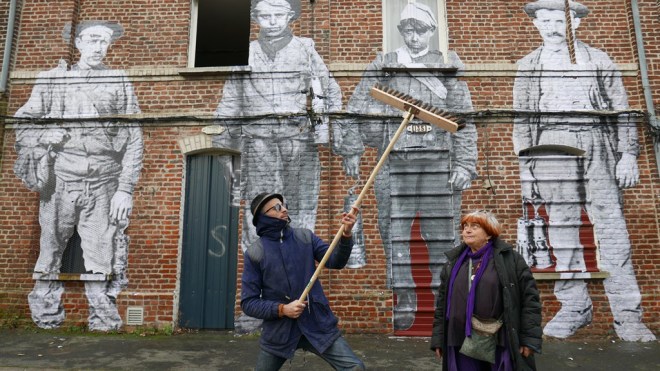
Their larger than life photo prints are then pasted onto buildings or open places for everyone to view, evoking the shared joy of living, working, and the collective memory of a meaningful past. Like this one with photos of pioneer miners pasted on a row of dilapidated homes slated for demolition in a miners’ community. The one remaining homeowner who refused to vacate her house was moved to tears upon seeing the completion of the project.

Miners from days past.jpg

Art undefined and unconfined, once pasted onto these surfaces, JR’s black-and-white photographic images convert the whole building or structure into an art form. The world is his canvas. Unlike Banksy, JR is transparent with his creative process, and lets the public view his work in progress. A TED Prize winner (2011), his large-scale, participatory art projects are installed all over the world, albeit sometimes illegally according to local laws, but the people welcomed him.

At age 89, Agnès Varda became the oldest nominee in Oscar history when Faces Places was nominated for Best Documentary for the 2018 Academy Awards. It’s now on DVD and Blu-ray. Her numerous older works may not be accessible for us so readily. Check your streaming or on demand services. I was able to watch two of her excellent films Vagabond (1985) and Cleo from 5 to 7 (1962, click on link to my review). Don’t miss this short clip on IMDb “Agnès Varda in Memoriam”.

The soul-stirring original music by Matthieu Chedid complement the meaningful duo collaboration. At the beginning, JR talks with Varda to organize the making of their joint project. We see them exchange the following dialogues:

AV:  What I like was meeting amazing people by chance.

JR:  So you want to carry on that way, with no plan or itinerary?

AV:  Yes. Chance has always been my best assistant.

JR:  Do you think chance will work for both of us?

AV:  Maybe.

From the film, we can see chance had worked for both of them marvellously.


AVJR-Chairs-on-the-beach-Normandy (2).jpg


~ ~ ~ ~ Ripples


***


Paris in July is hosted by Tamara at Thyme for Tea

PIJ2019 Tamara

Other Paris in July 2019 Posts on Ripples:

Pictures at an Exhibition 

‘Coco Before Chanel’ directed by Anne Fontaine

‘Gemma Bovery’ to cool your summer day

‘A Sunday in the Country’ is an Impressionist Cinematic Painting

‘Coco Before Chanel’ directed by Anne Fontaine

According to the French Ministry of Culture department that produces and promotes French cinema, 27 percent of French movies were directed or co-directed by women in 2017 compared to 20.8 percent in 2008. (source article here) An improvement, but they are still not pleased with the disparity and working towards a more equal representation.

For comparison, in Hollywood, according to the annual USC Annenberg Inclusion Initiative study (Jan. 2018), the figure is 4%, after examining 1,100 popular films. Now this result is found in the midst of the #MeToo and #TimesUp movements. For those interested to find out more, here’s a comprehensive report from Annenberg (July, 2018) comparing many more aspects of the film industry.

I just find these stats alarming. This is not a post to present an analysis of the issue, that warrants a thesis, but these figures just need to be shared. For Paris in July this week, I’ve chosen a film that showcases a woman succeeding in a man’s world, overcoming what looked to be insurmountable odds. Among its many accolades, I find this one notable: Best Movie About Women, given by the Women Film Critics Circle Awards (2009).

Another film from French director Anne Fontaine. Unlike Gemma Bovery in last week’s movie, this is a real-life heroine.

Coco Before Chanel (2009)

I’ve appreciated filmmaker Fontaine not doing a whole life biopic on the fashion icon, but focuses on her early years. What was her background? How did she overcome life’s obstacles to create a path for herself?  The intermingling of fate and choice is one important theme Fontaine had touched on in this cinematic account.


Coco Before Chanel


Gabrielle Chanel’s life is an extraordinary story, and Fontaine respects that. Before she became the world famous icon Coco Chanel, she was Gabrielle Chanel born on August 19, 1883, in Saumur, France.

The film opens with the camera following two young girls being driven to an orphanage. We soon find out they are sisters Gabrielle and Adrienne. What makes the scene sadder is that the driver of the horse-drawn cart in which the sisters are transported is their father. We never see his face. He doesn’t turn to say goodbye. He never visits.

That’s a short beginning. The next scene Fontaine shows us is fifteen years later in a cabaret where the sisters sing and dance. In there, Gabrielle (Audrey Tautou) meets Étienne Balsan (Benoît Poelvoorde), an older military man, paying passing interest in Coco, a name he’s created for her. Fontaine is effective to show us what Coco is like within just a few minutes of the cabaret scene. She’s a calm, self-assured woman, won’t sell herself to appease the guests; as a consequence, she and her sisters are fired. Looks like they’re happy to leave the place too.

They keep their day job as seamstresses but soon part as Adrienne is leaving with a man to live in Paris. Coco decides to go to Compiègne to look for Balsan. Balsan agrees to let her stay there in his country mansion temporarily but Coco has her resourcefulness to change Balsan’s mind. She learns to ride a horse on her own in a day, and soon breaks into the social circle of Balsan’s by distinguishing herself as a woman with style, talent and skills.

A raiser of race horses, Balsan’s social milieu and the horse races where members of the fashionable class exhibit their haute attires inspire the ingenuity of Coco. She begins to design hats for the ladies, and establishes herself as a unique contrarian. She wears a simple straw hat, alters a vest, a white shirt and a tie from Balsan’s closet to suit herself. Her style is “dresses without corsets, shoes with no heels, and hats with no feathers.”

Among Balsan’s business acquaintances is Boy Capel (Alessandro Nivola), a young Englishman. Coco’s short, intimate relationship with him soon changes her outlook in love and life. After a sad incidence, Coco becomes more independent, confident with herself and her skills, and determined to move to Paris to open a hat boutique. With the financial help from Balsan, she begins that first step, and the rest is history.

Tautou has come a long way from her role as Amelie. She is suitably cast as Coco, reflecting the character of the self-made persona. The signature suits she tailors for herself exude elegance devoid of adornments; the simple hats she designs for herself well-match her cool subtlety. Fontaine captures Coco with meticulous care, from nuanced expressions to her confident posture. Of course, kudos goes to costume designer Catherine Leterrier who won, deservedly, a César Award for Best Costume Design and garnered an Oscar nom.

Composer Alexandre Desplat’s score adds to the enjoyment. Not an epic of extraordinary stature, but like the hat Coco wears, the film is stylish without overstating, composed and effective.

~ ~ ~ Ripples 

Coco Before Chanel is on Netflix.

***

This is a review for Paris In July hosted by Tamara at Thyme for Tea.

PIJ2019 Tamara

Some Other Related Ripple Reviews of French Films:

Cleo from 5 to 7

Things to Come

I’ve Loved You So Long


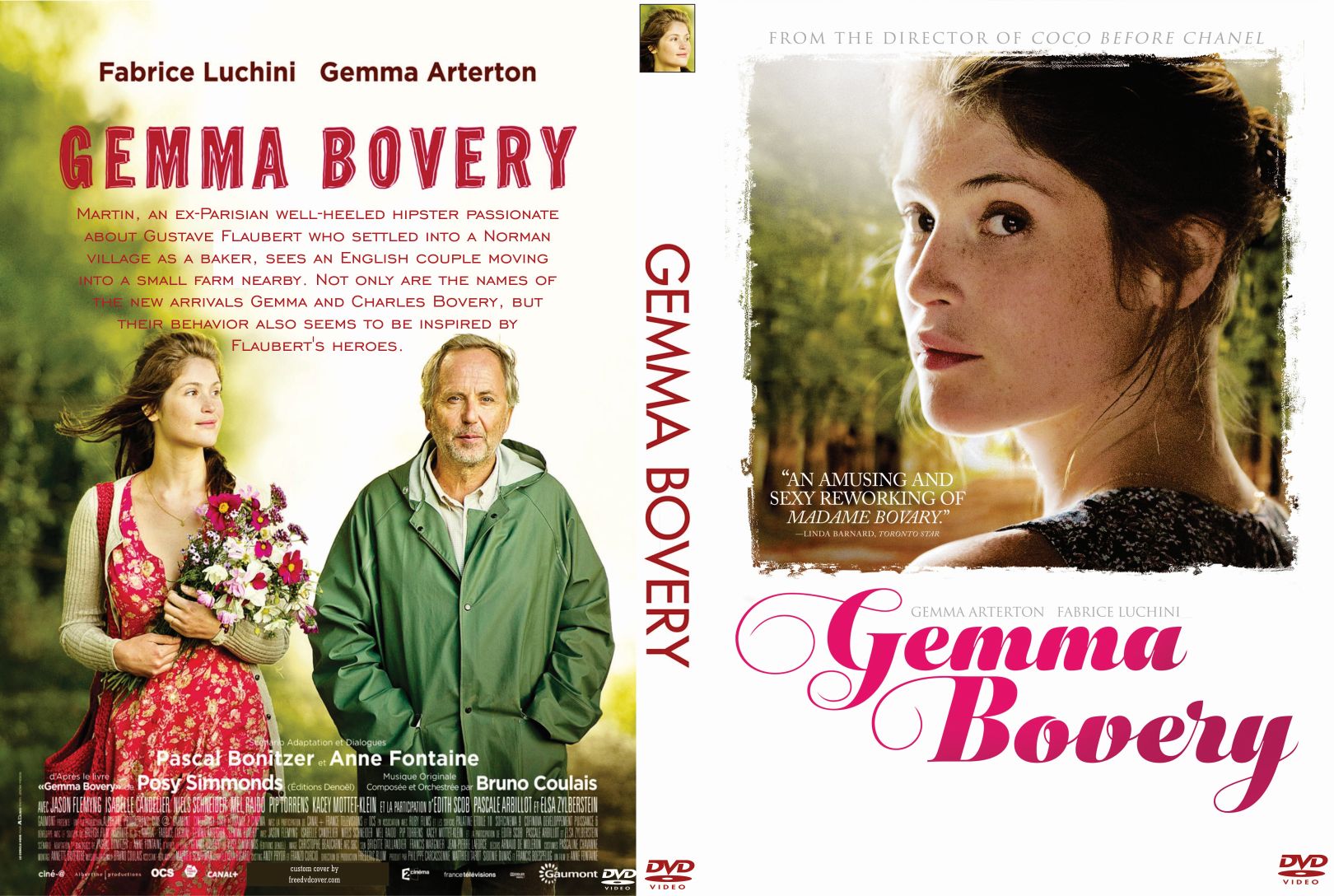
‘Gemma Bovery’ to cool your summer day

This film by the French director Anne Fontaine could offer you a couple hours of  cool entertainment in a lazy, hazy summer afternoon.

Gemma Bovery (2014)

Related image

Madame Bovary by Gustave Flaubert was published in 1856. There have been no less than half a dozen movie adaptations of this famous piece of literature, dating back as early as 1934 (dir. Jean Renoir). Only in 2014 did a female rendition emerge with Sophie Barthes in the helm and featured Mia Wasikowska as Emma Bovary. It’s a relatively conventional take on Flaubert’s literary classic.

Interestingly, in that same year, another movie version of Madame Bovary also came out. This one is by French director Anne Fontaine (born 1959). Under the helm of the versatile Fontaine, and in the spirit of Emma Bovary, this one looks like it’s a vignette from a parallel universe, defying traditional norms, laced with a deadpan, comical streak, and transported to modern day France.

Martin Joubert (Fabrice Luchini), a long-time academic publisher in Paris, moves back to Normandy to take over his father’s bakery, seeking for a peaceful and balanced life in the quiet region. A literature enthusiast, Martin’s antenna for the literary is sharp and sensitive. When a couple with the names of Charles and Gemma Bovery move into his adjacent house in the country, he quickly stands guard on the affairs of the young woman, as he knows the ending of the novel Madame Bovary by Flaubert. He uses all his male sense and sensibility to avoid a tragedy that could befall his new neighbours.

Director Fontaine’s title gives it away as a parody not to be taken too seriously. Gemma Arterton is a good choice as she appears to be a more convincing Gemma Bovery than Mia Wasikowska’s Emma Bovary. For those watchful for literary adaptations, Arterton was Tess of the D’Urbervilles (2008, TV miniseries) playing alongside Eddie Redmayne as Angel Claire. In a more recent year, Their Finest (2016) also saw her mastering her role poignantly.

Gemma is an interior decorator and Charles a furniture refurbisher. Parallel characters as in Flaubert’s novel appear in Gemma’s life after she moves into the Norman countryside, tempting her to fall into a similar track as Madame B.  Except, we don’t see her buying luxurious goods and remodelling her humble abode. Fontaine is bold to let her viewers see what Flaubert was describing with his words, albeit these scenes are short.

So, is Martin successful in avoiding a tragic end to his imagined literary heroine? No spoilers here. In a lazy, hazy summer afternoon, an ending short of crazy would not be worthwhile for a parody.


~ ~ 1/2 Ripples

**

Do you have a favourite French literature to movie adaptation?


Thanks to Tamara for hosting a 6th annual Paris in July event at Thyme for Tea.

PIJ2019 Tamara

‘A Sunday in the Country’ is an Impressionist Cinematic Painting

If the Impressionist painters were to make a movie, what would it be like? A Sunday in the Country (1984) could very well be an exemplar. French director Bertrand Tavernier used the camera as a paintbrush to tell his story, while the cast bring to life the human pathos that are deeper than a painting on the wall could convey. 

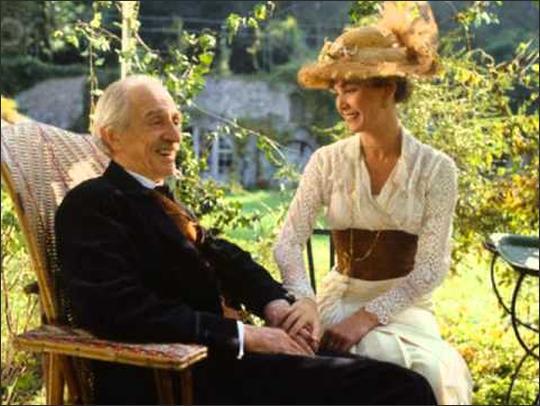
A Sunday in the Country - Un Dimanche à la Campagne (1984)

Monsieur Ladmiral is an elderly artist living in an idyllic country house on the outskirt of Paris. The setting is pre-WWI. M. Ladmiral is a widower, his daily routines assisted by a lived-in, indispensable housekeeper called Mercédès (Monique Chaumette). His home is cozy with classic charm, the adjacent studio, inspiring. The camera leads us to see every details of M. Ladmiral’s house and moves fluidly from far to close-in on the artist’s workplace, a quiet haven and a treasure trove of memories and life works. With his colours, Ladmiral attempts to capture traces of youth and life.

M. Ladmiral’s son Gonzague (Michel Aumont) and his wife Marie-Thérèse (Genevieve Mnich), together with their three children, come visit him from Paris every Sunday, but not frequent enough still. His two grandsons, Emile (Thomas Duvall) and Lucien (Quentin Ogler), add lively sparks to his serene environs, while little Mereille (Katia Wostrikoff) is simply adorable.

No matter how much Gonzague tries to give him, grandchildren and his family’s frequent visits, the son knows he’s a disappointment to his father. Deep in M. Ladmiral’s heart, he longs to see his daughter Irène (Sabine Azéma), who seldom visits. Irène is single, exuberant, fearlessly independent and cheerful, or at least, on the surface. She drives an automobile, a new invention. “Look at your sister Irene,” Ladmiral tells Gonzague. “She forges ahead.” Then after a beat, “you don’t.” Nice going, Dad.

The pace of the film is leisurely, taking its time for viewers to hear (or read the subtitle of) every single dialogue, capture every nuance, and observe every item in the mise en scène. Life is too precious to hurry by. As well, we get to appreciate the humour, but often as guise to underlying relational tensions.

Tavernier won Best Director at Cannes Film Festival in 1985 with A Sunday in the Country, as well as the César Award for his adapted screenplay. The film also saw Azéma who plays daughter Irene won the Best Actress César Award and Bruno de Keyzer for Best Cinematography.

The film is an adaptation from the French novel by Pierre Bost entitled “Monsieur Ladmiral va bientôt mourir”, translated in English: “Mr. Ladmiral will die soon”. Have to say, the movie title is much more appealing. One note though, be patient with the 1:40 min. of credits rolling at the beginning with just white words on black background without image. You’re looking into the mind of an old man. While the overall mood is warm and amusing, the undercurrents of  disappointment, mortality, and separation gently flow throughout the film.

On that Sunday as Gonzague and his family are visiting, Irene drops in unannounced in her automobile. Free-spirited Irene is a fresh breeze to the hot countryside, her automobile a progressive symbol for everyone to admire. She charms with her energetic presence and spontaneous delights. But as viewers, we are privy to her psyche and anxiety when she’s alone. Tavernier deals with the past and the present seamlessly, melding them as if showing us memories are natural extension of our present self, so’s our imagination. As she stands by the window looking out to the lawn, we see Irene’s flashback of her mother saying, “When will you stop asking so much of life, Irene?” 

Irene’s visit is short, albeit one that leaves a significant impact on her father. She takes him on a ride in her automobile to a guinguette for a drink and a dance, an episode that’s bound to be indelible in M. Ladmiral’s last memories. Guinguettes were open-air taverns in the outskirts of Paris where people would come on Sundays to have drinks and casual meals, listen to music, and dance. In the style of Renoir’s Bal du moulin de la GaletteTavernier paints a beautiful Impressionist movie moment in this scene:

hero_EB20030511REVIEWS08305110301AR

During the memorable father-daughter chat at the guinguette, M. Ladmiral talks about his own style, and admits that he’s a traditionalist unable to catch up with the changes other painters have brought about. Unable or unwilling, no matter, he’s at least honest to himself in painting the way he does, he tells Irene. In tearing eyes, daughter looks fondly at her father and asks him to dance with her.

Irene has to leave right after she drives her father home from the guinguette, upon receiving an upsetting telephone call. Later that evening, Gonzague and his family have to catch the late train back to Paris as well. After seeing them off, M. Ladmiral walks back home from the train station alone. For an old man, every goodbye could be the last.

But the final scene appears to turn the tide. M. Ladmiral goes into his studio, takes down the painting he’s been working on, a still-life subject he’s painted numerous times before and in a style he’s been following all his life. He replaces it with a blank canvas on the easel, sits down, and looks at it ponderously. Like his son’s, his life, too, has been a disappointment to himself. What M. Ladmiral is thinking staring into a blank canvas at that moment is up to anyone’s interpretation. What I see is a slight, nuanced smile on his face. Every blank canvas is a fresh start no matter how old you are.


~ ~ ~ ~ Ripples


***


This film review is a participation of the 6th Paris in July event at
Tamara’s Thyme for Tea. 

PIJ2019 Tamara

Related Posts on Ripple Effects:

Arles: In Search of Van Gogh

Séraphine and the wrought-iron chair

Inspired by Vermeer


The asset of ‘Yesterday’ is recalling Beatles memory

Ah… Summertime, and the viewing is breezy.

Even if you didn’t know the composer is George Gershwin, or Ella Fitzgerald’s voice doesn’t come to mind, you’d probably know I got the line from something bigger than it is, as the original song lyrics had made its way into our communal usage through the years… “Summertime, and the livin’ is easy.”

Here lies the very original story idea of the movie Yesterday: what if there’s no collective memory of The Beatles, except one person. And it happens that this guy is a struggling, busker kind of a singer songwriter on the brink of giving up his music and submitting to a career as a warehouse grocery stocker. Imagine, what would he do now?

Yesterday.jpg

Richard Curtis, whose expertise is writing rom coms, best known for Notting Hill, Love Actually, Bridget Jones and not the least, Mr. Bean, seems to have gone on a breezy trip imagining his newest work. Director Danny Boyle as well, reprises his rags-to-riches gist as in Slumdog Millionaire to create another fantasy. Yesterday looks to have the privilege of a dynamic duo of movie magic, and it seems they’d planned it as a summer joy ride.

To enjoy a fantasy, viewers have to drop their guards and suspend rationale. Stop trying to reason how a 12 seconds global blackout could wipe out the collective memory of The Beatles, both human and online memory that is, while one man, Jack Malik (Himesh Patel), being hit by a bus right at that moment, wakes up to find he has lost only his two front teeth but his memory is fully intact.

In his hospital bed, Jack says to his manager Ellie (the ubiquitous Lily James), who has had an unrequited crush on him since their junior high days, “will you still need me, will you still feed me when I’m 64?” Sure, but why 64? She asks. There’s the first clue.

Later when he gets out of the hospital, his close friends gift him a new guitar to replace the one that’s crushed by the bus. Keep on writing songs, they encourage him. So he sings his newest for them, it’s called “Yesterday”, and they’re almost moved to tears. Here’s the beginning of a world-wide sensation, Jack Malik, the one man show, creator of fresh, hit songs, and the rest is (new) history.

Now consider another premise, or maybe a philosophical construct: if a lesser known gallery painting is taken out of its frame and thrown on the sidewalk, will people have recognized it as a work of art? In parallel, if the collective memory of The Beatles had been wiped out and a Beatles song is sung by Jack Malik, a dowdy guy who doesn’t have the slightest sense of charisma, will it be a hit? Will it ever be turned into a classic? Well, too much thinking here. This is a rom com after all.

Curtis wants to humour us with quick, spontaneous laughs, and he delivers. Like showing us the Google search results for The Beatles when all such memory is lost, or when the less than attentive parents of Jack’s mistakenly remember the title of his new song as “Leave it be”. Or when Ed Sheeran, yes, the real Ed Sheeran, advises Jack on how to create a better song title, “Hey Jude” is a bit old-fashioned he tells him. “Hey Dude” sounds just right.

Kudos to the filmmakers, Jack’s Indian descent isn’t mentioned; he’s just another dude. It’s a kaleidoscope of humanity on our streets, no need to explain. As for the plagiarism issue, no worries, Boyle and Curtis deal with that at the end. So you can leave the theatre at peace with your conscience if you happen to really like the movie.

Jack’s friend and sidekick Rocky (Joel Fry) reminds us of Spike (Rhys Ifans) in Notting Hill, adding both sparks and silliness, especially in the weak, second part of the movie where it feels gas might have run out. As for Jack meeting a guru type of a guy called John in the last act feels an unnecessary add-on. Now Curtis really had run out of ideas.

On another note, I can’t seem to find much chemistry between James and Patel for them to a strike up an intimate relationship. Maybe they’re following to the dot the exact storyline, quiet, unrequited lover meets oblivious subject. Albeit I do see a chance there which unfortunately the director and writer had not pursued further.

The movie can be enriched if James is given more opportunity to perform. In Mamma Mia! Here We Go Again, as young Donna, James has shown herself to be a natural singer and dancer. There’s just one scene in Yesterday, maybe for a minute or less, where we see her character Ellie singing along with Jack in the recording studio. The story could be richer in content and more entertaining if James is given a chance to shine by accompanying Patel in some of his songs. After all, there were four harmonized voices that made up the Fab Four. Further, James’ participation in the music-making could beef up the story and open wider the road to romance as well.

Yesterday has an ingenious idea for a fantasy, Sheeran’s appearance as himself is marvellous. While the storyline turns weak and hard to sustain in the middle of the movie, the 15 Lennon-McCartney compositions save the production. Augmenting Patel’s singing with James’ collaboration would enhance the story and be more entertaining.

So for the overall production, I’ll give 2.5 Ripples, but I’ll still post this as a ‘Fresh’ on Rotten Tomatoes, for the originality of the concept as well as the memory of the Beatles numbers, especially for certain demographics among us.

~ ~ 1/2 Ripples

***

Related Ripple Review:

Nowhere Boy


‘Late Night’ Shines with Duo Emma Thompson and Mindy Kaling

“I have spread my dreams under your feet;
Tread softly because you tread on my dreams.”

                                                                                              – W. B. Yeats*

These two lines from Yeats’s poem appear at the beginning of the movie, but with hilarious effect. Director Nisha Ganatra and screenwriter actor Mindy Kaling do not waste time in setting the mood and pace of what is to come. Molly Patel (Kaling), a woman of Indian descent walking briskly on the streets of NYC meets her destiny as a full bag of garbage is thrown at her face while she recites these poetic lines to herself, mustering up courage and confidence as she heads to the interview for her dream job.

late-night-poster (1).jpg


She’s hired, but not based on her merits. Molly is now a writer for the TV talk show host, the iconic Katherine Newbury, whose late night show has been around for nearly three decades. The reason that Molly gets it? ‘Diversity hire’, for Molly has no background in writing comedy except cracking jokes over the PA in the chemical plant where she works as a quality control personnel. One writer in the team groans, “I wish I was a woman of colour so I could get any job I want with no qualifications.” With that line, we know that both Ganatra and Kaling, two ‘women of colour’, are poised to deal with a relevant workplace issue head-on.

Molly’s new work environment might just be as toxic as the chemicals in her previous employment because now she has to prove herself fit for the job, to her colleagues and her boss. The seven others in the writing team are all white male, while two other who used to be there have just been fired by Katherine, one for asking for a raise and the other talking on the phone with his girlfriend. The remaining seven know how to keep their job: colour within the lines and tread as carefully as possible so not to step on their boss’s ego.

Katherine Newbury is masterfully played by Emma Thompson. She is spot-on in portraying the sharp-tongued, hard-nosed TV anchor who is too blinded by her own light to realize her star rating has been falling like a meteoroid, and that a younger, cocky Daniel Tennant (Ike Barinholtz) is too eager to take over. The studio decision to terminate her show comes as a devastating blow to Katherine.

Scrambling to rescue her place, Katherine Newbury meets her writers for the first time. And in that writing room, the two women, Katherine the star TV anchor clashes with the novice, ex-chemical plant quality controller Molly, who points out––with good intention––Katherine’s lack of relevance in contemporary social media-driven society. Interestingly, as the two women from totally different demographic backgrounds come to interact with each other, the older one begins to feel like she’s looking at her former, younger self. And with that, Kaling brings in yet another critical societal issue: remaining relevant in the battle against ageism.

Thompson is brilliant in delivering depth and not merely a two-dimensional, Cruella type caricature of a boss as in The Devil Wears Prada, although she has plenty of opportunities to do just that. Thanks to Kaling’s subplot bringing in John Lithgow as Katherine’s Parkinson’s afflicted husband Walter, we get to know some of Katherine’s backstory. Although his character isn’t fully developed, Lithgow’s sporadic appearances act as a conduit through which we get to see a hidden facet inside the seemingly tough outer shell of Katherine’s. Kudos to Kaling in not focusing on her own story in the movie but letting Thompson shine in the limelight, and the veteran actor delivers with versatility and energy, probably rescuing  some overtly melodramatic sequences.

Who better to write the script than Mindy Kaling herself. The movie is like a biopic of her own TV career, well, not exactly in the details but definitely the trajectory. Before this her first full feature screenplay, Kaling, the daughter of immigrant parents from India, was first hired as a writer for the pilot of a new TV series called The Office (2005-2013). Exactly, that award winning series which later lasted for nine seasons. Kaling also appeared as the character Kelly Kapoor and became producer as well. After The Office, she went on to create her own series The Mindy Project with six seasons. She is Dr. Mindy Lahiri, the character inspired by Kaling’s mother who was an obstetrician/gynecologist, and the namesake, the author Jhumpa Lahiri. In the meantime, Kaling authored two books, collections of essays sharing candidly her private self and growing-up a child of immigrant parents. Kaling is an iconoclast in her own right.

Vancouver born director Nisha Ganatra is also of Indian descent. I applaud both women’s excellent efforts in bringing this Sundance (2019) acclaimed feature into mainstream entertainment via Amazon Studio with a reportedly $13 million price tag. Late Night is more glam, clever, and lively than Amazon’s The Big Sick two years back at $12 million. It’s my hope that one day, the word ‘diversity’ will not be necessary to describe contributions from ‘minorities’ or ‘non-whites’ as we all belong to the mainstream.


~ ~ ~ Ripples


*From the poem ‘He Wishes for the Cloths of Heaven’


***


Related Review:

‘The Big Sick’: A Real Life Romantic Comedy


Binge-Watching on the Small Screen

If you’ve not ventured out to the Cineplex lately for larger than life spectacles, you’re not alone. And that’s what Steven Spielberg is worried about. The small screen is taking over: streaming services such as Netflix, Amazon, Hulu, Crave… are keeping movie goers at home. What more, these services are making their own productions; memory of last year’s Netflix original movie, multiple Oscar winner Roma may still be fresh.

If binge-watching is the new urban phenom, then binge-racing has to be the newest spectator sport on the couch. Binge-racing, a term not in the OED yet, just means watching a whole Season of episodes all within the first 24 hrs. of their release. That could amount to 12 hrs. of binge-viewing.

In recent months I too have discovered the joy of small-screen bingeing. I declare though, I’m not a racer; as the title of this blog implies, I’m a ripple rider when it comes to small screen viewing. So for a while I’ve been catching up with some interesting titles and I must admit, I’ve thoroughly enjoyed the activity.

No, this is not a debate about which is better, watching big Hollywood productions in the theatre vs. streaming on your TV screen or just on your 6″ handheld device; it’s about accessing interesting human stories to watch in a continuous and user friendly mode, as you can pause to take care of more urgent needs that may arise, like heading to the snack counter, without missing a beat or having to wait for the next commercial break.

The following are some titles I’ve binge-watched in the past year or so. By ‘binge’ I just mean watching all the episodes in a Season in one sitting, or two. Some are mini-series, so it’s just like watching a slightly longer movie than you would in a theatre.

**

The Marvelous Mrs. Maisel (Amazon Prime Video)

The-Marvellous-Mrs-Maisel

This is probably the best period series I’ve watched in recent years. 1950’s NYC, Midge Maisel (Rachel Brosnahan), wife, mother of two young children, devoted daughter of a Jewish family living in the Upper West Side, decides to choose a different path.

Inciting incident is when her husband Joel (Michal Zegen) one day packs up and leaves. Happy families can be turned into unhappy in the blink of an eye, for various reasons. One time at the Gaslight Café in Greenwich Village, Midge rants about her domestic blues during open mike and is discovered, or rather, she hears her true calling, and that’s being a stand-up comedienne.

This must be kept a secret from her Columbia U. professor father Abe Weissman (Tony Shalhoub) and her mother Rose (Marin Hinkle), a deep-rooted figure in the community. Midge hides her double life successfully at first, and her resolve to strike out on her own is strong. First she finds a day job at B. Altman Department Store, unheard of in her social circle, and at night does stand-up gigs as a comedienne, even more far-fetched. She lies low with her new persona, why, her newly acquired language is too foul for her family and friends, but foul is fair for Mrs. Maisel’s career. 

Period events and personalities add to the authentic build up of the story: Lenny Bruce is Mrs. Maisel’s supporter, Jane Jacob hangs around the Village, emergent artists perform at the Gaslight Café, albeit some are the deadpan material of the comedy. For the larger picture, the Cold War, secrets and spies, the Kennedys form the backdrop.

Very well written comedy, beautiful set design and period costumes, superbly performed by the wonderful cast. Rachel Brosnahan won the Golden Globe for Best Actress in a TV series, Musical or Comedy (2019); the show won a GG for Best TV series, Musical or Comedy in 2018, and for 2019, it has snatched SAG Awards, Prime Time Emmy, AFI Award for TV Program of the Year. Enough said.

Mozart in the Jungle (Amazon Prime Video)

Mozart in the Jungle.jpg

No matter which classy name you put in, Bach, Beethoven, Schubert… it’s still a jungle. The series doesn’t just showcase the music of the fictional New York Symphony but probe their private, and not so private, life as well. In the jungle, you’d expect that’s where the wild things are. Their softball team is aptly named Wolf Gang (no doubt a playful pun on Mozart’s name). The Golden Globe and Emmy Award winner for Best TV series, Musical or Comedy, does have some inspiring musical scores and thoughtful lines.

To add some real-life flare, classical music figures Lang Lang, Emanuel Ax and Joshua Bell had made personal appearances. What more, while the regular cast members had to fake their instrument-playing, Dermot Mulroney (My Best Friend’s Wedding, 1997) didn’t need to. In one episode as a guest star, he’d shown himself to be an impressive cello virtuoso.

Coincidentally, I’ve recently finished Jamie Bernstein’s memoir Famous Father Girl: A Memoir of Growing up Bernstein. With her book, she had successfully destroyed the image of my American idol during my youthful days, Leonard Bernstein. Fact is stranger, or wilder, than fiction indeed. The classical music realm isn’t a ‘holier than thou’ kind of high-brow milieu. It’s occupied by humans after all.


Killing Eve (Crave)

Killing Eve

I don’t have Crave (HBO), so this one I watched on DVD, after a long wait for holds at the public library. Sandra Oh won a Best Actress Golden Globe for a TV series with her portrayal of MI5 agent Eve Polastri, obsessed with tracking down the psychotic killer Villanelle (Jodie Comer). Comer is good too, like a female version of Hannibal Lecter. Only difference is, she’s more humane than Lecter in that she’d rather put a fast bullet in her victim’s head than slowly eat the grey matter inside. Exactly, this is not for everyone, but for the thrill seekers and Oh fans. Slick and fast-paced, engaging performance and suspenseful storylines sprinkled with humor every now and then.

Collateral (Netflix)

Carey Mulligan in Collateral

I’ll watch anything that stars Carey Mulligan. The David Hare written, 4-Episode TV mini-series stands out, for it features a 7-month pregnant Mulligan as a London detective solving a street shooting. Exactly, why can’t a woman with a baby bump be a detective and fight crime, and along the way, exposes issues within the government about immigration policies and some dark secrets? Kudos to BBC, director S. J. Clarkson, and Carey Mulligan for taking on the challenge.

The Crown (Netflix)

The Crown.jpg

The series deserves all the accolades it has garnered. Claire Foy is superb as a younger Queen Elizabeth and the whole cast is notable. I’m eagerly waiting for the new Season with Olivia Colman as the Queen, continuing with the relay. QE is the longest reigning monarch in England’s history, so we’ll have many more Seasons to come(?) Helena Bonham Carter as Princess Margaret would make one lively addition in the upcoming Season.

The Kominsky Method (Netflix)

A dynamic acting duo, Michael Douglas and Alan Arkin exude good chemistry. Douglas is Sandy Kominsky, an acting coach transforming young actors with his own Kominsky Method. Arkin plays his long-time friend and agent Norman who recently lost his wife to cancer. Confusion and insecurities abound in this stage of their life. What better companion they have than each other to ride into the sunset. The well-written script and nuanced performance from both make this series an enjoyable and inspiring character study.

Z: The Beginning of Everything (Amazon Prime Video)

Based on the book Z: A Novel of Zelda Fitzgerald by Therese Anne Fowler, who produced  the TV series and wrote the screenplays of several episodes. Beautiful set design, costume and makeup. Fowler’s book and the adaptation is framed from Zelda’s point-of-view, a writer in her own right and a tragic heroine when it comes to her marriage. Zelda (Christina Ricci) is an unhappy wife overshadowed by an alcoholic, egoistic writer. Only one Season so far has been produced and the biopic stops in midlife. I hope the production will eventually pick up to the end. It’s an image-questioning look at F. Scott Fitzgerald who’d given us some of America’s best loved novels.

The Highwaymen (Netflix)

A Bonnie and Clyde remake but this time from the the point-of-view of two Texas Rangers who come out of retirement to take down the notorious outlaw couple. No, it’s not a comedy but yes, lightweight. Warren Beatty and Faye Dunaway are replaced by Kevin Costner and Woody Harrelson, who join hands to offer a non-glamorous take on the capture. Directed by John Lee Hancock (The Blind Side, 2009). A Netflix original movie.

**

What are you binge-watching these days?

‘Working Woman’ is yet another voice of the #MeToo Movement

Israeli director Michal Aviad’s “Working Woman” is a good reminder that even though the momentum of the #MeToo Movement might seem to have quieted down, there are still voices that need to be heard. Screened at international film festivals since last fall, the feature is now being released in selective theatres.

At the start of the movie, the roving camera follows Orna (Liron Ben-Shlush) as she walks briskly to a car her husband is waiting in. She has just come out of a job interview, exciting to be offered an opportunity to assist a real estate developer, Benny (Menashe Noy). There will be attractive financial rewards and career opportunities ahead.

As the husband parks the car on the road and we get to see the couple in their apartment in the next scene, a stationary camera captures all that is important, an establishing shot if you will. In one frame, we see the husband cooking, Orna clearing the table beside him, and not too far away but still within the frame, their children playing at a computer. We soon learn that the computer isn’t working properly, the kids want a new one, and Orna telling them not until the fridge has been paid off. Husband and wife then go on to talk about this new job she really wants to take, he not too sure about the irregular working hours.

In less than five minutes from the opening, we see Orna’s situation. A mother with young children to care for, a husband who is starting a new restaurant and a household that is cash-scrapped. Aviad’s camera work and succinct dialogues prime us with expectations.

Orna starts working as a personal assistant to real estate developer Benny on his flagship project, a skyscraper apartment by the seaside. He needs someone to organize his meetings, see the project through to completion and sell the luxury units. Being Benny’s protégé includes following him around, even waiting while he has a haircut. Orna has no experience in real estate but is a quick study; she has a knack for gaining trust from potential customers and the instinct for a fresh approach to getting things done.

A scene from WORKING WOMAN. A film by Michal Aviad. A Zeigeist Films release in association with Kino Lorber. Photo courtesy Zeigeist Films. 

Benny finds the ideal assistant in Orna. He soon promotes her to sales manager, noting her resourcefulness and creative thinking. His project by the seaside is now in good hands. But reaching that position and gaining her boss’s trust isn’t as smooth as Orna had first thought; it is becoming obvious that Benny appreciates not just her work skills but eyes her as a woman.

It first starts with commenting about her hair and telling her what to wear, then a kiss, for which he apologies. Other kinds of harassment follow, much like juvenile pranks. But a trip to Paris escalates his advances into a sexual assault. Orna’s pushback and outright ‘no’ means nothing to Benny. Aviad’s camera captures the scene matter-of-factly. The realism is disturbing to watch, not that Benny is violent but that it is obvious that the act is not consensual, his brute force the only means to subdue her in gratifying himself.

After coming back home from Paris, Orna is a different person. She is traumatized naturally, but when her suspecting mother asks what happened in Paris, she replies, “I made a mistake.”

That is a crucial statement. Such a mentality could well explain why she isn’t forthright with her husband, fearing his speculation on her part in the event, or maybe fearing his avenging Benny, making the matter worse. But we as viewers are witnesses to the scene. The ‘mistake’ definitely is not hers to shoulder.

Aviad’s storytelling is realistic and engrossing. Her handheld camera follows Orna like a shadow, the slightly roving movement accentuating the tension. Ben-Shlush’s acting is sensitive and nuanced. The screenplay spare and succinct. The 93-minute narrative feature is an effective and clear voice in stating a case of sexual harassment in the workplace, a powerful boss getting his way and taking advantage of a subordinate who needs her job for financial reason.

Fortunately, Aviad leads us towards a positive ending. We get to see Orna rise up from her challenging situation as she gains new strength to open for herself a way out.

Exclusive engagement of “Working Woman” will be screened at Landmark Lagoon Theatre in Minneapolis St. Paul beginning Friday, May 10th, 2019. Hebrew with English subtitles, 93 mins.

~ ~ ~ Ripples

***

‘The Aftermath’ has all the right ingredients except…

From the beginning, all the ingredients seem to be in place for a satisfying period movie. Sumptuous set design, beautiful costume and makeup, even the rubbles and chaos are realistic. What more, three seasoned, popular actors under a helmer who had proven he could do war movies with his Testament of Youth (2014).

Director James Kent is all set to pull us into great expectations from the start. British military wife Rachel Morgan (Keira Knightley) arrives by train in Hamburg, Germany,  in the year 1946.  She is greeted warmly by her husband Lewis (Jason Clarke), a British Colonel stationed there to enforce order in the aftermath of the War.

The Morgans are staying in a mansion requisitioned from the Nazi’s. But due to Lewis’s benevolence, the former owner, handsome German widower Stephen Lubert (Alexander Skarsgård) and his troubled teenaged daughter Freda (Flora Thiemann) are allowed to stay until they are sent to the camp. Why the delay is not explained, an arrangement definitely isn’t going to be too comfortable. Just look here, Rachel, who has lost her young son in the war, refuses to even shake hands with the enemy, now cohabitant of the mansion.

The Aftermath movie still
Alexander Skarsgård, Jason Clarke and Keira Knightley in an early scene of ‘The Aftermath’. Photo: Fox Searchlight.

No sooner had they settled than Lewis needed to go away on military duties, leaving his wife behind. What ensues is predictable, but unfathomable: How a woman who still mourns her lost young son and holds animosity against the enemy, and a German widower who’d lost his wife during the war and with her memory still vivid in the house, can come together so quickly just days of living under the same roof. From refusing to shake hands to sleeping with the enemy in just a few scene changes, the unconvincing storyline abruptly stops any appreciation I’ve had of other cinematic elements up to that point. 

Adapted from the novel by Rhidian Brook, the screenwriters, Joe Shrapnel and Anna Waterhouse, must have thought celebrity actors have the power and charisma to jazz up a weak script. Fact is, even talented actors are bound by the writing, or, hampered by it. Just look at some other works by Knightley, for example, Atonement (2007) or her latest Colette (2018), comparing her performance in those films with her role here in The Aftermath seems like we’re watching the living in contrast to a pedestal decorative that can tear up on demand.

Alexander Skarsgård can release much intensity if the script allows, case in point is his role in Big Little Lies (2017), for which he won a Best Supporting Actor Golden Globe. Instead, his character as Stephen in The Aftermath is bland, driven by inexplicable motive, except maybe an act of violation to avenge. But no, he and Rachel, who are practically strangers, seriously mean love here. Whatever happened to his late wife’s memory at the piano? With Rachel playing her music still placed on the Steinway, even Debussy’s Clair de Lune can’t shine a light on the blurry motive.

Jason Clarke is repeating his demeanour as in Mudbound (2017), a husband oblivious of what’s going on with the affair of his wife. Here in The Aftermath, the underlying motivations of each character and backstory is just slightly touched on without much elaboration. Are the visuals in bed more important than the rational for modern viewers? I sure hope not.

Movies set during the World Wars work only if there are more to mull on rather than just the actions and the aesthetics. Complexity of characters and conflicts are what pull viewers in, eliciting empathy. Some thought-provoking or a bit challenging ideas and dialogues could help too. Several recent examples are Their Finest (2016) and Darkest Hour (2017), or director Kent’s own Testament of Youth (2014); the other end would be the emotionless The Monuments Men (2014).

I can’t help but think of a WWII classic. Why Casablanca (1942) works, among many factors, are the intelligent dialogues and a surprise ending, surprising to the character involved, but gratifying for the viewers, leaving them with much to mull on, values, priorities, and a lingering feeling for two star-crossed lovers. Unfortunately, that kind of  emotions, thoughts and admiration for the characters were not the aftermath as I left the theatre.

~ ~ 1/2 Ripples

***

‘Ramen Shop’ is a delicious tale of reconciliation

This is not your ordinary foodie flick, for it touches on a subject that is not likely to be found in a culinary film: WWII memory lodged in the mind of those who had lived through Japanese occupation, a generation of victims and witnesses of a horrific chapter in Asian history. That is the backstory. Acclaimed Singaporean director Eric Khoo offers us a slow cooked, savoury broth, using ingredients that are comforting and heartwarming to present a scenario of reconciliation.

Ramen-Shop-Still 1
A scene from Eric Khoo’s “Ramen Shop”, screened at SFFILM earlier this month, now in selective theatres. Courtesy of SFFILM.

Screened at the San Francisco International Film Festival earlier this month, Ramen Shop is now released in selective theatres. Unlike the ramen western Tampopo (1985), Khoo’s concoction is of a gentler nature, melodramatic moments that are quiet and tasteful, including a moving denouement. Ramen Shop also shows how ordinary folks live and cook, much less spectacular than what we have seen in Crazy Rich Asians (2018), but delicious in a down-to-earth way.

Young ramen chef Masato (Takumi Saitô) from Takasaki, Japan, goes on a root-searching quest to Singapore where his late mother Mei Lian (Jeanette Aw) came from. She died when Masato was still a child; the boy grew up missing his mother sorely, especially her Bak Kut Teh, Signapore’s signature Pork Bone Soup.

Masato’s father Kazuo (Tsuyoshi Ihara) is a notable chef and owner of a ramen shop. To those not familiar, this is a good alternative if you’re reluctant to befriend raw fish (sushi and sashimi). Ramen are thin noodles in a long-cooked broth, usually goes with slices of braised pork, half a soft-boiled soya egg, scallions, sea weeds and other veggies. A trendy eat nowadays so the movie is timely.

Since his wife’s death, Kazuo has been too grief-stricken to notice Masato shares the pain no less; instead, Kazuo practically ignores his son.

“Sometimes I wish I were a bowl of ramen. At least that way, he’d show more interest in me,” Masato laments.

After Kazuo’s sudden death, Masato decides to go on a personal quest to search for his mother’s Singaporean roots, to find his long-lost Uncle and through him, his Grandmother who had estranged him since his birth. Taking with him faded childhood photographs, his mother’s journal written in Chinese and sweet memories of his mother’s comforting Bak Kut Teh, Masato heads to Singapore. On screen, the childhood scenes are presented with a washed-out colour, blending into the present effectively as we follow Masato walk down memory lane to re-live his early experience with his parents.

Food blogger Miki (Seiko Matsuda) whom Masato has been following online now acts as his personal guide while in Singapore. A chance encounter leads him to reconnect with his uncle, his mother’s younger brother. Played by Mark Lee, Uncle Wee is an animated and humorous character. He welcomes Masato into his home where he lives with his wife and two daughters, Masato’s new-found cousins.

More importantly, Uncle teaches Masato how to make Bak Kut Teh, literally meaning Pork Bone Tea. It’s called ‘tea’ because after finishing the ingredient-rich and savoury noodle soup, people usually drink tea as a wrap to the satisfying meal.

Upon Masato’s urging, Uncle brings him to meet Grandmother (Beatrice Chien). Realizing Masato is her late daughter’s son, Grandma rejects him outright; acknowledging a half-Japanese grandson would be too painful for her as her husband died in Japanese hands during the war.

The animosity his Grandmother holds against him shatters Masato but does not deter him. In a museum visit, he learns about Singapore’s wartime history. Eventually, he figures out a way to show his sincerity: what better way to reach out to Grandma than a delicious bowl of Japanese and Singaporean fusion, thus creating ‘Ramen Teh’ to bring to Grandma. Blending the favourites of both countries of his parental heritage, ‘Ramen Teh’ becomes the broth of reconciliation and the name of his new ramen shop when Masato returns home to Japan.

If a bowl of fusion noodle soup can melt away bitterness and long-held grievances among peoples, the world would be a better place. We have Khoo’s imaginary tale to thank if we move even one step closer to that ideal.

~ ~ ~ Ripples


***


San Francisco International Film Festival offers an eclectic selection

The San Francisco International Film Festival (SFFILM) will take place April 10-23, 2019. The longest running Film Festival in the United States, this is the 62nd edition of their annual celebration of films from all over the world.

SFFILM 2019 will showcase 163 works of various forms, from narrative features to documentaries, shorts to family-friendly animations, including 12 world premieres and 5 North American premieres. 52 countries are represented in 36 languages. Among SFFILM 2019 selections are 72 works directed or co-directed by women. This year’s Special Tribute will honor Laura Dern, Laura Linney, Claire Denis, and John C. Reilly.

The Special Interests Categories range from arts, design and architecture to social, legal, and environmental issues, to food, philosophy, crime, and science … just to name a few. Click Here to view their various Sections and Spotlights.

Here are two features I have previewed and highly recommend:

Toni Morrison: The Pieces I Am directed by Timothy Greenfield-Sanders (Marquee Presentations)

Toni-Morrison-2
Toni Morrison, subject of Timothy Greenfield-Sanders’s TONI MORRISON: THE PIECES I AM, playing at the 2019 San Francisco International Film Festival, April 10-23, 2019. Courtesy of SFFILM.

An inspiring biopic piecing together a multi-faceted life brimming with fearless convictions. At 87, Toni Morrison’s voice is intimate, her words far-reaching. Photos and footages tell not just the life story of a writer but that of America. She writes for all, transcending racial barriers, impacting readers globally. Angela Davis, Hilton Als, Fran Lebowitz, Oprah Winfrey and others lend their voices to present a portrait of the Nobel laureate with a gentle, personal touch.

**

Ramen Shop directed by Eric Khoo (Global Visions Program)


Ramen-Shop-Still 1
A scene from Eric Khoo’s RAMEN SHOP, playing at the 2019 San Francisco International Film Festival, April 10-23, 2019. Courtesy of SFFILM.


Acclaimed Singaporean director Eric Khoo’s latest feature is not your ordinary foodie flick. A young Japanese ramen chef goes on a root-searching journey to Singapore to find his mother’s family and seek reconciliation with his grandmother who has long estranged him. Painful WWII memory lodged indelibly in the older generation for Grandfather died in Japanese hands. A fusion of Japanese ramen and Singapore’s signature pork rib soup is the melting agent in Khoo’s moving concoction.


***

Toni Morrison: The Pieces I Am will be screened April 14th and 20th, Ramen Shop April 12th and 14th. For details of SFFILM 2019 programs, CLICK HERE .