Tate Modern and Billy Elliot

Solution to Arti’s Cryptic Challenge #1:  London… don’t mind the gap.

When time is short, you must select and forego.  The Tate Modern has long been on my ‘must-see’ list yet unfulfilled.  So for the short stay I had in London, I chose this one above all else.  Five years ago, my then 15 year-0ld son went to visit and wrote in his email back to me: ‘Tate Modern is brilliant.’  This time I got to see it first hand.

If a museum of modern art can wow a teenager, there must be something in there that links the gap.  And was I disappointed?  Yes and no.  No because it was brilliant indeed, both the conceptual design, architecture and the exhibits.  And yes, because I was so preoccupied with the directions getting there from our hotel that I forgot my camera.  No excuse for that, I know.  And what makes it worse, the museum allows photography even of its exhibits.  In my utter disappointment, my now 20 year-old said to me calmly, ‘you just have to make do.’  That I did with my iPhone.

The Tate Modern was converted into a modern art museum from an obsolete power plant on the south bank of the River Thames.  The idea itself is brilliant. What better use of a derelict power station along the beautiful Thames?  Used to be a gloomy stretch of land by the river bank, now the whole area, the Southbank, is revitalized and is home to many London attractions, including the Shakespeare Globe Theatre, the Millennium Bridge, The London Eye, theatres and green, open space.

And thanks to Wikipedia Commons, I found the following photos.  The Tate Modern viewed from the Millennium Bridge.
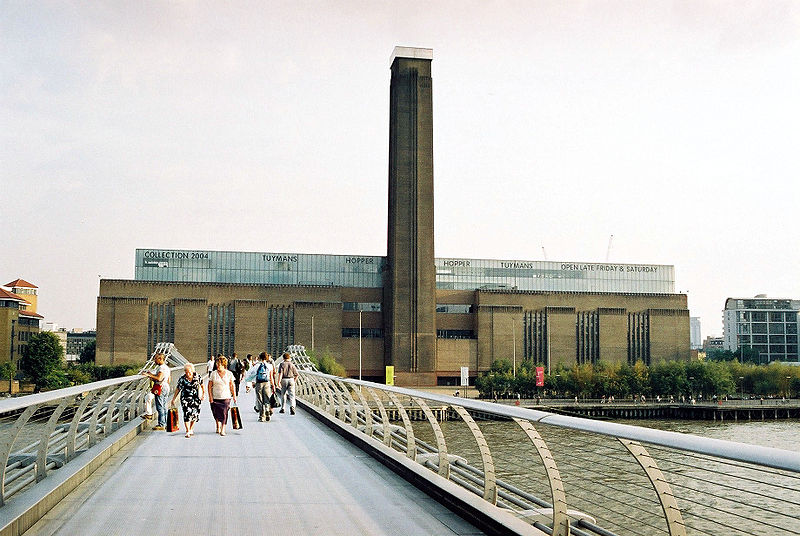
The Tate Modern was designed by the Swedish architects Jacques Herzog and Pierre de Meuron, the 2001 winner of the Pritzker Prize, the ‘Nobel Prize’ of architecture.  Their concept of maintaining the industrial motif and juxtaposing it with the artistic is ingenious.  Furthermore, they have turned the massive industrial space into a people space.  The main entryway is named The Turbine Hall, allowing people to fill the massive vacuum that was once associated with a power plant. The huge area also makes display of larger pieces of exhibits possible.  Now they are doing it again, yet another redesigning, an even more amazing remodelling and addition, all for the 2012 Olympics Summer Games in London.

Two streams of thoughts constantly ran through my mind during this trip.  One was the dichotomy of ‘High Art’ and ‘Public Art’, ‘high culture’ and ‘popular culture’.  Does such a rift still exist?  All the galleries and museums I visited were all flooded with people.  It was hard to take a picture without any heads caught in the frame.  So every photo I took was immediate.  I had to wait for people to move away and snap the moment quickly.  In the Turbine Hall at the Tate Modern, I saw families with young children, many pushing baby carriages, kids doing cartwheels on the huge floor space.

Is it still ‘high art’ if the exhibits are free to the public, a destination for family outing?  As a rock concert ticket can cost hundreds of dollars… now does that re-define the ‘high’ in culture?  Is it still ‘high art’ if people can get in free, as with the Tate Modern collection, enjoy what they see, gasp at the possibilities, or be bewildered by a notion conveyed through an artwork?  Do we need to ‘understand’ art in order to enjoy it?  Maybe we should just allow the object of art to speak for itself, and thereby, linking the gaps between us.

Here are a few exhibits I took with my iPhone.  Please do click on the link of each piece to see the good photos at the Tate Modern website and an explanation.  I was gratified to see works from some of my favourite artists in their original.

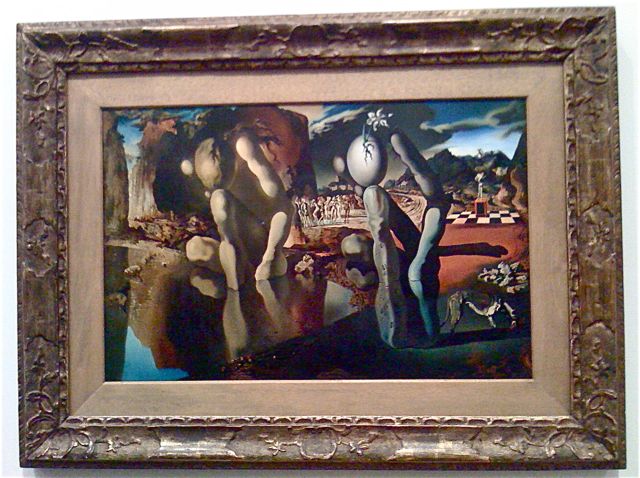
Metamorphosis of Narcissus by Salvadore Dali, the work that changed Freud’s original negative view of Surrealist art.  In the painting, you’re supposed to see Narcissus on a pedestal in the background, then kneeling by the fatal pond, and lastly transformed into a flower… and what a self-absorbed egghead he was:
.

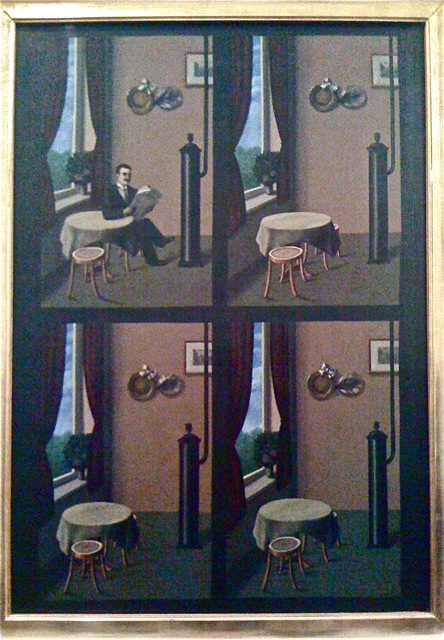
Man with a Newspaper (1928) by René Magritte (1898-1967), under the section ‘Poetry and Dream’.  These are supposedly four different perspectives … mmm … , but hey, this is Magritte speaking.  His dead pan surrealist style is regarded as a subtle form of social critique.
.

And here are a few other interesting works. Polish artist Magdalena Abakanowicz’s ‘Anti-form’ sculpture which she created during the 1960’s Soviet-occupation of Warsaw, another example of the freeing effect of art and the social statement they subtly convey:


Untitled sculpture with wood and wool by Jannis Kounellis, homage to Jackson Pollock’s drip painting:

.

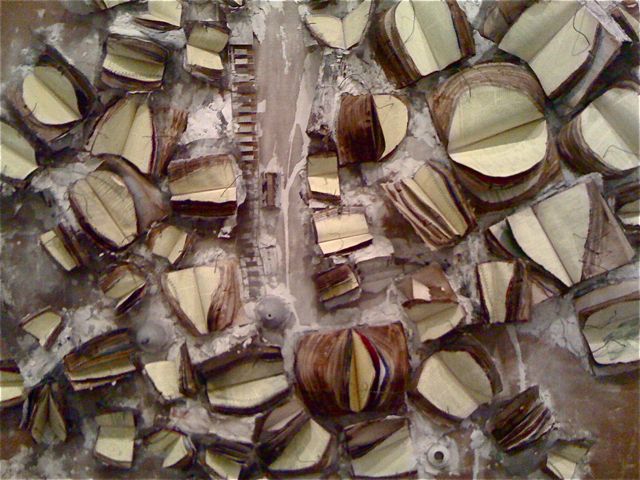
I like this work of open books, but don’t remember the artist or the name of it.  With the fast emergence of eBooks, this work could soon become an antique artifact:
***

The second event I chose was to see ‘Billy Elliot The Musical’.  I liked the movie a lot, appreciating the depth of conflicts which touch on the same dichotomy: ‘High Culture’ and ‘Mass Culture’, and the seeming incompatibility of art and life.  A miner’s son in a blue collar neighbourhood is attracted to the beauty of the ballet, and the freeing energy of dance.

The conflict persists starkly as the political backdrop of the miners’ strike turns ugly in the 1984-85 years. While their livelihood is at stake, and as the miners determine to pose the fiercest strike action against the Thatcher government, where does ballet come in?  It sounds trivial and even surreal to think of ballet compared to the major battles raging in the country. But this is also a conflict between the individual and the masses, the individual and, yes, even the family.

Billy’s new-found love and immense talent ultimately melt the heart of his macho father and older brother, and soon those in the mining community.  He is given the chance to audition for the National Ballet School, with the local miners raising funds to support his cause.
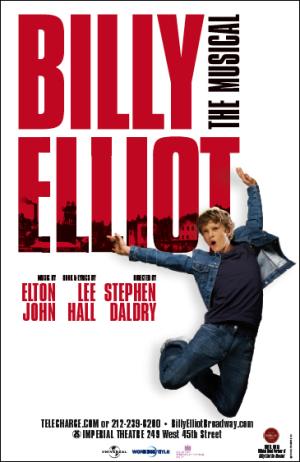

The movie allows more in-depth exploration of internal conflicts while as a musical, the focus has shifted to the dance performance, the music, and for crowd appeal, some Monty Python style romp com, mellow-dramatic scenes, and many exaggerated, stereotypical expressions and language choices. I’m afraid it looks like a contrived way to bring the ‘high’ down to the ‘common’ level.  Elton John’s music while lively, seems lacking in variety and depth compared to his other works and those in the Andrew Lloyld Webber tradition.

Performed on the London stage since 2005 and still going strong, ‘Billy Elliot the Musical’ is directed by Stephen Daldry, lyrics and book by Lee Hall.  It has won both the Lawrence Olivier Awards in England and the Tony Awards in the US.  It went on Broadway in 2008, and on the main stages in several other countries.  The night I went the role Billy Elliot was performed by 12 year-0ld Rhys Yeomans, and he was marvellous, both as actor and dancer.  He practically carried the whole show on his young shoulders, singing, acting, and dancing in superb style, energy, and versatility.  The role of Michael, Billy’s friend, was done animatedly by another 12-year-old, Reece Barrett. The boys’ performance were the main attractions for me.

In the middle of the show however, the performance was interrupted by a technical difficulty.  It was no minor glitch.  We had to wait in our seat for around 15 minutes before performance resumed.  Now that had discounted some of my enjoyment.  And when the show started again, a scene was skipped.  But overall, it was quite an experience at the Victoria Theatre in London.  A good choice I still think considering the limited time I had in London.

A Late Summer Hiatus

As the holidays draw to an end ever so quickly, and before I take off for a couple of weeks to recharge, it’s time to take stock and wrap up for the summer of 2010.

After watching 56 films in two months as a previewer for an upcoming international film festival, I don’t miss the cineplex for this summer’s offering. Yes, I’ve seen Inception.  And no, I didn’t dream that I saw it… although I remember waking up a couple of times. Anyway, its effect on me is quite similar to Avatar‘s, something I wouldn’t rave about except just say: ‘Been there, done that’.  The Girl With The Dragon Tattoo may well be the best summer movies in my opinion.

As for books, I’ve read a few, not a long list, but enough to keep me busy, relaxed, informed, and inspired. I’m glad I’ve discovered Tim Keller, pastor of the vibrant Redeemer Presbyterian Church of Manhattan.  His Reason For God has restored hope in me that it’s possible to embrace both faith and reason.  Seldom have I come across such an intellectual and sensible approach to the seeming dichotomy.

I must also mention Somewhere Inside: One Sister’s Captivity In North Korea and the Other’s Fight to Bring Her Home by Laura and Lisa Ling.  The book is a riveting account of journalist Laura Ling’s harrowing ordeal as a captive of the North Korean regime, and her remarkable release back to freedom together with her translator Euna Lee.  A testament of hope, resilience, the power of love, and the humanity we all share. An absorbing read, well told inside out.

Also, Bellezza’s Japanese Literature Challenge 4 has really done its job.  For it was a challenge indeed reading Kenzaburo Oe’s Rouse Up O Young Men of the New Age! Another more leisurely but no less intense work is Kazuo Ishiguro’s Never Let Me Go. I’ve purposely delayed posting about it until I’ve seen its movie adaptation coming out in September.  I’m looking forward to the film version, with Carey Mulligan as Kathy, Keira Knightly as Ruth, and Andrew Garfield (our new Spider-Man) as Tommy.  That would be for my commitment to C. B. James’s Read the Book/See the Movie Challenge over at Ready When You Are, C.B.

So now, my two weeks of late summer hiatus.  Just for fun, here’s Arti’s Cryptic Challenge… some hints as to where I’ll be in the next little while …  and most likely what you’ll see posted on Ripple Effects comes September.

1.  Don’t mind the gap:  risky when boarding, but good pointer for parenting.

2.  “I am not yet so much changed…”  Upon this re-visit, I don’t expect much change either, for it has kept quite the same for hundreds of years.

3.  From “Lost Generation” to “Beat Generation”, Beach to Whitman, it has much to offer other than curb appeal.

4.  And finally, this little clip on YouTube is my best prep:

Enjoy what’s left of your summer.  I’ll be happy to hear from you about your summer reads, movies, and wrap-up.  Feel free to leave your comments here and I’ll try to read and reply them whenever I find a free WiFi hot spot.

Bernini’s Corpus and Modern Movies

The Art Gallery of Ontario holds more than 79,000 items in its collection, from 100 A.D. to the present. I’d just seen a tiny fraction of them during the six hours I was there. But if I’m to say which one has stirred the most ripples, it would be the bronze sculpture by Bernini, Corpus (The Crucified Christ), ca. 1655.

Successor of Michelangelo, the Italian Baroque architect and artist Gian Lorenzo Bernini had produced many famous Papal works. I’m impressed by how contemporary this 17th C. sculpture looks with its silvery-bronze color and its minimalist styling. Further, I’m amazed that it has been in private hands all the years… Like you might hear at a party, “Oh, I just happen to own a Bernini.” Having been ‘lost’ and then ‘found’, the sculpture was last in the possession of the Frum family who donated it to the AGO in 2007, estimated value at that time was $50 million.

Murray Frum, real estate developer and philanthropist, had earlier donated an entire African art collection to the AGO. To the general public, probably the most well-known member of his family is his late wife who died of cancer in 1992, the prominent CBC news journalist Barbara Frum.

Unlike the other art works of the crucifix that I’ve seen, the Bernini Corpus has no cross. Its 5 foot 6 inches life-size body hung in midair, supported only at the base.  There it is, right in the middle of the darkened gallery room displayed at eye-level, the suffering Christ suspended in silence. You can get near to the outstretched arms, you can see the loincloth blown to the side, and every minute detail on the body.

Without the backing of the cross, the image gives a weightier impression. You can go right up to the work, except of course you can’t touch it or take a picture, even though both were what I actually wanted to do… But at least, I could look and wonder in nearness.

The cruciform pose of Christ being hung on an invisible cross turns the literal event into a symbolic timelessness. The mere posture of two outstretched arms has long been associated with the essence of the cross: suffering, sacrifice, redemptive salvation. Such a visual icon has been used in many movies effectively. Whether you agree with the director’s message or parallel is another matter. Nonetheless, the archetypal cruciform pose is a powerful image when aptly embedded in a visual context.

Here are a few movies that I can think of where the cruciform pose vividly depicts a memorable moment. (Warning: The following section carries Spoilers.)

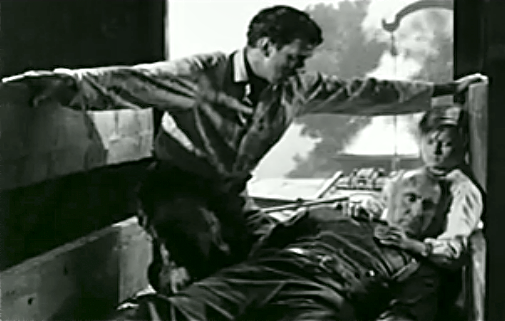
How Green Was My Valley (1941): John Ford’s visually contemplative work. When the shaft comes up from the underground mine carrying survivors of the explosion, you can see the rescuer Mr. Gruffydd in the cruciform pose. What’s more, you can even see the Pieta image:

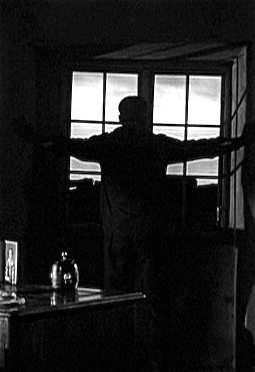
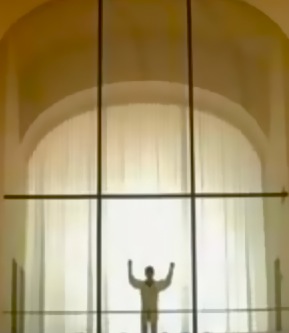
Through a Glass Darkly (1961): Ingmar Bergman’s classic. The estranged father David stretching his arms out in front of the window, sobbing and seeking redemption through family relationship: Cool Hand Luke (1967): After eating 50 eggs, it’s enough suffering for Luke (Paul Newman), a determined radical fighting a callous system in a hopeless prison. His graceful form is a clear contrast to the stark surroundings: The Graduate (1967): Ben (Dustin Hoffman) cries from above: “Elaine! Elaine! Elaine! …” Which yearning heart would not respond to such a passionate cry and be delivered in the nick of time out of a loveless union: Dances With Wolves (1990): Only when you’re not afraid to die, then can you live.  Lieutenant Dunbar (Kevin Costner) embraces death only to be ushered into a new life and adventure:

Shawshank Redemption (1994): Andy Dufresne (Tim Robbins) literally digs out a new path to salvation. This is the iconic scene of freedom and cleansing after climbing out from the sewage line: Superman Returns (2006): Superman (Brandon Routh) returning from Krypton to save the world. His famous line to Lois: “You wrote that the world doesn’t need a savior, but everyday I hear someone crying for one.” Gran Torino (2008): Walt Kowalski (Clint Eastwood) laying down his life to save his young friends from a neighborhood gang, in search of self-redemption: … I’m sure you can think of more.

***

Related Posts you might enjoy:

Alex Colville and the Movies

The Art Gallery of Ontario

***

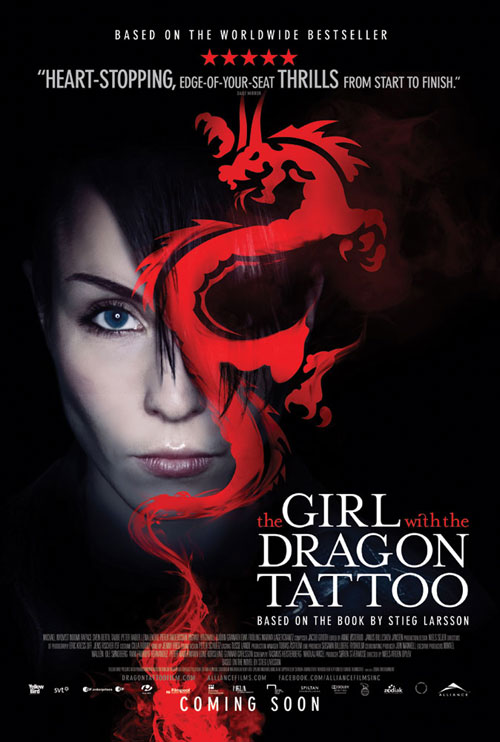
The Girl With The Dragon Tattoo: The Movie (2009)

Update Feb. 13: The Girl With the Dragon Tattoo just won BAFTA’s Best Film Not In The English Language.

Summertime… and the viewing is chilling.

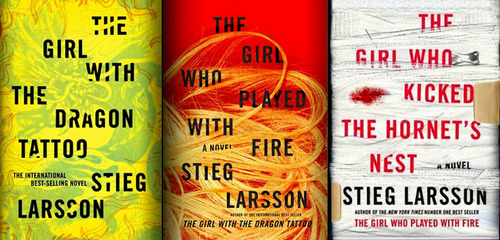
By now, we North Americans have caught the blazing heat that had swept other parts of the world a few years back, as we get the English translation of the Millennium Trilogy:  The Girl With The Dragon Tattoo, The Girl Who Played With Fire, and last of the series, The Girl Who Kicked The Hornets’ Nest.  All three books dominate the New York Times Best Seller Lists: When I last checked, the first two novels occupied the first and second places on the Paperback Trade and Mass-Market Lists, the newly published third title quickly claimed its second place on the Hardcover List.  The Trilogy has sold more than 27 million copies in 41 countries world wide.

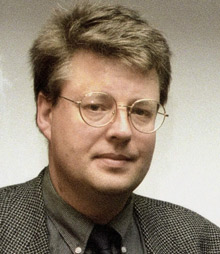
It’s just too sad that the Swedish author did not get a taste of his own success.  Stieg Larsson died in 2004 of a heart attack at 50.  All three books were published posthumously.  Before his fame as a writer and journalist, Larsson had championed against racism and right-wing extremism for decades.

Those who frequent Ripple Effects might know, I’m interested in the transforming of books into films.  There are many instances where I would read the book first before seeing the movie.  But here’s an exception.  I’m glad I went into the movie theatre knowing nothing about the story.  Because of that, I was held on the edge of my seat from beginning to end, my mind fully engaged, all 152 minutes of it.

The story begins with a high profile journalist with Stockholm’s Millennium Publication, Mikael Blomkvist (Michael Nyqvist), losing a libel suit brought on by a corrupt financial giant. Blomkvist is given half a year of freedom before serving a three-month jail term. Meanwhile, the reclusive industrial tycoon Henrik Vanger (Sven-Bertil Taube) approaches and hires the disgraced journalist to investigate the disappearance and likely murder of his beloved niece Harriet Vanger 40 years ago, a unique assignment that intrigues Blomkvist.  Initially, Vanger has recruited Lisbeth Salander (Noomi Rapace), a ‘researcher’ with a security firm, to do a background check on Blomkvist. Lisbeth is in fact an expert hacker. Believing Blomkvist to be set up in the libel suit, she continues to track him, and the two finally meet up and join hands in search of the truth behind the disappearance of Harriet Vanger… and a bit more.

This is one engrossing and highly suspenseful piece of filmmaking in the crime thriller genre.  First off, the cinematography and the overall visual tonality is reminiscent of film noir, setting the mood effectively.  As well, the many Vermeer moments wherein the playout of light and shadows reflect aptly the complexity of the characters.  The revealing of hidden facts and personal secrets drive the riveting momentum.  Pacing is suitably executed.  While it’s not your bullet-speed Bourne flick, it unfolds the story smoothly, allowing some real acting to take place.  There are effective action sequences and some poignant moments.  And yes, there are also scenes where the audience could well be aware that their emotions are being led towards an intended end.  As witness of a violent crime against the heroine, the audience is pulled to a cathartic revenge, and feels okay with it.  Herein lies the effectiveness of the film.  Less obscure is the original Swedish title: “Men Who Hate Women”.  So the warning is: graphic violence.  But it’s not gratuitous and I have to say, only reveals the reality of how low and depraved human can be.


Another measure of success is how quickly the film has elicited my empathy and even compassion for the female protagonist.  It can make an ear and nose-pierced, misanthropic, rage-wrapped goth to become the heroine within minutes into the film.  This idea is original, iconoclastic, and timely too.  It draws us from the surface of looks and attire into understanding one’s psyche, to see how past experiences mould a life.  There are layers of truths to be understood if one is willing to go past the facade.

Condensing 600 some pages (Paperback) into 152 minutes must be an arduous task.  A lot of details are bound to be put aside.  But with every adaptation, the movie ought to be viewed as a totally different medium, and not be judged by how literal the transformation is.  Turning words into visuals has always been the demanding job of the screenwriter but also the realization of a vision from the director.  As a movie viewer, I’ve appreciated the work as a congruent whole, very well edited and all loose ends tied, even opening a tiny portal for the sequels coming up.

Shot entirely on location in Sweden, the work is an artful piece of filmmaking.  The wintry Swedish landscape is a quiet visual relief for our hot summer months. The movie has garnered several noms and awards, most notably The Swedish Guldbagge Awards in Best Film for director Niels Arden Oplev and Best Actress for Noomi Rapace.  It was also honored with the Audience Award at the Palm Springs IFF.

.

.

But will the movie and its two sequels gather as much hype as the novels?  Here in English only North America, I’m afraid not, at least not with the Swedish versions. Here are the stats if you’re interested. Watching a movie with subtitles is much more common in other parts of the globe than here.  Thus prompts Hollywood to plan for an English version. Well, is it language or profit?

My recommendation is: go for the Swedish one.  See a film in its most authentic adaptation, Swedish setting, original language dialogues, and superb performance.  Don’t let Hollywood distract you from the real thing. There have been rumors of Carey Mulligan, Natalie Portman, and Kristen Stewart taking the role as Lisbeth Salander, and Daniel Craig, Johnny Depp, Brad Pitt, and George Clooney as Blomkvist.  Well, if they must make an English version, my picks for the leads are Ellen Page and Jeremy Renner.

But no matter what, the Swedish original is a hard act to follow.  It’s now on DVD and Blu-ray.  And if it’s still being shown in theatres in your area, nothing beats seeing a thriller on a sweltering summer day, or night, inside a cool, dark theatre.

~ ~ ~ 1/2 Ripples


To Kill A Mockingbird

Clint turns 80 today.  A book dedicated to him as well as a special DVD just out to celebrate his life-long achievement.  There’s no shortage of Father’s Day gift ideas.  I understand though the man himself does not want any celebration on his birthday.  So to make his day, I’m not going to say anything more about him.

But there’s another birthday, or anniversary rather, that should be mentioned.  To Kill A Mockingbird turns 50 this year. Another good choice for Father’s Day, or any day really, and not just for fathers.  In recent years, as I see current events unfold, I truly feel this will make a marvellous gift for Law School graduates, or any graduate for that matter.   In this tumultuous time we’re in, where honor, justice, and nobility of character seem to become obsolete as quickly as the latest techno gadget, we all need a guidepost, a moral compass, ever more so.

To commemorate the 50th anniversary of its publication, Harper Collins has published a special edition:

Harper Lee had based the story on her childhood experiences in her hometown Monroeville, Alabama.  Her understated storytelling of Atticus Finch, Scout and Jem of Maycomb had won readers’ hearts the world over.   Two children growing up learning the value of respect and justice, love and integrity from their father.  Theirs was a most trying of times when racism and the Depression joined hands to destroy any fragile decency still present in a poverty-stricken town in the deep south.

Strangely, the story of such a parochial setting had triggered universal resonance.  The novel has been translated into at least 40 languages, sold over 30 million copies.  It has gained the number one spot on the list of greatest novels of all time.  It is the choice of British librarians according to a poll conducted by the Museum, Libraries and Archives Council (MLA), in which librarians around UK were asked the question, “Which book should every adult read before they die?”  Just hope people don’t wait till then.

***

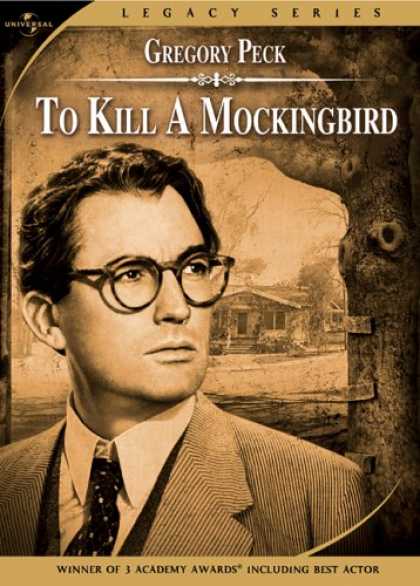
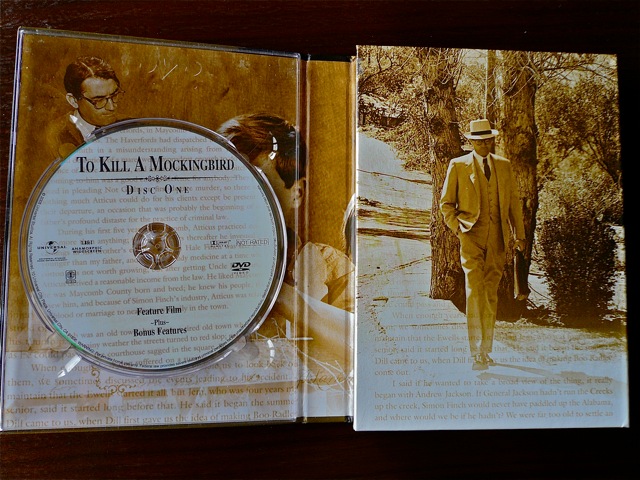
To Kill A Mockingbird DVD, Universal Legacy Series


To complement the book, I highly recommend the DVD set of the Oscar-winning movie (1962).  Make sure it’s the Universal Legacy Series (2005).  This is a two-disc collection with loads of memorable special features. Here’s a list:

  • Academy Award Best Actor Acceptance Speech — Gregory Peck
  • American Film Institute Life Achievement Award — Gregory Peck
  • Daughter Cecilia Park’s heartwarming tribute to her father
  • Scout Remembers — An interview with Mary Badham, who talks about her experiences working with Gregory Peck
  • Fearful Symmetry: The Making of To Kill A Mockingbird
  • The documentary A Conversation With Gregory Peck, produced by Cecilia Peck.  Scenes with Lauren Bacall, Martin Scorsese, President Bill Clinton and the Peck family.  Most moving is ordinary people sharing how the movie had impacted them, in their career choice, parenting and life.

“All the children of the whole world must have wished they could have Gregory Peck as their father.  He was ours, and that was our blessing.  He really was a lot like Atticus Finch… The last page of his film script of To Kill A Mockingbird, he had scrawled these four words at the bottom: Fairness, Courage, Stubbornness, Love. And they remind me so much of him…”  — Cecilia Peck’s tribute to his father

“It’s difficult to separate the man from the character.”  — Mary Badham (Scout) reminisces on her experience working with Gregory Peck

“Making millions is not the whole ballgame.  Pride of workmanship is worth more, artistry is worth more.  The human imagination is a priceless resource.  The public is ready for the best you can give them.  It just maybe that you can make a buck, and at the same time encourage, foster, and commission work of quality and originality.”  — From Gregory Peck’s acceptance speech for American Film Institute’s Life Achievement Award.

And if you think it’s all about Gregory Peck, well in a way it is.  I can’t think of anyone better to climb into the skin of Atticus and walk around in it.  The man is Atticus Finch, as his colleagues and family had testified. Gregory Peck received a well-deserved Best Actor Oscar for his role.  I must mention too that this is where Robert Duvall made his acting debut, without saying one single word, as Boo Radley.

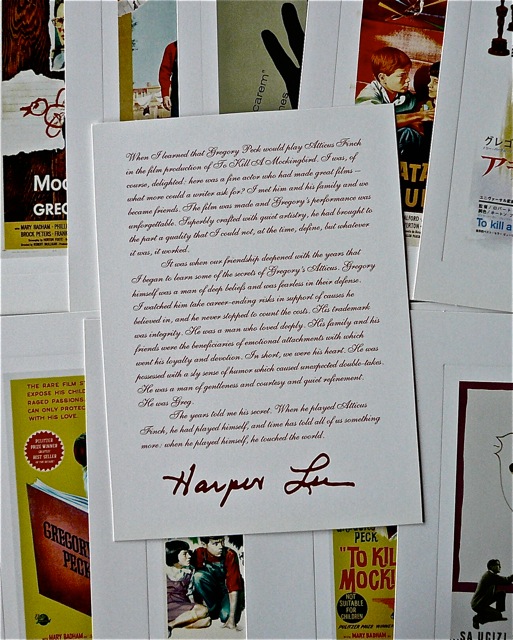
The other good reason for this Legacy Series is the 11 Exclusive Reproductions of Original Theatrical Posters. They are printed in a handsome set of cards, each a tribute from the country it comes from: Australia, Belgium, Italy, Japan, Argentina…

And last but never the least, a note from Harper Lee herself about the actor playing a character that was a cinematic reflection of her own father.

“When he played Atticus Finch, he had played himself, and time has told all of us something more:  when he played himself, he touched the world.”   —  Harper Lee

***

Exit Through the Gift Shop (2010)

Update: “Exit Through The Gift Shop” is nominated for an Oscar for Best Documentary Feature. Academy Awards ceremony Feb. 27, 2011.

If you haven’t seen a Banksy signature piece in any urban centres, now you can watch a Banksy film, Exit Through The Gift Shop, ‘directed’ by the elusive street artist himself, and legitimately shown in theatres near you. And a big spoiler: no, you don’t get to see his face… only a dark silhouette inside a hoodie, voice distorted… or, maybe that’s not even Banksy himself.

The infamous and secretive graffiti artist has been claimed by some as the instigator of the ‘street art movement’.  Believed to be based in Bristol, England, Banksy has made his presence known by spray painting his articulately constructed stencilled work on walls in the most unlikely places of the world.  The following one is found on the high, separating wall in the West Bank:

The May 10 issue of TIME magazine has included Banksy in the poll of 100 Most Influential People In The World.  His silent graffiti are clear political and social statements, thought-provoking messages imbued with whimsical and imaginary images.  His works have been auctioned off at Sotheby’s, including the murdered telephone booth on a London street.  Sign of the time: the triumph of the cell phone.

At the time of the film’s premiere screening earlier this year at the Sundance Film Festival in Park City, Utah, Banksy made his presence known by contributing to the city scene with his notorious images.  Here’s one of them:

.

The documentary Exit Through The Gift Shop, ironically, is more about the filmmaker wannabe Thierry Guetta “Terry” who started off filming street artists from Paris, London, and back to his home city L.A.  His life came to a drastic turn as he, by chance, was introduced to the underground Banksy, and started tagging along, capturing Banksy’s creative process in his camcorder.

What turned him around was Banksy’s advice that he wouldn’t be a good filmmaker.  That was motivation enough for Terry, who re-directed his energy towards his new ambition: to be a street artist himself.  So the film is exactly that, the first part is the exhilarating depiction of the colorful underground world of street artists from Europe to LA, hunt down and tagged along by Terry the videotaping enthusiast.  But the film dims into a lesser light when the latter half shifts to focus on Terry himself, who, without much self-discernment, churned out obviously second-rate works which prompted Banksy to declare never to help anyone produce a doc about street art again.  We learn that as the end credits roll.

Unlike the anonymous and elusive Banksy, Terry is a self-promoting opportunist, calling himself Mr. Brainwash, his productions MBW. He hired staff to help him produce works of pop fusions, tacky, Kinko re-mixes of Warhol reproductions, while at the same time, reaping millions of dollars from their sales.

And with that Banksy cleverly throws out to us the obvious questions: What is art, or maybe, When is art, art?  And, Who can be an artist?

As I watched the first part about these highly skilled and agile urban legends, reminiscence of none other than Phillippe Petit of Man On Wire, I was entertained and amazed at the artistic skills and versatility involved. But of course, these are less dangerous, more down-to-earth feats, nevertheless the spirit of Phillippe Petit lingers.  As fellow artist Shepard Fairey writes in TIME magazine about Banksy:

He doesn’t ignore boundaries; he crosses them to prove their irrelevance.

So naturally, the film leads us to that menacing debate: Street art or vandalism?  Here’s Banksy’s own take on this issue, quoted in LA Weekly:

“I’m not so interested in convincing people in the art world that what I do is ‘art,’ ” Banksy says. “I’m more bothered about convincing people in the graffiti community that what I do is really vandalism.”

… mmm interesting thought… but then again, as elusive as his persona.

Exit Through The Gift Shop tags along this subheading: “The World’s First Street Art Disaster Movie”.  The disaster apparently refers to the public’s indiscriminate taste for Terry’s MBW works.  However, it probes further into a deeper layer, the distinction between ‘good’ art and ‘bad’ ones. I like Shepard Fairey’s take on the Mr. Brainwash phenomenon:

“Don’t be annoyed by him. Make him irrelevant, make something better.”

If we can all agree on what is ‘better’.  Take for example, among Banksy’s works, I like this one the best… No, it doesn’t reflect Arti’s own personal habit.  It appeared on a Camden street, and later met the fate of being cleaned up by order of the Camden City Council:


‘Directed’ by Banksy himself, the doc is narrated by Rhys Ifans, an award-winning British actor (Notting Hill‘s Spike).  It’s entertaining, informative, and thought-provoking.  This is the closest to an original Banksy.

~~~ Ripples

***

With the film’s premiere showing in Toronto, guess Banksy has also made his debut on the walls there:

CLICK HERE TO SEE BANKSY IN TORONTO.

Thanks to a reader from England, I was given the link to this, a must-see:

CLICK HERE TO SEE BANKSY V. THE BRISTOL MUSEUM

***

Photo Sources:

Banksy on West Bank Wall: http://news.bbc.co.uk/2/hi/entertainment/4748063.stm

Banksy at Sundance, Park City, Utah: http://festival.sundance.org/2010/blog/entry/banksys_missive/

Murdered Telephone Booth: http://www.laweekly.com/2010-04-08/art-books/banksy-revealed/2

Maid Sweeps Under: Wikipedia Commons

***


Movies for Mom

Some good movies are on DVD now.  Great to spend the evening with mom at the comfort of home.  Here are Arti’s movie recommendations for Mother’s Day.

Georgia O’Keeffe (2009, TV)

.


The cinematic biopic of the great American artist stars Joan Allen as Georgia O’Keeffe, and Jeremy Irons as her husband, the photographer Alfred Stieglitz.  Both received Golden Globe acting nomination, while the movie got the nom for Best Picture made for TV.  The production is a visual delight illuminating not only the works of the artist, but her elegant poise, and her environs, especially the cinematic New Mexico landscape.  On top of the spectacular visuals, I’d enjoyed the personal narration and the quotable quotes.  My favorite: “Where I was born and where and how I have lived is unimportant. It is what I have done with where I have been that should be of interest.”  As for the tumultuous relationship between O’Keeffe and Stieglitz, is it fair to say it is a case of iron sharpening iron?

*

The Blind Side (2009)


If your mom still hasn’t seen this one, it’s a good time to watch it with her… if it’s just to give moral support to Sandra Bullock.  Like her predecessors (Kate Winslet, Reese Witherspoon, Hilary Swank, Charlize Theron, Halle Berry, Julia Roberts), winning the Oscar Best Actress just proves to be too much to handle when the consequence is marital breakdown.  And what’s this about life imitating art (ok, let’s just call it art), Bullock attempts to live her movie role with her mixed-race adoption.  One thing that she’d find I’m sure, real-life mothering will prove to be a much more demanding role than in the movies.

*

Crazy Heart (2009)


Jeff Bridges won the Best Actor Oscar as worn-out country singer Bad Blake. Spent and hopelessly alcoholic, Bad Blake is movingly revitalized by journalist Jane Craddock.  Even for one who’s not keen on country western music, I’d thoroughly enjoyed the songs performed by Bridges himself.  Song writers Ryan Bingham and T-Bone Burnett won the Best Original Song Oscar with ‘The Weary Kind’.   As a bonus, you can also hear Colin Farrell sing.  Maggie Gyllenhaal gives a convincing performance as journalist Craddock, who starts from professional interest with the country singer to deeper, personal involvement.  But ultimately, her role as mother wins out.

*

Arti’s other recommendations?  All the movies listed on the sidebar.  All of them are on DVD now.  To read my review, just click on the picture.

No matter which movie you watch with mom, do talk about it afterwards… that’s the best part of the experience.

Here’s Jeff Bridges singing the Oscar winning song The Weary Kind:

*

To all who play the real-life role of mothering: A Happy Mother’s Day!  May you all get the nod and award you deserve!

Notes on the Synthesis of Film, Art… Life?

Recently I’ve just finished reading Paul Schrader’s Transcendental Style in Film: Ozu, Bresson, Dreyer (1972).  Yes, that’s before Schrader rose to prominence as a screenwriter and filmmaker. Is such a book a bit dated?  Considering the techno-reigning world we’re living in now, where speed is measured by nanoseconds, and where 3D and CGI have become the necessary features for movies to generate sales, I think we need to read this all the more.

The three directors in the book had produced some of the best movies of all time. Since I have not seen all the films Schrader discusses, I might not have grasped as fully his arguments and illustrations as they deserve. And I admit I do not embrace unquestionably all those that I do get. Nevertheless, there are many, many parts that I want to record down. I’d consider them crucial elements to mull over during the creative process in just about anything. I’ve listed some of these fine quotes in the following.

They all point to the axiom of ‘less is more’, the value of stillness and simplicity, the speechless sketch that speaks volumes, the importance of being over doing, the quality of sparseness over abundance, the bare essence of life.

Notes to myself: when watching, writing, reading, doing, or just plain walking down the mundane path of everyday, keep these points in mind.

  • Ozu’s camera is always at the level of a person seated in traditional fashion on the tatami, about three feet above the ground. “This traditional view is the view in repose, commanding a very limited field of vision. It is the attitude for watching, for listening, it is the position from which one sees the Noh… It is the aesthetic attitude; it is the passive attitude.”[1]
  • Ozu chose his actors not for their “star” quality or acting skill, but for their “essential” quality. “In casting it is not a matter of skilfulness or lack of skill an actor has. It is what he is…”
  • “Pictures with obvious plots bore me now,” Ozu told Richie. “Naturally, a film must have some kind of structure or else it is not a film, but I feel that a picture isn’t good if it has too much drama or action… I want to portray a man’s character by eliminating all the dramatic devices. I want to make people feel what life is like without delineating all the dramatic up’s and downs.”
    .
  • His films are characterized by “an abstentious rigor, a concern for brevity and economy, an aspiring to the ultimate in limitation.”
  • Given a selection of inflections, the choice is monotone; a choice of sounds, the choice is silence; a selection of actions, the choice is stillness–there is no question of “reality”. It is obvious why a transcendental artist in cinema (the “realistic” medium) would choose such a representation of life: it prepares reality for the intrusion of the Transcendent…
  • “The opening five shots of An Autumn Afternoon: The everyday celebrates the bare threshold of existence; it meticulously sets up the straw man of day-to-day reality.”
  • In films of transcendental style, irony is the temporary solution to living in a schizoid world. The principal characters take an attitude of detached awareness, find humor in the bad as well as the good, passing judgment on nothing.

***

.

  • Like Ozu, Bresson has an antipathy toward plot: “I try more and more in my films to suppress what people call plot. Plot is a novelist’s trick.”
  • As far as I can I eliminate anything which may distract from the interior drama. For me, the cinema is an exploration within. Within the mind, the cinema can do anything.”
  • On the surface there would seem little to link Ozu and Bresson… But their common desire to express the Transcendent on film made that link crucial… Transcendental style can express the endemic metaphors of each culture: it is like the mountain which is a mountain, doesn’t seem to be a mountain, then is a mountain again.
    .
  • The abundant means sustain the viewer’s (or reader’s or listener’s) physical existence, that is, they maintain his interest; the sparse means, meanwhile, elevate his soul.  The abundant means are sensual, emotional, humanistic, individualistic. They are characterized by realistic portraiture, three-dimensionality…
    .
  • The “religious” film, either of the “spectacular” or “inspirational” variety, provides the most common example of the overuse of the abundant artistic means… the abundant means are indeed tempting to a filmmaker, especially if he is bent on proselytizing. (Now… why am I thinking of Avatar?)
  • The transcendental style in films is unified with the transcendental style in any art, mosaics, painting, flower-arranging, tea ceremony, liturgy.  At this point the function of religious art is complete; it may now fade back into experience. The wind blows where it will;  it doesn’t matter once all is grace.

***

Transcendental Style In Film: Ozu, Bresson, Dreyer, published by University of California Press, 1972. 194 pages.

[1] Schrader quoting Donald Richie, “The Later Films of Yasujiro Ozu,” Film Quarterly, 13 (Fall 1959), p. 21.
The following three quotes are from the same source.

.

Some informative links:

Paul Schrader http://www.paulschrader.org/, http://www.imdb.com/name/nm0001707/

Donald Richie http://www.movingimagesource.us/dialogues/view/274

Yasujiru Ozu http://www.guardian.co.uk/film/2010/jan/09/yasujiro-ozu-ian-buruma, http://www.a2pcinema.com/ozu-san/home.htm

Robert Bresson http://www.mastersofcinema.org/bresson/, http://www.imdb.com/name/nm0000975/

Carl Theodor Dreyer http://archive.sensesofcinema.com/contents/directors/02/dreyer.html

David Bordwell http://www.davidbordwell.net/

***

Floating Weeds (1959)

‘Floating weeds, drifting down the leisurely river of our lives.’

.

.

April is national poetry month… and I’ve been thinking poetry these days.  So that’s why the very title of this DVD on the shelf of the indie video store attracted me right away.  I took it down soon as I saw it was directed by Ozu.  Ozu’s films are visual poetry, the title ‘Floating Weeds’ is an apt prelude.

Floating Weeds (浮草, Ukigusa, 1959) is a remake of Ozu’s 1934 silent film ‘A Story of Floating Weeds’.  The title comes from a favored Japanese metaphor as the above quote depicts.  In this newer version the director has added colors and sound, and given his story a blossoming rebirth. The colors are vibrant yet the cinematography is contemplative.  Unlike some art house films, and despite its title, ‘Floating Weeds’ is enlivened by humor, human interests, and augmented by actions.  Despite the pensive mood the title evokes, I found it to be more story-driven than many of his other works.  However, it is characters that ultimately carry the story, and Ozu’s brilliant direction that makes viewers care about them.

The story begins with a train dropping off a troupe of travelling players to perform in a small town.  The master of the company Komajuro takes the chance to visit his former lover and see his son Kiyoshi, now grown up to be a fine young man, aspiring to attend college in the big city.  But Komajuro has kept his real identity as Kiyoshi’s father from his son because he does not wish his low social status as a travelling actor, and the vulgar circle he associates with to tarnish Kiyoshi’s future.  The plot thickens as Komajuro’s current mistress Sumiko finds out about his secrets. Burnt with anger and jealousy, she plots a scheme to destroy Kiyoshi by bribing the young actress Kayo to seduce him.  The young man soon falls for the actress, but the scheme turns into a full-blown mutual love relation.  Sadly, a marriage with Kayo would mean the quashing of his aspiration for higher education, and possible social reverberations and disgrace.

At the mean time, the drama troupe hits a low with disappointing attendance. The company has to disband.  Komajuro facing failure on different fronts, has to make choices not only for himself, but the future of his son.  In the final shot, the train that once took the travelling players to town now carries them off as disbanded individuals facing uncertain future. Like floating weeds, they drift on in the stream of life. And for Komajuro, he leaves town with the slim hope that his son would fare better than he in the oblivious currents of time.

I’ve enjoyed the subtle style of Ozu.   Here is one of my favorite scenes in the film, and the dialogues are as contemporary as you can find in a 2010 movie.  Whether one sees it as insight or foresight (considering it was remade in 1959), both are gems one discovers while watching the story unfold as casually as a quiet flowing stream.

The scene is about Komajuro talking to his son Kiyoshi as he arrives to his former lover’s home. All the years, Kiyoshi has only known Komajuro as an uncle.  Although Komajuro is ecstatic to see his son all grown up with a bright future, he is also wary that his travelling drama troupe does not measure up to what he would wish for his son.  Here in this scene, father and son’s conversation seems to touch on another issue: art and popularity.  Through this most casual dialogue exchange, Ozu might have conveyed his own ambivalence on the subject more sharply than any wordy treatise.

Kiyoshi: I’ll go see your show.  What do you play?

Komajuro: Forget it.  It’s not meant for you.

Kiyoshi:  Who is it for?

Komajuro:  An audience.

Kiyoshi:  I’m an audience.

Komajuro:  I know.  It’s nothing high-class.  Forget about it.

Kiyoshi:  Why show such plays?  Show something better.

Komajuro:  But I can’t.

Kiyoshi:  Why?

Komajuro:  Audiences today won’t understand good plays.  So you can’t come to see it.

**

In his commentary on the 1934 silent movie, writer and film critic Donald Richie notes that Ozu’s films are full of ellipses. There are story sequences he left out for the audience to bridge.  As well, he handled the story with restraints.  Such a subtle way of presenting the material is a very modern style of storytelling.  That might explain why I would care for characters in a Japanese movie made half a century back, where I have to read subtitles, and watch in black and white, or even silent.  Herein lies the ingenuity and artistry of Ozu, that an audience so far removed in time, space, and culture, would find universality and common ground to be totally absorbed.

The Criterion Collection 2-DVD set includes both the 1934 silent movie and the 1959 color remake. The first features commentary by Donald Richie, the later version by Roger Ebert. According to IMDB, ‘Floating Weeds’ (1959) is on Ebert’s list of 10 best movies of all times.

~~~~ Ripples

CLICK HERE to my review of Ozu’s classic Tokyo Story.

***

Yasujiro Ozu and The Art of Aloneness

Growing up in Hong Kong during the 60’s, I had my share of Japanese literature and films, as well, the early version of anime.  Books were in Chinese translations, films with Chinese subtitles, and anime needed no language.  As a youngster I had my fix of Samurai action flicks by the legendary Akira Kurosawa, or the early sagas of The Blind Swordsman deftly performed by Shintarô Katsu.  The fast, magical sword-fighting movements displayed in elegantly choreographed sequences defined what ‘cool’ was in the eyes of a very young film lover, decades before Jason Bourne emerged.

But I admit, I had never heard of Yasujiro Ozu (小津 安二郎, 1903-1963) before reading the book The Elegance of The Hedgehog, and since, have become a mesmerized Ozu fan.

In Muriel Barbery’s marvellous work of fiction The Elegance of The Hedgehog, I was fascinated by the following excerpt that led me to explore the world of Ozu. Barbery mentioned some dialogues in the Ozu film ‘The Munekata Sisters’ (1950). Here, after quoting elder sister Setsuko, Barbery wraps up the chapter from the point of view of the concierge Renée, narrator of the book:

SETSUKO
True novelty is that which does not grow old, despite the passage of time.

The camellia against the moss of the temple, the violet hues of the Kyoto mountains, a blue porcelain cup — this sudden flowering of pure beauty at the heart of ephemeral passion: is this not something we all aspire to?  And something that, in our Western civilization, we do not know how to attain?

The contemplation of eternity within the very movement of life.

I could not find any copy of ‘The Munekata Sisters’, but I did manage to find a few other Ozu films on DVD in The Criterion Collection at an independent video store. One particularly stands out, both the film and the special features.  And that’s Tokyo Story (1953), the best known and most acclaimed Ozu work.

.

TOKYO STORY (with spoiler)

.

.

Instead of the macho samurai films of his time, Ozu chose to explore the quiet subject of family relationships, parents and children, brothers and sisters, husbands and wives, and from them come the topics of marriage, loyalty, aging, death, filial duties, parental expectations, and generational conflicts.  Through his perceptive camera work, Ozu sensitively revealed the undercurrents beneath the seemingly calm surface of daily family interactions.

‘Tokyo Story’ is about an aging couple Shukichi (the Ozu actor Chishu Ryu) and Tomi (Chieko Higashiyama) from small town Onomichi going on a trip to visit their adult children in bustling Tokyo.  At that time, postwar Japan was cranking up her economic engine, and urbanization was taking off.  Shukichi and Tomi’s children were all busily engaged in their work and family, with no time or patience to entertain their visiting parents, albeit struggling with a thin sense of obligation. They passed the two old folks from home to home, and finally sent them off to a spa resort on their own, a supposedly well-meant package substituting for their absentee hospitality.

With his subtle cinematic language, Ozu explored the issues facing the family in urban, postwar Japan. I’m surprised that in a time when the rebuilding of national pride was as much an essential as that of the economy,  Ozu was brave enough to depict the collapse of the family, revealing the conflicts and tensions behind the amicable social façade.  It’s interesting how contemporary and universal they are.  Have we not heard of those ubiquitous ‘mother-in-law jokes’ in our modern Western society?  Or, in real life, do we not struggle between taking care of our own family and career, and finding the time and energy to look after our aging parents?

.

But the contemplative cinematic offerings of Ozu draw us into deeper thoughts. ‘Tokyo Story’ quietly depicts the truth of these issues: No matter how many siblings there are in a family, each person is responsible for his or her own decision and action.  Even in a mass society like Japan, one can still make individual choices. Despite the currents, one can stand alone against the tides, and act according to one’s heart and conviction. While the brothers and sister are evading the task of hospitality, the young widowed daughter-in-law Noriko (the Ozu actress Setsuko Hara) chooses to care for her deceased husband’s parents out of genuine love.  She stands alone in her kindness and grace, a selfless heroine in a family hinged upon superficial ties.

Illness and death too have to be borne alone.  Despite their being together all the years of their marriage, Shukichi and Tomi each has to face the imminent all alone.  After Tomi falls ill upon arriving home from Tokyo, the strong bond of togetherness in marriage quickly dissolves into helpless resignation of parting and letting go.  Shukichi soon realizes he has to face life all alone.  The poignant scene though is that despite his loss, he looks out for his daughter-in-law Noriko, appreciating her loyalty, and relieving her of further obligations.  Despite having no blood ties, the two of them have touched each other in a way that’s beyond flesh and blood. Noriko selflessly gives while Shukichi accepts and appreciates in the midst of aloneness. The tables are turned, while they are left to face life alone, they are yet bound together in an unspoken bond, one that’s far stronger than filial ties.

The Criterion Collection carries several sets of Ozu titles.  ‘Tokyo Story’ is one in a trilogy of Noriko’s stories.  Disc Two features ‘I Lived, But…’,  a two-hour documentary on the life of Ozu, and ‘Talking with Ozu’: a 40-minute tribute to the great director featuring reflections from international auteurs Stanley Kwan, Aki Kaurismaki, Claire Denis, Lindsay Anderson, Paul Schrader, Wim Wenders, and Hou Hsiao-hsien.  It also features audio commentary by Ozu film scholar David Desser.

~~~~ Ripples

CLICK HERE to my review of another Ozu classic: Floating Weeds (1959)

History Made At The Oscars: Kathryn Bigelow Wins Best Director

The 82nd Annual Academy Awards has made history on several fronts.

Probably the most talked about is Kathryn Bigelow becoming the first woman to claim the Best Director Oscar. And lesser known is the fact that her film “The Hurt Locker” has also distinguished itself as the lowest grossing movie to win Best Picture. With $15 million spent on its production, “The Hurt Locker” has gained back $14.7 million in its domestic gross, and a total worldwide sale of $21 million, paltry compared to Avatar’s $2.6 billion. Bravo to the Academy voters.

Another major breakthrough at Oscars 2010 is Geoffrey Fletcher winning Best Adapted Screenplay for his work “Precious: Based on the Novel Push by Sapphire.”  He is the first African American ever to win a screenwriting Oscar.  Let me re-direct you to an inspiring post on Geoffrey Fletcher’s win from the blog Screenwriting From Iowa.

The Celluloid Ceiling

Does Bigelow’s win signify the turning of a new page for all female directors and woman workers in the film industry? Or is it just a one-time victory? Throughout Oscar history, there have only been three other women nominated for Best Director: Lina Wertmüller for “Seven Beauties” in 1976, Jane Campion for “The Piano” in 1993; and Sofia Coppola for “Lost in Translation” in 2003. None of them won.  It has taken 82 Academy Awards to arrive at this point today.

The annual ‘Celluloid Ceiling’ report compiled by Dr. Martha Lauzen at the Center For the Study of Women in Television and Film at San Diego State University tracks women employed in the film industry over the years. Her 2009 study records the following findings:

  • Women comprised of 16% of all directors, executive producers, producers, writers, cinematographers, and editors working on the top 250 domestic grossing films. This represents a decline of 3% from 2001.
    .
  • Women accounted for 7% of directors in 2009, a decrease of 2% from 2008, and no change since 1987.
    .
  • As for behind-the-scenes employment of 2,838 individuals working on the top 250 domestic grossing films of 2009, women represented 2% of the cinematographers and 8% of writers.

Has Bigelow shattered the Celluloid Ceiling once and for all? The answer is yet to be seen.  Considering the gender disparity in the film industry, it remains a long and arduous journey for aspiring woman filmmakers.

But I admire Kathryn Bigelow for one thing: she downplays the gender issue and pursues the universal role of ‘director’, shunning being called a ‘female director’.  When accepting her Award, she did not even mention the history-making significance of her win but rather acknowledged the troops at war.

Of course, she won on her own merits and not on account of her gender.  So just let me help Barbra Streisand utter what is unsaid in her statement, the all important subtext:

“Well, the time has come … for us to recognize the excellent work of a director despite the fact that she is a woman.”

Bigelow, a painter turned filmmaker, was first trained at the San Francisco Art Institute and later won a scholarship for the Independent Study Program at the Whitney Museum in New York, “which gave her the opportunity to study and produce conceptual art that was critiqued by the likes of Richard Serra and Susan Sontag.” Later she re-directed her passion to film theory and criticism at Columbia University.

When asked about her movies not being “female”, Bigelow, gives a thought-provoking answer from the point of view of an artist [1]:

But you don’t get exasperated with this notion that your movies are not “female”?

No, because I respect it, and I understand it. The thing that’s interesting is that I come from the art world, or that’s where I was creatively, aesthetically, and intellectually formed and informed.

Certainly at the time I was there, there was never a discussion of gender per se. Like, this is a woman’s sculpture or a man’s sculpture. There was never this kind of bifurcation of particular talent. It was just looked at as the piece of work. The work had to speak for itself. And that’s still how I look at any particular work.

I think of a person as a filmmaker, not a male or female filmmaker. Or I think of them as a painter, not a male or female painter. I don’t view the world like that. Yes, we’re informed by who we are, and perhaps we’re even defined by that, but yet, the work has to speak for itself.

Hopefully the film industry can learn from the art world, such that we would never have to give a movie a gender, or stigmatize its filmmaker for being a woman.  Then we can comfortably call them all artists.

****

[1]  CLICK HERE to read the full interview by Willa Paskin on Slate Magazine “What Kathryn Bigelow learned from Rembrandt.

Oscar Results 2010

For Oscar Results 2011 CLICK HERE.

We’ve just watched history in the making at the 82nd Academy Awards:  The first woman to win a Best Director Oscar, deservedly, Kathryn Bigelow for “The Hurt Locker.”  “The Hurt Locker” is also the major winner of the night, garnering 6 Academy Awards from its 9 nominations:

  • Best Picture
  • Directing
  • Original Screenplay
  • Film Editing
  • Sound Mixing
  • Sound Editing

[picapp align=”none” wrap=”false” link=”term=kathryn+bigelow+82nd+annual+academy+awards&iid=8196556″ src=”3/a/8/f/82nd_Annual_Academy_61d5.jpg?adImageId=11093993&imageId=8196556″ width=”234″ height=”355″ /]

.

“Well the time has come…” Barbra Streisand said as she announced the Oscar for Best Director.  It took 82 Academy Awards to arrive.  Only three other women had ever been nominated in this category, but none had won.  I’m excited to see Kathryn Bigelow turn a new page of Oscar history last night.

She was clearly moved by this honor, describing it as: “The moment of a lifetime.”  Bigelow gave credits to many, but especially to Mark Boal who was an embedded journalist in a bomb disposal team in Iraq for writing the story, and dedicated the award to “women and men in the military who risk their lives on a daily basis. May they come home safe.”

[picapp align=”none” wrap=”false” link=”term=kathryn+bigelow+82nd+annual+academy+awards&iid=8196456″ src=”d/d/a/2/82nd_Annual_Academy_2274.jpg?adImageId=11094012&imageId=8196456″ width=”234″ height=”350″ /]

.

To me, the last half hour was the most worthwhile, as with all Oscar award shows, but especially this one.  The comedic duo of Steve Martin and Alec Baldwin was a disappointment.  I expected better.  When jokes were made at the expense of color and race, personal relationships of exes, and Meryl Streep’s record Oscar losses, you know they could have put in more effort.  Was that a postmodern, deconstructing comic gig?  Or simply denigrating the very films the night was supposed to honor?  Of course, the audience could take a joke, or two… but I didn’t see all of them laughing.  After Neil Patrick Harris’s enthusiastic opening musical, Martin and Baldwin paled in comparison. We might have just discovered who could be the next Oscar host.

However, there were a few more memorable moments that saved the show:

.

[picapp align=”none” wrap=”false” link=”term=john+hughes&iid=8195141″ src=”4/1/c/6/82nd_Annual_Academy_81c8.jpg?adImageId=11093950&imageId=8195141″ width=”270″ height=”185″ /]

.

The tribute to John Hughes was especially touching. Passed away last year, Hughes was the legendary director whose movies were themselves expressions of teen angst.  They represented a generation of youth striving to belong and to connect, in whatever way they knew how.  It was quite a moment to see these actors come on stage to honor their director.  The now middle-age Molly Ringwald and Matthew Broderick, stars of the iconic “Ferris Bueller’s Day Off” gave a moving tribute.  They were later joined on stage by Jon Cryer, Judd Nelson, Ally Sheedy, the truant youths of “The Breakfast Club”.  And who would forget “Sixteen Candles”, “Pretty In Pink”, and a bit more recent, the “Home Alone” movies. Macauley Culkin also joined in.  The Hughes family was in attendance to acknowledge the tribute.

[picapp align=”none” wrap=”false” link=”term=sandra+bullock+82nd+annual+academy+awards&iid=8196632″ src=”d/7/2/a/82nd_Annual_Academy_9bff.jpg?adImageId=11094074&imageId=8196632″ width=”234″ height=”361″ /]

.

Sandra Bullock won Best Actress for her role in The Blind Side.  “Did I really earn this or did I just wear you all down?” she asked.  Just a day ago she won another acting award, the Razzie, the Worst Actress Award for “All About Steve”.  But she took it all in stride.  “I had the best time at the Razzie… it’s the great equalizer. No one lets me get too full of myself,” she said after the Oscars. Ahh… what a deserving Oscar winner.

[picapp align=”none” wrap=”false” link=”term=jeff+bridges+82nd+annual+academy+awards&iid=8196722″ src=”5/b/4/e/82nd_Annual_Academy_7b13.jpg?adImageId=11094103&imageId=8196722″ width=”225″ height=”300″ /]

.

Jeff Bridges won Best Actor finally after four nominations, his first one dating back to 1971 for “The Last Picture Show”.  On the red carpet, when asked what his late father Lloyd Bridges would have said to him if he were here tonight, he answered: “He’d say, atta boy, atta boy!”  I was most impressed by his performance in “Crazy Heart” as a washed-up country-western singer, not just acting, but singing as well.

[picapp align=”none” wrap=”false” link=”term=geoffrey+fletcher+oscar&iid=8196318″ src=”b/f/8/f/Oscars_2010_11ea.jpg?adImageId=11094421&imageId=8196318″ width=”234″ height=”259″ /]

.

While I had expected Jason Reitman to win Best Adapted Screenplay, I was glad to see Geoffrey Fletcher getting the recognition for “Precious: Based on the Novel Push by Sapphire”, the first African American to win a screenwriting Oscar, and with his first feature screenplay.  He was definitely moved, “This is for everybody who works on a dream every day, Precious boys and girls everywhere.”

When interviewed after the show, Kathryn Bigelow had this to say to all prospective female directors: “Never give up on your dream.”

So, it was a late-winter night’s dream for many.  And it’s gratifying to see some deserving talents have theirs realized in a most amazing way.

For a full list of Oscar Winners, CLICK HERE to the official site of The Academy of Motion Pictures of Arts and Sciences.