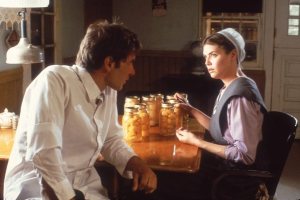
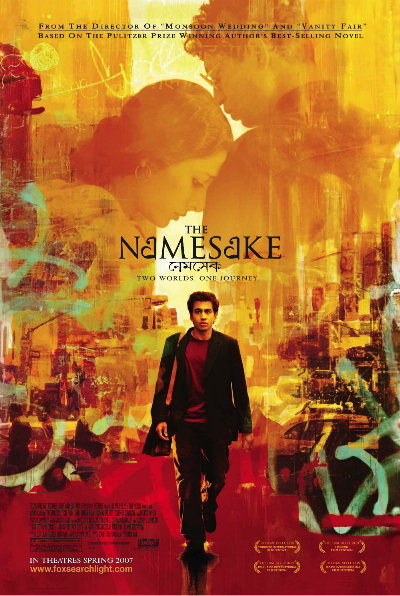
The Namesake (2006, DVD): Movie Review

This is a sequel to my last post, Book Review of The Namesake by Jhumpa Lahiri.  These back-to-back write-ups form my second instalment for the Read the Book, See the Movie Challenge over at Ready When You Are, CB.

“If it weren’t for photography, I wouldn’t be a filmmaker.  Every film I make is fuelled by photographs…. Photographs have always helped me crystallize the visual style of the film I’m about to make.”

—Mira Nair

And photography has brought to life the poignant novel The Namesake.

This is a perfect match.  The Namesake film adaptation is privileged to be crafted in the hands of the accomplished director Mira Nair, and its screenplay written by the multi-talented Sooni Taraporevala.  Both born in India the same year, grew up and educated there, later both had attended Harvard.  After earning her Masters at NYU majoring in Film Theory and Criticism, Taraporevala moved back to India and pursued a successful career in photography and other artistic endeavours. Mira Nair went on to become an acclaimed filmmaker and professor of Film at Columbia University.  Nair and Taraporevala collaborated on several films that have garnered international nominations and awards, including Cannes, Venice, BAFTA, and the Oscars.

The pair could have been characters taken right out of Jhumpa Lahiri’s stories.  They must have known from personal experience the realities of Lahiri’s stories, the feelings of being transplanted, the quest for identity.  As a result, they have effectively brought into visualization the internal worlds of Ashoke, Ashima, Gogol and Moushumi.  It is interesting to hear Nair describe herself as “a person who lives in many worlds”.  Every immigrant is at least a bicultural being.  Our postmodern world has only made it more and more viable to navigate across boundaries and sustain multiple identities.  The Indian meaning of the name Ashima could well have spoken to such a modern day phenomenon: without borders.

From this perspective, Nair is the best person then to take what could have been just another “ethnic movie” to a universal plane.  She has created a colorful rendition of a human story for us to enjoy.  You don’t have to be Bengali to appreciate the Ganguli saga.  Elements such as love, marriage, parent-child relation, expectations, self-fulfilment and its obstacles, the search for one’s place in the family and the world, these are all situations we can relate to.   It’s just now the issues have been explored from a different frame, offering us an alternative perspective.

I have appreciated the quiet development of love between Ashoke and Ashima despite their arranged marriage.  Their intimate husband and wife relationship is sensitively played by Irrfan Khan (Slumdog Millionaire, 2008) and the model and award-winning actress Tabu, an excellent choice in casting.  I particularly admire Tabu’s gentle and elegant poise.  It’s interesting to see how the two exchange deep sentiments by wordless, nuanced expressions and body language.

The treatment of the story in the hands of a visual artist understandably would be quite different from its original literary form.  Instead of the sombre tone, Nair has given the story a lively adornment, sustained by animated characters.  Nair’s Gogol is a more outgoing young man than that from the book, and I’m fine with that.  Kudos to Kal Penn’s portrayal of  Gogol/Nick Ganguli, an interesting performance fusing youthful energy and wistfulness at the same time.

Yes, that’s Kal Penn of the stoner movies Harold and Kumar fame (2004, 2008, and coming 2011) A much more serious role here in The Namesake.  A lively Gogol is only natural and fun to watch, for he is an American born young man who just wants to belong.  So we see him being impatient with his father’s restrained and non-communicable composure, we see him playing air guitar to loud music in his room, we see tender moments when he teases his younger sister Sonia, or the natural comedic look on his face, culture shocked during his family trip back to Calcutta, and we see his romance with Maxine (Jacinda Barrett, New York, I Love You, 2009), the American girl who is so oblivious to the cultural baggage he is carrying.

But Kal Penn has earned his role.  He wrote to Nair earnestly seeking for the part, telling her that The Namesake is his favorite book and often times, he would use the pseudonym Gogol Ganguli to check in hotels.  Some method acting, who’d have known he’s in character all along.

The bonus with watching a DVD is of course the special features.  The Namesake is a keeper if you’re into the creative process of filmmaking.  My favorite featurette is The Anatomy of The Namesake: A Class at Columbia University’s Graduate Film School in which Nair and other crew members engage in conversation with film students about the making of the movie.  Other wonderful featurettes include Photography as Inspiration, and Fox Movie Channel interview In Character with Kal Penn.

Overall, a faithful adaptation of Lahiri’s book, offering an entertaining, visually inspiring rendition of a story deserving to be seen.

~ ~ ~ Ripples

Bath’s Persuasion

Solution to Arti’s Cryptic Challenge #2:  Bath

From London’s Paddington Station we took the 90 minute train ride to Bath Spa, saving us half the time than with the bus.  The City of Bath is a UNESCO World Heritage Site.  Its magnificent Roman Baths and stylish Georgian streets and architecture make this a wonderful gem for tourists.  The first time I visited there was in December, 2007. For a more general overview of the beauty of Bath you can find my two previous posts here and here.

In this revisit, I was a more intentional traveller.  I let Austen’s Persuasion be my guide.  With a detailed street map of Bath in my hand, I went exploring the places mentioned in the novel, coincidentally, many of them I missed in my last visit.

“I was not so much changed…” was Anne Elliot’s words to Captain Wentworth upon seeing him eight years after turning him down.  The termination of their relationship was not her own intention, but duty had driven her to yield to Lady Russell’s persuasion.  It would have been a “throw-away” for Anne at 19 to engage with “a young man who had nothing but himself to recommend him, and no hopes of attaining affluence, … uncertain profession, and no connections.” (p. 20)

But the star-crossed lovers are granted the bliss of a second chance, and rightly grab it this time.  Austen’s setting of Bath in the book is no coincidence.  The Georgian City was the centre of fashion and the epitome of genteel society, a hotbed of social phenom for the critic and satirist in Austen.  Jane had lived in Bath herself for four years, 1801 – 1805, with her sister Cassandra and their parents.  Ironically, she was unpersuaded by its attractions according to her biographer Claire Tomalin.

Austen aptly uses Bath’s addresses for the purpose of her characterization.  Geographical location is everything in a class-conscious society, as Keiko Parker’s excellent article Jane Austen’s Use of Bath in Persuasion points out.

First off,  there’s the Pump Room, where in Jane Austen’s days people socialized and met one another, gathered to drink the therapeutic water, catch the latest fashion, simply to see and be seen.  The magnificent structure and decor makes The Pump Room a fine restaurant now:

Despite its grand decor, the areas around the baths are residences for the common folks in Austen’s time.  Mrs. Smith, the poor, infirmed widow with whom Anne maintains a loyal friendship, lives in the Westgate Buildings close to the Baths.  Anne becomes a laughing stock for the snobbish Sir Walter when he hears of her least favourite daughter is determined to visit Mrs. Smith instead of accepting an invitation to Lady Dalrymple’s, someone belonging to the upper echelon of society:

“Miss Anne Elliot, you have the most extraordinary taste! Everything that revolts other people, low company, paltry rooms, foul air, disgusting associations, are inviting to you.” (p. 113)

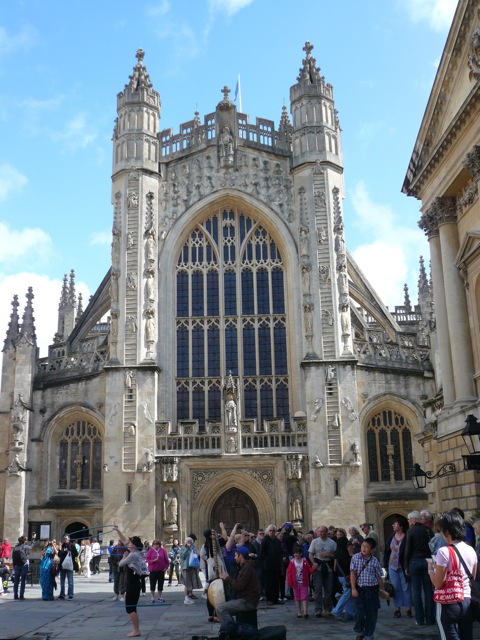
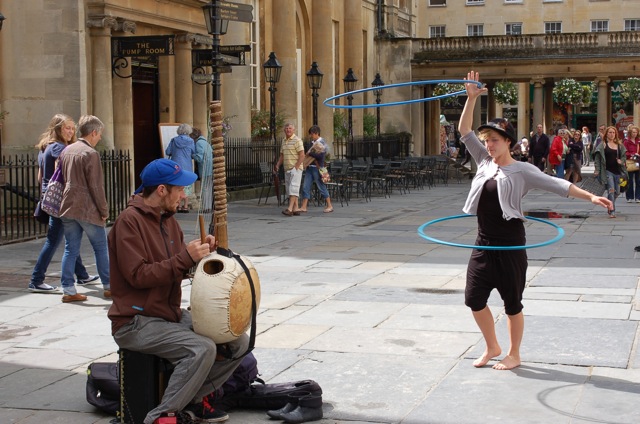
Today, the open area outside the Pump Room by the Roman Baths is perhaps the most popular tourist gathering place. Tour buses stop at the Bath Abbey for pick up and drop off, buskers perform in the open space outside the Roman Baths and Pump Room:

.

Nearby is Sally Lunn’s Bun, originated in 1680 by a young French refugee, in the oldest house of Bath, ca. 1482.  Now a restaurant on top with the cellar a museum that houses the original kitchen and cookwares, Sally Lunn’s serves this traditional creation: a large, soft, round bun that can go with just about anything.  But probably best like this, simply with garlic butter:


The beautiful street corner outside Sally Lunn’s:
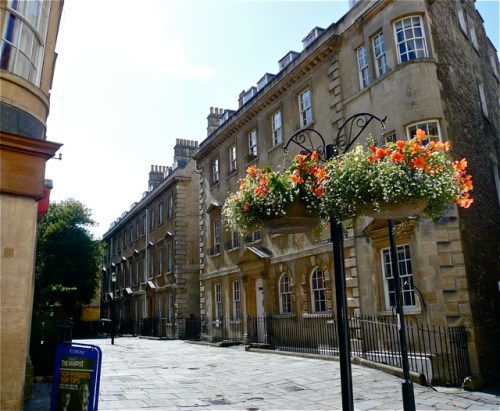
.

Further up the town, there’s Milsom Street, a vibrant commercial area of shops and businesses.  The first time Anne saw Captain Wentworth again in Bath was on Milsom Street.  Here’s a present day view of the same site:
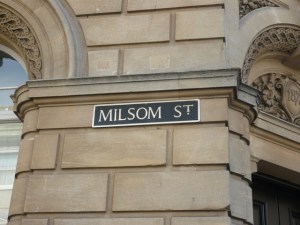
.

.

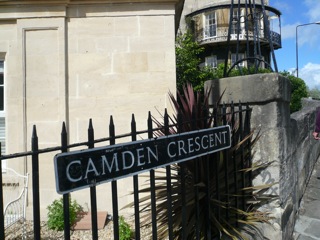
As for Sir Walter himself, despite having to rent out his country mansion Kellynch Hall to avoid financial ruins, he has no intention that his retreat to Bath should compromise his status and comfort.  It’s only natural that others are curious: “What part of Bath do you think they’ll settle in?”  The answer is quite obvious:  the part that is befitting their social standing.  According to Keiko Parker’s insightful article, physical elevation in Bath directly corresponds to social standing.  The highest point at that time would have to be Camden Place, which is today’s Camden Crescent.  While I was looking for it,  the ‘Ye Old Farmhouse Pub’ was mentioned to me as the marker.  I was glad to find it while walking up Landsdown Road, for it was indeed quite an uphill walk.

.

.

“Sir Walter had taken a very good house in Camden Place, a lofty, dignified situation, such as becomes a man of consequence; and both he and Elizabeth were settled there, much to their satisfaction.

Anne entered it with a sinking heart, anticipating an imprisonment of many months…” (p. 98)

Just typical Austen, the overt contrast of characters using something indirect, here, the sense of place.

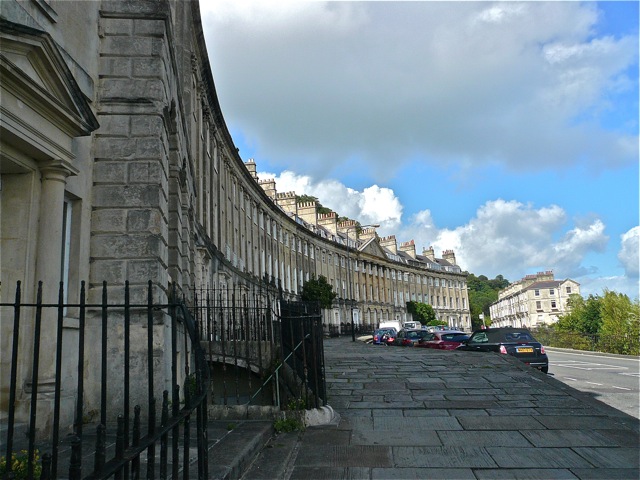
The houses on Camden Crescent has unobstructive view of lower Bath.  They are not grand mansions, but then again, location is everything.  The following are some of the houses found on this road across from the escarpment:

.

And where do Sir Walter’s tenants Admiral and Mrs. Croft lodge during their short stay in Bath?  On Gay Street, not too high, not too low: “… perfectly to Sir Walter’s satisfaction.  He was not at all ashamed of the acquaintance, and did, in fact, think and talk a great deal more about the Admiral than the Admiral ever thought or talked about him.” (p. 121)

Elizabeth is not even half as kind as her vain and snobbish father.  Regarding the Crofts’ arrival in Bath, she suggests to Sir Walter that “We had better leave the Crofts to find their own level.” (p. 120)

In contrast, Anne has a good impression of the Admiral and his dear wife, the kind and down-to-earth couple, Mrs. Croft being the sister of Captain Wentworth having minimal bearing on Anne’s fondness of them. During their sojourn in Bath to mend a gouty Admiral Croft, Anne enjoys watching them strolling together, “it was a most attractive picture of happiness to her.” (p. 121)

So I’m just not a bit surprised to see their temporary lodging in Bath being on Gay Street.  Who else had lived there?  Jane Austen herself: #25 to be exact:
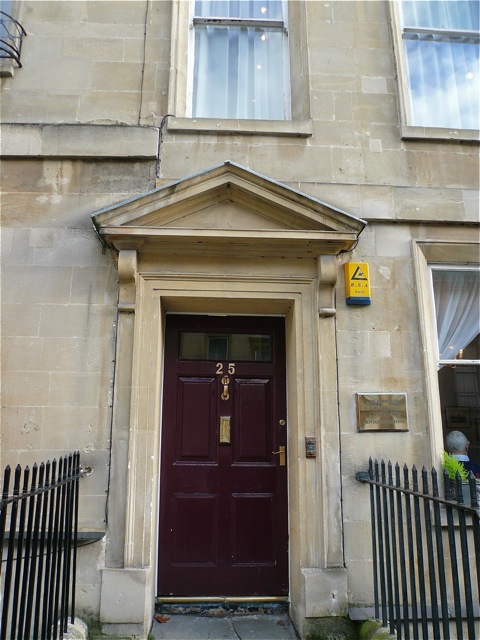
.

As for a suitable place for socializing, Sir Walter and his favourite daughter Elizabeth choose the Upper Assembly Rooms, a much newer development closer to their upper, more fashionable side of town, although he would prefer entertaining in private which is even more prestigious.

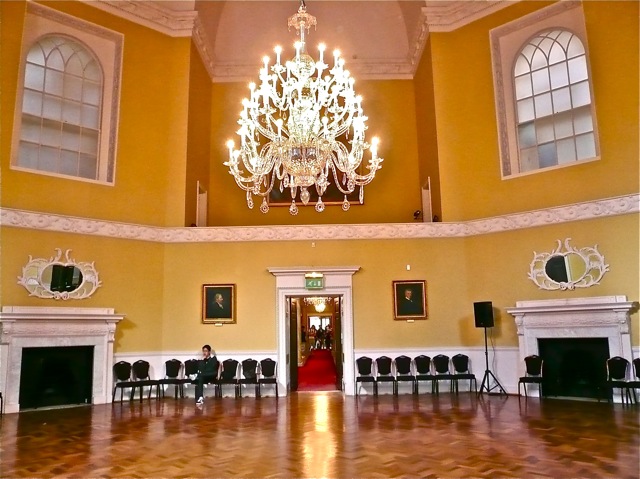
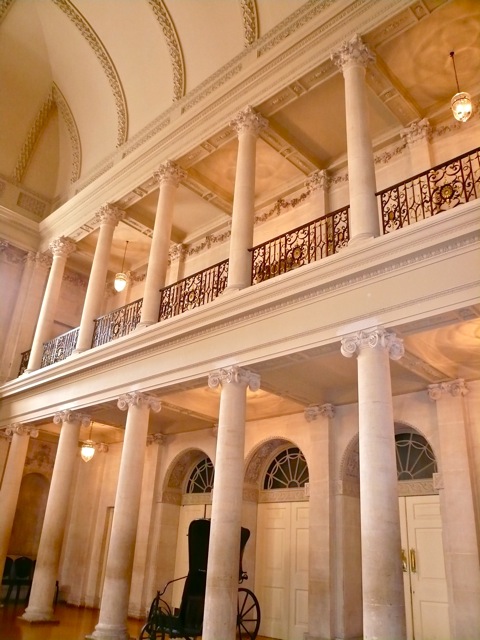
The Assembly Rooms are a magnificent architectural legacy in their own rights.  Designed by John Wood the Younger, who raised the £20,000 needed for the venture, the ground-breaking project began in 1769 and opened for public use in 1771.  It was the biggest investment in a single building in 18th Century Bath. Four public rooms made up the suite:  The Octagon, Ball Room, Card Room, and Tea Room.

“Sir Walter, his two daughters, and Mrs, Clay, were the earliest of all their party at the rooms in the evening; and as Lady Dalrymple must be waited for, they took their station by one of the fires in the Octagon Room (p. 131).

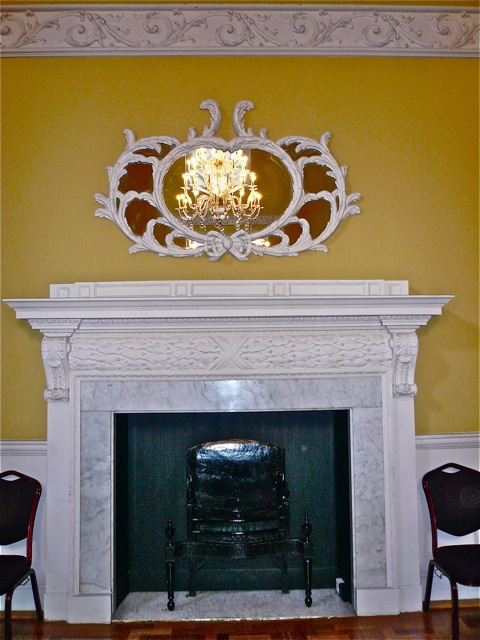
Here’s the exquisite Octagon Room:

Regarding the chandelier, there’s this interesting account in The Authorised Guide (p.7):

“On 15 August 1771 Jonathan Collett quoted £400 for supplying five cut-glass chandeliers for the Ball Room.  They were up in time for the opening of the Rooms in September, but the following month disaster struck when ‘one of the arms of the chandilers in the Ballroom fell down during the time the company was dancing, narrowly missing  Gainsborough.  What could be salvaged from the set was made up into a single chandelier, which now hangs in the Octagon.”

I was just simply amazed at how long these chandeliers had lasted, well over 300 years, and in excellent shape.  Their brilliance had not faded, evolving first from candlelight, then to gas, and now electric:

.

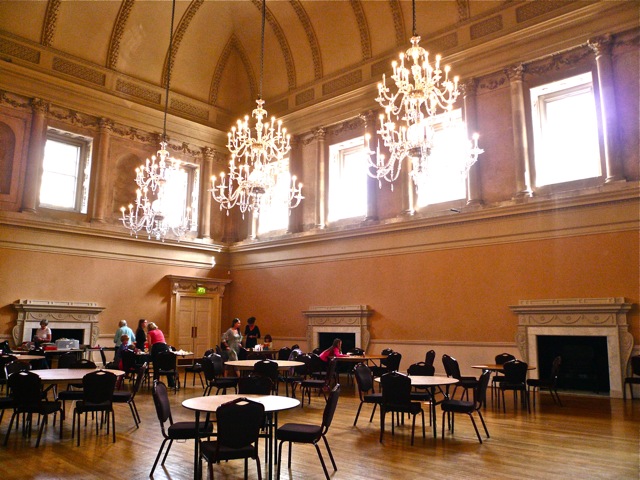
Anne and her party attend a music program in the Concert Hall.  That’s a function in the Tea Room.  Despite the name which seems to convey a small and cozy setting, the Tea Room is a gorgeous room of 60 ft. by 43 ft. dimension.  On one end is a magnificent colonnade of the Ionic order.  Subscription concerts are regular events held in the Tea Room. Mozart and Haydn had written compositions to be performed there, with Haydn himself having graced the magnificent venue.
.
.

But what does Anne Elliot think about all the grandeur?  After earlier in the Octagon Room talking with Captain Wentworth, who has openly expressed his long-held passion for her, Anne, overwhelmed by a great flood of euphoria, now walks into the Concert Room (Tea Room):

“Anne saw nothing, thought nothing of the brilliancy of the room.  Her happiness was from within.  Her eyes were bright, and her cheeks glowed; but she knew nothing about it.  She was thinking only of the last half hour…” (p. 134)

As a visitor to the historic venue, I was captivated by the well-maintained interior and its elegance, and presently amused and surprised to find this display in between two columns: The Chair, which is mentioned several times in Persuasion. The Bath Chair was invented right here in the Georgian City to transport the rich and the sick.  It could be steered by the passenger:

.

.

Jane might have noticed the frivolity and seen through the façade of high society of her time, and sharply depicted her observations in her brilliant novels, but as a modern day tourist and Janeite, I’m just amazed at how well history has been preserved, and that all these locations and life had been experienced by Jane herself. She might have the burden of society on her, which ironically had inspired and unleashed her talents, but for me, a present day tourist and reader of her works, I am totally persuaded that Bath is a place I will definitely revisit some more in the future.

***

All photos taken by Arti of Ripple Effects, August 2010.  All Rights Reserved.

References:

1. Jane Austen: A Life by Claire Tomalin, Penguin Books, 2000.

2.  Persuasion by Jane Austen, The Modern Library Classics, Introduction by Amy Bloom, Modern Library Paperback Edition, 2001.

3. The Authorised Guide: The Assembly Rooms, Bath. Published by the Heritage Services division of Bath and North East Somerset Council in association with the National Trust.  Written by Oliver Garnett and Patricia Dunlop.

4. “What Part of Bath Do You Think They Will Settle In?”: Jane Austen’s Use of Bath in Persuasion by Keiko Parker.  Retrieved Online http://www.jasna.org/persuasions/printed/number23/parker.pdf
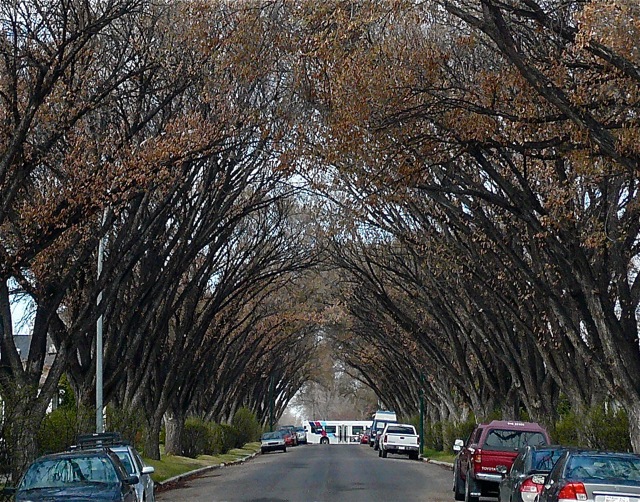
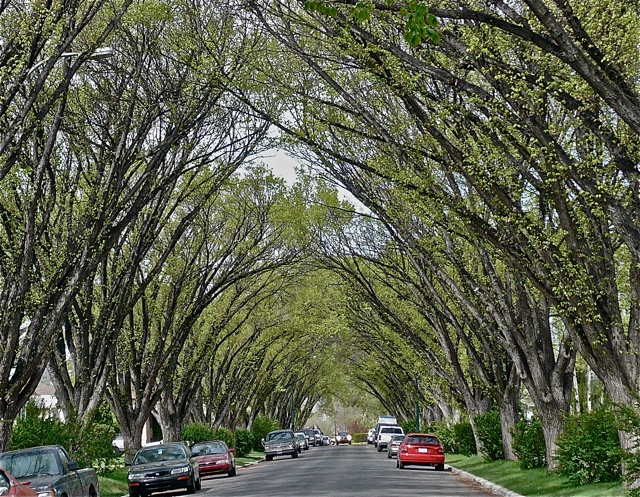
Greening of a Calgary Street

April 23

.

May 23

.

June 23

.

Waiting

He could have said
Let there be life
As in the beginning
But He made me wait.
For three months
I went back to the same spot
and watched
slowly
green bursting out from bare branches
fighting storms and snow
into full bloom.

.

I had waited before
Nine years, nine months
He could have said
Let there be…
But He had made me wait
and watch
slowly
like time-lapse photography
the gestation of a miracle.
He could have just said,
But He made me wait
and watch.

***

Pictures and poem by Arti of Ripple Effects, June 2010.  ALL RIGHTS RESERVED.

That Was Then… This Is Now

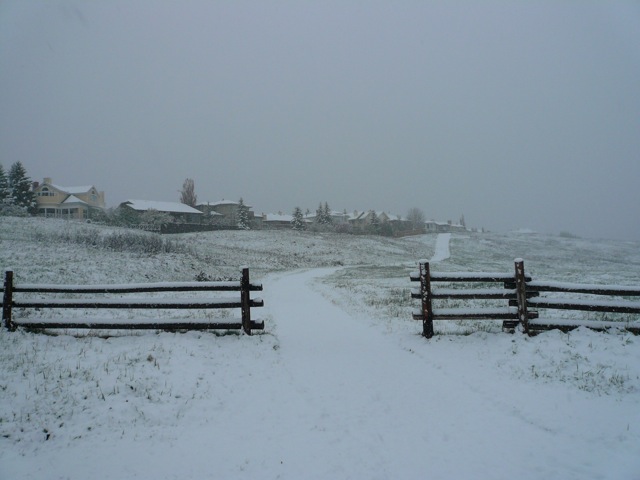
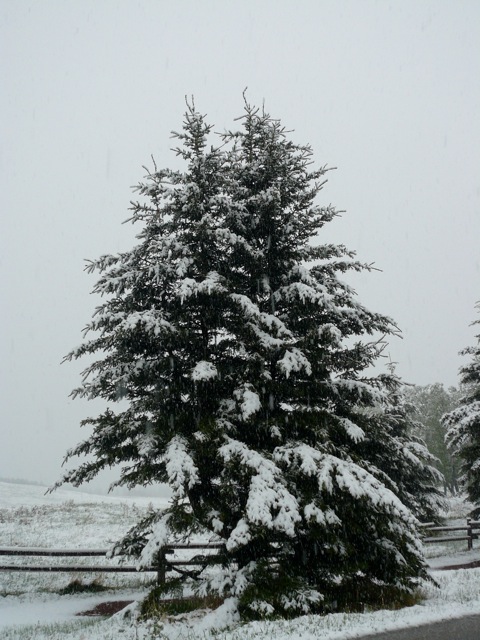
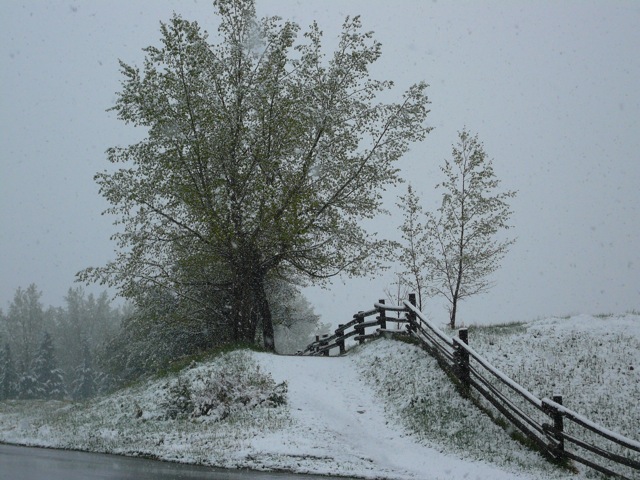
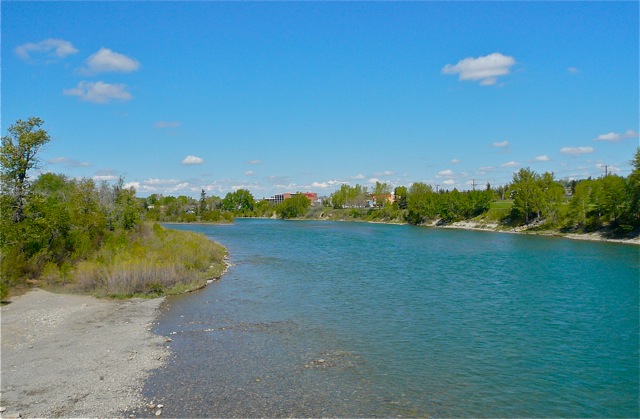
Just three days ago I was walking along The Bow River, enjoying the brilliant double-digit temperature.  Today is quite a different picture.  These are photos I took just a couple of hours ago, temperature hovering around 3 degrees C.  They were taken not too far from the deer sighting location on Mother’s Day. But today, May 27, three days after Victoria Day, the scene is another world.

As one who tries to preserve the most natural and authentic images, I’ve left the photos as they are, no adjustment, not even cropping here.  I like the blurry overtone, their lack of colors, for in reality, it was snowing heavily and the sky was grey.  I’d enjoyed this impromptu photo session.  I came home soaking wet.

But all this time I’ve been thinking about the oil spill down in the Mexican Gulf coast.  It’s one thing about snow in May for us, or even in July, or baseball-size hail in August, or the fierce blizzards in the winter, these we’ve learned to take as they come, knowing they’re ‘act of God’.

But, if something happens due to human errors or negligence, or which is preventable if more caution was paid, or less greed was involved, or political interests were laid aside, or more value placed on life, human or nature, then it’s a different matter.  Such are the times when we can’t be docilely yielding, as to a sovereign deity. Drastic measures are definitely needed in a time such as this.

No doubt, these pictures are thousands of miles from the Gulf coast, a huge gap in climate, a drastic difference in natural habitat.  Nonetheless, the air that once was in Chernobyl would ultimately reach us just the same as the tides from the tsunami of the Indian Ocean.  We’re shrouded by the same atmosphere; we’re linked by the same waters.  So, your pelican is also my pelican, likewise, my deer, your deer.

.

.

.

.

.

All photos taken by Arti of Ripple Effects, May 27, 2010.  ALL RIGHTS RESERVED.

****

A Victoria Day Walk

Today is Victoria Day, when we Canadians are indebted to Queen Victoria (1819-1901) for a nice, long weekend. For many, it marks the first camping trip of the year, a summer kick-off.  Ironically, it’s usually a weekend with overnight frost and even snow.   So the custom is, plant your garden only after Victoria Day.

To commemorate, I should be watching The Young Victoria.  But, for all these years, I haven’t done anything Victorian on this day.  I guess they did take long walks.  So, I took a stroll along the Bow River.  Just as the day, this is a leisurely post.  Here are some sights I captured, yes again, with my pocket camera.  They’re a bit more cheery than the Mother’s Day outing of the deer family.  What a difference two weeks can make.

The Bow River:

A single flowering tree:

Holiday or not, this is life:

Making a splash is way more fun, especially if you can’t swim:

Spring, summer… green or white, we’ll take what comes:

Photos taken by Arti of Ripple Effects on Victoria Day, 2010.  All Rights Reserved.

***

Mother’s Day Picnic

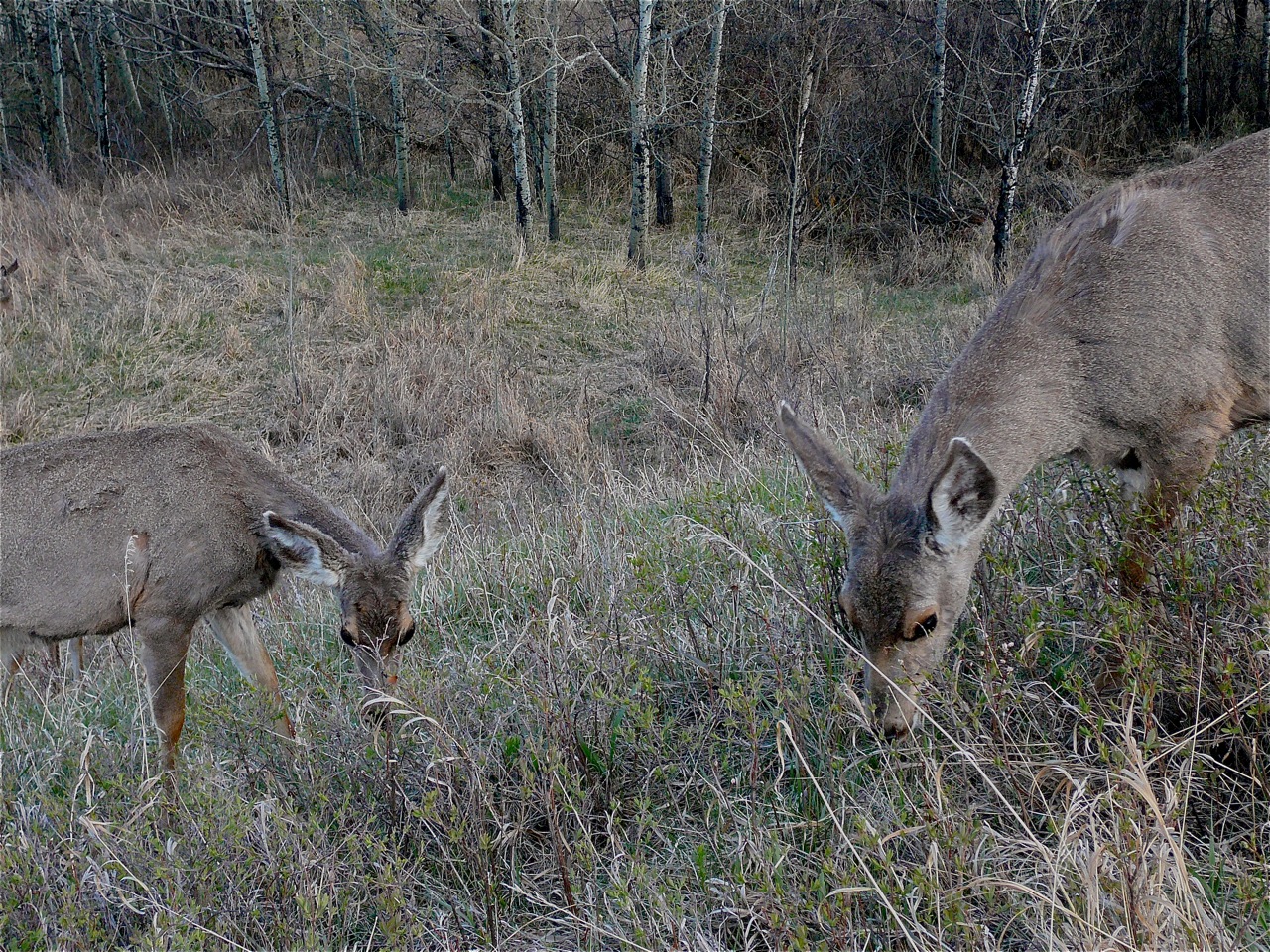
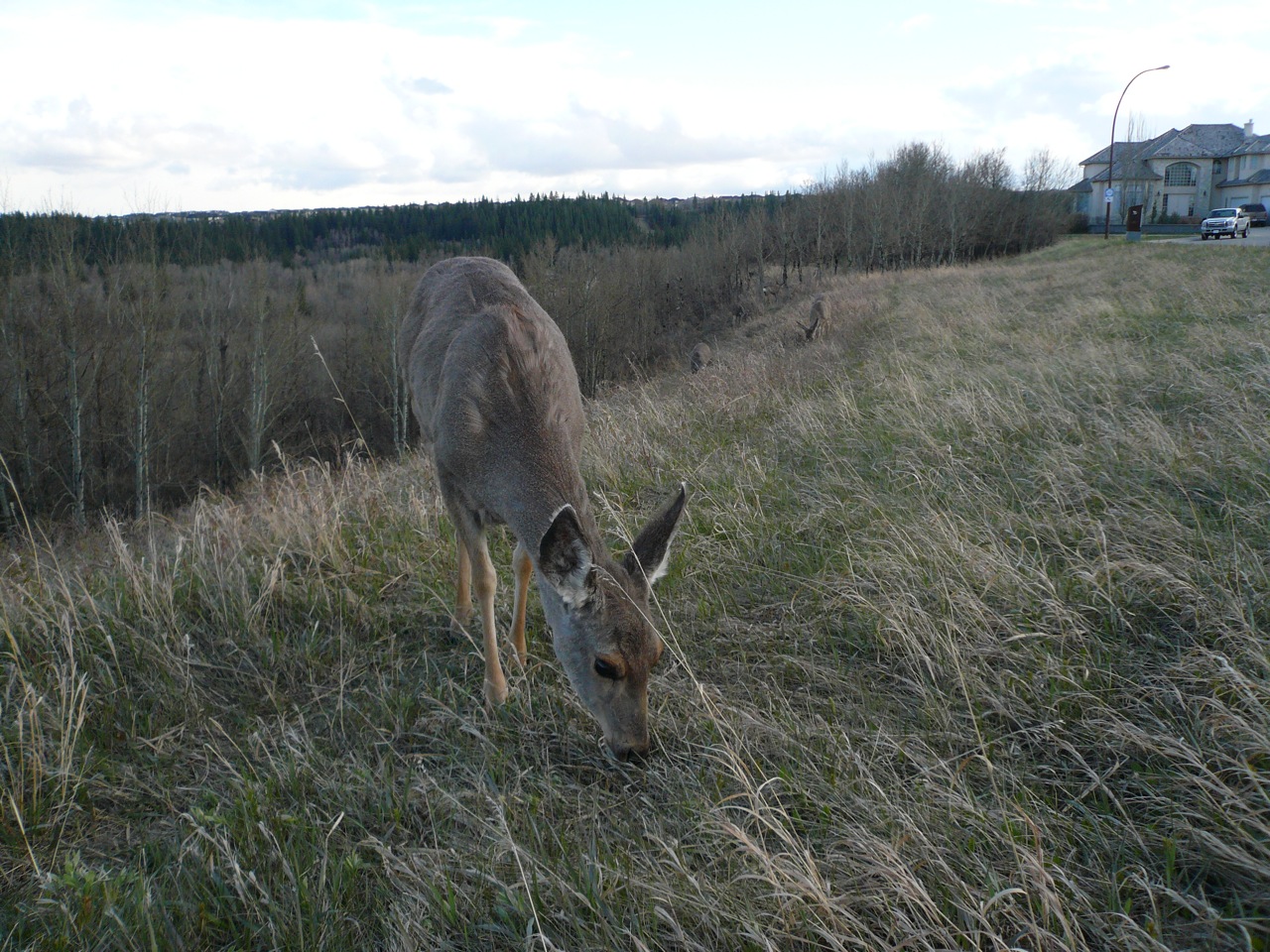
Here we are, our clan of extended family, out for a Mother’s Day picnic.  The weather’s just fine, though a bit chilly.  But for a May afternoon in Cowtown, we think it’s acceptable.

.

Well you got to eat out some time.  What better day than on Mother’s Day.  Why, our human neighbors have to cook… can smell their Bar-B-Q from far.  What a chore!   Wonder if it’s their Mom who has to clean up.  As for us, even though the grass is a bit dry, at least we don’t have to deal with all that trans fat and high sodium.

.

Wait, this is just too good to pass up.

.

And an evening stroll after dinner.  Ahh… Mother knows best.

.

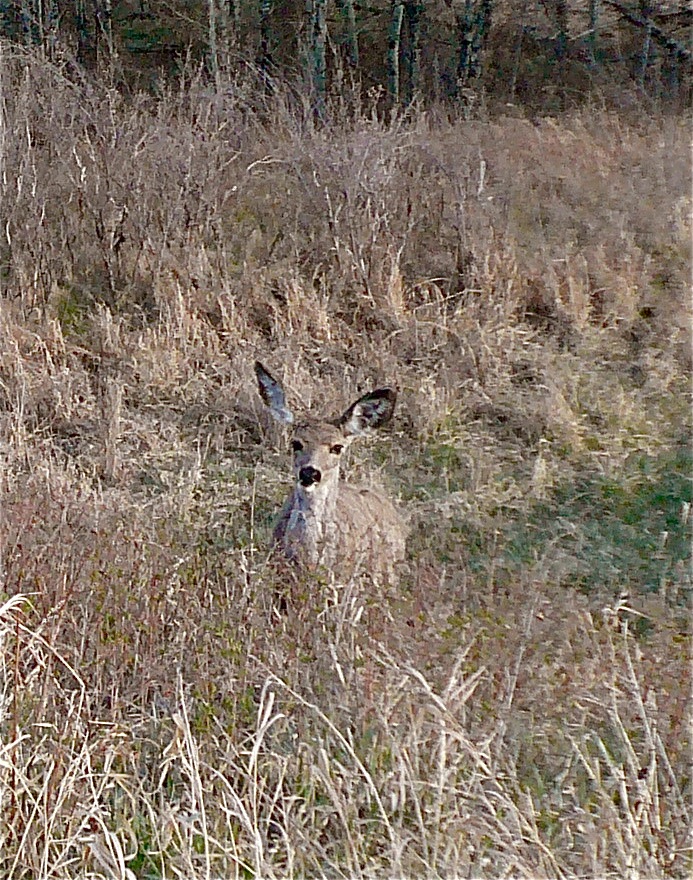
Hey, who’s that trying to take our pictures?  Haven’t you seen a deer family picnic before?  Oh right, not in your backyard… but, isn’t this our backyard?

*

A Note About the Photos:  Arti took them in her neck of the woods, the shared backyard with the Deer Family, on Mother’s Day, 2010.  All Rights Reserved.

***

The AGA Exhibits: Images In Sight And Sound

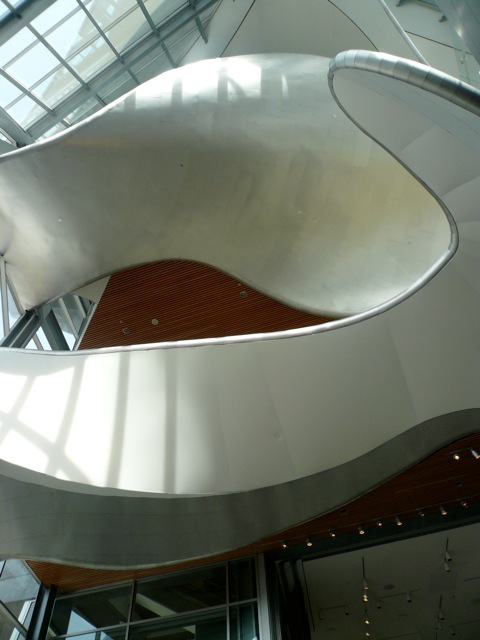
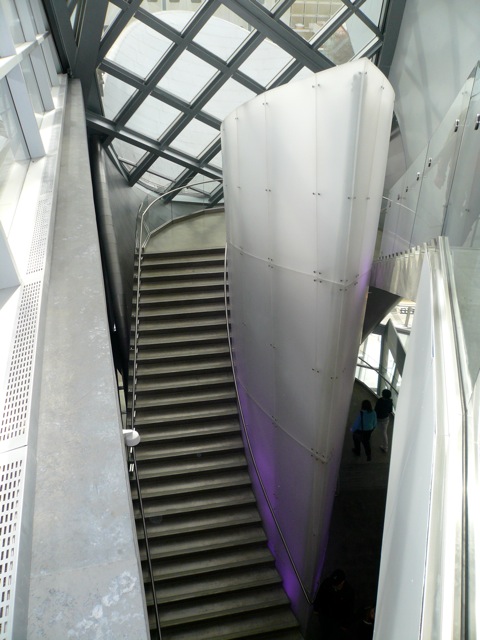
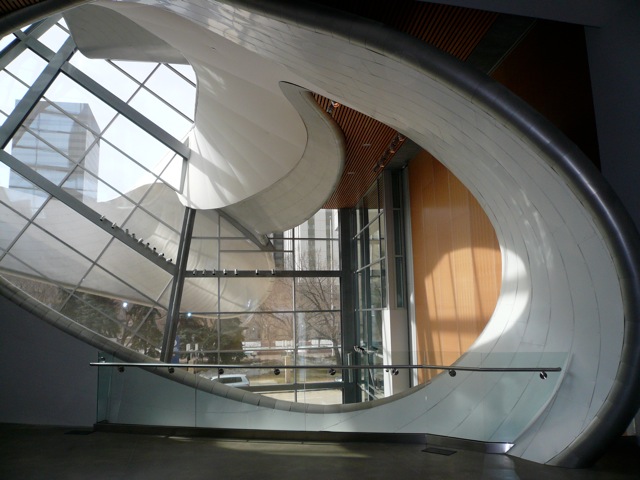
The AGA actually is a much smaller building than I expected.  But what’s appealing is the ubiquitous windows and glass allowing natural light to pour in, visually expanding the interior space.  The windows also make the surrounding downtown buildings visible from within, enhancing the sense of connection with the adjacent urban environs.  The exhibits are distributed among three floors of galleries.

Figures in Motion showcases 40 of Edgar Degas’ (1834-1917) bronze sculptures of dancers, bathers, and horses.  Juxtaposed in the exhibits are paintings, pastels, drawings, and prints of early photographs showing these figures in action.  The nuance of a single movement, as simple as the drying motion of bathers, can turn into a subject of grace and beauty under the sensitive eyes and expressive hands of the artist.

In contrast, Francisco Goya’s (1746-1828) etching prints suites Los Caprichos (1799) and The Disasters of War (1810-1820) are the realistic depiction of the ugliness and foibles of humanity.  A sharp social critic, his art mightier than the sword, Goya’s works expose unreservedly the horror of war and his critique of his time.

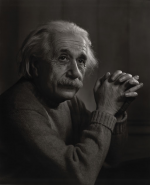
Up to the second floor I came face to face with the archetypal portraits by the renowned Canadian photographer Yousuf Karsh (1908-2002) in the exhibit Karsh: Image Maker.  We all must have seen some of his black and white portraits of famous people, somewhere.  The most well-known probably is Winston Churchill from whose mouth Karsh reportedly pulled out a cigar as he did his work.  Other famous portraits include that of Albert Einstein, Martin Luther King, Ernest Hemingway, Princess Elizabeth, Pablo Picasso, Andy Warhol, Alfred Hitchcock, Helen Keller, Grey Owl and numerous remarkable history makers.  I was totally absorbed as I walked by these meditative portraits of iconic personalities.

It seemed that the exhibits grew more interesting with every flight of stairs I stepped up.  The third floor offered an experience totally new to me.  As far as I can recall, this is the first sound installation mixed media art that I’ve encountered.  In a large, rectangular room occupying the whole floor, The Murder of Crows is installed.  Sound sculptors Janet Cardiff and George Miller have shown this work, their largest sound installation, in Australia, Germany and Brazil.  This is their North American premiere.

98 speakers are placed strategically and aesthetically in a large room, surrounding a table in the middle.  On the table is a megaphone.  Audience seats are grouped in the space encircled by the speakers.  The whole setting visually is a minimalist display.  The photo below is this installation in Berlin.  Even without the sound, the arrangement is an artistic presentation in itself.

But what we had at the AGA was a windowless room with dim lighting.  The added effects were even more haunting and claustrophobic.

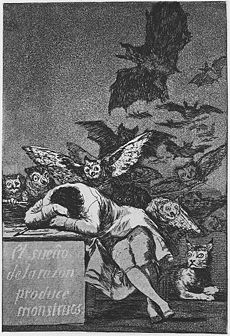
The 30 minutes sound presentation is a fusion of narrations, voices, footsteps, birds and bats, choral and orchestral music.  It evokes sequences of dreamscapes, and in part is an audio rendition of Goya’s etching The Sleep of Reason Produces Monsters in the Los Caprichos series (See image above).  The etching shows the artist himself asleep at his desk, with owls and bats hovering over him. The title divulges layers of meaning, prompting speculations of Goya’s actual thoughts.  The sleep of reason unleashes powerful imagination, even nightmares. Or, the erosion of reason led humanity into chaos and irrationality…

The phrase ‘the murder of crows’ refers to the collective gathering of the ominous birds, re-created here by the groupings of the 98 black speakers, some mounted on stands, some placed on chairs.  The very title and the effects made me feel like I was in the middle of the Hitchcock movie The Birds.  The sound was so riveting that I was glued to my seat in suspense… and the music from the massive choir and orchestra was both amazing and disturbing.  Click here to watch a 5-minute video clip of the sound installation. Click here to read an interview with Cardiff and Miller.

The AGA is not a big structure, but what is offered inside spans the artistic expressions separated by a chasm of time, form, and style.  From Goya’s disturbing etchings to the graceful renditions of Degas’ dancers, to the photographic images of iconic personalities captured by Karsh, and to end with the haunting sound installation The Murder of Crows, the exhibits were rains of pebbles into this quiet pond of thoughts… something I had not anticipated at the start of the trip.

Photography was not allowed in the galleries, so I cannot post any authentic visual experience here.  The above images are from the following sources:

Degas’ bronze sculpture Little Dancer and Karsh’s portrait of Albert Einstein from AGA website http://youraga.ca/current

Goya’s The Sleep of Reason Produces Monsters from Wikipedia Commons

The Murder of Crows sound installation from Cardiff and Miller’s website  http://www.cardiffmiller.com/artworks/inst/murder_of_crows.html

***

Art Gallery of Alberta

Drove up to Edmonton to take in the new Art Gallery of Alberta.  My first impression when I looked at the promotional materials was its similarity to a Frank Gehry like the Disney Concert Hall in L.A. and the Peter B. Lewis Building on the Case Western Reserve University campus.

A look at it in real life confirmed my thought, it sure was a Gehry style architecture.  A little googling later led me to the information that its architect Randall Stout used to work at Frank Gehry’s studio.  CLICK HERE for an extensive interview of Randall Stout and some spectacular images of his portfolio.

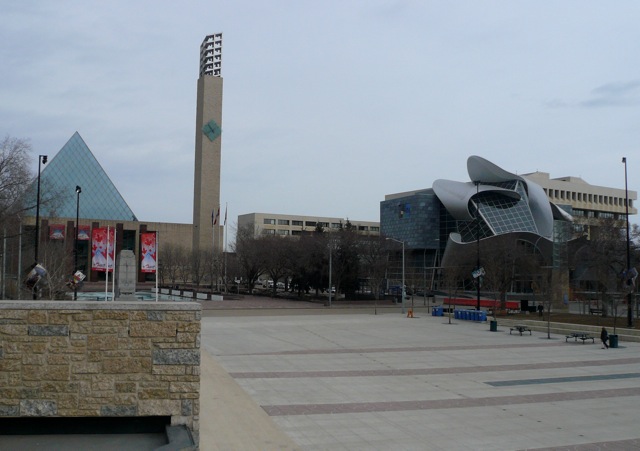
I don’t have any sophisticated photo software to take out the traffic lights and the sewage repair work underway, so the following picture shows the real life street scene of the remarkable structure at its most authentic.  But for some sparkling clear views and a detailed description of the architecture, CLICK HERE.

And here are some pictures of the inside, like the above, were taken by my little Panasonic Lumix pocket camera, no touch-up or editing:

.

.

.

The AGA is situated adjacent the Sir Winston Churchill Square in downtown Edmonton, a public open space linking the City Hall with the arts:

The Winspear Centre, home of the Edmonton Symphony is just across from the Square:

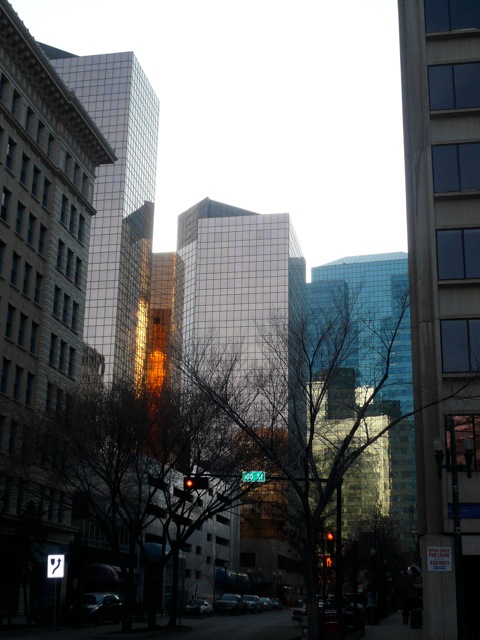
To finish off my day visit, I saw this colourful reflection of the slowly setting sun on the downtown buildings:

.

Of course, I didn’t drive three hours from Calgary just see the the architecture, but the exhibits.  And that has to be another post.

Photos taken by Arti of Ripple Effects, March 2010.
All Rights Reserved

Alberta Bound

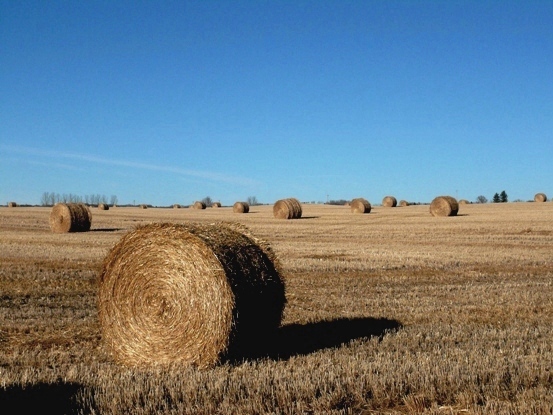
Autumn in rural Alberta is immensity amplified.  Big sky and expanse of farmland is the main scenery, something what W. O. Mitchell describes as “the least common denominator of nature… land and sky.”

The air is crisp, fresh, and dry.  Colors are simple:  Big blue sky, golden harvest, even just hay rolled up in bales.  Farming against the snow-capped Rockies, rustic, serene, rejuvenating, harmonious fusion of nature and human endeavor.

Trees as windbreaks in the summer, nature’s sculpture in the fall.  So the leaves are gone, but only then can we see the beauty of the bare branches, like dancers celebrating the changing of the seasons.

The solitary figure in the field… en masse.

“Think I’ll go out to Alberta,
Weather’s good there in the fall.
Got some friends that I can go to working for…”

For some inexplicable reasons, as I’m posting these photos, a flood of nostalgia whirls up in me.  The melodies and lyrics of those songs and singers that we can claim our own keep filling my mind all day. Not too many up-and-coming like to hang around here, since all the fame and glory one seeks is down south.

But these remain our own: Gordon Lightfoot, Ian and Sylvia Tyson, Neil Young… and songs about Alberta, about heading west to seek a new life, or to escape from the pain of lost love.  Maybe the wide open country, big blue sky and wide expanse of land do have their healing powers.

And memories, forever clear, keep us rooted… here’s home.

****

Photos taken by Arti of Ripple Effects, November, 09.  All Rights Reserved.

Alaska!

Arti disappeared from Cowtown for a few days and reappeared in Ketchikan, Alaska.  That’s the cause for the delay in replying some of your comments from the last post.  I decided to rid myself of all internet and phone access so I could make these short few days a real getaway.

But herein lies the nagging dilemma:  Is there a better way to access nature other than the commercial route?  Arti had to follow the crowd and board a cruise ship, not her choice of transport, but … what are the options?

So here it is, a visual account of my journey at sea to Ketchikan, the south-western tip of Alaska, north of Vancouver, British Columbia, Canada.

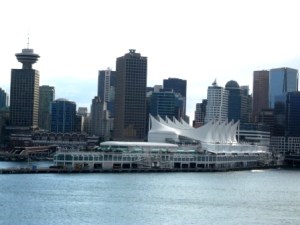
We set sail at the Canada Place Terminal.  On deck looking out, Port Vancouver’s famous architectural sails look slightly surreal, a virtual outdoor gallery of sculptures larger than life:

Canada Place View from Deck

Leaving Port Vancouver:

Leaving Port of Vancouver

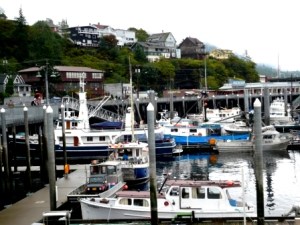
After a couple of days at sea, we arrived at Ketchikan, Alaska.  Among  other things like being the salmon capital of the world, Ketchikan is famous for its rain, measuring its precipitation in feet, not inches.

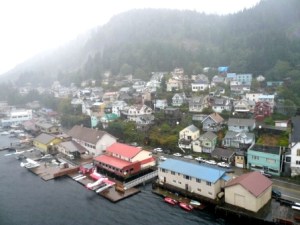
Here’s Ketchikan under overcast sky:

Ketchikan under overcast sky

A little  more cheery scene:

Ketchikan, Alaska

Ketchikan is also home to The Tongass Rain Forest, the largest national forest in the United States.  It is part of the Pacific Temperate Rain Forest Region, which is second in size to the world’s largest Amazon Tropical Rain Forest.

Moss on treesArti ventured into this area with a naturalist. Together with 15 others in our group, we trod the trails of the Alaska Rain Forest Sanctuary.  Here are the sights I’ve sailed all the way for:

.

.

.

.

.

Berries UndergrowthColorful undergrowth

.

.

.

MushroomOne of the many species of mushrooms, some giant ones grow on trees.

.

.

Devil's Paw Food for the BearsDevil’s Paw, food for the bears.  Underneath are poisonous hooks, but the bears deftly eat off the stems of the plant.
.

.

Ferns and mossFerns and moss: Even tree branches are covered with moss.  As the branches grow heavier, they will break off the tree, fulfilling a natural pruning process.
.

.

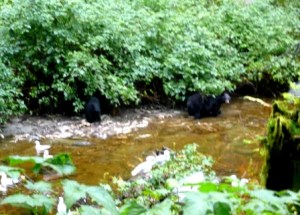
Momentarily, we came to a creek.  Yes, salmon swam up here: Right in the middle of a rain forest we saw gulls gathering, competing with the bears for the salmon in the water.  We were fortunate to see a mother bear with two cubs.  Here in this fuzzy (sorry, Arti was too excited) photo, you can see, even though ‘bearly’, the mother and one of her cubs on the left:

Bears having lunch

And this next one is out of this world.  Gulls flying all around above the creek, a magical, even mythical sight to behold:

Rainforest Gulls

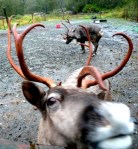
Reindeer

We next visited a reindeer farm.  I’ve seen elks and deers in my neck of the woods in Alberta, but this is the first time I saw reindeers.  Here’s a curious fella:

When we left Ketchikan, it was pouring rain:

Leaving Ketchikan in the rain

On our way back to Vancouver, we cruised through the Inside Passage.  It offered one of the most beautiful sights in the whole journey:

Sailing through the Inside Passage

.

Of course, it’s Arti’s nature to find ripples everywhere:

Ripples

.

Ripples 3

.

.

.

.

The Inside Passage at dusk, the silence punctuated only by the calls of gulls and frolicking dolphins splashing in and out of the quiet water.  Yes, I saw the synchronized dances of two dolphins jumping out of the water and diving back in, but it was just too impromptu to capture by my camera.

The Inside Passage at Dusk

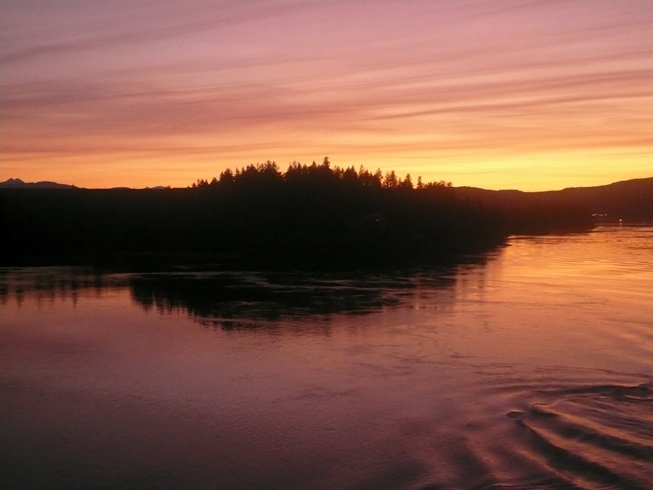
This is my best memory, sunset along the Inside Passage:

Sunset in the Inside Passage

*****

Photos taken by Arti of Ripple Effects, September, 09.  All Rights Reserved.

From Banff to Jasper

My cousin and her husband came to visit from Ohio.  They wanted to see ‘the most beautiful highway in the world’.  Not that I’m touting my own horn, but if they didn’t mention it I wouldn’t have known of such a claim.  That’s the stretch of roadway from Banff north to Jasper National Park here in Alberta.  Since I considered that part of the country my neck of the woods (relatively speaking), I was glad to take to the road with them as a guide.  Yes, I admit beauty may be subjective, but I’m sure you’ll agree these are some of the most extraordinary sights one can behold.

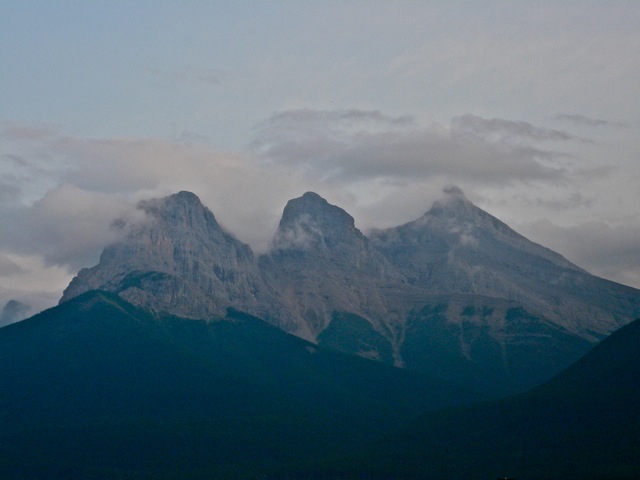
Canmore, Alberta, is the gateway to Banff National Park.  This little town hosted some of the ’88 Winter Olympics events at its Nordic Centre.  Here’s a view of the nearby Three Sisters Mountain at dusk when we arrived:

P1010421_2

From Canmore we headed to Banff National Park the next morning.  Despite the commercialized Banff Avenue, we could still get close to the wild near the Bow River. Elkie was so busy munching his lunch that he seemed oblivious to his human intruders:

P1010403_2

P1010414_3

From Banff, we continued on the Trans Canada Highway to Lake Louise and Moraine Lake. If you happen to have an old Canadian twenty-dollar bill, take a look at the back of it.  Here’s the real thing, Moraine Lake:

P1010472_2

From Moraine Lake, we headed north on highway 93, the Icefields Parkway, towards Jasper National Park. This stretch of the road offered some of the most beautiful sceneries in the world.

Bow Lake at the bottom of glaciated mountains.  The beautiful emerald color is the result of rock flour, moraines grounded to fine powder suspended in the water:

P1010465_2

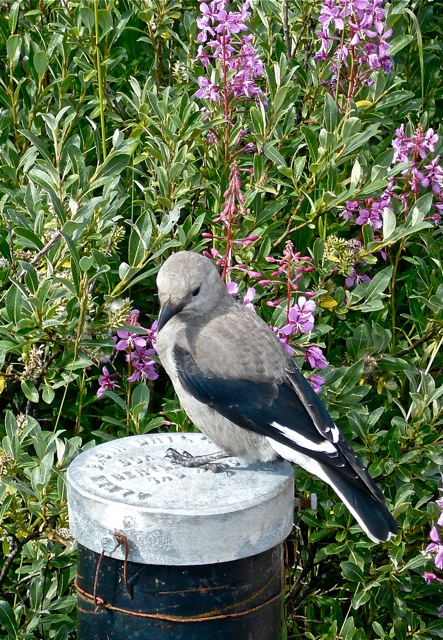
The Clark’s Nutcracker is a common bird in the area, among wildflowers by the glacier water:

P1010468_2_2

P1010457_2

.

.

The serene Waterfowl Lake:

P1010454

After a couple of hours drive, we entered Jasper National Park.  The major attraction as soon as we entered was the Columbia Icefields, the largest body of ice in the Rocky Mountains.  It spans 325 sq. km (130 sq. miles),  with an estimated depth of 365 m. (1,200 ft.)  Elevation averages 3,000 m. (10,000 ft.)

Mount Andromeda:

P1010430_3

The Athabasca Glacier spans an area of 6 sq. km (2.5 sq. mi), with a depth of 90 – 300 m. (270 – 1000 ft.) Its elevation about 2700 m (8900 ft).  Yes, there we were, in the middle of August in our summer clothes, thousands of feet above sea level, walking on the remnant of the last ice age over 10,000 years ago.  Here’s the magnificent view:

P1010445_2

That was only the entrance of Jasper National Park, but more than we could fathom for our short excursion.

**

Header Picture:  Bow Lake, Banff National Park, Alberta, Canada.

All photos taken by Arti of Ripple Effects https://rippleeffects.wordpress.com August, 2009.  ALL RIGHTS RESERVED.

Inspired by Vermeer

I’m just having so much fun discovering the immense influence of Vermeer on his posterior that I must post some more.  Here are a few interesting samples that I’ve found.

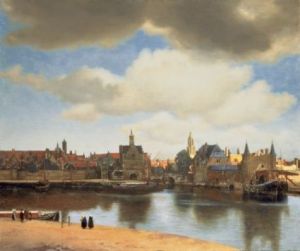
Holland has long been renowned for its natural light, and Vermeer has long been credited with his keen sensitivity in capturing that.  Here’s his View of Delft (ca. 1660),  which Marcel Proust called “the most beautiful painting in the world”:

Vermeer View of Delft

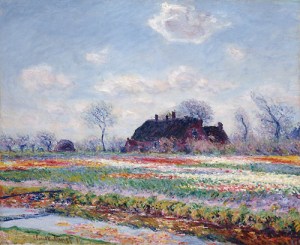
Visiting the Netherlands in 1886, Claude Monet adopted Vermeer’s point of view in observing the light of Holland in his painting of tulip fields and a farmhouse near Leiden:

Monet Tulip Fields near Leiden, Netherlands

**

Look at this famous Vermeer painting entitled Woman in Blue (ca. 1663):

Vermeer Woman in Blue

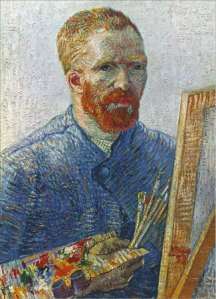
Van Gogh commented in 1888 on the exquisite artistry of Vermeer’s colors in the painting, “…blue, lemon-yellow, pearl-gray, black and white… the whole gamut of colors.”   He must have really liked Vermeer’s palette:

Van Gogh Self Portrait at Easel

**

Vermeer loved his subjects by the window.  Here’s another well known painting Girl Reading A Letter At An Open Window (1658), and below, Salvador Dali’s parody, homage, to Vermeer’s signature pose entitled Disappearing Image (1938).  Like Hitchcock, Dali liked to put himself in the picture:

Vermeer Girl Reading A Letter By The Window

Dali The Image Disappears

Tom Hunter Woman Reading A Possession Order

Now here’s a more contemporary example.  UK artist Tom Hunter, the first photographer to have a one-man show at the National Gallery of London, won the Kobal Photographic Portrait Award in 1998 with this poignant picture of a squatter, entitled Woman Reading a Possession Letter:

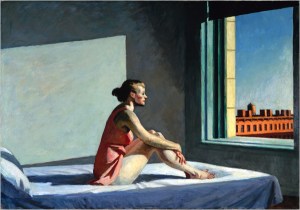
How about this from American realist painter Edward Hopper, Morning Sun (1952):

Edward Hopper Morning Sun

(For more Edward Hopper, Click Here.)

**

Director Peter Weir has created some ‘Vermeer scenes’ in his highly acclaimed 1985 movie ‘Witness’, with Harrison Ford and Kelly McGillis.  I can’t find pictures of the scene where the young Amish woman Rachel Lapp (McGillis) tending the wounded detective John Book (Ford) in the attic of her Amish house.  That is signature Vermeer.  But this one by the window can give you a glimpse.  Look at the contrast between the light and shadow on the two characters, the innocent and cloistered Rachel Lapp and the street-smart and gun wielding John Book:

Witness Harrison Ford and Kelly McGillis

**

And last but not least, Vermeer’s inspiration on modern packaging and product design.  Click here to read more about it.

Vermeer inspired Dutch Chocolate Cream Liquer

****

Related Posts:

Vermeer in Vancouver: Noticing the Obvious

Girl With A Pearl Earring

Edward Hopper, William Safire: The Visual and the Word.

Arles: In the Steps of Van Gogh

The Letters of Van Gogh

***

Sources and links:  All Vermeer paintings, Click here to go to Essential VermeerClick here to Tom Hunter Website. Click here to Webmuseum for Edward Hopper. Click here to Van Gogh Gallery. Click here to Metmuseum for Monet’s Tulip Fields near Leiden.