Diary of a Country Priest: Film Adaptation (1951)

For me, the cinema is an exploration within. — Robert Bresson (1903-1999)

Robert Bresson is one of the most influential figures in French cinema. The acclaimed New Wave director Jean-Luc Godard once noted: “Robert Bresson is French cinema, as Dostoevsky is the Russian novel and Mozart is German music.”

I know, Austrians would say Mozart was Austrian. But this just shows his influence can cross borders. Same with Bresson, who is acclaimed as one of the forefathers of the French New Wave, even though his style is not experimental. The iconic Swedish director Ingmar Bergman had specifically cited Diary of a Country Priest as influence for his Winter Light.

Before Bresson adapted Diary of a Country Priest, two previous screenplays were attempted by others but turned down by the author Georges Bernanos himself. Bresson’s film was made after Bernanos died. Bernanos had nothing to worry about with Bresson’s interpretation, for the film is an almost literal and a worthy cinematic translation. It won the Prix Louis Delluc in France (best film of the year) and several international film awards. Bresson was given the Career Golden Lion at the 1989 Venice Film Festival.

That Bresson, a professed agnostic, would choose to adapt a work by the Catholic writer Bernanos shows the moving power and the universal appeal of the book. The parish of Ambricourt is a microcosm of the human world. The seemingly placid village hides a spiritually barren landscape and a cocoon of depravity. The young priest, an unwelcome alien, is captured cinematically as small and vulnerable, an apt depiction of how he feels within:
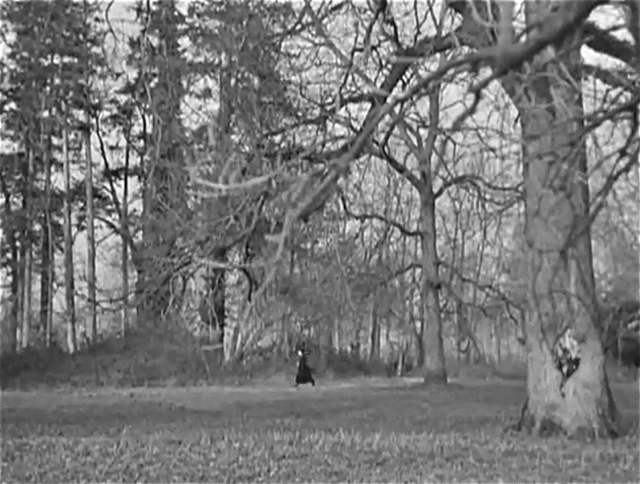
An outsider barred from a gated mansion of dark secrets, like here at the front gate of the Château.

The light comes into the world, but the darkness refuses it. On screen, we see the young priest often shut out of gates and windows. The glass pane allows him to be observed from the inside, yet he is very much on the outside isolated, the weight of the world heavy on his face.

Bresson’s style is minimal, you may find this film somewhat austere. But I’m gratified by such style, devoid of color and whatever additives we find in movies today. Instead, every frame conveys an aesthetic simplicity and thematic purpose.

To explore the drama within, Bresson chose ‘non-actors’. “As far as I can, I eliminate anything which may distract from interior drama,” Bresson was quoted saying, and distractions included ‘acting’. He selected his ‘models’ (as he called them, not ‘actors’) first for their voice. He particularly looked for inexperience. The young Curé of Ambricourt was Claude Laydu’s first film role. Others that Bresson used were often one-time actors just for the film he was making.
The Criterion Collection DVD has a most helpful commentary by film historian Peter Cowie. His insight is invaluable to the appreciation of Bresson’s adaptation. One of his remarks is the off-screen sounds we often hear in a scene. The most intense one would have to be the climatic spiritual battle between Mme la Comtesse and the young priest. Totally engulfed by grief, hatred and bitterness, and living in isolated misery all the years since her young son died, Mme la Comtesse finally releases her pain and receives blessings from the priest. And what sound do we hear off-screen the whole time they are engaged in this soul-piercing scene in the drawing room: the gardener’s raking of dead leaves.

Another source I’ve often sought out is the book written by Paul Schrader: Transcendental Style in Film: Ozu, Bresson, Dreyer. Yes, if I must choose a word to describe Bresson’s style, I would use Schrader’s term: transcendental. His minimal, aesthetically simple, ‘non-acting’ style raises the viewer to a meditative plane which is beyond the material, beyond all distractions. That’s the essence of cinema that I find so meaningful and gratifying.

And finally, despite succumbing to his illness, the young priest leaves a legacy that his superiors, the senior vicars, could not have: an embodiment of the suffering Christ and the redemptive power of grace. Despite his own frailty and ultimate death, the young country priest  triumphs through his faith, however feeble it may have seemed in his own eyes. It does not matter, for all is grace.

~ ~ ~ ~ Ripples

***
AND TO ALL, A HAPPY EASTER!
***
Other related posts on Ripple Effects:
.
.
.
.
***

Diary of A Country Priest: A Book for Easter

Every year around this time, I come back to my perennial read The Diary of A Country Priest by French author Georges Bernanos(Journal d’un curé de campagne, 1936). In this book, I find the essence of Easter.

A young preist comes to his first parish, the rural town of Ambricourt, full of humble ideals. All he wants is to serve the people, to give of himself, to bring God’s love. But as soon as he sets foot in the village, he is engulfed by hatred and rejection. There are dark secrets too sinister to be exposed. The young priest is an unwelcome alien. In a town afflicted by hypocrisy, pride, anger and bitterness, he is despised, taunted and ridiculed. His own innocence is no match even for the children in his catechism class, especially the precocious Seraphitas, a girl ‘with a hardness far beyond her years.’

Ambricourt is a world afflicted by the ‘leprosy of boredom’, a microcosm of the human condition. Bernanos uses diseases to illustrate his point well. The young priest himself is being slowly consumed by terminal illness. The pain in his stomach ultimately defeats his body, cancer. His diet consists mainly of bread dipped in wine which he makes for himself, and some potato soup. Poverty of means, but also frailty of body to take in solid food. Many a times we see him in the Garden of Gethsamane, pleading for strength in anguish. But he faithfully presses on, using his diary to confide his deepest thoughts, a means to commune with his God.

On the outskirt of Ambricourt is the Château of the powerful M. le Comte. The Count needs no priest to know about his adulterous affairs, this time, with the governess Mlle Louise. His wife Mme la Comtesse is totally absorbed by her long-held bitterness and grief from the loss of her young son. And his daughter Mlle Chantal is a deeply disturbed girl eaten up by anger and jealousy. Soon, she will be sent away to England, a most convenient plan devised by her father.

It is with this deep mess of a family that the young priest finds himself entangled. The most intense scene of the whole book, the climatic moment, comes when the priest goes to the Château to meet with Mme la Comtesse. She lost her beloved son when he was only eighteen months old, a child hated by his jealous older sister Chantal.

On his last day they went out for a walk together. When they came back my boy was dead.

Mme la Comtesse is fully engulfed by hatred for her daughter, grief for her lost son, and bitterness towards God.

Hearing her speak, a tear flows down the face of the young priest. “Hell is not to love any more, madame.” The young priest responds. And with miraculous strength, he delivers the following words.

… But you know that our God came to be among us. Shake your fist at Him, spit in His face, scourge Him, and finally crucify Him: what does it matter? It’s already been done to Him.

Towards the end of some soul piercing exchanges, Mme la Comtesse kneels down, releases her pain, and receives blessings from the young priest. Afterwards, she writes to him in a letter:

… I have lived in the most horrible solitude, alone with the desperate memory of a child. And it seems to me that another child has brought me to life again…

And this young child, a priest, consumed by illness, wreaked by frailty of spirit, can only marvel at the power through weakness:

Oh miracle — thus to be able to give what we ourselves do not possess, sweet miracle of our empty hands!

Not long after this, he succumbs to his illness. A life too short, a mission seems unaccomplished. But his last words faintly uttered on his deathbed are as powerful as the God who sends him:

Does it matter? Grace is everywhere…

And in the film, these three words leave me with one of the most impressive endings of all the films that I’ve seen:

“All is grace.”

 ***

~ ~ ~ ~ Ripples

CLICK HERE to read my film review of The Diary of a Country Priest.

The Diary of a Country Priest by Georges Bernanos, translated by Pamela Morris, Perseus Books Group, Philadelphia, PA, 1965, 298 pages.

Journal d’un curé de campagne, 1936, was winner of the Grand prix du roman de l’Académie française.

The Importance of Being Earnest by Oscar Wilde

To celebrate St. Patrick’s Day, I’d like to post my second selection for the Ireland Reading Challenge 2012, and raise a toast to Oscar Wilde for his LOL funny three-act play The Importance of Being Earnest.  

Though written in 1894, Wilde’s work is surprisingly modern. Subtitled “A Trivial Comedy for Serious People”, it is a mashup of mistaken identities, social satire, biting ironies, and one-liners worthy of our late-night talk shows.

You can finish the breezy eighty-some pages in one sitting, but don’t read it in public. You don’t want to be mistaken. To most people, only a lunatic would LOL alone without a bluetooth hanging on his ear.

Jack Worthing is in love with Gwendolen Fairfax of London, cousin of his friend Algernon Moncrieff. But obstacles abound for his courtship. As a country gentleman with many responsibilities, he has to create a wayward younger brother and town-dweller named Earnest as an excuse for him to go out to town for pleasure and to see Gwendolen. While in town, he has taken the name Earnest. Algernon, just the opposite, has to create an invalid Bunbury in the country for him to visit so he can meet and woo Jack’s ward Cecily, while pretending he is Earnest, Jack’s younger brother from London.

Locales may be a hindrance, their major obstacle is Lady Bracknell, Gwendolen’s mother and Algernon’s Aunt, a formidable and feisty gatekeeper of aristocratic matrimony.

With Downton Abbey’s dialogues still ringing in my ears (been re-watching the blu-rays perpetually since its Season 2 Finale on PBS) I can easily imagine the Dowager Countess of Grantham, Violet Crawley, uttering Lady Bracknell’s lines. Screening for Jack’s eligibility as a suitor for her daughter Gwendolen, Lady Bracknell conducts the following interview.

LADY BRACKNELL:  How old are you?

JACK:  Twenty-nine.

LADY BRACKNELL:  A very good age to be married at. I have always been of opinion that a man who desires to get married should know either everything or nothing. Which do you know?

JACK (after some hesitation):  I know nothing, Lady Bracknell.

LADY BRACKNELL:  I am pleased to hear it. I do not approve of anything that tampers with natural ignorance. Ignorance is like a delicate exotic fruit; touch it and the bloom is gone. The whole theory of modern education is radically unsound. Fortunately in England, at any rate, education produces no effect whatsoever…

LADY BRACKNELL:  Are your parents living?

JACK:  I have lost both my parents.

LADY BRACKNELL:  To lose one parent, Mr. Worthing, may be regarded as a misfortune; to lose both looks like carelessness.

JACK:  The fact is, Lady Bracknell … I don’t actually know who I am by birth. I was … well, I was found.

LADY BRACKNELL:  Found!

JACK:  The late Mr. Thomas Cardew, an old gentleman of a very charitable and kindly disposition, found me, and gave me the name of Worthing, because he happened to have a first-class ticket for Worthing in his pocket at the time. Worthing is a seaside resort.

LADY BRACKNELL:  Where did the charitable gentleman who had a first-class ticket for this seaside resort find you?

JACK (gravely):  In a hand-bag.

LADY BRACKNELL:  A hand-bag?

JACK (very seriously):  Yes, Lady Brakcnell. I was in a hand-bag—a somewhat large, black leather hand-bag, with handles to it—an ordinary hand-bag in fact.

LADY BRACKNELL:  In what locality did Mr. Thomas Cardew come across this ordinary hand-bag?

JACK:  In the cloak-room at Victoria Station. It was given to him in mistake for his own.

LADY BRACKNELL:  The cloak-room at Victoria Station?

JACK:  Yes. The Brighton line.

LADY BRACKNELL:  The line is immaterial. Mr. Worhting. I confess I feel somewhat bewildered by what you have just told me. To be born in a hand-bag, whether it had handles or not, seems to me to display a contempt for the ordinary decencies of family life…

And many more lines that would show you Wilde could have made one great Oscar host.

***

The Movie (2002, DVD)

I’ve got the DVD. It never fails to delight no matter how many times I re-watch it. Lady Brecknell is portrayed by Judi Dench, as proficient as any Dench performance, albeit a bit too severe here. But just as well, she’s a monster to Jack Worthing.

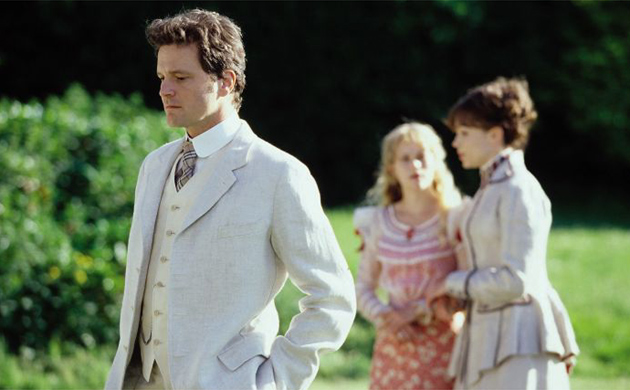
Jack is played by the ever talented Colin Firth. Dispelling the Mr. Darcy myth, Firth shows he can be one freewheeling comedic actor. Having seen many of his works, I find that with the right words to say, he can always deliver in style, even if he needs to stammer to get his words out.

Before Mamma Mia! (2008), Colin Firth had sung in a movie strumming a guitar, it is here. With Rupert Everett as the piano playing Algernon, the two come together in a duet to woo their love.

Frances O’Connor, who plays Fanny Price in Mansfield Park (1999), is Gwendolen, animated but much intimidated by her icily fierce mother Lady Brecknell. Reese Witherspoon is Cecily, Jack’s 18 year-old ward. The gals can easily call each other sisters if not for the mistaken identity of their love interest, Earnest. Thinking they are romantic rivals, the ladies are at each other’s throat as much as their genteel upbringing can allow, and  quickly become allies once the misunderstanding clears up.

Both Jack and Algernon are willing to go all out to have their names changed to Earnest via christening by the minister Dr. Chasuble, a role mastered easily by veteran actor Tom Wilkinson. Dr. Chasuble is a silent admirer of Cecily’s governess Miss Prism, played by Anna Massey with much comedic sense and timing.

At the end, Jack finds out his true parentage, realizes that he is more kin than kind to Algernon, and three matrimonies ensue, a happy ending Jane Austen would have approved. The movie adaptation is an enjoyable way to go through the play, not just with sight, sound and cinematic fun, but a delightful all-star cast.

Some tidbits: The film won a Best Costume Design award from Italy, and Reese Witherspoon was a nominee of the Teen Choice Award 2002. Looking at the cast today, we see 3 Oscar winners and 1 Oscar nominee.

As usual, the DVD carries special features like The Making Of and Behind the Scene featurettes, interviews with stars and crew, and audio commentary, always a valuable companion to the main feature.

~ ~ ~ Ripples

The Grey (2012): Of Wolves and Men

There are films that I expect to glean meaning from but leave me disappointed. And then there are those that do not appear to provoke thought at the outset and yet manage to do so, sending me out the theatre with gratified resonance. The Grey is one such film.

A plane carrying a group of Arctic oil-rig workers crash in the deep snow of the Alaskan wilderness. There are seven survivors. The task of leading them out of the crash site to seek safety falls on the shoulders of John Ottway (Liam Neeson). His job at the oil rig is security, a marksman protecting the workers from wild wolves. At the beginning of the film Ottway is shown to be suicidal, overwhelmed with grief from the recent passing of his wife. It is ironic to see at the end, he is propelled by courage to fight for his life.

In the cold expanse of Alaska, Ottway leads the surviving men to trudge through deep snow, trying to get to safety away from wolf territory. The men are pitted against each other, stranded at nature’s mercy, defenceless against a pack of carnivorous grey wolves. It’s a survival story, a suspense thriller that has me on the edge of my seat. But it goes further than that.

Director Joe Carnahan does not just show a group of roughnecks toughing it out in extreme condition, facing death at every turn. He brings to the forefront some existential queries, as one by one the men fall prey to the wild. Stripped to bare existence, how is man different from wolves? For what do we live? For what do we die? Such moments of ruminations are enhanced by Masanobu Takayanagi’s meditative cinematography.

As they leave the crash site, Ottway tells the survivors to collect all the wallets from the victims so they can contact their family, if they ever get back home. From the photos in their wallets, we get a glimpse of lives lived, and know that they have loved ones waiting. Following their treacherous path, we might sense that their outward skepticism masks a painful and silent hope for a transcending force, One who can save them from their fateful predicament.

The men don’t bond right away. The unruly, the scared acting tough. But extreme circumstances change them quickly. Sitting around a fire, they learn to cherish the memories they’ve had in their life, and begin to value each other. We know their fears. We listen to their stories. In one moving moment, Ottway shares a poem he remembers his Irish grandfather had written. Little does he know those words would become the fuel that catapults him to fight for his life at the end.

There’s something about Liam Neeson that stands out in a film. He embodies a kind of dignified charisma. But here in The Grey, it’s not just charisma, it is like poignant reality. The look on his face speaks volumes. In the film, he conjures up in his mind the wife he has loved and lost lying beside him. “Be brave,” he can hear her loving whisper. In real life, he just may be aching for the same, as his wife Natasha Richardson died after an accident in the snow three years ago.

Animal advocacy groups have voiced out their opposition to the portrayal of the Grey Wolves in the movie. Wolves are social animals, gentle and non-aggressive, they argue. The film gives them a bad rap. My thought is this: If a young human can go into his school and massacre his peers, and if humans can murder members of their own clans, why is it hard to imagine carnivorous wild wolves would prey and attack intruders in their territory? Showing that animals do act on their instinct is no disrespect.

After all, this is not a scientific study of wolf behavior. The film is less about wolves than men. The questions it poses cannot be answered by Science. And if you have to be accurate about all the facts, it’s not in Alaska where they shot the film, but here in Arti’s territory of Western Canada, Alberta and British Columbia to be exact. But what does it matter?

I will not give away spoiler about the ending, for it struck me most strongly and left me with deep resonance as I walked out of the theatre. It is poignant and powerful, although I did hear a gasp of ‘what?’ from someone in the dark theatre. If you go to see this movie, do sit through the credits, and stay there until the very end of the roll, you’ll see something more.

Yes, there is suspense and some action. But what’s more important is that there are quiet moments for ruminations. If you are comfortable with that, you would likely care to follow these men in their precarious strive for survival.

~ ~ ~ Ripples

***

Oscar Nominations 2012

Feb. 26th is Oscar night. I’m reposting here my take on the Best Picture nominees, and some more… a post I wrote on Jan. 24th, shortly after they were announced at 5:30 am PST.

***

With the announcement of the 84th Academy Awards Nominees this morning, I’ve prepared here a guide to the nominated films for Best Picture plus some more. I’ve seen them all except one, which I admit is somewhat unexpected, that’s Extremely Loud and Incredibly Close. For some of the others, do click on the link in the title to read my full review.

Here are the 9 nominees for Best Motion Picture:

The Artist —  Riding high the waves in this Awards Season, and most likely to grab the top Oscar. Kudos to the filmmakers for taking a bold and contrary step to pay homage to the silent era of Hollywood. Audacious in its attempt at a black and white silent film in 2011, where CGI and 3D’s are the cinematic effects, a long way from the great advancement of sound. Sure it’s light and frothy, which makes me admire all the more the boldness and foresight of the financial backers. Actions do speak louder than words. 10 noms in all.

The Descendants —  Well acted, probably George Clooney’s best performance I’ve seen, a close Oscar contender with Jean Dujardin of The Artist for Best Actor. The idyllic setting in Hawaii shrouds conflicts among family members: between husband and wife, parents and children, and in the extended level, relatives when it comes to monetary gains and interests. A fine film from Oscar winning director Alexander Payne of Sideways fame. While there are interesting twists and turns, the ending is predictable. A close contender with The Artist for Best Picture.

The Tree of Life — I’m excited to see Terrence Malick’s existential epic included in the list.  The film generally draws two opposing reactions, like its premiere in Cannes, boos and applause. Ironically, those might well be the two ways the film portrays, two possible views towards life. Other noms: Terrence Malick for Best Director, and deservedly, Emmanuel Lubezki for Best Cinematography.

Midnight In Paris — It has been a long time since Woody Allen won a Best Picture Oscar (Annie Hall, 1977), glad it’s time again for a nod, even though its chance of winning is slim. As in a few other nominated movies on this list, nostalgia is key. An imaginary trip back to Paris during the literary and artistic golden age of Gertrude Stein, Hemingway and Picasso, an aspiring writer from California learns the notion of golden is only relative. What’s precious may well be the time at hand. Woody Allen also receives noms for Directing and Original Screenplay.

Hugo — Leading the Oscar nom counts with 11. Another homage to the cinema, or, the creation of the cinema dating back to the Lumière Brothers, but specifically to Georges Méliès, the French innovator of cinematic special effects. Interesting to see Martin Scorsese uses the modern technique of 3D to honor the pioneer Méliès. A visually stunning adaptation of Brian Selznick’s The Invention of Hugo Cabret. Scorsese has proven to me that 3D doesn’t have to be synonymous with soulless gimmick. Heart-warming, beautiful film for everyone.

The Help — As Roger Ebert was labelled “a lackey for imperialism” after writing that he likes ‘Downton Abbey’, I must put in this Disclaimer: I have high respect for the courageous fighters in the civil rights movement, both on a societal level like Martin Luther King Jr. and those making personal steps like Rosa Parks. How I feel about this movie is strictly to do with the movie itself. Ok, here it is: I find it riddled with simplistic and contrived sentiments. The pool of major acting talents are morphed into caricatures. As I was watching, I felt they were all acting, not being. Can’t blame them, they were following a script and a director. Viola Davis nom for Best Actress, Jessica Chastain and Octavia Spencer for Best Supporting Actress. And the Oscar likely goes to Spencer.

The War Horse — Again, a Disclaimer here: I’m not against animals in movies… often, it’s the humans that leave much to be desired. Personally, I’m surprised that this is from Spielberg. Lacklustre storytelling, cliché moments and superficial characterization. The most natural and beautiful actor could well be Joey, the horse. The film is an adaptation of the children’s book of the same name written from the POV of the horse. Now, that sounds fresh and unique.

Moneyball — Can strike the heart of even non-baseball fans. A well paced and edited, engaging movie. The real story of Oakland A’s general manager Billy Beane. It’s always satisfying when the underdog wins, David overcoming Goliath, especially when money is involved. Brad Pitt getting Best Actor nom, and Jonah Hill Best Supporting. Other categories include Editing and Adapted Screenplay.

Extremely Loud and Incredibly Close — The is the only one among the nine I have yet to see, for truly I did not expect it to be nominated for Best Picture. I’ve read Jonathan Safran Foer’s novel, the source material, with mixed feelings. And for it to be adapted into a film, much has to be done to interpret, alter, and display.  So, I reserve judgement on the film until I’ve seen it.

Other Nominees:

Meryl Streep for Best Actress in The Iron Lady — If you want historical accuracy, go see a documentary. But even there it depends on the POV of the filmmaker.  Director Phyllida Lloyd (Mamma Mia!) has conjured up an internal world of the only woman Prime Minister of Britain, Margaret Thatcher. Unless she comes to rebut the director’s view, who are we to argue against it? Let’s just go beyond the debates and appreciate the marvellous performance by Meryl Streep. This might well be her chance for a second Best Actress Oscar since Sophie’s Choice in 1983. Jim Broadbent always complements superbly.

Michelle Williams for Best Actress in My Week With Marilyn — Michelle Williams proves her amazing versatility here. I mean, after seeing Wendy and Lucy, Blue Valentine, can you imagine a more diverse role as Marilyn Monroe? She delivers convincingly. Kenneth Branagh gets the nom for Best Supporting Actor as Sir Laurence Olivier. And who’s that obscure chap that gets to spend a week with Marilyn? Why, he’s Eddie Redmayne, Angel Claire in Tess of the D’Urbervilles.

Gary Oldman for Best Actor in Tinker Tailor Soldier Spy — Film scholar David Bordwell suggests that we see it as ‘a moving mosaic’. This film is made up of fragments of John Le Carré’s complex and massive work. So it’s better that you’ve read it first before watching. But if you’re like me, abandoning the book without finishing, you can still appreciate the overall atmosphere and the fine acting. Intricately weaving characters and time frames, the film’s intriguing ending has prompted me to go back to the book after watching it. CLICK HERE to read Bordwell‘s insightful review to help you through the Labyrinth.

***

CLICK HERE for a full list of Nominees.

Death Comes to Pemberley by P. D. James

This is how I see it. Living to 91 is an achievement in itself, let alone write a book at that age. I admire the adventurous spirit of P. D. James, sailing out to new waters at this stage of her career. This is her first attempt at creating an Austen sequel, a Pride and Prejudice fan fiction. So, how do I reconcile the flaws in this book with her previous acclaimed mystery works?  Let’s just say… the editor did it.

Take for example the error in referring Darcy as an Oxford man, who had actually gone to Cambridge, and with Wickham too. The ubiquitous redundancy of retelling, or the irrelevant details such as taking an inventory of how many candles are lit in which room.

Or, this dialogue between Sir Selwyn’s, the magistrate, and Darcy, as Darcy goes to his home to report to him a body is found in the woodlands. Are lines like these necessary? I find them incredibly amusing. Greeting Darcy, Sir Selwyn says:

Please sit. That chair with the carved back is said to be comfortable and should hold your weight.”

Since it was the chair Darcy usually occupied he had every confidence that it would. He seated himself and told his story…

The book begins with an epilogue detailing the story of Pride and Prejudice framed by a Jamesian view. It then starts off with the Darcy household preparing for the annual Lady Anne’s Ball at Pemberley, a tradition honouring Darcy’s mother ever since he was a child. A screaming Lydia comes charging in, uninvited, manically hysterical. Somebody has shot her dear husband Wickham, she claims. A search party led by Colonel Fitzwilliam soon takes action, and a body is found lying in the dense woodlands on Pemberley grounds. Wickham, very much alive, is seen hovering over it, blood stained and drunk. The episode comes early, the rest of the book is the revealing of the facts, whodunnit and why.

This is no CSI. The body is removed once found and brought back to Pemberley. Wickham, the key witness also now the key suspect, is washed clean of the blood on him, given a sedative, and is deep asleep when the magistrate arrives to question him. The later inquest at Lambton and final trial at London’s Old Bailey sound like child’s play when compared to, what comes to mind for me, Dicken’s Bleak House trials.

Simple, straight forward, not much mystery to it. But readers get to be entertained by James’ literary rendering and imagination of all the main characters from Pride and Prejudice, six years after it has ended in Austen’s hands. Darcy and Elizabeth now are parents to two boys, Fitzwilliam, 5, and Charles, 2. Readers so fond of their courtship would be disappointed at not seeing them together much in the book. Georgiana still lives in Pemberley, has two suitors, Colonel Fitzwilliam and a young lawyer Alveston, who seems to have a much higher chance.

At the end, we see the problem that has given rise to the motive of the crime neatly resolved by … Harriet Smith, who is married to farmer Robert Martin, no kidding. You’re right, that’s the Harriet Smith who used to go to a successful girl’s school run by Mrs. Goddard in Highbury, and the farmer Robert Martin who is a good friend of Mr. and Mrs. Knightley. All characters from Emma. This part reads like a parody. But we ought to be familiar with this sort of things by now in our current culture, a total mash-up.

All in all, I say, don’t resist your curiosity. Despite its flaws, and if you don’t take Austen or James too seriously, this just could make one great escape from all the demands of rationality in your daily routines.

~ ~ 1/2 Ripples

***

For all Jane Austen / Pride and Prejudice fans, this review from The Guardian is a must-read.

Oscar Nominations 2012

With the announcement of the 84th Academy Awards Nominees this morning, I’ve prepared here a guide to the 9 nominated films for Best Picture plus a few more. I’ve seen them all except one, which I admit is somewhat unexpected, that’s Extremely Loud and Incredibly Close. For some of the others, do click on the link in the title to read my full review.

Here are the 9 nominees for Best Motion Picture:

The Artist —  Riding high the waves in this Awards Season, and most likely to grab the top Oscar. Kudos to the filmmakers for taking a bold and contrary step to pay homage to the silent era of Hollywood. Audacious in its attempt at a black and white silent film in 2011, where CGI and 3D’s are the cinematic effects, a long way from the great advancement of sound. Sure it’s light and frothy, which makes me admire all the more the boldness and foresight of the financial backers. Actions do speak louder than words. 10 noms in all.

The Descendants —  Well acted, probably George Clooney’s best performance I’ve seen, a close Oscar contender with Jean Dujardin of The Artist for Best Actor. The idyllic setting in Hawaii shrouds conflicts among family members: between husband and wife, parents and children, and in the extended level, relatives when it comes to monetary gains and interests. A fine film from Oscar winning director Alexander Payne of Sideways fame. While there are interesting twists and turns, the ending is predictable. A close contender with The Artist for Best Picture.

The Tree of Life — I’m excited to see Terrence Malick’s existential epic included in the list.  The film generally draws two opposing reactions, like its premiere in Cannes, boos and applause. Ironically, those might well be the two ways the film portrays, two possible views towards life. Other noms: Terrence Malick for Best Director, and deservedly, Emmanuel Lubezki for Best Cinematography.

Midnight In Paris — It has been a long time since Woody Allen won a Best Picture Oscar (Annie Hall, 1977), glad it’s time again for a nod, even though its chance of winning is slim. As in a few other nominated movies on this list, nostalgia is key. An imaginary trip back to Paris during the literary and artistic golden age of Gertrude Stein, Hemingway and Picasso, an aspiring writer from California learns the notion of golden is only relative. What’s precious may well be the time at hand. Woody Allen also receives noms for Directing and Original Screenplay.

Hugo — Leading the Oscar nom counts with 11. Another homage to the cinema, or, the creation of the cinema dating back to the Lumière Brothers, but specifically to Georges Méliès, the French innovator of cinematic special effects. Interesting to see Martin Scorsese uses the modern technique of 3D to honor the pioneer Méliès. A visually stunning adaptation of Brian Selznick’s The Invention of Hugo Cabret. Scorsese has proven to me that 3D doesn’t have to be synonymous with soulless gimmick. Heart-warming, beautiful film for everyone.

The Help — As Roger Ebert was labelled “a lackey for imperialism” after writing that he likes ‘Downton Abbey’, I must put in this Disclaimer: I have high respect for the courageous fighters in the civil rights movement, both on a societal level like Martin Luther King Jr. and those making personal steps like Rosa Parks. How I feel about this movie is strictly to do with the movie itself. Ok, here it is: I find it riddled with simplistic and contrived sentiments. The pool of major acting talents are morphed into caricatures. As I was watching, I felt they were all acting, not being. Can’t blame them, they were following a script and a director. Viola Davis nom for Best Actress, Jessica Chastain and Octavia Spencer for Best Supporting Actress. And the Oscar likely goes to Spencer.

The War Horse — Again, a Disclaimer here: I’m not against animals in movies… often, it’s the humans that leave much to be desired. Personally, I’m surprised that this is from Spielberg. Lacklustre storytelling, cliché moments and superficial characterization. The most natural and beautiful actor could well be Joey, the horse. The film is an adaptation of the children’s book of the same name written from the POV of the horse. Now, that sounds fresh and unique.

Moneyball — Can strike the heart of even non-baseball fans. A well paced and edited, engaging movie. The real story of Oakland A’s general manager Billy Beane. It’s always satisfying when the underdog wins, David overcoming Goliath, especially when money is involved. Brad Pitt getting Best Actor nom, and Jonah Hill Best Supporting. Other categories include Editing and Adapted Screenplay.

Extremely Loud and Incredibly Close — The is the only one among the nine I have yet to see, for truly I did not expect it to be nominated for Best Picture. I’ve read Jonathan Safran Foer’s novel, the source material, with mixed feelings. And for it to be adapted into a film, much has to be done to interpret, alter, and display.  So, I reserve judgement on the film until I’ve seen it.

Other Nominees:

Meryl Streep for Best Actress in The Iron Lady — If you want historical accuracy, go see a documentary. But even there it depends on the POV of the filmmaker.  Director Phyllida Lloyd (Mamma Mia!) has conjured up an internal world of the only woman Prime Minister of Britain, Margaret Thatcher. Unless she comes to rebut the director’s view, who are we to argue against it? Let’s just go beyond the debates and appreciate the marvellous performance by Meryl Streep. This might well be her chance for a second Best Actress Oscar since Sophie’s Choice in 1983. Jim Broadbent always complements superbly.

Michelle Williams for Best Actress in My Week With Marilyn — Michelle Williams proves her amazing versatility here. I mean, after seeing Wendy and Lucy, Blue Valentine, can you imagine a more diverse role as Marilyn Monroe? She delivers convincingly. Kenneth Branagh gets the nom for Best Supporting Actor as Sir Laurence Olivier. And who’s that obscure chap that gets to spend a week with Marilyn? Why, he’s Eddie Redmayne, Angel Claire in Tess of the D’Urbervilles.

Gary Oldman for Best Actor in Tinker Tailor Soldier Spy — Film scholar David Bordwell suggests that we see it as ‘a moving mosaic’. This film is made up of fragments of John Le Carré’s complex and massive work. So it’s better that you’ve read it first before watching. But if you’re like me, abandoning the book without finishing, you can still appreciate the overall atmosphere and the fine acting. Intricately weaving characters and time frames, the film’s intriguing ending has prompted me to go back to the book after watching it. CLICK HERE to read Bordwell‘s insightful review to help you through the Labyrinth.

***

CLICK HERE for a full list of Nominees.

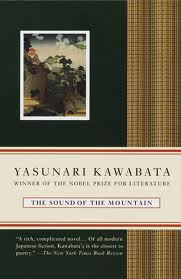
The Sound of the Mountain by Yasunari Kawabata

The Sound of the Mountain (山の音) is my book for Japanese Literature Challenge 5 at Dolce Bellezza, the only one this time and posting it before the Challenge ends this month. It is the first book I finished in 2012, at 1 a.m. January 1st. Truth is, I wanted to finish it by the end of last year, but couldn’t. I’ve been reading it for weeks in December. It’s a book that I had to read ever so slowly.

Yasunari Kawabata (川端 康成, 14 June 1899 – 16 April 1972) is the first of two Japanese Nobel laureates in literature, receiving the honor in 1968 (Kenzaburo Oe in 1994). So far I’ve only read two of Kawabata’s books, Snow Country and The Sound of the Mountain. But from this limited experience, I’ve found that reading Kawabata is like watching an Ozu film. The camera is set low and mostly stationary to depict quiet expressions and gestures. Viewers are engaged by the nuanced dialogues as the director explores in depth thematic materials rather than presents plot-driven sequences. Both masters deal with intimate relationships, their characterization sensitive , their imagery poetic.

Ogata Shingo is in his early sixties, beginning to show signs of old age. Ever introspective and sensitive, he can almost hear the beckoning of death as sound that comes from the mountain to the rear of his house in Kamakura. As he lies in bed at night, beside his oblivious, snoring wife Yasuko, he can distinctly hear that sound:

It was like wind, far away, but with a depth like a rumbling of the earth… The sound stopped, and he was suddenly afraid. A chill passed over him, as if he had been notified that death was approaching.

At most, Shingo feels a duty towards his wife Yasuko. His heart though is drawn to two women, one is his wife Yasuko’s older sister who passed away from an illness some time ago. Yet Shingo still cherishes memories of her. The other is his son Shuichi’s wife, his own daughter-in-law Kikuko, who lives in his house. Nurturing a crush on two women who are not his wife has troubled Shingo deeply.

But the guilt he wrestles with is only a part of the distress he faces so late in life. Shingo has to face the marital problems of both his son Shuichi’s and his daughter Fusako’s.  Shuichi, who lives with his wife Kikuko in the house of his parents, has been seeing another woman, Kinu. And Shingo’s daughter Fusako has recently returned to her parent’s home with her two young children after her husband has deserted them.  Despite their being adults now, Shingo feels responsible for the failure of his children’s marriage.

In a restrained bickering between father and son, Shingo is put on the spot:

I’ve been thinking a little,” muttered Shuichi. “About Father’s life.”
“About my life?”
“Oh, nothing very definite. But if I had to summarize my speculations, I suppose they would go something like this: has Father been a success or a failure?

…..

But whether or not a parent is a success would seem to have something to do with whether or not his children’s marriages are successful. There I haven’t done too well.

As I was reading this book, I thought of Ozu’s films. Like Ozu, Kawabata is bold to expose the breakdown of the traditional family and the threat to paternal authority in post WWII Japan. He depicts the shift from a parent-child emphasis to one between husband and wife. He is honest in revealing the common cracks of unfaithfulness which can destroy marriages. In the book, he openly describes the strain and alienation between generations and within a marriage.

Besides relationships, Shingo has to battle with something more inherent and spiritual. His son Shuichi neglects his wife Kikuko and often goes to his mistress, Kinu, who later becomes pregnant. Shingo not only takes upon himself to deal with Kinu, but is drawn into something even more difficult to confront, for in Shuichi, he sees himself:

Shingo was astonished at his son’s spiritual paralysis and decay, but it seemed to him that he was caught in the same filthy slough. Dark terror swept over him.

Shingo is a man afflicted on severals fronts, guilt, responsibility, spiritual decay. Author Kawabata instills relief for his protagonist as well as his readers by means of Nature.

Gingko Tree in Japan

Shingo is superbly in tune with the natural world, and in turn, nature is a mirror from which he sees himself clearly. The temperamental sky reflects his moods; the typhoon, his inner turmoil; stalks of bamboo broken off by the storm parallel the broken family relationships he lives with; the noise of locust wings spells restlessness; and yet the unseasonable buds on the great gingko tree splashes hope in a troubled time:

The gingko has a sort of strength that the cherry doesn’t,” he said. “I’ve been thinking the ones that live long are different from the others. It must take a great deal of strength for an old tree like that to put out leaves in the fall.

And thus comes the turning point in Shuichi and Kikuko’s marriage, though fragile, still a glimmer of hope, while Fasuko’s marriage comes to an abrupt end like an overnight storm. As for Shingo, we wish him well, like the unseasonable buds on the great gingko tree.

The Sound of the Mountain requires slow reading and quiet contemplation. Like a good film, I know I will go back to it as time goes by.

**

The Sound of the Mountain by Yasunari Kawabata, translated by Edward G. Seidensticker, published by Vintage International, NY., 1996, 276 pages.

Note: ‘gingko’ in this book is spelt differently from our common spelling nowadays ‘ginkgo’

Ginkgo Tree photo from Wikimedia Commons

***

Other related posts on Japanese Literature and Films:

Reading Snow Country in Snow Country

Rouse Up O Young Men of the New Age by Oe

Yasujiro Ozu and the Art of Aloneness 

Notes on the Synthesis of Film, Art… Life?

The Artist (2011)

I like to start the year with something bright and cheerful. Glad I found it in The Artist. It’s a colourful and spirited romance comedy, kicking off the new year with style. The Artist is a black and white silent film made in 2011.

Directed by Michel Hazanavicius, it premiered at Cannes and was nominated for the Palme d’Or. The French actor Jean Dujardin won Best Actor at the Festival. The Artist is now gathering momentum for an Oscar Best Picture nom.

I was totally captivated by the film, an homage to the silent era of Hollywood movie-making. In the style and tradition of Charlie Chaplin and Buster Keaton, The Artist is a comedy with a heart. It’s not a deep exploration of true love, or what makes an artist, but a light, fun and melodramatic genre piece, gratifying without demanding much.

The story is about a silent movie star George Valentin (Jean Dujardin), who is the rave of the time. His presence is cheered by live audiences at the cinema and on the streets, greeted by swarms of women screaming and swooning. One of them is Peppy Miller (Bérénice Bejo), an aspiring actress. Miller’s dance steps and perky personality soon open doors for her into Hollywood. She can now get close to George, who in turn is mesmerized by her.

But the torrents of change are callous and indifferent. The year is 1927, the pioneering of talking movies. Sound quickly replaces silence. George soon finds himself swept from the top of the world into oblivion. He’s dumped by his producer Al Zimmer (John Goodman), for George is now a nobody from yesterday. Reduced to poverty, he has to let go of his last supporter, his faithful butler Clifton (James Cromwell).

Now folks, this is 1927… not unlike what we’re seeing today. All trends are ephemeral. And uh… I hate to say this, but it was mentioned by my college son who saw the movie with me, sound ~ 3D of today?

Seeing George Valentin’s plight, Peppy Miller cautiously comes to the rescue. Now a popular Hollywood star, she knows how proud he is of his career as a silent film actor, an artist, a purist who refuses to be lured into what he perceives as the gimmick of sound productions. So ultimately, the story is about change, and how one can still seek to accommodate without compromising.

The Artist is a genre romance comedy, silent style. That’s when acting and outward expressions of thoughts and emotions take over in the absence of dialogues. I was impressed by how effective it is. I remember in a screenwriting course, I was told to leave the dialogues to the last. Since film is a visual medium, the actions should tell the story even without any words spoken.

How true it is. I can see vividly this axiom in action by watching The Artist. Sure there are prompters for us, like the old silent films where short descriptions of words are inserted on occasions, more for comedic effects I feel. But I can follow the story, totally immersed in the circumstance of the characters, their highs, their lows, purely from watching them act without saying a word. That is a wonderful experience.

It’s not totally silent though… there’s music of course, and it’s an important part of the movie, generating the mood and momentum. I was totally engaged through it.

And last but not least, I must mention this. All ye dog lovers, even if you aren’t, this is a film for you. If there’s an Oscar for the Best Dog Actor, Uggie should definitely get the honor.

A new year bang. Let the silence speak for itself. Uggie never has to say a word.

~ ~ ~ 1/2 Ripples

All The Year’s Best

All the year’s best are coming out now: Best books, best movies, best… whatever. And I admit, I’m one who’s always on the look-out for such lists. Hundreds of books and movies in a year reduced to a list of 10, definitely makes one convenient Christmas shopping list.

Here are some of the best book lists:

Publishers Weekly Top 10 Books of 2011

NPR 10 Best Novels of 2011

New York Times 10 Best Books of 2011

Best Fiction 2011 from “The World’s Toughest Book Critics”

The Globe 100 Best Books of 2011 shopping list

Books of the Year 2011 The Telegraph

A list of indispensable books from Harvard Gazette, not your usual best-sellers

And here’s a one-stop shopping lists for The Top 10 Everything of 2011 from TIME Magazine.

**

Movies? Year’s best lists are everywhere. Of course, all lead to the ultimate finale of the Award Season: The Oscars. But for Christmas shopping suggestions, here are several lists, albeit some of the current releases may not have come out in DVD or Blu-ray yet:

American Film Institute’s Best Films 2011

Critics Awards for 2011 Best Films

Roger Ebert’s Best Films of 2011

NYT Stephen Holden Best Films 2011

NYT A. O. Scott’s & Manohla Dargis’s lists

Metacritic’s Best Films 2011

Toronto Film Critics’ Picks

Time-Out London

And more lists are coming out even as I type.

But of course, the most important to readers/movie viewers is whether they agree or not, whether what the critics say happen to be their own favorites. If not, there’s really not much relevance to all these lists, is there? No? I’d like to hear from you… Do you read movie reviews first before heading out to the theatre? Do you depend more on film critics or ‘user-reviewers’? Herein lies another subtle (or not so subtle) battle between the critics vs. the reader/movie watcher, and… alright, the blogger.

So, from one POV, here’s Arti’s year-end tally. Yes, I happen to have written down, if I remembered to do so, all the movie titles I’ve watched this year. There are about 90 that I’ve got down, not including those I previewed for a film festival.

If I’m to choose the best film of this year from all that I’ve watched, I’ll have to say The Tree Of Life by Terrence Malick. It’s a film by far the most unique, cinematically gratifying, cerebral, transcendent, and a showcase of excellent talents. I hope the young actor Hunter McCracken can get some recognition for his sensitive and intelligent performance.

Other titles I should mention for my list of best 2011 films include The Artist, Midnight In Paris, Drive, Cave of Forgotten Dreams, My Week With Marilyn, and The Descendants. I’m still waiting for the screening in our city of some titles which I highly anticipate, including A Dangerous Method, Carnage, Take Shelter, Tomboy, and Tinker, Tailor, Soldier, Spy, and We Need to Talk About Kevin.

And for older films I’ve seen this year, some I rewatched, others are my catch-up on acclaimed titles I’ve missed in the past. I’ve a few favorites (in no particular order):

Animal Kingdom, My Life As A Dog, Truly, Madly, Deeply, Autumn Sonata, Play It Again Sam, Interiors, Marvin’s Room, Shine, Badlands, Days of Heaven, Fargo, The Makioka Sisters, Radio Days, Anne Hall, Manhattan, Match Point, Pickpocket, Howards End, The Third Man.

As a slow reader, much slower than my movie-watching speed, the ratio of film to book for me this year is about 2:1. My picks for my favorite reads this year (not all published in 2011), and in no particular order:

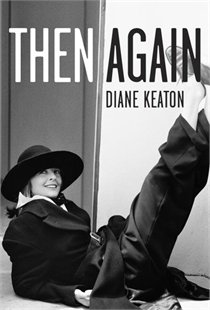
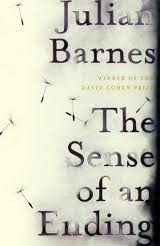
Then Again by Diane Keaton, The Sense of An Ending by Julian Barnes, Blue Nights by Joan Didion, Let The Great World Spin by Colum McCann, The Paris Wife by Paula McLain, A Moveable Feast by Ernest Hemingway, The Letters of Vincent Van Gogh, True Grit by Charles Portis, Howards End by E. M. Forster, The Cat’s Table by Michael Ondaatje, The English Patient by Michael Ondaatje, Diary of a Country Priest by Georges Bernanos.

**

What about you? What are your year’s best in books and movies?

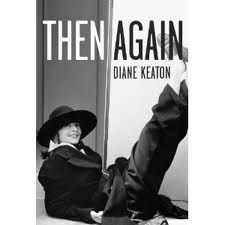
Then Again by Diane Keaton

It’s interesting to read Diane Keaton’s memoir after Julian Barnes’ The Sense of an Ending. In contrast to Tony’s hazy past in Barnes’s novel, here we have memories strung together with clarity and adequate documentation. Take a look at these insert photos. I admit, they were the very reasons the second I opened the library copy that I decided I must get my own to keep.

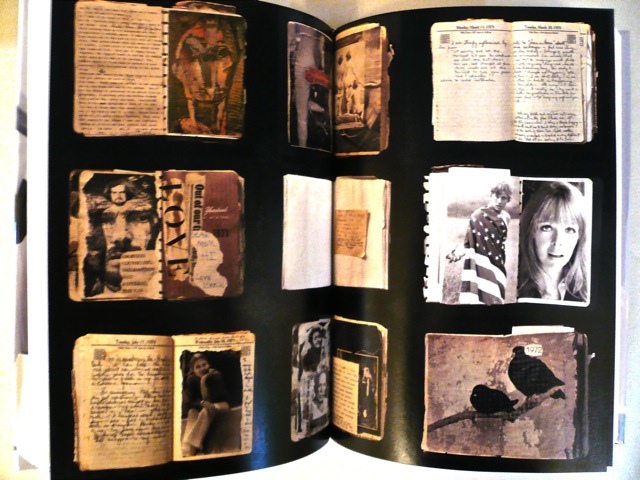
Dorothy Keaton’s Journals

These are journals belonging to Diane’s mother Dorothy Keaton.  She first started with a series of letters she wrote from her California home to her eldest daughter Diane, who had moved to NYC at age 19. Letter writing developed into full volumes of family journals and scrapbooks. Further, she had kept detailed documentation of Diane’s career from 1969 to 1984. With the onset of Alzheimer’s, Dorothy still kept close contact with her daughter through letters and phone calls, leaving phone messages which showed the signs of a mind quickly sliding down the slope.

Stacks of memories

Diane has poignantly interwoven her own thoughts and memories with her mother Dorothy’s, a daughter’s attempt to capture life that was THEN in order to relive the moments AGAIN. Diane’s father Jack Hall died of cancer in 1990, only a few months after the diagnosis. Dorothy died of Alzheimer’s in 2008. This memoir is a joint endeavor of a daughter with her mother who has passed on, yet whose presence is strongly felt:

Now I’m alone, juggling with a memoir that’s also your memoir.

Family Scrapbook

Diane Hall grew up in California and had enjoyed a vibrant suburban family life before she moved to NYC to study at The Neighborhood Playhouse. She kept close contact with her family through letters. I admire her courage to reveal these correspondences, for through them, we see the private side of Diane Keaton, a persona with all the insecurities and non-glamorous aspects of a real life human being. After the Neighborhood Playhouse, she decided to change her name from Hall to Keaton. She got her first break in the musical Hair. This is her letter home:

Hi, Everyone,

Well, I’m in a hit, we opened the 29th… A real job, and on Broadway. Big stars have come to see it, like Warren Beatty (remember my crush on him from Splendore in the Grass) and Julie Christie, who is the most beautiful woman I’ve ever seen, and Liza Minnelli… Apparently Hair is the in thing to see. People stand in lines every day to get tickets.

Things are pretty much the same. I’m certainly the same. Will I ever change? I’m still the dumbest person alive. One apparently does not grow out of stupidity. Oh, also I’m on a diet…

And on that note, Diane goes on to reveal her past battle with bulimia in the next chapter, a piece of private history that has been kept secret until now.

From Hair, to Play It Again, Sam, and later from stage to screen. Thanks to Woody Allen, we have many fabulous movies but the most memorable probably is Annie Hall (1977), which brought Diane Keaton the Best Actress Oscar, and Woody Allen the Best Director and Best Writing Oscars. It also won Best Picture. Here’s Diane’s memory of the production:

Woody’s direction was the same. Loosen up the dialogue. Forget the marks. Move around like a real person. Don’t make too much of the words, and wear what you want to wear. Wear what you want to wear?  That was a first. So I did what Woody said: I wore what I wanted to wear…

And her choice of ‘costume’ became a classic:

And yes, there was a real life Grammy Hall. She was Jack Hall’s mother Mary Hall. She could have given Woody the idea of the movie character, for she was just as nasty. Regarding Diane winning the Oscar, this is Grammy Hall’s response when interviewed in the local paper:

People say I’m in the clouds, I ain’t in no clouds. I’ll tell you one thing about the Academy Awards. It’s something big for a small family. That Woody Allen must be awfully broadminded to think of all that crap he thinks of

As for Woody Allen, he didn’t even attend the Awards ceremony nor did he talk about it afterwards.

Diane is also candid about her ‘romantic failures’, beginning with Woody Allen, then Warren Beatty whom she co-starred in Reds, and Al Pacino as they worked together on Godfather II & III.

At age 50, Diane stepped out to make a most courageous move: she adopted a newborn baby girl, Dexter, and  five years later a baby boy, Duke. Her role as a single mother bringing up a daughter and a son is probably the most gratifying.

In between some serious skirmishes–like when he refuses to have his diaper changed, or when he starts crying because he’s been put down or Dexter has stolen his waffle, or when he bangs his head on the sidewalk… –in between these scuffles, there are moments that feel like an eternity of bliss.

The final pages of the memoir are the most moving for me. Diane Keaton as daughter who ultimately had to say farewell to both parents, writing at 63 and as mother to a 14 and 9 year-old, she could hear as if Dorothy is telling her: “Dear Diane, my firstborn, take a deep breath, be brave, and let go…”

Here’s her reply:

I’m trying, Mom, but it goes against every instinct I possess. I promise you one thing though. I promise to unleash Duke and Dexter from the stranglehold of my need before it’s too late. I promise to give them their freedom no matter how much I want them to hang on. I promise to let go of you too, the you I created for the benefit of me…

Through her memoir, moments Then are relived Again. It is also a catch and release, the challenging process of gathering and letting go.

~ ~ ~ ~ Ripples
***

The Sense of an Ending by Julian Barnes

When we are young, we invent different futures for ourselves; when we are old, we invent different pasts for others.

How reliable is our memory? How accurate are our thoughts, analysis of situations, perception of people? Yet we live by them and interpret our experiences through their lenses.

The winner of the 2011 Man Booker Prize, Julian Barnes’ The Sense of an Ending plays with these subjective faculties and crafts a scenario that’s captivating and with a touch of surprise at the end. A man in his 60’s looks back at his life, focusing on what he can remember about his relationships and their aftermath.

In the first part of the book, we see three school buddies in the upper form, the narrator Tony Webster with his classmates Alex and Colin,  happy to befriend a newcomer, Adrian Finn. Obviously superior in brain, insight, and self-composure, Adrian soon becomes the model they look up to. Apart from the pretentiousness of youth in intellectual matters, Tony has to concede that Adrian is indeed  superior material. When asked by the teacher “What is history?”, while Tony gives the relatively pat answer “History is the lies of the victors”, Adrian articulates this thought:

History is that certainty produced at the point where the imperfections of memory meet the inadequacies of documentation.

With these words at the beginning pages of the book, Barnes has quietly laid the enquiry of his story.

Post-secondary life leads them to different paths. Adrian, not surprisingly, gets into Cambridge on scholarship, while Tony goes to Bristol to read history. There, he starts to go out with Veronica Ford. One weekend, Veronica brings him home to meet her family. In Tony’s memory, that is a humiliating episode. He leaves with bewilderment: Veronica’s aloofness, her father’s joking insults, her mother’s mysterious gesture, and her brother’s silent wink.

After that, Tony introduces Veronica to his friends. Naturally, she strikes up a good rapport with Adrian right away, with a common tie of Cambridge where her brother also attends. Later, Tony and Veronica break up.  Adrian soon starts to date Veronica. As usual, Tony seems resigned to his circumstances and  moves on with his own life, and assumedly, others too with theirs… until later he hears the shocking news about Adrian. Time flows by, Tony marries a less mysterious Margaret, has a daughter Susie, and years later, his marriage ends in divorce.

Tony is now retired in his 60’s, expecting a life that’s bland and uneventful. Retired life for him is a natural drift of time, flat and oblivious. But he’s roused by an unexpected letter from a solicitor one day, naming him to receive £500, a bequest in the will of someone he has only met once forty years ago, Veronica’s mother. What’s more intriguing is together with this money, he is to be left with Adrian’s diary.

Life to Tony now is a quest for finding out what had actually happened to these people. His investigation has cast fearful doubts on his own memory and sense of personal history. In his retirement, Tony is awakened to re-interpret his past.

… the history that happens underneath our noses ought to be the clearest, and yet it’s the most deliquescent.

It will take his whole remaining life to solve the mystery of how real his perceptions are, and what has taken place in the lives of those he once knew as close friends. Such queries only lead to a more taxing question: “Does he play a role in other people’s fate?”

In just 150 pages, Barnes has opened a floodgate of inquiries into our subjective mind, carrying us through with a tantalizing story, towards an ending that, I feel, is a tad bit sensational, however reserved the tone. Nonetheless, I come out of the reading experience marvelling at the power of the economy of words in the hands of a master storyteller.

~ ~ ~ 1/2 Ripples

The Sense of An Ending by Julian Barnes, published by Random House Canada, 2011, 150 pages.

***