The Salesman: A Timely Film

It’s time we get used to reading subtitles.

The Salesman is one of five nominees for Best Foreign Language Film in the upcoming 89th Academy Awards on February 26. Due to the executive order banning travellers from seven Muslim countries, Iranian director Asghar Farhadi will not be attending. The director has indicated he will not accept any exception made for his case. Co-star Taraneh Alidoosti has stated she will boycott the ceremony as a protest.

Whose loss is it that Asghar Farhadi is banned from coming to the Academy Awards?

After the untimely passing last year of Iranian auteur Abbas Kiarostami (Certified Copy, 2010), Farhadi continues to carry the legacy of fine Iranian filmmaking with international accolades. Starting with About Elly, which he won Best Director at Berlinale in 2009, Farhadi went on to capture both the Oscar and the César Award in France for Best Foreign Language Film with A Separation (2011). The Past (2013) brought him two Cannes prizes. His newest work The Salesman won a Best Screenplay for the writer/director and a Best Actor award for his star Shahab Hosseini at Cannes last year. Now North American viewers have a chance to see this engaging family drama.

thesalesman_poster_2764x4096-copy

The story starts off with an evacuation of an apartment building on the verge of collapsing. A couple, Emad (Shahab Hosseini, A Separation, About Elly) and Rana (Taraneh Alidoosti, About Elly) are among the anxious residents fleeing the building. We can see large cracks on the wall in their bedroom. Responding to the shout for help, Emad diverts to his neighbor’s unit to carry his adult, mentally ill son on his own back to go down the stairs. A seemingly spontaneous move in the rush of evacuation, Farhadi lets us see an act of kindness from his main character.

A friend offers Emad and Rana a recently vacated apartment unit to stay. Its previous tenant still has her belongings stored in one room. She has left in haste, a shady figure who has frequent male clients coming to her unit. Emad only learns of this after a violent incident that happens to his wife. Rana is alone in the unit one night. She leaves her apartment door ajar for Emad, thinking he will come home soon while she steps into the shower.

Emad returns home to see traces of blood on the stairs and soon learns that his wife has been taken to the hospital emergency by neighbors. We as viewers do not know exactly what has happened but can conjecture by the circumstance. We see a traumatized Rana with stiches on her forehead. She is released to recover at home, but refuses to let Emad call the police. Later, as Emad discovers a cell phone and a set of keys left by the intruder, he decides to investigate on his own and takes matters into his own hands.

Since the incident, husband and wife begin to drift slowly apart, Rana being reticent and Emad vigilant. Here we see Farhadi’s signature cinematic handling: incisive depiction of domestic tensions shrouded in Hitchcokian suspense. We soon forget we are watching an Iranian couple living in Tehran. As with his previous works, Farhadi is effective here in engaging his viewers and to elicit empathy for both the husband and the wife despite their very opposite response to the attack.

Emad and Rana belong to a local theatre group. They are presently rehearsing for a run of Arthur Miller’s Death of a Salesman, playing Willy and Linda Loman. Farhadi deftly intertwines the on-stage and the real-life couple with intricate parallels. In the play, we see the demise of Willy Loman and the end of a relationship; in their real life, we see Emad and Rana’s marriage deteriorate, and a demise of a different kind for Emad. The cracks on the wall above their bed at the opening scene is now an apt metaphor, their once close bond slowly crumbles.

Actually, there are two plays involved in the film. The obvious one is Miller’s. The other is easy to miss. During the day, Emad is a teacher. In one scene, we see him teaching a play called The Cow, a work written by the prolific Iranian writer Gholām-Hossein Sā’edi. Reminiscent of Kafka’s The Metamorphosis, The Cow evokes much enthusiasm in his class of teenage boys. The play is an allegory about a man who owns the only cow in a village; his daily life is closely tied to the animal, his identity defined by his ownership of this unique possession. When one day he loses his cow in an accident, he ends up turning into one.

Here are two prominent lines. A student asks: “How can you turn into a cow?” Emad answers: “Gradually.” Sounds like a joke, but no student laughs. Farhadi subtly leads us to see how.

The last part of the film is the most crucial. Emad’s good detective work leads him to come face to face with the attacker. He has him locked in a room in their previous, vacated apartment. Playing to the attacker’s fear of revealing to his wife and family what he had done, Emad calls them to come over. Farhadi is brilliant in leading us to a situation where we as viewers are challenged to empathize all his characters despite their opposing sides, and to weigh in on what we would have done. He puts his viewers in the position not as a judge, but witness.

Slowly we are led to see how a man can lose the veneer of civility and change into something else as he allows revenge dominates his emotions. The kind and helpful man we see in the opening scene is now shrouded in a different sentiment. In the most nuanced and quiet manner, Farhadi lets us visualize Emad’s earlier reply to his student, how a man can gradually change into a different being. Or, is it a latent potency we all have that different circumstances would elicit a different aspect of our self?

At this juncture, Farhadi reveals to us a multi-faceted man. A helpful neighbour, loving husband, well-liked teacher, and a cultured stage actor. When put in a situation where vigilante justice takes over, and revenge molds the mind, or even when the social expectation of being a protective male head in a marriage prevails, is Emad free to act? If the accused pleads for his own release, and the victim herself is willing to forgive, should the husband carry out his reprimand? On the other hand, should the attacker just go free?

In the final shot, we see Emad and Rana sit beside each other as make-up is applied to get them ready for their parts as Willy and Linda. Their expressions in the mirrors make one haunting image to end the film.

Banned from entering the United States, what Farhadi will lose are the glitz and glam of the Oscars. By his absence at the ceremony, the Academy will lose the chance to honor an internationally acclaimed director who is a master in revealing human frailties and eliciting from viewers the very empathy we so need in this testing time.

Fortunately we can still watch his film.

~ ~ ~ ~ Ripples

***
Silence the Movie Arrives in the Most Unwelcome Time


Why is La La Land being embraced so readily and Silence shunned? Evidence from box office sales and nominations during this Awards Season clearly show the difference between the two. Just now, the Oscar Nominations are in. La La Land: 14  Silence: 1

Allow me to speculate.

One in glamorous primary colours, the other shrouded in misty shades of gloom. One a fantasy, romance in song and dance, the other realism of suffering, persecution, death. One is layback, relaxing entertainment, the other is 2.5 hours of intense engagement. One charms, the other disturbs. When offered at the end of a tumultuous year, and as we step into a new one when hopes and fears are renewed, the choice is easy. La La Land is an amiable feature (although I won’t get into the overrated debate here), but Silence sure doesn’t deserve the disregard it’s getting.

It’s just that Silence arrives in the most unwelcome time. But then again, there’s no suitable time for a feature like it. Isn’t it revelatory and even prophetic that this film, probably director Martin Scorsese’s most important in his oeuvre, seems to be a total outcast, a lost cause? Exactly, that’s just as it would have ended up.

It would be ironic, wouldn’t it, for a film about spirituality, other-worldly and intangible values, and challenges of faith in the face of persecution to be celebrated by this power and fame-obsessed, material world? For it to receive praise and honor would be the ultimate irony indeed.

In a society which aims at being great, where ratings, numbers, wealth and social media status define success, where loudness rules and silence shunned, it is only expected that a film entitled “Silence” will not be cheered on. It runs against the grains of popularism, for it’s a film about failure.

I have posted a book review of Silence back in December, 2016. In it is a historical note. To summarize, Christianity was introduced to Japan by Francis Xavier in 1549. It was well received then, and by 1600, there were 300,000 Christians in Japan. But the Edo Period beginning in 1603 changed everything. Ruler Tokugawa Ieyasu ordered expulsion of foreign influences and Christianity had to survive underground. Torture was used to drive Christians to disavow their faith. Stepping on the fumie, a brass plague engraved with a Christ figure, is the convenient way to show one’s apostasy, leading to instant release. During this time, the Catholic Church received the news that the stalwart leader of the Jesuits mission in Japan, Father Christovao Ferreira had disavowed his faith and became an apostate. He had since lost contact with the Church.

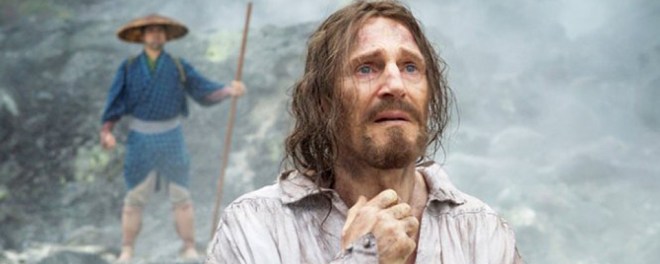
The film doesn’t need many words to explain these historical events, for its visuals are self-explanatory. It starts off with father Ferreira’s apostasy, apparently under duress as he sees his flock being tortured to death. Liam Neeson’s gaunt and horrified expressions speak all. That’s the power of cinema.

ln-in-silence

Back in Portugal, two young priests, Father Sebastian Rodrigues (Andrew Garfield) and Father Garupe (Adam Driver) appeal to their superior Father Valignano (Ciarán Hinds) to allow them to go to Japan to look for Ferreira and to seek the truth of the situation. Thus begins the story.

I’ve long learned not to judge a movie adaptation according to how loyal it is to the book, for the two are different art forms and a direct transposition may not be possible. But here is one exception. I’m glad that Scorsese’s Silence, co-written with screenwriter Jay Cock (Gangs of New York, 2002), is surprisingly faithful to Shusaku Endo’s historical novel, and that ‘faithfulness’ is both desirable and most admirable here.

By following Endo’s storyline to the dot, extracting pertinent text from the book as dialogues and voiceover, and spending time to cover the all important Epilogue, the director shows his desire to honour the author’s work, a wish that had long hidden in his heart. Indeed, it has been twenty-five years since Scorsese first read Endo’s masterpiece and was so deeply moved that he knew he needed to film it one day.

Another way we see Scorsese’s regard for Endo is his restraint when portraying the tortures of Japanese Christians. What we have, surely, is visual, graphic scenes which, while reading the book are left to the author’s descriptions and our imagination, but on screen are left to the director’s discretion. Kudos to Scorsese, those scenes are done with much restraints. This was a welcome surprise to me. I went into the theatre braced for his treatment like the ending scene of Taxi Driver (1976), or the bloody mayhem in Gangs of New York (2002). I need not have worried. But what I was hit with I had not expected.

Scorsese can definitely unleash more gore in Silence. But he chose not to. The scenes in the film are done with the utmost respect and dignity for the persecuted. Here’s a confession, I’m not one who easily succumbs to emotions, never need a Kleenex while watching a movie in the theatre. Here in Silence, as I watched the three Japanese Christians hanging on the makeshift crosses at the seashore swallowed up by the rising waves, tears slowly streamed down my face. What more, the guy sitting behind me was sniffing away, uncontrollably.


The main actors are powerful in taking hold of our emotions. Liam Neeson’s painful expressions both at the beginning and the end are very moving. Adam Driver lost 50 pounds for his role. His skeletal form is almost painful to watch. The Japanese actor Yôsuke Kubozuka is effective as Kichijiro, the ‘Judas character’.

The emotion of the whole film, however, is driven by two actors: Andrew Garfield as young father Rodrigues and the calculated, ruthless inquisitor Inoue played by Issei Ogata. The two form a stark foil: the hot-blooded idealist slaughtered slowly by the cold, harsh ruler. A tidbit for those who had watched Taiwanese director Edward Yang’s Yi Yi (2000), Ogata is Mr. Ota in there.

Garfield is effective in leading us to feel for Father Rodrigues’ sad and tragic journey. Martyrdom is the path to glory, and an easy way out. But no, Rodrigues isn’t given that luxury. Rather, he is faced with a most precarious test, tearing his soul and conscience, that is to apostatize or see his flock die by torture. It is unfortunate that the film has not been well received. Garfield deserves a nomination for Silence.

While it may be about the hidden church that runs underground to avoid annihilation, Silence is more about one man’s struggle with faith and doubt, and ultimately, making his choice and living with it for the rest of his life.

Here’s the rub. In this ‘either or’ society we live in, Rodrigues’s predicament is particularly distressing for us. It is often convenient and tempting to oversimplify issues and splitting them into clean-cut opposing sides, either B or W, L or R, D or R. In Silence, we’re confronted with yet another dichotomy: Devout or Apostate. What Scorsese reveals to us with his last scene is that, the line separating the two is blurry and permeable.

silence-and-beauty-free-chapter-mako-fujimura-1

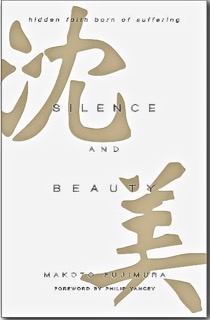
In his compendium book to the movie, Silence and Beauty: Hidden Faith Born of Suffering, Japanese-American artist Makoto Fujimura, who is special adviser to the film, discusses the necessary existence of a ‘hidden’ identity to those practising Christianity in that historical era in Japan. For 250 years during the anti-foreign, ironclad Shogunate rule of the Edo Period (1603-1868), the only way to survive as Christians was to become hidden, Kakure Kirishitans as they were called in Japan. Stepping on the fumie, as the officials say, could well be only a formality, for it likely did not represent the heart. It is unfortunate that the persecuted Kakure Kirishitans had to succumb to this double life. As outsiders looking in, should we be so easy to judge them? Silence challenged us with that question. Unlike the bold declaration of Western Christianity, the Kakure Kirishitans held on to an inner faith that on the outside was wrapped with weakness and failure, total submission to the ruling authority. A painful, paradoxical existence.

The crucial, final scene in the film, which is the Epilogue of Endo’s book, holds the key to the question. I appreciate Scorsese’s closure. That is also how Fujimura explains Endo’s viewpoint. No spoiler here. Cinematically, the production is an artistic and powerful work worthy of Endo’s masterpiece. Scorsese’s quarter-century quest had not been in vain. Being recognized or not in the Awards Ceremonies just may not be as important an issue.

Of course, there’s always the bottom line. After investing so much resources, time and talents in the production, it is only natural to wish for a positive return. Could the voice that speaks to Rodrigues at that most crucial fumie moment speaks also to Scorsese as well regarding his film Silence?

“Trample! Trample! It was to be trampled on by men that I was born into this world…”


~ ~ ~ ~ Ripples


***

CLICK HERE to read my review of the book Silence by Shusaku Endo

Lion: From Personal Memoir to the Big Screen

The memoir A Long Way Home by Saroo Brierley, first published in 2014, has officially changed its name to Lion. This may well be a metaphor for its author. Only a change in the name, but everything inside remains intact. From a child lost on the streets in Calcutta, India, to a man grown up in Hobart, Tasmania, Saroo remains who he is. He writes in his memoir: “I now have two families, not two identities. I am Saroo Brierley.”

lion-movie-tie-in-edition

Lion (previously titled A Long Way Home) the memoir by Saroo Brierley

5 year-old Saroo was lost in a Calcutta (now Kolkata) train station, almost a thousand miles away from his home in a small village, Ganesh Talai. With no language (a different dialect), not clear of the name of the place he calls home (mispronounced by him as “Ginestlay”) or even his own last name, Saroo is utterly alone and helpless. Living dangerously on the streets of Calcutta for some weeks, he was picked up and sent to a youth detention centre, which was only a tiny bit safer from the streets. Subsequently Saroo was sent to an orphanage, Nava Jeevan (“new life”), run by the benevolent Mrs. Sood. There she arranged for his adoption by a loving Australian couple, John and Sue Brierley.

That could have been the happy ending of a tumultuous experience for Saroo, as he grew up in calm and beautiful Hobart, Tasmania, well adjusted and dearly loved by his adoptive parents. But for twenty-five years, Saroo has not forgotten his first home. As he grew, he was all the more tormented by the memory of his birth mother, and the brothers and sisters who had shared the first five years of his life. An important message he has always wanted to convey to them is that he’s ok, and that they need not worry about him. For years he has been haunted by the thoughts that his mother and older brother Guddu must have been devastated with losing him without a trace, as it was Guddu who had left him alone on a bench at the train station near his home, telling him to stay put as Saroo was too sleepy to tag along on that fateful night.

With the help of Google Earth twenty years later, and vague memories of the physical features of his home surrounding, Saroo finally located his village and flew back to India to search for his mother. They reunited a few doors down from his old home, as his mother had persisted all these years to not move away but stay there to wait for him, hoping against hope that her son would come back to her. The photo inserts in the book add even more poignancy as we see the Brierleys meet Saroo’s birth mother Kamla in India.

Utterly moving, authentic, genuine and real. While Slumdog Millionaire may be entertaining and eye-opening for those of us who are not familiar with Indian’s millions of children living on the streets, Lion is a true portrayal of one lost child, determined to find his way back home twenty-five years later across the oceans.

**

Lion the Movie

Is the movie any good? For those who think it’s always the book that’s better, here’s my answer: Yes, very good. Premiered at TIFF16 last September, Lion has since garnered awards and nominations, including young Sunny Pawar, his debut performance as an actor. Kudos to all those involved in transporting this story from a personal memoir onto the big screen for international viewers. If not for the movie, even though it has been reported in India and Australia, I for one in North America would not have known about this real life miracle.

So, hats off to Australian director Garth Davis, screenwriter, the acclaimed Australian  poet/writer Luke Davies, and the cast, Sunny Pawar as young Saroo, Dev Patel (Slumdog Millionaire, 2008) as the adult, Nicole Kidman and David Wenham the adoptive parents, Rooney Mara the girlfriend, and the cast of Saroo’s Indian family. They have delivered an authentic and moving real-life story.

Basically structured into three parts, the first focuses on five year-old Saroo, living in poverty but is loved by his mother and siblings. One night he pleads with his older brother Guddu to go with him to his night work, salvaging garbage left on trains. After reaching the closest station from his home village, Saroo is too tired, so he stays behind sleeping on a bench to wait for Guddu. He wakes up in the middle of the night to find himself all alone. He gets on one of the parked train to look for Guddu but falls asleep again in there. He wakes to his horror as he finds he is being transported in the speeding train further and further away from his home.

Cinematographer Greig Fraser (Zero Dark Thirty, 2012; Bright Star, 2009) uses his camera effectively showing some haunting images, a horrified 5 year-old, alone on a train speeding to the unknown. Throughout the film as well, he tells the story poignantly with his camera. Scores composed by Volker Bertelmann and Dustin O’Halloran add power in eliciting emotions, taking us closely with Saroo on his incredulous life journey.

Second part we see Saroo grown up in Australia, having a good relationship with his adopting parents but troubled nonetheless by his past. The frustration of having only vague memories of the physical features of the train station near his home makes it an impossible task to search for an unknown town in the vast land of India. Thanks to Google Earth and his unyielding perseverance, the adult Saroo was rewarded with a dream come true.

While the physical locales might be distant and vague, memories of his childhood experiences are lucid and close. In the second part, the director and screenwriter have deftly inserted Saroo’s memories of his childhood days in India, enriching the screen story of his intimate relationships with his family. These inclusions add to the texture and are placed aptly to enhance the continuity of the child and the man. Very effective.

I welcome the quiet and slower pace in Part Two, and appreciate Patel’s portrayal of inner turmoils. Kidman has done an amiable job as the adoptive mother trying to hold the family together, with two Indian boys, now grown men, both deeply troubled by their past in different ways. If Part One is about the outward dangers of a lost child, Part Two illustrates the internal turmoils one still wages into adulthood.

Part three is that triumphant and exhilarating reunion. How we want to see a happy ending by then. Although we know that is forthcoming, it is still exciting and gratifying to embrace the uplifting end. Lion is a story well told cinematically, and worth every minute of a viewer’s attention. Do wait till the very end before you leave the theatre, the photos at the closing credits make a beautiful wrap. And why the title Lion? That’s for you to find out.

~ ~ ~ ~ Ripples 

for both Book and Movie

***

Related Reviews on Ripple Effects:

Slumdog Millionaire

The Best Exotic Marigold Hotel

The Second Best Exotic Marigold Hotel

The Lunchbox

Reading the Season: Silence by Shusaku Endo

Click for ‘Silence’ movie review and thoughts.

For this year’s Reading the Season, I’ve chosen Shusaku Endo’s masterpiece Silence. Unlike previous years, it’s not as pleasing and exulting a read at Christmas time.  Rather, it’s unsettling and disturbing. It will interfere with your festive mood. It presents an excruciating dilemma that we hope we may never need to confront, and a question that more likely for us to face: Where is God during our suffering?

silence

Why so unpleasant a read at this time? We’re all busy with our festivities. Who would want to think about such a somber question? Director Martin Scorsese thinks it’s seasonal; Dec. 23 is the day his adaptation of Silence will be released in North America. Mind you, before showing here, it will first premiere at the Vatican. What a diversion of Christmas over there.

Thanks to Scorsese, I dug out Endo’s book and reread it. This time around, it’s even more disturbing for me. However, I also see the light seeping through the cracks of a broken human scene. I sure hope Scorsese’s film — twenty-five years brewing in the director’s heart — can lead to some quiet meditation amidst the cacophony bombarding us these days.

Historical Note

First off, very crucial before reading Silence is to establish a frame of reference; this is furnished by the Historical Note at the beginning of the book. Christianity was introduced to Japan by Francis Xavier in 1549. It was very well received at that point, despite an expulsion order later in 1587 by the Shogun Hideyoshi and the subsequent crucifixion of twenty-six Japanese Christians and European missionaries. By 1600, there were an estimated 300,000 Christian converts living in Japan.

By the time the second expulsion order was issued in 1614, however, the Christian Church in Japan was driven underground. Warlord Tokugawa Ieyasu was resolute in wiping out all traces of Christianity that from 1614 to 1640, an estimated five to six thousand Christians were killed. He later found out martyrdom wasn’t as effective an eradication measure as forced apostasy, especially with leaders of the faith, so torture was widely used towards that end.

crucifixion

In 1632, the Catholic world was shocked to learn that the stalwart leader of the Jesuits mission in Japan, Father Christovao Ferreira, had disavowed his faith and become an apostate after being tortured at ‘the pit’ in Nagasaki. No news of him came after that.

Upon this setting Endo begins his story. The historical novel describes the journey of one fervent young priest from Portugal, Father Sebastian Rodrigues, who has had the privilege to be taught and mentored by Father Ferreira years before. Upon hearing Ferreira’s apostasy, and with the reluctant approval of the Jesuit Superior, Rodrigues and fellow priest Father Francisco Garrpe board a ship and sail all the way to Japan to look for their beloved teacher and to investigate the situation. They have been forewarned, the magistrate Inoue is ruthless.

While still on the ship, the priests encounter Kichijiro, a sly, cowardly, and ambiguous figure who later will wade on shore ahead to guide them to some hidden Christians. For a while, the two Fathers have to hide themselves in a hut on a mountain during the day, and minister to the needs of Japanese believers who, despite the danger, come to seek them out for spiritual matters at night.

Later Kichijiro leads them to a nearby island to meet with more hidden believers. To the welcoming relief of the villagers, the fathers secretly conduct mass and baptism despite the risks. The evasive Kichijiro hangs around like a phantom nemesis.

The people suffer greatly under the rule of magistrate Inoue, yes, that Inoue who Rodrigues was forewarned. He extracts from the poor peasants harsh revenues and infuse the utmost fear into those of the Christian faith with his deathly measures. Rodrigues observes that “The persecutions of Christians make their faces expressionless. They cannot register on their faces any sorrow —nor even joy. The long years of secrecy have made the faces of these Christians like masks. This is indeed bitter and sad.”

Never before has Rodrigues felt so deeply about the meaningfulness of his mission:

“… like water flowing into dry earth … For the first time they have met men who treated them like human beings. It was the human kindness and charity of the fathers that touched their hearts.”

But such a firm conviction begins to shatter when Rodrigues comes closer and closer to the reality of persecution. No, not just of his own, but those of the Japanese peasants, his flock. Many are faithful to the end. When discovered, they would be tied on trees in the shape of a cross at the seashore, the rising tide slowly consumed their bodies after two or three days.

The ultimate punishment is ‘the pit’. Believers are tied up and suspended upside down above a pit. Blood would flow out of their eyes, ears, nose and the slits on the neck. They would be literally drip dry into a slow death through several days.

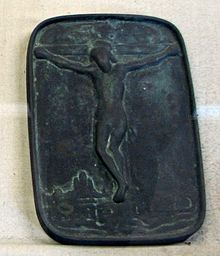
fumieA way out of such torture is to trample on the fumie. The fumie is a wooden plaque with a copper plate on which the image of Christ was artfully engraved. A person’s willingness to trample on the fumie is Inoue’s way of testing if one belongs to the outlawed Christian religion. It is also a convenient way to turn a believer into an apostate upon the threat of torture and death. One only needs to put one’s foot on the fumie, trample or even just step on it, then one can be released immediately, a most easy and convenient ‘formality’ to show one’s denunciation of faith. This was what happened to Father Ferriera.

The officials would say: “I’m not telling you to trample with sincerity and conviction. This is only a formality. Just putting your foot on the thing won’t hurt your convictions.”

To a believer, this may sound like a temptation, or self-deception. Or, is it a necessary choice to survive?

In this historically based novel, Shusaku Endo (1923 – 1996), a Japanese Catholic, paints a vivid picture of the crisis of faith in the face of extreme suffering, the doubts that often lie hidden even in the most devout. In the midst of persecutions, where is God? Why is He silent?  Endo is not depicting so much about the hubris of foreign missionaries coming with the hope and optimism to preach and convert, but just the opposite, he has exposed the lowest state a believer, let alone a priest, can possibly experience, the utter humiliation of being the one to denounce and betray his God, albeit under duress.

The duress is horrific indeed. The priest sees no glorious martyrdom but is witness to unbearable torture of these peasants. For several nights, the screams and moans of five Christian villagers accompany him in his sleepless nights. Father Rodrigues is thus being dragged into the ultimate dilemma: He only needs to place his foot on the fumie and all five of these suffering peasants will be released right away.

In a court of law, a statement or action made under duress cannot stand as evidence to lay blame, as the subject is under threat and coercion like Father Rodrigues is here. But in the court of the priest’s conscience, it is an ironclad verdict: Apostasy!

As he is struggling with this painful dilemma, trample on it and denounce his faith or five peasants will be suspended in the pit till death, Father Rodrigues seems to encounter an epiphany. Seeing the well-trodden, blacken face of the Christ image on the fumie, the priest hears a voice breaking through the silence:

“‘Trample! Trample! I more than anyone know of the pain in your foot. Trample! It was to be trampled on by men that I was born into this world. It was to share men’s pain that I carried my cross.’

The priest placed his foot on the fumie. Dawn broke. And far in the distance the cock crew.”

Indeed, the allusion to Peter’s denial of Christ three times before the cock crows points to Christ’s forgiveness, the light that sheds through the cracks of human failure. After his denial, Peter later served his Lord with transformed fervency and love. Yes, even the Rock, upon whom the Church was to be built, had once denied Christ.

When I first read Silence a few years ago I could not accept Rodrigues’s action. This time around, I’ve come to see that Endo is not discussing theology here, but depicting an imaginary scenario. In the darkest hour of a believer’s journey—likely Endo’s own as well—when a devout is entrapped in an excruciating dilemma like being suspended in the deep pit of spiritual conflicts, Endo draws our attention to the response of a compassionate Christ.

As to the seeming silence of God, Endo lets us hear these internal dialogues:

‘Lord, I resented your silence.’
‘I was not silent. I suffered beside you.’

At the humble manger some two thousand years ago, God had spoken, with a birth that pierced the darkness of that silent night.

***

Reading the Season of Christmas Past:

2015: The Book of Ruth

2014: Lila by Marilynne Robinson

2013: Poetry by Madeleine L’Engle

2012: Surprised by Joy by C. S. Lewis

2011: Walking on Water by Madeleine L’Engle

2010: A Widening Light, Luci Shaw

2009: The Irrational Season 

2008: The Bible and the New York Times by Fleming Rutledge

2008: A Grief Observed by C. S. Lewis

***

A Quiet Passion at TIFF16

“A Quiet Passion” is a biopic of the reclusive 19th century American poet Emily Dickinson. It is written and directed by the esteemed English auteur Terence Davies, who brought us the adaptation of Edith Wharton’s novel “The House of Mirth” in 2000, “The Deep Blue Sea” based on Terence Rattigan’s play in 2011, and last year’s “Sunset Song”, a beautiful cinematic rendition of Scottish writer Lewis Grassic Gibbon’s work.

Literary filmmaking is Davies’ repertoire. If a movie is about a poet, under his helm, it is only natural that it would be crafted like poetry. In this sense, “A Quiet Passion” is a fine example. Every frame is meticulously composed and lit, the atmosphere dense with meaning. We also hear lines from Dickinson’s poems read out as voiceover. We experience poetry in sight and sound.

However, not all poetry is of the Romantics, roaming vales and hills, dancing with the daffodils. Davies’s Emily Dickinson (Cynthia Nixon) is confined in her father Edward’s (Keith Carradine) Amherst house. Her main human interactions are with her immediate family, a stern father, a depressed mother (Emily Norcross), an attorney brother Austin (Duncan Duff), and her younger sister (Jennifer Ehle). If she ever felt claustrophobic, there’s her sister-in-law Susan Gilbert (Jodhi May) and her close friend Vryling Buffam (Catherine Bailey). Too narrow a social circle? Not really, for they are all responsible for sharpening her views and words. And they make a wonderful cast.


a-quiet-passion
Terence Davies, Cynthia Nixon, Jennifer Ehle, Jodhi May, Catherine Bailey
Under the direction of Davies, Cynthia Nixon (of ‘Sex and the City’ fame) portrays Emily Dickinson with an austere persona restrained by social mores and troubled by unrequited romantic pursuit. She might have been a rebel with a just cause in confronting restrictive societal norms, but I was surprised to see Dickinson here as a verbal combatant, a bitter and belligerent soul. Somehow from my limited reading of her poetry, that image has not set in my mind.

“A Quiet Passion” is a mixed bag of oxymoron. In an austere setting, characters deliver ornate speeches like you only hear in a stage play. Shrouded in a confining milieu, you hear comedic exchanges and humorous, deadpan facial expressions, even LOL moments. While the cinematography is meditative and calm (as in Davies’ last work “Sunset Song”), the feeling evoked is unsettling anticipation.

Emily’s supportive and devoted sister Lavinia (Vinnie), well played by Jennifer Ehle (of Elizabeth Bennet fame), gives me a breath of fresh air, for often she is the quiet passion supporting the poet, a gentle strength and a moral compass. Vinnie is the pragmatic and rational voice, like reminding Emily that Rev. Wadsworth—on whom Emily has a romantic crush—is a married man. But she is ever so sweet and pleasant as Jennifer Ehle is, even when admonishing.

The sisterhood between Nixon’s Emily and Ehle’s Vinnie makes me think of another literary sisterhood, that of Jane and Cassandra Austen. But what a difference. I long for Jane’s joie de vivre, something that’s missing here in this relatively harsh portrayal of Emily Dickinson. Further, I couldn’t help but compare this film with another that’s also about a poet: Jane Campion’s “Bright Star” (2009), a beautiful cinematic rendering of the English Romantic poet John Keats (Ben Whishaw) and his muse Fanny Brawne (Abbie Cornish).

The last scenes are as severe as they are heart breaking. Death may be a frequent motif in Dickinson’s poetry, as Emily had experienced the passing of her parents, but the constant pounding of her own illness makes me think of another oxymoron: superfluous suffering. The repeated scenes of seizures Emily goes through in the last section of the film may be a bit too much to watch for some, although Nixon has certainly given us a true-to-life performance. I can’t imagine all the takes she had to repeat, acting out those excruciating seizures on her bed.

When asked about the seizures in the Q & A after, Nixon replied that she had not done any research or specifically prepared; she just went ahead and did it. All the research had been done by Davies. He had read up on volumes of Dickinson’s biographies for the film.

What “A Quiet Passion” has done for me is stirring up my curiosity in finding out what Emily Dickinson the person was really like, and, I want to delve into more of her poetry. I have to remind myself though that the cinematic portrayal here is only Davies’ own interpretation and personal response to her poetry. I just like to explore on my own.

~ ~ ~ Ripples


‘Our Little Sister’: A Respite from Summer Superhero Movies

The following is my review of the film “Our Little Sister” by the acclaimed Japanese director Hirokazu Kore-eda, published in Asian American Press. I thank aapress.com for allowing me to post it here on my blog.

For those who might think a Japanese film would never make it to your local cinema, check this list of U.S. screenings:

http://sonyclassics.com/ourlittlesister/dates.html

***

our-little-sister

Premiering last year at Cannes, and later screened at other international film festivals the world over, Hirokazu Kore-eda’s “Our Little Sister” finally trickles into the local theatres of North American cities, which is timely. In a world rocked by tumultuous strife and unrests, this latest from Kore-eda makes a quiet solace, offering a taste of the ideal in human relationships and harmony despite brokenness.

“Our Little Sister” is Kore-eda’s most recent work after his 2013 Cannes Jury Prize winning “Like Father Like Son”. Following his usual subject of relationships in various family situations, “Our Little Sister” sees Kore-eda at the helm as director, writer, and editor of this production based on the popular Japanese graphic novel “Umimachi Diary” by Yoshida Akimi.

The three Koda sisters have not seen their estranged father for fifteen years. Sachi (Haruka Ayase), Yoshino (Masami Nagasawa) and Chika (Kaho) are now adults, living in the family’s traditional home his father had long deserted in the seaside town of Kamakura. His recent death sends the sisters to his funeral, awkwardly, meeting the woman who had stolen their father’s heart. But it is an inciting incident that changes all their lives. They meet their half sister, 15 year-old Suzu (Suzu Hirose). Herein lies the turning point for the four sisters. Moved by her little step-sister’s mature and quiet demeanor, or maybe stirred by her own older-sister instinct, Sachi invites Suzu to come away and live with them in Kamakura. Suzu gladly agrees.

The new Koda household now is a haven of happy sisterhood. Living under one roof, we see minimal conflicts and constant congeniality. Viewers from a different culture may find the saccharine relationships unrealistic. Are there not any conflicts at all? Of course there are. Kore-eda deftly leads us to some slow revealing. After three quarters of the 120-minute film, we begin to see inner turmoil rise to the surface.

Suzu had to take care of her father in his illness and seeing him to his last breath due to the incompetence of her mother; here is a young teenager bearing the burden of an adult. Now living with three older sisters, Suzu can finally enjoy the childhood she has missed. She quickly captures the attention of other students in her new school with her soccer skills, congeniality and maturity.

In the Koda household, Suzu is the angel of harmony, stirring up love and life. Kore-eda may have spent too much time on the leisurely-paced, day-to-day living such that viewers might feel the lack of conflicts to move the story along. I credit the style to Kore-eda’s realism and a candid camera focusing on the subtleties of nuanced interplay among the characters. Like his previous films “I Wish” (2011), the yearning for family connections of a young boy is shown by his actions and not so much by words, or in “Like Father Like Son” (2013), wherein conflicts are portrayed by contrasts and parallels. Here, while still nursing a deep resentment towards her father for deserting them years ago, Sachi struggles with the moral parallel now as she carries on a relationship with a married doctor at the hospital where she works.

Moral dilemmas, what to choose, how to live, and the search for identity are the issues Kore-eda’s characters have to deal with, but in a way that is quiet and gentle. He introduces us to other endearing characters in the town, adding numerous episodes to build up a human mosaic of harmony in the presence of brokenness and even death.

The scenic seaside town of Kamakura provides a beautiful backdrop for cinematographer Mikiya Takimoto (“Like Father, Like Son”) to shoot the film, reflective of the idyllic life that can be had, even in an imperfect world. The arching branches of the cherry blossoms, landscapes and seascapes mark the healing power of nature. But also like the petals of the cherry blossoms, which third sister Chika likes to pick up and gather in her palm, life is ephemeral.

Reminiscent of Ozu’s films, the passing train is a visual metaphor for the passage of time, changes, and the transience of life. To enrich the visuals, Yoko Kanno’s original score sweeps us through with warmth and tenderness, as a supporting voice telling the story. “Our Little Sister” is a heartwarming film for the unhurried heart to savor.


~ ~ ~ Ripples

***

Related Posts on Ripple Effects:

‘Like Father Like Son’: A Parent and Child Reunion

Yasujiro Ozu and the Art of Aloneness

Words Without Music by Philip Glass

“For me music has always been about lineage. The past is reinvented and becomes the future. But the lineage is everything.”    — Philip Glass

This 400 plus page memoir by Philip Glass (1937 -), with 14 pages of photos and 20 pages of index, is nothing short of epic. Glass has not only told us the story of his life so far, but chronicling a generation of American arts and music from an insider’s perspective. The zeitgeist of the Beat Generation and the preoccupation of Eastern philosophy with its search for transcendental experiences make the memoir an interesting and informative read.

Pertaining to Glass’s innovative musical style, I’ve experienced the book in several ways: reading the first half in hardcopy, listening to the latter part in audiobook format via hoopla, superbly performed by narrator Lloyd Jones, and listening to Glass’s works available on hoopla. Hoopla, btw, is wonderful.

Words Without Music Cover

Born 1937 to a secular Jewish family in Baltimore, Glass’s father Ben was a record store owner, mother Ida a librarian. The flute and the violin were his first instruments. Bursting with potentials ready to be unleashed, he left home to attend The University of Chicago at merely 15 years of age majoring in philosophy and mathematics. At Chicago, he’d decided what he wanted to do after graduation, to pursue a career in music, albeit the realization of which was still a blurry vision.

As a young college grad, Glass worked at a steel mill to save enough money to head to NYC for Juilliard, a decision that was against the wish of his mother: “If you go to New York City to study music, you’ll end up like your Uncle Henry, spending your life traveling from city to city and living in hotels.” His uncles also frowned on such an idea. They wanted him to take over the family’s building supplies business.

But the teenaged Glass was determined, only to face a closed door upon audition at Juilliard. No, he wasn’t qualified as a flute player, but, he was given the chance at the extension program to learn composition. Only a detour. Once he’d become a full-fledged student in Juilliard, he devoured all opportunities to learn. You’d think such a talent would become a young success soon after? Well, that wouldn’t have been as interesting a story as real life.

Philip Glass is classified as a ‘minimalist’, a label which he frowns upon. Reading the memoir, I can only say what’s minimal is the material means, money, while all else, passion, intellect, talents, cultural milieu, internal space, and the prolific output of works have been abundant throughout his life journey.

It would be decades later that Glass could earn enough to make a living by only composing. Along the way, he was contented with his day jobs in NYC, including being a furniture mover, plumber, and taxi driver. He nearly got killed driving a cab in NYC, albeit he does recall more pleasant excitement like the time he picked up Salvador Dali from 57th Street to the St. Regis Hotel. During that short trip, he was, alas, tongue-tied. Yes, the word is “contented”, for no matter what he had to do to earn a living—at first just for himself, later a family of four—he seemed happy to be on the right course striving for the ultimate goal. That in itself is inspiring. The tone of the book reflects a quiet and humble soul, reflective and personal.

Glass’s contact list is a who’s who of the Beat Generation and cultural icons in the following decades. He was a contemporary with Jack Kerouac, Jackson Pollack, John Cage, friend with Alan Ginsberg, Doris Lessing, Richard Serra, collaborator with Ravi Shankar, Leonard Cohen, wrote music for the works by Jean Cocteau, Samuel Beckett, composed for Martin Scorsese, Steven Daldry, Woody Allen, studied with Nadia Boulanger as an American in Paris, journeyed to the East to find enlightenment in New Delhi, Katmandu, Darjeeling, explored and created global music with musicians from India, Himalaya, Chinese, Australia, Africa, and South America. Just a few names. The 20 page index is a definite asset.

“I have come to understand that all music, without exception, is ethnic music.”

As for his own music, people always say it’s like “the needle is stuck in the groove.” To understand this, of course, you’ll have to know the operation of a vinyl record. To counteract the general public impression of repetition to no end of his music, he explains in details the Glass music theory. That I let you to explore for yourself.

But here are some passages that I’ve particularly noted with low tech stickies on the side of the page:

About John Cage’s famous piece 4′ 33″, wherein the pianist sits at the piano for four minutes and thirty-three seconds without touching any keys, whatever sound the audience hears during that time lapse becomes the piece, Glass writes:

“… a work of art has no independent existence… What Cage was saying is that there is no such thing as an independent existence. The music exists between you—the listener—and the object that you’re listening to. The transaction of it coming into being happens through the effort you make in the presence of that work. The cognitive activity is the content of the work.” (p. 95)

What goes on internally in the listener is what the piece is about. Makes me think of Roland Barthes’s “The Death of the Author” notion.

So do we have “the death of the composer” now?  Wait, actually, no. You see, Glass has this brilliant point. The composer still lives in that the performer interacts with and interprets his works, thus becoming a co-creator:

“… the performer has a unique function in terms of what I call this transactional reality which comes from being in the presence of the work: that the interpreter/player of the music becomes part of that. Until then, I had really thought of the interpreter as a secondary creative person. I never thought he was on the same level with Beethoven or Bach. But after I had spent some time thinking about all that and began playing myself, I saw that the activity of playing was itself a creative activity… ” (p. 96)

And how should the performer play the music? By listening intently and purposefully:

“The ideal way of performing, to my way of thinking, would be when the performer allows the activity of playing to be shaped by the activity of listening, and perhaps even by the activity of imagining listening.” (p. 97)

In 1957, Jack Kerouac’s On the Road had just been published and “everybody had read it”. With the $750 prize money he received from Juilliard at the end of his third academic year, he bought a motorcycle, probably an unintended item on which the music school would like to see the scholarship spent. Off he went on a cross-country road trip. But what’s the difference between he and his friends and the Kerouac’s clan? Glass writes:

“His [Kerouac’s] book is full of interesting characters, but that’s not what happened for us. We weren’t interested in having those kinds of experiences, we were out and abroad in America, consuming the country visually and experientially by driving through it…. (p. 102)

The renowned sitar virtuoso Ravi Shankar, or Raviji as he was known to friends and colleagues, at that time started collaborating with George Harrison. Glass notes that “The casual drug use by young people particularly upset him. Sometimes he would lecture me about drugs, and I had to remind him that I was drug-free.” Ummm, wonder if Raviji had lectured George Harrison on same.

In 1964, with a Fulbright Scholarship, Glass went to Paris to study with the eminent music guru Nadia Boulanger. For two years, she inspired and led Glass to higher grounds of musical epiphanies. One of the crucial lessons he took away after two years with Boulanger was the route to innovation. First, learn the conventional theoretical foundation, then you diverge and create your own:

“… an authentic personal style cannot be achieved without a solid technique at its base. That in a nutshell is what Madame Boulanger was teaching.” (p. 145)

His mother Ida went by train from Baltimore to NYC for her son’s first concert at Queens College on April 13, 1968. There were only six people in the audience including herself. As Glass drove her back to the train station after the concert, the only comment she made was that his hair was too long.

The second time Ida attended her son’s concert was eight years later in November 1976. This time, she was in the full house audience of four thousand people at the Metropolitan Opera for the performance of his first opera, Einstein on the Beach.

Glass movingly recalls his conversation with his mother at her death bed. She was in and out of a coma. She whispered two last words to him: “The copyrights”. Mother and son came to a perfect understanding. He reassured her, “It’s all taken care of, Mom. I’ve registered them all.”

He’d better.

Glass has composed more than twenty operas, eight symphonies, two piano concertos and concertos for violin, piano, timpani, and saxophone quartet and orchestra, soundtracks to films, 125 credits on IMDb for all sorts: full features, doc, shorts, TV. And more to come.

***


Stillman’s Love & Friendship: More than Book Illustration

Back in 2007, the Welsh-born film director Peter Greenaway made the following stark comment:

“Cinema is predicated on the 19th-century novel. We’re still illustrating Jane Austen novels — there are 41 films of Jane Austen novels in the world — what a waste of time.”

I’m afraid since then, must be to Greenaway’s disdain, more Jane Austen movie adaptations had come out. As recent as early this year, Greenaway had reiterated his stance with an even starker comment: “all film writers should be shot.

Not that he’s anti-Austen, or holds a grudge against Tolkien or Rowling… I don’t think, but that he is pushing for a non-text-based, purely visual medium for movies.

Well, I’m glad his view remains just that, a personal opinion, and that writer/director Whit Stillman had not become a casualty of such an incendiary thought.

love-and-friendship-08.png

For thanks to Stillman, we have an intelligent, delightful and worthy adaptation of Jane Austen’s novella Lady Susan, a first for the author’s lesser known Juvenilia, apart from her famous six novels. The film is definitely not an illustrated book, but a worthy stand-alone cinematic production that Jane would approve.

As for dear Jane, I think she’d be pleased to know that her works are being cherished enough to be adapted into this modern invention called a movie two centuries later, and that in this post-modern era, we have a director by the name of Whit Stillman who’s enthused enough to turn her novella, written when she was still in her teenage years, into a movie production.

The epistolary novella “Lady Susan” was deemed unfinished and published posthumously. So this is a plus as Stillman could finished it for Jane, with an ending that’s aligned with the plot’s trajectory, and in a style that’s so well melded one would marvel at the perfect alchemy of Austenesque characters and language. Smartly borrowing the name of another of her novella “Love and Friendship”, Stillman toys with dear Jane’s uncontested approval.

While written in letters format, “Lady Susan” is highly entertaining. Austen’s talent is apparent on every page. How well she presents her characters merely through their written correspondences. Acerbic commentaries from an 18 year old? Hard to believe. But indeed, here are some lines describing Mr. Johnson (Stephen Fry), Lady Susan’s only friend Alicia’s (Chloë Sevigny) husband:

“My dear Alicia, of what a mistake were you guilty in marrying a man of his age! just old enough to be formal, ungovernable, and to have the gout; too old to be agreeable, too young to die.” (Letter 29, Lady Susan Vernon to Mrs. Johnson)

Interestingly, Stillman has toned down Lady Susan’s language and made her a more amicable heroine. The above lines were shortened and delivered by Kate Beckinsale in a casual manner. Yes, turning the letters into movie scenes are tricky, crafting mere letter writers into flesh and blood can be challenging, something I hope Greenaway can appreciate.

Stillman has taken Love & Friendship to 21st C. audience with fast paced, short scenes. The settings are elegant, the period costumes appealing, overall, a fine cinematic production. It is an apt visual presentation of Austen’s ingenuity. Writing “Lady Susan” while merely 18 or 19, she had seen through the marriage system of her country, understood human nature and foibles, depicting her characters and the main heroine, no, anti-heroine, with piercing sarcasm and generosity.

Having read the novella first could be an advantage as the viewer knows exactly who the characters are and the backstory as the film begins. With the literary source in mind, the viewer can also have a heightened appreciation of the cinematic rendering and alterations needed to make it work as a movie. The fusion of Austen / Stillman humour is most delightful, punctuated with some whimsical rendering on screen that I won’t mention here but leave for viewers to enjoy.

Kate Beckinsale portrays Lady Susan with deadpan astuteness. Deadpan or dead-on, no matter, for Beckinsale is a fine Lady Susan, newly widowed, not too young to be gullible and definitely not too old to flirt for her own gains. Don’t blame her, for she has a sixteen year-old daughter Frederica (Morfydd Clark) to mind, and so, two eligible candidates who need to wed.

If one were to find fault, blame it on the social system allowing the female population only one track to go for sustainability, i.e. to find a husband. The ultimate goal of the marriage contract is more for finance than romance. (Maybe that’s why we love Pride and Prejudice so much, for its triumph of true love.) Here in this story, it’s a social milieu where love is remote and friendship useful. Lady Susan Vernon ultimately finds her conquest, never one to boast, just a project accomplished, all bottom lines met.

Stillman has a wonderful cast to work with, and they look like they had a lot of fun making the film, the most lively being Sir James Martin (Tom Bennett). It must be a joy to be silly without restraint, yes, let it all out.

Alicia, Lady Susan’s only friend, is aptly played by Chloë Sevigny, who reunites with Kate Beckinsale from “The Last Days of Disco” (1998) where the two are the yuppie heroines under Stillman’s direction. Great to see the two friends in “Disco” have now emerged as allies yet again, this time in a comedy of manners with real Austen roots.

Stillman is a master of dialogues, and so’s Austen. In both the novella and the film, conversations make the characters. But mind you, Janeites know this, and it shows in Stillman’s film, Austen’s humour is not your roll on the floor laughing type of funny

rofl_1

but a clever kind of jokes that elicits a knowing chuckle or a smile, ones that exude insight into human nature, ones that you’d want to jot down:

images.jpg

And for those who have read the epistolary novella penned by a young female writer of the 18th century, one cannot help but marvel at her prodigious astuteness and now director Stillman’s revealing of her brilliant mind. A long time Austen ‘apologist’, Stillman’s previous work “Metropolitan” (1990) is unabashedly a “Mansfield Park” of the time. My favorite line in that movie is uttered by the Fanny Price parallel character Audrey Rouget (Carolyn Farina), when she is talking to Tom Townsend (Edward Clements) about one of her favorite Austen works, Mansfield Park. Tom has not read any Austen but feels qualified to criticize nonetheless:

Tom: But it’s a notoriously bad book. Even Lionel Trilling, one of her greatest admirer thought that.

Audrey: Well, if Lionel Trilling thought that, he’s an idiot.

(But of course, it was Tom who hasn’t read any Austen that has misread Trilling.)

That was Stillman’s debut film. Since “Metropolitan”, he had proven his mastery in the comedy of manners in our times… preppies, yuppies, and maybe someday I hope,  millennials. To say his oeuvre is a conglomeration of Woody Allen, Noah Baumbach, and Wes Anderson would be unfair, neglecting his own style of humour and social observations, although his works do leave traces of all the above.

When awards season comes, I anticipate the film to receive some nominations, specifically Adapted Screenplay, Set Design, Costumes and Hair, and perhaps directing.

Here’s my recommendation: read Jane’s novella Lady Susan first before watching the movie would probably reap the most enjoyment. Afterwards, there’s the bonus. Yes, Whit Stillman has wrapped it all up with the novel Love & Friendship: In Which Jane Austen’s Lady Susan Vernon Was Entirely Vindicated published by Little, Brown and Co. in May, 2016. Icing on the cake.

Jane Austen doesn’t need a defender, but I’m sure she wouldn’t mind getting acknowledgement for her lesser known Juvenilia, some works started when she was only twelve. “Love & Friendship” is a first attempt and a worthy homage to her ingenuity. I’m glad there are many prospects. Whit Stillman and Jane Austen make one fine match indeed.

~ ~ ~ 1/2 Ripples

***

Related posts on Ripple Effects:

Love & Friendship and Other Prospects

Too Much Jane?

Why We Read Jane Austen

Mansfield Park: Jane Austen the Contrarian


Wonder by R. J. Palacio: Required Reading for All

Wonder Book Cover

I woke up this morning thinking about Auggie. I missed him.

His extraordinary face with the unevenly positioned eyes, one half-shut all the time, the cleft lip and misshapen ears, abnormal features (I’ve learned not to use the word ‘deformed’ now) indelibly imprinted would elicit fear from those who see him the first time, especially unexpectedly. The shock may send out an uncontrolled gasp or even a scream. And if one is  maliciously driven, tiny-framed Auggie is a ready and easy target for bullying, especially in the setting he’s in now, middle school, the breeding ground for raw emotions and unchecked cruelty in both words and deeds. The ten year old has had twenty-seven surgeries big and small so far in his life. Homeschooled until now, Auggie is stepping out into 5th grade with unimaginable trepidation, mustering a courage no less than that required for all the surgeries he’d faced in his life.

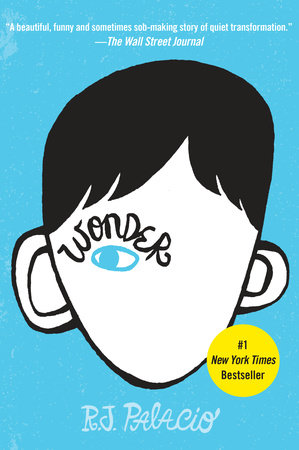
Auggie, or, August Pullman, is a fictional character from R. J. Palacio’s book for 9-12 year olds, but he’s as real as my neighbor’s son, or even, my own. That’s the power of Palacio’s nuanced and realistic writing. This is a book for all ages, a required reading for every human being if I have my way, for Palacio has painted a perfect world.

In a perfect world, there are still babies born with facial abnormality. But that little life is still wrapped with warmth and cuddled with love and acceptance.

In a perfect world, that child will grow up not thinking himself ‘different’ or deficient, but as normal as any other kid his age. He can still enjoy reading his comics, be read to and tugged in at bedtime, master video games, watch Star War movies, play with his light saber, hug his doggie, and all those he loves: mom, dad and older sis. The child knows no deficiency.

In a perfect world, even after that child steps out of his well protected, comfort zone and ventures precariously into the reality of middle school, he can still find friends, however few at the beginning.

In a perfect world, there are still bullies and jerks. The child will still have to face incredulous challenges and learn to ignore horrible remarks more distorted than his facial features. In a perfect world, even in this seemingly cruel microcosm of the human society, this child can still find love, support, acceptance, and life-sustaining kindness.

In a perfect world, that child is considered a gift and a blessing, a challenge for us to be better human beings.

In a perfect world, good will overcome evil.

Seldom does a children’s book has such power over me. Actually, seldom do I read a children’s book, haven’t for a long, long while. But glad I’ve discovered Wonder. Auggie will live in my mind for a while even now that I’ve finished the book. I wish author R. J. Palacio’s Choose Kind anti-bullying movement will continue to flourish.

A book like this deserves a good movie adaptation. A recent announcement has given me hope that a worthy one might be on the drawing board. Well, just with the two being cast so far. Jacob Tremblay, the wonder boy who plays Jack in the acclaimed movie adaptation of Emma Donoghue’s Room is to play Auggie. His mom? Julia Roberts. As a mother of 10 and 8 year-olds, Roberts would have some insights to instill into her role.


***

In Other Words: Lahiri’s Reconstruction of Self

In Other Words book cover

A couple of years ago, I was surprised to read about Jhumpa Lahiri moving to Italy to live, even just for a few years. Author of four works of fiction – Interpreter of Maladies, The Namesake, Unaccustomed Earth, and The Lowland – at the prime of her writing and teaching career, having received the O. Henry Award in 1999, the Pulitzer in 2000, and her latest The Lowland shortlisted for the Booker in 2013, Lahiri decided to uproot her family and move to Italy to totally immerse in the Italian language. That means speaking, reading and writing in Italian.

In Other Words is Lahiri’s brave and candid account as a language learner. It compiles twenty-one essays and two short stories which she wrote in Italian. She uses the metaphor of swimming out into the lake instead of safely hugging the shore to refer to her Italian language learning experience. From her descriptions of the challenges and risks, the loss of anchor, the inability to express herself and be literate, let alone literary, the disorientation, the total humbling, her Italian venture is more like jumping off a precipice to billowy waters of unfathomable depth.

My hat off to Lahiri’s honest revealing of her frustrations and strive for a new identity; yes, after all, language is a major determinant of identity, one which is, unfortunately, superseded by one’s outer appearance and racial features. So it is heart-wrenching to read that despite her love of the Italian language, her total devotion to adopt it not just to live but as a tool of her trade as a writer, she is often seen as an outsider, a foreigner, barred from acceptance. Even when she speaks to Italians fluently in their language, they would respond to her in English.

English, that’s the rub. I was surprised to read that, while the author had achieved so much in her literary career as a writer in English, she chose to discard it to totally immerse in Italian. In the chapter entitled “The Metamorphosis”, she candidly admits that her writing in Italian (which she had been learning in America for some twenty years before) is a flight:

“Why am I fleeing? What is pursuing me? Who wants to restrain me?
The most obvious answer is the English language. But I think it’s not so
much English in itself as everything the language has symbolized for me…
It has represented a culture that had to be mastered, interpreted. I was
afraid that it meant a break between me and my parents. English denotes
a heavy, burdensome aspect of my past. I’m tired of it….”

Of course, that’s also the language that she loved, and succeeded with. The conflict in identity, first as an Indian immigrant with Bangali as her mother tongue, then as a writer in English who had garnered the Pulitzer Prize – an award that she felt she did not deserve – had shrouded her with unresolved tensions. Lahiri had felt deeply the tug of war between her parental heritage and adopted land. A rejection of both had silently crept in. Italian provides a way out:

“Italian offers me a very different literary path. As a writer I can demolish
myself, I can reconstruct myself, I can join words together and work on
sentences without ever being considered an expert. I’m bound to fail when
I write in Italian, but, unlike my sense of failure in the past, this doesn’t
torment or grieve me.”

Unbelievably surprising and honest, written in Italian and translated by The New Yorker editor Ann Goldstein, the bilingual book opens up to a dual English and Italian version. The short essays chronicle the progress of not only an insightful identity search and reconstruction of selfhood, but an invaluable personal documentation of second – no, additional – language learning journey. If this book was published a couple of decades earlier, I would likely have another topic for my thesis in my graduate work on second language learning; not only that, my view of English being the lingua franca, the language holding linguistic hegemony, would have completely changed as well.

After reading In Other Words and my surprising discovery of Lahiri’s ‘tormenting sense of failure’ with the English language (for all its symbolic meaning) or even her ‘undeserving’ feeling towards her award in her writing, I am relieved of a hidden burden. I don’t feel so badly about having had to constantly check and re-check my English: prepositions, idiomatic expressions, phrasal verbs usage, subject verb agreement… All the hurdles that confront me every time I write a post or an article. If Lahiri can be so candid about her frustrations and errors when it comes to language learning, why can’t I?

~ ~ ~ ~ Ripples 

***

My thanks to Asian American Press for allowing me to post my book review here on Ripple Effects. The last paragraph is added in just for my Ripple readers.

Related Posts on Ripple Effects:

 The Namesake by Jhumpa Lahiri: Book Review

The Namesake (2006, DVD): Movie Review

Unaccustomed Earth by Jhumpa Lahiri


Downton Abbey Season 6 Finale: Goodbye to All That

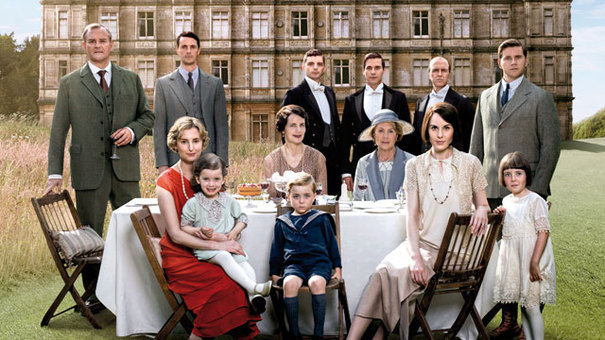
With the Finale of Downton’s last Season wrapping up the six-year serial, we’ve come to the end of an era. Ok, maybe not an era, but definitely the end of a saga. What exactly are we saying goodbye to? That’s a worthy subject to discuss.

The Finale on Sunday night (March 6, 2016: A date to remember) is the epitome of what Downton is all about.

Downton-Abbey-season-6


We’re saying goodbye to:

Multiple characters with multiple storylines told in equal appeal. Depending on your favourites, some of course are more appealing than others. Scribe Julian’s forte is in telling many tales at the same time. How did he do that? With the stopwatch on my iPhone, I notice that many of these fast-paced scenes are no more than one minute in length. More important scenes run longer. Take e.g. the one with Bertie and Edith at the Ritz’s surprised dinner, secretly arranged by a repentant Mary, lasted three minutes. Yes, only three minutes.

The old-fashioned goodness, kindness, honesty, courage, and even altruistic chivalry, are presented in a favourable light and not as acerbic laughing stock or shrouded with sarcasm. The value of overcoming evil with good is the prevalent virtue throughout. Why, even the once in-house villain, Thomas Barrow, can be turned around by the kindness of everyone; not only that, he can even replace Mr. Carson as the butler of Downton.

The retirement of Carson means we’re saying goodbye to an era of unquestionable loyalty. Think of the butler Mr. Stevens (Anthony Hopkins) in the film adaptation of Ishiguro’s The Remains of the Day (1993), where nothing interrupts his sacred duties as a butler, not even his own father’s death, needless to say, unrequited love from Miss Kenton (Emma Thompson). While scribe Julian captures the hearts of viewers by gratifying us with the union of Mr. Carson and Mrs. Hughes, the surprised retirement of Mr. Carson in the last episode in a way is an end of that total devotion of a servant to his master. I’m sure Barrow won’t be as die-hard a Crawley loyalist as Carson is.

Even trite dialogues, when delivered by an expert actor, can be effective and even inspiring. Why, something like: “Make peace with your sister, then make peace with yourself” doesn’t sound like a contrived word of wisdom from a Kung Fu Master to Grasshopper, but from Maggie Smith’s mouth, becomes a genuine, heartfelt advice from a loving grandmother to a wayward granddaughter. That line is from the second last episode, setting the stage for Edith’s reconciliation with Bertie in the Finale. And the world is made peaceful as a result, with the rival sisters at peace with each other.

Grand mansions and castles as the setting for a TV series. I’m not saying there won’t be any more Highclere’s out there waiting to be used as filming location, but such an opportunity of using a classy, old mansion in situ sure doesn’t come by often. The Grand Finale shows us even that there are grander estates than Highclere. In a reversal of fortune, Edith gets to live in an even more magnificent property than Mary. Yes, Edith sure has found her Mr. Darcy and Pemberley. And I’m happy for her.

Old status quo being taken for granted. Downton is not about the maintenance of aristocracy, but the torrential changes that bombard traditions and social structure. The very first episode of Season 1 is a significant symbol. The thought-to-be unsinkable Titanic came to a tragic end; later, with WWI comes the break down of social status and yes, even the aristocrats suffered casualties. All men are equal in the face of death and destruction. In real life, that Highclere Castle was used as a convalescent home was an exemplar of how the war had brought about changes.

Are we also saying goodbye’s to traditional TV productions,  or the conventional platforms of broadcasting? The blurring of the line between movies and TV productions could mean  new kind of shows in the future. While the methods may be different, let’s hope the quality and values can be maintained no matter what change may come.

What’s your take on the last Season Finale of Downton Abbey?

***

Previously on Downton Abbey Season 6:

Episode 1

Episode 2

Episode 3

Episode 4

Episode 5


Downton Abbey S6 Episode 6

An episode of romantic linking and midlife career changes. First the pairing of some main characters: Mary and Henry Talbot, Edith and Bertie Pelham, Isobel and Lord Merton, (again), Mrs. Patmore and Mr. Mason (now, what’s with Daisy spoiling the fun?) And Baxter and Coyle? Not a reunion I hope.

Midlife career changes are thrusted upon other characters. The most important one is Cora, a job that she has never dreamed of, or dared to think about. Crossing Violet? Definitely not her own choosing. On second thought, after a career of bringing up three daughters, now she’s ready for another challenge. Being the President of the merger of the village hospital with York’s, she’s ushered into a brave new world. Now, that sounds like a much easier task than her previous job.

As for Molesley, his midlife career change is something he hasn’t dared to entertain before, beyond his wildest dream. Need to pass an exam first, but still very exciting. It’s interesting to see that his open tuition to help Daisy is so well received and respected by everyone, while Barrow’s secret tutorial offered to Andy is met with suspicion. But kudos to him for keeping Andy’s problem confidential. O Mr. Barrow, can you ever redeem yourself?

So Barrow is now the in-house piggy backer. The position of under butler is soon to be obsolete. Looks like Mr. Carson has a clearer view of occupational trends than Barrow: “In twenty years time I doubt there’s one footman working at Downton.” Or a lady’s maid, for that matter. Nothing personal, just the end of the aristocratic era. So when Season 6 ends, we’re saying goodbye to all that.

Mr. Carson, you won’t be long either, I’m afraid. The butler too will soon become “a post that is fragrant with memories of a lost world…” Eloquent with words strung up like that can sure open doors for you if it’s your time to leave. Prepare for the day when you’ll have no one to polish your cutlery or fold that bedsheet into sharp corners. Poor Mrs. Hughes, I knew her decision to have the wedding reception at the local school would be her last autonomous say. Would the real Mrs. Hughes please stand up? I sure miss you.

Downton Open House

The main attraction of the episode is the Downton Open House for the local hospital, a charity event. Wait a minute, charging people to come look at your living quarters? Who would want to pay? Yes, as Isobel Crawley says, “even Elizabeth Bennet wanted to see what Pemberley was like inside.” But that’s different though. For one thing, she didn’t have to pay; further, she got a bonus seeing Darcy in a wet shirt. Now, Barrow, since you’ve already warmed up with odd jobs like offering piggyback rides to the kids, get ready to jump into the pond.

No worries, people line up to pay to get in. Good idea! Tom’s business mind quickly turns and comes out with a wonderful idea. Wouldn’t that be a fine source of revenue to help maintain the huge mansion? Sounds like a version of reality. Isn’t Scribe Julian describing Highclere Castle where Downton is filmed?

But still, the question remains in some of their visitors’ mind I’m sure. Why, the pint-size philosopher who pops into Lord Grantham’s bedroom has posed a legit question: why not buy somewhere comfy instead of living in such a big house? Well son, it’s a long story. Never mind that. But one thing we can agree upon, it’s our mothers. They get terribly wrought up about things.

In this episode, we get to see another side of Lord Grantham. He looks like a totally bored little boy trying to entertain himself with all sorts of funnies while sick in bed. Mary in the bath? O my, wait till Mommy hears that.

To London again, Mary brings Anna to see Dr. Ryder, and thank God it’s just normal pregnancy discomfort. But what a great opportunity to do some side shows like… surprise! Henry Talbot must feel like he’s lured by a racing trophy. What a catch, Mary Crawley. Here’s the funny thing, looks like Mary is encouraging Henry Talbot, but when he does get close, she rejects him somehow.

Certainly, she has her bad memory. Matthew died in a car crash. But is that all that’s holding her back with Henry Talbot? Or is it the idea of marrying down? Or too fast too soon? Don’t forget, Mary, Henry’s a race car driver. Time is of the essence. Speed is the thrill. Occupational hazards, no, skill sets.

And romantic characters have the rain to thank, for usually what happens when sudden rain befalls, somehow that would lead to a private escape resulting in the first kiss. It happens in Woody Allen movies and it can happen right here in Downton Abbey.

In contrast, Edith and Bertie are enjoying some smooth sailing, despite Mary’s skepticism. Mary, you need to know, any man willing to take Edith plus a child must be genuinely in love with her. So, Marigold could well be the tester of true intention.

Your take on this episode?

***

With this recap, Arti is taking a hiatus from the pond. There are 600+ posts on Ripple, you’re welcome to spend your time lingering still and throw in your two pebbles. Hope they can hold your interest until Arti’s return.

***

Previously on Downton Abbey Season 6:

Episode 1

Episode 2

Episode 3

Episode 4

Episode 5