Vermeer in Vancouver: Noticing the Obvious

For more Vermeer, Click Here to go to my post “Inspired By Vermeer”.

Vancouver Art Gallery’s premier summer kick-off is the impressive exhibition: Vermeer, Rembrandt and the Golden Age of Dutch Art. The exclusive show of masterpieces from Amsterdam’s renowned Rijksmuseum includes paintings, drawings, and decorative arts from 17th century Holland. After five hours at the Gallery, I left hungry for more Vermeer. Overall it was gratifying, but I was expecting just a few more glimpses of the great master.

Of all the 128 pieces of art work, there’s just one Vermeer painting. Placed at the end of the exhibit, apparently the highlight and climax of the show, is Vermeer’s Love Letter (1669). From his signature point of view, peeking through a partial opening of pulled-back curtain, we look into another room and see a maid just handed her mistress a letter. By the exchange of their glances, it seems they’re sharing a secret understanding. This is another one of Vermeer’s works that’s full of potential stories and rich in subtexts. Actually anyone of them is a novel to be written, not less dramatic as Girl With A Pearl Earring.

Vermeer's The Love Letter

Love Letter by Vermeer (1669-70)

~~

17th century Holland was a new Republic that had just gained independence from Spanish rule. The beginning of the exhibits sets the stage depicting a young nation with great maritime power. Domestically, it was a country marked by a vibrant economy and a rising middle class, as well as the flowering of arts and science, architecture and urban planning.

In the midst of such affluence and fresh hope, some of the artists spoke with their brushes as prophets of their time. Among paintings of naval glory and conquests, as well as glimpses of domestic life of the rich, there are also the quiet displays of still life. I must have seen them before. Why have I not noticed their significance previously?

They are paintings of withered blossoms, burnt out candles, hourglasses, books and musical instruments, and most prominently, skulls, eerie arrays of them, decaying bones and teeth. Why all these objects? The audio commentary confirms that they are Vanitas still life, the term rooted in Ecclesiastes, “Vanity of vanities.” And obviously, they are symbols of the fleeting nature of life, the callous passage of time, the transience of knowledge and human achievements:

Pieter Claesz Vanitas Still Life

Pieter Claesz: Vanitas Still Life (1628)

~

Skulls on a Table

Aelbert Jansz van der Schoor: Skulls on a Table (1660)

~

On the piece of writing crumpled up is one last word, Finis, The End:
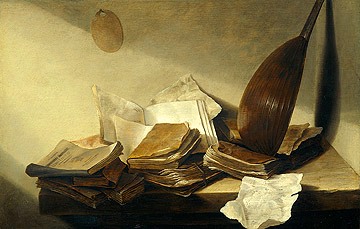
Still Life with Books Jan de Heem

Jan Davidsz de Heem, Still Life with Books (1625-29)

It’s commendable that the rich and powerful were willing to be reminded thus, considering these were once paintings adorning the walls of their affluent homes, a nagging presence they could not ignore. And they must have paid to have them painted.

~~

One of my favorites in the exhibition is Nicolaes Maes’ Old Woman in Prayer. Maes, a student of Rembrandt, had captured the simple piety of the old woman of lowly means: her earnest concentration, wrinkled face and hardened hands, the earthen wares and simple meal, and above all, her meager possessions on the ledge, an open Bible, a lamp, an hourglass and a prayer book. The warm light on her face almost makes her look divine. Maes did not forget to include a comic relief, her cat at the lower right bottom must have known what’s for dinner:

Nicolaes Maes Old Woman in Prayer

Nicolaes Maes: Old Woman in Prayer (1650-60)

~~

Sources: Skulls on a Table from Vancouver Sun. All other paintings in this post: Rijkmuseum, Amsterdam.

The Appeal and Fallout of the Susan Boyle Phenomenon

Update:  CLICK HERE to read my post on Susan Boyle’s debut Album ‘I Dreamed A Dream’.

By now, tens of millions have converged on YouTube to watch the sensational phenomenon of Susan Boyle, the middle-age woman from Scotland on Britain’s Got Talent.  Arti has waited for the dust to settle a bit before commenting, allowing her hindsight to catch up.

So, what’s the appeal of Susan Boyle?  The planned and scripted intention of the producer and judges aside, what is so attractive about the 47 year-old woman?  Is it the plain, country look, the greying frizzy hair, the unkempt and overweight physique?  In this image-driven, urbane society of ours, these features definitely aren’t valuable assets.  Or, as so many have claimed, it’s her voice that has enthralled us all.  Yes,  the lady certainly has potential and talent in this regard.   But truth be told, could Susan Boyle have garnered so much praise if she had looked differently?

The universal appeal of Susan Boyle is the mismatch of her look with her voice, a perceived dissonance based on a prejudiced, preconceived notion marking viewers’ expectations.   What talent could a middle-age, plain-looking, hamlet-dwelling woman have?  The public has a real fun case of being fooled.  Ha, the joke is on us.  We’ve been wrong all along.  Unattractive bodies can be talented personalities.  And the audience had enjoyed the twist and surprise.  Susan Boyle’s  TV appearance provides real entertainment value, albeit manipulative according to skeptics of reality shows.  Simon Cowell should be most gratified.   It’s all about the ratings, and future record sales.

susan-boyles-new-lookBut wait, don’t speak too soon.  Now the 47 year-old has a few hairs on her eyebrows plucked, her unruly lock trimmed and dyed a younger look, donned some neater attire.  Lo and behold, the mismatch has diminished.  As the excitement wanes, criticisms arise.  “She shouldn’t change too much,” the public decries.  “That’s the limit that she should go, no further,” the critics advise.  Wouldn’t it be terrible if Susan Boyles decides to join Weight Watchers.  Of course she shouldn’t, it’ll be much less entertaining.

What have we become now?  Spectators of a freak show in a circus?  What about those lyrics that have enthralled us initially?  Can a woman not be allowed to have her own way, make her own decision to change or not, choose her own lifestyle, and interpret her own dream?  Is she selling her soul just by having a facial?  I’m afraid Susan Boyle is no match for our sensationalism and thrill-seeking crowd of  reality TV viewers, or the humongous entertainment business looking to generate more profits in whatever way possible.

I worry too that the overnight rise to stardom is making Susan Boyle equally vulnerable to become an instant victim of the fallout.  A trampled rose or discarded weed, they meet the same destiny.  Of course, I wish her well and that the pursuit of her dream will not become a nightmare in the callous arena of public opinion.

The curious case of Susan Boyle also reminds me of another woman with talent living in obscurity two hundred years ago.  She was a bit younger,  living in rural England, striving to be herself in the pursuit of her dream to become a writer.  Sadly, she did not live to middle-age, nor see her name credited to her work.  To avoid fallouts and social reverberations, she had to seek anonymity.  Now we know her as Jane Austen.

The lyrics of that tune still sound poignant:  “After changes upon changes, we’re more or less the same;  after changes, we’re more or less the same…”

Photo Credit:  Andrew Milligan/PA,  Source: Times Online http://entertainment.timesonline.co.uk/tol/arts_and_entertainment/tv_and_radio/article6161198.ece

***

Original writing by Arti of Ripple Effects.  ALL RIGHTS RESERVED.  If you are reading this on a website other than Ripple Effects, you are reading a post that has been copied without permission.  Go to https://rippleeffects.wordpress.com to read this and other original and interesting articles on entertainment, books and movies.

National Poetry Month

April is National Poetry Month.  I’m glad we still celebrate poetry in this day of ephemeral twittering.  W. H. Auden once described poetry as “memorable speech”.  As millions upon millions join in on-line chats, exchanging the most trivial of their everyday life unreservedly, and even addictively all day long, how we need poetry all the more, to create lines that strive for some memorable quality worthy of keeping.

The late Canadian communication guru Marshall McLuhan was right, the medium is the message.   And such is the message of our time.  Mind you, I’m no Luddite, my iPhone is evidence.  I’ve gone through this before, so I’m not going to dwell on it here again.  It’s just that the rash and temporal nature of our medium, and mode, for that matter,  make me long for quality and permanence.

After posting an excerpt of  T.S. Eliot’s poetry in my last entry, I just didn’t have enough.  I re-read and explored more of his work and was amazed at how prophetic his vision was.  To celebrate National Poetry Month, here’s Arti’s selections of  lines from the work of T.S. Eliot, just for our post-modern, Facebook and Twitter generation.

nighthawk-by-edward-hopper

Twit twit twit

Jug jug “>jug jug jug jug jug

So rudely forc’d.

— The Waste Land (1922)


Teach us to care and not to care
Teach us to sit still.

— Ash Wednesday (1930)


There will be time, there will be time
To prepare a face to meet the faces that you meet;

….

Do I dare
Disturb the universe?
In a minute there is time
For decisions and revisions which a minute will reverse.

For I have known them all already, known them all: —
Have known the evenings, mornings, afternoons,
I have measured out my life with coffee spoons;

….

In the room the women come and go
Talking of Michelangelo.

— The Love Song of J. Alfred Prufrock (1915)


The endless cycle of idea and action,
Endless invention, endless experiment,
Brings knowledge of motion, but not of stillness;
Knowledge of speech, but not of silence;
Knowledge of words, and ignorance of The Word.

All our knowledge brings us nearer to our ignorance,
All our ignorance brings us nearer to death,
But nearness to death no nearer to God.
Where is the Life we have lost in living?
Where is the wisdom we have lost in knowledge?
Where is the knowledge we have lost in information?
The cycles of Heaven in twenty centuries
Brings us farther from God and nearer to the Dust.

— Choruses from The Rock (1934)


****

Visual: Nighthawks (1942) by Edward Hopper.  CLICK HERE FOR MORE EDWARD HOPPER.

Stream of Easter Consciousness

stained-glass-2a2So students are sent back to school this week, just in time for Easter.  Nobody wants to have a holiday right on Easter week, especially the public school board.  That’s how you survive,  by being politically correct.  And the last two weeks’ holiday is called Spring Break of course.   Easter has almost become a banned word, like Christmas.  Who wants to be rude and offend others, we’re Canadians after all.

I know,  it’s not totally a taboo yet.  It’s a much tamer word, Easter, than Christmas, just because it doesn’t have the six-lettered word in it.  You can curse with that name, but no, God forbid you should say it in a proper context.   I can see you sneer, what’s a proper context, you ask.  You’re right of course, no word or context is more proper than others, we’re egalitarians after all.  As for Easter, as long as it’s synonymous with eggs and bunnies, pastels and flowers then it’ll never die.  Who needs resurrections?

All Fridays are good.  They even have a whole restaurant chain commemorating the day.  What’s it called… yes,  T.G.I. Friday’s.  Who says we’re not religious, we thank God for happy hours.  We’re much more open-minded now,  more civilized, equal and fair, don’t want to pick one day to be better than the others.  But definitely we won’t forget Ramadan, or the Chinese New Year.

There’s probably no God,  so stop worrying and enjoy your life, the sign on the bus says.  So we’re safe?   Whew!  No God means we can now be happy, worry free, all life, no death, …  Umm just let me figure this one out.  Give me a minute, I’m just not as smart as them.

Jesus wept.  He wept at the graveside of Lazarus, brother of his dear friends Martha and Mary.  He wept at the fragility of life.  He wept at the searing pain of separation.  He wept at the hopeless and uncomprehending expression on Mary’s face, even after he said to her I am the resurrection and the life.

Fleming Rutledge said more than ten years ago:  “I am deeply convicted, more so each year, of the profound sinfulness of the human race.  Yet because of the Cross and Resurrection of Jesus Christ — because of that and nothing else, because of that and nothing less — I am also convicted of the truth of what the Bible tells us about God’s plan of salvation.  The rainbow bridge does not lead to Valhalla, where the gods quarrel so much that they destroy themselves.  The rainbow bridge leads to the Cross and to the empty tomb on Easter Day.”

Utterly politically incorrect!  Who uses the word sin anymore?  Who’s Fleming Rutledge, anyway.  Never heard of him.  No?  It’s a she?  No wonder.

Now these words echo loud and clear too, written by T. S. Eliot in… what, 1934?  Aren’t they a bit archaic now?  Or, maybe they’re really prophetic:

Where is the Life we have lost in living?
Where is the wisdom we have lost in knowledge?

Where is the knowledge we have lost in information?

The cycles of Heaven in twenty centuries

Bring us farther from God and nearer to the Dust.

We should go on living, be happy and worry-free, the sign on the bus says.

So we go on living…

and Jesus still weeps.

stained-glass-41

*****

Original photos and text copyright by Ripple Effects, https://rippleeffects.wordpress.com, April 2009.  All Rights Reserved.

No Texting for Lent and The End of Solitude

Roman Catholic Bishops in Italy have added some contemporary relevance in the fasting tradition during Lent:  High Tech Fast.  The faithful are urged to free themselves from the bondage of technology and gadgets, and refrain from surfing, emailing, twittering, texting … in order to prepare themselves for Easter.  This could prove to be a penance much harder to practice than not eating meat, even just on Fridays, for texting could well be the newest form of addiction today.

At about the same time, I heard an interview on the CBC Radio program Spark.  Host Nora Young conducted an interview with William Deresiewicz, literary critic and essayist, who has recently written an article entitled ‘The End of Solitude’.

Deresiewicz taught at Yale from 1998 to 2008.  When he asked his students what place solitude had in their lives, he got this reply: “Why would anyone want to be alone?”

With the ubiquitous use of high tech gadgets, and the torrents of Internet social networks around us, we are caught in a web of connectivity like never before:

Not long ago, it was easy to feel lonely.  Now, it is impossible to be alone.

Not only that, the goal now seems to be to gain as much self-exposure as possible, to be visible.  It seems that the number of friends we have on Facebook, and the number of hits on our blog directly leads to our self-esteem and our quality of self.  The irony is, the pseudo and the virtual are substituting the genuine and the authentic.

What does friendship mean when you have 532 “friends”?  How does it enhance my sense of closeness when my Facebook News Feed tells me that Sally Smith (whom I haven’t seen since high school, and wasn’t all that friendly with even then) ‘is making coffee and staring off into space’?

Deresiewicz notes that solitude used to be a desirable social value.  From religious sages to the Romantics like Wordsworth, solitude is the channel one hears the still, small voice of God, or heed the beckoning of Nature.  As modernism crept in,  the literati turned inward to find validation of self, like Woolf, Joyce, Proust.

Then came urbanization and suburbanization.  The generation that used to vegetate in front of the TV has given way to the child of the Internet, the networked self.  And we no longer believe in the solitary mind.

So what does it matter when we have lost the moments to be alone?  What have we lost?

First, the propensity for introspection, that examination of the self that the Puritans, and the Romantics, and the modernists (and Socrates, for that matter) placed at the center of spiritual life — of wisdom, of conduct.

Also, the urge to be instantly connected has bred a new generation of skippers and skimmers, replacing readers.

… five minutes on the same Web page is considered an eternity

No wonder we’re told to keep our blog posts short if we want to attract readership.

With the loss of the capacity for solitude, we’ve lost the ability to cultivate depth of self  and create independent thinking.  Emerson said that “Solitude is to genius the stern friend.”  Deresiewicz goes on to say:

…no real excellence, personal or social, artistic, philosophical, scientific or moral, can arise without solitude.

The irony is, the more we are connected with the virtual world out there, the less we are connected with ourselves inwardly.  But this is what’s valued nowadays, isn’t it, to be open, sociable, gregarious.  But to maintain a sense of authentic self, we may have to sacrifice popularity, to be not so polite:

Thoreau understood that securing one’s self-possession was worth a few wounded feelings.  He may have put his neighbors off, but at least he was sure of himself.

Those who would find solitude must not be afraid to stand alone.

Maybe this is one meaningful connection we should strive for: solitude, introspection, slow blogging, quality thinking, quality reading, quality writing, quality self.

****

Click here to listen to the full interview.

Click here to read the article ‘The End of Solitude’ by William Deresiewicz.

Click here to read my review of Sherry Turkle’s Alone Together

Click here to read my post on Virginia Woolf’s A Room of One’s Own in which she explored the privilege of Solitude.


Time’s 25 Best Blogs 2009

Just when Arti is wondering how to spend the next 48 hours before Sunday’s Academy Awards, an incoming link pops up on her dashboard.  It is a blog talking about Time’s recent selection of  25 Best Blogs for 2009.   A stroke of glamour no less than the golden Oscar flashes across Arti’s muddled mind… huh, Ripple Effects got linked to what?  The researcher in Arti quickly heeds the call to check it out.   No, Ripple Effects is not on the list.  Slap, slap, wake up, this is the real world now… it’s just that one of Ripple Effects’ posts got linked by WordPress’ auto-generated linking mechanism.  In the huge blogosphere out there, being chosen as one of the top 25 blogs is just got to be harder than winning the Oscars.  What am I thinking.

For those interested in the curious case of  Time’s 25 Best Blogs of 2009, here is the list and the subject matter of the blogs:

  1. Talk Points Memo — Political
  2. The Huffington Post — Political
  3. Lifehacker — “Tips and downloads”
  4. Metafilter — Wikiweblog
  5. The Daily Dish — Atlantic Andrew Sullivan’s Political blog
  6. Freakonomics — NY Times Stephen Dubner and Levitt, Economics
  7. BoingBoing — Technology and fringe culture
  8. Got2BeGreen — Environment
  9. Zen Habits — Self-help and motivational
  10. The Conscience of a Liberal:  NY Times Paul Krugman, Nobel Laureate, Economics
  11. Crooks and Liars — Political
  12. Generación Y — Political
  13. Mashable — Social Networking
  14. Slashfood — Food
  15. The Official Google Blog — Business
  16. synthesis — opinions & ideas
  17. bleat — life in retro
  18. /Film — Films and Video Games
  19. Seth Godin’s Blog — Marketing
  20. Deadspin — Sports
  21. Dooce — Heather Armstrong on a female life
  22. The Pioneer Woman — Ree Drummond on a female pioneer life
  23. Said the Gramophone — Music
  24. Detention Slip — cheat sheet for education news
  25. Bad Astronomy — in praise of real science

So, here they are, your celebrities, the blockbusters of the blogosphere, some attracting millions of page views per month, the Hollywood Oscar scene of blogging.  But I must say I regret to see there are no blogs on the list that are dedicated to the arts or books.  Further, hats off to all those who write in obscurity, like many of my favorites.  They are the solitary bloggers who quietly express their views towards life’s issues, or share their love of a book, response to a film, or simply capture a moving moment, blogs that deserve to be read just the same as the blockbusters.

Maybe there needs to be an indie blogging recognition, like in the film industry, an Independent Spirit Award for bloggers who write and toil just for the simple pleasure of observing, expressing, sharing, and celebrating the essence of being human.  No glamour, no red carpet.

*****

P.S.  Ok, they have the red carpet too at the Spirit Awards and glamour automatically comes with that I suppose… Anyway, I’m sure you get my point.


Reading the Season: A Grief Observed by C. S. Lewis

c-s-lewis2To embrace the Christmas season in a more meaningful way, I’ve been trying to stay close to the heart of the matter by reading.
A Grief Observed by C. S. Lewis is one of my selections. Now, of all the wonderful books by the Oxford scholar, why would I choose this title for the Season?

From my reading of Joan Didion’s The year of Magical Thinking, I learned that during her mourning for the loss of her husband, she had read C. S. Lewis’ A Grief Observed. That sparked my curiosity. After finishing Didion, I turned right away to explore Lewis’s book about his own experience of loss.

After 58 years of bachelorhood, Lewis found the love of his life in Helen Joy Gresham, an American author who had come all the way to England in search of a genuine and credible faith. Their love story is poignantly portrayed in the movie Shadowlands (1993). In Helen Joy Gresham (‘H’ in the book),  Lewis found his equal in wit, intellect, and a faith that had endured testing and evolved from atheism to agnosticism and ultimately reaching irrevocable belief. Lewis entered into marriage with Joy at her hospital bed as she was fighting bone cancer. She did have a period of remission afterwards, during which the two enjoyed some traveling together. Regretfully, only four years into their marriage, Joy succumbed to her illness.

shadowlands

A Grief Observed is a courageous and honest disclosure of a very private pain. But what’s so different about this personal loss is that this prominent Christian apologist, acclaimed academic and writer, was willing to lay bare his questioning mind and disquiet heart to his readers. As his step-son Douglas Gresham wrote in the Introduction, the book is “a man emotionally naked in his own Gethsemane”. By crying out in anguish and exposing his torments, he shared his personal journey of painfully seeking the meaning of death, marriage, faith, and the nature of God. Lewis was brave enough to question “Where is God?” during his most desperate moments, when his heart was torn apart by searing pain and his intellect failed him with any rational answers.

Gradually he came out of despair realizing that the loudness of his screams might have drowned out the still, small voice speaking to him.

The time when there is nothing at all in your soul except a cry for help may be just the time when God can’t give it:  you are like the drowning man who can’t be helped because he clutches and grabs…

After all, you must have a capacity to receive, or even omnipotence can’t give.

After the fog of doubt has dispersed and the dust of despair has settled, Lewis saw the dawning of a gentle glimmer. He realized that he had been mourning a faint image or memory of his beloved, but not beholding the reality of her. The fickleness of his senses offered only fading fragments of her image. However, it is in praise that he could enjoy her the best.

I have discovered, passionate grief does not link us with the dead but cuts us off from them. This become clearer and clearer.  It is just at those moments when I feel least sorrow–getting into my morning bath is usually one of them–that H. rushes upon my mind in her full reality, her otherness.

Praise is the mode of love which always has some element of joy in it. Praise in due order; of Him as the giver, of her as the gift.

Further, as with God, he knew he should grasp the reality, not just the image.  He should treasure God Himself, not just the idea of Him:

I need Christ, not something that resembles Him.  I want H., not something that is like her.

Upon this revelation, Lewis powerfully points out that the Incarnation, the Word becoming flesh, is how God reveals Himself to us in His full reality.  Our ideas of God are shattered by Christ Himself.

The Incarnation… leaves all previous ideas of the Messiah in ruins.  And most are ‘offended’ by the iconoclasm; and blessed are those who are not.

As Christmas draws near, I ponder once again the humbling of the Creator God, born a babe to grow up to experience the full spectrum of being human, showing us by His life and death the reality of God, an iconoclastic act only He can perform.

Lewis has drawn me to the heart of the matter, the crux of the Season:

And the Word became flesh and dwelt among us, and we have seen his glory, glory as of the only Son from the Father, full of grace and truth.

— John 1:14

*****

‘Reading The Season’ Posts over a Decade:

2020: Jack by Marilynne Robinson

2019: ‘A Hidden Life’ – A Film for the Season

2018: A Verse from Madeleine L’Engle’s The Irrational Season

2017: A Wrinkle in Time by Madeleine L’Engle

2016: Silence by Shusaku Endo

2015: The Book of Ruth

2014: Lila by Marilynne Robinson

2012: Surprised by Joy by C. S. Lewis

2011: Walking on Water by Madeleine L’Engle 

2010: A Widening Light by Luci Shaw

2009: The Irrational Season by Madeleine L’Engle

2008: The Bible and the New York Times by Fleming Rutledge 

2008: A Grief Observed by C. S. Lewis

Slow Blogging and the Long Take

Recently, I’ve been mulling over the notion of slow blogging, a movement that is gradually gaining attention. I first read about it in a blog I frequent.  In her post entitled “Slow, Stefanie has drawn out the essence of what slow blogging is. It’s all about thinking through, reading and studying in depth, chewing and digesting, and finally putting something meaningful down in words. I don’t know who initiated the idea. It may have sprouted up from various bloggers, those who care about the quality of their writing, and the effects of their posts. I urge my readers to visit the Oxford University Press blog post on the subject, and the Slow Blog Manifesto.

Yes, a Slow Blog Manifesto, written by Todd Sieling dated back to September, 2006. But for some uncanny reasons, just as I was working on my draft of this very post, after I’ve linked the SBM to my draft, it has now been taken off the WWW.  Hope this is not an omen of things to come.  Fortunately, before its disappearance, I had the chance to read and mull over his words:

“Slow Blogging is a rejection of immediacy.  It is an affirmation that not all things worth reading are written quickly.”

(It’s back!  Todd Sieling has just re-posted his SBM. He has created a whole new site just for this.  Click here to go there.  You may want to read his comment at the end of this post. I’m just going to leave the following paragraph as is.)

But then, all is not lost.  Barbara Ganley’s BGBLOGGING is still standing.  Ganley had taught writing at Middlebury College in Vermont for some years until quiting her academic job in recent months and ventured into uncharted personal exploration.  She is an advocate of slow blogging, and related the idea to the term meditative blogging, way back in November 2006.  Here’s the link to that post.

After more than two years, the notion has finally reached Arti of Ripple Effects. As my blog name suggests, I thrive on hindsights and delayed resonance. I may not have immediate response to all that I come across, but for those ideas I find stimulating, I would delve into and mull over, research and read about them, sometimes for a long while, before I dare to put thoughts into words. I’m glad I have finally found a name for the kind of writing and thinking with which I feel most comfortable all along.

leaves-on-pavement-webpage2

And that is why I find a recent article in the November issue of ‘The Atlantic’ so disconcerting.  In his article entitled “Why I Blog”, Andrew Sullivan , the prominent political commentator and blogger, describes blogging as postmodern writing that thrives on its immediacy. By nature it is rash and temporal.

“It is the spontaneous expression of instant thought. As a blogger, you have to express yourself now, while your emotions roil, while your temper flares, while your humor lasts.”

What Sullivan is pronouncing is that you may have an instant platform accessible by all in the blogosphere, and with links authenticating your sources, but what you write is as ephemeral as your breath, as unreliable as your mood, and as momentary as your fleeting thoughts. Time is of the essence in the blogging world.

I can understand such a perspective may apply to political and news blogs, where bloggers’ views and comments are almost on a par with professional journalists, or where bloggers are journalists, such as Sullivan himself.

But I’d just like to remind Sullivan that there are also those of us for whom blogging is not about beating to the punch, or channeling rants and angsts, or climbing to a higher ranking and authority. What we write may seem like ramblings at times, but they are thoughts that have gone through regurgitation, pondering, and conscious self-censure. For the writing I read in some of the blogs I visit, their quality is not undermined by the self-publishing nature of blog writing.  Their message is no less important, their style no less eloquent, their impact no less powerful than many conventionally published materials.

pilings-in-astoria-slow-blogging

Around the same time, I came across the post on the long take in Brett McCracken’s blog The Search. Do click on the link there to read the whole essay when you are there.  The long take is a technique where a camera follows its subject for an extended period of time without cutting, capturing life in real time. Viewers looking for instant gratification and fast actions would often find the long take boring, incongruent to the normal pacing of a normal movie. But as blog writer and movie critic Brett McCracken reflects, the long take leads us to confront life in a real sense, in real time:

I go to movies to recapture time—that achingly pervasive burden that keeps us so unceasingly busy in our normal lives. In the movies, time is “free.” We need not worry about our own time; all that is required of us is that we cede our imagination to the screen, where time is footloose and fancy free, dancing to and fro in flashback, flashforward, slow-mo, still, etc.

voyage-du-ballon-rougeA vivid example is Hou Hsiao-Hsien’s Flight of the Red Balloon which I reviewed in my last post.  Who would want to sit in a theatre to watch a balloon slowly drifting above the urbanscape, other than those who enjoy the grace of unhurried moments, those who consciously seek for poetics in the mundane, and those who take time to ponder the meaning conveyed by the filmmaker.

Slow blogging and the long take, two powerful ways to glean the indelible essence of life.

*****

Art Imitates Life, Life Imitates Art, or…

Neither. After reading Tomalin and Shields on the life of Jane Austen, I am inclined to draw that conclusion. The often sanguine outlook of Austen’s works is deceptive.  The seemingly jovial ending may lead some to assume they are reading the simplistic stories of a woman wrapped in romantic bliss all her life.

Reality is, that Austen could persevere, write and published is already an incredible achievement considering the confining social environment she was in. Instead of embracing the normative female role in comfort, she chose to trod the road less traveled to become a writer despite the gloomy prospect of poor spinsterhood,  enduring rejection even from her own mother. She wrote in secret and struggled in isolation. For a long period she battled depression. Upon her death, her beloved sister Cassandra could not attend her funeral because the presence of females at such events was not sanctioned, apparently for fear of any outbursts of emotion.

It is Austen’s imagination that empowers her to break free of her reality and to rise above her constraints. She has created her art from the palette of  the imaginary, as Tomalin has lucidly observed:

Hampshire is missing from the novels, and none of the Austens’ neighbours, exotic, wicked or merely amusing, makes recognizable appearance.  The world of her imagination was separate and distinct from the world she inhabited.

Austen’s contemporary, the renowned Gothic writer Ann Radcliffe, has attested that it is the imagination and not real-life experience which gives rise to story-telling. A scene in the movie Becoming Jane (2007) has vividly illustrated this point.

In the famous little book, The Educated Imagination, a must-read for any literature student, the late great Canadian literary critic Northrop Frye states that :

The world of literature is a world where there is no reality except that of the human imagination.

Austen has great proficiency in the language of imagination. In her novels, she has created a world that never was, but one that makes her readers yearn for. There is no Mr. Darcy in real life, or Elizabeth Bennet for that matter, but we could well use them as the ideal types to measure by, or, to strive for.

What about the satirist in Austen? How can the social critic be extracted from reality?  How can one write social commentaries devoid of real life input? Austen may have toiled in isolation for fear of social repercussion, she did not write in a vacuum.  While her art did not imitate her life, Austen had the chance to sharpen her observation from the very public sitting-room of her home and those of her relatives and friends, an opportunity that was conducive to her novel writing, as Virginia Woolf has pointed out.  Ever since her childhood, the Austen home was the hub of family readings and discussions.  Her brothers grew up to be men well versed in the fields of the military, clergy, and business.

In her ingenious way, by satirizing the things that ought not to be, Austen is bringing out the world that ought to be. In Frye’s words:

The fundamental job of the imagination in ordinary life, then, is to produce, out of the society we have to live in, a vision of the society we want to live in.

If art imitates life, it would be just a reproduction; if life imitates art, well… ours would be one very wacky world. But life could well be the reason for creating art, channeling our imagination to build a sublime vision of the ideal.

Visual: Starry Night by Vincent van Gogh

Update: This article has just been published in the Jane Austen Centre Online Magazine. Click here to go there for other interesting reads on Jane Austen and the Regency World.


*****


First Blogaversary and Summer Wrap-up

Last year on this day, August 29, 2007, I began my blogging journey on WordPress.  One year and 104 posts later, this sputtering engine is still chugging along.  I’d like to think of my blogging experience as a road trip.  The kind of vehicle I have in mind is the VW van in the movie Little Miss Sunshine.  Almost an obsolete wreck and yet still functioning, just needs a little running push.   

It has been an eventful summer for me.  Having had to move twice and living out of a suitcase, sustaining the horrors of home renos, tending illness in the family, and caring for two elderly parents have put my life on hold…or maybe this is life.  All this time, I didn’t have easy access to the internet, no TV, or other high tech luxuries.  While my posts have been more sparse than I’d like, blogging, even though infrequent, has at least kept some kind of normalcy for me during this unsettling and chaotic period.

While I’ve missed many important events during these two months, such as Hilary’s concession speech, and the Olympics… I’ve been able to catch some summer flicks and read a few books.  As I take stock of this summer’s entertainment consumption, I’m surprised to find that my list is long despite the interruptions:

The following are straight from memory, in no particular order:

Movies seen at theatres:

  • Mamma Mia! 
  • The Dark Knight
  • Swing Vote
  • Brideshead Revisited

Live Musical:

  • Spamalot

DVD’s watched or re-watched:

  • Persuasion (1996)
  • Persuasion (2008)
  • Sketches of Frank Gehry (2005)
  • Life As A House (2001)
  • Eternal Sunshine of the Spotless Mind (2004)
  • Vantage Point (2008)
  • The Bank Job (2008)
  • Miss Pettigrew Lives for a Day (2008)
  • Plus about 25 titles previewed for a Film Festival

Books read or re-read:

  • Persuasion by Jane Austen
  • Then She Found Me by Elinor Lipman
  • The Savior by Eugene Drucker
  • The Glass Castle by Jeannette Walls
  • Up Till Now by William Shatner
  • Lady Killer by Lisa Scottoline

So this is the summer of 2008.  Will be leaving for Ontario tomorrow to take our son back to university, Arti is wrapping up another summer, and the first year of blogging. 

What’s your blogging trip been like this summer?   And your list of books and entertainment?

                                                                           *****

Sketches of Frank Gehry (2005) DVD


“You can look anywhere and find inspiration.”

—- Frank Gehry

The past couple of months I’ve been tied down with previewing films for an upcoming International Film Festival that I haven’t time to watch films of my own choosing.  The past weekend I decided to cease the dry spell and watched the DVD I’ve purchased for a long while but haven’t the chance to view.  My only regret: Why did I wait so long?

This is a documentary about and made by two of my favorite artists:  Architect Frank Gehry and film director Sydney Pollack (Best Director 1985, Out of Africa), whom I sadly miss upon his untimely passing on May 26.  (To read my tribute to Sydney Pollack, click here.) Pollack worked on this film, his first documentary, over weekends
for about five years.  An official selection at the 2006 Cannes Film Festival, Sketches of Frank Gehry is his last directorial work.

Pollack has taken a simple and casual approach to present his long time friend Frank Gehry to the viewer, and that’s what impresses me.  The low-key yet artistic design of the film is a modest portrait of the architect whose body of work is often associated with rule-defying, bold and striking structures around the world.

Born 1929 in Toronto, Canada, Gehry moved to the United States with his family in 1947. His career spans four decades, establishing himself with renowned projects such as the Guggenheim Museum, Bilbao, Spain (1997), the Vitra Design Museum, Germany (1989), and more recently the Walt Disney Concert Hall, L.A. (2004). The personal and unpretentious portrayal of the architect brings out the mild and human side behind these massive physical structures.

Through informal dialogues, the filmmaker effectively captured the essence of artistic pursuit: the self-doubt during the creative process, the incubation and collaboration of ideas, the uncertainty of the soundness and appeal, and the ultimate exhilaration of the successful completion and reception of the work. Interestingly, the film works like a double-edged sword.  It explores the creative process of both the subject and the filmmaker.  And it is such revelation that makes the documentary so appealing.

In the beginning was the void:

Sydney:  Is starting hard?

Frank:  You know it is… I’m always scared that I’m not gonna know what to do.  It’s a terrifying moment.  And then when I start, I’m always amazed, “Oh, that wasn’t so bad.”

The veteran director had his uncertainties as well:

Sydney:  Several people approached him with the idea of making a documentary about him.  And when he asked me if I’d do it, I thought he was crazy.  Not just that I didn’t know anything about making documentaries, I don’t know anything about architecture.

“That’s why you’re perfect,” he said.

Maybe all our training and experience that we hang on to so dearly are impediments to a fresh, new perspective.

The film gives us the insider view of the Gehry creative process.  It is a collaborative effort involving inputs from design partners mulling over paper models and computer expertise transferring concepts to 3D digital mode. Despite the elaborate and sometimes long incubation period, every piece of work begins with the architect’s own signature squiggles on a blank piece of paper.

We see Pollack using a hand-held digital camera to capture more agile and personal shots. As the title suggests, the filmmaker interviewed and chatted with various artists, architects, critic, and even Gehry’s therapist to gain different perspectives into the heart and mind of the architect.  He was able to elicit some insightful comments.

Writer and curator Mildred Friedman has this to say about Gehry:

He’s an architect who’s also an artist.  He takes so many risks.  And that’s what artists do.  Artists take risks to do something new that no one has seen before.

Gehry’s therapist Milton Wexler:

A great many people come to me hoping they can change themselves, settle their anxieties, their problems, their marriage or whatever…  When an artist comes to me, he wants to know how to change the world.

And from Pollack, when talking about the epic and mythical Guggenheim Museum, Bilbao, Spain:

He sees that the whole reason for being an artist is that moment in somebody’s eyes when you reach him.

The nay-sayer is represented by Hal Foster, Professor of Art and Archaeology, Princeton University, who criticizes Gehry of making a spectacle of his work.  We also see montage of printed words from the media, such as “ugly”, and even “perverse”.

Responding to criticisms about Gehry’s galleries and museums competing with the very exhibits they showcase, Julian Schnabel, artist and filmmaker (The Diving Bell and the Butterfly, 2007), defends Gehry’s design with this audacious sum up:

I feel very comfortable in his spaces.  He understands scale.  And if it does compete with the art, maybe that art isn’t good enough.

Such thought-provoking comments are just some ideas one can mull over long after the film.

I must also mention the original score composed by Sorman and Nystrom.  Like a soothing balm, it is pure delight looking at Gehry’s fluid designs with the equally flowing and meditative musical rendering.

The special features on the DVD include a bonus 35 minutes interview and audience Q & A with Sydney Pollack at the L. A. Premiere of the film.  The icing on the cake, this feature offers Pollack’s reminiscence of the production and more thoughts on the creative process.  A valuable DVD to keep for anyone interested in the artistic expression of the human mind.

~ ~ ~ ½ Ripples

A note on the photos:  Arti has the pleasure of visiting two of Frank Gehry’s work.  The above photos are taken by Arti in October 2007 and February, 2008. The first two are the Walt Disney Concert Hall in L.A.  The last two are different views of The Peter B. Lewis Building at Case Western Reserve University in Cleveland, Ohio.  All Rights Reserved.

The source for the squiggles image:  Maclean’s Magazine.

Beach Reads and Summer Reading 2008

It’s that time of the year when you let it all hang loose and not care about whether what you’re reading is ‘literature’ or not. For some strange reasons, the hot summer months, the taking leave of work and school, the temporal evasion of chores and responsibilities seem to have emboldened us to new adventures, legitimizing ‘escape reading’. But my question is why only in the summer? Do seasons regulate our choices? Should ‘summer reading’ differ from that of the other 10 months in the year? Has the term “Beach Read” been coined merely to jack up book sales?

A look at some current writers’ “summer reading” casts even more doubts on arriving at a clear cut definition of “Beach Reads”. Dan Zak of Washington Post interviewed a sample of them and surveyed their summer reads. Here’s what he found:

  • Mary Higgins Clark: Gift from the Sea by Anne Morrow Lindbergh
  • Susan Choi: War and Peace by Leo Tolstoy
  • Janet Evanovich: The Great Gatsby by F. Scott Fitzgerald
  • Thomas Mallon: Nicholas Nickleby by Charles Dickens
  • Sue Monk Kidd: The Grimke Sisters From South Carolina: Pioneers for Women’s Rights and Abolition by Gerda Lerner.

… and so on and so forth. Click here to read more of Dan Zak’s article on summer reading.

And here’s Arti’s list. I’m currently reading Lisa Scottoline’s Lady Killer, which should satisfy a ‘traditional’ definition of a ‘beach read’. Other than that, I’m also re-reading Jane Austen’s Persuasion, and still plowing through two of Robert K. Johnston’s books, Reel Spirituality: Theology and Film In Dialogue and Reframing Theology and Film. If a ‘beach read’ is defined as a fast pace, plot-driven page-turner, these definitely don’t qualify.

I’ve just finished The Glass Castle by Jeannette Walls, which is one dynamite read, a wild ride any time of the year. It deserves a whole new post. But to categorize it as a ‘beach read’ would seem to have down-graded its quality and impact.

A few titles I plan on getting hold of this summer:

  • Then She Found Me by Elinor Lipman. After watching the film, I’m really interested to find out how a writer instills spirituality into the narrative of everyday living.
  •  Away by Amy Bloom. I’ve wanted to know more about her through her reading. So far I’ve only read one thing from her: Introduction to Jane Austen’s novel Persuasion.
  • The Savior by Eugene Drucker, founding member of the renowned Emerson String Quartet. In this debut novel, he dispels the myth of the saving power of music, using a Holocaust death camp as the backdrop. Should be one poignant read.

What’s your summer reading list like? Typical ‘beach read’ or evidence shattering its existence?

Summer Reading 2009 Click Here.

***