Proust Read-Along: Swann’s Way Part One, Combray

Reading these first 264 pages of Proust conjures up some of my own memories…

I was sitting in a graduate class. A fellow student was doing a presentation on phenomenology. He brought into class a chocolate cake, cut it and gave each of us a piece. We were to describe this particular act of ‘Eating chocolate cake in class’.

What elicited only single words or phrases from us, Proust could have written pages. Why, from pages 60 to 64 the narrator details his experience of eating four morsels of the little cakes ‘petites madeleines’, the uplifting sensation, the taste, the action of dipping them into tea before eating, and the diminishing enjoyment after each mouthful. Above all, he relays how the very act of eating these madeleines has evoked long-buried childhood memories of Combray:

… in that moment all the flowers in our garden and in M. Swann’s park, and the waterlilies on the Vivonne and the good folk of the village and their little dwellings and the parish church and the whole of Combray and its surroundings, taking shape and solidity, sprang into being, town and gardens alike, from my cup of tea. (p. 64)

I don’t pretend to understand everything I read. Far from it. These first 264 pages of Proust’s seven volumes of In Search of Lost Time for me is a learning experience. I have to read through ambiguity, discard the expectations of clarity and congruity, accept incomprehension and press on. But an experience still, and surprisingly, an enjoyable one. An eye-opener too. Where have I read a sentence of 31 lines (p. 67-68) in such flowing prose, with such sensitivity and nuanced observations? And I must add, which I read at 1 a.m. I’m a quick study.

Sure, the unexamined life is not worth living. Proust must have plowed through his to the single second, and in depth too, as the madeleine-eating episode reveals. Insomnia sure has its benefits… arousing volumes of memories for the narrator.

Proust Book

From this first reading I’m surprised to find Proust’s subject matter comes from the mundane, from people and places in the village Combray where the narrator would go to stay for a period of time every year as a child. Even more a surprising delight is the loquacious way he describes the events, the people, the scenery, and the insights he can generate from the minutest observations.

A tiled roof is a tiled roof, okay, it looks more beautiful reflected on the river. But I was struck by how the narrator caught himself with speechless admiration, and ironically, articulating it with lucidity and humor:

The tiled roof cast upon the pond, translucent again in the sunlight, a dappled pink reflection which I had never observed before. And, seeing upon the water, and on the surface of the wall, a pallid smile responding to the smiling sky, I cried aloud in my enthusiasm, brandishing my furled umbrella: “Gosh, gosh, gosh, gosh!” But at the same time I felt that I was in duty bound not to content myself with these unilluminating words, but to endeavour to see more clearly into the sources of my rapture.  (p. 219)

Indeed, humor is another surprising find for me. In several places I’ve put down on the margin of the page, LOL!

So, I’ve quickly learned to go past those passages and sentences that have lost me, but soon as I come to something I can comprehend, and do resonate, I’d stop and reread, savoring the beauty of that moment.

My favourite passages include the heartbreaking accounts of the child’s longing for his mother’s goodnight kiss, the description of the church St. Hilaire where he goes to Sunday mass, the pages depicting the river Vivonne and the hawthorn trees in Swann’s park, the child’s discussions with Swann on reading and books, and his frustration with writer’s block as he strives to write poetry as a youngster.

But there is one passage I must mention. That is about the child’s Mamma caring to talk with their house maid and cook Françoise, asking her little questions about her feelings for her own family:

Francoise answered, laughing: ‘Madame knows  everything… [like] the X-rays that they brought here for Mme Octave, and which can see what’s in your heart’ — and she went off, overwhelmed that anyone should be caring about her, perhaps anxious that we should not see her in tears: Mamma was the first person who had given her the heart-warming feeling that her peasant existence, with its simple joys and sorrows, might be an object of interest, might be a source of grief or pleasure to someone other than herself (p. 73).

This, I think, is exactly what Proust has done.

Seeing the extraordinary in the ordinary, the village life, the kitchen and the table, the interactions and socializing, family relations, walking the country paths, the irises and the hawthorns… Reading this first part reminds me of paintings by Pieter Bruegel, or Van Gogh… and, not far from eating chocolate cake.

***

How’s your reading so far?

Janell of An Everyday Life

tuesday in silhouette

Wrap up post on Parts Two and Three: May 15.

***
Just another Easter thought

This Luci Shaw poem was read out in the Tenebrae service I attended on Good Friday.

***

P1000367

Judas, Peter

because we are all
betrayers, taking
silver and eating
body and blood and asking
(guilty) is it I and hearing
him say yes
it would be simple for us all
to rush out and hang ourselves

but if we find grace
to cry and wait
after the voice of morning
has crowed in our ears
clearly enough
to break our hearts
he will be there
to ask us each again
do you love me

— Luci Shaw

***

A Happy Easter to all!

A Thought for Valentine’s

Beginning this year, I started subscribing to a daily piece of meditation from The Henri Nouwen Society. Here’s the one for Saturday, January 19. As Valentine’s Day draws near, I feel this is most apt:

Creating Space to Dance Together

When we feel lonely we keep looking for a person or persons who can take our loneliness away. Our lonely hearts cry out, “Please hold me, touch me, speak to me, pay attention to me.” But soon we discover that the person we expect to take our loneliness away cannot give us what we ask for. Often that person feels oppressed by our demands and runs away, leaving us in despair. As long as we approach another person from our loneliness, no mature human relationship can develop. Clinging to one another in loneliness is suffocating and eventually becomes destructive. For love to be possible we need the courage to create space between us and to trust that this space allows us to dance together.

                                                                                   — Henri Nouwen

Solitary 1

***

Photo: Bow Valley Ranch, Fish Creek Provincial Park, Alberta. Taken by Arti of Ripple Effects, November, 2012.

Upcoming Post:

Feb. 15, Bonhoeffer Read-along Part 1, Ch. 1-18 (Or any part of it)

***

Anna Karenina Read-Along Parts 5 – 8… And The Curtain Falls

Funny, writing a post on this last part to wrap up our Read-Along is much harder than I first thought. Where do I begin?

Here are just some thoughts.

Tolstoy the Psychoanalyst… and More

First, this is not just one story but several, and not just appreciating a 19th C. writer in distant Russia, but this is Tolstoy the master storyteller. I’m amazed at his craft. What a sharp observer of human nature, the incisive psychoanalyst decades before Freud, not only piercing into the minds of women and of men, but our canine pals as well. Tolstoy the dog whisperer. Why, the hunting scene in Part Six is a unique exploration into the cognitive dissonance of Levin’s four-legged hunting partner Laska. And Tolstoy has amusingly shown us why dogs are man’s best friend. They know their master’s shortcomings, yet still remain faithful.

Tolstoy the Late-Night Show Host

And then there’s the humor. I was surprised from the start that Tolstoy’s style is so light and sometimes even deadpan. The best quotes comes from the minor characters. Here’s one from Yashvin, Vronsky’s friend from the military, condensing the 800 plus pages in a nutshell:

 ‘A  wife’s a worry, a non-wife’s even worse,’ thought Yashvin… (p. 544)

Tolstoy can make one superb late-night show host. Listen to this:

A man can spend several hours sitting cross-legged in the same position if he knows that nothing prevents him from changing it; but if he knows that he has to sit with his legs crossed like that, he will get cramps… (p. 528)

That was what Vronsky feels with regard to society. And we know Vronsky gets more than just leg cramps.

Tolstoy the humorist? Or realist? Even the most casual remarks could bring me a smile of agreement. Like here, responding to Vronsky’s urge to go out for a walk, Oblonsky has aptly voiced out my sentiment:

 ‘If only it was possible to stay lying down and still go,’ Oblonsky answered, stretching. ‘It’s wonderful to be lying down.’ (p. 589)

All the World’s a Stage

Mariinsky Theatre, preeminent venue for music and ballet in 19th C. Russia

And then there are the spectacles. Society’s a stage where people are actors and spectators all at the same time. Tolstoy throws in many scenes reminding us that. When Anna and Vronsky come back to Petersburg, they appear separately in public at the theatre, something that Vronsky insists and Anna is indignant about. Vronsky seems to favour the spectator role, searching out people through his opera-glasses. In contrast, Anna would rather be the actor, bravely ignoring reverberations, be on centre stage. From his glasses, Vronsky saw Anna’s head, “proud, strikingly beautiful, and smiling in its frame of lace.” But now that he has her the mystery vanishes. Her beauty, though still entices, begins to ‘offend’ (p. 546).

Anna, oh Anna…

If Anna could have detached more and emoted less… Of course, she has never expected how fickle love can be, or that passion is so short-lived or changeable due to varying circumstances, or that too much of it could smother and delude. Ironically, she does look before she leaps. If only she has used her rationale for better judgement rather than calculating when the middle between two train cars will come, all for satisfying her own delusional revenge on Vronksy.

Further, which should have been no surprise to her, that marriage has ties that linger even after intimacy ends. Anna does not choose Vronsky over her husband, but Vronsky over her son, the two loves of her life. She has chosen romance over motherhood. If I’m being a tad bit unsympathetic, maybe that’s Tolstoy’s doing.

What’s surprising to me is that Tolstoy is quite matter-of-fact about Anna’s predicament. His description of Anna’s tragic demise is just one paragraph, and after that, no more mention of her. Following that comes Part 8, wrapping up the whole book with the limelight on Levin. Quite puzzling really since the book is her namesake.

Levin … Tolstoy?

At the end, is Tolstoy offering a contrast to Anna’s tragic end by detailing Levin’s spiritual awakening? The master storyteller certainly doesn’t shy away from issues which would be considered sensitive subjects and even taboos today, like God, religion, spirituality and morality. So in the book entitled Anna Karenina, Levin has the last word. Umm… which leads to a speculation that Tolstoy might have ‘an agenda’ behind his writing. Is he proselytizing?

More and more these days, I’m seeing people getting edgy about others presenting the case for faith, especially taking offence when it comes to Christianity. Nobody would squirm a bit if suddenly one day you declare you’ve become a Zoroastrian. Mind you, Tolstoy’s handling of Levin’s conversion is reasonably and philosophically grounded, albeit that sudden spark of epiphany is too overwhelming and spontaneous to be rationalized.

And all is within context of the story. Levin, having exceedingly gratified by marital bliss, by the pure love of an angelic woman in Kitty, and witnessed the miracle of life in seeing the birth of his son, has opened unreservedly his heart and soul towards God. We can read it as it is, a convincing turn for a character who has consistently been authentic and genuine in his search for meaning.

If we take offence to this ending, suspecting a hidden agenda from Tolstoy, then we could well shed similar sentiments towards other writers whose faith, convictions, or philosophical viewpoints are presented overtly or seeped through silently in their works. Would we be equally alarmed or offended when we read, for example, Thomas Hardy with his naturalism, Camus and Sartre their existentialism, Graham Greene his Catholicism, Isaac Bashevis Singer his Judaism, Somerset Maugham his Buddhism, and for that matter, Salman Rushdie his atheism? There’s no neutral writing, is there? Every writer breathes into his writing that which stems from his or her own personal world view and hopefully authentic self.

Funny too how Tolstoy in his time could so freely describe Levin’s spiritual awakening and explicitly write about the argumentations for the Christian faith in a literary work. Just makes me think that there might be more freedom of expression in days past than in today’s society.

***

So here we are, at the end of another Read-Along. Thanks to those who has participated in reading these 800 plus pages with me. To all who have stopped by the pond and thrown in a pebble or two, I’ve appreciated the ripples. To those who are just curious onlookers, your visits mean no less. It’s been a fun ride. Hopefully we’ll do another one in 2013. Will you join us then?

And now, to the movie…

***

Do go and visit these other Read-Along participants and join in the discussion there:

Janell of An Everyday Life

Bellezza of Dolce Belleza 

Care’s Online Book Club

Stefanie of So Many Books

***

CLICK HERE to read my first post on Anna Karenina Read-Along: Parts 1 – 4

Photo of Mariinsky Theatre from russiantourguide.com

Saturday Snapshot Nov.10: A New Gravatar

After a few years of using the blue ripples as my Gravatar, recently I’ve created a new one. It combines several of my interests… at present. I designed the set and took the photo in a mini makeshift ‘studio’, a little corner on a desk.

This Gravatar depicts pages rippling in fight, the soaring power of words. From the symbolic to the actual, most noticeable in the background is my bird book, guide to a new-found passion.

Underneath the pages in flight is Hemingway’s A Moveable Feast. While Hemingway may not be my favorite writer, the title of this book is significant, albeit you can’t see it here. Less noticeable is the screenplay I’m writing at the base of the pile. Can you see the brad? And oh, the title of the open book? Roger Ebert’s memoir Life Itself.

Books, films, birds and screenplay in progress… a moveable feast.

***

Thanks to Alyce of At Home With Books for hosting Saturday Snapshot.

Posts you may like:

A Moveable Feast by Earnest Hemingway 

Roger Ebert in Toronto: A Close Encounter

Saturday Snapshot: Gliding Into The Sunset

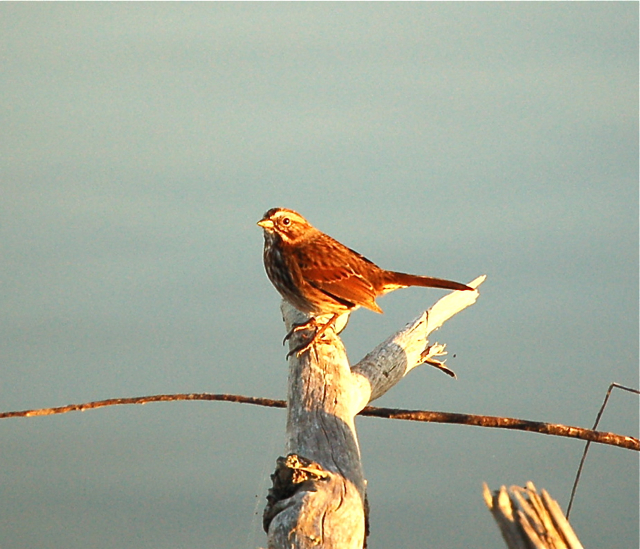
On Thanksgiving Monday (Canada, Oct. 8), I stopped by Iona Beach in Richmond, B.C.  On the smooth water illuminated in a golden hue were Mallards gliding into the sunset.

The common Sparrow too was swept in an amber tone. In that frame, nothing seemed common anymore.

And finally, I saw the sun slide down the distant sky. What a sight to wrap up Thanksgiving. If anything’s common… it’s common grace.

***

Saturday Snapshot is hosted by Alyce of At Home With Books.

A Note About These Photos: No colours had been added nor saturation altered in any of them.

This is My Spring…

… and I’m fine with it.

I’ve seen lush green meadows, full bloom flowers, and fresh plump berries from many of your spring posts. I must share with you what I’m getting…

It’s a long process before green appears, but we’re used to that. Spring for us is a gestation of life, a long process. There can be false starts too, teasing us with more snow. It tests our patience.

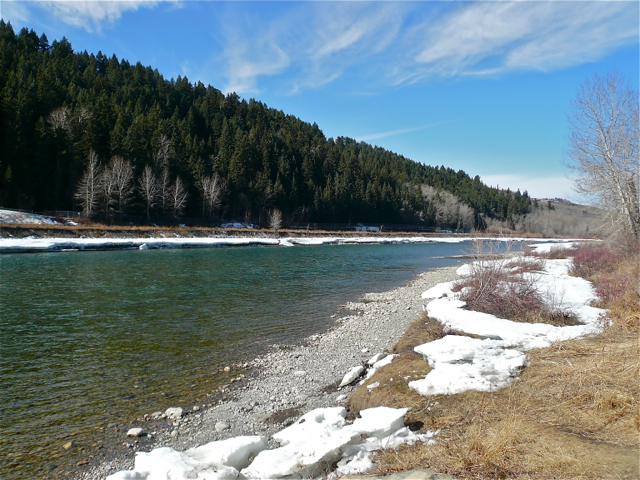
First we wait for all the snow to melt:

The melting Bow River
Another view, another colour

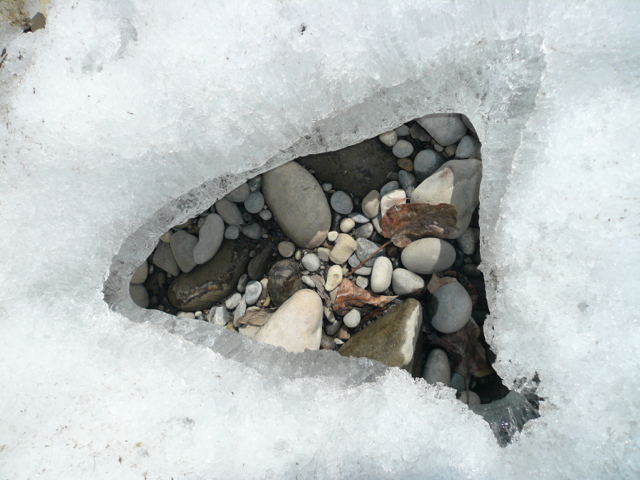
A closer look only fascinates me more, the sight and sound of spring… a rythmic ploink… ploink.

Dripping ice water
Icy frame of a kaleidoscope

The slowness of spring allows me to cherish a while longer the sights of a season past:

Snow bank along the Bow
Remnants of a colourful fall

Meanwhile… the buds silently appear. No greens yet, but still a sure sign of spring. Brown tips burgeoning out everywhere, keen and strong:

Sure sign of spring

Before the greens, many colours have to parade by, nature’s processional. As a spectator, I can only applaud.

Spring will burst forth in all its glory…  in its time.

***

Diary of A Country Priest: A Book for Easter

Every year around this time, I come back to my perennial read The Diary of A Country Priest by French author Georges Bernanos(Journal d’un curé de campagne, 1936). In this book, I find the essence of Easter.

A young preist comes to his first parish, the rural town of Ambricourt, full of humble ideals. All he wants is to serve the people, to give of himself, to bring God’s love. But as soon as he sets foot in the village, he is engulfed by hatred and rejection. There are dark secrets too sinister to be exposed. The young priest is an unwelcome alien. In a town afflicted by hypocrisy, pride, anger and bitterness, he is despised, taunted and ridiculed. His own innocence is no match even for the children in his catechism class, especially the precocious Seraphitas, a girl ‘with a hardness far beyond her years.’

Ambricourt is a world afflicted by the ‘leprosy of boredom’, a microcosm of the human condition. Bernanos uses diseases to illustrate his point well. The young priest himself is being slowly consumed by terminal illness. The pain in his stomach ultimately defeats his body, cancer. His diet consists mainly of bread dipped in wine which he makes for himself, and some potato soup. Poverty of means, but also frailty of body to take in solid food. Many a times we see him in the Garden of Gethsamane, pleading for strength in anguish. But he faithfully presses on, using his diary to confide his deepest thoughts, a means to commune with his God.

On the outskirt of Ambricourt is the Château of the powerful M. le Comte. The Count needs no priest to know about his adulterous affairs, this time, with the governess Mlle Louise. His wife Mme la Comtesse is totally absorbed by her long-held bitterness and grief from the loss of her young son. And his daughter Mlle Chantal is a deeply disturbed girl eaten up by anger and jealousy. Soon, she will be sent away to England, a most convenient plan devised by her father.

It is with this deep mess of a family that the young priest finds himself entangled. The most intense scene of the whole book, the climatic moment, comes when the priest goes to the Château to meet with Mme la Comtesse. She lost her beloved son when he was only eighteen months old, a child hated by his jealous older sister Chantal.

On his last day they went out for a walk together. When they came back my boy was dead.

Mme la Comtesse is fully engulfed by hatred for her daughter, grief for her lost son, and bitterness towards God.

Hearing her speak, a tear flows down the face of the young priest. “Hell is not to love any more, madame.” The young priest responds. And with miraculous strength, he delivers the following words.

… But you know that our God came to be among us. Shake your fist at Him, spit in His face, scourge Him, and finally crucify Him: what does it matter? It’s already been done to Him.

Towards the end of some soul piercing exchanges, Mme la Comtesse kneels down, releases her pain, and receives blessings from the young priest. Afterwards, she writes to him in a letter:

… I have lived in the most horrible solitude, alone with the desperate memory of a child. And it seems to me that another child has brought me to life again…

And this young child, a priest, consumed by illness, wreaked by frailty of spirit, can only marvel at the power through weakness:

Oh miracle — thus to be able to give what we ourselves do not possess, sweet miracle of our empty hands!

Not long after this, he succumbs to his illness. A life too short, a mission seems unaccomplished. But his last words faintly uttered on his deathbed are as powerful as the God who sends him:

Does it matter? Grace is everywhere…

And in the film, these three words leave me with one of the most impressive endings of all the films that I’ve seen:

“All is grace.”

 ***

~ ~ ~ ~ Ripples

CLICK HERE to read my film review of The Diary of a Country Priest.

The Diary of a Country Priest by Georges Bernanos, translated by Pamela Morris, Perseus Books Group, Philadelphia, PA, 1965, 298 pages.

Journal d’un curé de campagne, 1936, was winner of the Grand prix du roman de l’Académie française.

The Grey (2012): Of Wolves and Men

There are films that I expect to glean meaning from but leave me disappointed. And then there are those that do not appear to provoke thought at the outset and yet manage to do so, sending me out the theatre with gratified resonance. The Grey is one such film.

A plane carrying a group of Arctic oil-rig workers crash in the deep snow of the Alaskan wilderness. There are seven survivors. The task of leading them out of the crash site to seek safety falls on the shoulders of John Ottway (Liam Neeson). His job at the oil rig is security, a marksman protecting the workers from wild wolves. At the beginning of the film Ottway is shown to be suicidal, overwhelmed with grief from the recent passing of his wife. It is ironic to see at the end, he is propelled by courage to fight for his life.

In the cold expanse of Alaska, Ottway leads the surviving men to trudge through deep snow, trying to get to safety away from wolf territory. The men are pitted against each other, stranded at nature’s mercy, defenceless against a pack of carnivorous grey wolves. It’s a survival story, a suspense thriller that has me on the edge of my seat. But it goes further than that.

Director Joe Carnahan does not just show a group of roughnecks toughing it out in extreme condition, facing death at every turn. He brings to the forefront some existential queries, as one by one the men fall prey to the wild. Stripped to bare existence, how is man different from wolves? For what do we live? For what do we die? Such moments of ruminations are enhanced by Masanobu Takayanagi’s meditative cinematography.

As they leave the crash site, Ottway tells the survivors to collect all the wallets from the victims so they can contact their family, if they ever get back home. From the photos in their wallets, we get a glimpse of lives lived, and know that they have loved ones waiting. Following their treacherous path, we might sense that their outward skepticism masks a painful and silent hope for a transcending force, One who can save them from their fateful predicament.

The men don’t bond right away. The unruly, the scared acting tough. But extreme circumstances change them quickly. Sitting around a fire, they learn to cherish the memories they’ve had in their life, and begin to value each other. We know their fears. We listen to their stories. In one moving moment, Ottway shares a poem he remembers his Irish grandfather had written. Little does he know those words would become the fuel that catapults him to fight for his life at the end.

There’s something about Liam Neeson that stands out in a film. He embodies a kind of dignified charisma. But here in The Grey, it’s not just charisma, it is like poignant reality. The look on his face speaks volumes. In the film, he conjures up in his mind the wife he has loved and lost lying beside him. “Be brave,” he can hear her loving whisper. In real life, he just may be aching for the same, as his wife Natasha Richardson died after an accident in the snow three years ago.

Animal advocacy groups have voiced out their opposition to the portrayal of the Grey Wolves in the movie. Wolves are social animals, gentle and non-aggressive, they argue. The film gives them a bad rap. My thought is this: If a young human can go into his school and massacre his peers, and if humans can murder members of their own clans, why is it hard to imagine carnivorous wild wolves would prey and attack intruders in their territory? Showing that animals do act on their instinct is no disrespect.

After all, this is not a scientific study of wolf behavior. The film is less about wolves than men. The questions it poses cannot be answered by Science. And if you have to be accurate about all the facts, it’s not in Alaska where they shot the film, but here in Arti’s territory of Western Canada, Alberta and British Columbia to be exact. But what does it matter?

I will not give away spoiler about the ending, for it struck me most strongly and left me with deep resonance as I walked out of the theatre. It is poignant and powerful, although I did hear a gasp of ‘what?’ from someone in the dark theatre. If you go to see this movie, do sit through the credits, and stay there until the very end of the roll, you’ll see something more.

Yes, there is suspense and some action. But what’s more important is that there are quiet moments for ruminations. If you are comfortable with that, you would likely care to follow these men in their precarious strive for survival.

~ ~ ~ Ripples

***

What If… A Northern Nativity

The late Canadian artist William Kurelek embraced a nativity that’s beyond time and culture. In his children book A Northern Nativity, he envisioned through a little Prairie boy’s dreams the various scenarios: what if Christ was born in the land of deep snow in an Inuit community, or what if Mary and Joseph, homeless on our streets, had to take shelter in a soup kitchen, what if… Would we have noticed? Would we even care?

This is a moving video clip on the paintings in Kurelek’s children book A Northern Nativity, accompanied by Chris de Burgh’s touching piano music “When Winter Comes”.

.

And to All, A Merry Christmas!


***

Reading The Season: Walking On Water by Madeleine L’Engle

It’s that time of the year when a quiet respite is probably the most precious gift. For the past four years since I started blogging, amidst the cacophony of December festivities, I would pick something to read that anchors me to the spiritual meaning of the occasion.  I call these attempts “Reading The Season”. This year, I took down from the shelf a long-time TBR, Walking On Water: Reflection On Faith And Art by Madeleine L’Engle.

After reading it, I went straight to her Newbery Award novel A Wrinkle In Time (another long time TBR for me). Amazed at its wisdom and depth, once I finished it I went back to reread Walking On Water, appreciated all the more L’Engle’s intricate weaving of intellect and spiritual insights.

At the very beginning of the book, these words jumped right out at me:

I sit on my favourite rock, looking over the brook, to take time away from busyness, time to be. I’ve long since stopped feeling guilty about taking being time; it’s something we all need for our spiritual health, and often we don’t take enough of it.

And just a few pages after that, I found this gem:

Leonard Bernstein tells me … for him music is cosmos in chaos. That has the ring of truth in my ears and sparks my creative imagination. And it is true not only of music; all art is cosmos, cosmos found within chaos.

Bernstein might have echoed a Jungian concept of the power of memory and the subconscious self, but there’s a spiritual reality in the thought.

It all began with the calling forth of light from darkness, splendor from void, life from nothingness, the Creation. Terrence Malick’s The Tree of Life comes to mind… the cosmic light and galaxy clouds, the molten lava that spews out of the earth, the roaring breakers of the ocean deep, and my heart resounds: ‘day to day pours forth speech, night to night declares knowledge.’

But what’s most awesome is not just the forming of the cosmos, but the Creator incarnated, the infinite confined, the invincible made vulnerable in order to live the hurts, to share the pains. L’Engle writes:

To be alive is to be vulnerable. To be born is to start the journey towards death… We might paraphrase Descartes to read, ‘I hurt; therefore I am.’

The Creator demonstrated that behind the majesty, there’s the power of love, that driving force behind the willingness to stoop, to be made vulnerable, to be stripped naked, be born a babe. Utterly unfathomable. At one point in human history,  Cosmos entered and lived among Chaos.

And artists, those who write, who paint, who sing, who dance, who act… they are birth-givers. “An act of art is an incarnational activity,” L’Engle writes. Artists partake in the continuation of creation, bringing wholeness to a fragmented world, hope in the slough of despair.

As well, true artists live the vulnerability as the One who first took that cosmic plunge, taking the risk of birth because of love.

Here, take a 3:44 minute respite to enjoy some Seasonal reflections. Click on the video to listen to the music as you read Madeleine L’Engle’s poem:

The Risk of Birth 

This is no time for a child to be born,
With the earth betrayed by war & hate
And a nova lighting the sky to warn
That time runs out & the sun burns late.

That was no time for a child to be born,
In a land in the crushing grip of Rome;
Honour & truth were trampled by scorn–
Yet here did the Saviour make his home.

When is the time for love to be born?
The inn is full on the planet earth,
And by greed & pride the sky is torn–
Yet Love still takes the risk of birth.

Madeleine L’Engle

***

Walking On Water: Reflections On Faith And Art by Madeleine L’Engle, Commemorative Edition, published by Shaw, 1998, 227 pages.

CLICK HERE to Reading the Season 2012: Surprised by Joy

‘Reading The Season’ posts in previous years:

Reading The Season: C. S. Lewis

Reading The Season: Fleming Rutledge

Reading The Season: Madeleine L’Engle’s The Irrational Season

Reading The Season: Luci Shaw

A Good Man is Hard to Find and Other Stories by Flannery O’Connor

“The heart is deceitful above all things, and desperately wicked: Who can know it?”  Jeremiah 17: 9, The King James Bible

I’m delving into Flannery O’Connor like mad, looking for violence. It all started with my stumbling upon this YouTube clip of Father Robert Barron’s movie review of Coen Brothers’ acclaimed movie “Fargo.”

I was bemused to hear him compare Joel and Ethan Coen’s films to Flannery O’Connor’s stories, for in them we can find violence juxtaposed closely with humor. It has been years since I read O’Connor’s stories. After watching “Fargo” again the other night, I thought, I must read more of Flannery O’Connor, this time in a different light. I want to experience how this is true. I’m curious to find out how and why a deeply religious female author would instil violence in her stories. A Good Man is Hard to Find and Other Stories is a good source for my purpose.

Within the ten stories in this collection, I’ve encountered shocking and disturbing scenes that if being shown in cinematic light today could match what’s on screen, not only physical violence, but malicious deceits, verbal abuse, nasty and mean motives leading to disturbing actions.

Here are some of the scenes: Leading the pack is “A Good Man Is Hard To Find”, where a family of six from baby to Grandma is killed by an escaped convict The Misfit and his men. In “Good Country People”, a deceitful young man posing as a Bible salesman outsmarts a woman aiming to seduce him, overpowering her and robbing her prosthetic leg.

Or how about these scenes: A grandfather denies knowing his young grandson in the face of danger in an unfamiliar city in “The Artificial Nigger”. A stranger gaining the trust of an old woman and later marrying her deaf-mute daughter but ends up abandoning her and driving off with her mother’s car and money after the wedding in “The Life You Save May Be Your Own”. Children setting off a wild-fire and endangering a home and its occupants out of revenge, jealousy, or plain malice in “A Circle in the Fire”. Almost all the stories depict human depravity in a shocking way, albeit intermingled with humor. But often, for me, the humor does not compensate for the disturbing and grotesque. From what I’ve read in this collection, O’Connor could well have written the movie “No Country for Old Men”, except she would have sprinkled with a dash of sardonic fun.

But why? If for anything but to show the depravity and the hypocrisy among supposedly ‘good country folks’, and by extension, all humanity, O’Connor is most successful. Like the choir boys turned savages in The Lord of the Flies, what we are is largely circumstantial, the author seems to point out. O’Connor is very bold and direct in conveying this message. She does not cover up the dark side of human nature but exposes it. By so doing, she points to the need for redemptive grace.

In “A Good Man Is Hard To Find”, we see at the moment of imminent death, the grumpy Grandma looks at The Misfit in a new light, realizing that her existential predicament is not much different from the criminal’s. She says to The Misfit:

Why you’re one of my babies. You’re one of my own children! She reached out and touched him on the shoulder.

But her epiphany comes too late for herself.

The Misfit sprang back as if a snake had bitten him and shot her three times through the chest.

While we see the murder of a seemingly innocent old woman, albeit hypocritical, O’Connor delivers the verdict of our human condition ironically by the words of The Misfit:

She would of been a good woman,” The Misfit said, “if it had been somebody there to shoot her every minute of her life.

I find too, that violence in O’Connor’s stories are not gratuitous. It’s a situation, an action that comes as unexpected, and with that, O’Connor deftly tips the balance. These shocking acts usually serves to shatter the status quo of her characters, challenge their world view and convictions. O’Connor does not go about describing the grotesque in gory images, rather, in a matter-of-fact way. We only hear gun shots from afar when the other members of the family are killed. And for the Grandma, The Misfit “shot her three times through the chest.” These mere seven words send out the eerie and shocking effect of cold-blooded murder without having to dwell on the explicit.

Likewise, in “A Circle in the Fire”, it’s a few sardonic words from the disgruntled kid Powell that send chill down our spine as he lights up a match to set fire to the dry wooded area outside Mrs. Cope’s farm home:

Do you know what I would do with this place if I had the chance?… I’d build a big parking lot on it…

Powell told his two companions. Seeing this, the slow-witted daughter of Mrs. Cope’s runs home excited, shouting:

Mama, Mama, they’re going to build a parking lot here!

Yes, a likely scene and dialogue from a Coen Brothers movie.

But it is O’Connor’s own words that is most revealing in pointing out the reasons behind the violence:

In my own stories I have found that violence is strangely capable of returning my characters to reality and preparing them to accept their moment of grace.  Their heads are so hard that almost nothing else will do the work.

And violence is never an end in itself:

We hear many complaints about the prevalence of violence in modern fiction, and it is always assumed that this violence is bad thing and meant to be an end in itself.  With the serious writer, violence is never an end in itself.  It is the extreme situation that best reveals what we are essentially…

In reading (and movie watching, for that matter) we need to find and catch that glimpse of grace. With this, O’Connor had also set a standard for a good screenplay:

Our age not only does not have a very sharp eye for the almost imperceptible intrusions of grace, it no longer has much feeling for the nature of the violence which precede and follow them.

It is the “intrusion of grace” that the violent act is set up for. Without the Grandma’s final epiphany and the gesture of reaching out to The Misfit, O’Connor had said, “I would have no story.”

The writer sure knew a bit about the human heart.

***