Paris: The Latin Quarter

Solution to Arti’s Cryptic Challenge #3: Paris

It was pure serendipity that I’d picked a hotel right in The Latin Quarter.  At the time of my booking I wasn’t aware of so culturally rich a Parisian sector I’d be staying, and with many attractions on my list within walking distance.   The Latin Quarter derived its name from the fact that Latin was widely spoken in the area during Medieval time.  This has been the academic and literary part of Paris, and remains so today. Bookstores are everywhere, almost all in French though, many specializing in philosophy.

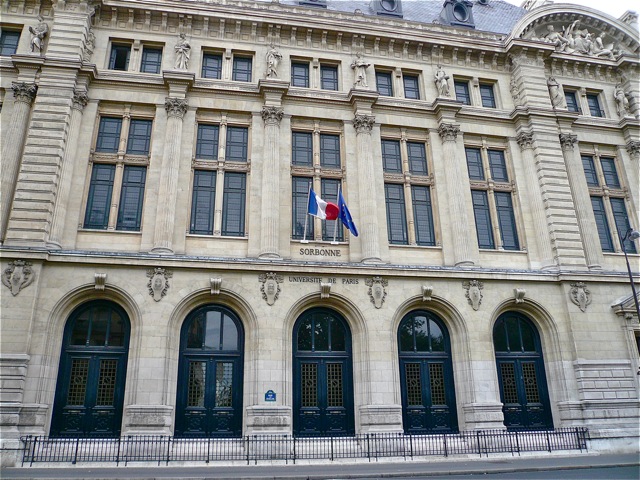
Our hotel is situated right across from the Sorbonne, Universite de Paris.  Unfortunately it was closed during the summer months, the guard at the gate making sure people stay out, so I did not get a chance to go inside or browse in their bookstore.

.

The Panthéon is also located in The Latin Quarter, about a 15 minutes walk from where we stayed.  It is the burial site of several renowned intellectual and literary figures of France, including Voltaire, Rousseau, Hugo, Zola, Pierre and Marie Curie:

.

Not just as a memorial ground, the Latin Quarter is a vibrant sector where writers, intellectuals and academics congregate, meet each other to engage in discourses over coffee or a glass of wine. Here is a restaurant where Camus and Sartre were among its prominent patrons, now a tourist point of interest on the map, Le Brasserie Balzar:

.

Heading down rue St. Jacques from Balzar, I walked towards the River Seine.  I could see from afar the Notre Dame:

.

.

But I wasn’t going to make my way across just yet, for I’ve found the number one item on my must-see list situated on this side of the Seine, the Left Bank, and that was the legendary bookstore-library, Shakespeare and Company:

.

.

On November 17, 1919, American expatriate Sylvia Beach opened the English language bookstore-library in Paris, and turned the page in literary history.  Beach was not merely a bookseller, but a multi-faceted literary personality, a writer and a subject for other writers, the publisher of James Joyce’s Ulysses in 1922, the proprietor of a literary hub that welcomed expatriate writers to mingle, read, write and stay.  In one of her many literary parties she introduced F. Scott Fitzgerald to James Joyce, the former was too intimidated to approach Joyce himself.   Many icons of the ‘Lost Generation’ had been affiliated with the literary hang-out, including Hemingway, Gertrude Stein, Ezra Pound, to name a few.  Click here for a historic photo of Beach and Joyce in front of Shakespeare and Company.

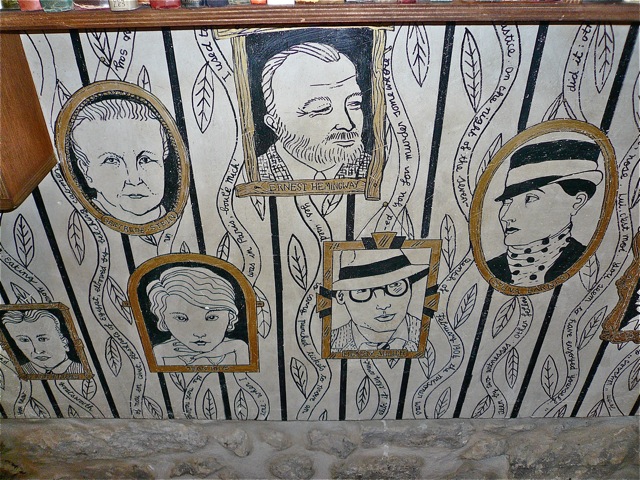
Hemingway and some of the ‘Lost Generation’ found on the walls of the bookstore:

.

.

Closed down during WWII, the new owner George Whitman, another American expat and a friend of Beach’s,  re-opened its doors in 1951 in the present location on the Left Bank of the Seine.   Now in his 90’s, Whitman has stood by his commitment not to sell his little bookstore to developers, and kept the tradition alive: a sanctuary for writers.  For almost 60 years now, Whitman, himself a writer and a poet, has offered lodging and writing opportunities to countless aspiring souls.  The bookstore is now run by daughter Sylvia Beach Whitman.  According to its website, Shakespeare and Company has served more than 50,000 heads on the pillows of its 13 bed facilities for free, accommodating such literary figures as Henry Miller, Anais Nin, Lawrence Durrell, and Alan Ginsberg.  Click here for a personal account of what it’s like staying at Shakespeare and Company, and some house rules.

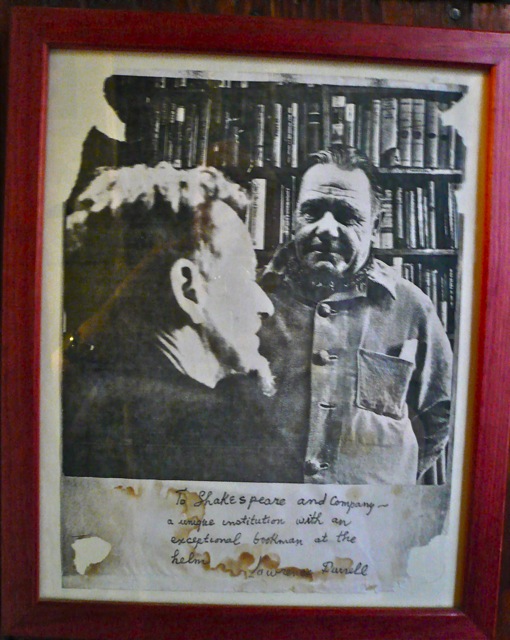
A mementos from Lawrence Durrell:

.

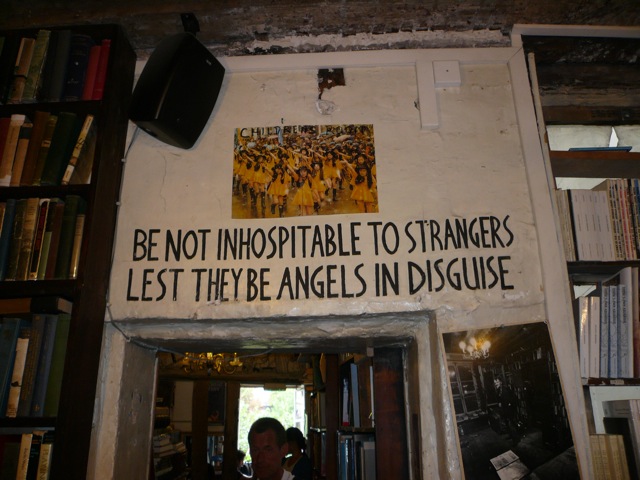
Upholding the spirit of hospitality:

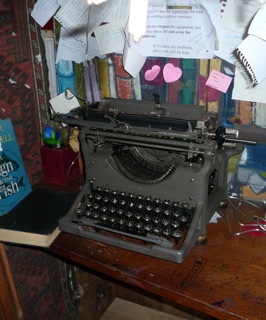
Typewriter for use, tradition alive and well:

Some impromptu music-making:

.

Just last week, even the editor of the New York Times has declared the inevitable, that the print version of the New York Times will end some time in the future. Under the sweeping torrents of eBooks and ePublishing, seems like independent bookstores are fighting an uphill, if not a losing, battle.  I wish the Whitman family well in standing strong against the tide.  From a little bookshop-library, it has stayed true to its tradition, and by so doing, gained a spot on the historic map of Paris.  In 2006, Whitman was honoured by the French Minister of Culture with the Order of Arts and Letters. More than just a point of interest for tourists, Shakespeare and Company has now become a cultural institution that just, hopefully, might not be so easily demolished to make way for new development along the Seine.

Click here to read an interesting article and personal interview with George Whitman from Bloomberg, yes, Bloomberg.

***

All Photos Taken By Arti of Ripple Effects, August 2010.  ALL RIGHTS RESERVED.

Bath’s Persuasion

Solution to Arti’s Cryptic Challenge #2:  Bath

From London’s Paddington Station we took the 90 minute train ride to Bath Spa, saving us half the time than with the bus.  The City of Bath is a UNESCO World Heritage Site.  Its magnificent Roman Baths and stylish Georgian streets and architecture make this a wonderful gem for tourists.  The first time I visited there was in December, 2007. For a more general overview of the beauty of Bath you can find my two previous posts here and here.

In this revisit, I was a more intentional traveller.  I let Austen’s Persuasion be my guide.  With a detailed street map of Bath in my hand, I went exploring the places mentioned in the novel, coincidentally, many of them I missed in my last visit.

“I was not so much changed…” was Anne Elliot’s words to Captain Wentworth upon seeing him eight years after turning him down.  The termination of their relationship was not her own intention, but duty had driven her to yield to Lady Russell’s persuasion.  It would have been a “throw-away” for Anne at 19 to engage with “a young man who had nothing but himself to recommend him, and no hopes of attaining affluence, … uncertain profession, and no connections.” (p. 20)

But the star-crossed lovers are granted the bliss of a second chance, and rightly grab it this time.  Austen’s setting of Bath in the book is no coincidence.  The Georgian City was the centre of fashion and the epitome of genteel society, a hotbed of social phenom for the critic and satirist in Austen.  Jane had lived in Bath herself for four years, 1801 – 1805, with her sister Cassandra and their parents.  Ironically, she was unpersuaded by its attractions according to her biographer Claire Tomalin.

Austen aptly uses Bath’s addresses for the purpose of her characterization.  Geographical location is everything in a class-conscious society, as Keiko Parker’s excellent article Jane Austen’s Use of Bath in Persuasion points out.

First off,  there’s the Pump Room, where in Jane Austen’s days people socialized and met one another, gathered to drink the therapeutic water, catch the latest fashion, simply to see and be seen.  The magnificent structure and decor makes The Pump Room a fine restaurant now:

Despite its grand decor, the areas around the baths are residences for the common folks in Austen’s time.  Mrs. Smith, the poor, infirmed widow with whom Anne maintains a loyal friendship, lives in the Westgate Buildings close to the Baths.  Anne becomes a laughing stock for the snobbish Sir Walter when he hears of her least favourite daughter is determined to visit Mrs. Smith instead of accepting an invitation to Lady Dalrymple’s, someone belonging to the upper echelon of society:

“Miss Anne Elliot, you have the most extraordinary taste! Everything that revolts other people, low company, paltry rooms, foul air, disgusting associations, are inviting to you.” (p. 113)

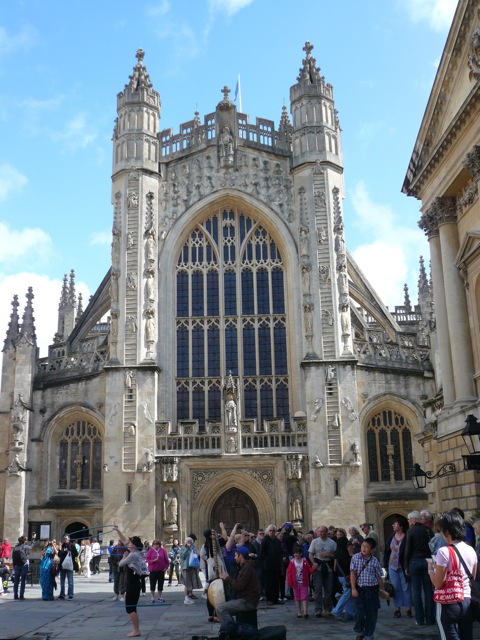
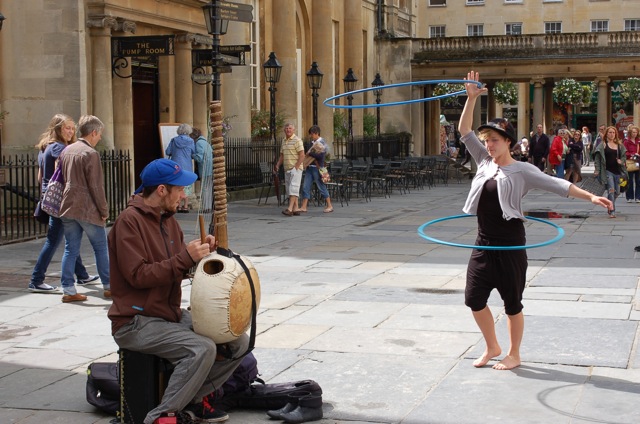
Today, the open area outside the Pump Room by the Roman Baths is perhaps the most popular tourist gathering place. Tour buses stop at the Bath Abbey for pick up and drop off, buskers perform in the open space outside the Roman Baths and Pump Room:

.

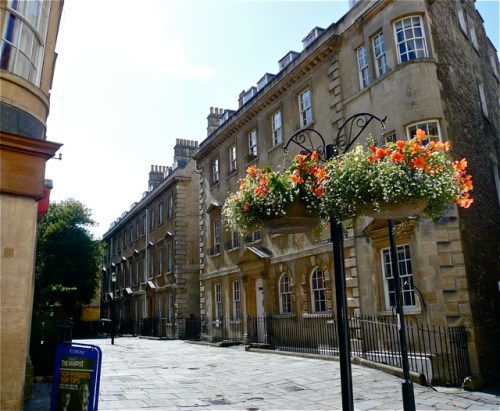
Nearby is Sally Lunn’s Bun, originated in 1680 by a young French refugee, in the oldest house of Bath, ca. 1482.  Now a restaurant on top with the cellar a museum that houses the original kitchen and cookwares, Sally Lunn’s serves this traditional creation: a large, soft, round bun that can go with just about anything.  But probably best like this, simply with garlic butter:


The beautiful street corner outside Sally Lunn’s:
.

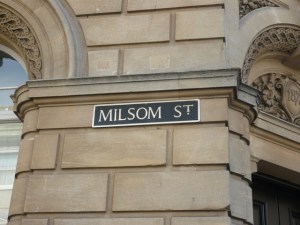
Further up the town, there’s Milsom Street, a vibrant commercial area of shops and businesses.  The first time Anne saw Captain Wentworth again in Bath was on Milsom Street.  Here’s a present day view of the same site:
.

.

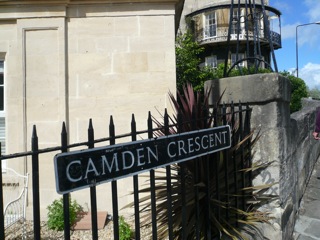
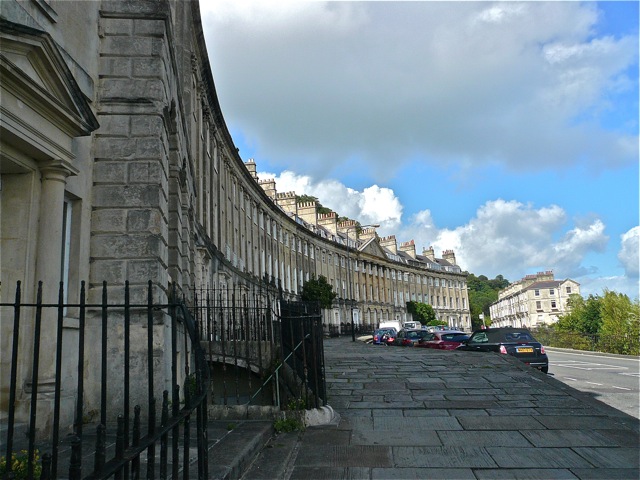
As for Sir Walter himself, despite having to rent out his country mansion Kellynch Hall to avoid financial ruins, he has no intention that his retreat to Bath should compromise his status and comfort.  It’s only natural that others are curious: “What part of Bath do you think they’ll settle in?”  The answer is quite obvious:  the part that is befitting their social standing.  According to Keiko Parker’s insightful article, physical elevation in Bath directly corresponds to social standing.  The highest point at that time would have to be Camden Place, which is today’s Camden Crescent.  While I was looking for it,  the ‘Ye Old Farmhouse Pub’ was mentioned to me as the marker.  I was glad to find it while walking up Landsdown Road, for it was indeed quite an uphill walk.

.

.

“Sir Walter had taken a very good house in Camden Place, a lofty, dignified situation, such as becomes a man of consequence; and both he and Elizabeth were settled there, much to their satisfaction.

Anne entered it with a sinking heart, anticipating an imprisonment of many months…” (p. 98)

Just typical Austen, the overt contrast of characters using something indirect, here, the sense of place.

The houses on Camden Crescent has unobstructive view of lower Bath.  They are not grand mansions, but then again, location is everything.  The following are some of the houses found on this road across from the escarpment:

.

And where do Sir Walter’s tenants Admiral and Mrs. Croft lodge during their short stay in Bath?  On Gay Street, not too high, not too low: “… perfectly to Sir Walter’s satisfaction.  He was not at all ashamed of the acquaintance, and did, in fact, think and talk a great deal more about the Admiral than the Admiral ever thought or talked about him.” (p. 121)

Elizabeth is not even half as kind as her vain and snobbish father.  Regarding the Crofts’ arrival in Bath, she suggests to Sir Walter that “We had better leave the Crofts to find their own level.” (p. 120)

In contrast, Anne has a good impression of the Admiral and his dear wife, the kind and down-to-earth couple, Mrs. Croft being the sister of Captain Wentworth having minimal bearing on Anne’s fondness of them. During their sojourn in Bath to mend a gouty Admiral Croft, Anne enjoys watching them strolling together, “it was a most attractive picture of happiness to her.” (p. 121)

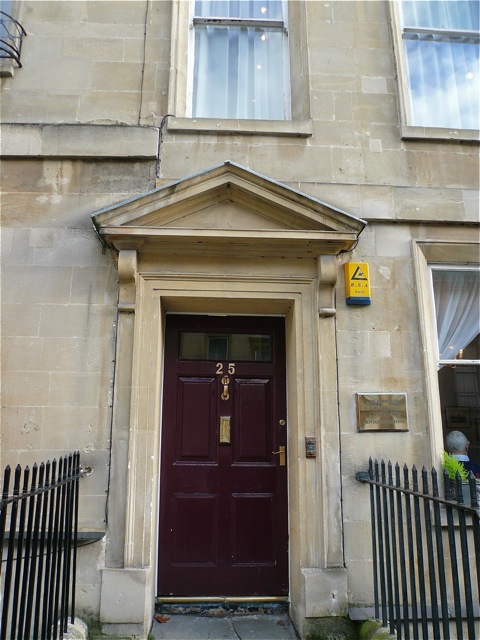
So I’m just not a bit surprised to see their temporary lodging in Bath being on Gay Street.  Who else had lived there?  Jane Austen herself: #25 to be exact:
.

As for a suitable place for socializing, Sir Walter and his favourite daughter Elizabeth choose the Upper Assembly Rooms, a much newer development closer to their upper, more fashionable side of town, although he would prefer entertaining in private which is even more prestigious.

The Assembly Rooms are a magnificent architectural legacy in their own rights.  Designed by John Wood the Younger, who raised the £20,000 needed for the venture, the ground-breaking project began in 1769 and opened for public use in 1771.  It was the biggest investment in a single building in 18th Century Bath. Four public rooms made up the suite:  The Octagon, Ball Room, Card Room, and Tea Room.

“Sir Walter, his two daughters, and Mrs, Clay, were the earliest of all their party at the rooms in the evening; and as Lady Dalrymple must be waited for, they took their station by one of the fires in the Octagon Room (p. 131).

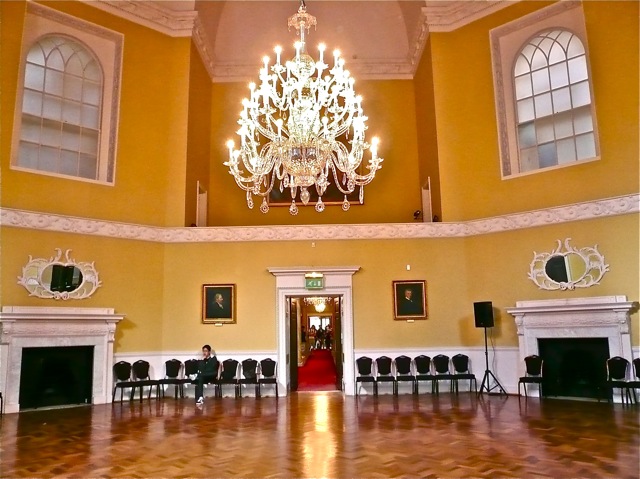
Here’s the exquisite Octagon Room:

Regarding the chandelier, there’s this interesting account in The Authorised Guide (p.7):

“On 15 August 1771 Jonathan Collett quoted £400 for supplying five cut-glass chandeliers for the Ball Room.  They were up in time for the opening of the Rooms in September, but the following month disaster struck when ‘one of the arms of the chandilers in the Ballroom fell down during the time the company was dancing, narrowly missing  Gainsborough.  What could be salvaged from the set was made up into a single chandelier, which now hangs in the Octagon.”

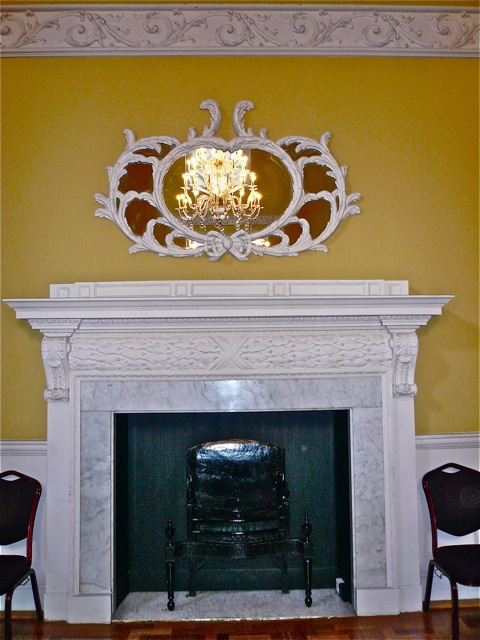
I was just simply amazed at how long these chandeliers had lasted, well over 300 years, and in excellent shape.  Their brilliance had not faded, evolving first from candlelight, then to gas, and now electric:

.

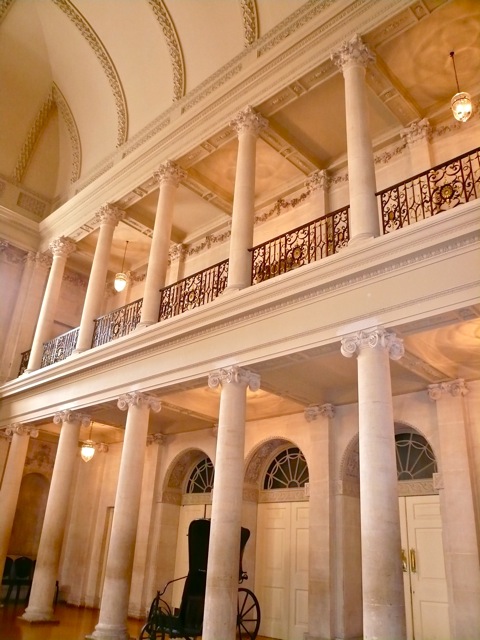
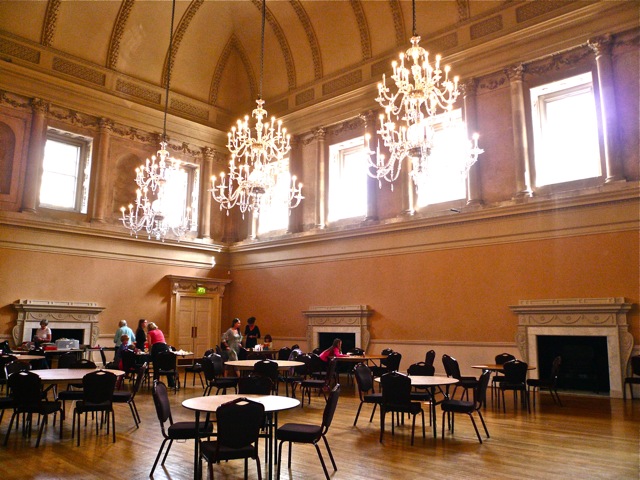
Anne and her party attend a music program in the Concert Hall.  That’s a function in the Tea Room.  Despite the name which seems to convey a small and cozy setting, the Tea Room is a gorgeous room of 60 ft. by 43 ft. dimension.  On one end is a magnificent colonnade of the Ionic order.  Subscription concerts are regular events held in the Tea Room. Mozart and Haydn had written compositions to be performed there, with Haydn himself having graced the magnificent venue.
.
.

But what does Anne Elliot think about all the grandeur?  After earlier in the Octagon Room talking with Captain Wentworth, who has openly expressed his long-held passion for her, Anne, overwhelmed by a great flood of euphoria, now walks into the Concert Room (Tea Room):

“Anne saw nothing, thought nothing of the brilliancy of the room.  Her happiness was from within.  Her eyes were bright, and her cheeks glowed; but she knew nothing about it.  She was thinking only of the last half hour…” (p. 134)

As a visitor to the historic venue, I was captivated by the well-maintained interior and its elegance, and presently amused and surprised to find this display in between two columns: The Chair, which is mentioned several times in Persuasion. The Bath Chair was invented right here in the Georgian City to transport the rich and the sick.  It could be steered by the passenger:

.

.

Jane might have noticed the frivolity and seen through the façade of high society of her time, and sharply depicted her observations in her brilliant novels, but as a modern day tourist and Janeite, I’m just amazed at how well history has been preserved, and that all these locations and life had been experienced by Jane herself. She might have the burden of society on her, which ironically had inspired and unleashed her talents, but for me, a present day tourist and reader of her works, I am totally persuaded that Bath is a place I will definitely revisit some more in the future.

***

All photos taken by Arti of Ripple Effects, August 2010.  All Rights Reserved.

References:

1. Jane Austen: A Life by Claire Tomalin, Penguin Books, 2000.

2.  Persuasion by Jane Austen, The Modern Library Classics, Introduction by Amy Bloom, Modern Library Paperback Edition, 2001.

3. The Authorised Guide: The Assembly Rooms, Bath. Published by the Heritage Services division of Bath and North East Somerset Council in association with the National Trust.  Written by Oliver Garnett and Patricia Dunlop.

4. “What Part of Bath Do You Think They Will Settle In?”: Jane Austen’s Use of Bath in Persuasion by Keiko Parker.  Retrieved Online http://www.jasna.org/persuasions/printed/number23/parker.pdf

Greening of a Calgary Street
April 23

.

May 23

.

June 23

.

Waiting

He could have said
Let there be life
As in the beginning
But He made me wait.
For three months
I went back to the same spot
and watched
slowly
green bursting out from bare branches
fighting storms and snow
into full bloom.

.

I had waited before
Nine years, nine months
He could have said
Let there be…
But He had made me wait
and watch
slowly
like time-lapse photography
the gestation of a miracle.
He could have just said,
But He made me wait
and watch.

***

Pictures and poem by Arti of Ripple Effects, June 2010.  ALL RIGHTS RESERVED.

Top 20 Under 40

The New Yorker has released the anticipated list of top 20 fiction writers under 40, kicking off their summer fiction issue. It’s been eleven years now since the last list.

I’ve no trouble with the number 20, but I admit the number 40 does pose a problem.  If these figures represent the ‘defining voices’ of contemporary fiction, the stars to watch, is there still a future for those who by chance happen to be on the other side of that magic number?

Why should age be a demarkation when it comes to creative writing?  And, why 40? Why not 32 or 46?  It sounds arbitrary doesn’t it.  I know, we’re a lists-obsessed people.  Even the New Yorker editors admit that.  It’s funny that they seem to justify their act by citing The Ten Commandments, the twelve disciples, the seven deadly sins, the Fantastic Four.  Wow, do we ever need to elevate literary stardom to epic proportion… we have fierce competitions in 3-D movies, ‘Dancing with the Stars” and interactive video games, just to name a few.

Writers on their previous list include Jonathan Franzen, Jhumpa Lahiri, Michael Chabon and David Foster Wallace.  So, it’s a highly anticipated star roster.   As well, other magazines have published similar recognition.  Granta has its “Top 21 Under 35” twice a few years ago.  Sounds like a well-established marketing strategy.

Fine.  That is certainly understandable in a time when so many alternatives are competing with reading a short story or a novel. But still, the number 40 troubles me.  My sympathy goes to those who are no less promising but alas, have shot further than the 40 mark.  Without being recognized as ‘young’ anymore, will they still have a future?  Further, is there hope for those who might choose to pursue a passion that comes late in life?  I can see the futility if that dream is to be a concert pianist if one hadn’t taken up the instrument by the ripe old age of 12.  But, what about writing?  Is starting at 40, or 50, or even 60 too late?  Is the term ‘late bloomer’ a misguided notion offering false hope?

**

Oh… the promise and glamour of youth.  And woe to us who are beyond rescue in a society that’s obsessed with popularity and rankings, youthful looks and prodigious fame.

To soothe the wounded spirit, and keep the creative fire burning, Ripple Effects would like to propose the following iconoclastic list in this day ruled by ageism:

  • Top 50 over 53:  To honor the best 50 unpublished writers over 53
  • Top 100 under 67:  To seek out the best 100 blog writers under 67 in lieu of being published in the real world.  Why 100?  I’m sure this is just a minuscule sample of the tens of thousands possible candidates out there in the blogosphere.
  • Top 15 over 74:  To encourage the best 15 yet-to-be literary stars over 74, just to give hope to those still pursuing their life-long dream.
  • Top 3 over 82:  To celebrate the late-bloomers who have finally made it, actually publishing their debut novel after 82.  Why 3?  That’s obvious.

Sour grape?  No, that would be immature.  Let’s just say, virtual tasting of the elusive grape.  Never underestimate the power of hope and the freedom of casting aside the burden of age.

.

You can still see the ripples at eventide.   — Arti

.

***

Photo taken by Arti at The Inside Passage to Alaska,  September, 2009.  ALL RIGHTS RESERVED.

Notes on the Synthesis of Film, Art… Life?

Recently I’ve just finished reading Paul Schrader’s Transcendental Style in Film: Ozu, Bresson, Dreyer (1972).  Yes, that’s before Schrader rose to prominence as a screenwriter and filmmaker. Is such a book a bit dated?  Considering the techno-reigning world we’re living in now, where speed is measured by nanoseconds, and where 3D and CGI have become the necessary features for movies to generate sales, I think we need to read this all the more.

The three directors in the book had produced some of the best movies of all time. Since I have not seen all the films Schrader discusses, I might not have grasped as fully his arguments and illustrations as they deserve. And I admit I do not embrace unquestionably all those that I do get. Nevertheless, there are many, many parts that I want to record down. I’d consider them crucial elements to mull over during the creative process in just about anything. I’ve listed some of these fine quotes in the following.

They all point to the axiom of ‘less is more’, the value of stillness and simplicity, the speechless sketch that speaks volumes, the importance of being over doing, the quality of sparseness over abundance, the bare essence of life.

Notes to myself: when watching, writing, reading, doing, or just plain walking down the mundane path of everyday, keep these points in mind.

  • Ozu’s camera is always at the level of a person seated in traditional fashion on the tatami, about three feet above the ground. “This traditional view is the view in repose, commanding a very limited field of vision. It is the attitude for watching, for listening, it is the position from which one sees the Noh… It is the aesthetic attitude; it is the passive attitude.”[1]
  • Ozu chose his actors not for their “star” quality or acting skill, but for their “essential” quality. “In casting it is not a matter of skilfulness or lack of skill an actor has. It is what he is…”
  • “Pictures with obvious plots bore me now,” Ozu told Richie. “Naturally, a film must have some kind of structure or else it is not a film, but I feel that a picture isn’t good if it has too much drama or action… I want to portray a man’s character by eliminating all the dramatic devices. I want to make people feel what life is like without delineating all the dramatic up’s and downs.”
    .
  • His films are characterized by “an abstentious rigor, a concern for brevity and economy, an aspiring to the ultimate in limitation.”
  • Given a selection of inflections, the choice is monotone; a choice of sounds, the choice is silence; a selection of actions, the choice is stillness–there is no question of “reality”. It is obvious why a transcendental artist in cinema (the “realistic” medium) would choose such a representation of life: it prepares reality for the intrusion of the Transcendent…
  • “The opening five shots of An Autumn Afternoon: The everyday celebrates the bare threshold of existence; it meticulously sets up the straw man of day-to-day reality.”
  • In films of transcendental style, irony is the temporary solution to living in a schizoid world. The principal characters take an attitude of detached awareness, find humor in the bad as well as the good, passing judgment on nothing.

***

.

  • Like Ozu, Bresson has an antipathy toward plot: “I try more and more in my films to suppress what people call plot. Plot is a novelist’s trick.”
  • As far as I can I eliminate anything which may distract from the interior drama. For me, the cinema is an exploration within. Within the mind, the cinema can do anything.”
  • On the surface there would seem little to link Ozu and Bresson… But their common desire to express the Transcendent on film made that link crucial… Transcendental style can express the endemic metaphors of each culture: it is like the mountain which is a mountain, doesn’t seem to be a mountain, then is a mountain again.
    .
  • The abundant means sustain the viewer’s (or reader’s or listener’s) physical existence, that is, they maintain his interest; the sparse means, meanwhile, elevate his soul.  The abundant means are sensual, emotional, humanistic, individualistic. They are characterized by realistic portraiture, three-dimensionality…
    .
  • The “religious” film, either of the “spectacular” or “inspirational” variety, provides the most common example of the overuse of the abundant artistic means… the abundant means are indeed tempting to a filmmaker, especially if he is bent on proselytizing. (Now… why am I thinking of Avatar?)
  • The transcendental style in films is unified with the transcendental style in any art, mosaics, painting, flower-arranging, tea ceremony, liturgy.  At this point the function of religious art is complete; it may now fade back into experience. The wind blows where it will;  it doesn’t matter once all is grace.

***

Transcendental Style In Film: Ozu, Bresson, Dreyer, published by University of California Press, 1972. 194 pages.

[1] Schrader quoting Donald Richie, “The Later Films of Yasujiro Ozu,” Film Quarterly, 13 (Fall 1959), p. 21.
The following three quotes are from the same source.

.

Some informative links:

Paul Schrader http://www.paulschrader.org/, http://www.imdb.com/name/nm0001707/

Donald Richie http://www.movingimagesource.us/dialogues/view/274

Yasujiru Ozu http://www.guardian.co.uk/film/2010/jan/09/yasujiro-ozu-ian-buruma, http://www.a2pcinema.com/ozu-san/home.htm

Robert Bresson http://www.mastersofcinema.org/bresson/, http://www.imdb.com/name/nm0000975/

Carl Theodor Dreyer http://archive.sensesofcinema.com/contents/directors/02/dreyer.html

David Bordwell http://www.davidbordwell.net/

***

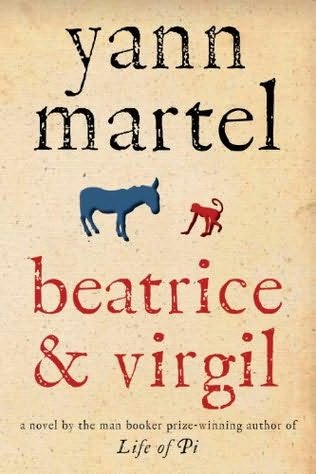
Beatrice & Virgil by Yann Martel

It has been nine years since Yann Martel’s second novel The Life of Pi first published. Its winning the Booker Prize in 2002 has solidly placed him on the international literary stage. Beatrice and Virgil is the long awaited third novel by this Saskatoon based Canadian author.

Beatrice is a donkey.  Virgil, a howler monkey.  They are the two characters in a play written by a taxidermist.  Beatrice and Virgil are also specimens in his shop Okapi Taxidermy.  The two names come from Dante’s Divine Comedy, to which the book has made reference. The metaphor of taxidermy is a fresh frame Martel constructed to look at the Holocaust. The preservation of evidence of lives lived, the mounting of historical facts.

Beatrice and Virgil is also a love story.  The two animals cherish each other and have to face the cruelty of extinction together.  In the play, they have elaborate talks about fruits, a striped shirt, God and faith.  It’s all allegorical of course.  And there’s the rub.

While I fully appreciate Martel’s attempt at creating a new frame to present the atrocity of the Holocaust, I doubt using animals as symbols and parallels, depicting the cruel treatment of them would suffice to convey the magnitude and severity of this horrific crime against humanity.  Despite a sincere intent and the riveting storyline, I feel the book fails to deliver the dynamics and efficacy in its form as an allegory.

Nonetheless, the book conveys some very interesting points, through which Martel has demonstrated the imaginative power of literary creation.  First off, the author plays with the notion that the line separating fiction and non-fiction is indeed blurry.  To make a case of it, he writes himself into the story.  The main character is an author called Henry, whose wife Sarah later on gives birth to their son Theo, the name of Martel’s own son with his partner, the writer Alice Kuipers.

Back to the story, Henry’s second book has stirred international sensations, winning prizes, adopted by schools and book clubs, and adapted into a Hollywood movie.  Life of Pi is all that.  And just like in real life, it has been a few years after that before the fictional Henry completes his third novel, a book on the Holocaust.  But this time, he has trouble finding a publisher (now this may diverge from real life.)

This new book Henry wants to get published is a literary fusion. He wants it to be a ‘flip book’.  One side is fiction, the other side an essay, with the title on both.  And that is exactly what the cover of this book Beatrice and Virgil is like.  Henry observes that all Holocaust accounts have been ‘historical, factual, and literal’, it is worthwhile to create a fictional rendition of it, “a new choice of stories”, providing readers with an artistic expression representing these well documented, horrific happenings.  And this is exactly what Martel has done, constructing imaginary portals based on facts.

Once these layers have been peeled off, there is yet another with Henry meeting the taxidermist who is writing the play using Beatrice and Virgil as the two main characters. Coincidentally, he is also called Henry. So, the amateur writer Henry mysteriously involves the professional writer Henry to help him with the completion of his play on the Holocaust.  But of course, there remains yet another layer of secret.

The image of Escher’s Drawing Hands keeps emerging in my mind as I read the book, how a writer would write himself into the story and into the story.

While the style of storytelling is intriguing, when one considers the topic and the major crux of the book, that being the atrocity that is the Holocaust, it is apparent that the choice of the deadpan treatment of a donkey and a howler monkey in allegorical terms just would not suffice. While the play in the book is reminiscent of other two-character plays, namely, Tom Stoppard’s Rosencrantz And Guildenstern Are Dead and Samuel Beckett’s Waiting For GodotBeatrice and Virgil seems to lack the wit of the former and the depth of the latter.

And as I think about the fact that it has taken the author nine years to come to this one, I wonder, just wonder… Oh, the creative process is indeed an incomprehensible and uncertain path, as cryptic as an Escher drawing.

Beatrice & Virgil by Yann Martel, published by Knopf Canada, 2010, 224 pages.

~~ ½ Ripples

***

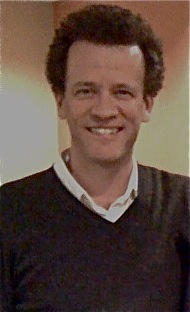
Epilogue:  Yann Martel Reading at the Calgary Public Library

.

.

After writing the above section on Beatrice & Virgil, Arti has the privilege of listening to Yann Martel read from his new book at the Calgary Public Library tonight (April 28, 2010).  It’s always interesting to hear a writer read from his own work.  It’s even more gratifying listening to the Q & A session afterwards.  Yes, he is still sending books to Stephen Harper because he firmly believes that literature is the tool to understand the human condition.

The writer also talked about the creative act, and the use of animals as symbolism. Animals are inherently poignant.  And, how did he know at that pivotal moment of his life, that he wanted to become a writer?  It’s from within, you’d know it because you’d simply want to write without any consideration of monetary gains or praises.  It’s a strong feeling inside moving you to just do it.

Do I need to make any changes to the review above after hearing the author read from the book?  No, I don’t think so.  But what has changed is my view of the writer.  I have come face to face with a very personable and casual human being, someone who is convinced that literature can teach us how to be human, that fiction is as important as facts, and that the creative act of writing is driven by an inherently insatiable desire to simply write, without the intention of being published or any notion of ‘success’ in mind.

***

The Power of Aloneness

.

Before the resurrection was the death.
Before the death, the long path of suffering.
Before the suffering, the lonely struggle,
Agonizing solitude.

The Garden of Gethsemane,
Epitome of aloneness.
Even the closest would fall asleep
But one kept watch, awake for all.

Sweat dropped like blood
A heart pierced before nails were hammered in.
The soul cried out no, not this cup
But oh, not my will.

Not fear of sinews tearing from the joints
But the searing pain of separation
A Father who would leave totally alone
the tainted Son of Sin.

A prostrating prayer, a yielding spirit
The power of aloneness thus transformed.
As He got up from that rock, He had risen
Ready to accept the kiss of death.

I would never know the nailing pain
nor the bitter taste of that dreadful cup
But let me feel the power of solitary rest
To stay awake and rise and conquer death.

.

***

Poem by Arti of Ripple Effects
On the Eve of Good Friday, 2010.

Photos taken by Arti in Israel, 2007.
Top: Via Dolorosa, Bottom: A Garden in Jerusalem

All Rights Reserved.

Alone Again… Unnaturally

A year ago around this time, I wrote the post ‘No Texting for Lent and The End of Solitude’. It was in response to the news about some Roman Catholic bishops urging the faithful to restrain from texting as a penance during Lent.  And around the same time, I came across the article by William Deresiewicz ‘The End of Solitude’, pointing out the difficulty of remaining alone in our over-connected society.

Now a year after Deresiewicz published his essay, the number of tweets had grown by 1,400%.  Now there are 50 million tweets per day, an average of 600 tweets per second.  So, if you’re calling for ‘No texting’ at Lent, you might as well tell people not to use the phone, the computer, the iPhone, all the smart gadgets, in other words, get off the human race for the time being.

Hey, that may not be such a bad idea.  The current issue of The American Scholar has another article by Deresiewicz, yes, on solitude again.  I’m glad to read articles on ‘Solitude’, why?  There just aren’t too many written on this topic.  And thanks to Deresiewicz, seems like his is the only voice crying in the digital wilderness.  The article is a lecture he delivered to the plebe class at the United States Military Academy at West Point in October of last year, entitled ‘Solitude And Leadership’.

If you want others to follow, learn to be alone with your thoughts.

This quote at the beginning of the article just about sums it all up.

Speaking to this class of freshman, all eager and gung-ho to fall in line with the rank and file of this prestigious Military Academy, Deresiewicz has the audacity (ok, guts) to tell his audience to shun conformity, break away from regimentation, to ask questions, to seek their own reality, to form their own opinion, and to exercise moral courage.  And his main crux: it is only through solitude can they do this.

Facebook and Twitter, and yes, even The New York Times, only expose you to other people’s thinking. Whenever you check your tweets, or get on to your social network, or read the newspaper for that matter, you are only hearing other people’s voices:

That’s what Emerson meant when he said that “he who should inspire and lead his race must be defended from travelling with the souls of other men, from living, breathing, reading, and writing in the daily, time-worn yoke of their opinions.” Notice that he uses the word lead. Leadership means finding a new direction, not simply putting yourself at the front of the herd that’s heading toward the cliff.

He urged them to read books instead.  Well aren’t books other people’s opinion too?  True, sometimes you need to put them down too to visualize you own reality and formulate your own stance.  But, books, especially the time-tested ones, have weathered social scrutinies and oppositions, and yet still stand today offering us wisdom of perspectives in finding our own path.

Further, the major difference between a well-written book and a tweet, or a Comedy Central episode, or even a newspaper article, is basically, time.

The best writers write much more slowly than everyone else, and the better they are, the slower they write. James Joyce wrote Ulysses, the greatest novel of the 20th century, at the rate of about a hundred words a day… for seven years. T. S. Eliot, one of the greatest poets our country has ever produced, wrote about 150 pages of poetry over the course of his entire 25-year career. That’s half a page a month. So it is with any other form of thought. You do your best thinking by slowing down and concentrating.

Of course, this may sound reductionist.  But, I like the idea of slowing down in this rapidly shifting world. Deresiewics urged the freshmen of West Point to practice concentrating and focusing on one thing rather than multi-tasking. He charged them to take the time to slowly read, think, and write, in solitude, an axiom that’s so rad that his audience probably had never heard before.

In this über connected world we’re in, it’s unnatural to be alone.  A solitary moment has to be strived for with extra effort, and much self-discipline.  That means unplugging the phone, turning off the computer and anything smart, yes, including friends, real or virtual.   For Lent or not for Lent, it could well be the only way to find out who we are and where we are heading.  Even if we’re not aspiring to lead, at least we know whom we should follow.  And, you’ll never know, others may be attracted to our slowness and surety that they just might step right behind us.  So it’s best not to steer them too close to the cliff.

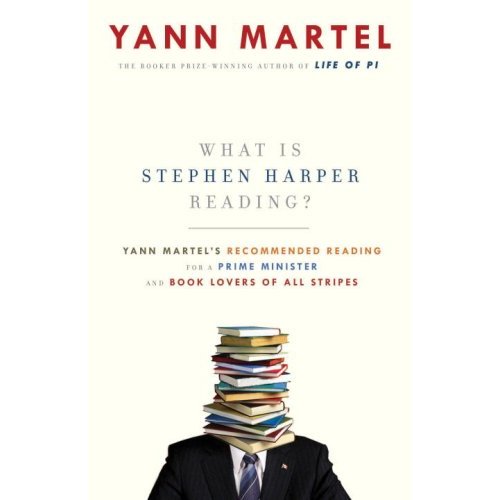
What Is Stephen Harper Reading?

.
Now that the Winter Olympics have come to a close, maybe more of the world would have heard of Stephen Harper.  No, no, he isn’t a medal winner.  Just a hockey fan, and, he happens to be Canada’s Prime Minister.
.

And it’s good time to read this book.  It all started one March day in 2007.  Fifty Canadian artists of all sorts were invited to a Parliamentary session to celebrate the fiftieth anniversary of the Canada Council for the Arts, each of them representing a particular year.

There they were sitting in the Visitors’ Gallery of the House of Commons, waiting for their item to come up on the long agenda of the day.  At 3:00 pm, the business came to the celebration.  All fifty of them were asked to stand up. The Minister for Canadian Heritage, Bev Oda at the time, rose up, acknowledged their presence, and gave a five-minute speech.  Applause.  Then on to the next business item.  Stephen Harper did not even look up at them standing in the Gallery.

The fifty guest artists were incredulous.  Among them was Yann Martel, who received a Canada Council grant in 1991 allowing him to write his first novel.  His literary career reached an admirable high in 2002 when he was awarded The Man Booker Prize for his book Life of Pi.  (CLICK HERE to read one appreciative reader’s response to the book, a personal note from Barack Obama.)

After this incident, driven by frustration, Martel decided to launch a most interesting project.  He started sending Stephen Harper a book every two weeks, with his personal letter introducing  the work, and of course, whenever appropriate, fill him in as to why that’s a good read for a Prime Minister.   With such an intention, one can predict the tone of these letters.  They are mostly sincere, mind you, albeit embedded with the occasional sarcasm, irony, and yes, some condescending subtext.

But overall, these letters to the Prime Minister sent with the books are genuine appeal to the Leader of the country to place more emphasis on the arts. They offer a place of stillness in the busy agenda of a politician.  Martel’s is a gentle voice to remind the prime policy maker the role of the arts, in particular, literature and its appreciation, in the making of a nation, the importance of beauty and the imagination in the building of a vision and in shaping the humanity of her people.

So, it’s not so much as to what Stephen Harper is reading, but what’s on his TBR list.  It remains unknown whether the PM has actually read any of these gifts, although letters of appreciation had been sent to Martel from his office. It’s fun too to read the choices of the titles… and their reasons.  But above all, I’ve enjoyed reading Martel’s insights into how the literary speaks in the context of contemporary political and social landscape.  Here are some examples.  I’ve included a quote or two from Martel’s letter sent with each title:

Animal Farm by George Orwell

Animal Farm is about collective folly.  It is a political book, which won’t be lost on someone in your line of business.  It deals with one of the few matters on which we can all agree:  the evil of tyranny.

Animal Farm is a perfect exemplar of one of the things that literature can be: portable history.  … in a scant 120 pages, … the reader is made wise to the ways of the politically wicked.  That too is what literature can be: an inoculation.”

The Island Means Minago by Milton Acorn (People’s Poet of Canada)

“But any revolution that uses poetry as one of its weapons has at least one correct thing going for it: the knowledge that artistic expression is central to who and how a people are.”

“… the past is one thing, but what we make of it, the conclusions we draw, is another.  History can be many things, depending on how we read it, just as the future can be many things, depending on how we live it… And it is by dreaming first that we get to new realities.  Hence the need for poets.”

The Educated Imagination by Northrop Frye

“Literature speaks the language of the imagination.”

“… the better, the more fertile our imagination, the better we can be at being both reasonable and emotional. As broad and deep as our dreams are, so can our realities become.  And there’s no better way to train that vital part of us than through literature.”

A Modest Proposal by Jonathan Swift

“So, more cuts in arts funding… What does $45 million buy that has more worth than a people’s cultural expression, than a people’s sense of who they are?”

Mister Pip by Lloyd Jones

“Lloyd Jones’s novel is about how literature can create a new world.  It is about how the world can be read like a novel, and a novel like the world.”

The Kreutzer Sonata by Leo Tolstoy

“Why a book on music?  Because serious music, at least as represented by new and classical music, is fast disappearing from our Canadian lives… the latest proof of this: the CBC Radio Orchestra is to be disbanded… How much culture can we do without before we become lifeless, corporate drones?  I believe that both in good and bad times we need beautiful music.”

The Uncommon Reader by Alan Bennett

“The irony in the story is as light as whipped cream, the humour as appealing as candy, the characterization as crisp as potato chips, but at the heart of it there’s something highly nutritious to be digested:  the effect that books can have on a life.”

“Whenever an independent bookstore disappears, shareholders somewhere may be richer, but a neighbourhood is for sure poorer.”

Gilead by Marilynne Robinson

“Speaking of President Obama, it’s because of him that I’m sending you the novel Gilead, by the American writer Marilynne Robinson.  It’s one of his favourite novels.”

“I would sincerely recommend that you read Gilead before you meet President Obama on February 19.  For two people who are meeting for the first time, there’s nothing like talking about a book that both have read to create common ground and a sense of intimacy, of knowing the other in a small but important way.  After all, to like the same book implies a similar emotional response to it, a shared recognition of the world reflected in it. This is assuming , of course, that you like the book.”

Julius Caesar by William Shakespeare

“Since Julius Caesar is about power and politics, we might as well talk about power and politics.  Let me discuss concerns I have with two decisions your government recently announced.

My first concern is about the Social Sciences and Humanities Research Council.  New money allocated to the Council is apparently to be spent exclusively on “business-related degrees”…. we’re losing sight of the purpose of a university if we think it’s the place to churn out MBAs.  A university is the repository and crucible of a society, the place where it studies itself.  It is the brain of a society.  It is not the wallet… A university builds minds and souls.  A business employs.”

Louis Riel by Chester Brown and The Sailor Who Fell From Grace With The Sea by Yukio Mishima

“But I’ve always liked that about books, how they can be so different from each other and yet rest together without strife on a bookshelf.  The hope of literature, the hope of stillness, is that the peace with which the most varied books can lie side by side will transform their readers, so that they too will be able to live side by side with people very different from themselves.”

**

Yann Martel is still sending books to Stephen Harper every two-weeks.  Other authors he has sent include Jane Austen, Flannery O’Connor, Ayn Rand, Gabriel Garcia Marquez, Douglas Coupland, Philip Roth, Alexander Solzhenitsyn, Franz Kafka, Virginia Woolf, Samuel Beckett, Michael Ignatieff, Paul McCartney, Dylan Thomas, Laura and Jenna Bush… quite an eclectic selection. Excellent demonstration of how we can be so drastically different in our perspectives and background, and yet can still stand shoulder to shoulder in this vast land of the free.

To read the full list of all the books he has sent, and yes, including this one, CLICK HERE to go to the official site:  What Is Stephen Harper Reading dot ca

What Is Stephen Harper Reading? by Yann Martel, published by Vintage Canada, 2009, 233 pages.

****

Regarding the role of universities and the humanities as dying disciplines, CLICK HERE to read my post: THE HUMANITIES AS AN ENDANGERED SPECIES.

Why We Read Jane Austen

The first challenge you face when writing about Pride and Prejudice is to get through your first sentences without saying, “it is a truth universally acknowledged…”

—–  Martin Amis

Isn’t it true that these words from the clever and satirical opening line of Jane Austen’s Pride and Prejudice [1] have been so overused that they have sadly become a cliché in our contemporary language, together with ‘zombies’ and ‘vampires’?

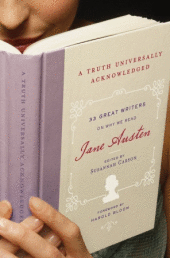
So what did I expect from a book entitled A Truth Universally Acknowledged:  33 Great Writers on Why We Read Jane Austen?

I admit, at first I thought it was a literary version of those lifetime achievement award presentations, where the honoree is showered with superfluous speeches by his/her peers, over champagne and frivolous dinner, something which Jane Austen herself would abhor.

I found out soon enough that between the modest and classic looking covers, Susannah Carson, the editor of the volume, had gathered the essays of 33 writers, not toasts or roasts, but detailed biographical notes, thoughtful musings, heartfelt admiration and in-depth analysis of Austen characters and works.  It is a collection of articles stemming from a balanced fusion of sense and sensibility, something that Austen herself would have approved.

Included are literary figures from the late 19th to 20th centuries like E. M. Forster, W. Somerset Maugham, C. S. Lewis, Eudora Welty and Virginia Woolf.  Contemporary contributors include writers, academics, Austen historian, and screenwriters.  There are views from Harold Bloom, Lionel Trilling, Janet Todd, Anna Quindlen, A. S. Byatt, Amy Bloom, to name a few.  All of them point to Austen’s inimitable humor, incisive observations of human nature and unwavering moral stance that make her works still relevant two hundred years later today.

The following are some samples from this smorgasboard of Austen delights.

Harold Bloom, writing the preface, concludes with these lines:

We read Austen because she seems to know us better than we know ourselves, and she seems to know us so intimately for the simple reason that she helped determine who we are both as readers and as human beings.

Anna Quindlen, defending the subject matter in Austen’s works being mainly about the family (it’s a pity that she even needs to do this):

…[Austen was] a writer who believed the clash of personalities was as meaningful as—perhaps more meaningful than—the clash of sabers.  For those of us who suspect that all the mysteries of life are contained in the microcosm of the family, that personal relationships prefigure all else, the work of Jane Austen is the Rosetta stone of literature.

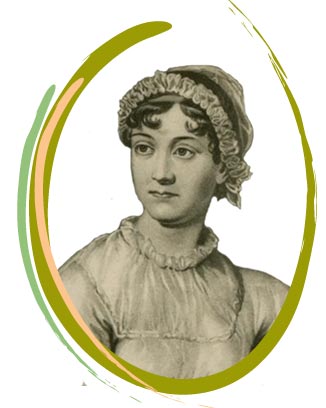
Austen once referred her own writing as “the little bit (two inches wide) of ivory on which I work with so fine a brush, as produces little effect after much labour.”  In response, screenwriter and director Amy Heckerling, who has adapted Emma into the movie ‘Clueless’, compares Austen’s writing to a Vermeer painting:

“Sometimes the finest brushes paint the biggest truths.”

James Collins, a writer and editor, and frequent contributor to The New Yorker, shares a very personal view:

I find that reading Jane Austen helps me clarify ethical choices, helps me figure out a way to live with integrity in the corrupt world, even helps me adopt the proper tone and manner in dealing with others… Reading Austen I sometimes feel as if my morals are a wobbly figurine that her hand reaches out and steadies.

But she is not all didactic and stern… far from it.  Jane Austen has long been celebrated for her animated humour and witty ironies, the essence of her writing.  I love this analogy that Collins uses:

Her ironies swirl and drop like the cast of a fly fisherman. This rhythmic motion seems to me ideal for both accepting and rejecting the ways of the wretched world while maintaining balance.

Demonstrating the relevance of her satires for today, Benjamin Nugent, the author of American Nerd: The Story of My People, discusses the nerds in Pride and Prejudice, Mary Bennett and Mr. Collins, and why they miss out on life.

If you read sci-fi novels, you’ll generally read about worlds in which scientists and the technologies they create drive the plot; if you read Austen, you’ll read about a world in which technology means nothing and the triumphs and failures of conversational agility drive everything.

His advice for modern day nerds:

Young nerds should read Austen because she’ll force them to hear dissonant notes in their own speech they might otherwise miss, and open their eyes to defeats and victories they otherwise wouldn’t even have noticed.  Like almost all worthwhile adolescent experience, it can be depressing, but it can also feel like waking up.

It takes a sharp ear and intelligence to be a good humorist, and Austen shows that she has what it takes to be one at an early age.  About her prodigious talent, Virginia Woolf praises her first work, the novella Love and Friendship, written when Austen was only 15:

an astonishing and unchildish story… Spirited, easy, full of fun, verging with freedom upon sheer nonsense–Love and Friendship is all that…  The girl of fifteen is laughing, in her corner, at the world.

Indeed, as editor Susannah Carson has stated, any hint of ‘romance’ in her novels is merely the irony of it. About the seemingly unconvincing romantic plot in Northanger Abbey, Carson asserts:

What if Austen actually intended the romance plot to be unconvincing?  … It is probable… that Austen intended the failure of the romance plot, not to sabotage her own work, but to make a point about romance plots in general… that [they] are inherently artificial.

That Northanger Abbey is a satire on the gothic novel has long been noted.  Other writers also stress that Austen should not be labelled as a ‘romance writer’ because of the satirical styling behind her writing.  W. Somerset Maugham keenly observes:  “She had too much common sense and too sprightly a humor to be romantic.”

In his essay ‘Beautiful Mind’, writer Jay McInerney bravely admits that: “If my actual romantic life has sometimes been influenced by superficial considerations, as an Austen reader the basis of my affections has been almost entirely cerebral.

Amy Bloom sums it up succinctly about this common confusion about romance and love:

Jane Austen is, for me, the best writer for anyone who believes in love more than in romance, and who cares more for the private than the public. She understands that men and women have to grow up in order to deserve and achieve great love, that some suffering is necessary (that mewling about it in your memoir or on a talk show will not help at all), and that people who mistake the desirable object for the one necessary and essential love will get what they deserve.

To master such a distinction could well be one of the main reasons why we read Jane Austen.

**

A Truth Universally Acknowledged:  33 Great Writers on Why We Read Jane Austen, edited by Susannah Carson, published by Random House, NY, 2009, 295 pages.

**

[1] The first line of Pride and Prejudice goes like this: “It is a truth universally acknowledged, that a single man in possession of a good fortune, must be in want of a wife.”

Photos Sources: Book cover randomhouse.com, Jane Austen Portrait tvo.org, Jane Austen Centre, Bath, taken by Arti of Ripple Effects, Dec. 07.

This article has recently been published in the current Jane Austen Centre Online Magazine. Click to go there for other interesting articles on Jane and the Regency world.

**

Related Posts you might enjoy:

In Praise of Austen: Virginia Woolf’s A Room Of One’s Own

A Jane Austen Education by William Deresiewicz

**

Those Magical Numbers: Year-End Musings

10

Are we coming to the end of a decade?  Or still have another year to go?  Does the new decade start with 2010, or 2011?  No matter, that debate is just academic and immaterial in light of the actual events that had taken place after we entered the new century.  From a wider perspective, it’s been a period that TIME magazine called ‘the Decade from Hell’, ‘the Reckoning’, ‘the Decade of Broken Dreams’.  Now, the new normal is recession, terrorism, climate change, pandemic.

On a personal level, a decade sounds weighty enough to send chills down the spine.  Where have all the years gone?  A decade of our life has already slipped by since the beginning of the millenium, the novelty of Y2K rubs off like the fleeting fragrance of the night-blooming flower.  Above all, how do we put into perspective a life among all the tensions on a wider scale?  Can we sculpt out a little private, inner space where peace can still thrive, and faith, hope, and love indwell despite the overwhelming odds in the outside world?

12

According to the liturgical calendar, Christmas celebration continues for 12 more days into the new year, until the Epiphany, January 6th.  With the backdrop of mostly negative global affairs, it’ll do us good to stretch the Christmas spirit a bit longer.  Let the joy and peace last for a few more days.  A reader has reminded me that Christmas Day is arbitrarily picked anyway.  True.  But since we’re given one day to ‘legitimately’ celebrate the birth of Christ, might as well make the best use of it… for I really don’t know how long such a tradition will last, or us given the ‘right’ to mention Christ publicly.  So it’s Epiphany then, 12 more days.  But… is that enough?  I mean the peace and joy, not the hustle and bustle.  Shouldn’t we extend the spirit of Christmas to all the days of the year?  Wouldn’t it be a better world if we let the Word dwell among us just a while longer, or in our wildest dream, let Truth and Grace prevail in every single day?

24

Never mind the decade, just think about the 24 hours I’m endowed with.  How should I spend my next allotment?  Not until I break down the day into 24 units can I find some pressing reality and urgency.  Years back, I used to work in a consulting firm where we had to fill in a time-sheet at the end of the day.  I had to account for my time in 15-minute units, so the firm could charge my time back to the right clients.  My boss would really frown on the category ‘general office’.  That’s what we put down when we were not actually working on a particular project, so our time is charged back to the firm.  I’m afraid it’s ‘general office’ most of the time these days… Is taking care of elderly parents ‘general office’?  umm… what about blogging?  Is it real work?  Who do I charge to?  Can I measure my time in chargeable units?

365

The most amazing site I’ve come across this year is Nina Sankovitch’s Read All Day.  On October 28, 2008 Nina embarked on the 365 Project.  She was to read one book a day and write a review on her blog for one year.  On October 28, 2009 she completed it.  What an incredible endeavour!

Nina lives in Westport, Connecticut, with a family of four reading boys to raise.  Incredible indeed.  Her first book in the Project?  The Elegance of the Hedgehog, one of my favorite books of the year.  Click Here to read her New York Times interview.

As a book lover, there’s nothing more she’d rather do than just to read all day. But Nina embarked on this project for some other reasons as well.  She read to learn, to find her place in the world, to seek directions on how to conduct her life, raise her children, relate to her fellow humanity. Also, four years after the death of her older sister at age 46,  she had now come to that age herself. She wrote on her site her purpose for reading with the most poignant words.  I would not paraphrase a single line:

“This year I am the age she was when she died: 46.  She was too young to die, she loved to read, I am fulfilling maybe even a fraction of the reading she should have had left to her. But I am not only reading to compensate, I am reading to endure.  Books — especially novels — offer a window into how other people deal with life, its sorrows and joys and monotonies and frustrations.  I can find empathy, guidance, fellowship, and experience through my reading.  I will never be relieved of my sorrow for my sister.  I am not looking for relief: I am looking for resilience.”

This is one of the most moving reasons for reading.  Nina Sankovitch now writes a book column for Huffington Post, and is still keeping her Read All Day site, down to maybe three books a week.  She is also preparing for publication a book on her 365 Project.

My next allotment of 365 is coming up very shortly.  I know I can’t take that for granted.  Who can guarantee 365, or even 24.  A book a day, what an inspiring concept… something I can never imagine myself doing.  What motivates me though isn’t her achieving that 365, but maintaining the momentum every 24.

It’s not so much about reaching that magical number, or completing a task, it’s all about finding a purpose, and the resilience to live it every single day.

***

Photo:  Footbridge to Bow Lake, Alberta.  Taken by Arti of Ripple Effects, August, 09. All Rights Reserved.

Books and the Gender Issue

My review of Girl With A Pearl Earring has recently been linked to a book list. While I appreciate the link, I must admit it has stirred up in me some unintended ripples.  It’s the title of the list:  ‘101 Books Every Woman Should Read’.

Now I’m always wary about books that are labeled and geared towards one gender.  Like recently I came across a book entitled 100 Places in Italy Every Woman Should Go… makes you wonder what exactly they’re luring you into. Imagine a book called 100 Places Every Man Should Go…

Anyway, back to the list of books every woman should read.  The range is eclectic with the titles neatly categorized.

Just let me list a sample from each of the categories:

The Classics: Frankenstein by Mary Shelly, The Fountainhead by Ayn Rand, Howards End by E. M. Forster, To Kill a Mockingbird by Harper Lee, Pride and Prejudice by Jane Austen, Wuthering Heights by Emily Bronte, Middlemarch by George Eliot, Mrs. Dalloway by Virginia Woolf…

Children’s Literature:  Pippi Longstockings by Astrid Lindgren, The Wizard of Oz by L. Frank Baum, Charlotte’s Web by E. B. White, Alice’s Adventures in Wonderland by Lewis Carroll…

Books into Movies:  The English Patient by Michael Ondaatje, Beloved by Toni Morrison, Memoirs of a Geisha by Arthur Golden, Out of Africa by Isak Dinesen…

Books Featuring Familial Relationships:  The Joy Luck Club by Amy Tan, The Poisonwood Bible by Barbara Kingslover, The God of Small Things by Arundhati Roy, Away by Jane Urquhart…

Books Celebrating the Strength of Women:  Jane Eyre by Charlotte Bronte, The Bell Jar by Sylvia Plath, The Scarlet Letter by Nathaniel Hawthorn, Babette’s Feast by Isak Dinesen…

Current Literature:  Unaccustomed Earth by Jhumpa Lahiri, The Elegance of the Hedgehog by Muriel Barbery, Water for Elephants by Sara Gruen…

Books about Finding Oneself:  Bee Season by Myla Goldberg, The Heart is a Lonely Hunter by Carson McCullers…

Stories of Real Women: I Know Why the Caged Bird Sings by Maya Angelou,  Amelia: A Life of the Aviation Legend by Donald M. Goldstein and Katherine V. Dillon, Diary of a Young Girl by Anne Frank, The Story of My Life by Helen Keller, Portrait of an Artist: A Biography of Georgia O’Keeffe by Laurie Lisle…

Banned or Challenged Books:  Leaves of Grass by Walt Whitman, Fahrenheit 451 by Ray Bradbury, Of Mice and Men by John Steinback, The Kite Runner by Khaled Hosseini.

Non-Fiction: Pilgrim at Tinker Creek by Annie Dillard, Silent Spring by Rachel Carson, Gorillas in the Mist by Dian Fossey, On Death and Dying by Elisabeth Kubler-Ross,  A Room of One’s Own by Virginia Woolf

You get my point.  Sounds like any typical high school and college reading list, but why specify women?

Yes, they’re mostly written by women authors, and many with strong female protagonists.  They depict the journey of self-discovery, of overcoming odds, of seeking meaningful relationships and ideals in a hostile world.  In the non-fiction section there are influential books that have achieved significance in the area of writing, psychology, environmentalism, social justice.

But my query is:  If these books depict the inner journey of women, or portray the poignant reality of their struggles, if they have shed any light on the human race in terms of equality, justice, or existential meaning, are these not all the more reasons for men, or anyone, to read them?

Of course, for the sake of argument, one could point out that the statement “books every woman should read” doesn’t preclude that men should not.  But that’s just being contentious.

Books for women, books for men, why can’t books be just books?  Maybe it has to do with the writing of books, or, step back further, society’s view on male and female authors.

Posting on the Guardian blog, writer and editor Harriet Evans vehemently declares that:

“I’m fed up with seeing some of our best novelists written off as ‘chick lit’ — you don’t see the same belittling line taken with male writers…

It winds me up that books about young women are seen as frivolous and silly, while books about young men’s lives that cover the same topics, are reviewed and debated, seen as valid and interesting contributions to the current social and media scene.

And regarding the reading public, it has been noted that women read more than men, both in the U.S. and the U.K.  With that in mind, Evans goes on to state that:

The truth is, women happily read books (and watch films and TV) aimed primarily at men…. They read thrillers, travel books, biographies – and yet the majority of these books are marketed for men… But men rarely try women’s fiction, because they’ve been conditioned to think they can’t pick up a book with a pink cover.”

Indeed, worthy literature written by women authors are sometimes reduced to ‘romance’ or ‘chick lit’.  Jane Austen is a prime example.  Her incisive social satires, eloquent writing and sense of humor have often been swept aside while the romantic union of the protagonists at the end is given the main focus.  In this way, her work is conveniently labeled as ‘chick lit’, dreaded by male readers, until some brave souls dare to take up the challenge and are floored by her relevance and intelligence.

Virginia Woolf sharply observes in her Cambridge lecture series compiled in A Room Of One’s Own that historically, social norm has always been one that coops up women in the domestic while offering men the world.

Taking her view further, I can understand why the dichotomy, however arbitrary, in male and female writing, their difference in subject matters, subsequently, books for men and books for women.

I have a feeling that if the protagonist of The Catcher In The Rye is called Helen Caulfield, the book could well be dismissed as another trivial version of teen angst, schoolgirl blues, fussing over boys and growing up.  And likely we won’t see it on any reading list.