Here’s the other one of my perennial posts, a wrap for the year. Books I’ve read and film experience that top the year for me. Here are the lists, in no particular order:
MOVIES
I’m appreciating foreign language films more and more, for they offer some of the best examples of what cinematic arts can offer, not CGI sparked spectacles. In my Top 10 list, the first four are from non-English speaking countries. They are also short-listed for the coming Academy Awards Best Foreign Language Film category. Links are to my reviews.
I must mention two films that I’d highly anticipated but somehow didn’t connect as I’d wanted to. Maybe if I’ve the chance to watch them again I might change my mind: Cold War and First Reform.
Two movies from 2017 which I hadn’t watched until January this year that should be mentioned here:
These are not necessarily published in 2018, but the best books that I’ve read this year. I’m not a ‘quantity reader’, nevertheless, a look back at my Goodreads record, I can’t believe I ate all these (links are to my reviews):
The Guermantes Way by Marcel Proust (after 3 years, finally finished)
Hillbilly Elegy: A Memoir of a Family and Culture in Crisis by J. D. Vance
***
Selective Top Ripples from past years are listed on the side bar. Click on the pictures to my reviews.
Again, thanks for visiting the Pond and throwing in your two pebbles. I’ve enjoyed every single ripple. Hope you’d found a quiet respite here for thoughts and renewal.
And to all, may 2019 bring you more great books and movies to cherish.
HAPPY NEW YEAR!
***
Update: This post should be written on the last day of the year. Since I’d posted it, I saw another film today which I feel should be included here on the Top Ripples 2018 list, and that’s The Favourite (Just opens today in our City). I’m taking The Rider out to keep the list of 10. The Rider I found I’d already included it in my Top Ripples list last year.
‘Reading the Season’ is my Christmas post every year. It’s always a pleasure to spend some quiet time amidst the hustle and bustle of the festivities to meditate on the essence and meaning of the Season. Yes, something like the perennial “A Charlie Brown Christmas”.
In recent weeks, one of my previous ‘Reading the Season’ posts has seen particularly high traffic, and that’s where I selected a few of Madeleine L’Engle’s poems. Indeed, the brilliant L’Engle had given us more than just A Wrinkle in Time. The versatile writer had 63 publications to her credits.
My favourite of her works is The Crosswicks Journal series. In there is the alchemy of wisdom, experience, and faith. Rereading Book 3 The Irrational Season this time, I came upon this verse which I didn’t notice much before. But this year’s different, for there’s a newborn in the family.
Here’s L’Engle’s short intro before the poem:
“When I wrote the following lines I thought of them as being in Mary’s voice, but they might just as well be in mine––or any parent’s.” (p. 115, The Irrational Season)
Now we may love the child.
Now he is ours,
this tiny thing,
utterly vulnerable and dependent
on the circle of our love.
Now we may hold him,
feeling with gentle hands
the perfection of his tender skin
from the soft crown of his head
to the sweet soles of his merrily kicking feet.
His fingers softly curl
around one finger of the grownup hand.
Now we may hold.
Now may I feel his hungry sucking at my breast
as I give him my own life.
Now may my husband toss him in the air
and catch him in his sure and steady hands
laughing with laughter as quick and pure
as the baby’s own.
Now may I rock him softly to his sleep,
rock and sing,
sing and hold.
This moment of time is here,
has happened, is:
rejoice!
Child,
give me the courage for the time
when I must open my arms
and let you go.
**
And oh what letting go it was for Mary that day at the foot of a cross, that ultimate letting go, and with it, the awakening which must have brought her back to that first night when she gave birth in the manger.
***
Above Photo Credit: Diana Cheng. An evening view from Ontario’s Point Pelee National Park, September, 2018.
This awards season, a black-and-white film stands out. Many have noted its cinematography and director Alfonso Cuarón’s versatility, from his multiple Oscar-winning space drifting Gravity (2013) and adaptation of P. D. James’s dystopian thriller Children of Men (2006) to the current Roma, a semi-autobiographical work. Surely I agree to all these, but it’s the personal resonance that the film evokes that makes it so memorable for me.
Yalitza Aparicio as Cleo in Alfonso Cuarón’s Roma. Photo courtesy of TIFF.
I first saw Roma at the 2018 Toronto International Film Festival in September. The large screen effects are enfolding. Cinematography is thoughtful and the state-of-the-art Dolby Atmos sound mixing–especially the climatic ocean scene towards the end of the film–was totally engulfing, as if I was alone in the raging sea, despite sitting in a fully packed theatre.
Watching it again this time on my laptop streaming from Netflix is another experience. The intimacy and allowance for repeat viewing and listening to specific dialogues (re-reading the subtitles) are the obvious benefits. Especially with our local theatres not screening the film, the streaming service has a definite role to play in bringing the worthy feature to more viewers. Certainly if Roma plays in your local theatre, do watch it on the big screen as the production was meant to be seen.
What’s most moving is the director’s gentle rendering of his maid and nanny Cleo (first-time performance by Yalitza Aparicio) in his childhood home in Roma, an upper-middle class neighbourhood in Mexico during the years 1970-71. Cuarón juxtaposes Cleo’s personal ordeal with the political backdrop of the time, and weaving an unassuming life of a maid with episodes of an earthquake, a fire and a threatening ocean climatic scene. Other than these, the everyday work of a maid are deceptively mundane, for underlying are the emotive elements of human relationships.
Cleo is an essential member of the household, cleaning, cooking, serving, and taking care of the four children and their parents. She’s the one who puts the younger ones to bed and wakes them up in the morning. From the nuanced, naturalistic framing and some deeply affective moments, Roma is an ode to those who care for children not just out of duty but genuine love.
The reciprocal sentiments from the children, mom Sofia (Marina de Tavira) and grandma Teresa (Verónica García) make the glue that hold the family together at a critical time when the father (Fernando Grediaga) disappears, supposedly on an academic trip to Quebec but coincidentally is seen on the street with another woman. Here the role played by Cleo, a maid, is delicate and precarious. “No matter what they tell you, we women are always alone,” wife Sofia says to Cleo one night returning home by herself half drunk. Cleo shares her pain.
The film belongs to Yalitza Aparicio who plays Cleo with unadorned naturalness. Before this first time acting, she was a preschool teacher. This could well explain her instinctive fondness for the children under her care in the film. Cleo has her personal sad experience with a young man with a different agenda, and it is the family and the children that rekindle her zeal after a personal tragedy, a remarkable exchange of mutual support and kindness.
As the cinematographer himself, Cuarón’s planning of shots is meticulous and masterful. The camera captivates from the opening credits. We see the close-up frame of what looks like clay tiles of the ground, yes, they are, as water is splashed on them and sounds of sweeping and cleaning are heard. As the story unfolds we learn that it is Cleo cleaning dog wastes in the family porch. But don’t lose sight of this seemingly mundane scene. Once water is splashed on the flat, dirty tiles they reflect an open sky above with an airplane flying across from afar. That is the exact ending shot of the film. From waste-filled clay tiles on the ground to the open sky, water is the agent of reflection, a cleansing element, and towards the end, water marks a confirming love and new zest for life.
Last week, I made a long distance phone call to the maid and nanny of my family when I was growing up in Hong Kong. She is 97 years old now and living on her own, still goes to the market to buy fresh ingredients to cook for herself. I was able to chat with her and send well wishes. Childhood memories are powerful markers of identity and experiences; thanks to Roma for evoking such while one is unaware, as it works magic in creating new imagery to sustain them.
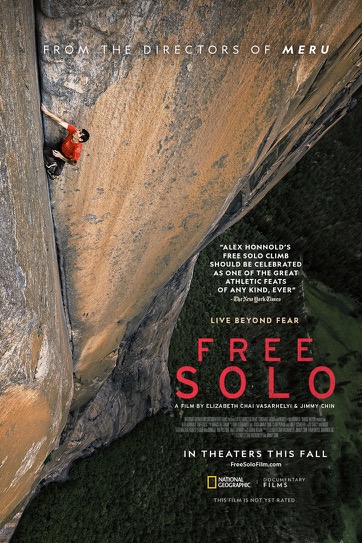
FreeSolo was showcased in the 2018 Toronto International Film Festival in September and won TIFF’s People’s Choice Awards in Documentary. It is currently showing in selective cities.
In the movie listing of our local theatres, Free Solo appears right after First Man, a Gala feature at TIFF18 that is now released widely. Other than the alphabetical coincidence, their being listed together is most apt, for the parallels are significant. Both involved the audacity of single-minded, death-defying courage, and yes, maybe a self-driven obsession.
The scale of the two endeavours massively differ. While First Man dramatizes astronaut Neil Armstrong’s (played by Ryan Gosling) attempt to place human’s first step on the moon, a mission propelled by the leading edge of science and technology of the time, Free Solo documents professional rock climber Alex Honnold scaling the 3,000 feet vertical wall of El Capitan in California’s Yosemite National Park using the lowest tech available: his bare hands and feet, solo and free from ropes and safety gears.
Both Armstrong and Honnolds knew clearly the risks involved. Director Damien Chazelle of First Man spends substantial screen time on the human cost of the space missions and the lives lost, while Honnolds was well aware of professional climbers before him falling to their death. Both men however had to focus on the task at hand and cast the risk factors aside. Worrying and negative thinking would only impede the mission in front of them. Such matters are better left to their significant others, Armstrong’s wife and sons, and Honnold’s girlfriend.
For one man to rise to a death-defying challenge, his loved ones boldly bear the emotional costs. The equation looks to be a zero-sum game.
Alex Honnold pondering El Capitan. Credit: National Geographic
Kudos to the filmmakers of both features then, for bringing the issue to the forefront. The overarching parallel of First Man and Free Solo looks to be the emotional toll on a hero’s significant others. One conflicting sentiment that is so intensely displayed by actor Claire Foy as Armstrong’s wife Janet is realizing that, to her husband, the mission appears to be more important than the family. In Free Solo, Honnold’s girlfriend Sanni had shed silent tears and borne the reality that she had to step aside and not be an obstacle blocking Honnold’s ambition. Getting her boyfriend to move from living in a van to a house, and gently warming him up to a meaningful relationship could be her mountain to scale.
Husband-and-wife directors Jimmy Chin and Elizabeth Chai Vasarhelyi captivate audience with their stunning cinematography in chronicling star rock climber Honnolds’ career and his rise to the peak (so far). What’s thought-provoking is their focus not just on the physical but the psyche of those involved, and especially girlfriend Sanni’s emotional toll and those of close friends in the climbing community such as Tommy Caldwell, who has given up free solos now that he’s put his wife and children into the equation.
Free solo, the climb. Credit: National Geographic
But this is after all a documentary of bravery. Casting aside sentiments, doubts and softening vibes, it’s pure determination, courage, athleticism and obsession that drove Honnold to a free solo climb up El Capitan. Tim McGraw’s new song “Gravity” written with Lori McKenna for the film points out the other side of the equation, one must conquer fear to reach one’s goal when it’s so close; to Honnold, it’s worth the risks. “Gravity is a fragile thing / All of the work that you left in your roads / All of the dreams and that all / Now you can finally see them / They meet you at your destination / Now that you have made it so far.” (listen to the song)
Director Jimmy Chin‘s camera team consisted of all professional rock climbers/photographers. They situated themselves on the vertical granite wall in strategic locations to capture Honnold’s ascent. Remote cameras were also set up to minimize distractions. They knew dead silence and the least commotion were crucial for their work; a single pebble falling off could break Honnold’s concentration. For the free solo climber, one small misstep would bring certain death. So this was no spectacle for millions to watch on live TV like the lunar landing. That would only add more pressure. This is just one man’s audacious will to fulfill a lifelong dream.
Chin knows exactly the risks and what it takes to look fear in the face and not flinch, being an acclaimed mountaineer and photographer/filmmaker himself. When only 23, he had organized and led an expedition to Pakistan’s Karakoram mountains, and the rest is climbing history. Chin had since conquered numerous mountain tops as well as captured dangerous shots published in National Geographic and lauded worldwide. His award winning film Meru (2015) co-directed with wife Elizabeth Chai Vasarhelyi documented his three-men expedition to Meru Peak in the Himalayas, a peak more difficult than Everest which he’d reached several times. In 2016, he climbed Everest again and skied down its vertical surface.
DirectorsElizabeth Chai Vasarhelyi and Jimmy Chin. Credit: National Geographic
Chin had known Honnold for about a decade and had gone on climbing expeditions together. Both knew each other well before committing to a documentary of the free solo up El Capitan, a National Geographic production.
The story doesn’t end here, at least I hope. Cut to director/mountaineer/photographer/filmmaker Jimmy Chin.
Born in Minnesota and grew up in a Chinese immigrant family, Chin learned hard work and humility from his librarian parents. To shatter the stereotype of a Chinese boy growing up in America, Chin’s story is exemplary. Surely he excelled in academics, read voraciously, and yes, played the violin and practiced martial arts, but Chin distinguished himself by wearing courage on his sleeve and manifested great strength and athleticism through his climbing expeditions. When as a young college grad, he shifted his devotion to mountaineering and adventure, a passion his parents did not embrace, all of them would not have imagined what a second generation Chinese immigrant boy born in Minnesota could have grown up to be.
Writer-director Sandi Tan’s bio reads like an anime heroine. Born in Singapore, where chewing gum is outlawed and family expectations confining, teenager Sandi led a subversive life immersed in the rad, forbidden culture of Singapore. At the prodigious age of 14, she wrote for “Big O”, a magazine of Singapore’s underground rock scene. At 16, she started her own zine “The Exploding Cat” with best friend Jasmine Ng. It attracted a cult following; they received fan letters from New York, London, Paris, Jerusalem, even from prisons. But that’s not the exciting part. At the ripe old age of 19, Sandi made the first indie road movie of Singapore, with a few devoted cinephiles and curious onlookers.
It all began when an enigmatic American expat called Georges Cardona arriving in Singapore and started a film class attended by mostly 18 and 19 year-old girls. Sandi started Georges’ class with great aspirations. He took her and a few other gals under his wings, went on night drives after class and introduced them to the French New Wave.
In the summer of 1992, energized by youthful zeal, Sandi made a movie called “Shirkers” with people from her filmmaking class, a remarkable feat. She wrote the script and played the main role, a 16 years-old assassin called “S”. Her best friend Jasmine was editor; another friend Sophie Siddique was producer, and Georges, the director. Sophie as executive producer wrote a letter to Kodak and received all film supplies free. How they rounded up supporting actors and extras, location scouts, sound and techs was an endeavour only youthful verve would attempt.
After the completion of the filming, Sandi and her friends left Singapore for University; she went to England, Jasmine to New York, and Sophie to L.A. Georges remained in Singapore. And that was when the girls lost contact with him. None of them had seen any of the footage, and Jasmine had all the intention to return after school term to do editing work. Georges had disappeared without a trace and taken with him all the 16mm reels of their “Shirkers” film. A large chunk of the girls’ life had gone missing, especially Sandi’s, who had put her heart and soul into the venture, and who, on her own, had gone on a road trip in America with Georges, by then her best friend, a man twice her age with a wife and kid.
With Georges’s mysterious exit, the filmmaking dream of the clan had all but vanished into thin air. After finishing university in England, Sandi went back to Singapore and wrote for Singapore’s Straits Times as a film critic, apparently a dream detoured. Yet life went on. A few years later she proceeded to NYC for film school at Columbia University and later settled in the U.S. She had since made a couple of short films and written a novel, The Black Isle (Hachette USA), which was well received. But at the back of her mind, she could not forget “Shirkers”. Then, twenty-five years later, that fateful day arrived.
Without giving out spoilers, somehow events led to the recovery of the complete “Shirkers” in its original condition in 70 canisters of 16mm film, together with storyboards, scripts, mementos and props used in the production. An amazing turn.
The present documentary is not only about the creative process in filmmaking by a group of young enthusiasts, but also a chronicle of a period in Singapore’s social and cinematic history. What’s more, Sandi Tan’s feature could well kick off something like the #MeToo Movement, not about sexual advantage taken by the powerful, but about adults in mentoring positions toying with the hopes and dreams of their protégé, about the betrayal of trust and the robbing of rightful ownership of creative endeavours. But of course, Georges could well be just a deeply disturbed soul shirking from real life challenges and responsibilities.
Shirkers the documentary is a cinematic collage of 16mm film, digital, Super 8, slides, animations, hand-drawn illustrations and writing, a visual cacophony of creative expressions. Cinematographer Iris Ng (The Apology, Stories We Tell) has done a realistic capture of old friends reuniting with the Jasmine and Sophie interviews plus those of other personnel associated with the original production. Jasmine is now a filmmaker and Sophie faculty of Film at Vassar.
The editing in bridging the 25-year-gap is seamless, the mood personal and quirky. Notable also are the sound mixing and the original score. Shirkers is more than just a chronicle of a mysterious lost-and-found, but a narrative that transcends grievances to situate personal experience in a larger social and cultural context.
Shirkers premiered at the 2018 Sundance Film Festival in January where Sandi Tan won the World Cinema Documentary Directing Award. The film was later acquired by Netflix and released October 26 via the streaming service.
Latest news is that Shirkers is among the 166 entries for Best Documentary Feature in the coming Oscars. Nominations for the short-list will be announced on Tuesday, January 22, 2019. The 91st Academy Awards show will be broadcast live on Sunday, February 24, 2019.
~ ~ ~ Ripples
***
Update Nov. 16: Shirkers has just been nominated for Best Documentary Independent Spirit Award.
A Korean director shooting a film while attending the Cannes Film Festival, with two prominent Korean and French actors in his cast, taking just days in shooting to make what seems like a spontaneous gig had resulted in this whimsical 69-minute dramedy. Looks like something only the prolific, Cannes-honored director Hong Sangsoo can pull off. The versatile Isabelle Huppert (Things to Come, Elle) in one of her interviews said it took her only five days to do Claire’s Camera with Hong, with no script, except a daily run-through of the day’s story and lines.
Kim Minhee and Isabelle Huppert in Hong Sangsoo’s Claire’s Camera. Photo courtesy of Cinema Guild.
This is Huppert’s second time collaborating with Hong. The parallels in Claire’s Camera with real life are the very elements that lends to the film’s subtle humour. Claire (Huppert) is a school teacher from Paris visiting Cannes for the first time, accompanying a friend to the Film Festival. While wandering alone in this seaside resort taking pictures with her camera, Claire bumps into a triangle entanglement: a Korean director So (Jung Jinyoung), his film’s sales rep Yanghye (Chang Mihee) who has more than just a business relationship with So, and separately, her sales assistant Manhee (played by Hong’s muse Kim Minhee, On the Beach at Night Alone), whom she fires as she finds out Manhee’s one-night stand with the director.
Claire makes fast friends with Manhee after they meet on the beach. Here we see two actors from different countries using English to communicate, a language that’s not their own mother tongue. The verbal limitations may be a bother for some watching the film, but apparently not a hindrance for the two of them striking up an instant, equal friendship. They seem to know what the other is trying to say, and they care to ask each other questions, some quite personal, in order to know the other more.
Contrast that to a conversation where Manhee has with her boss Yanghye over coffee when she gets the message that she’s fired. They share the same Korean language, yet their interlocution is marked by unspoken sentiments and the boss’s minimal attempt to make it a two-way flow. Here’s a realistic depiction of a lopsided communication, one that’s not exclusive to the Korean culture. Those in authority hold the key to conversations.
In another scene, the lack of communication is what makes the naturalistic, deadpan humor work. When Claire first meets director So, the two are sitting at adjacent tables outside a café. As conversation begins, So asks Claire if he can sit with her at her table. She agrees and he stands up and moves to sit by her. But then the two have nothing more to say to each other, maybe due to language limitations. Claire then goes on to Google him on her phone to find out more about this director who’s sitting beside her. One has to take this as a comedic scene to appreciate the irony.
Jung Jinyoung and Isabelle Huppert in Claire’s Camera. Photo courtesy of Cinema Guild.
The film is breezy and leisurely as the Cannes seaside, refreshing as the yellow jacket Claire is wearing; incidentally, her ‘costume’ is the actual wardrobe Huppert had brought when she was attending Cannes at that time. The setting is scenic and pleasant, whether it’s the pounding waves or the small lanes winding along cafes. No, we don’t get to see the red carpet or any of the glamour of the Cannes Film Festival, but we’re led into the side streets of storytelling.
The pitfall for those not familiar with Hong’s eccentric style could be the naturalistic, seemingly unscripted demeanours of his actors and their haphazard dialogues, and in this case especially sound laboured when characters try to interact with each other in a foreign language. And speaking of communication, the usual hard-drinking of his characters—director So here—could well be a language of expression in itself.
As for the camera Claire is always carrying, one would wish Hong could have used that a bit more, cinematically and imbued with deeper meaning. Hers is a Polaroid, so the image appears slowly on a hard copy. But we don’t get to see this effect or be led to any deeper relevance. However, in one notable dialogue towards the end when Manhee finally asks Claire a question that must have been on her mind all along, we finally hear something revealing:
Manhee: Why do you take pictures?
Claire: Because the only way to change things is to look at everything again very slowly.
Manhee: That sounds very nice.
The unfinished part seems to be, “but do we do it?”
Considering Hong Sangsoo’s signature style of repeating his film sequences in a movie like we’re watching it all over again but towards different results, Claire’s words could be more layered than they appear, and the slow appearing of an image on the Polaroid print could well be a mirroring for reflection.
Premiered at the Cannes Film Festival in May, 2017, Claire’s Camera has since been playing in film festivals all over the world. Cinema Guild will be releasing the film on Blu-Ray and DVD beginning Nov. 6, 2018. For more details click here: http://www.cinemaguild.com/theatrical/clairescamera.html
Burning is based on the short story “Barn Burning” by the popular Japanese writer Haruki Murakami, the translated English version first published in the November issue of The New Yorker in 1992. Acclaimed Korean director Lee Chang-dong has fleshed out the minimalist narrative of Murakami’s story and created an extended ending, turning Burning from mere rumination into a dramatic suspense thriller, shedding traces of a myriad of literary allusions. That is the appeal of the works by the Korean novelist-turned-filmmaker.
Winner of the FIPRESCI Prize and a nominee for the Palme d’Or at Cannes this year, Burning had its North American premiere on September 9 at the Toronto International Film Festival. As well, South Korea has announced that Burning will be its official entry to the Best Foreign Language Film race at the 91st Oscars in 2019. The acclaimed film will be released in November in selective cities.
More than fifty years before Murakami’s short piece appeared in The New Yorker, back in 1939, a short story of the same name, “Barn Burning”, was published in Harper’sMagazine. Its author was William Faulkner. It was a dramatic story of class discrepancy in the American South, the chasm between the rich and the poor and the hateful revenge of a tenant farmer burning down the properties of his land owner. Interesting to note that Murakami made no mention of Faulkner in his story, which can be seen as a modern-day version of the American author’s work.
Director Lee’s adaptation shares similar meaning-imbued elements as his last feature Poetry from eight years ago. While his previous work is a character study of a grandmother trying to seek out a way to renew her life, in Burning, Lee focuses on the young, specifically, the millennials, and contrasting the social chasm between the rich and the poor with two characters.
Yoo Ah-in as Jongsu in ‘Burning’. Photo courtesy of TIFF.
Jongsu (Yoo Ah-in) graduated from university majoring in creative writing. At present he is doing menial jobs as a living while trying to write a novel. On a delivery one day he comes across an old schoolmate, Haemi—impressive performance by newcomer Jun Jong-seo—working as a raffle promoter on the street. She recognizes Jongsu as according to her, they used to live in the same community when they were children. That brief encounter sparks off a precarious relationship between the two.
Due to some legal entanglement of his father’s, Jongsu has to leave the city to return to his father’s impoverished farm to look after it. He sleeps in a run-down shack, drives a rusty truck and clears the waste of the only cow left. At the same time, Haemi is going on a trip to Africa, and has asked Jongsu to go to her small apartment to feed her cat while she is away. This he gladly obliges.
But when Haemi returns after some time, she brings with her another man, Ben (Steven Yeun of the TV series ‘The Walking Dead’), a third person to the intimate relationship Jongsu had wanted to establish with Haemi. Ben is more than just a disruptor but an enigma. He lives in a high-end apartment, dresses stylishly, drives a Porsche and exudes sophisticated tastes. He does not hold a job nor seem to mind Jongsu’s presence, but invites him home and brings him into his circle of friends. “The Gatsby in Korea” as Jongsu figures him, Ben is a man with a mysterious past and unsearchable intention.
Steven Yeun as Ben, ‘The Gatsby in Korea’.
Things become more intriguing and uncomfortable when one night, Ben confides in Jongsu that he burns greenhouses for his own pleasure. He would scout out his target and set fire to it while watching from afar. The next one he has in mind actually is quite close to where Jongsu is staying, near his father’s farm. Here we see Murakami’s interesting flip of Faulkner’s story. Instead of a hateful man from a lower economic class driven by jealousy and bitterness to commit arson, we have the resourceful rich burning down greenhouses, but for what reason?
Unlike Murakami, Lee alludes to Faulkner, but also takes up Murakami’s suggestion that it is not only poverty or revenge that drives one to commit incendiary acts, but ennui, self-indulgence, or mere emptiness can also prod one towards inexplicable behaviour.
Steven Yeun, the Korean-American actor known for the TV series “The Walking Dead”, takes up his first major role in a Korean film. Yeun’s portrayal of an amoral, metrosexual may well be a modern-day parallel of Camus’s L’Etranger, The Stranger. His often expressionless, but not unpleasant, face could well have conveyed the inner psyche of a rootless and purposeless existence.
One time at a social gathering, Haemi imitates the African ‘hunger dance’ in front of Ben and his friends. First, she acts with small, silent gestures showing the ‘little hunger’ of the literal, physical pang then changing to the ‘great hunger’ with her arms reaching upward and swaying to signify the empty soul reaching out in search of fulfilment. Watching her, Ben’s response is a yawn and a slight smile. Then a quick cut to a loud, electrifying night club scene with Haemi dancing wildly in a smoky, hazy atmosphere. Lee’s cinematic storytelling is stark and to the point.
The director’s rendering of passion and the human psyche is enhanced by Hong Kyung-pyo’s mesmerizing cinematography and the engaging score by Mowg and other incidental music, presenting sequences that are at times dreamlike, and at times, sadly realistic. In a stirring scene, Haemi dances again, this time against the setting sun out in Jongsu’s farm, her silhouette captivating her audience of two subtle rivals, one genuine, the other, unsearchable.
The plot thickens towards the last section when Jongsu tries to connect with Haemi after some time but finds her missing. Her apartment has been vacated, her phone disconnected. The next time he sees Ben, Ben is with another woman and admitted no knowledge of Haemi’s whereabouts. The disappearance of Haemi ignites Jongsu’s suspicion and drives the tension towards an explosive denouement which Lee adds to Murakami’s short story. It is an ending that is a surprise and yet also natural in context. Lee brilliantly brings his viewers full circle back to Faulkner with his layered storytelling.
Just like his previous works Poetry (2010) and Secret Sunshine (2007), Lee has shown once again that he is not only a masterful director but an astute observer of human psyche and behaviour.
***
~ ~ ~ 1/2 Ripples
Note: My review above was originally published in Asian American Press on Sept. 12, 2018. I thank AAPress for permission to repost here.
***
Update Nov. 16: “Burning” just nominated for Best International Film (South Korea) at the Film Independent Spirit Awards.
In Min Jin Lee’s acclaimed novel Pachinko, there’s this episode in an early chapter. Sunja is harassed by three Japanese high school boys while heading home after shopping at the market. Hansu appears just in time to rescue her. After that, he kindly warns her:
“Listen, you have to be careful not to travel alone or ever be out at night. If you go to the market by yourself, you must stay on the main paths. Always in public view. They are looking for girls now.”
She didn’t understand.
“The colonial government. To take to China for the soldiers. Don’t follow anyone. It will likely be some Korean person, a woman or a man, who’ll tell you there’s a good job in China or Japan. It may be someone you know. Be careful, …” (p. 32, Pachinko)
Korean-American author Lee is subtle here and does not dwell further on the issue. But this episode offers a realistic backdrop to her story set during the Japanese occupation of a large part of Asia. Sadly, the two sisters who work in Sunja’s mother’s boarding house are lured to work in China, with no news after that.
What was Lee referring to?
United Nations researchers report that between 1931 and 1945, the Japanese military forced an estimated 200,000 to 400,000 women and girls into institutionalized sexual slavery. They are called comfort women, a term used by the Imperial Japanese Army, euphemism for sexual slaves. Girls and young women were kidnapped, tricked, or taken away from their homes in Korea, China, Philippines, and Indonesia to comfort stations, another euphemism, for military brothels. To say they were victims of sexual assault was a description put mildly, because many of these women were literally raped on a daily basis.
Writer-director Tiffany Hsiung
Chinese-Canadian filmmaker Tiffany Hsiung’s documentary The Apology follows three surviving comfort women. To honor them with dignity, Hsiung calls them ‘Grandmas’: Grandma Gil in Korea, Grandma Adela in the Philippines, and Grandma Cao in China.
Since 2009, the Toronto-based writer/director began documenting survivors of this silent atrocity, silent due to the long-held shame and fear of rejections of sexual violence victims. The six years of making The Apology had turned Hsiung into an advocate for WWII comfort women, seeking justice and sharing their stories in communities and universities in North America.
What had been a silent issue was first exposed by Korean survivor Kim Hak-sun, who spoke out in 1991, nearly five decades after World War II. Her brave act of putting away the shame and openly testifying to the horrible ordeals she had suffered prompted many other survivors to follow her lead. Such war-time atrocities began to draw international attention. The voices of these comfort women soon became a poignant outcry, a pioneer of social activism way before the present-day #MeToo Movement.
Grandma Gil of Korea was only 13 when she was forcibly taken away by Japanese soldiers from her home in Pyongyang to be a comfort woman in Harbin, China. She was seriously damaged physically, had gone through four operations during which she was made sterile. Today in her late 80’s, she is still separated from her family as Pyongyang now is in North Korea. She dreams of unification one day so she can see her family again.
Grandma Adela in the Philippines was 14 when she was taken away. Hsiung’s documentary shows us an actual comfort station in the Dona Baray Garrison, now desolate. Adela had not told her late husband about her past fearing rejection, but now felt she needed to let her son know. Hsiung’s camera captured the quiet understanding from her son as he learned of his mother’s painful experience during the war, a shameful secret no more. Sadly, Grandma Adela passed away after that before the production was completed.
Grandma Cao in a village in rural China had never told her adopted daughter. Again, Hsiung’s filming opened up the channel of release for her. There were three comfort women in her village. They were actually already documented by a local writer and a book had been published.
Grandma Gil in Korea is the most outspoken among these three survivors. She continues the protests that Kim Hak-sun had started. She bravely goes to Japan personally to speak to young women of a new generation, students who have not heard of such atrocities. She sits in street protests, over a thousand of such gatherings had taken place so far, yet all but fallen on deaf ears. Not only that, these woman protesters were often met with counter accusations and derogatory insults shouted at them.
A recent comment by a Japanese politician could well have represented the official view. Mayor Hashimoto had said that ‘sex slavery was necessary.’ His political party stated there was no need to apologize.
So, the protesters pressed on. Eventually 1.5 million signatures were gathered from across Asia and as far as Canada. Grandma Gil and several supporters personally delivered the boxes of petitions pressuring Japan to own up to their war crime and offer an apology. The documentary follows Grandma Gil all the way to the office of the United Nations Human Rights Council in Geneva, Switzerland, where the group delivered the boxes of signatures and met with the UN Human Rights Commission.
As of today, no apology has been given by the Japanese government.
The Apology is produced by the National Film Board of Canada. It will premiere on PBS’s POV Monday, October 22, 2018. Check your local station showtime, filmmaker info, trailer and other resources including reading list and lesson plan here:
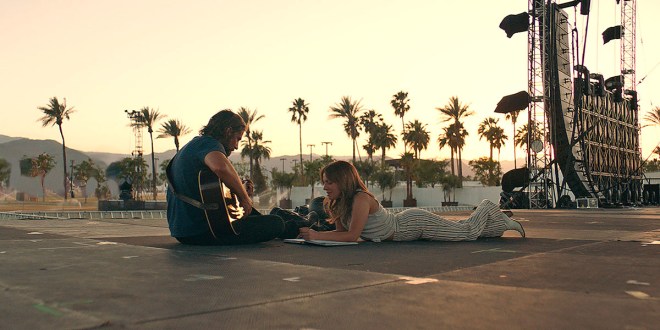
Bradley Cooper and Lady Gaga walked the red carpet at the Toronto International Film Festival (TIFF) this September for the North American premiere of their movie “A Star is Born”, a Gala presentation at TIFF. Now the movie reaches the general public as it is released in theatres worldwide.
Bradley Cooper as Jack and Lady Gaga as Ally in “A Star is Born”. Photo courtesy of TIFF.
This is a bold and spectacular debut for both of them, Cooper as first time director, and the superstar singer her first leading movie role. The two manifest great chemistry on screen, casual and heartfelt. Cooper plays a famous singer Jackson Maine discovering the sensational voice and talent of a struggling singer/songwriter, restaurant worker Ally, a stripped-down, no (or minimal?) make-up Lady Gaga. It’s also a sad story as one star rises just as fast as the other falls like a meteor, self-destruct by alcoholism.
The love story begins with Maine searches for a drink after a performance one night as he has emptied the bottle in his car. His driver roams the streets for any bar that’s still open. They find one and Maine stumbles in just in time to hear Ally begin her gig. The song that she performs hooks and wows him. It’s “La Vie en Rose“, the iconic number by the legendary French singer Edith Piaf. That’s the inciting incident of the movie.
After the song he goes backstage, needing no introduction; he is Jackson Maine. He sits beside her and watches her take off her make-up, then with her permission, helps her peel off the Edith Piaf thin-lined eye brow. It’s just pasted on, not real. But what’s authentic is her voice, which Jack already knows, and he’ll soon discover, her heart as well.
That night, the two sit in the parking lot outside a grocery mart and chat into the night. Why doesn’t she write songs and sing her own work? People like her songs alright, but not her looks, she tells him. She’s self-conscious about her nose. He traces her facial features tenderly with his finger and tells her she’s beautiful. When his driver drops her off, as she’s walking up to her front door, he calls out from the car window: “Hey”. She looks back, he says: “I just wanted to take another look at you.” This line will later become the ominous turn into a heartbreaking end.
It’s Cooper’s directorial debut, and from this feature, we can see he’s a meticulous, sensitive and conscientious helmer. He catches and releases the right amount of tension and emotion with expert timing. His love lines are nuanced, casual yet touching. His singing is seasoned, a bit raspy and therefore quite moving. A Star is Born is remarkable achievement considering he’s the director, co-writer, actor, singer, and co-songwriter, with Lady Gaga and Lukas Nelson (son of Willie) of the 17 original songs in the production.
Kudos to Lady Gaga, other than a mesmerizing voice, her acting looks to be another talent that’s authentic; indeed, a star is born with this movie debut. But maybe that shouldn’t be surprising. She’s been a bold and versatile performer for a long while. It’s the unplugged looks and demeanour in the movie that’s a pleasant surprise. In reality, she’s already a supernova, so where will this further catapult her career? How will movie success affect other aspects of her life?
In the film, the change of Ally from a plain-looking, struggling artist to a performing star with dyed hair, showy costumes and vibrant dance steps stir Jack to remind her to go deep into her soul. Nothing’s perfect. Success comes with a price. Ally handles it relatively well. What is authentic? Surely not the appearance, the stage persona. At least, she still knows her heart. It looks like Jack has a harder time dealing with Ally’s success than the crumbling of his own. That still may be the easier part when compared to conquering the demon of alcoholism.
The very story of A Star is Born is itself a cautionary tale. Interestingly, Hollywood loves this story. The Cooper and Gaga version is the fourth time the tale is told. The very first A Star is Born back in 1937, its screenplay by Dorothy Parker, was based on a 1932 movie What Price Hollywood? directed by George Cukor. Imagine someone back in 1932 was already mulling on this question.
Cukor later directed Judy Garland and James Mason in the 1954 remake. Fast forward to 1976, Barbra Streisand and Kris Kristofferson starred in another version, this time Joan Didion and her husband John Gregory Dunn co-wrote the screenplay, turning the limelight to the musical stage from the movie industry. The 2018 Cooper-Gaga reprise gives credit to Didion and Dunn’s script.
In a perfect world, artistic success can find an ideal integration and balance with popularism and consumerism, while addictions are absent, superficiality and shallowness all but banished. A perfect scenario, but not in the real world. In the real world, we have stories, some repeated and same old but in different versions. No matter how many times they’ve been told, we still embrace them. All because they are real.
Watching foreign language films could be an acquired taste for some, not unlike eating sushi. Once you’ve gotten over the seemingly counter-intuitive idea of eating fish raw and allow the soft texture to melt in your mouth, you’ll be pleasantly surprised by the cold freshness and welcome the brain-stirring sting of the wasabi, as well, appreciate the sweet taste when lightly dipped in soya sauce, balanced by the blandness of the vinegared rice morsel. A delightful exploration.
Film festivals are the best venues for one to have a taste of these international, cinematic delicacies. And as usual, the 43rd Toronto International Film Festival (TIFF) this September was a launching pad for films from all over the world, several were subsequently announced as their country’s official entry to the upcoming Oscars Best Foreign Language Film race.
“Shoplifters”, this year’s Palme d’Or winner and Japan’s official entry to the
91st Oscar Best Foreign Language Film race. Photo courtesy of TIFF
The following is the list of TIFF selections that made it to represent their country at the 91st Oscars. Posted also are their premiere status at TIFF. Some of these I’d seen at the Festival and since reviewed (just click on the links). More reviews are forthcoming. The Oscar nominations will be announced Tuesday, Jan. 22, 2019.
**
El Angel, Argentina, dir. by Luis Ortega, North American (NA) Premiere
Hidden Man, China, dir. by Jiang Wen, International Premiere
Birds of Passage, Columbia, dir. by Cristina Gallego & Ciro Guerra, Canadian (CA) Premiere
Sergio and Sergei, Cuba, dir. by Ernesto Daranas, NA Premiere
Winter Flies, Czech Republic, dir. by Olmo Omerzu, International Premiere
Never Look Away, Germany, dir. by Florian Henckel von Donnersmarck, NA Premiere
Sunset, Hungary, dir. by László Nemes, NA Premiere
The Cakemaker, Israel, dir. by Ofir Raul Graizer
Dogman, Italy, dir. by Matteo Garrone, CA Premiere
About this time last year, I had a post entitled “Golden Fall”. Yes, the title says it all. We don’t have much reds in our fall, no maples, but we have foliage like gold.
Here are some photos I took after returning from Toronto a few days ago, just in time to witness the changing of the seasons and catch the last remaining songbirds before they fly south. This is ‘my Pond’, home at the foothills of the Rocky Mountains.
An Orange-crowned Warbler in the golden foliage. It’s goodbye until next Spring, my avian friend:
Here’s another one. Olive against red.
A ‘Where’s Waldo’ puzzle for you:
The White-breasted Nuthatch against a watercolour backdrop:
Two-frame capture of a shy subject. See it in both?
Home is where you know every path and turn, where to shoot with the sun at your back for the best light, and where to look for your friends whatever the season, to wave goodbye as they leave, and then welcome them back for another new lease.
On November 26, 2008, the City of Mumbai, India, was under siege by terrorists in a co-ordinated shooting and bombing attack that lasted four days. For long hours until security forces arrived from outside of the City, twelve sites in Mumbai were attacked and civilians were gunned down defenceless or taken hostage.
An Australian production, Hotel Mumbai had its world premiere at the 43rd Toronto International Film Festival in September, 2018. Director Anthony Maras in this his debut feature captures the horrific attack ten years ago with a pace that is intense and sweeping, leaving viewers breathless as they watch terror unfold on screen, acts after acts of senseless violence. But don’t let this drive you away.
The setting of the thriller Hotel Mumbai is the luxury heritage Hotel Taj Mahal Palace, or the Taj, where many foreign, renowned personalities had frequented. It was one of the twelve targets of the terror attacks, for obvious reason. Gunmen armed with AK-47 assault rifle and hand grenades took foreigners hostage at the five-star hotel and shot point-blank many others. In the aftermath, 31 in the hotel were killed, almost half were staff refusing to escape but stayed to defend and assist the trapped hotel guests.
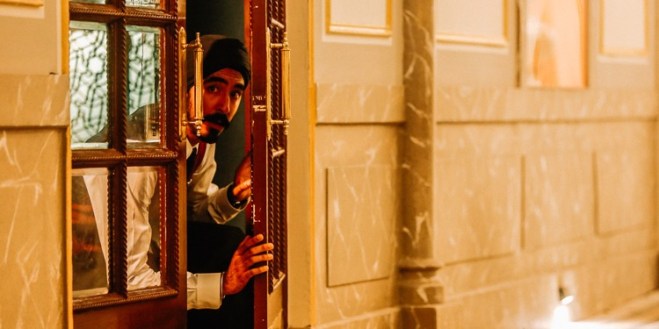
Dev Patel as Arjun in “Hotel Mumbai”. Photo courtesy of TIFF.
The storylines following several guests in the hotel are particularly gripping, like Sally (Tilda Cobham-Hervey) hiding in a closet caring for a baby who wouldn’t stop crying as the baby’s parents David (Armie Hammer) and Zahra (Nazanin Boniadi) are trapped somewhere else in the hotel, trying to get to their infant son.
Dev Patel plays staff server Arjun. The turban he wears makes one of the guests fearful. A crisis situation could tip either way, as an opportunity for understanding and the breakdown of barrier, or an incendiary fuse leading to deeper hatred and animosity. In a volatile situation as the hotel is besieged, complications could be deadly. But Arjun exudes ample dignity and generosity. That turban will later become a symbol of selfless grace.
The consoling breathers and the meaningful elements in the film then were these acts of kindness and courage. Maras captures the human foibles in the face of dangers, as well the strength of the hotel staff in protecting their guests. Their sacrificial, heroic acts render the film not merely a record of atrocity, but a gratifying chronicle of resilience and bravery.
The bullet-riddled and fire damaged five-star hotel was fully reopened after only twenty-one months. A special commemoration was held and a monument set up to honor those who died.
“Hotel Mumbai” Press Conference at TIFF. From left: Director Anthony Maras, actors Dev Patel, Tilda Cobham-Hervey, Nazanin Boniadi, Anupam Kher, Jason Isaacs, and Armie Hammer (back). Photo by Diana Cheng
There was a good representation of main cast members at the press conference of the film, moderated by Richard Crouse of CTV. Present were director Anthony Maras and actors Dev Patel, Armie Hammer, Nazanin Boniadi, Jason Isaacs, Tilda Cobham-Hervey, and Anupam Kher. They all commended the hotel staff for their extraordinary courage, some they had met in person who were survivors of the attack.
Upon talking with hotel staff and understanding the actual events, the actors were impressed that small acts of kindness were the essence of resistance. There were staff who had escaped but went back to save hotel guests. Some in the kitchen would put cookie sheet inside their clothes as shield to protect themselves in order to cover guests as they escape. One particular poignant observation they all felt was the breakdown of barriers as both staff and guests were all victims of the horrific act of violence. All racial and financial barriers came down in the face of crisis.
The cast also stressed the point that the perpetrators were all misguided and brainwashed young men. Nine of the ten gunmen were killed. But the mastermind, called “the Bull” in the film—who was in constant contact, directing the attackers throughout by means of their cell phones—was never caught.













 Ripple Effects