Reading the Season: Silence by Shusaku Endo

Click for ‘Silence’ movie review and thoughts.

For this year’s Reading the Season, I’ve chosen Shusaku Endo’s masterpiece Silence. Unlike previous years, it’s not as pleasing and exulting a read at Christmas time.  Rather, it’s unsettling and disturbing. It will interfere with your festive mood. It presents an excruciating dilemma that we hope we may never need to confront, and a question that more likely for us to face: Where is God during our suffering?

silence

Why so unpleasant a read at this time? We’re all busy with our festivities. Who would want to think about such a somber question? Director Martin Scorsese thinks it’s seasonal; Dec. 23 is the day his adaptation of Silence will be released in North America. Mind you, before showing here, it will first premiere at the Vatican. What a diversion of Christmas over there.

Thanks to Scorsese, I dug out Endo’s book and reread it. This time around, it’s even more disturbing for me. However, I also see the light seeping through the cracks of a broken human scene. I sure hope Scorsese’s film — twenty-five years brewing in the director’s heart — can lead to some quiet meditation amidst the cacophony bombarding us these days.

Historical Note

First off, very crucial before reading Silence is to establish a frame of reference; this is furnished by the Historical Note at the beginning of the book. Christianity was introduced to Japan by Francis Xavier in 1549. It was very well received at that point, despite an expulsion order later in 1587 by the Shogun Hideyoshi and the subsequent crucifixion of twenty-six Japanese Christians and European missionaries. By 1600, there were an estimated 300,000 Christian converts living in Japan.

By the time the second expulsion order was issued in 1614, however, the Christian Church in Japan was driven underground. Warlord Tokugawa Ieyasu was resolute in wiping out all traces of Christianity that from 1614 to 1640, an estimated five to six thousand Christians were killed. He later found out martyrdom wasn’t as effective an eradication measure as forced apostasy, especially with leaders of the faith, so torture was widely used towards that end.

crucifixion

In 1632, the Catholic world was shocked to learn that the stalwart leader of the Jesuits mission in Japan, Father Christovao Ferreira, had disavowed his faith and become an apostate after being tortured at ‘the pit’ in Nagasaki. No news of him came after that.

Upon this setting Endo begins his story. The historical novel describes the journey of one fervent young priest from Portugal, Father Sebastian Rodrigues, who has had the privilege to be taught and mentored by Father Ferreira years before. Upon hearing Ferreira’s apostasy, and with the reluctant approval of the Jesuit Superior, Rodrigues and fellow priest Father Francisco Garrpe board a ship and sail all the way to Japan to look for their beloved teacher and to investigate the situation. They have been forewarned, the magistrate Inoue is ruthless.

While still on the ship, the priests encounter Kichijiro, a sly, cowardly, and ambiguous figure who later will wade on shore ahead to guide them to some hidden Christians. For a while, the two Fathers have to hide themselves in a hut on a mountain during the day, and minister to the needs of Japanese believers who, despite the danger, come to seek them out for spiritual matters at night.

Later Kichijiro leads them to a nearby island to meet with more hidden believers. To the welcoming relief of the villagers, the fathers secretly conduct mass and baptism despite the risks. The evasive Kichijiro hangs around like a phantom nemesis.

The people suffer greatly under the rule of magistrate Inoue, yes, that Inoue who Rodrigues was forewarned. He extracts from the poor peasants harsh revenues and infuse the utmost fear into those of the Christian faith with his deathly measures. Rodrigues observes that “The persecutions of Christians make their faces expressionless. They cannot register on their faces any sorrow —nor even joy. The long years of secrecy have made the faces of these Christians like masks. This is indeed bitter and sad.”

Never before has Rodrigues felt so deeply about the meaningfulness of his mission:

“… like water flowing into dry earth … For the first time they have met men who treated them like human beings. It was the human kindness and charity of the fathers that touched their hearts.”

But such a firm conviction begins to shatter when Rodrigues comes closer and closer to the reality of persecution. No, not just of his own, but those of the Japanese peasants, his flock. Many are faithful to the end. When discovered, they would be tied on trees in the shape of a cross at the seashore, the rising tide slowly consumed their bodies after two or three days.

The ultimate punishment is ‘the pit’. Believers are tied up and suspended upside down above a pit. Blood would flow out of their eyes, ears, nose and the slits on the neck. They would be literally drip dry into a slow death through several days.
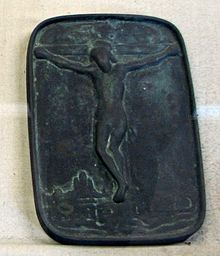
fumieA way out of such torture is to trample on the fumie. The fumie is a wooden plaque with a copper plate on which the image of Christ was artfully engraved. A person’s willingness to trample on the fumie is Inoue’s way of testing if one belongs to the outlawed Christian religion. It is also a convenient way to turn a believer into an apostate upon the threat of torture and death. One only needs to put one’s foot on the fumie, trample or even just step on it, then one can be released immediately, a most easy and convenient ‘formality’ to show one’s denunciation of faith. This was what happened to Father Ferriera.

The officials would say: “I’m not telling you to trample with sincerity and conviction. This is only a formality. Just putting your foot on the thing won’t hurt your convictions.”

To a believer, this may sound like a temptation, or self-deception. Or, is it a necessary choice to survive?

In this historically based novel, Shusaku Endo (1923 – 1996), a Japanese Catholic, paints a vivid picture of the crisis of faith in the face of extreme suffering, the doubts that often lie hidden even in the most devout. In the midst of persecutions, where is God? Why is He silent?  Endo is not depicting so much about the hubris of foreign missionaries coming with the hope and optimism to preach and convert, but just the opposite, he has exposed the lowest state a believer, let alone a priest, can possibly experience, the utter humiliation of being the one to denounce and betray his God, albeit under duress.

The duress is horrific indeed. The priest sees no glorious martyrdom but is witness to unbearable torture of these peasants. For several nights, the screams and moans of five Christian villagers accompany him in his sleepless nights. Father Rodrigues is thus being dragged into the ultimate dilemma: He only needs to place his foot on the fumie and all five of these suffering peasants will be released right away.

In a court of law, a statement or action made under duress cannot stand as evidence to lay blame, as the subject is under threat and coercion like Father Rodrigues is here. But in the court of the priest’s conscience, it is an ironclad verdict: Apostasy!

As he is struggling with this painful dilemma, trample on it and denounce his faith or five peasants will be suspended in the pit till death, Father Rodrigues seems to encounter an epiphany. Seeing the well-trodden, blacken face of the Christ image on the fumie, the priest hears a voice breaking through the silence:

“‘Trample! Trample! I more than anyone know of the pain in your foot. Trample! It was to be trampled on by men that I was born into this world. It was to share men’s pain that I carried my cross.’

The priest placed his foot on the fumie. Dawn broke. And far in the distance the cock crew.”

Indeed, the allusion to Peter’s denial of Christ three times before the cock crows points to Christ’s forgiveness, the light that sheds through the cracks of human failure. After his denial, Peter later served his Lord with transformed fervency and love. Yes, even the Rock, upon whom the Church was to be built, had once denied Christ.

When I first read Silence a few years ago I could not accept Rodrigues’s action. This time around, I’ve come to see that Endo is not discussing theology here, but depicting an imaginary scenario. In the darkest hour of a believer’s journey—likely Endo’s own as well—when a devout is entrapped in an excruciating dilemma like being suspended in the deep pit of spiritual conflicts, Endo draws our attention to the response of a compassionate Christ.

As to the seeming silence of God, Endo lets us hear these internal dialogues:

‘Lord, I resented your silence.’
‘I was not silent. I suffered beside you.’

At the humble manger some two thousand years ago, God had spoken, with a birth that pierced the darkness of that silent night.

***

Reading the Season of Christmas Past:

2015: The Book of Ruth

2014: Lila by Marilynne Robinson

2013: Poetry by Madeleine L’Engle

2012: Surprised by Joy by C. S. Lewis

2011: Walking on Water by Madeleine L’Engle

2010: A Widening Light, Luci Shaw

2009: The Irrational Season 

2008: The Bible and the New York Times by Fleming Rutledge

2008: A Grief Observed by C. S. Lewis

***

Risen for Hope

The photo was taken just yesterday. Due to illness in the family, I’ve been staying mostly indoor as a caregiver. Yesterday was the first time I went out to greet spring and the birds. A Downy Woodpecker darted right into frame.

DSC_0614 (1)

While we’re enjoying an early spring this year, there had been times when it felt like spring would never come. A few years ago, I wrote this poem at Easter, when winter lingered and spring seemed so far away… and it was already April.

**

April is the month of empty dreams
Half the days gone
waiting for words and spring
still frozen ground
and on the screen
a frigid page as white as snow.

Brown could be the color of hope
After the white
for all I know
green is too much to wish for
I’m contented to see a patch
of dry and withered brown.

The sun is a perpetual sign
that there’s still hope
But it’s no herald of the seasons
for its presence comforts all year long
warming my blank and barren state
as I await for words and spring.

But Easter is an apt reminder
that The Word had come
spoken clear to half-frozen ears
His body hung on a lifeless tree
Blood and water flowed
onto parched and dusty earth

So what if no words come to me
That dreaded writer’s block
reigning the winter of sterility
numbing senses,
snatching thoughts,
seizing any sign of spring.

It’s not about a post or a blog,
Or even buds and melting snow.
The Word had come
lived and loved among us,
broken, bled, died and rose,
melting frozen hearts to greet
a new dawn and eternal Spring.

– by Arti, April 2011

  ***

We look not towards the climate, but the Christ.

Happy Easter to all!


Seven Stanzas for a Happy Easter

Rocks


“Seven Stanzas At Easter” by John Updike

Make no mistake: if he rose at all
It was as His body;
If the cell’s dissolution did not reverse, the molecule reknit,
The amino acids rekindle,
The Church will fall.

It was not as the flowers,
Each soft spring recurrent;
It was not as His Spirit in the mouths and fuddled eyes of the
Eleven apostles;
It was as His flesh; ours.

The same hinged thumbs and toes
The same valved heart
That—pierced—died, withered, paused, and then regathered
Out of enduring Might
New strength to enclose.

Let us not mock God with metaphor,
Analogy, sidestepping, transcendence,
Making of the event a parable, a sign painted in the faded
Credulity of earlier ages:
Let us walk through the door.

The stone is rolled back, not papier-mache,
Not a stone in a story,
But the vast rock of materiality that in the slow grinding of
Time will eclipse for each of us
The wide light of day.

And if we have an angel at the tomb,
Make it a real angel,
Weighty with Max Planck’s quanta, vivid with hair, opaque in
The dawn light, robed in real linen
Spun on a definite loom.

Let us not seek to make it less monstrous,
For our own convenience, our own sense of beauty,
Lest, awakened in one unthinkable hour, we are embarrassed
By the miracle,
And crushed by remonstrance.

– John Updike (1932-2009)

***

Happy Easter to All!

And The Word Was Made Homeless

Awesome Sky

The House of Christmas

by G. K. Chesterton (1874–1936)

There fared a mother driven forth
Out of an inn to roam;
In the place where she was homeless
All men are at home.
The crazy stable close at hand,
With shaking timber and shifting sand,
Grew a stronger thing to abide and stand
Than the square stones of Rome.

For men are homesick in their homes,
And strangers under the sun,
And they lay on their heads in a foreign land
Whenever the day is done.
Here we have battle and blazing eyes,
And chance and honour and high surprise,
But our homes are under miraculous skies
Where the yule tale was begun.

A Child in a foul stable,
Where the beasts feed and foam;
Only where He was homeless
Are you and I at home;
We have hands that fashion and heads that know,
But our hearts we lost – how long ago!
In a place no chart nor ship can show
Under the sky’s dome.

This world is wild as an old wives’ tale,
And strange the plain things are,
The earth is enough and the air is enough
For our wonder and our war;
But our rest is as far as the fire-drake swings
And our peace is put in impossible things
Where clashed and thundered unthinkable wings
Round an incredible star.

To an open house in the evening
Home shall men come,
To an older place than Eden
And a taller town than Rome.
To the end of the way of the wandering star,
To the things that cannot be and that are,
To the place where God was homeless
And all men are at home.

*****

“And the Word was made flesh, and dwelt among us.” John 1:14

**

(Photo taken by Arti of Ripple Effects, Sept. 2010. All Rights Reserved.)

***

 MERRY CHRISTMAS EVERYONE!

 
***


Just another Easter thought

This Luci Shaw poem was read out in the Tenebrae service I attended on Good Friday.

***

P1000367

Judas, Peter

because we are all
betrayers, taking
silver and eating
body and blood and asking
(guilty) is it I and hearing
him say yes
it would be simple for us all
to rush out and hang ourselves

but if we find grace
to cry and wait
after the voice of morning
has crowed in our ears
clearly enough
to break our hearts
he will be there
to ask us each again
do you love me

— Luci Shaw

***

A Happy Easter to all!

Saturday Snapshot March 30: Tenebrae

Tenebrae is Latin for shadows. I was in a Tenebrae Good Friday service yesterday, a symbolic visualization of the Easter narrative.

7 candles

Seven lit candles were gradually extinguished between scriptures, poetry, and music, symbolizing the imminent death of Christ. Ultimately only the centre flame, the Christ candle, was burning. Momentarily, it too was snuffed out.

“Then [Peter] began to curse and swear, ‘I do not know the man!’ And immediately a rooster crowed.” — Matthew 26:74

Total darkness.

Tanabrae

Later, the single Christ candle was relit… the resurrection, light illuminating darkness again. The solitary flame is in the lower left in the above photo.

***

Saturday Snapshot is hosted by Alyce of At Home With Books. These two photos were taken from where I sat, using my iPhone.

***

Diary of a Country Priest: An Easter Meditation

Last year around this time, I wrote about the book The Diary of A Country Priest by French author Georges Bernanos, (Journal d’un curé de campagne, 1936). I’d like to repost my review this week, for every time I read it, I find the essence of Easter.

***

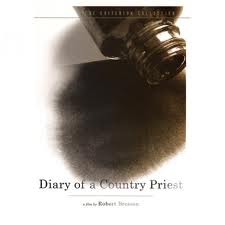
The Diary of a Country Priest Book Cover

A young priest comes to his first parish, the rural town of Ambricourt, filled with humble hopes. All he wants is to serve the people, to give of himself, to bring God’s love. But as soon as he sets foot in the village, he is engulfed by hatred and rejection. There are dark secrets too sinister to be exposed. The young priest is an unwelcome alien. In a town afflicted by hypocrisy, pride, anger and bitterness, he is despised, taunted and ridiculed. His own innocence is no match even for the children in his catechism class, especially the precocious Seraphitas, a girl ‘with a hardness far beyond her years.’

Ambricourt is a world afflicted by the ‘leprosy of boredom’, a microcosm of the human condition. Bernanos uses diseases to illustrate his point well. The young priest himself is being slowly consumed by terminal illness. The pain in his stomach ultimately defeats his body, cancer. His diet consists mainly of bread dipped in wine which he makes for himself, and some potato soup. Poverty of means, but also frailty of body to take in solid food. Many a times we see him in the Garden of Gethsemane, pleading for strength in anguish. But he faithfully presses on, using his diary to confide his deepest thoughts, a means to commune with his God.

On the outskirt of Ambricourt is the Château of the powerful M. le Comte. The Count needs no priest to know about his adulterous affairs, this time, with the governess Mlle Louise. His wife Mme la Comtesse is totally absorbed by her long-held bitterness and grief from the loss of her young son. And his daughter Mlle Chantal is a deeply disturbed girl eaten up by anger and jealousy. Soon, she will be sent away to England, a most convenient plan devised by her father.

It is with this deep mess of a family that the young priest finds himself entangled. The most intense scene of the whole book, the climatic moment, comes when the priest goes to the Château to meet with Mme la Comtesse. She lost her beloved son when he was only eighteen months old, a child hated by his jealous older sister Chantal.

On his last day they went out for a walk together. When they came back my boy was dead.

Mme la Comtesse is fully engulfed by hatred for her daughter, grief for her lost son, and bitterness towards God.

Hearing her speak, a tear flows down the face of the young priest. “Hell is not to love any more, madame.” The young priest responds. And with miraculous strength, he delivers the following words.

… But you know that our God came to be among us. Shake your fist at Him, spit in His face, scourge Him, and finally crucify Him: what does it matter? It’s already been done to Him.

Towards the end of some soul piercing exchanges, Mme la Comtesse kneels down, releases her pain, and receives blessings from the young priest. Afterwards, she writes to him in a letter:

… I have lived in the most horrible solitude, alone with the desperate memory of a child. And it seems to me that another child has brought me to life again…

And this young child, a priest, consumed by illness, wreaked by frailty of spirit, can only marvel at the power through weakness:

Oh miracle — thus to be able to give what we ourselves do not possess, sweet miracle of our empty hands!

Not long after this, he succumbs to his illness. A life too short, a mission seems unaccomplished. But his last words faintly uttered on his deathbed are as powerful as the God who sends him:

Does it matter? Grace is everywhere…

And in the film, these three words leave me with one of the most impressive endings of all the films that I’ve seen:

“All is grace.”

 ***

~ ~ ~ ~ Ripples

CLICK HERE to read my film review of The Diary of a Country Priest.

The Diary of a Country Priest by Georges Bernanos, translated by Pamela Morris, Perseus Books Group, Philadelphia, PA, 1965, 298 pages.

Journal d’un curé de campagne, 1936, was winner of the Grand prix du roman de l’Académie française.

Diary of a Country Priest: Film Adaptation (1951)

For me, the cinema is an exploration within. — Robert Bresson (1903-1999)

Robert Bresson is one of the most influential figures in French cinema. The acclaimed New Wave director Jean-Luc Godard once noted: “Robert Bresson is French cinema, as Dostoevsky is the Russian novel and Mozart is German music.”

I know, Austrians would say Mozart was Austrian. But this just shows his influence can cross borders. Same with Bresson, who is acclaimed as one of the forefathers of the French New Wave, even though his style is not experimental. The iconic Swedish director Ingmar Bergman had specifically cited Diary of a Country Priest as influence for his Winter Light.

Before Bresson adapted Diary of a Country Priest, two previous screenplays were attempted by others but turned down by the author Georges Bernanos himself. Bresson’s film was made after Bernanos died. Bernanos had nothing to worry about with Bresson’s interpretation, for the film is an almost literal and a worthy cinematic translation. It won the Prix Louis Delluc in France (best film of the year) and several international film awards. Bresson was given the Career Golden Lion at the 1989 Venice Film Festival.

That Bresson, a professed agnostic, would choose to adapt a work by the Catholic writer Bernanos shows the moving power and the universal appeal of the book. The parish of Ambricourt is a microcosm of the human world. The seemingly placid village hides a spiritually barren landscape and a cocoon of depravity. The young priest, an unwelcome alien, is captured cinematically as small and vulnerable, an apt depiction of how he feels within:

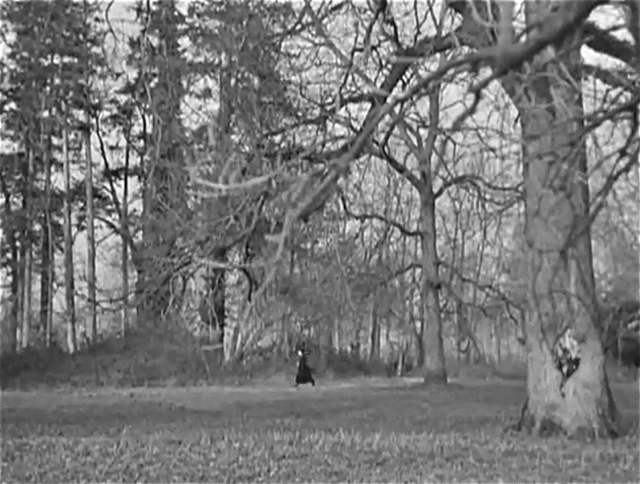
An outsider barred from a gated mansion of dark secrets, like here at the front gate of the Château.

The light comes into the world, but the darkness refuses it. On screen, we see the young priest often shut out of gates and windows. The glass pane allows him to be observed from the inside, yet he is very much on the outside isolated, the weight of the world heavy on his face.

Bresson’s style is minimal, you may find this film somewhat austere. But I’m gratified by such style, devoid of color and whatever additives we find in movies today. Instead, every frame conveys an aesthetic simplicity and thematic purpose.

To explore the drama within, Bresson chose ‘non-actors’. “As far as I can, I eliminate anything which may distract from interior drama,” Bresson was quoted saying, and distractions included ‘acting’. He selected his ‘models’ (as he called them, not ‘actors’) first for their voice. He particularly looked for inexperience. The young Curé of Ambricourt was Claude Laydu’s first film role. Others that Bresson used were often one-time actors just for the film he was making.

The Criterion Collection DVD has a most helpful commentary by film historian Peter Cowie. His insight is invaluable to the appreciation of Bresson’s adaptation. One of his remarks is the off-screen sounds we often hear in a scene. The most intense one would have to be the climatic spiritual battle between Mme la Comtesse and the young priest. Totally engulfed by grief, hatred and bitterness, and living in isolated misery all the years since her young son died, Mme la Comtesse finally releases her pain and receives blessings from the priest. And what sound do we hear off-screen the whole time they are engaged in this soul-piercing scene in the drawing room: the gardener’s raking of dead leaves.

Another source I’ve often sought out is the book written by Paul Schrader: Transcendental Style in Film: Ozu, Bresson, Dreyer. Yes, if I must choose a word to describe Bresson’s style, I would use Schrader’s term: transcendental. His minimal, aesthetically simple, ‘non-acting’ style raises the viewer to a meditative plane which is beyond the material, beyond all distractions. That’s the essence of cinema that I find so meaningful and gratifying.

And finally, despite succumbing to his illness, the young priest leaves a legacy that his superiors, the senior vicars, could not have: an embodiment of the suffering Christ and the redemptive power of grace. Despite his own frailty and ultimate death, the young country priest  triumphs through his faith, however feeble it may have seemed in his own eyes. It does not matter, for all is grace.

~ ~ ~ ~ Ripples

***
AND TO ALL, A HAPPY EASTER!
***
Other related posts on Ripple Effects:
.
.
.
.
***

Diary of A Country Priest: A Book for Easter

Every year around this time, I come back to my perennial read The Diary of A Country Priest by French author Georges Bernanos(Journal d’un curé de campagne, 1936). In this book, I find the essence of Easter.

A young preist comes to his first parish, the rural town of Ambricourt, full of humble ideals. All he wants is to serve the people, to give of himself, to bring God’s love. But as soon as he sets foot in the village, he is engulfed by hatred and rejection. There are dark secrets too sinister to be exposed. The young priest is an unwelcome alien. In a town afflicted by hypocrisy, pride, anger and bitterness, he is despised, taunted and ridiculed. His own innocence is no match even for the children in his catechism class, especially the precocious Seraphitas, a girl ‘with a hardness far beyond her years.’

Ambricourt is a world afflicted by the ‘leprosy of boredom’, a microcosm of the human condition. Bernanos uses diseases to illustrate his point well. The young priest himself is being slowly consumed by terminal illness. The pain in his stomach ultimately defeats his body, cancer. His diet consists mainly of bread dipped in wine which he makes for himself, and some potato soup. Poverty of means, but also frailty of body to take in solid food. Many a times we see him in the Garden of Gethsamane, pleading for strength in anguish. But he faithfully presses on, using his diary to confide his deepest thoughts, a means to commune with his God.

On the outskirt of Ambricourt is the Château of the powerful M. le Comte. The Count needs no priest to know about his adulterous affairs, this time, with the governess Mlle Louise. His wife Mme la Comtesse is totally absorbed by her long-held bitterness and grief from the loss of her young son. And his daughter Mlle Chantal is a deeply disturbed girl eaten up by anger and jealousy. Soon, she will be sent away to England, a most convenient plan devised by her father.

It is with this deep mess of a family that the young priest finds himself entangled. The most intense scene of the whole book, the climatic moment, comes when the priest goes to the Château to meet with Mme la Comtesse. She lost her beloved son when he was only eighteen months old, a child hated by his jealous older sister Chantal.

On his last day they went out for a walk together. When they came back my boy was dead.

Mme la Comtesse is fully engulfed by hatred for her daughter, grief for her lost son, and bitterness towards God.

Hearing her speak, a tear flows down the face of the young priest. “Hell is not to love any more, madame.” The young priest responds. And with miraculous strength, he delivers the following words.

… But you know that our God came to be among us. Shake your fist at Him, spit in His face, scourge Him, and finally crucify Him: what does it matter? It’s already been done to Him.

Towards the end of some soul piercing exchanges, Mme la Comtesse kneels down, releases her pain, and receives blessings from the young priest. Afterwards, she writes to him in a letter:

… I have lived in the most horrible solitude, alone with the desperate memory of a child. And it seems to me that another child has brought me to life again…

And this young child, a priest, consumed by illness, wreaked by frailty of spirit, can only marvel at the power through weakness:

Oh miracle — thus to be able to give what we ourselves do not possess, sweet miracle of our empty hands!

Not long after this, he succumbs to his illness. A life too short, a mission seems unaccomplished. But his last words faintly uttered on his deathbed are as powerful as the God who sends him:

Does it matter? Grace is everywhere…

And in the film, these three words leave me with one of the most impressive endings of all the films that I’ve seen:

“All is grace.”

 ***

~ ~ ~ ~ Ripples

CLICK HERE to read my film review of The Diary of a Country Priest.

The Diary of a Country Priest by Georges Bernanos, translated by Pamela Morris, Perseus Books Group, Philadelphia, PA, 1965, 298 pages.

Journal d’un curé de campagne, 1936, was winner of the Grand prix du roman de l’Académie française.

What If… A Northern Nativity

The late Canadian artist William Kurelek embraced a nativity that’s beyond time and culture. In his children book A Northern Nativity, he envisioned through a little Prairie boy’s dreams the various scenarios: what if Christ was born in the land of deep snow in an Inuit community, or what if Mary and Joseph, homeless on our streets, had to take shelter in a soup kitchen, what if… Would we have noticed? Would we even care?

This is a moving video clip on the paintings in Kurelek’s children book A Northern Nativity, accompanied by Chris de Burgh’s touching piano music “When Winter Comes”.

.

And to All, A Merry Christmas!


***

Reading The Season: Walking On Water by Madeleine L’Engle

It’s that time of the year when a quiet respite is probably the most precious gift. For the past four years since I started blogging, amidst the cacophony of December festivities, I would pick something to read that anchors me to the spiritual meaning of the occasion.  I call these attempts “Reading The Season”. This year, I took down from the shelf a long-time TBR, Walking On Water: Reflection On Faith And Art by Madeleine L’Engle.

After reading it, I went straight to her Newbery Award novel A Wrinkle In Time (another long time TBR for me). Amazed at its wisdom and depth, once I finished it I went back to reread Walking On Water, appreciated all the more L’Engle’s intricate weaving of intellect and spiritual insights.

At the very beginning of the book, these words jumped right out at me:

I sit on my favourite rock, looking over the brook, to take time away from busyness, time to be. I’ve long since stopped feeling guilty about taking being time; it’s something we all need for our spiritual health, and often we don’t take enough of it.

And just a few pages after that, I found this gem:

Leonard Bernstein tells me … for him music is cosmos in chaos. That has the ring of truth in my ears and sparks my creative imagination. And it is true not only of music; all art is cosmos, cosmos found within chaos.

Bernstein might have echoed a Jungian concept of the power of memory and the subconscious self, but there’s a spiritual reality in the thought.

It all began with the calling forth of light from darkness, splendor from void, life from nothingness, the Creation. Terrence Malick’s The Tree of Life comes to mind… the cosmic light and galaxy clouds, the molten lava that spews out of the earth, the roaring breakers of the ocean deep, and my heart resounds: ‘day to day pours forth speech, night to night declares knowledge.’

But what’s most awesome is not just the forming of the cosmos, but the Creator incarnated, the infinite confined, the invincible made vulnerable in order to live the hurts, to share the pains. L’Engle writes:

To be alive is to be vulnerable. To be born is to start the journey towards death… We might paraphrase Descartes to read, ‘I hurt; therefore I am.’

The Creator demonstrated that behind the majesty, there’s the power of love, that driving force behind the willingness to stoop, to be made vulnerable, to be stripped naked, be born a babe. Utterly unfathomable. At one point in human history,  Cosmos entered and lived among Chaos.

And artists, those who write, who paint, who sing, who dance, who act… they are birth-givers. “An act of art is an incarnational activity,” L’Engle writes. Artists partake in the continuation of creation, bringing wholeness to a fragmented world, hope in the slough of despair.

As well, true artists live the vulnerability as the One who first took that cosmic plunge, taking the risk of birth because of love.

Here, take a 3:44 minute respite to enjoy some Seasonal reflections. Click on the video to listen to the music as you read Madeleine L’Engle’s poem:

The Risk of Birth 

This is no time for a child to be born,
With the earth betrayed by war & hate
And a nova lighting the sky to warn
That time runs out & the sun burns late.

That was no time for a child to be born,
In a land in the crushing grip of Rome;
Honour & truth were trampled by scorn–
Yet here did the Saviour make his home.

When is the time for love to be born?
The inn is full on the planet earth,
And by greed & pride the sky is torn–
Yet Love still takes the risk of birth.

Madeleine L’Engle

***

Walking On Water: Reflections On Faith And Art by Madeleine L’Engle, Commemorative Edition, published by Shaw, 1998, 227 pages.

CLICK HERE to Reading the Season 2012: Surprised by Joy

‘Reading The Season’ posts in previous years:

Reading The Season: C. S. Lewis

Reading The Season: Fleming Rutledge

Reading The Season: Madeleine L’Engle’s The Irrational Season

Reading The Season: Luci Shaw

Urban Sanctuary

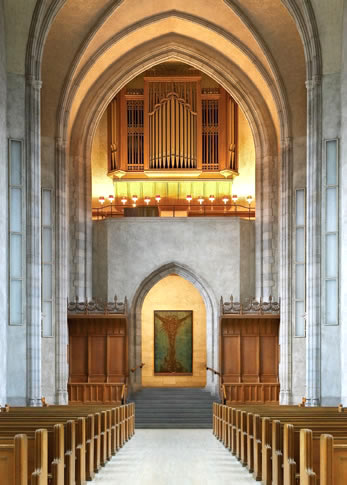
June has been a month of travelling for me. From the natural beauty of Vancouver to über busy and congested Metro Toronto, I’ve shifted gear and gone from park to overdrive in two short weeks. Quiet garden paths have been replaced by the 12-lane Highway 401, rain forest has turned into concrete jungle. And so I was pleasantly surprised by this serendipitous find right in the heart of downtown Toronto. Amidst the hustle and bustle, I found this sanctuary… literal and spiritual, the Trinity College Chapel on the campus of the University of Toronto:

Every step into the magnificent architecture instills awe and wonder, every artefact a symbol:

Looking back to the choir loft is another stunning view (this photo from Wikipedia):

The painting on the wall in the narthex, a crucifix, is entitled “Mediterranean Christ” by the artist Juan Sala Santonja:

***

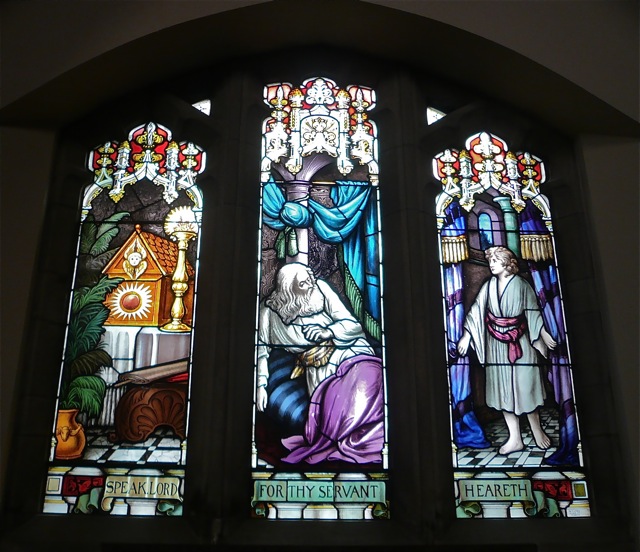
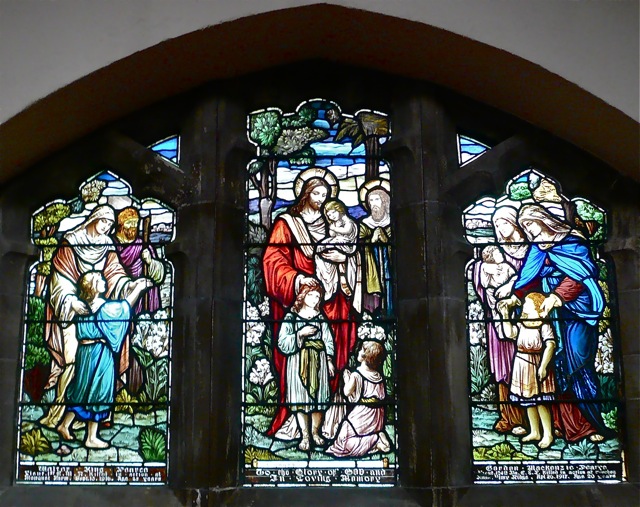
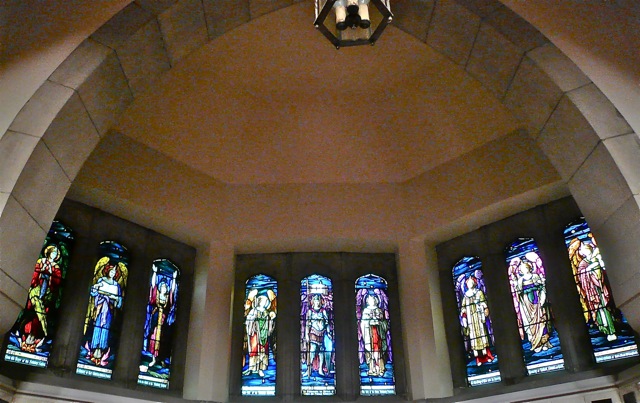
Another joy of discovery is Grace Church On the Hill, Anglican. My expectation of my short sojourn in Toronto had never been stained glass or religious art. But here I was, beholding Biblical themes in beautiful stained glass:

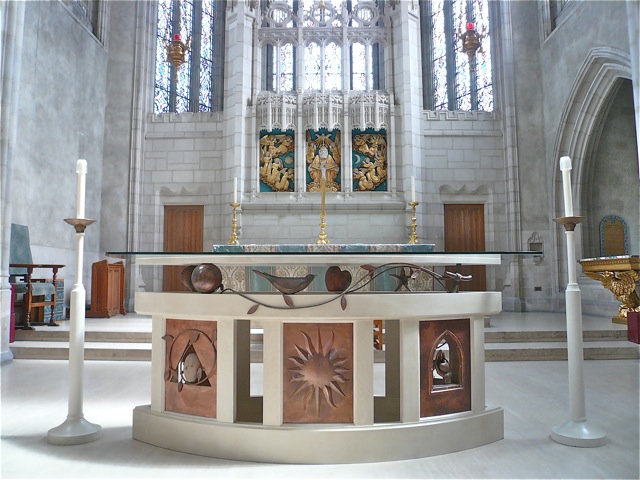
This contemporary wall sculpture created by Catherine Widgery of Montreal juxtaposes well among the stained glass, for its message points to a similar theme:

Entitled “By Her Own Radiant Light”, John Milton’s verse is engraved on a brass plaque beside the installation:

By her own radiant light, though sun and moon

were in the flat sea sunk.

And Wisdom’s self

oft seeks to sweet retired solitude,

Where, with her best nurse

Contemplation,

She plumes her feathers,

and lets grow her wings.

The pamphlet beside the art installation conveys the meaning: As the Moon’s illumination is the reflection of the Sun, Christian disciples are reflectors of the Greater Light. The phases of the moon suggest an eternal cycle of life, death and rebirth. Loss returns to fullness; darkness becomes light. The fragments of reflected light on water form a triangle below the full moon. Each fragment of light is a single piece of metal, cut and assembled so as to suggest the light’s effect on the surface of the water. At the heart of the circle, the light reflected on the surface is brilliant and intense, and diminishes as it spreads farther from the source.

As someone who’s always drawn to ripples, I spotted this installation right away as I entered the  sanctuary. Reading Milton’s verse and the explanation of the art work helped me gain a deeper appreciation of the visual symbolism.

No rain forests and greenery, but I was drawn to explore another landscape, one where art and imagination formed a bridge towards the unseen and spiritual, no less powerful in bringing out the wonders of creation and the Creator, the Source of Light and Wisdom.

***

CLICK HERE to watch a video clip with visual artist Catherine Widgery

PHOTOS: All photos were taken by Arti of Ripple Effects except the one noted from Wikipedia. Arti’s photos taken in June, 2011. All Rights Reserved.