Saturday Snapshot May 28: New Kids on the Block

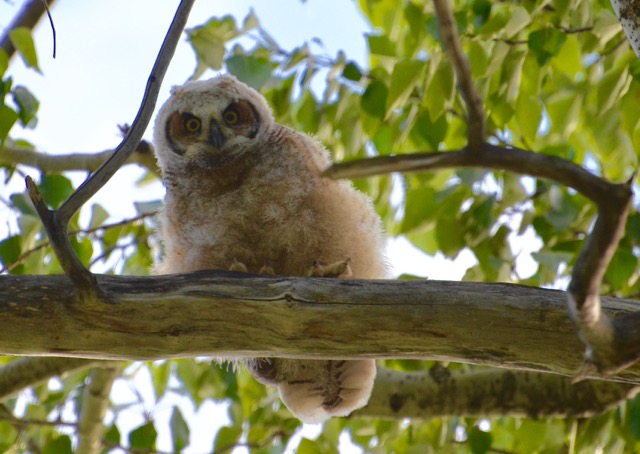
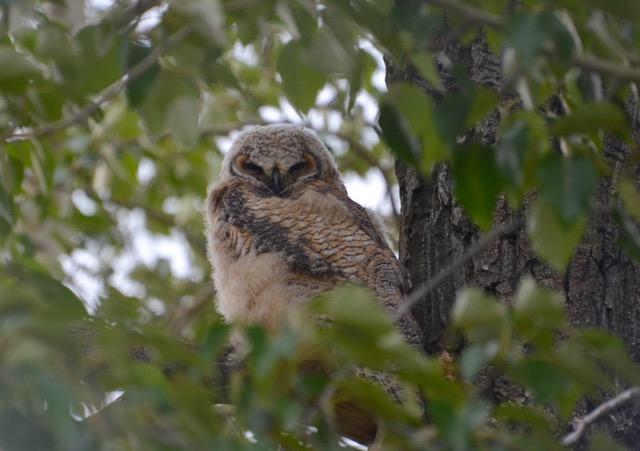
A month ago I saw two newborns in the Owlington abode. Here’s one of them out and about; the other must be still sleeping:

Owlington baby

A curious fella:

Owlington 1

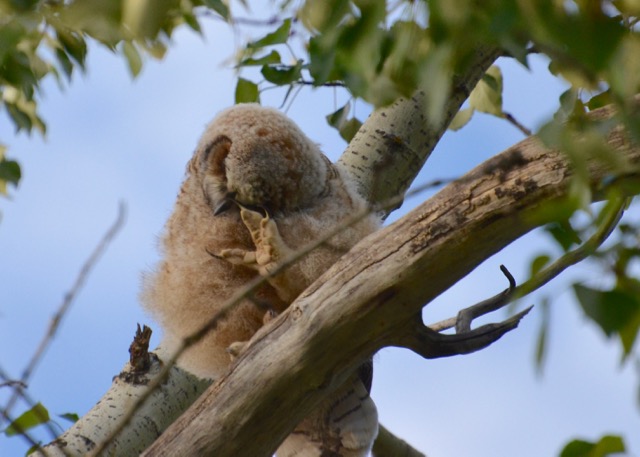
Scratching and preening:

Owlington baby scratching

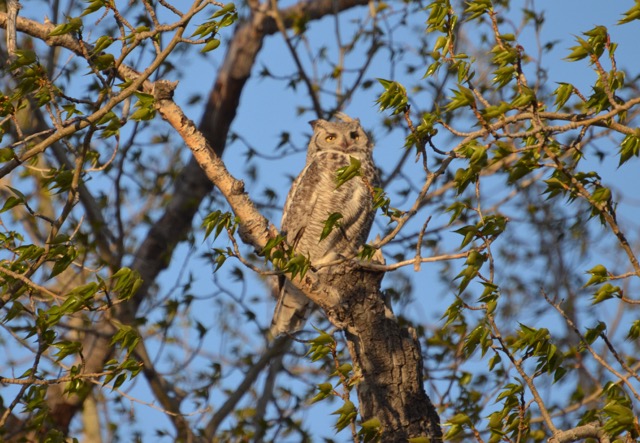
Mrs. Owlington is always close by watching:

Mrs. Owlington

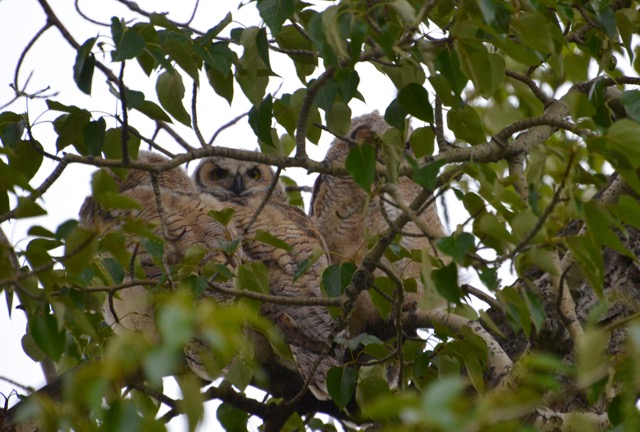
I’ve always thought the Owlington is the only owl family by the pond until I came across these new kids in another part of the hood. Three of them snuggled up against one another on that windy afternoon:

New Kid 3.jpg

No mama or papa around. Wait, not just three, there’s one more on another branch. This bro is all cool and aloof:

New Kid 4

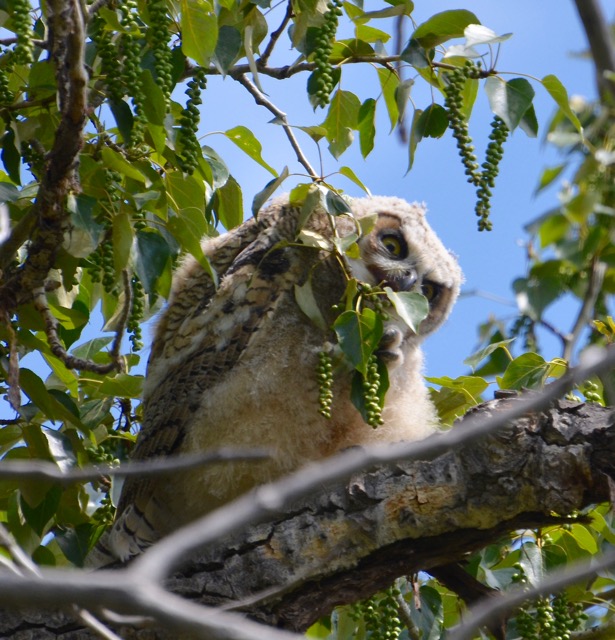
The next day I went back there and saw li’l bro again. This time his style really shown through. Why wait for papa to bring back dinner? Fast food right here:

Can't wait

These are some of the pictures I’d taken in the past weeks. As spring slowly arrives and is here to stay, so are myriads of new lives, bursting out in the hood, some are new encounters for me. Stay tuned for more Nature Photography here on Ripple Effects.

***

Saturday Snapshot is hosted by West Metro Mommy Reads. CLICK HERE to see what others have posted.


Spring Time at the Pond

Still no sign of the Blue Heron, and Warblers aren’t here yet. But we have other attractions. I’m happy with just seeing a Robin looking smart and handsome:

Robin

Or this Red-winged Blackbird, calling across the pond to a hopeful prospect:

Redwinged Blackbird


Signs too of someone working hard. Soon we’ll have no more trees:

Beaver's work

Beaver's work 1

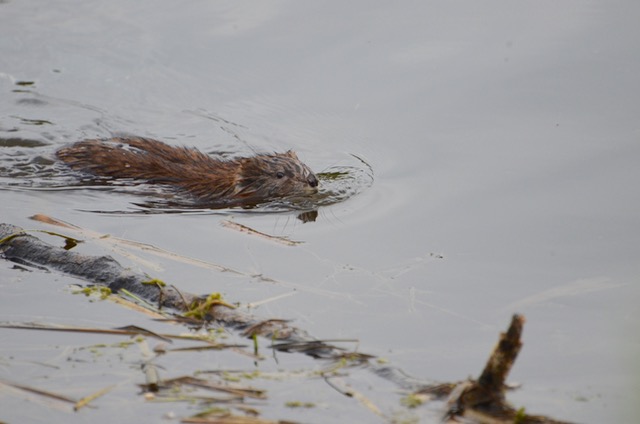
The usual suspects? Leave it to the Beavers. It runs in the family. The little one learns the trade early. Here he is. Look at that face, can you blame him?

Beaver babe

Beaver babe 1

Wait… I need to check my eyes.

B3

Is that Paddington Bear swimming in the pond?

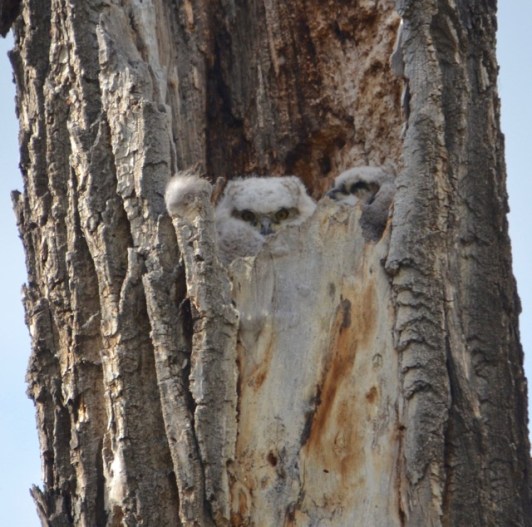
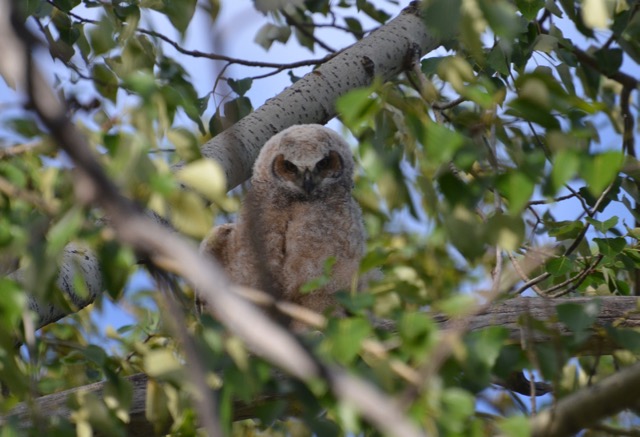
The main attraction by the pond is definitely the Owlington Family. There are always nature paparazzi gathering outside their home about 40 ft. up in a hollow tree trunk, huge lens and tripods set up below waiting for the tiniest movement. The babies are showing their faces a bit more now, although still snuggling up in their nest all day:

Owlets

The eyes

Interesting that there’s always one that’s more alert and nosy while the other rather sleeps in:

Owlet 1

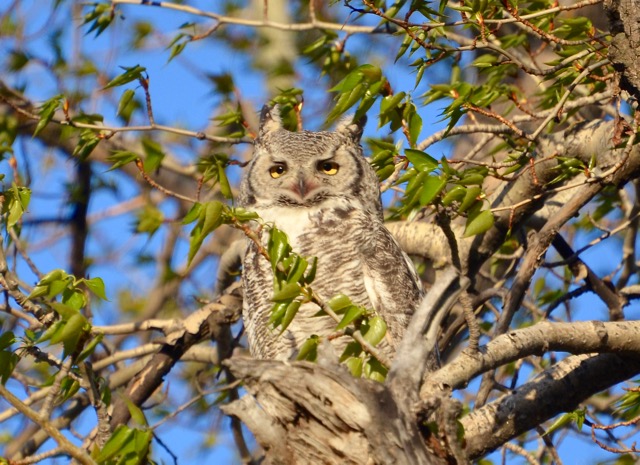
Looks like he’s got his Mama’s eyes:

Mama

More photos to come as spring warms up more… and as the owlets fledge.

***


I’m nobody! Who are you?

April is still here I’m glad. Here’s a timely piece to join in the celebration of National Poetry Month.

***

I’m nobody! Who are you?
Are you nobody, too?
Then there are two of us – don’t tell!
They’d banish us, you know.

How dreary to be somebody!
How public, like a frog
To tell your name the livelong day
To an admiring bog!

Emily Dickinson (1830-86)


DSC_0739

Oh the comfort of anonymity, no need to trend, to like or be liked, to climb the social media ladder, to reach new heights with more followers. Dickinson sure enjoyed her reclusive life, felt fine with being an unknown. Most of her poems were published posthumously, including this one.

***


Risen for Hope

The photo was taken just yesterday. Due to illness in the family, I’ve been staying mostly indoor as a caregiver. Yesterday was the first time I went out to greet spring and the birds. A Downy Woodpecker darted right into frame.

DSC_0614 (1)

While we’re enjoying an early spring this year, there had been times when it felt like spring would never come. A few years ago, I wrote this poem at Easter, when winter lingered and spring seemed so far away… and it was already April.

**

April is the month of empty dreams
Half the days gone
waiting for words and spring
still frozen ground
and on the screen
a frigid page as white as snow.

Brown could be the color of hope
After the white
for all I know
green is too much to wish for
I’m contented to see a patch
of dry and withered brown.

The sun is a perpetual sign
that there’s still hope
But it’s no herald of the seasons
for its presence comforts all year long
warming my blank and barren state
as I await for words and spring.

But Easter is an apt reminder
that The Word had come
spoken clear to half-frozen ears
His body hung on a lifeless tree
Blood and water flowed
onto parched and dusty earth

So what if no words come to me
That dreaded writer’s block
reigning the winter of sterility
numbing senses,
snatching thoughts,
seizing any sign of spring.

It’s not about a post or a blog,
Or even buds and melting snow.
The Word had come
lived and loved among us,
broken, bled, died and rose,
melting frozen hearts to greet
a new dawn and eternal Spring.

– by Arti, April 2011

  ***

We look not towards the climate, but the Christ.

Happy Easter to all!


The Outsider Visualized

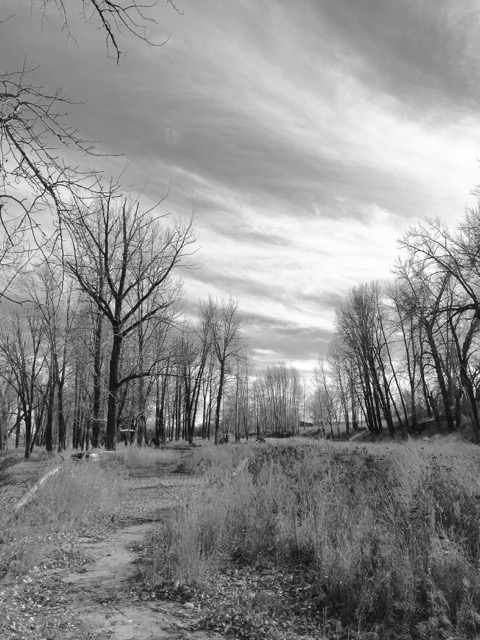
Just finished rereading Albert Camus’s The Outsider (or, The Stranger, L’Étranger). For some reasons, I find these two photos which I took late last fall well represent my thoughts. Words may come later in another post; until then, these visuals will suffice.

The Outsider 2

IMG_3400 (1)

***

The hardest part is getting out of the car

In chilly -5C (23F), snow a foot deep in some areas, the hardest thing is to get out of a warm car. I drove around, actually left the natural park and then, a couple of blocks later, thought about turning back, all because of the flocks of dark spots by the river I saw from afar.

Glad I finally mustered the will to make a U-turn, find a spot to park and part with the story I’ve been listening from the audiobook CD.  I layered up, attached the ice grippers on my shoes (discovered this secret only a year ago), put on toque and gloves, and with my camera gear in tow, stepped out of the car.

Here’s my reward.

From afar, just some tiny black dots on the water…

From afar


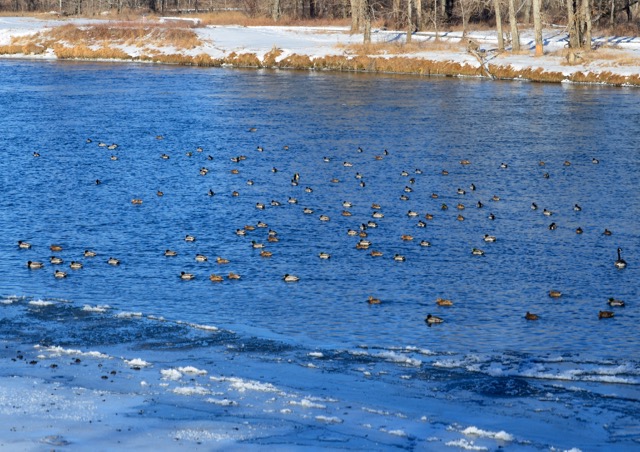
that turned out to be a party of ducks and geese, basking in the afternoon sun on the icy river:

DSC_0406


Basking

And from behind tall grass, a buck watching me watching the ducks:

Buck behind grass

Suddenly from the corner of my viewfinder, a pheasant flew into frame. Here’s the serendipitous sequence:

Pheasant 1Pheasant 2Pheasant 3

At another spot, more Mallards gathering, over a hundred of them:

More ducks

These pigeons could only watch.

Pigeon A: Don’t you wish you could swim?

Pigeon B: And get all wet in the icy water? I’m thankful that I can’t swim.

Your guess: which is A? and B?

If only we could swim


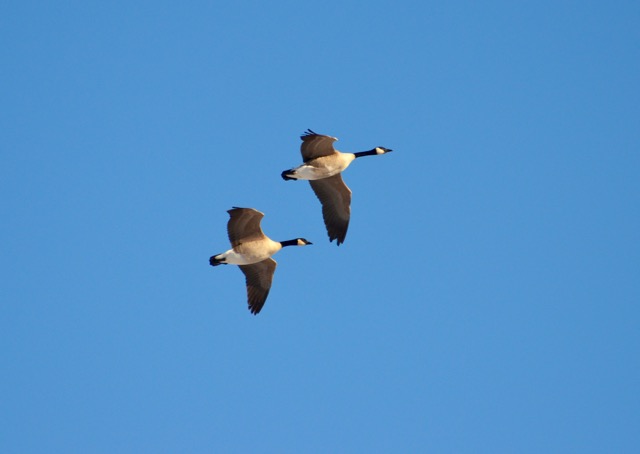
In the sky Canada Geese flew by:

DSC_0565

On the ground, remnants of fall:

DSC_0549


and some positive human footprints left behind.

DSC_0489


And so I learned: Any worthwhile journey began with a step out of a warm car.

Oh, and one more thing… 

Wisdom from the pigeon: Be thankful for what you can’t do. I’ve got lots to be thankful for.

***

This is my post for Saturday Snapshot: Nov. 28. Thanks to West Metro Mommy Reads for hosting. CLICK HERE to see what others have posted.

ALL PHOTOS IN THIS POST TAKEN BY 

ARTI OF RIPPLE EFFECTS

DO NOT COPY OR REBLOG


Write Where You Are

During my New England road trip, I’ve visited several literary places. Now these are my own way of storing my memories. Whatever site I’ve been that relates to a literary figure, I categorize it as such. And it’s interesting to note the different sources of inspiration.

Thoreau went for the minimal, the Spartan way of existence. So he built a log cabin in the woods and kept only the simplest furniture. Why he only stayed for two years two months and two days may be self-explanatory. But no matter, we’re glad he had tasted the bare minimum for us so we can read all about it in his book.

Interior

By comparison, his friend Ralph Waldo Emerson, who owned those woods where Thoreau had his experiment, lived in relative luxury and comfort. Here’s his residence, not a mansion but still a handsome house.

DSC_0561

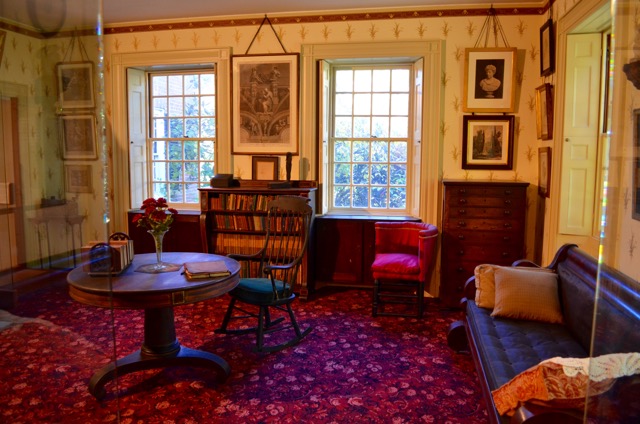
And inside the Concord Museum I saw his study with a flashy fuchsia decor which Thoreau might not have raved about. Just might not, but one never knows. They were friends.

Emerson's Study

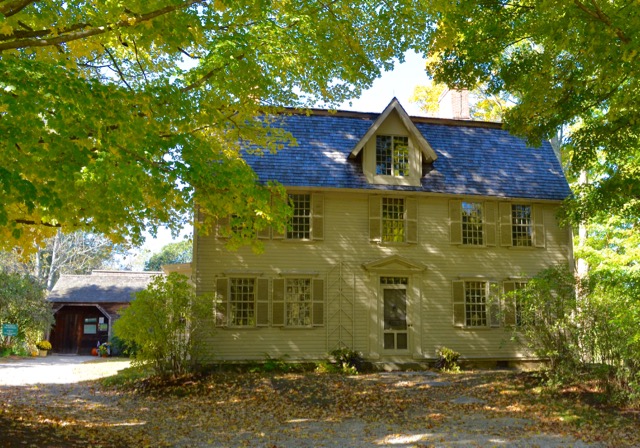
Ralph Waldo’s grandfather The Rev. William Emerson’s house, The Old Manse (Scottish term for ‘Minister’s House’), wasn’t shabby either. Quietly situated by the river, a historic residence where literary figures gathered and where Ralph Waldo had lived for a while and wrote Nature, which sparked the Transcendental Movement (1834-35).

Manse 2

Nathaniel Hawthorne had lived in the same house too for a few years (1842-45), writing a book called Mosses from an Old Manse. He enjoyed the garden immensely; it was planted by Thoreau in 1842 to celebrate Hawthorne’s marriage to Sophia Peabody. Hawthorne could have found inspiration right there among the beets.

The Beets

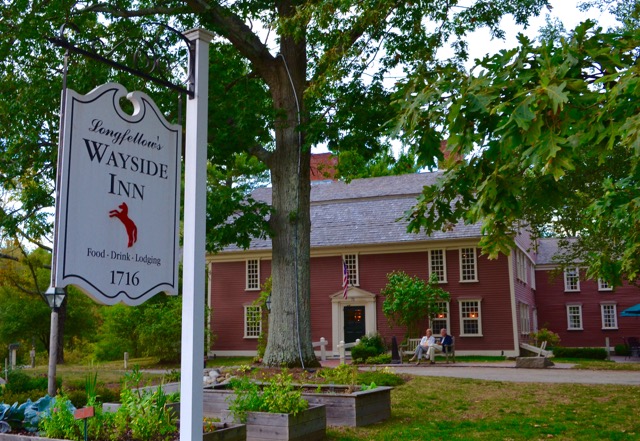
Longfellow, on the other hand, was intrigued by an old tavern and boarding house he had stayed one time in 1862. A homestead made into a lodge for itinerant farmers and transient guests had put stories in the mind of the creative, hence the publication of the Poet’s Tales of a Wayside Inn. For its namesake, the premises had since been named Longfellow’s Wayside Inn.

DSC_0193

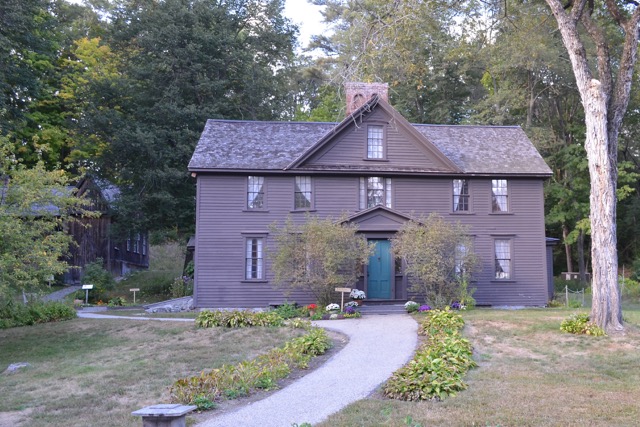
Louisa May Alcott’s Orchard House looks like a warm haven for story brewing too, even though the family could have used more material goods than their philosophically-minded father had provided:

The Orchard House

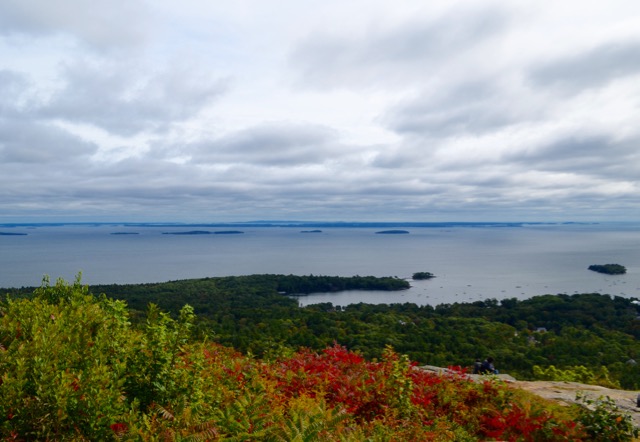
Back to Nature, the aspiring young poet Edna St. Vincent Millay climbed to the top of Mt. Battie in Camden and beheld the magnificent bird’s eye view of Penobscot Bay. Sky and water pressed close into the impressionable mind of young Edna, triggering a catalyst reaction of permanent change.

View from the top 3

For another, it’s the connection with the land, the toiling of the soil, the gathering of its fruits that inspired. He might have many roads to choose, but aren’t we glad Robert Frost had chosen orchard tending in Vermont and not the ones he did not; we get plenty of thoughts.

Frost's Apple

And for those born into affluence and wed into more, life was a choice of how to use the resources one gets. I’m glad that Edith Wharton had spent her fortune on something that can be left behind for me to set foot on, yes, The Mount.

EW's Garden

I learned too that her legacy had been more than literary pleasures and architectural delights, but something more altruistic after she moved to Paris.

As WWI broke out, Wharton could have gone back to America for safe haven. But she stayed in France, and poured herself in the war efforts, which was inspiration in itself. Here I quote from The Mount’s webpage:

“She set up workrooms for unemployed seamstresses, convalescent homes for tuberculosis sufferers, hostels for refugees, and schools for children fleeing war-torn Belgium. In the first seven months of her efforts, nearly 900 refugees were cared for, “including the nuns and about 200 infirm old men and women, who are ‘children’ too … and could not be left alone in the ruins.” (Edith Wharton, New York Times, 1915)”

and the story didn’t end there… Click on the above link to read more.

Where does one find inspiration, motivation? The answer can vary as much as asking what I should eat today. But one thing I’d experienced on this trip was that life can be lived in myriads of ways, and with it comes inspiration; it could be as simple as a leaf on the ground, or as huge as a war. But I’ll choose the leaf, thank you.

The Leaf

Wherever I am, that’s a good start.

***

My New England Road Trip Series:

Serendipity on Route 7

My drive continued south from Bennington, Vermont, via RT 7 to Williamstown, Massachusetts. There I stayed for the night. I knew Williams College was located there. But while exploring the town, I came to this building and saw the huge banner. Upon further investigation, I was excited to discover the campus of Shakespeare & Company:

The Miller BldgDSC_0337 (1)Later I found out that the actor Christopher Reeve met his future wife Dana in Williamstown where they later married. Reeve began as an apprentice at age 15 with the Wiliamstown Theater Festival right in those venues and eventually performed there for fourteen more seasons.

I had the chance to talk to a woman who was working on the grounds and learned that, lo and behold, she was born in Alberta, Canada, my home province! Imagine a chance encounter with an Alberta born American thousands of miles away.

The Berkshires region is beautiful and cultural. I made a mental note to come back to Williamstown for its annual Theater Festival.

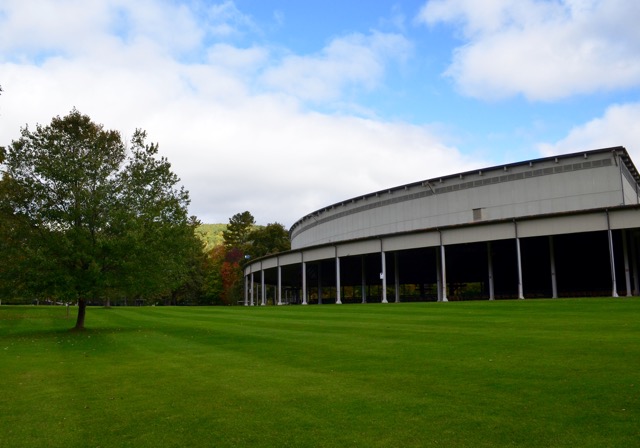
My original plan was just to drive south on RT 7 from Williamstown to Lenox to see the Edith Wharton House at The Mount, when another serendipitous find came upon me: Tanglewood Music Center. So here I was at the famous summer home of the Boston Symphony Orchestra on my way to Edith Wharton House.

The Koussevitzky Music Shed was named after the Russian-born conductor, composer and double-bassist, long-time music director of the Boston Symphony Orchestra from 1924 to 1949:

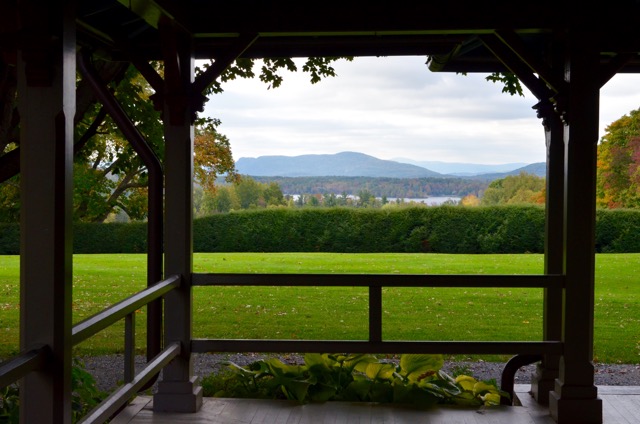
TanglewoodI lingered at Tanglewood for quite some time, for the grounds were beautiful and offered magnificent views. Another mental note: I must come back for the Tanglewood Festival in the summer. :

viewAcross the road from Tanglewood, fall foliage began to emerge. That was October 7. I can imagine how beautiful it is now:

across from TanglewoodAnd finally, to The Mount, Edith Wharton’s home from 1902 – 1911. I knew she was a prolific novelist and short-story writer, the first woman to win the Pulitzer Prize (The Age of Innocence, 1921); later I learned too that she had been nominated for the Nobel Prize for Literature three times.

So I was a little surprised to find out from the tour guide at The Mount that she was also a house and landscape designer in her own right. Her book The Decoration of Houses is still used today by architects and designers.

Built as a writers retreat, The Mount reflects Wharton’s fondness of symmetry:

SymmetryWhat happened to the left side of the building? That makes it not symmetrical, you might ask. That’s the servants quarter which Wharton was willing to compromise her design principle.

Here’s another view why it’s called The Mount:
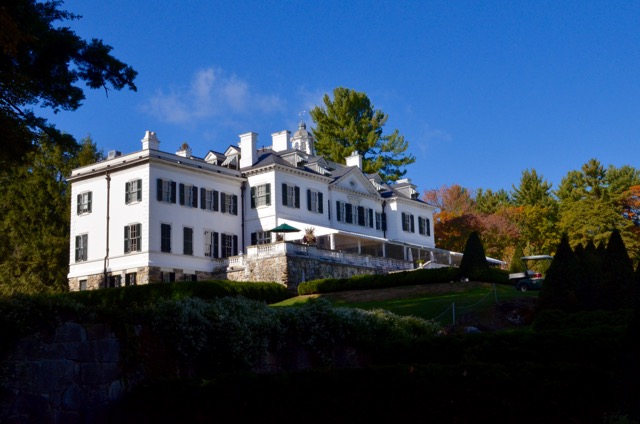
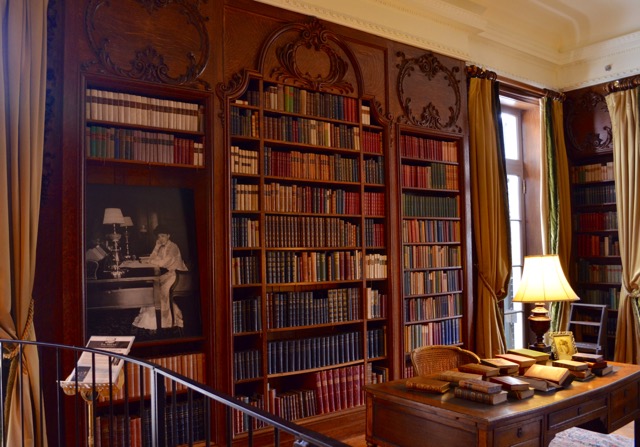
The MountI took a tour of both the inside as well as her gardens. Here’s one wall of her library:

One wallWell read in several languages since she was young, Wharton left these books behind  when she moved away to live in Paris the latter part of her life after the demise of her marriage. Her husband Edward had fallen into a state of dementia after lengthy bouts of depression and mental illness. The writer’s years at The Mount had not been as happy as its surroundings could offer her.

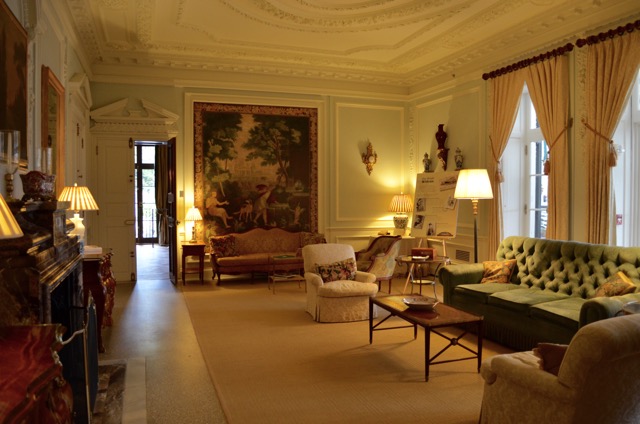
The Drawing Room:

The Drawing RoomDining Room, where Henry James was one of several usual guests:

Dining RoomBut where did she write? Not in the library, or at the desk in her room, but right in her bed. She had an assistant who would take her handwritten pages and type them up after her six hours of continuous writing every morning before she got out of bed. I’m sure Wharton would love to have a laptop:

Writing bed (1)And these other items I found interesting. Downton images conjured up in my mind. Typewriter, telephone, telegram:

DSC_0347
An original 1902 ice box, Daisy would love it but maybe not Mrs. Patmore. Give her some time to warm up:

Ice Box
A luggage lift. Definitely would be a fave among the footmen:

Luggage lift

And only after the tour did I find out, The Mount had given a Life Time Achievement Award to Julian Fellowes. The Downton creator had attributed Wharton as a major influence on his works, first Gosford Park (Oscar Best Original Screenplay, 2002) and then Downton Abbey. Speaking upon receiving the Award at the Harvard Club, Fellowes noted that he was particularly inspired by Wharton’s “… ability to judge without feeling the need to condemn.”

I bought the book The Custom of the Country in the gift shop and only just now did I learn that it is being adapted into a TV mini-series, with Scarlett Johansson playing the anti-heroine, Undine Spragg. This will mark Johansson’s first TV role.

As for Julian Fellowes’ new work? I eagerly await. After visiting The Mount, I can see what a natural shift it is for him to create an American version of Downton. The Gilded Age should be a smooth sequel.

From Lenox, I began the last leg of my New England Road Trip. I headed east on I90, a breezy 2.5 hrs. drive back to Wayland, the suburb outside Boston, thus completing the loop and a memorable journey. An item checked off my bucket list.

***

Follow my New England series:
Vermont: More than Scenery

Vermont has so much to offer on top of the scenery. But I’ll start with that.

The hills are alive overlooking a breathtaking view of the distant Green Mountains. That was what attracted the von Trapp Family to settle there. Right, that’s the Family von Trapp of The Sound of Music fame. Goerg and Maria moved to Vermont in 1941 and bought a 300 acre farm near Stowe, as that location reminded them of their native Austria. There on the mountain top they started a guest lodge and had since developed into what is now an upscale resorts on 2,500 acres.

The Trapp Family Lodge in Stowe, VT, owned and operated by the eldest son of Maria and Georg von Trapp:

Trapp Family LodgeJust 36 miles west of Stowe was Lake Champlain on the edge of Burlington, a vibrant college town. The Lake is a large body of fresh water, once called the sixth of the Great Lakes. It borders the States of Vermont, New York and stretches up north to Quebec, Canada.

At the pier of Lake Champlain:

Lake ChamplainI totally get how this boat is named:

DSC_0096I took the Vermont scenic drive Rt. 100 and headed south from Stowe. My destination was Bennington in the southwest corner of the State.

Not far from Stowe I arrived at Waterbury, a town with lots of restaurant choices for such a small place. I visited two major tourist sites there.

Just off RT 100 was the Ben & Jerry’s Ice Cream Factory, and they sure were prepared for the hundreds of visitors on the day I was there. A well organized and informative factory tour let me see how two college buddies’ $50 investment on an online ice cream making course had come to fruition. What’s impressive is their commitment to use supplies from local farms and cows that are steroids-free. A fair trade business to ensure global responsibility. (no, I don’t get a buck for writing this.)

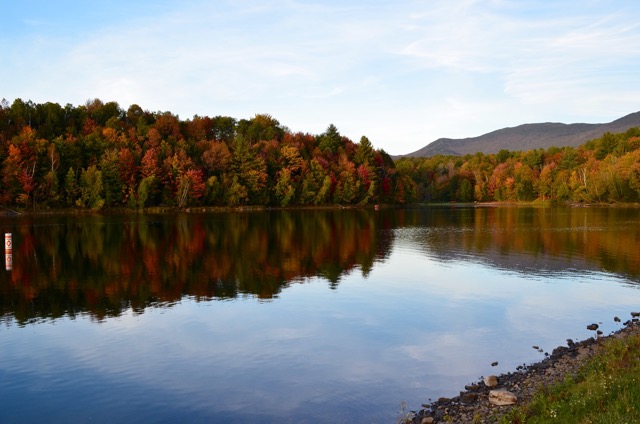
Product MissionIn contrast, not far from the madding crowd at Ben & Jerry’s was the serene Waterbury Reservoir. When I got there it was already past sunset. So glad I could still take these photos:

Waterbury Reservoir

W R

Reservoir

Continued on Vermont Rt. 100 south I came by this most interesting site in the fields outside the small town of Waitsfield, population: 1,719 (2010). Here I found The Big Picture Theater, screening The Martian:

DSC_0103Two posters at the door caught my attention:

Kickstarter FFDownton Talk

One was a “Kickstarter Film Festival”. An indie film festival in this area? I was most impressed.

Another poster was about a talk on “The Costumes of Downton Abbey”. Here’s what the poster says if you can’t see it clearly (above right):
“Jule Emerson, former Costume Designer and Theater Professor at Middlebury College will discuss the fashions worn by Lady Mary and her family in the popular PBS series Downton Abbey. Free and Open to the Public”

No place is too remote for films and the Crawleys.

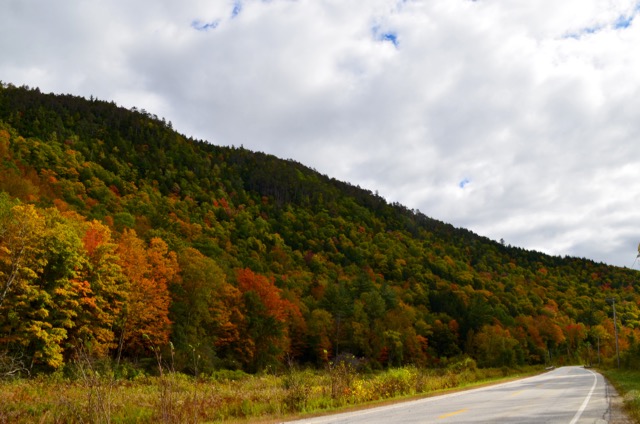
Rt. 100 offered some fall scenery very different from NH. I was attracted by the clumps of trees in distant hills along the road. It was a cloudy day, so instead of seeing bright and cheery foliage, I was captivated by the moody atmosphere. Just as beautiful:

Moody

Before arriving at Bennington, I stopped by South Shaftsbury to visit Robert Frost Stone House Museum. Frost bought the stone house and its 80 acres land in 1920, moving from the White Mountains in NH to warmer Vermont mainly for “a better place to farm and especially grow apples.” Aren’t we glad that he threw in some poems as well in his time-off from apple-picking.

In this fertile soil Frost not only gathered apples but poetic harvests as well. In the Stone House, there’s a “Stopping by Woods” Room where the Poet wrote his most famous “Stopping by Woods on a Snowy Evening.” A facsimile of the handwritten manuscript and many other pertinent materials – parody included – were displayed. Trust my words. I didn’t want to get caught taking pictures in a ‘Photography Forbidden’ premises.

I did take photos outside of Frost’s Stone House:

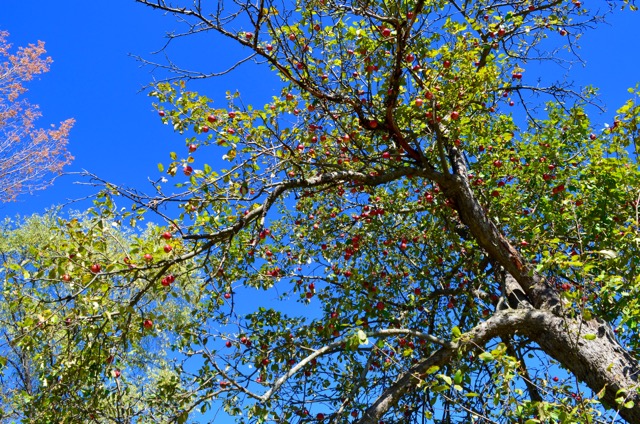
Frost's Stone Houseand his juicy legacy, the apple tree in front of the house:

DSC_0205From Shaftsbury I drove the few blocks to Bennington, There at the back of the First Congregational Church was the cemetery where Robert Frost was buried.

Yes, the sky was that blue that day:

DSC_0270Frost’s grave gathered no pens or pencils as I saw in Authors Ridge of Sleepy Hollow Cemetery in Concord ; instead, people have left pennies there. If they were meant to be tributes to the Poet, it’s simply mind boggling to see how people could think a penny would suffice. Allow me to offer a little alteration to a common saying, standing in front of Frost’s grave: If you don’t have anything poetic to leave there, don’t leave anything.

DSC_0251Coming up: my last stop, Lenox, MA.

***

Follow my New England series:
Finally, Fall Foliage

This was a fall foliage road trip after all, albeit I must say I’d thoroughly enjoyed the coastal scenery in Maine.

New Hampshire’s White Mountain National Forest offered some magnificent sights. Last heard, there’s snow in NH and Vermont. So I’m all thankful for even getting a glimpse of maybe just 40% of fall foliage before the white stuff cometh.

The trees were lovely at the White Mountain National Forest Visitors Center:

WMNF Visitors CenterThere, I learned that a portion of the Appalachian Trail passed nearby. I told myself, I must experience that.

Appalachian TrailI stepped onto the path of the relatively difficult trail (for me anyway), just to have a taste and to see how challenging it was. To make a short story even shorter, I only stayed for a little while. Here’s a view looking upward while there:

Looking UpwardI’d asked for recommendation for an easy walk to a scenic point and was given instructions to the 64 ft. drop of the Glen Ellis Falls at Pinkham Notch; now that’s much better. I’ll leave the Appalachian Trail to the adventurous, like Redford and Nolte:

Glen Ellis Falls

To continue on westward to Vermont, I’d read that I must take the Kancamagus Highway for the magnificent views. And so I did. Driving the 34 miles on the scenic route from Conway to Lincoln, NH, is one of the highlights of my trip. Here are some views of the foliage along The Kanc, as the locals call it.

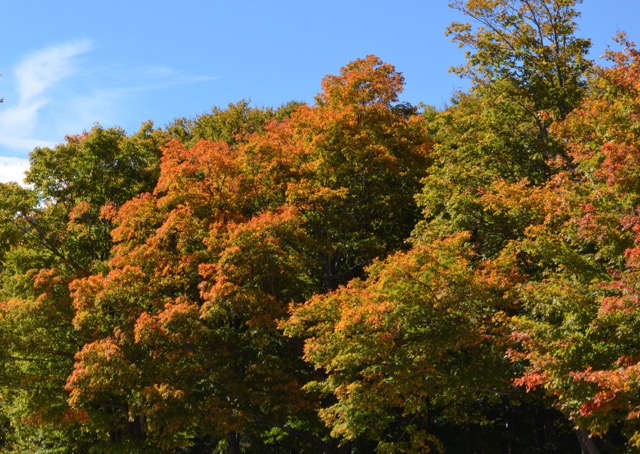
Kancamagus Hwy

The KancCar-stopping view:

Car stopping viewsOnward to Vermont, some picturesque country roads as well:

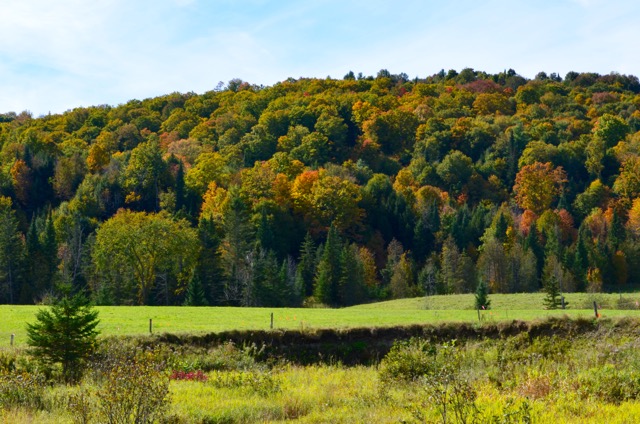
Scenic Dr

More about Vermont to be continued…

***

Follow my New England series:
Orange is the Primary Colour

Driving from coastal Maine westward to New Hampshire, the foliage colours began to change a bit more. Even though I was totally enjoying myself along the coast, I did look forward to seeing some fall foliage as I moved inland.

I drove from Rockport to Maine’s capital Augusta, then continued on some small country roads towards Bethel and Gilead before crossing the State line to Gorham, New Hampshire. It was a pleasure driving through these more remote parts of the country, for the routes offer some gratifying scenery:

Driving thru MaineCountry road in MaineBut it was the colour orange on the ground that caught my eyes. From afar, they were tiny orange dots in the field:

Tiny orange dots on the groundA bit closer I knew, of course, that was a pumpkin patch. And it was orange that would be the predominant colour everywhere, in towns and in the country.

On flatbeds and wagons:

DSC_0501

DSC_0509

wagonfull

Or laid out neatly in arrays on grass:

DSC_0870

arrays

In various shapes and forms:

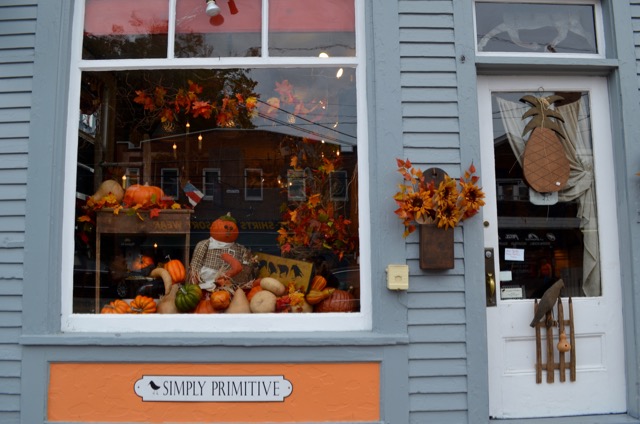
DSC_0508At door fronts, entrances, in hanging baskets and shop windows:

EntrancesHanging Basket

DSC_0544 (1)

DSC_0420

DSC_0549

DSC_0555

DSC_0620

Or in the form of pumpkin people:

DSC_0552DSC_0784Or as pumpkin elves like these two sitting outside Elf Academy:

DSC_0617

No wonder there’s a shortage of pumpkins in the U.S. as the demand is so high. With recent crops diminished by record rain, there arose a pumpkin shortage. Help is on the way though. Here’s a recent headline on CBC News Business section:

“Canadian pumpkin patches poised to fix U.S. lack-o’-lanterns problem.”

What are neighbors for?

***

This is my Saturday Snapshot October 17 entry. Saturday Snapshot is hosted by West Metro Mommy Reads. CLICK HERE to see what others have posted.

Follow my New England series:

Scenic Drive from Rockport to Camden, ME

Rockport and Camden used to be one town at the mid-coast of Maine. Now separated as two but are still joined closely with easy access. The Maine Route 1 could lead me from Rockport in the south up to Camden in just 6 minutes, but I chose to drive into Camden using the side streets, the scenic route, more slowly, stopping for photos along the way.

The day broke grey but I was grateful that despite the overcast sky, there was no rain. Actually, after that wet pounding on I95 to Portland the day before, all the rest of the driving in my road trip was breezy and enjoyable.

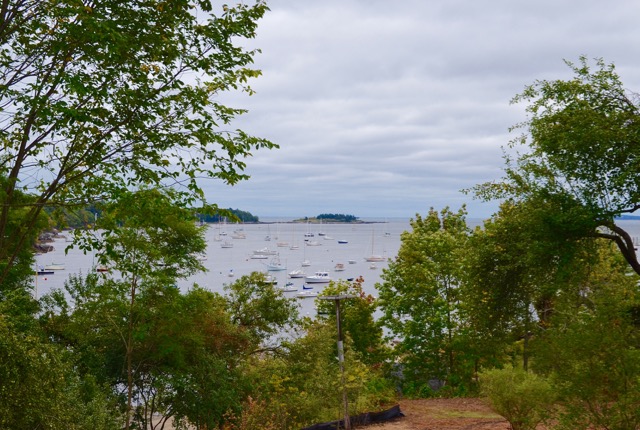
The scenic route from Rockport to Camden was particularly memorable. Here’s a view out to Rockport Harbor along the drive:

Rockport Harbor 2

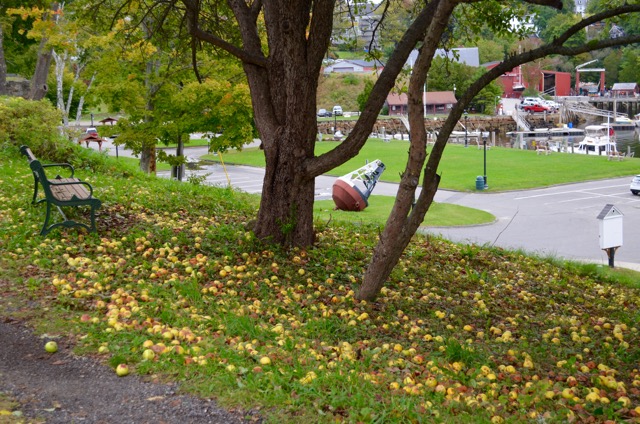
And what I saw as I looked down to the ground was an unusual sight, for me anyway:

Fallen ApplesApples everywhere:

Apples among rocks Coming from the foothills of the Rocky Mountains in Western Canada, I’d never seen so many apples fallen from trees, covering the lawn. I mean, they were not tiny Crabapples which are common back home, but big ones that I usually associate with orchards, but not at a harbor or marina.

Apples everywhereWhat I did connect though was the huge number of apple pies they could make…

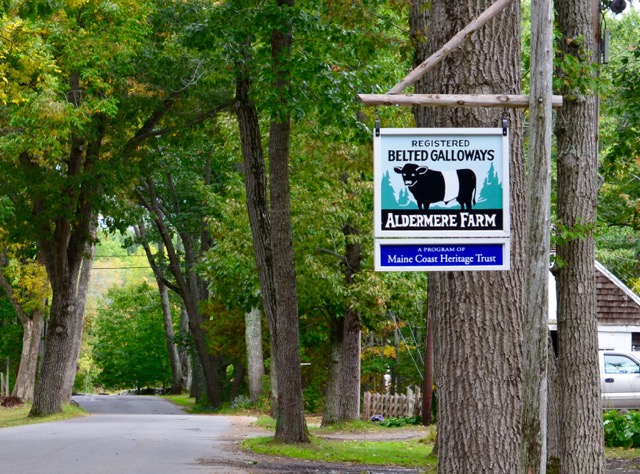
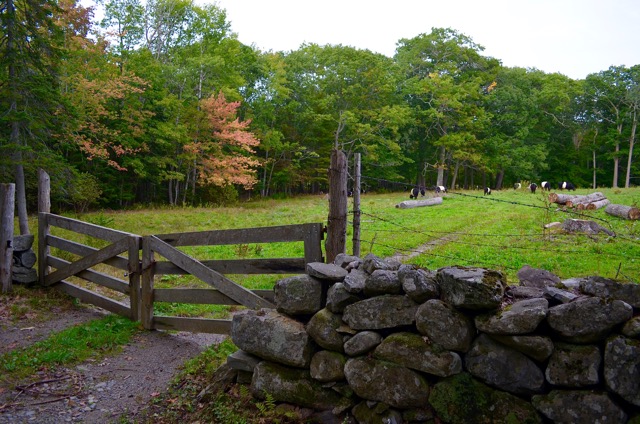
From Route 1 heading north I turned off Pascal Avenue, then followed the scenic loop beginning with Central, then Russel, Limerock and Union. Once on Russel Avenue, I came to the Aldermere Farm, a landmark of mid-coast Maine. The farm is the world’s premier breeders of Belted Galloway cattle, or ‘Belties’, a breed originated from Southwest Scotland.

Aldermere FarmThese white-belted cattle sure made one whimsical picture as they lazed on lush green pastures… think Oreo cookies in a large dish of wasabi:

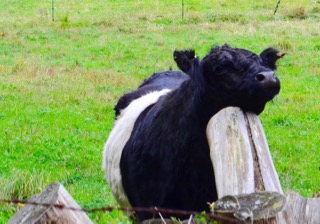
2. White-belted cowsSeeing I had a camera, this ‘beltie’ showed off how to scratch an itch with no hands:
How to scratch an itchScratch againThe foliage was still overwhelmingly green, making the few sporadic splashes of orangey-red even more inviting, confirming to me, yes, I was a week or two early. No matter, this kind of a setting was pure joy, even just for a look. And yes, the grass is always greener on the other side…

Greener Grass

***

Follow my New England series: