A Moveable Feast (Restored Edition) by Ernest Hemingway

Reading A Moveable Feast is like walking along the sea shore. On the fine sandy beach you see many attractive shells, but you don’t have a bucket with you. You pick the finest ones and put them in your pockets, until they’re full. But every step you take further, you see more that you want to keep. This post is too limited for me to display all the shells I’ve collected, but allow me to just pour them out from my pockets, without sorting, sand and all.
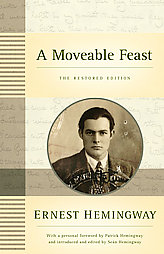
I first read about the term “Moveable Feast” while sitting in an Anglican church in Vancouver, flipping through the The Book of Common Prayer. After some googling later, I got the idea. A feast in the liturgical calendar that you commemorate no matter which date it falls on year after year. In the Foreword of this restored edition, Hemingway’s son Patrick (with second wife Pauline Pfeiffer) writes:

The complexity of a moveable feast lies in the calculation of the calendar date for Easter in a given year, from which it is simple enough then to assign a calendar date to each and every moveable feast for a given year. Palm Sunday is seven days before Easter.

A memorable experience that will follow you all the years of your life. You’ll cherish it whenever and wherever you are. Hemingway’s friend A. E. Hotchner suggested this title. Author of the biography Papa Hemingway, Hotchner recalls Hemingway once said to him:

If you are lucky enough to have lived in Paris as a young man, then wherever you go for the rest of your life, it stays with you, for Paris is a moveable feast.

Like Rick says to Ilsa in “Casablanca”: “We’ll always have Paris.” Same sentiment.

A Moveable Feast is Hemingway’s memoir written from notes he had forgotten in two steamer trunks stored at the Ritz Hotel in Paris since 1928. In 1956 he repossessed the treasure trove, upon the urging of the hotel management. The book details his experience while living in Paris from 1921 to 1926, when the author was in his early 20’s. The memoir was first published posthumously in 1964. The Paris Years was a period when Hemingway, just married Hadley Richardson, young and care-free, decided to give up journalism to strive at being a novelist.

He would write in a rented room or in a café over café crème,
meet Gertrude Stein for critique of his writing, go back home for lunch with wife Hadley, or have oysters and wine in a restaurant, socialize with Fitzgerald, Ezra Pound, and other expats, borrow piles of books from Sylvia Beach’s library in her bookshop Shakespeare and Company, visit Luxembourg gardens and museum…

Two people, then, could live comfortably and well in Europe on five dollars a day and could travel.

No wonder Gil in “Midnight in Paris” dreams of such a life.

What strikes me initially is Hemingway’s frankness, sometimes blatant description of his opinion about the people he met. Like the first time he saw the artist Wyndham Lewis through Ezra Pound:

I watched Lewis carefully without seeming to look at him, as you do when you are boxing, and I do not think I had ever seen a nastier-looking man… I tried to break his face down and describe it but I could only get the eyes. Under the black hat, when I had first seen them, the eyes had been those of an unsuccessful rapist.

According to grandson Sean Hemingway who edited and wrote the introduction of this restored edition, Hemingway developed his sharp eye and ear during these Paris years. Here’s an account of Scott Fitzgerald when Hemingway first met him in the Dingo bar:

Scott was a man then who looked like a boy with a face between handsome and pretty. He had very fair wavy hair, a high forehead, excited eyes and a delicate long-lipped Irish mouth that, on a girl, would have been the mouth of a beauty. His chin was well built and he had good ears and a handsome, almost beautiful, unmarked nose.

This is only a little excerpt in a two page description of Scott’s appearance. It’s sentences like these that stand out for me. They all point to the writer at work: observing.

I kept on looking at him closely and noticed…”

“I kept on observing Scott.

And putting down in words later:

I wasn’t learning very much from looking at him now except that he had well shaped, capable-looking hands, not too small, and when he sat on one of the bar stools I saw that he had very short legs. With normal legs he would have been perhaps two inches taller.

But it was Scott’s talents despite his eccentricities and alcoholism that formed the building blocks of their friendship.

When I had finished the book [The Great Gatsby] I knew that no matter what Scott did, nor how preposterously he behaved, I must know it was like a sickness and be of any help I could to him and try to be a good friend. …   If he could write a book as fine as The Great Gatsby I was sure that he could write an even better one. I did not know Zelda yet, and so I did not know the terrible odds that were against him.

It is perhaps with such candour and devotion in writing that he constantly sought to “write one true sentence.” Woody Allen has grasped the essence in this juicy line from “Midnight in Paris”:

No subject is terrible if the story is true, if the prose is clean and honest, and if it affirms courage and grace under pressure.

The restored edition brings back sections missing in the earlier 1964 publication which was edited by fourth and last wife Mary. According to Sean Hemingway, this restored work represents the content that Hemingway himself had intended the book to have, with the chapter “Nada y Pues Nada” (Nothing And Then Nothing) written three months before his suicide.

The second last chapter “The Pilot Fish and the Rich” shows he was remorseful over the breakdown of his first marriage to Hadley towards the end of his Paris days. A mutual friend they both knew, journalist Pauline Pfeiffer, came in between them. “You love them both now… Everything is split inside of you and you love two people now instead of one.”

But A Moveable Feast belongs to Earnest and Hadley and their young son Bumby.  “… this is how Paris was in the early days when we were very poor and very happy.” As a reader, I feel a sense of loss as I come to the end, for Earnest and Hadley were so much in love the first few years in Paris:

She: ‘And we’ll never love anyone else but each other.’

He: ‘No. Never.’

Their 2-room rental walk-up with no electricity and no hot water had been a haven of warm meals and intimate talks. It was the time when he was “a young man supporting a wife and child … learning to write prose.” Their short marriage lasted only six years. In 1927 Hemingway married Pauline, four months after divorcing Hadley.

The last section at the end of the book is entitled “Fragments”. These are “false starts”, beginning paragraphs of an introduction Hemingway tried to write for this book. Interestingly, every one of these attempts starts with: “This book is fiction.” Many include this sentence: “I have left out much and changed and eliminated and I hope Hadley understands.” In another fragment he wrote: “No one can write true fact in reminiscences…”

I’m baffled. But maybe unnecessarily. From our very subjective mind, our often hazy view of what did happen and what we wish to have happened and what could have happened, we conjure up a fusion. Should there be a clear line separating them? It’s because the demarkation of fact and fantasy is fluid that we can appreciate the arts, such as the film “Midnight in Paris.” The events that happen to Gil after midnight would remain fondly with him as reality, so real that they change his decision regarding his future. Facts or fiction… or fusion?

~ ~ ~ 1/2 Ripples

***

A Moveable Feast: The Restored Edition by Ernest Hemingway, published by Scribner, NY, 2009, 240 pages. Foreword by Patrick Hemingway, introduced and edited by Sean Hemingway.

This post is to participate in the Paris In July blogging event hosted by Karen of BookBath and Tamara of Thyme for Tea. You can also find another review of A Moveable Feast here at Dolce Bellezza.

To read my review of “Midnight In Paris”, CLICK HERE.

Photos: Paris, Shakespeare and Company, Writers’ portraits and The Library in Shakespeare and Company taken by Arti of Ripple Effects, Aug. 2010. All Rights Reserved.

Click on the following links for some insightful interviews:

National Post Interview with Sean Hemingway on the restored edition

Interview with Woody Allen on making “Midnight In Paris”

Urban Sanctuary

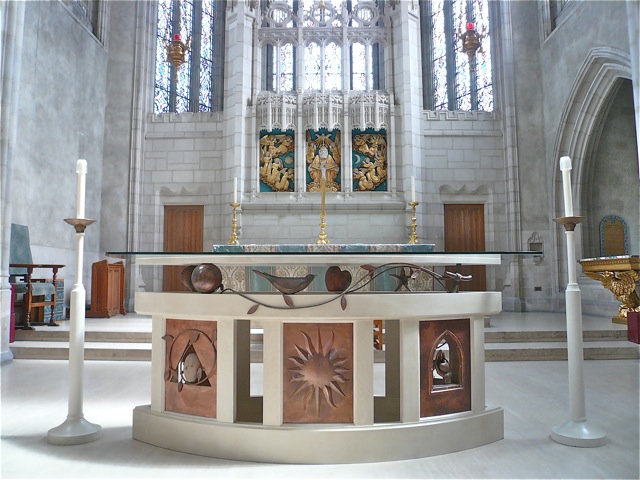
June has been a month of travelling for me. From the natural beauty of Vancouver to über busy and congested Metro Toronto, I’ve shifted gear and gone from park to overdrive in two short weeks. Quiet garden paths have been replaced by the 12-lane Highway 401, rain forest has turned into concrete jungle. And so I was pleasantly surprised by this serendipitous find right in the heart of downtown Toronto. Amidst the hustle and bustle, I found this sanctuary… literal and spiritual, the Trinity College Chapel on the campus of the University of Toronto:

Every step into the magnificent architecture instills awe and wonder, every artefact a symbol:

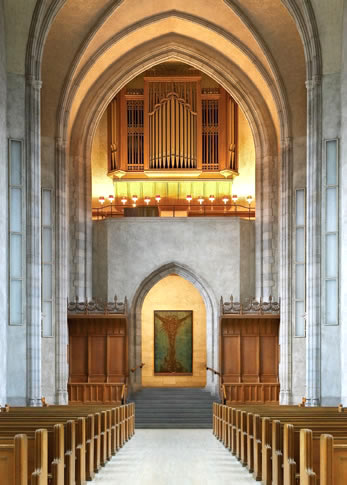
Looking back to the choir loft is another stunning view (this photo from Wikipedia):

The painting on the wall in the narthex, a crucifix, is entitled “Mediterranean Christ” by the artist Juan Sala Santonja:

***

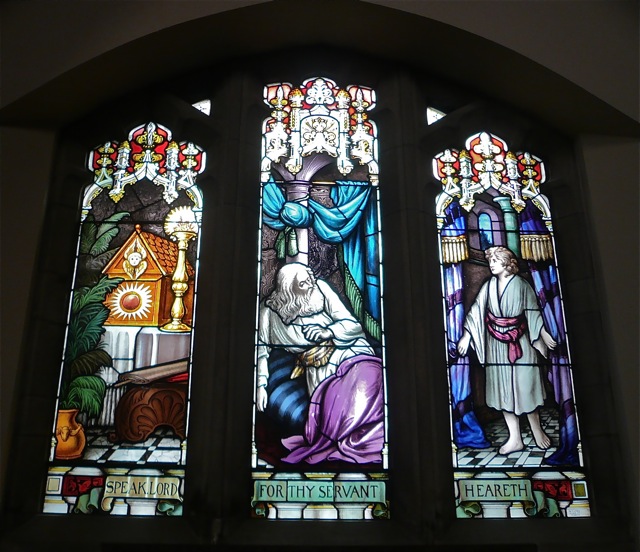
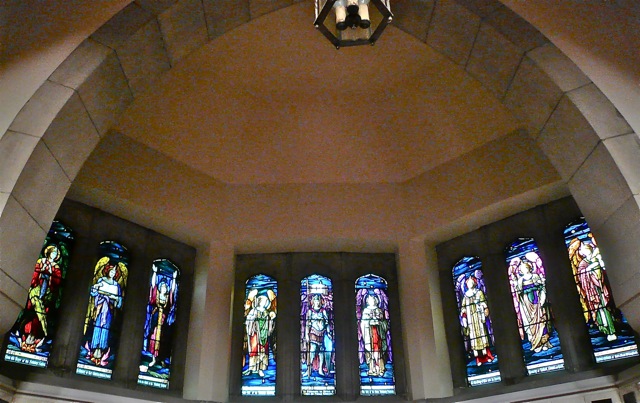
Another joy of discovery is Grace Church On the Hill, Anglican. My expectation of my short sojourn in Toronto had never been stained glass or religious art. But here I was, beholding Biblical themes in beautiful stained glass:

This contemporary wall sculpture created by Catherine Widgery of Montreal juxtaposes well among the stained glass, for its message points to a similar theme:

Entitled “By Her Own Radiant Light”, John Milton’s verse is engraved on a brass plaque beside the installation:

By her own radiant light, though sun and moon

were in the flat sea sunk.

And Wisdom’s self

oft seeks to sweet retired solitude,

Where, with her best nurse

Contemplation,

She plumes her feathers,

and lets grow her wings.

The pamphlet beside the art installation conveys the meaning: As the Moon’s illumination is the reflection of the Sun, Christian disciples are reflectors of the Greater Light. The phases of the moon suggest an eternal cycle of life, death and rebirth. Loss returns to fullness; darkness becomes light. The fragments of reflected light on water form a triangle below the full moon. Each fragment of light is a single piece of metal, cut and assembled so as to suggest the light’s effect on the surface of the water. At the heart of the circle, the light reflected on the surface is brilliant and intense, and diminishes as it spreads farther from the source.

As someone who’s always drawn to ripples, I spotted this installation right away as I entered the  sanctuary. Reading Milton’s verse and the explanation of the art work helped me gain a deeper appreciation of the visual symbolism.

No rain forests and greenery, but I was drawn to explore another landscape, one where art and imagination formed a bridge towards the unseen and spiritual, no less powerful in bringing out the wonders of creation and the Creator, the Source of Light and Wisdom.

***

CLICK HERE to watch a video clip with visual artist Catherine Widgery

PHOTOS: All photos were taken by Arti of Ripple Effects except the one noted from Wikipedia. Arti’s photos taken in June, 2011. All Rights Reserved.

Midnight In Paris (2011)

.

.

A Woody Allen movie rated G? Yes, and maybe only in B.C. where I saw it in Vancouver yesterday. If you’re offering charming characters, lively performance from some talented actors, Woody Allen’s own clever screenplay inundated with witty dialogues, and have him direct in the backdrop of dreamlike Paris, the result is pure delight. You don’t need too much of anything extra, hence the MPAA PG-13 rating. And maybe because of that, clean and crisp, this is one of the Woody Allen movies I enjoy most for some years. And yes, this is the one with French first lady Carla Bruni in it, where Allen has to direct under the watchful eyes of the French President and his security personnel.

Gil (Owen Wilson) and Inez (Rachel McAdams) are engaged to be married. They take a trip to Paris with Inez’s parents John (Kurt Fuller) and Helen (Mimi Kennedy) for John’s business merger. While Gil and Inez first appear to be a romantic pair, we soon find them to be incompatible. Gil is an underachieved screenwriter from California, aiming to write his first novel. His dream of Paris is one of the golden age, nostalgically inhabited by the modernists, the artists and literati of the 1920’s.

However, his fiancé Inez fails to see his aspiration or potential, and the imagination that the cultural city can unleash in him. Rather, she falls for their American friend Paul (Michael Sheen), the intellectual snob whose self-importance drives him to snub Gil and even counter their museum guide (Carla Bruni) in the accuracy of her information. But Gil is more preoccupied with his midnight encounters, which ultimately transform him and change their individual paths. These experiences after midnight are just wonderful surprises for Gil, and me. Without giving too much of a spoiler, let’s just say it’s Woody Allen’s version of ‘Back to the Future’.

When I first saw the trailer, I had reservation about Owen Wilson being the leading man in a Woody Allen movie set in Paris. Would that be a miscast? Well, I’m proven wrong the moment he appears on screen. Wilson embodies the unassuming and delusional Gil, screenwriter from Pasadena, CA. He casts all of his previous film roles out of my mind and replaces with only this one of the moment, offering a performance that is impressively convincing. He leads a cast of wonderful actors, including the charming Marion Cotillard, veteran Kathy Bates, the versatile Michael Sheen, and a very dramatic Adrien Brody. And I won’t give away who is supposed to be who, I’ll leave that joy of discovery for you.

This is a movie for art and literature lovers, ideal for book bloggers and discussion groups. Allen has cleverly juxtaposed the modernists in the turn of the 20th century with their contemporary admirer Gil. We encounter all these iconic figures in the film: Ernest Hemingway, Scott and Zelda Fitzgerald, Gertrude Stein, Pablo Picasso, Cole Porter, Salvador Dali, T.S. Eliot and more… it’s so much fun to hear allusion to their works, and some of them utter lines that are their own but in the style and wit of Woody Allen’s.

What makes the movie gratifying of course is not just the visuals, people and places, but how the story leads. The twist towards the end is the pivotal revelation for Gil. While one can bask in nostalgia, one needs to embrace the present in order to fully live. As I watched the movie, I wanted to read the script and capture Allen’s ingenuity. As I left the theatre, I wanted to see it again.

~~~1/2 Ripples

To read my review of Hemingway’s A Moveable Feast CLICK HERE.

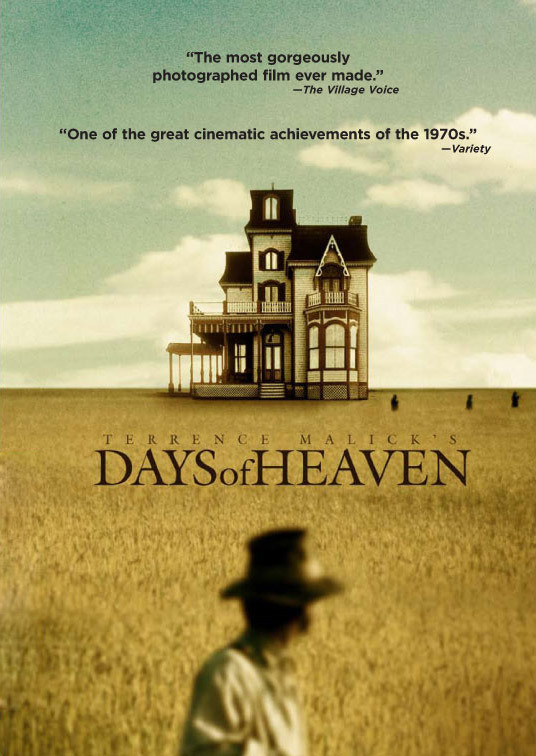
Days of Heaven (1978) by Terrence Malick

It all began when I watched the “The Tree of Life” trailer in the theatre. I was mesmerized. A few seconds into the trailer I decided it would be a must-see for me. Then later it won the Palme d’Or at the Cannes Film Festival on May 22. I’m now catching up on Terrence Malick’s previous works before “The Tree of Life” screens here in our city in a few weeks time.

The reclusive auteur Terrence Malick has only made five feature films in his directing career which spans four decades: Badlands (1973), Days of Heaven (1978, Won Oscar for Best Cinematography), The Thin Red Line (1998, seven Oscar noms), The New World (2005), and The Tree of Life (2011, Won Palme d’Or at Cannes, so far). His academic background in philosophy at Harvard and later as a Rhode Scholar at Oxford has found its expressions in his cinematic creation.

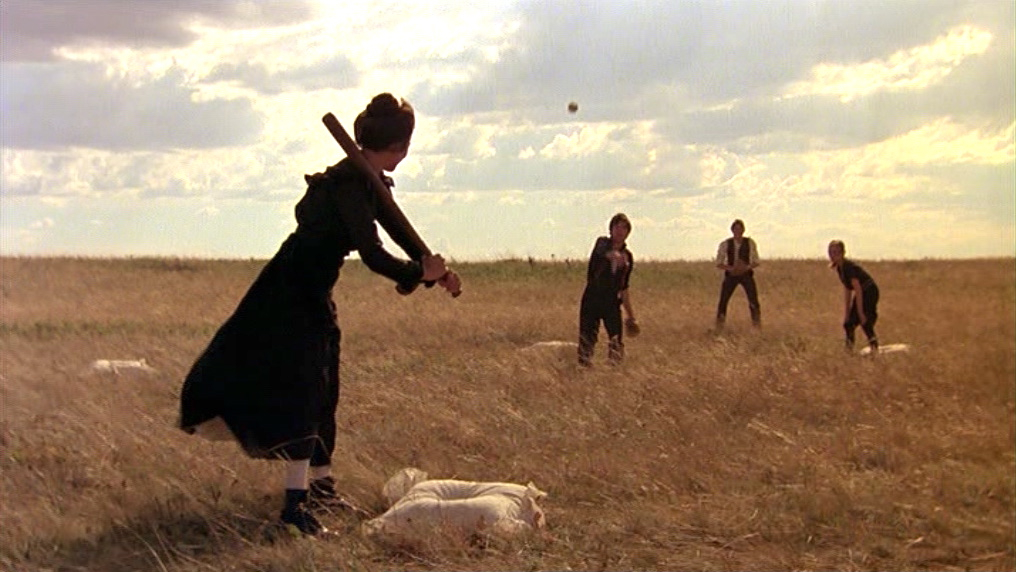
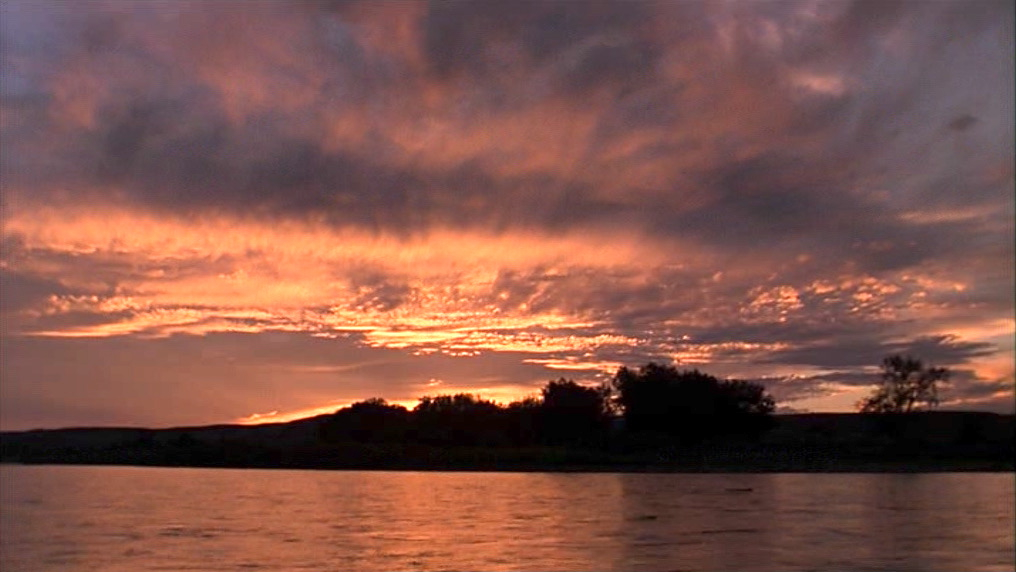
“Days of Heaven” in the Criterion Collection is a fantastic restoration and transfer. I watched it on the DVD. I suppose the Blu-ray would be even more spectacular. Some call “Days of Heaven” one of the most beautiful films ever made. Well, I haven’t seen all movies ever made to say that, nevertheless, of all that I have seen, such a statement is certainly not an exaggeration. Using mostly natural light, every shot is cinematic poetry. Enthralling scene sequences joined together to produce a piece of artwork that speaks the quiet, and sometimes silent, language of visual eloquence.

Written and directed by Malick, the film is nostalgically set in the 1910’s. The story is about Bill (Richard Gere), a hot-tempered steel mill worker in Chicago, who has to flee after an altercation leaving a man dead. He and his lover Abby (Brook Adams), and his younger sister Linda (Linda Manz) run away together and end up working in the harvest on a Texas farm. Pretending to be Bill’s sister, Abby is soon courted by the farmer (Sam Shepard). Overhearing that the farmer has only a year to live due to an illness, Bill persuaded Abby to marry the farmer so they can inherit his properties after his death. Every choice has its consequence. The plot unfolds in intriguing ways. Biblical parallels are deftly embedded in the scenes, Abraham and Sarah, the plague of locusts, Linda’s voice over allusion to the apocalypse… not just offering stunning images but thought-provoking as well.

And I must mention, I have a connection to the movie. It was shot right here in southern Alberta, and some scenes right here in Calgary, in Heritage Park to be exact. No, I wasn’t an extra. But proud that this regarded by some as one of the most beautiful films was shot entirely on location here in this province. It is the magnificent expanse of Alberta’s wheat fields and not those in Texas that we see in the film. The reason: from the DVD commentary I learn that the wheats were four feet tall in Alberta while those in Texas were only two feet.


***

CLICK HERE to read my review of The Tree of Life (2011) by Terrence Malick.

CLICK HERE to my post “A Sequel to Days of Heaven, Mr. Malick?”

Photo Source: Screenmusings.org. Use as per outlined in Fair Use, for review and educational purposes only.

Can a movie adaptation ever be as good as the book?

The more I watch movies and read books, the more I see the two as totally different art forms. They evoke different kinds of pleasure and enjoyment. A direct translation just may not work. I used to seek for how ‘faithful’ a movie is compared to its literary source, but more and more, I’m looking for how good it stands alone as a production in terms of cinematic elements.

A film adaptation can make an apt homage to the original literary work. It is not merely an ‘illustrated book’, but a new creation, if you will, one that offers a different experience from reading. In telling the story from a visual and sound perspective, it offers a multidimensional take on the original work. By so doing, it may need to alter the source material. But then again, how do you know the images on-screen are not those already conjured up in some readers’ minds as they interact with the text… or, theirs are not even more far-fetched?

While a film is the artistic expression of the filmmaker’s interpretation, it is also a collaboration of talents and perspectives, as cast and crew contribute their expertise, in cinematography, set design, costume, writing, sound, music, editing… all under the artistic direction and insight of the auteur. It is an alchemy of sights and sounds. On top of that, there are the key agents of delivery, the actors. An intelligent and nuanced performance can bring out the literary essence, unfurling the thematic matter, characters and conflicts, and above all, the humanity embedded in the text.

In his article entitled “Snobbery”, Ta-Nehisi Coates, senior editor for The Atlantic, says that as he reads Pride and Prejudice, Austen’s brilliant literary depiction has formed some vivid images in his mind.

I like the pictures in my head, and would not see them overthrown.

Yes, that’s usually the case with many readers who guard the ownership of their imagination as sacred territory, hence, the refusal to step out to explore other grounds of artistic expressions. So, despite hearing how splendid the BBC version of Pride & Prejudice is, Ta-Nehisi Coates has this to say:

I don’t doubt it–but I think mine is better. For right now, I’m just a snob that way. I reserve the right to change.

I’ve been mulling over this ‘snobbery’ idea after reading his article back in March, and feel that another word might be more apt to describe such a condition: “hegemony”… the claim of the literary being supreme, over other forms of artistic expression. On a personal level, it is also the hegemony of subjectivity… valuing one’s own mental images exclusively. It’s about sharing, isn’t it, seeing and experiencing what others’ imaginary worlds are like in response to a piece of literary work? I believe we are richer when we share, especially, our vision and imagination.

As a literature lover and a Janeite myself, I’m only glad to hear another high praise of Austen’s ingenuity, not that her works need any more approval to be of value. However, as a film lover I don’t want to wage war by dichotomizing the literary and the visual. They are two different art forms, two distinct vehicles of storytelling. Even though the story comes from the same source, it could be told from different perspectives, filtered through different lenses, structured in different styles, and ultimately received by interacts with the reader and the viewer in a very individual and personal way.

I’ve appreciated Kazuo Ishiguro’s openness regarding the creative process during the film adaptation of his book Never Let Me Go. According to a TIME magazine article, Ishiguro said to Alex Garland, the screenwriter:

Your only duty is to write a really good screenplay with the same title as my book.

What ended up was both the author and the screenwriter share a very similar vision. Here is what director Romanek has done to bring out the literary:

… he imparts a mood so subtle, with so many emotional cataclysms conveyed through a glance or a few tears, that the film might have been made by the Japanese master Yasujiro Ozu.  The nuance is both emotional and visual… Romanek also researched the Japanese notion of wabi-sabi, ‘which is the beauty of things that are broken and worn and rusted and imperfect. So production designer Mark Digby and I, we just wabi-sabied everything. The dried flowers are an example of that. There’s nothing new in the film. Everything shows the wear of time.

Watching a film then is like listening to another language, the language of the visual, and appreciating the significance of mise-en-scène.

***

As a language and literature lover as well as a movie buff, I’m always on the lookout for the perfect fusion. To those who insist that a movie will never be as good as the book, allow me to suggest the following sampler. No, they aren’t perfect, but some are close to it. They are all worthy of and have done justice to their source material. Just from memory I’ve made the following list. All I’ve read and watched, some several times. (click on the link to read my review). There are more good movie adaptations of course, but I’m just listing those which I’ve both read the book and seen the film, thereby able to evaluate the adaptions against their source material:

Great Expectations (1946)
Novel by Charles Dickens, directed and screenplay co-written by the legendary David Lean.

Diary of a Country Priest (1951)
Novel by Georges Bernanos, screenplay and directed by Robert Bresson

To Kill A Mockingbird (1962)
Novel by Harper Lee, Robert Mulligan director, Gregory Peck IS Atticus Finch

The Heart is a Lonely Hunter (1968)
Novel by Carson McCullers, Memorable performance by Alan Arkin

A Room With A View (1985)
Novel by E. M. Forster, a Merchant Ivory film. Helena Bonham Carter emerged.

Howards End (1992)
Another E. M. Forster/Merchant Ivory film. Ruth Prawer Jhabvala won Oscar for Best Adapted Screenplay, Emma Thompson Best Actress. Beautiful rendition of sight and sound. Helena Bonham Carter, Vanessa Redgrave, Anthony Hopkins and many more made up the talented cast.

The Music of Chance (1993)

Paul Auster’s absurdist/existential novel is hauntingly adapted into film (How can you show philosophical concepts? Here it is) perfectly interpreted by James Spader and Mandy Patinkin. Excellent cast and superbly directed by Philip Haas.

The Remains of the Day (1993)
Kazuo Ishiguro’s Booker Prize winning novel, another Merchant Ivory film. Poignant performance by Emma Thompson and Anthony Hopkins.

Pride and Prejudice (1995, BBC)
In my opinion, the definitive version of Jane Austen’s film adaptation. BBC production, Andrew Davis screenplay. Colin Firth remains the inimitable Mr. Darcy to this day.

Sense and Sensibility (1995)
Emma Thompson did justice to Jane Austen with her Oscar winning screenplay. Ang Lee directs Emma Thompson, Kate Winslet, Alan Rickman, Hugh Grant. Still my favorite version of S & S.

The English Patient (1996)
Booker Prize winning novel by Michael Ondaatje, directed and screenplay written by Anthony Minghella. Ralph Fiennes, Kristin Scott Thomas, Juliette Binoche.

Girl With A Pearl Earring (2003)
Novel by Tracy Chevalier, Peter Webber directs Colin Firth as Johannes Vermeer, Scarlett Johansson as the servant girl Griet. An artistic, nuanced production.

Bleak House (2005, BBC)
The TV mini-series that prompted me to read the 1,000 page book by Charles Dickens. Gillian Anderson, Anna Maxwell Martin, Denise Lawson, and a cast of talented actors delivered a most enjoyable and exceptional rendition.

Away From Her (2006)
Short story by Alice Munro, the young Canadian talent Sarah Polley wrote the screenplay and directed veteran actors Julie Christie and Gordon Pinsent. A moving portrait of the destruction of a marriage by Alzheimer.

3:10 to Yuma (2007)

Short story by Elmore Lenard, James Mangold directs Christian Bale and Russell Crowe. Movie captures the psychological conflicts marvellously.

Atonement (2007)
Novel by Ian McEwan, Joe Wright directs Keira Knightly and James McAvoy. Saoirse Ronan’s breakout performance.

When Did You Last See Your Father? (2007)
Memoir by Blake Morrison, David Nicholls screenplay. Anand Tucker directs Colin Firth, Jim Broadbent, Juliet Stevenson and the young rising stars Carey Mulligan and Matthew Beard.

The Diving Bell and the Butterfly (2007)
Jean-Dominique Bauby ‘wrote’ the book by blinking one eye. Julian Schnabel director. Mathieu Amalric plays Bauby, the true story of a stroke survivor who was left paralyzed except the movement of his left eye.

Never Let Me Go (2010)
Novel by Kazuo Ishiguro, Alex Garland screenplay, Mark Romanek directs the talented British trio of Carey Mulligan, Keira Knightly, and Andrew Garfield.

True Grit (2010)

Book by Charles Portis. This is an updated movie version by the Coen brothers, Hailee Steinfeld’s breakout role, deservedly garnering her an Oscar nom. Jeff Bridges is better than John Wayne I feel. 10 Oscar nominations in total.

Still more…

The Hours (2002)
Pulitzer Prize winning novel by Michael Cunningham, David Hare screenplay, Stephen Daldry directs. Homage to Virginia Woolf and Mrs. Dalloway. Nicole Kidman won Oscar Best Actress as V. Woolf. Moving performance also by Julianne Moore, Meryle Streep, and Ed Harris.

Doubt (2008)
John Patrick Shanley wrote the play, later the screenplay as well as directed the film. Engaging performance by Meryl Streep, Amy Adams, Phillip Seymour Hoffman, Viola Davis. (For this one, I’ve yet to read the play)

A Single Man (2009)
Novel by Christopher Isherwood, Tom Ford’s directorial debut. Colin Firth’s first Oscar nom. Julianne Moore, Matthew Goode, Nicholas Hoult. Heart- stirring music.

An Education (2009)
Memoir (essay) by Lynn Barber, screenplay by Nick Hornby, directed by Lone Scherfig. Carey Mulligan got her first Oscar nom. Peter Saarsgard, Dominic Cooper, Rosamund Pike, Olivia Williams.

Life of Pi (2012)

12 Years A Slave (2013)

2015 UPDATES:

45 Years (based on the short story “In Another Country” by David Constantine)

Room 

2016 UPDATES:

Love & Friendship

Arrival

Silence

2017

Lion: From Personal Memoir to the Big Screen

Certain Women

Mudbound

2018

Wildlife

2019

Little Women

2021

Nomadland

Passing

2022

The Power of the Dog

Drive My Car

2023

The Quiet Girl

**What are your favourite film adaptations of literary works?

***

Remembering John Barry this Valentine’s Day

To me, John Barry (Nov. 3, 1933 – Jan. 30, 2011) would always be the romantic of screen music.

As a youngster, I was thrilled by the iconic theme and melodies from all the James Bond movies, unaware of the name John Barry, the composer. I had seen them all, beginning with “Dr. No”, “From Russia With Love”, “Goldfinger”, “Thunderball”, “You Only Live Twice”…  knowing only one name: Sean Connery.  I did not care to find out more about the creator behind the music which had invigorated a youngster’s fantasy, that of the urbane spy hero, gadget-savvy, resourceful, adroit and indomitable, the romance of a childhood.

And then there was the wild world of nature, and the romance against its backdrop to run free and uninhibited. Again, John Barry’s screen score and Don Black’s lyrics had enriched a young heart with the ideal of freedom and beauty, and instilled the notion that “life is worth living, but only worth living ’cause you’re born free”.  I was oblivious to John Barry’s winning two Oscars with his music for “Born Free” (1966).  To me, what was important was to see the lion Elsa being set free into the wild to go back to her real home.

Years later, as the child grew up to become the ever steadfast romantic, I was again mesmerized by John Barry’s melodies set to some most memorable cinematic renderings, utterly enthralled by the simple melodic lines from “Somewhere In Time” (1980). Christopher Reeve and Jane Seymour brought out the most heart-wrenching scenario of unrequited love. CLICK HERE to listen and watch on YouTube.

Again a few years later, there emerged the deep yearning and expansive orchestral score from “Out Of Africa” (1985). Another pair of star-crossed lovers entered the romantic landscape. Robert Redford and Meryl Streep poignantly portrayed the auto-biographical sketch of Danish writer Isak Dinesen (Karen Blixen). John Barry won another Oscar.  CLICK HERE to watch and listen on YouTube.

Fast forward some more, the sweeping orchestration of “Dances With Wolves” (1990) with Kevin Costner’s epic cinematic depiction of the Sioux nation presented another frame of romantic offering: a people striving to defend their raison d’être, and a man clinging to his own ideals.  John Barry’s musical creation had done it again, capturing another Oscar.  CLICK HERE to watch and listen on YouTube.

There are many more works by Barry, who at the end of a career that spanned almost 50 years, had garnered 5 Oscars and many other accolades.  Some other acclaimed film scores include Best Music Oscar for “The Lion In Winter” (1968), Best Music Oscar nomination for “Chaplin” (1992) and “Mary Queen of Scots” (1971). Still others include “Zulu” (1964), “Midnight Cowboy” (1969), “Walkabout” (1971), “King Kong” (1976), “Body Heat” (1981), “Jagged Edge” (1985)…

This Valentine, I remember John Barry as a romantic. I lament the passing of another figure among a generation of artists who worked with genuine talents and old-school creativity without massive hi-tech glamour. This Valentine, I remember also Sydney Pollack (1934-2008) and Anthony Minghella (1954-2008).

***

Gifts to Myself

December 26 is Boxing Day in Canada.  Like Black Friday in the US, that’s the time to pick up bargains, and pay half the price you did just two days before.  And like Black Friday, it’s the time for legitimate self indulgence for the common good, our economy.

In recent years I’ve avoided shopping on Boxing Day. I know some people getting up at 5 am to line up for a store opening at 6.  My own experience of the Boxing Day craze had been standing 3 or 4 people deep, stretched out my arm to the sale table and grabbed whatever I could out of it, hopefully something I needed.

Out of curiosity, I gave it a try again this time around… and sure glad I ventured out.  I didn’t have to fight the crowds, and waited just a bit longer in line-ups . But well worth it.  Here are some of the gifts I got for myself at half price: wall calendars which I won’t be hanging up.

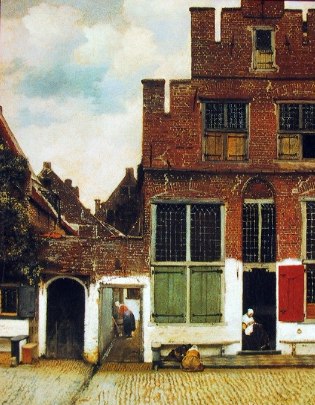
I know, prices here are not as low as in the US… we’re always paying a few dollars more in printed products. But just about $10 each, these beautiful art calendars are good buys for me. Best of all, I found all my favorite artists.  Those familiar with Ripple Effects would know.  I’ve posted on Vermeer (Dutch, 1632-75) here, Edward Hopper (US, 1882-1967) here, and images of René Magritte (Belgian, 1898-1967) here and here.  So I was really excited to be able to find big prints of their works.

VERMEER 2011


The 12 paintings are some of Vermeer’s well known works.  The cover of course is the most famous, The Girl With The Pearl Earring (1665).  If you’re interested, you might like to read my reviews of the book based on this painting and the film adaptation here.

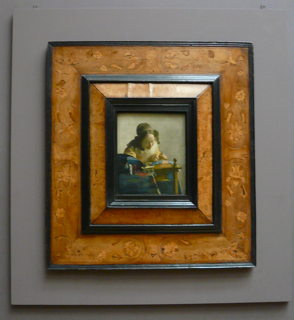
I have seen two of the paintings in the calendar, The Lacemaker (1669) and The Geographer (1668-69), both at The Louvre.  Interesting that the calendar prints are about the same size as the originals, or maybe even a tad bigger, for The Lacemaker.  Here are my photos of them hanging on the wall in the Louvre:


But the July print stands out, the only one that has an exterior view.  It’s my favorite of all the twelve months.  The Little Street (1658):


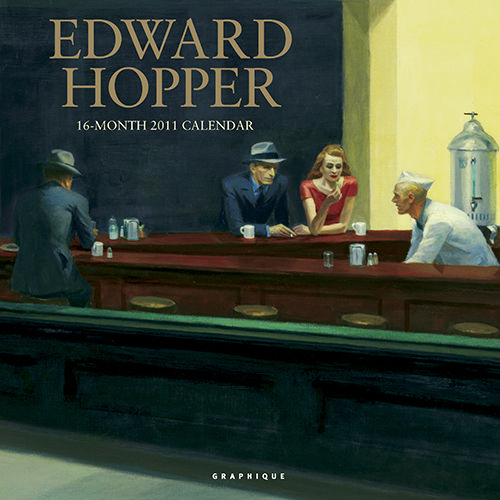
Edward Hopper 16-Month 2011 Calendar


I have 16 prints of some of my favorite Hopper paintings.  A few of them I’ve posted before, asking readers’ opinion on them. Here are a couple more that I’d like to elicit your views:

People In The Sun (1960)


Chop Suey (1929)


Magritte 2011


The cover is the Belgian artist’s work in 1953, Golconda.  Just wondering… is this the origin of the term “rain man”?  Or, are the men going up like balloons?

René Magritte was born just 16 years after Hopper, and died the same year, 1967.  So contemporaries they had been for some years, but a world of difference in terms of style.  I like the realism and existential elements hidden in Hopper’s works, but I also enjoy Magritte’s surrealist and whimsical images, openly challenging our sense of reality:

The Treachery of Images (1929)

Ceci n’est pas une pipe:  This is not a pipe.  Your take on this?


The Interpretation of Dreams (1935)


In the past years, I’ve saved up a lot of visuals just like these calendars, as teaching materials for adult ESL.  But this one definitely cannot be used for vocabulary building.  Just hang on… that may well be what Magritte is saying: ‘In a dream world, a horse can be a door, a jug a bird…’  And for that matter, how do you know you’re not dreaming right now?  Mmm… just wondering, has the movie Inception included Magritte in the credits?


***


Winter Wonderland

I caught this lone cross-country skier on a frozen creek in snow country.  Let this be my Christmas card to all:

May your Christmas be as serene and exhilarating as this magical moment.


***

And, thanks to a reader’s suggestion, may the following carol warm the winter chills and quiet the holiday frenzy.

‘In The Bleak Midwinter’


A Merry Christmas To All!

***

Photo taken by Arti of Ripple Effects, December 2010, All Rights Reserved.

Nowhere Boy (2009)

“He’s a real Nowhere Man
Sitting in his Nowhere Land
Making all his nowhere plans for nobody”

—– John Lennon’s ‘Nowhere Man’

Other than the iconic first chord of ‘A Hard Day’s Night’ at the beginning of the movie, there is no mention of The Beatles in Nowhere Boy, which is fitting.  After all, the film is not about the Beatles, but a teenaged boy by the name of John Lennon growing up aimless and angry, and how he found passion and poured his life into a goal that finally led him to become one of the most important music figures of our time.

An apt title.  Lennon had had a tumultous childhood.  Raised by his aunt Mimi since five years-old, he did not meet his birth mother again, Mimi’s younger sister Julia, until he was 15.  The film picked up from there until he went to Hamburg in 1960.  Screenwriter Matt Greenhaigh had crafted a moving relational story based on the book written by John Lennon’s half-sister, Julia Baird, entitled Imagine This: Growing Up with My Brother John Lennon.

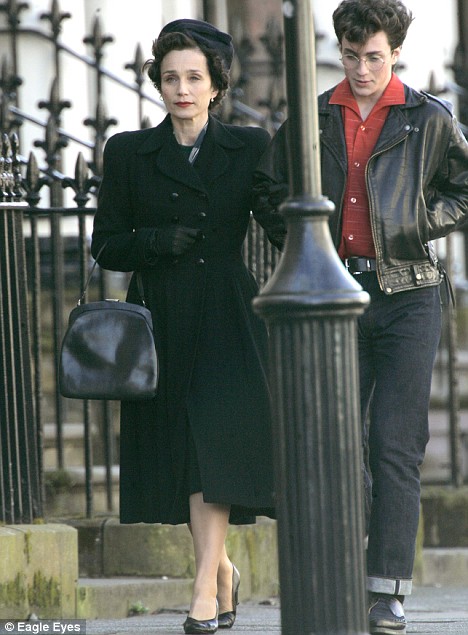
I’ve particularly enjoyed the mother-son relationship depicted so poignantly in the movie, and the tug of war between the one who has given birth to and the one who has raised the child.  For me, there is also a bit of competition, comparing the two amazing actors, Anne Marie Duff as Julia, Lennon’s birth mother, and Kristin Scott Thomas, as Aunt Mimi, who has raised the boy, stayed with him through thick and thin, and watched him emerge into a man of importance.

Everyone who watches a movie does so from his/her own frame of reference and perspective. While I’ve enjoyed the pre-Beatles era music and the early rock and roll in the film, as well as the human interest of youth striving to gain some sense of self, I’m nevertheless drawn to Scott Thomas’s role as Aunt Mimi.  She has shown what a mother is, even though she is not the one who has given birth to John.  She is someone who stays and not escapes, who takes care of daily tedium, who instills the ever unpopular notions of discipline and responsibility, and who takes nasty insults and hurting actions from a rebellious and still maturing teenager, all because of love.  Scott Thomas’s marvellous performance as the strict and stern Mimi is an effective foil against Duff’s frolicking Julia.  Both performances are moving.

Aaron Johnson has done a marvellous job in portraying a tormented soul torn between these two women. Meeting his birth mother Julia at 15, he can feel right away the thickness of blood.  On the outset, his musical talent has come from Julia, and his free spirit a natural extension of hers, yet he knows he is also tied to Mimi, and despite her restrained persona, he knows she has loved him deeply.

On his first gig as the Quarrymen, John is introduced to a fifteen year-old well-mannered teen by the name of Paul McCartney, nicely played by Thomas Brodie Sangster. Again, an effective foil between the two.  Paul is gentle, polite, chooses tea over beer, and does not have to bust and bang to release his pent-up emotions.  He also helps John with his guitar skills, teaching him more chords, and suggesting they write their own songs.  Paul definitely has it all collected under a stronger self despite the loss of his own mother just a year earlier.  Thus marks the beginning of a valuable friendship.

The fine production is significant considering it is a fact-based biopic of a period of Lennon’s life that has not been explored on film. Cinematographer Seamus McGarvey (Atonement, 2008) has crafted some colorful renditions for this period film.  The two sisters are also color-coded, Julia in red and pink, and Mimi, back and grey.  A bit too dramatic at times, but the point well taken, maybe something to do with director Sam Taylor-Wood being a visual artist before this her first feature film.  Also, some scenes may look melodramatic, but I was so immersed in the story I had thoroughly enjoyed them. The most moving scenes come at the end, and all the way through the credits.  That is when real photos and actual historical accounts are revealed, a poignant resonance to the film.

At the beginning of the end credits, we see that the film is dedicated to Anthony Minghella (1954-2008), the Oscar winning director who had brought us the The English Patient (1996), Cold Mountain (2003) and The Talented Mr. Ripley (1999), to name a few.  Minghella was instrumental in encouraging director Sam Taylor-Wood to make the transition from visual artist to filmmaker, and had worked with her on her short Love You More, which has earned her a nom for the Golden Palm at Cannes 2008.

Nowhere Boy garnered four BAFTA nominations including Outstanding British Film and Outstanding Debut Director for Sam Taylor-Wood.   Both Scott Thomas and Duff were nominated for BAFTA and The British Independent Film Awards, which Duff won, as well as the London Critics Circle Film Awards. Johnson’s impressive performance also led him to noms and wins.  Overall, a moving tribute to a pop icon and the two mother figures that had shaped his early life.

~~~ Ripples

A Late Autumn Walk

What’s more pleasurable

than a late Autumn walk in the wild

Chopin as companion, ballade cinematic

Tonal colors streamed through earbuds

Sight and sound in perfect harmony


.

Stripped of adorning leaves,

the birches displayed their true essence.

Backbones strong against the wind,

Branches lifted to reach the remaining sun

Stoic elegance intertwined Romanze Larghetto


.

.

And then we met,

A surprise encounter, a momentary start,

Among the low bushes a deer, antlers majestic,

Eyes darted up from his quiet meal,

Weighing my next move.


I walked past without stopping.

It’s not polite to stare,

especially when someone’s eating.

His gaze held me a moment, then let me pass.

I sensed a mutual respect, nature shared.


And so we parted, unperturbed,

after just a split second of cautious exchange,

leaving each other feeding freely,

foliage in his mouth,

and Chopin in my ears.


***


This is what I was listening to… Chopin Piano Concerto No. 1, Second Movement, Romanze Larghetto.

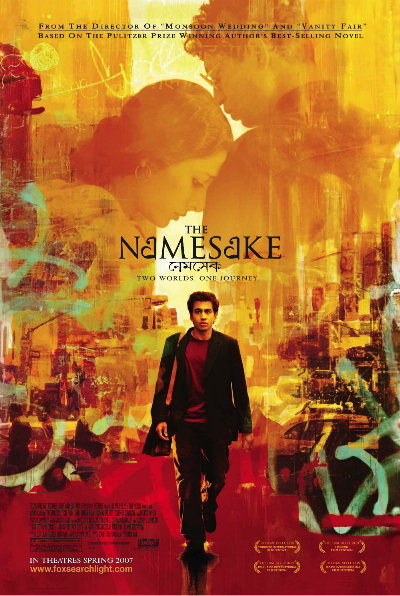
The Namesake (2006, DVD): Movie Review

This is a sequel to my last post, Book Review of The Namesake by Jhumpa Lahiri.  These back-to-back write-ups form my second instalment for the Read the Book, See the Movie Challenge over at Ready When You Are, CB.

“If it weren’t for photography, I wouldn’t be a filmmaker.  Every film I make is fuelled by photographs…. Photographs have always helped me crystallize the visual style of the film I’m about to make.”

—Mira Nair

And photography has brought to life the poignant novel The Namesake.

This is a perfect match.  The Namesake film adaptation is privileged to be crafted in the hands of the accomplished director Mira Nair, and its screenplay written by the multi-talented Sooni Taraporevala.  Both born in India the same year, grew up and educated there, later both had attended Harvard.  After earning her Masters at NYU majoring in Film Theory and Criticism, Taraporevala moved back to India and pursued a successful career in photography and other artistic endeavours. Mira Nair went on to become an acclaimed filmmaker and professor of Film at Columbia University.  Nair and Taraporevala collaborated on several films that have garnered international nominations and awards, including Cannes, Venice, BAFTA, and the Oscars.

The pair could have been characters taken right out of Jhumpa Lahiri’s stories.  They must have known from personal experience the realities of Lahiri’s stories, the feelings of being transplanted, the quest for identity.  As a result, they have effectively brought into visualization the internal worlds of Ashoke, Ashima, Gogol and Moushumi.  It is interesting to hear Nair describe herself as “a person who lives in many worlds”.  Every immigrant is at least a bicultural being.  Our postmodern world has only made it more and more viable to navigate across boundaries and sustain multiple identities.  The Indian meaning of the name Ashima could well have spoken to such a modern day phenomenon: without borders.

From this perspective, Nair is the best person then to take what could have been just another “ethnic movie” to a universal plane.  She has created a colorful rendition of a human story for us to enjoy.  You don’t have to be Bengali to appreciate the Ganguli saga.  Elements such as love, marriage, parent-child relation, expectations, self-fulfilment and its obstacles, the search for one’s place in the family and the world, these are all situations we can relate to.   It’s just now the issues have been explored from a different frame, offering us an alternative perspective.

I have appreciated the quiet development of love between Ashoke and Ashima despite their arranged marriage.  Their intimate husband and wife relationship is sensitively played by Irrfan Khan (Slumdog Millionaire, 2008) and the model and award-winning actress Tabu, an excellent choice in casting.  I particularly admire Tabu’s gentle and elegant poise.  It’s interesting to see how the two exchange deep sentiments by wordless, nuanced expressions and body language.

The treatment of the story in the hands of a visual artist understandably would be quite different from its original literary form.  Instead of the sombre tone, Nair has given the story a lively adornment, sustained by animated characters.  Nair’s Gogol is a more outgoing young man than that from the book, and I’m fine with that.  Kudos to Kal Penn’s portrayal of  Gogol/Nick Ganguli, an interesting performance fusing youthful energy and wistfulness at the same time.

Yes, that’s Kal Penn of the stoner movies Harold and Kumar fame (2004, 2008, and coming 2011) A much more serious role here in The Namesake.  A lively Gogol is only natural and fun to watch, for he is an American born young man who just wants to belong.  So we see him being impatient with his father’s restrained and non-communicable composure, we see him playing air guitar to loud music in his room, we see tender moments when he teases his younger sister Sonia, or the natural comedic look on his face, culture shocked during his family trip back to Calcutta, and we see his romance with Maxine (Jacinda Barrett, New York, I Love You, 2009), the American girl who is so oblivious to the cultural baggage he is carrying.

But Kal Penn has earned his role.  He wrote to Nair earnestly seeking for the part, telling her that The Namesake is his favorite book and often times, he would use the pseudonym Gogol Ganguli to check in hotels.  Some method acting, who’d have known he’s in character all along.

The bonus with watching a DVD is of course the special features.  The Namesake is a keeper if you’re into the creative process of filmmaking.  My favorite featurette is The Anatomy of The Namesake: A Class at Columbia University’s Graduate Film School in which Nair and other crew members engage in conversation with film students about the making of the movie.  Other wonderful featurettes include Photography as Inspiration, and Fox Movie Channel interview In Character with Kal Penn.

Overall, a faithful adaptation of Lahiri’s book, offering an entertaining, visually inspiring rendition of a story deserving to be seen.

~ ~ ~ Ripples

Another Year (2010)

Update Feb. 10: Leslie Manville just won British Actress of the Year at the London Film Critics’ Circle Awards.

Update Jan. 25: Mike Leigh is nominated for an Oscar for Original Screenplay.

Update Jan. 18: Another Year is nominated for a BAFTA for Outstanding British Film of the Year, and Leslie Manville for Best Supporting Actress.

“Ah, look at all the lonely people.”

— ‘Eleanor Rigby’

Every DayAnother Year, film titles like these evoke the oblivious passage of time, and the human experiences that float down the stream of life. The kind of films we would find in art-house cinemas, not your fast-paced action or effects-generated spectacle.  Another Year would gratify one’s need for slow ruminations and offer one time to savour the dynamics among characters.  The film was on my ‘must-see’ list at the Calgary International Film Festival 2010, which ended last weekend.  It had met all my expectations and offered more.

What’s more is the excellent performance from a high calibre cast of British actors.  Their nuanced portrayals of characters convey emotions unabashedly, but in a deep, restrained and unsentimental manner.  That is what makes Another Year so satisfying.  I enjoyed it much more than director Mike Leigh’s previous title, equally acclaimed Happy-Go-Lucky (2008), in which Poppy (Sally Hawkins) the happy gal is just a bit too loud and even obnoxious for me.  While here in Another Year, Tom and Gerri are the happy couple whose relationship is one of mature, quiet and gentle bliss, compassionate towards themselves and others.

Framed in the passing of the four seasons, the film explores the realities of life: ageing, loneliness, death, love, marriage, friendship… Yet the occasional animated and humorous renderings of the characters allow a lighter way of handling the subject matters.

Gerri (Ruth Sheen) and Tom (Jim Broadbent) are a happily married couple living in London.  In the midst of the bustling city, they have their own plot of land close by their home where they work hard to grow vegetables. They bring home fresh produce to cook healthy meals and entertain guests.  Their vegetable garden is an apt metaphor for the love they cultivate in their relationship despite the busyness of everyday life. Tom is a geologist and Gerri a counsellor in a medical office. If there’s any pun intended here with their names, it would be for the very opposite effect that they are a harmonious pair whose relationship has attracted those less happy to cling on for stability and support.

Their usual dinner guest is Gerri’s office administrator Mary (Lesley Manville).  A single, middle-aged woman, emotionally fragile, alcohol dependent, and desperately seeking love and companionship. Her male version is Tom’s long time friend Ken (Peter Wight), equally miserable. A heavy smoker and drinker, Ken’s physical health mirrors his emotional state.

But why Tom and Gerri gather such damaged and dependent friends the film does not explain.  What we do see is a most gracious couple extending their lives to them. Through their interactions, we see the contrast. While we admire the almost perfect marriage, we ache for the singles, sad and lonely… as we see them in this film.  I trust the director is making a specific rendering and not a generalization on singlehood.  The contented Poppy (Sally Hawkins) in Happy-Go-Lucky (2008) is the best spokesperson for the single league.

Tom and Gerri have an adult son Carl (Martin Savage) who frequently comes home to visit his parents from a nearby town by train. When I saw the shot of a commuter train going past on screen, it flashed upon my mind the image in Ozu’s works.  That is one of the Japanese director’s signature shots, a train passing through, and his favourite subjects also being family, marriage, nuanced interactions.  I thought, if Ozu were an Englishman living today, this would be the kind of films he would make.  And lo and behold, I found this tidbit of trivia on IMDb: One of Mike Leigh’s top 10 films of all time is Tokyo Story (1953).

If one is to find fault with Another Year, it could be the very fact that Tom and Gerri’s marriage is just too perfect. But with all the ubiquitous dysfunctional families we see represented in movies nowadays, Leigh might have opened a window to let in some much needed fresh air. Tom and Gerri make an ideal contrast to what we have so sadly gotten used to seeing in films.

There are excellent performances from the veteran actors, but one stands out. Lesley Manville’s animated portrayal of the vulnerable Mary deserves an Oscar nomination. The most impressive shot comes at the end. Without giving it away, let me just say the ending shot lingering on her face and the ultimate fade to black is poignant and most effective. Of course, it’s acceptable to applaud after a festival screening. And so we did, appreciatively, a much needed channel for a cathartic response.

~ ~ ~ 1/2 Ripples