Another Year (2010)

Update Feb. 10: Leslie Manville just won British Actress of the Year at the London Film Critics’ Circle Awards.

Update Jan. 25: Mike Leigh is nominated for an Oscar for Original Screenplay.

Update Jan. 18: Another Year is nominated for a BAFTA for Outstanding British Film of the Year, and Leslie Manville for Best Supporting Actress.

“Ah, look at all the lonely people.”

— ‘Eleanor Rigby’

Every DayAnother Year, film titles like these evoke the oblivious passage of time, and the human experiences that float down the stream of life. The kind of films we would find in art-house cinemas, not your fast-paced action or effects-generated spectacle.  Another Year would gratify one’s need for slow ruminations and offer one time to savour the dynamics among characters.  The film was on my ‘must-see’ list at the Calgary International Film Festival 2010, which ended last weekend.  It had met all my expectations and offered more.

What’s more is the excellent performance from a high calibre cast of British actors.  Their nuanced portrayals of characters convey emotions unabashedly, but in a deep, restrained and unsentimental manner.  That is what makes Another Year so satisfying.  I enjoyed it much more than director Mike Leigh’s previous title, equally acclaimed Happy-Go-Lucky (2008), in which Poppy (Sally Hawkins) the happy gal is just a bit too loud and even obnoxious for me.  While here in Another Year, Tom and Gerri are the happy couple whose relationship is one of mature, quiet and gentle bliss, compassionate towards themselves and others.

Framed in the passing of the four seasons, the film explores the realities of life: ageing, loneliness, death, love, marriage, friendship… Yet the occasional animated and humorous renderings of the characters allow a lighter way of handling the subject matters.

Gerri (Ruth Sheen) and Tom (Jim Broadbent) are a happily married couple living in London.  In the midst of the bustling city, they have their own plot of land close by their home where they work hard to grow vegetables. They bring home fresh produce to cook healthy meals and entertain guests.  Their vegetable garden is an apt metaphor for the love they cultivate in their relationship despite the busyness of everyday life. Tom is a geologist and Gerri a counsellor in a medical office. If there’s any pun intended here with their names, it would be for the very opposite effect that they are a harmonious pair whose relationship has attracted those less happy to cling on for stability and support.

Their usual dinner guest is Gerri’s office administrator Mary (Lesley Manville).  A single, middle-aged woman, emotionally fragile, alcohol dependent, and desperately seeking love and companionship. Her male version is Tom’s long time friend Ken (Peter Wight), equally miserable. A heavy smoker and drinker, Ken’s physical health mirrors his emotional state.

But why Tom and Gerri gather such damaged and dependent friends the film does not explain.  What we do see is a most gracious couple extending their lives to them. Through their interactions, we see the contrast. While we admire the almost perfect marriage, we ache for the singles, sad and lonely… as we see them in this film.  I trust the director is making a specific rendering and not a generalization on singlehood.  The contented Poppy (Sally Hawkins) in Happy-Go-Lucky (2008) is the best spokesperson for the single league.

Tom and Gerri have an adult son Carl (Martin Savage) who frequently comes home to visit his parents from a nearby town by train. When I saw the shot of a commuter train going past on screen, it flashed upon my mind the image in Ozu’s works.  That is one of the Japanese director’s signature shots, a train passing through, and his favourite subjects also being family, marriage, nuanced interactions.  I thought, if Ozu were an Englishman living today, this would be the kind of films he would make.  And lo and behold, I found this tidbit of trivia on IMDb: One of Mike Leigh’s top 10 films of all time is Tokyo Story (1953).

If one is to find fault with Another Year, it could be the very fact that Tom and Gerri’s marriage is just too perfect. But with all the ubiquitous dysfunctional families we see represented in movies nowadays, Leigh might have opened a window to let in some much needed fresh air. Tom and Gerri make an ideal contrast to what we have so sadly gotten used to seeing in films.

There are excellent performances from the veteran actors, but one stands out. Lesley Manville’s animated portrayal of the vulnerable Mary deserves an Oscar nomination. The most impressive shot comes at the end. Without giving it away, let me just say the ending shot lingering on her face and the ultimate fade to black is poignant and most effective. Of course, it’s acceptable to applaud after a festival screening. And so we did, appreciatively, a much needed channel for a cathartic response.

~ ~ ~ 1/2 Ripples
Arles: In The Steps of Van Gogh

Solution to Arti’s Cryptic Challenge #4: Arles

While Paris has her cultured beauty and sophistication, I’d appreciated the change of scenery and warmer weather as I headed south to Provence.  Three hours via the TGV took us to the historic City of Avignon, site of the Papal Palace before the Vatican. We stayed in Avignon for three days, taking daily excursions out to nearby towns.  Arles was a must-see on my list.

Van Gogh moved to Arles from Paris in 1888, seeking the tranquility that was so elusive to him in the big city.  In his letter to his brother Theo upon arrival to Arles, he wrote:

It seems to me almost impossible to be able to work in Paris, unless you have a refuge in which to recover and regain your peace of mind and self-composure. Without that, you’d be bound to get utterly numbed.”    — Tuesday, Feb. 21, 1888.

The fresher and more colourful palette is apparent during this most prolific period of the artist’s life.  Bright yellows, blues, shorter and swirling brush strokes established his signature style.  As for me, I was a bit disappointed to see the sunflowers have already withered in late August.  Fields of yellow were now massive brown.  They would be harvested at a later time for their oil, a good reminder that, for tourists, it’s the view, but for those living here, it’s their livelihood.  The lavenders on the Luberon mountains too had long passed the season.  Note to myself:  Early to Mid July is best if I ever come this way again.

But all was not lost.  I was gratified to follow some of Van Gogh’s footsteps as I explored the clearly posted Van Gogh sites in the town, the scenes and locales where the artist so vividly captured in his paintings.

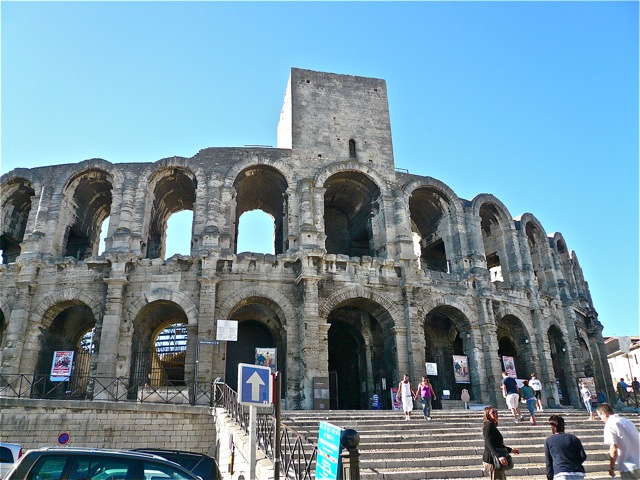
Arles is a Roman town.  What more prominent to reflect its past glory than the Roman Arena in the town centre.  Why all the arches?  The free flow of pedestrian traffic.  The full seating capacity, 20,000 people, could exit the Arena in 7 minutes.

.

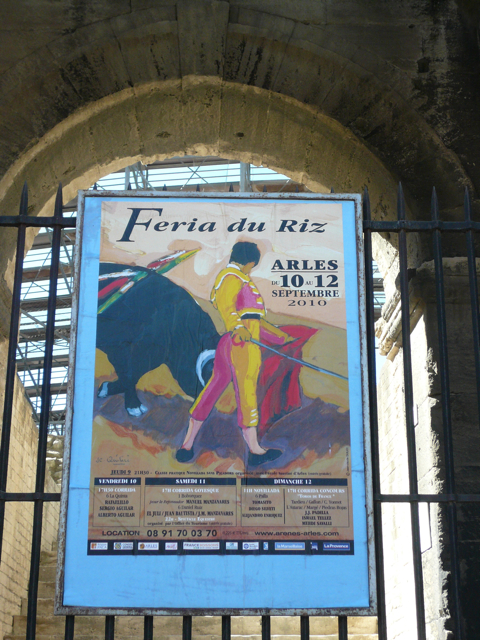
Used by gladiators in ancient time, the Arena is still the venue for bullfights:

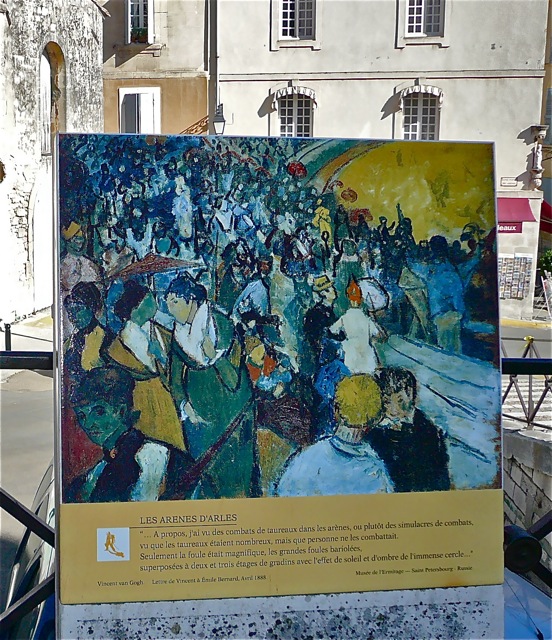
But Van Gogh’s interest was not so much on the violent action of bullfighting than on the people, as his painting Spectators In The Arena At Arles (December, 1888) clearly shows:

The Café Terrace on the Place du Forum was his hang-out, renamed Café Van Gogh now.  The yellow building upon the backdrop of the blue, starry night had deeply inspired the artist:

Café Terrace At Night (September, 1888):

Van Gogh had wanted to make Arles a hub for fellow artists.  Upon his urging, Gauguin came to join him in October, 1888.  The two painters frequented the Café Terrace many a night but only for two short months.  What happened on December 23rd was reported by the local paper the next day:

At 11:30 pm., Vincent Vaugogh [sic], painter from Holland, appeared at the brothel at no. 1, asked for Rachel, and gave her his cut-off earlobe, saying, ‘Treasure this precious object.’  Then he vanished.[1]

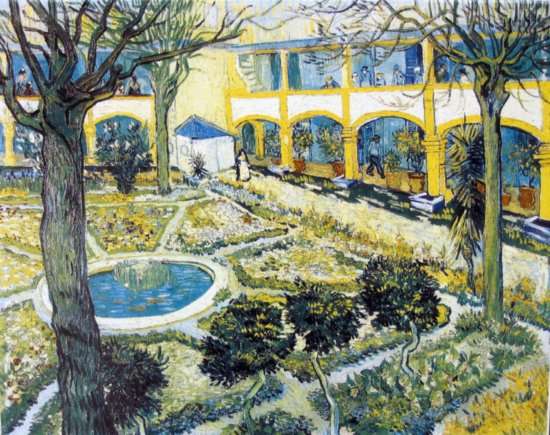
After this incident, Van Gogh was admitted to a local hospital, now the Espace Van Gogh in Arles, a cultural centre:

In January, 1889, Van Gogh returned home to the Yellow House, but for the next few months, suffered onslaughts of hallucinations and delusions. His view of his own condition nevertheless was lucid and even progressive for his time.  His letter to Theo is poignant, as he openly faced his predicament and earnestly sought a solution:

And for the time being I wish to remain confined, as much for my own tranquillity as for that of others.

What consoles me a little is that I’m beginning to consider madness as an illness like any other and accept the thing as it is, while during the actual crises it seemed to me that everything I was imagining was reality.”

— Sunday, April 21, 1889.

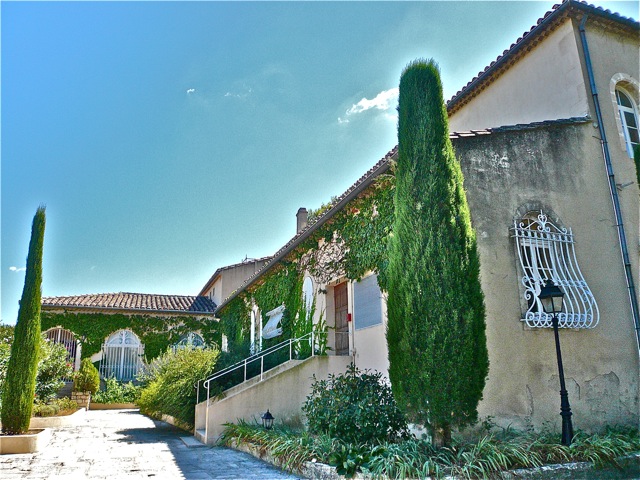
On May 8, 1889, he checked himself into the Saint Paul de Mausole, the mental hospital at St-Rémy-de-Provence.  Under the care of his doctor Théophile Peyron, the artist’s condition improved and he thrived in the idyllic environment there.  Art therapy had brought healing and prolific output.  Van Gogh stayed there for a year and created more than 150 paintings.

Dr. Théophile Peyron out at the front garden:

.

The olive grove outside St. Paul hospital:

.

To his brother Theo, he wrote on Sunday, May 11, 1890:

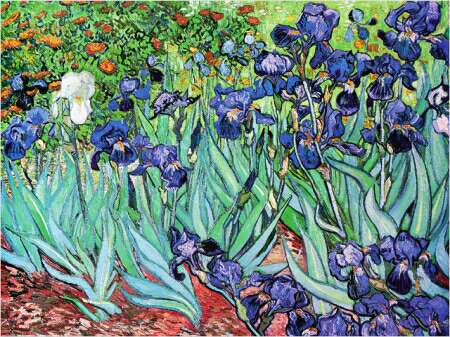
At the moment the improvement is continuing, the whole horrible crisis has disappeared like a thunderstorm, and I’m working here with calm, unremitting ardour to give a last stroke of the brush.  I’m working on a canvas of roses on bright green background and two canvases of large bouquets of violet Irises…

My Van Gogh trip ended at St. Rémy, and so be it.  I’ve seen the sites wherein the artist was at his most prolific.  I’ve seen the town and surroundings where he found inspiration.  I’ve seen his final solace where he attained some stability and painted with passion.  I’d like to keep these as memories of my travel to Provence.  I could hardly bear to think of his last days, discharged from St. Rémy just a few days after the above letter, headed north to Auvers-sur-Oise on the outskirt of Paris, and in just two short months, succumbed to the recurrence of his illness. He shot himself in the chest with a revolver on July 27, 1890, and died of his wound two days later.

Back to the thoughts I wrote about in my last post: How do we keep art from turning into a cliché?  I think it takes a certain awareness of the artist as a person, plus a measure of empathy and respect for the struggle to live and create… and realizing that the beautiful works are often triumphs in spite of life’s overwhelming adversities, rather than the natural products of bliss and fortune.

To wrap up my travel posts, and taking the risk of turning it into a cliché albeit my motive is pure, here’s the YouTube clip again, Don McLean’s tribute to Vincent:

Some Van Gogh links:

An excellent and comprehensive site for Van Gogh’s letters, 900 of them, poignant account of his life.

The Van Gogh Museum, Amsterdam

Van Gogh Gallery online

Wikipedia: Vincent Van Gogh

***

[1]  Rick Steves’ Provence and French Riviera 2010, published by Avalon Travel, p. 69.

Art and Cliché

My musing on high art and popular culture earlier in my trip came to a new twist as I visited the Louvre. I just couldn’t help but wonder: Can art be too popular? When does art turn from a form of aesthetics into a subject of parody? Will mass popularity reduce an objet d’art into a cultural cliché?

Here’s what prompted my query:

.

Even more fascinating is this view twenty feet away:

.

And in comparison, here’s another gallery in the Louvre displaying lesser known works:

.

.

When does art become a cliché?  In our case, the Mona Lisa…

When you see her in comics, or paint-by-number sets in dollar stores, or morph into Alfred E. Neuman on Mad Magazine’s cover, or into Monica Lewinsky on the New Yorker, or find her on The Far Side Gallery, or in The Simpsons, or a Pantene commercial showing off her revitalized curly hair, or when you find 450 parodies of her image on a single website. According to an image tracking source, the Mona Lisa is the most used and abused image in advertising.

I know, other artists had created altered versions of Mona Lisa from early on. Eugene Bataille (Sapeck) painted her smoking a pipe, Marcel Duchamp added a moustache and goatee, Salvadore Dali fused himself into her image.

Poor girl, she didn’t even know what hit her, or how her one time, private sitting for da Vinci had generated so many imaginative renditions centuries down the road, as people are still using, or abusing, her image for private gains. She should have bargained for residual payments.

Are we more comfortable now that the barrier of ‘high art’ has been broken?  Are we enjoying the legacy and freedom the Dada Movement and the Surrealists had claimed for us?  I must declare outright, I’m not particularly a fan of the Mona Lisa, but I’m just a bit annoyed seeing other similar misuse, like Michelangelo’s David in boxers, or Venus de Milo wearing sunglasses.

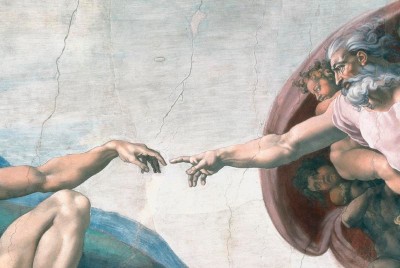
Other vulnerable examples are not hard to find. Think of this magnificent piece of painting in the Sistine Chapel… another easy target for cliché and parody:

Or this self portrait of a tormented soul:

.

Or take these beginning haunting notes from a brilliant symphony, they have become an expression of suspense not much deeper than the tune in Final Jeopardy:

.

The opening chorus of this masterpiece has now been reduced to a punctuation mark in our vernacular, an exclamation used for scenarios from finding your lost keys to losing 10 pounds:

Isn’t the advertising industry supposed to be the flagship of creativity?  And, when it comes to the creative process, aren’t we supposed to flee from clichés and produce fresh expressions? Isn’t originality a goal to strive for anymore? Or, has parody become the new genre and proof of ingenuity in our time?

And I’m just too tired to go into all the zombie and vampire versions of Jane Austen’s novels…

Pussywillows, Cattails, Soft Winds and Roses

Took a short trip to Ontario last week and came home overwhelmed with nostalgia.  It all started when I visited the town of Unionville and saw these, crowds and crowds of cattails growing profusely in the pond, the fields, by the footbridge:

.

For some inexplicable reasons, I’m much fond of cattails. The first time I learned about them was from listening to the song by Gordon Lightfoot… before I’d actually seen one.

Some time in the 70’s, for many afternoons I sat in the art room of a high school somewhere in Alberta, working on some art project, but mostly doing nothing at all while listening to Gordon Lightfoot.  Mr. Hannington held a laissez faire art class… we could do just about anything, or nothing.  Usually, there would only be three or four of us in the room.  We would just sit around, chat, daydream, and immerse in the voice of Gordon Lightfoot on the radio.

I didn’t turn out to be an artist, while one of us did.  But I’ve remained partial to cattails, mesmerized by the song and the singer.  Those Lightfoot afternoons in the art room emerged from the depth of hazy memories, the lyrics were the soft winds caressing naked limbs as I walked in this natural reserve in Unionville.

Pussywillows, cat-tails, soft winds and roses
Rainpools in the woodland, water to my knees
Shivering, quivering, the warm breath of spring
Pussywillows, cat-tails, soft winds and roses

Catbirds and cornfields, daydreams together
Riding on the roadside the dust gets in your eyes
Reveling, disheveling the summer nights can bring
Pussywillows, cat-tails, soft winds and roses

Slanted rays and colored days, stark blue horizons
Naked limbs and wheatbins, hazy afternoons
Voicing, rejoicing the wine cups do bring
Pussywillows, cat-tails, soft winds and roses

Harsh nights and candlelights, woodfires a blazin’
Soft lips and fingertips resting in my soul
Treasuring, remembering, the promise of spring
Pussywillows, cat-tails, soft winds and roses

(To my artist friend CD: Keep the fire burning.)

***

Summertime… and the reading is easy

.

Since my TBR booklist has evolved into one gigantic beast preying to devour my fragile conscience, I’m feeling the burden of possession with every single book I acquire, be it only $1.50 or even free.  While summer has officially slipped in, with all its alluring promises and freeing energy, I feel it’s time to confront the beast and with one resolve, slay it.

So, may I present herewith Arti’s Declaration of Independent Reading. It may not be self-evident to all that there exist certain unalienable rights for us book lovers yearning for emancipation.  Allow me to use the collective pronoun here as I feel I just might not be the only one.  Therefore, all ye under the bondage of your TBR beast, here are our claims:

  1. Nonobligatory reading.  Reading for the simple joy of the act, and not for any courses, profs, teachers, groups, bloggers or to appease that monstrous beast.  We might have book challenges to meet, but they are our own choosing.  Even if we have miles to go before we sleep, we go the miles to honor our own quest.

  2. We hold the right to buy and not read, just for the satisfaction of owning a title. We deserve to be recognized for our contribution to the economy and the publishing industry.  By our perpetual purchasing, we are supporting local and national businesses and the livelihood of many workers.

  3. Freedom to follow our hearts in our book selections, and not the New York Times bestseller lists, Amazon’s recommendations, or Oprah’s earnest plea.  No need to follow trends or don literary fashion.  No need to challenge those titles simply because we are told to read before we die.  Literary and the not-so-literary, classics or contemporary, all to our heart’s content.

  4. Smorgasbord Reading.  Our right to have more than one item on our plate, our right to read more than one book at a time.  Fiction, non-fiction, bios or poetry, whatever that suits our palate at the moment.

  5. Not to be discriminated against.   As bookaholics, we will resist any attempt to be added to the pathological list of substance abuse, addictions, or to be forcefully admitted into any 12-step programs or obsessive-compulsive behavior therapy.

  6. In the spirit of slow blogging, we hold the right to read slowly, to mull and chew, at our own pace without having to meet any quotas, numbers, or deadlines. Further, we have the right to reread a book or an author as many times as we want, and not be labelled as subversive, fanatics or cultic.

  7. We have the liberty to stop reading, throw a book out the window, or honestly declare our dislike, if that’s our view.  With this right, we keep our sanity intact, our discernment sharpened, our intelligence preserved.

***

There.  Now that’s off my chest, let me get back to my reading… or not.

oooh, summertime…

.

Photos by Arti of Ripple Effects, June, 2010.  ALL RIGHTS RESERVED.

***

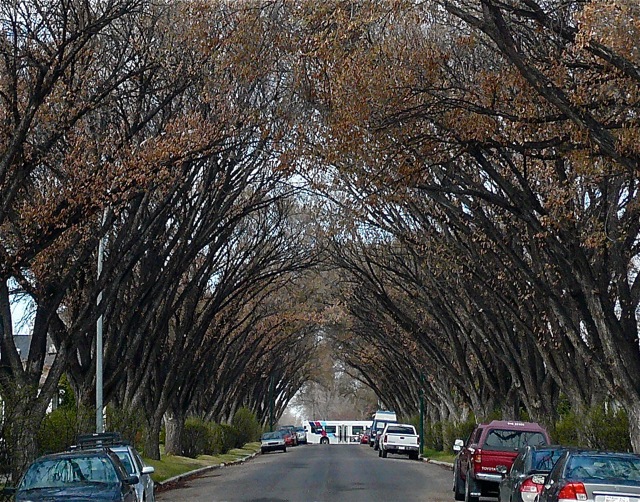
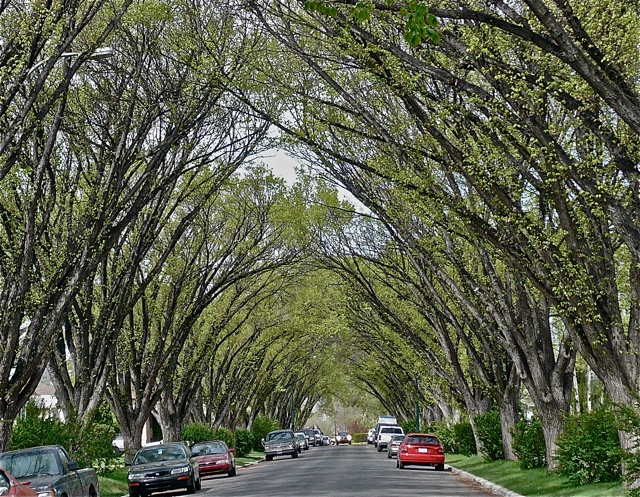
Greening of a Calgary Street

April 23

.

May 23

.

June 23

.

Waiting

He could have said
Let there be life
As in the beginning
But He made me wait.
For three months
I went back to the same spot
and watched
slowly
green bursting out from bare branches
fighting storms and snow
into full bloom.

.

I had waited before
Nine years, nine months
He could have said
Let there be…
But He had made me wait
and watch
slowly
like time-lapse photography
the gestation of a miracle.
He could have just said,
But He made me wait
and watch.

***

Pictures and poem by Arti of Ripple Effects, June 2010.  ALL RIGHTS RESERVED.

Top 20 Under 40

The New Yorker has released the anticipated list of top 20 fiction writers under 40, kicking off their summer fiction issue. It’s been eleven years now since the last list.

I’ve no trouble with the number 20, but I admit the number 40 does pose a problem.  If these figures represent the ‘defining voices’ of contemporary fiction, the stars to watch, is there still a future for those who by chance happen to be on the other side of that magic number?

Why should age be a demarkation when it comes to creative writing?  And, why 40? Why not 32 or 46?  It sounds arbitrary doesn’t it.  I know, we’re a lists-obsessed people.  Even the New Yorker editors admit that.  It’s funny that they seem to justify their act by citing The Ten Commandments, the twelve disciples, the seven deadly sins, the Fantastic Four.  Wow, do we ever need to elevate literary stardom to epic proportion… we have fierce competitions in 3-D movies, ‘Dancing with the Stars” and interactive video games, just to name a few.

Writers on their previous list include Jonathan Franzen, Jhumpa Lahiri, Michael Chabon and David Foster Wallace.  So, it’s a highly anticipated star roster.   As well, other magazines have published similar recognition.  Granta has its “Top 21 Under 35” twice a few years ago.  Sounds like a well-established marketing strategy.

Fine.  That is certainly understandable in a time when so many alternatives are competing with reading a short story or a novel. But still, the number 40 troubles me.  My sympathy goes to those who are no less promising but alas, have shot further than the 40 mark.  Without being recognized as ‘young’ anymore, will they still have a future?  Further, is there hope for those who might choose to pursue a passion that comes late in life?  I can see the futility if that dream is to be a concert pianist if one hadn’t taken up the instrument by the ripe old age of 12.  But, what about writing?  Is starting at 40, or 50, or even 60 too late?  Is the term ‘late bloomer’ a misguided notion offering false hope?

**

Oh… the promise and glamour of youth.  And woe to us who are beyond rescue in a society that’s obsessed with popularity and rankings, youthful looks and prodigious fame.

To soothe the wounded spirit, and keep the creative fire burning, Ripple Effects would like to propose the following iconoclastic list in this day ruled by ageism:

  • Top 50 over 53:  To honor the best 50 unpublished writers over 53
  • Top 100 under 67:  To seek out the best 100 blog writers under 67 in lieu of being published in the real world.  Why 100?  I’m sure this is just a minuscule sample of the tens of thousands possible candidates out there in the blogosphere.
  • Top 15 over 74:  To encourage the best 15 yet-to-be literary stars over 74, just to give hope to those still pursuing their life-long dream.
  • Top 3 over 82:  To celebrate the late-bloomers who have finally made it, actually publishing their debut novel after 82.  Why 3?  That’s obvious.

Sour grape?  No, that would be immature.  Let’s just say, virtual tasting of the elusive grape.  Never underestimate the power of hope and the freedom of casting aside the burden of age.

.

You can still see the ripples at eventide.   — Arti
.

***

Photo taken by Arti at The Inside Passage to Alaska,  September, 2009.  ALL RIGHTS RESERVED.

That Was Then… This Is Now

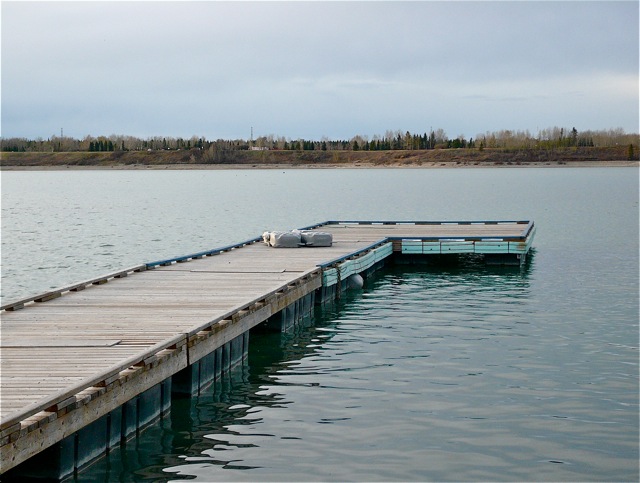
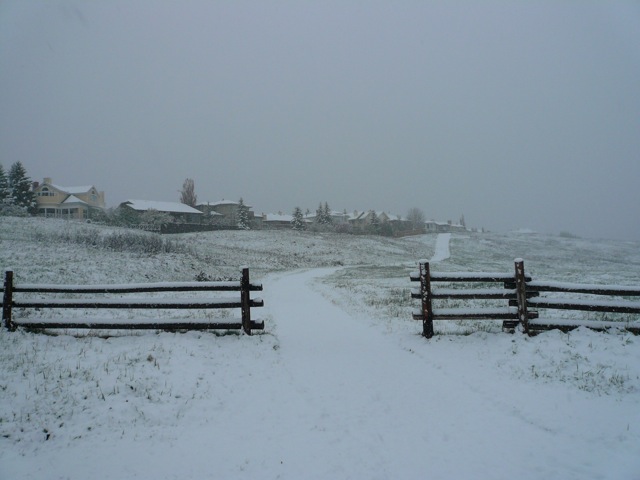
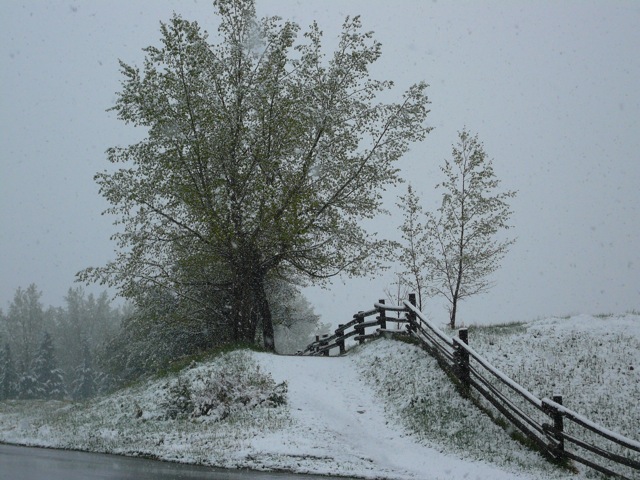
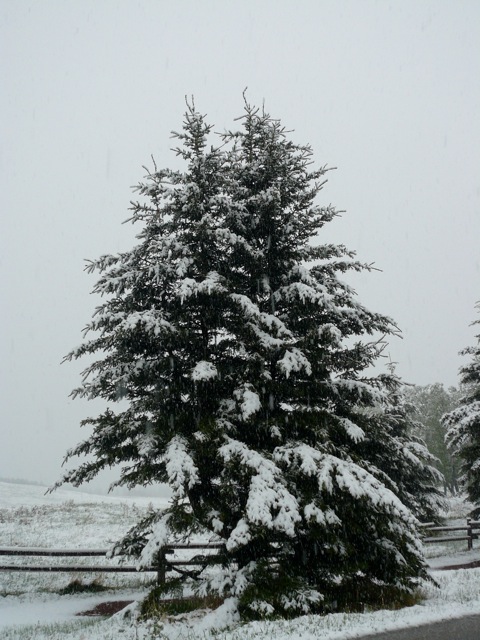
Just three days ago I was walking along The Bow River, enjoying the brilliant double-digit temperature.  Today is quite a different picture.  These are photos I took just a couple of hours ago, temperature hovering around 3 degrees C.  They were taken not too far from the deer sighting location on Mother’s Day. But today, May 27, three days after Victoria Day, the scene is another world.

As one who tries to preserve the most natural and authentic images, I’ve left the photos as they are, no adjustment, not even cropping here.  I like the blurry overtone, their lack of colors, for in reality, it was snowing heavily and the sky was grey.  I’d enjoyed this impromptu photo session.  I came home soaking wet.

But all this time I’ve been thinking about the oil spill down in the Mexican Gulf coast.  It’s one thing about snow in May for us, or even in July, or baseball-size hail in August, or the fierce blizzards in the winter, these we’ve learned to take as they come, knowing they’re ‘act of God’.

But, if something happens due to human errors or negligence, or which is preventable if more caution was paid, or less greed was involved, or political interests were laid aside, or more value placed on life, human or nature, then it’s a different matter.  Such are the times when we can’t be docilely yielding, as to a sovereign deity. Drastic measures are definitely needed in a time such as this.

No doubt, these pictures are thousands of miles from the Gulf coast, a huge gap in climate, a drastic difference in natural habitat.  Nonetheless, the air that once was in Chernobyl would ultimately reach us just the same as the tides from the tsunami of the Indian Ocean.  We’re shrouded by the same atmosphere; we’re linked by the same waters.  So, your pelican is also my pelican, likewise, my deer, your deer.

.

.

.

.

.

All photos taken by Arti of Ripple Effects, May 27, 2010.  ALL RIGHTS RESERVED.

****

Notes on the Synthesis of Film, Art… Life?

Recently I’ve just finished reading Paul Schrader’s Transcendental Style in Film: Ozu, Bresson, Dreyer (1972).  Yes, that’s before Schrader rose to prominence as a screenwriter and filmmaker. Is such a book a bit dated?  Considering the techno-reigning world we’re living in now, where speed is measured by nanoseconds, and where 3D and CGI have become the necessary features for movies to generate sales, I think we need to read this all the more.

The three directors in the book had produced some of the best movies of all time. Since I have not seen all the films Schrader discusses, I might not have grasped as fully his arguments and illustrations as they deserve. And I admit I do not embrace unquestionably all those that I do get. Nevertheless, there are many, many parts that I want to record down. I’d consider them crucial elements to mull over during the creative process in just about anything. I’ve listed some of these fine quotes in the following.

They all point to the axiom of ‘less is more’, the value of stillness and simplicity, the speechless sketch that speaks volumes, the importance of being over doing, the quality of sparseness over abundance, the bare essence of life.

Notes to myself: when watching, writing, reading, doing, or just plain walking down the mundane path of everyday, keep these points in mind.

  • Ozu’s camera is always at the level of a person seated in traditional fashion on the tatami, about three feet above the ground. “This traditional view is the view in repose, commanding a very limited field of vision. It is the attitude for watching, for listening, it is the position from which one sees the Noh… It is the aesthetic attitude; it is the passive attitude.”[1]
  • Ozu chose his actors not for their “star” quality or acting skill, but for their “essential” quality. “In casting it is not a matter of skilfulness or lack of skill an actor has. It is what he is…”
  • “Pictures with obvious plots bore me now,” Ozu told Richie. “Naturally, a film must have some kind of structure or else it is not a film, but I feel that a picture isn’t good if it has too much drama or action… I want to portray a man’s character by eliminating all the dramatic devices. I want to make people feel what life is like without delineating all the dramatic up’s and downs.”
    .
  • His films are characterized by “an abstentious rigor, a concern for brevity and economy, an aspiring to the ultimate in limitation.”
  • Given a selection of inflections, the choice is monotone; a choice of sounds, the choice is silence; a selection of actions, the choice is stillness–there is no question of “reality”. It is obvious why a transcendental artist in cinema (the “realistic” medium) would choose such a representation of life: it prepares reality for the intrusion of the Transcendent…
  • “The opening five shots of An Autumn Afternoon: The everyday celebrates the bare threshold of existence; it meticulously sets up the straw man of day-to-day reality.”
  • In films of transcendental style, irony is the temporary solution to living in a schizoid world. The principal characters take an attitude of detached awareness, find humor in the bad as well as the good, passing judgment on nothing.

***

.

  • Like Ozu, Bresson has an antipathy toward plot: “I try more and more in my films to suppress what people call plot. Plot is a novelist’s trick.”
  • As far as I can I eliminate anything which may distract from the interior drama. For me, the cinema is an exploration within. Within the mind, the cinema can do anything.”
  • On the surface there would seem little to link Ozu and Bresson… But their common desire to express the Transcendent on film made that link crucial… Transcendental style can express the endemic metaphors of each culture: it is like the mountain which is a mountain, doesn’t seem to be a mountain, then is a mountain again.
    .
  • The abundant means sustain the viewer’s (or reader’s or listener’s) physical existence, that is, they maintain his interest; the sparse means, meanwhile, elevate his soul.  The abundant means are sensual, emotional, humanistic, individualistic. They are characterized by realistic portraiture, three-dimensionality…
    .
  • The “religious” film, either of the “spectacular” or “inspirational” variety, provides the most common example of the overuse of the abundant artistic means… the abundant means are indeed tempting to a filmmaker, especially if he is bent on proselytizing. (Now… why am I thinking of Avatar?)
  • The transcendental style in films is unified with the transcendental style in any art, mosaics, painting, flower-arranging, tea ceremony, liturgy.  At this point the function of religious art is complete; it may now fade back into experience. The wind blows where it will;  it doesn’t matter once all is grace.

***

Transcendental Style In Film: Ozu, Bresson, Dreyer, published by University of California Press, 1972. 194 pages.

[1] Schrader quoting Donald Richie, “The Later Films of Yasujiro Ozu,” Film Quarterly, 13 (Fall 1959), p. 21.
The following three quotes are from the same source.

.

Some informative links:

Paul Schrader http://www.paulschrader.org/, http://www.imdb.com/name/nm0001707/

Donald Richie http://www.movingimagesource.us/dialogues/view/274

Yasujiru Ozu http://www.guardian.co.uk/film/2010/jan/09/yasujiro-ozu-ian-buruma, http://www.a2pcinema.com/ozu-san/home.htm

Robert Bresson http://www.mastersofcinema.org/bresson/, http://www.imdb.com/name/nm0000975/

Carl Theodor Dreyer http://archive.sensesofcinema.com/contents/directors/02/dreyer.html

David Bordwell http://www.davidbordwell.net/

***

The AGA Exhibits: Images In Sight And Sound

The AGA actually is a much smaller building than I expected.  But what’s appealing is the ubiquitous windows and glass allowing natural light to pour in, visually expanding the interior space.  The windows also make the surrounding downtown buildings visible from within, enhancing the sense of connection with the adjacent urban environs.  The exhibits are distributed among three floors of galleries.

Figures in Motion showcases 40 of Edgar Degas’ (1834-1917) bronze sculptures of dancers, bathers, and horses.  Juxtaposed in the exhibits are paintings, pastels, drawings, and prints of early photographs showing these figures in action.  The nuance of a single movement, as simple as the drying motion of bathers, can turn into a subject of grace and beauty under the sensitive eyes and expressive hands of the artist.

In contrast, Francisco Goya’s (1746-1828) etching prints suites Los Caprichos (1799) and The Disasters of War (1810-1820) are the realistic depiction of the ugliness and foibles of humanity.  A sharp social critic, his art mightier than the sword, Goya’s works expose unreservedly the horror of war and his critique of his time.

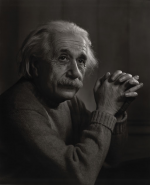
Up to the second floor I came face to face with the archetypal portraits by the renowned Canadian photographer Yousuf Karsh (1908-2002) in the exhibit Karsh: Image Maker.  We all must have seen some of his black and white portraits of famous people, somewhere.  The most well-known probably is Winston Churchill from whose mouth Karsh reportedly pulled out a cigar as he did his work.  Other famous portraits include that of Albert Einstein, Martin Luther King, Ernest Hemingway, Princess Elizabeth, Pablo Picasso, Andy Warhol, Alfred Hitchcock, Helen Keller, Grey Owl and numerous remarkable history makers.  I was totally absorbed as I walked by these meditative portraits of iconic personalities.

It seemed that the exhibits grew more interesting with every flight of stairs I stepped up.  The third floor offered an experience totally new to me.  As far as I can recall, this is the first sound installation mixed media art that I’ve encountered.  In a large, rectangular room occupying the whole floor, The Murder of Crows is installed.  Sound sculptors Janet Cardiff and George Miller have shown this work, their largest sound installation, in Australia, Germany and Brazil.  This is their North American premiere.

98 speakers are placed strategically and aesthetically in a large room, surrounding a table in the middle.  On the table is a megaphone.  Audience seats are grouped in the space encircled by the speakers.  The whole setting visually is a minimalist display.  The photo below is this installation in Berlin.  Even without the sound, the arrangement is an artistic presentation in itself.

But what we had at the AGA was a windowless room with dim lighting.  The added effects were even more haunting and claustrophobic.

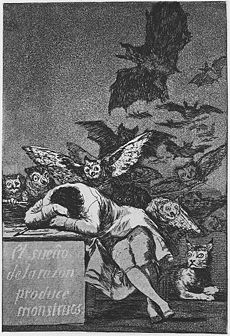
The 30 minutes sound presentation is a fusion of narrations, voices, footsteps, birds and bats, choral and orchestral music.  It evokes sequences of dreamscapes, and in part is an audio rendition of Goya’s etching The Sleep of Reason Produces Monsters in the Los Caprichos series (See image above).  The etching shows the artist himself asleep at his desk, with owls and bats hovering over him. The title divulges layers of meaning, prompting speculations of Goya’s actual thoughts.  The sleep of reason unleashes powerful imagination, even nightmares. Or, the erosion of reason led humanity into chaos and irrationality…

The phrase ‘the murder of crows’ refers to the collective gathering of the ominous birds, re-created here by the groupings of the 98 black speakers, some mounted on stands, some placed on chairs.  The very title and the effects made me feel like I was in the middle of the Hitchcock movie The Birds.  The sound was so riveting that I was glued to my seat in suspense… and the music from the massive choir and orchestra was both amazing and disturbing.  Click here to watch a 5-minute video clip of the sound installation. Click here to read an interview with Cardiff and Miller.

The AGA is not a big structure, but what is offered inside spans the artistic expressions separated by a chasm of time, form, and style.  From Goya’s disturbing etchings to the graceful renditions of Degas’ dancers, to the photographic images of iconic personalities captured by Karsh, and to end with the haunting sound installation The Murder of Crows, the exhibits were rains of pebbles into this quiet pond of thoughts… something I had not anticipated at the start of the trip.

Photography was not allowed in the galleries, so I cannot post any authentic visual experience here.  The above images are from the following sources:

Degas’ bronze sculpture Little Dancer and Karsh’s portrait of Albert Einstein from AGA website http://youraga.ca/current

Goya’s The Sleep of Reason Produces Monsters from Wikipedia Commons

The Murder of Crows sound installation from Cardiff and Miller’s website  http://www.cardiffmiller.com/artworks/inst/murder_of_crows.html

***

The Power of Aloneness

.

Before the resurrection was the death.
Before the death, the long path of suffering.
Before the suffering, the lonely struggle,
Agonizing solitude.

The Garden of Gethsemane,
Epitome of aloneness.
Even the closest would fall asleep
But one kept watch, awake for all.

Sweat dropped like blood
A heart pierced before nails were hammered in.
The soul cried out no, not this cup
But oh, not my will.

Not fear of sinews tearing from the joints
But the searing pain of separation
A Father who would leave totally alone
the tainted Son of Sin.

A prostrating prayer, a yielding spirit
The power of aloneness thus transformed.
As He got up from that rock, He had risen
Ready to accept the kiss of death.

I would never know the nailing pain
nor the bitter taste of that dreadful cup
But let me feel the power of solitary rest
To stay awake and rise and conquer death.

.

***

Poem by Arti of Ripple Effects
On the Eve of Good Friday, 2010.

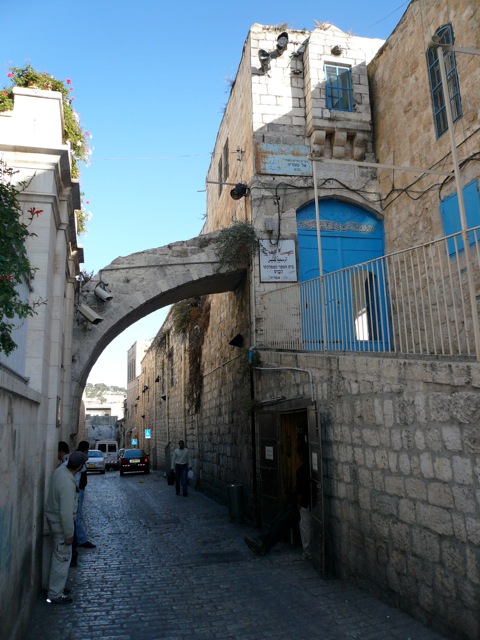
Photos taken by Arti in Israel, 2007.
Top: Via Dolorosa, Bottom: A Garden in Jerusalem

All Rights Reserved.

History Made At The Oscars: Kathryn Bigelow Wins Best Director

The 82nd Annual Academy Awards has made history on several fronts.

Probably the most talked about is Kathryn Bigelow becoming the first woman to claim the Best Director Oscar. And lesser known is the fact that her film “The Hurt Locker” has also distinguished itself as the lowest grossing movie to win Best Picture. With $15 million spent on its production, “The Hurt Locker” has gained back $14.7 million in its domestic gross, and a total worldwide sale of $21 million, paltry compared to Avatar’s $2.6 billion. Bravo to the Academy voters.

Another major breakthrough at Oscars 2010 is Geoffrey Fletcher winning Best Adapted Screenplay for his work “Precious: Based on the Novel Push by Sapphire.”  He is the first African American ever to win a screenwriting Oscar.  Let me re-direct you to an inspiring post on Geoffrey Fletcher’s win from the blog Screenwriting From Iowa.

The Celluloid Ceiling

Does Bigelow’s win signify the turning of a new page for all female directors and woman workers in the film industry? Or is it just a one-time victory? Throughout Oscar history, there have only been three other women nominated for Best Director: Lina Wertmüller for “Seven Beauties” in 1976, Jane Campion for “The Piano” in 1993; and Sofia Coppola for “Lost in Translation” in 2003. None of them won.  It has taken 82 Academy Awards to arrive at this point today.

The annual ‘Celluloid Ceiling’ report compiled by Dr. Martha Lauzen at the Center For the Study of Women in Television and Film at San Diego State University tracks women employed in the film industry over the years. Her 2009 study records the following findings:

  • Women comprised of 16% of all directors, executive producers, producers, writers, cinematographers, and editors working on the top 250 domestic grossing films. This represents a decline of 3% from 2001.
    .
  • Women accounted for 7% of directors in 2009, a decrease of 2% from 2008, and no change since 1987.
    .
  • As for behind-the-scenes employment of 2,838 individuals working on the top 250 domestic grossing films of 2009, women represented 2% of the cinematographers and 8% of writers.

Has Bigelow shattered the Celluloid Ceiling once and for all? The answer is yet to be seen.  Considering the gender disparity in the film industry, it remains a long and arduous journey for aspiring woman filmmakers.

But I admire Kathryn Bigelow for one thing: she downplays the gender issue and pursues the universal role of ‘director’, shunning being called a ‘female director’.  When accepting her Award, she did not even mention the history-making significance of her win but rather acknowledged the troops at war.

Of course, she won on her own merits and not on account of her gender.  So just let me help Barbra Streisand utter what is unsaid in her statement, the all important subtext:

“Well, the time has come … for us to recognize the excellent work of a director despite the fact that she is a woman.”

Bigelow, a painter turned filmmaker, was first trained at the San Francisco Art Institute and later won a scholarship for the Independent Study Program at the Whitney Museum in New York, “which gave her the opportunity to study and produce conceptual art that was critiqued by the likes of Richard Serra and Susan Sontag.” Later she re-directed her passion to film theory and criticism at Columbia University.

When asked about her movies not being “female”, Bigelow, gives a thought-provoking answer from the point of view of an artist [1]:

But you don’t get exasperated with this notion that your movies are not “female”?

No, because I respect it, and I understand it. The thing that’s interesting is that I come from the art world, or that’s where I was creatively, aesthetically, and intellectually formed and informed.

Certainly at the time I was there, there was never a discussion of gender per se. Like, this is a woman’s sculpture or a man’s sculpture. There was never this kind of bifurcation of particular talent. It was just looked at as the piece of work. The work had to speak for itself. And that’s still how I look at any particular work.

I think of a person as a filmmaker, not a male or female filmmaker. Or I think of them as a painter, not a male or female painter. I don’t view the world like that. Yes, we’re informed by who we are, and perhaps we’re even defined by that, but yet, the work has to speak for itself.

Hopefully the film industry can learn from the art world, such that we would never have to give a movie a gender, or stigmatize its filmmaker for being a woman.  Then we can comfortably call them all artists.

****

[1]  CLICK HERE to read the full interview by Willa Paskin on Slate Magazine “What Kathryn Bigelow learned from Rembrandt.