‘Downhill’: Faux Majeure

Here’s a quote I’ll use again and again, from South-Korean director Bong Joon Ho’s acceptance speech for Parasite winning Golden Globe’s Best Foreign Language Film award in January:

“Once you overcome the one-inch-tall barrier of subtitles, you will be introduced to so many more amazing films.”

Downhill

Downhill is a case in point. If one is willing to overcome the one-inch tall barrier called subtitles (they are in English, mind you), one will be amazed how true and powerful and entertaining the Swedish film Force Majeure (2014) is, and that watching the Ruben Östlund directed original would likely reap the most enjoyment and provoke some deep thoughts. Maybe an American version isn’t needed to begin with.

Written and directed by Nat Faxon and Jim Rash, with the Oscar nominated Jesse Armstrong as co-writer, if they’re to make an American version, there could have been potential for a fresh take. Force Majeure‘s literal meaning is a superior force, an unavoidable, overtaking power. Here’s the premise of the movie, which in itself is an interesting case for discussion:

A well-intentioned family holiday at a ski resort for bonding is shattered as the result of an instinctive reaction on the part of the husband/father. It happens when a controlled avalanche strikes a little too close to his family sitting at an outdoor dining table, he runs for his life while his wife huddles and protects their two boys. What follows is the underlying current of discontent and anger of the wife’s surfacing like a geyser. 

The producers must have seen the potential comedy in such a scenario. One of them is Julia Louis-Dreyfus, the Emmy and Golden Globe winning comedy actor, and a fan of the original Swedish film. Playing the wife Billie, Dreyfus shows she has her heart in it. In several scenes, she’s effective in bringing out Billie’s frustration. However, the issues of the movie are beyond her control, a real case of force majeure?

First is the casting of the husband Pete with Will Ferrell. Surely, for a comedy, Ferrell would be a natural choice. Call it irony, the indifferent demeanor Ferrell gives out as an actor in this movie actually parallels the husband Pete’s attitude, as if he’s being dragged up the ski hill. Have cell, will travel. His phone is what he’s resorted to as companion on a family holiday that he’s not ready to go on.

Pete’s work friend Zach (Zach Woods) and his girl friend Rosie (Zoe Chao) happen to be near where they vacation, so Pete secretly texts them to come over to their hotel in the guise that it’s their initiative to drop in. Here’s a pair of supporting roles if given more to play can add substance and context to the thin storyline, but they don’t have the chance. In the original Force Majeure, this couple plays a crucial part, especially with Kristofer Hivju’s performance as Mats, who’s full of humor. Hivju is also in Downhill, but only with a very minor role as the ski hill manager.

Other issues pervade, the script could well be a major one. As a comedy, there’s not much for laughs. It presents a problem but doesn’t delve into it; a comedy doesn’t mean superficial treatments. As a film that’s supposed to capture a sporting vacation, it lacks energy. No wonder the kids are so bored. The title is prophetic; I’m sure that’s unintentional. 

If an American version is the intent, then make it truly American, tell an American marriage story with this scenario. With Downhill, however, the European location, the ski resort surroundings, the actual scene of the controlled avalanche mishap, the set design, even the teeth-brushing moments in the hotel bathroom look almost the same as the Swedish original, other than the fact that the actors speak English. With its loose editing and scattered thematic matters, Downhill looks more like a parody of Force Majeure than a stand-alone comedy on its own.


~ ~ Ripples 


***


CLICK HERE to read my review of Force Majeure


Rashomon and other Stories by Ryunosuke Akutagawa

In participation of Japanese Literature Challenge 13 hosted by Bellezza.

Rashomon and Other Stories

Ryūnosuke Akutagawa (芥川龍之介 1892 – 1927) was an acclaimed early 20th Century Japanese author of the modernist style. Prolific in his short life, Akutagawa had written more than a hundred short stories upon his death by suicide at age 35. He is cited as “The Father of Japanese Short Stories”. The prestigious Akutagawa Prize established in 1935 was named after him to reward the best work of fiction by a new author. Japanese Nobel Laureate Kenzaburō Ōe and crime fiction writer Seichō Matsumoto are among the past winners.

Even though written in the early decades of the 20th century, the six stories compiled in this collection are surprisingly modern in their relevance. Further, despite the author’s gloomy outlook, a few of these stories are sprinkled with a touch of lively humour. The collection shows Akutagawa as an incisive depicter of the human condition and an astute observer of the human psyche.

***

Here are the stories:

In A Grove –– This story and the next are adapted into the renown film Rashomon (羅生門 1950) directed by the legendary Akira Kurosawa (黑澤明 1910 – 1998). The body of a murdered samurai is found in the forest by a woodcutter. His wife has been raped. What has truly happened, however, can’t be determined as the witnesses all tell very different stories. They are the woodcutter, a beggar, a priest, the wife, and the dead husband speaking through a spirit. Akutagawa presents the multiplicity of subjective point-of-views retrieved from memory. Can objective truth ever be found?

Rashomon –– “The Rashōmon” is the largest gate in Kyoto, the ancient capital of Japan. It was constructed in the year 789. When this story takes place, the gate is dilapidated and has become the hideout for thieves and robbers, what more, corpses are left there unclaimed. A servant who has just been let go is standing under the gate waiting for a break in the pouring rain. With no employment now, he struggles with the moral dilemma of becoming a thief or face the consequence of poverty, starving to death. What Akutagawa depicts after this is a dark reality of survival. Kudos to Kurosawa, he turns a chilling story into a film with a hopeful ending.

Yam Gruel –– Reads like a cautionary tale about the satiation of desire, but with whimsical touches and acerbic humour. Goi, a plain-looking samurai suffering from low self-esteem is the laughing stock of everyone, but he learns to live with the ridicules he faces everyday. Goi has one longing, the delicious yam gruel which his boss treats the samurais once a year. What follows is like a dream come true. He’s led to a long distance away on horseback by his boss to a place where he can have limitless yam gruel. But the result isn’t as he has expected. Why, when you have unlimited supply of what you desire, they will soon upset your appetite. Be careful what you wish for.

The Martyr ––  Christianity had a substantial influence in Japan during the 16th Century. With The Martyr, Akutagawa spins a tale about a boy named Lorenzo who is adopted by the Jesuits. Time passes and as he emerges into manhood, Lorenzo is wrongly accused of getting a village girl pregnant, resulting in his exile away from society. Later in a moment of crisis, Lorenzo’s real character prompts him to act by offering the ultimate sacrifice.

Kesa and Morito –– An early version of the popular genre we have now, psychological murder mystery as told by different narrators, again, multiplicity of POVs. The substance and motive for the crime is similar to “In A Grove”, adultery, love, hate, and lust, two internal monologues revealing Akutagawa’s grasp of the darkness lodged in the human soul.

The Dragon –– An ingenious take on fake news. Here’s the post the priest Hanazō makes up to play a trick on his colleagues, sticking a message board by the pond, it can well be a tweet today: “On March third a dragon shall ascend from this pond.” Retweets follow. Words soon spread, first local people then out to the whole province and finally to other provinces. So on March third, a humongous crowd gathers by the pond waiting to see the dragon king rise up. Here’s what Hanazō learns afterwards: if you have enough likes and followers, what’s fake will become true. Even when you confess you made it all up to begin with, nobody will believe you.

***

Rashomon and Other Stories by Ryūnosuke Akutagawa, Translated by Takashi Kojima. Tuttle Publishing, Singapore, 1952.


JLC13


________________


My previous Japanese Literature Challenge posts:

The Sound of the Mountain by Yasunari Kawabata

Reading Snow Country in Snow Country

Rouse Up O Young Men of the New Age! by Kenzaburo Oe


‘Parasite’ Makes Oscar History and more…

This morning you’d probably waken up to Parasites everywhere. What is Parasite, you might ask. In case you’re one of those who avoids watching the perennial award show of The Academy of Motion Picture Arts and Sciences, after 92 years, they have opened their door and allowed a non-English film to win the top prize, Best Picture of the Year.


Parasite
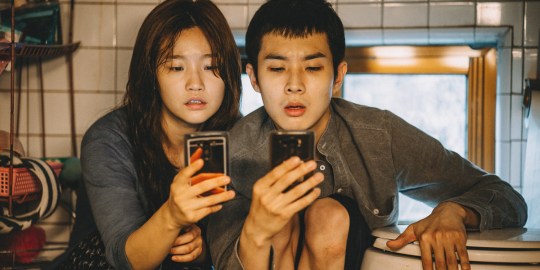
Looking for Wi-Fi connection are brother and sister Woo-sik Choi and So-dam Park, a scene in “Parasite”. Photo courtesy of TIFF.

Last night at the Dolby Theatre in Hollywood, the South Korean, genre-bending dark comedy directed by Bong Joon Ho garnered four Oscars. Other than Best Picture, it won Best Director, Best Original Screenplay, and Best International Feature Film. Haven’t heard of Best International Feature Film either? It’s the new name for the old category Best Foreign Language Film, an effort to dispel the awkwardness of the term ‘Foreign’. Even within the continent of North America, many languages are spoken.

Previously, no non-English film had ever won Oscar Best Picture even though nominated: Ingmar Bergman’s Cries and Whispers (1974 Oscar), Ang Lee’s Crouching Tiger, Hidden Dragon (2000), Michael Haneke’s Armour (2013), Alfonso Cuarón’s Roma (2019). Parasite makes a monumental win in Oscars’ 92 years history by being the first non-English language film to reach the highest prize.

By opening this door, the Academy begins to reach out to tap its potential, international stature. The closest I can think of is Cannes. The most prestigious film festival in the world that takes place annually in the small resort town in the French Provence-Alpes-Côte d’Azur has maintained its status of bestowing the highest cinematic accolades across national borders.

About borders, director Bong’s vision is global: “I don’t think it’s necessary to separate all the borders of division if we pursue the beauty of cinema.” Referring to Chinese American filmmaker Lulu Wang’s Indie Spirit Best Picture win for her film The Farewell just the day before the Oscars, Bong said: “Like Lulu, we just all make movies.”

When it comes to breaking down barriers, Bong’s own acceptance speech at the Golden Globes is succinct and spot-on. As translator Sharon Choi relayed in English, the director’s commentary on differences and the language that unites is inspiring for our divisive world:

“Once you overcome the 1-inch-tall barrier of subtitles, you will be introduced to so many more amazing films. Just being nominated along with fellow amazing international filmmakers was a huge honor.” And in English, he added, “I think we use only one language: the cinema.”

I’ve had the chance to enjoy some refreshing cross-border collaborations at Film Festivals. Just to name a few from last year:

Frankie – the Cannes nominated American Ira Sachs directing two veterans of the cinema, French actress Isabelle Huppert and Irish actor Brendan Gleeson in a film shot in Portugal. Language: English, French, Portuguese.

To the Ends of the Earth – Director Kiyoshi Kurosawa shot the film in Uzbekistan (a former Soviet republic close to the Eurasian border) on a commission to celebrate the diplomatic relationship between Japan and Uzbekistan. Language: Japanese, Uzbek

The Truth Japanese auteur Hirokazu Koreeda directing the legendary Catherine Deneuve, Juliette Binoche and Ethan Hawke (no need to declare nationality, I think you got the idea) Language: French, English

Maybe the art of cinema could well be the lingua franca to unite us all.


***


Related posts on Ripple Effects:

My review of Bong Joon Ho’s Parasite and Lulu Wang’s The Farewell


Unfilmed Novels

That’s a Jeopardy! category a few days ago in the Double Jeopardy round. Here are the five questions, or answers, rather. Five novels that have not been adapted to screen. For purists, their stance would be Leave Them Unfilmed. But just for interests sake, let’s see which novels Jeopardy! has included:

Catcher in the Rye (1951) by J. D. Salinger

Rumor has it that Salinger didn’t like movies. “If there’s one thing I hate, it’s the movies.” But no, Salinger didn’t say that, it’s Holden Caulfield who said that. In a letter Salinger had written, he denied that stance.

The Amazing Adventures of Kavalier & Clay (2000) by Michael Chabon

Chabon’s novel Wonder Boys was turned into a movie, but his Pulitzer winning The Amazing Adventures has not.

Foucault’s Pendulum (1988) by Umberto Eco

It’s been reported that the Italian philosopher/writer Umberto Eco wasn’t pleased with the movie adaptation of his earlier novel The Name of the Rose, so he said no more even though Stanley Kubrick had shown interest to work on Foucault’s Pendulum.

Blood Meridian (1985) by Cormac McCarthy

Many have attempted but to no avail, including Tommy Lee Jones, James Franco, Ridley Scott, and even Michael Haneke. It’s been noted that BM is more violent than No Country for Old Men. Do we need another one now, in our state of global chaos?

A Confederacy of Dunces (1980) by John Kennedy Toole

Although Hollywood had shown interest, even actors had been attached, the Pulitzer Prize winning novel remains unfilmed. Those of you who have read it, can you suggest some reasons why this is so.

***

A Note to Jeopardy Question Writers: Can’t you think of at least one novel from a woman author, just for the balance of your questions, let alone representation?

To my Ripple Readers: Can you suggest some good titles that have yet been turned into film? Old classic or current? Any books that you’d like to see transported to the big screen, in the helm of a worthy director with a talented cast and crew to bring out a deserving production?

Here are a few I can think of, some may have TV versions, but a full length, cinematic feature on the big screen is yet to be done:

Middlemarch by George Eliot (An old attempt years ago, but nothing realized. Now, let’s have Greta Gerwig write and direct. After Little Women, she just might have a fresh take on this classic.)

Beware of Pity by Stefan Zweig

The Moviegoer by Walker Percy

Lila / Gilead by Marilynne Robinson

Short stories by Jhumpa Lahiri


***

Your two pebbles?


Greta Gerwig Creates A Third Way to Adaptation with ‘Little Women’

In recent decades, there seems to have emerged two paths to approach movie adaptations of literary works, especially for a classic: faithful to the source, or awash it with contemporary strokes.

Here’s the rub: total loyalty would trigger criticisms of movies being a kind of illustrated book, simply redundant. But gloss it over with postmodern touches could strip an adaptation of the meaning and authenticity of the original text. Debates arise as to which is a better path.

A few days ago, in a Writers Panel with five screenwriters at the Santa Barbara International Film Festival, Greta Gerwig presented a third way. She didn’t call it that, but that’s how I see it, a happy medium (pun intended). Her approach to Little Women is both loyal to the spirit and letter of Louisa May Alcott’s as well as creating a contemporary, artful production for modern viewers to enjoy.


little-women-1


I’ve to quote her exact words as they are inspiring. Here’s the link to the video. The following quotes can be found from 27 to 36 mins. How does Gerwig handle the loyalty aspect? The writer-director did extensive research in preparation for her screenplay:

I wanted to treat the text of Little Women as almost a sacred text, also other texts that Louisa May Alcott and her family and other contemporaries had generated between letters, and other books that she’d written. I wanted to ground as much as I could in that. I wanted everything to be footnoteable (she well had coined a new word) and I wanted every line you ask me about and I can say it’s here, that I have my references.

How does her version relate with previous adaptations?

But the fact that it’s been adapted for screen seven times, it’s been made into an opera, and made into a musical and made into two anime shows, this is a loved and interpreted work. The way that something that’s been loved and interpreted many times you get this collective memory of what it is.

There’s the text, which is the book, and then there’s urtext, which is every time it’s loved and interpreted again. Urtext does have a relationship with the text, but it’s also separate… I wanted to deliver on the pleasures of Little Women as we’ve collectively come to know them.

And how does the collective interplay with the personal?

Gerwig instilled her own style and framed it in her own light. Quite a few things I’ve observed, the most obvious difference from previous versions is the structure, her juxtaposing the past and present timelines. The story is told as Jo’s memories seamlessly woven with her present as a struggling writer alone in NYC, a fresh take that adds depth and texture.

Gerwig paints the past with a golden hue signifying the warmth of cherished family memories and the present with a cool, blueish tone sending out harsher, lonelier vibes. She has also given an elevated role for Amy to interact with Jo, two seemingly rival siblings but could well be two sides of the same coin. Amy the pragmatic realist who grows up to understand too well her lack of economic status as a woman and who is ready to take financial security over real love ultimately gets both. Jo the dreamer and idealist, who’d vowed she’d never marry, has also carved out a path of her own.

So what does the ending mean?

I don’t want to say: O here’s what the ending means… I wanted to create something that’s open to interpretation along two lines. I think the movie belongs to the audience, so it’s down to the reflection you see…

With the layered ending, Gerwig effectively depicts the struggles of not only the book character Jo as an aspiring author in Little Women, but parallels it with Louisa May Alcott the woman writer in a man’s publishing world, and extending by implication to Gerwig’s own reality as a woman writer-director striving in a male-dominated film industry. The triple-layered final act opens the door to a golden future as we see a progressive school for boys and girls, and a published author giving birth to her work and keeping her own copyright. As for that third, invisible layer, I do wish Gerwig continual success in her writing and filmmaking career despite the obstacles she faces in the real world.

***

Related Posts on Ripple Effects:

Little Women Movie Review

Top Ripples of 2019 and the Decade

Can a Movie Adaptation ever be as Good as the Book?


A Visit to the Art Gallery of Ontario

Whenever I’m in Toronto, the AGO is a must-see. Over the Christmas holidays I had the chance to catch the last few days of an awesome exhibition there: Early Rubens, plus some impressive works from other artists.

I use the word ‘awesome’ not casually, I mean exactly as the word is originally intended. Flemish Baroque artist Peter Paul Rubens’s (1577-1640) paintings are huge, depicting Biblical characters and narratives in epic scale. On a wall I read this Rubens quote:

I confess that I am by natural instinct better fitted to execute very large works than small curiosities. Everyone according to his gifts; my talent is such that no undertaking, however vast in size or diversified in subject, has ever surpassed my courage.   –  Peter Paul Rubens, Letter dated 1621

Glad he mentioned ‘Everyone according to his gifts’, or else those who are afraid of heights would never be able to score any artistic achievement.

Anyway, this one in particular haunted me, The Massacre of the Innocents, around 1611-1612. Mothers try desperately to protect their sons against muscular men:

Massacre of the Innocents

Those entangled, near-naked bodies are men following an order from King Herod to kill all babies under the age of two after hearing that the King of the Jews had been born in Bethlehem. Mary and Joseph took their baby son Jesus and fled to Egypt to escape a ruler’s jealous rage and his desperate cling to power. Yes, Jesus and his parents were migrants, one of the early political refugees escaping from a ruthless government.

Fast forward several centuries to 1903, and in contrast to the massive scale of human tragedy of the above painting, I was drawn to this very quiet, seemingly simple painting of a mother giving a bowl of soup to her child. The mother looks unwell and seems to give away what she needs to her child. This poignant and sparse scene entitled The Soup is Pablo Picasso’s social statement of poverty and homelessness:

Pablo Piccaso The Soup

A more relaxed social scene. This painting from the 19th C. French landscape painter Eugène Boudin, Beach Near Trouville, linked my thoughts to a movie scene right away. Boudin’s work is dated 1864, that’s around the same period as Louisa May Alcott wrote Little Women. Boudin depicts Parisian high society mingling on the beach town of Trouville. Notice the women’s dresses:

IMG_9395

My mental association was naturally the Greta Gerwig directed Little Women beach picnic scene. I couldn’t help but compare their formal attires even at the beach and the actual chairs they sat on in Boudin’s painting with the beach scene in Little Women, so free and casual (not displayed in AGO):

Beach Scene in Greta Gerwig's Little Women

Don’t you want to fly a kite with the March sisters on that sandy beach?

From the historic to the futuristic, the iconic Japanese artist Yayoi Kusama (born 1929) has invented visions of infinity with her experimental installations for three decades. Her work was exhibited at the AGO in 2017 and now the Gallery has a permanent set up Kusama called The Infinity Mirrored Room – Let’s Survive Forever. I had to reserve a time slot ahead for my visit. At my appointed time, which was another hour later, I still had to wait in line to go into the room.

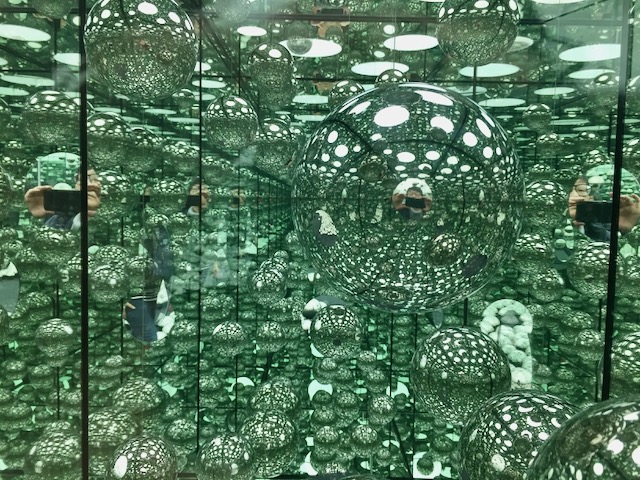
It’s a room of silver spheres suspended from the ceiling and arranged on the floor set against mirrors. A person standing in the room will see seemingly infinite reflections:

Yayoi Kusama's Infinity Mirrored Room

Here’s the image of one silver ball in the middle of the room. I didn’t do any colour changes, so just interesting to see what looked to me was a silver ball came out green in the photo:

One silver ball

You can actually see me taking the picture. What does this all mean? According to Kusama, the room gives a person a sense of infinity and limitlessness.

Only two visitors were allowed inside the room at one time. And how long could we spend in there? One minute. A staff with a timer in hand monitored the flow of visitors. When our time was up, she knocked on the closed door for us to go out and another two would go in. Call it a visual oxymoron if you will: A one-minute taste of infinity. O the limits of our human experiences.


***

Related Posts on Ripple Effects:

Alex Colville and the Movies

Bernini’s Corpus and Modern Movies

My review of Greta Gerwig’s Little Women


Concord revisited with ‘Little Women’

Five years ago, I took a New England road trip with my cousin. It was a major endeavour for me coming from Western Canada, over 2,500 miles away. The photos here were taken during the road trip that fall. We began our drive across three States starting from Wayland, MA. Nearby Concord was our first point of interest. This is where Louisa May Alcott grew up and later transposed her real life family onto the page to write Little Women.

Thanks to writer/director Greta Gerwig’s adaptation, fond memories flash back as I watch the New England scenery captured so beautifully on screen. One of the memorable scenes is the panoramic autumn hillside in which Laurie made his failed attempt proposing to Jo. Another one was the Christmas morning breakfast give-away as Marmee led the girls to exercise love-in-action.

CONCORD, MA

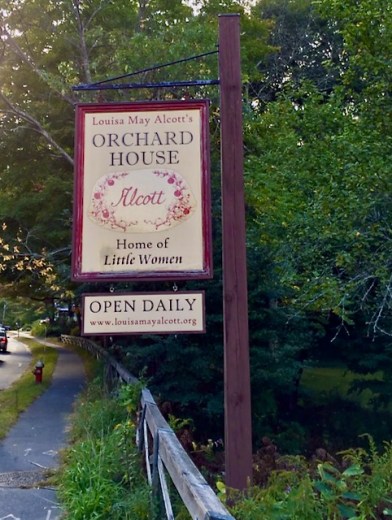
A major attraction in Concord is Orchard House where Louisa May Alcott wrote Little Women. The Alcott family owned Orchard House from 1857 to 1884, within which period all four Alcott girls Anna, Louisa, Lizzie and May had their most influential growing up years. The house is now a museum:

Sign

The rooms and furniture, Louisa’s (Jo) writing desk, the costume and props the girls made for their plays, Anna’s (Meg) wedding gown, and all of May’s (Amy) original paintings on the walls of her room are preserved inside the Orchard House Museum:

The Orchard House Museum

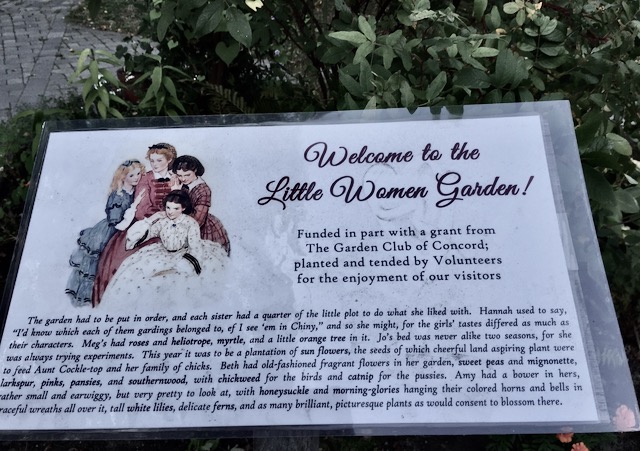
Louisa transposed her family onto the page, creating parallel characters in the March household. In the Little Women Garden, the March sisters had their own flower bed, each planted their section according to their taste or maybe, character. Here’s from the quote on the sign indicating their choices:

Meg – roses and heliotrope, myrtle, and a little orange tree
Jo – never alike two seasons, for she was always trying experiments
Beth – old-fashioned fragrant flowers, sweet peas and mignonette, larkspur, pinks, pansies, southernwood, with chickweed for birds and catnip for the pussies.
Amy – honeysuckle and morning-glories hanging their colored horns and bells in graceful wreaths all over it, tall white lilies, delicate ferns, and as many brilliant, picturesque plants.

The Garden

***

Here’s the issue many have questioned: Did Greta Gerwig alter the Little Women characters to appeal to modern day viewers, or, is she merely revealing Louisa May Alcott’s true image?

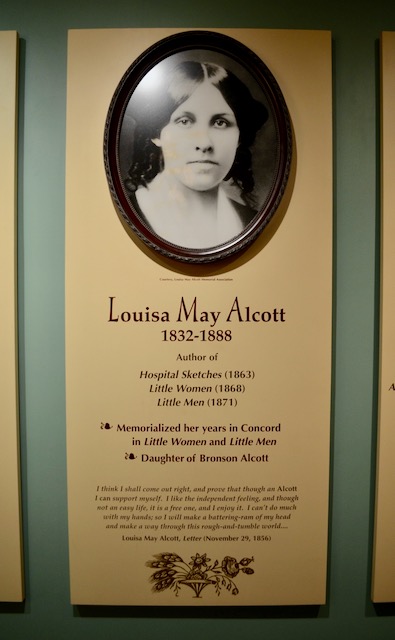
From Orchard House we went to visit the Concord Museum. Among plaques presenting some of Concord’s famous residents is this one of Louisa May Alcott. The quote on there comes from a letter Louisa wrote dated November 29, 1856:

I think I shall come out right, and prove that though an Alcott I can support myself. I like the independent feeling, and though not an easy life, it is a free one, and I enjoy it. I can’t do much with my hands; so I will make a battering-ram of my head and make a way through this rough-and-tumble world…


LMA

The Alcott parents, Bronson and Abigail were abolitionists and environmentalists. Bronson was the first teacher in Boston to admit a black student to his class despite protests from white parents who threatened either the black student go or they go. Bronson’s school was left with very few students consequently as he insisted his stance.

But his educational ideals must have been embraced by students as Bronson introduced the idea of raising their hands to speak in class, and he was the one who invented recess in school. There you go for a Jeopardy question.

Louisa’s mother Abigail was one of the first social workers in Boston, and was active in Women’s rights. She’d said, “I will go to the polls before I die if my daughters had to carry me there.”

The Alcott’s close friends and neighbours included prominent intellectuals and writers of the day: Emerson, Thoreau, Hawthorne. They made frequent, mutual visits, and had personal influence on Louisa’s formation and writing.

Down the road from the Alcott’s was Emerson’s home. Emerson had helped the financially strapped Bronson with acquiring Orchard House:

Emerson's Home

And living minimally by choice as an experiment, here’s Thoreau’s cabin (replica) at nearby Walden Pond:

thoreaus-cabin


Thoreau's Lake Side Cabin

Growing up under such stimulating milieu where thinkers and writers are free to explore new ideas and generate new philosophy, it was only natural that Louisa grew up grasping the values and the spirit of her parents and their friends, becoming a non-conformist herself.

Louisa had admitted she’s Jo in Little Women and added: “I didn’t make her half-bad enough.” If she’d been here today and directed the movie, I’ve a feeling she’d make Jo twice as radical and assertive. Gerwig is admirably restrained and for this, kudos to her.


***


Related Posts on Ripple Effects:

Little Women (2019) movie review

Can a movie adaptation ever be as good as the book?

A New England Fall Foliage Road Trip


More Movie Adaptations 2020

Previously on Ripple, a list of movie adaptations coming out this year was posted. Here are a few more, not only from books, but Broadway musicals (not as scary as Cats, so give them a try), and a Chinese poem.
.
Emma by Jane Austen

EMMA

While there have been many TV miniseries, and the modern-day spinoff, Clueless (1995), the only full-length movie adaptation of Austen’s Emma is back in 1996 with Gwyneth Paltrow as the heroine, Jeremy Northam as Mr. Knightley, and Toni Collette, Harriet Smith. The 2020 version stars Anya Taylor-Joy, born the year the last Emma adaptation came out. This 24 year-old rising star has already won acting awards in the US, UK, and at Cannes. This updated version sees Johnny Flynn as Mr. Knightley, Bill Nighy, Mr. Woodhouse, and Josh O’Connor (Prince Charles in The Crown, S3) as Mr. Elton. Do you want to see a new full-length movie adaptation of Emma? Or another Austen book?

..

The Turn of the Screw by Henry James
..

THE TURN OF THE SCREW
Movie title is The Turning, perhaps to take in the vibes of the horror classic The Shining. Why this genre is so popular is beyond me. Back in 1898 when Henry James published his horror novella as a serial, he couldn’t have imagined his writing would be turned into a motion picture projected on a huge screen 122 years later. Directed by Canadian photographer/filmmaker Floria Sigismondi, who’d made music videos for Marilyn Manson, David Bowie, and many others. Her disturbing style just might be what James had intended. Cast includes TV Stranger Things’ Finn Wolfhard and Brooklynn Prince (The Florida Project, 2017).


Deep Water
by Patricia Highsmith

Deep Water

Highsmith specialized in psychological thrillers. Several of her novels had been adapted into successful movies: Strangers on a Train (1951), The Talented Mr. Ripley (1999), and Carol (2015). Coming out this year is a marital thriller that Gone Girl author Gillian Flynn had identified as her favorite book and is, in her words, “a thriller about a suburban couple bent on mutual destruction.” Ben Affleck (Gone Girl, 2014) and Ana de Armas (Knives Out, 2019) star. Directed by Adrian Lyne, also a marital thriller specialist, whose works include Fatal Attraction (1987), Indecent Proposal (1993), and Unfaithful (2002), which was the last film he directed until now.
..


West Side Story by Arthur Laurents, Broadway musical by Leonard Bernstein and Stephen Sondheim.

WEST SIDE STORY POSTER (1).jpegSteven Spielberg directs this remake of the Bernstein/Sondheim musical (1957) and the 1961 Jerome Robin/Robert Wise movie for our time. In Dec. 2020, we’ll witness a new version of Shakespeare’s Romeo and Juliet. A cast of 130+ will join the Spielberg team with screenwriter Tony Kushner (Lincoln, 2012) and cinematographer, 2-time Oscar winner Janusz Kaminski (Saving Private Ryan, 1998 and Schindler’s List, 1993). Additional new music by David Newman. Ansel Elgort plays Tony; Maria is Rachel Zegler, chosen from 30,000 auditioned. Rita Moreno, who played Anita in the 1961 movie, also stars in this remake.


..
In the Heights
by Lin-Manuel Miranda

IN THE HEIGHTS.jpeg

Before Hamilton, there was In the Heights, Miranda’s breakout musical that won 4 Tony Awards in 2008. The musical is based on the book by Quiara Alegria Hudes, who now writes the screenplay transposing it onto the big screen. Miranda stars in this story set in the Hispanic-American neighborhood of Washington Heights in NYC. The movie is shot on location there. Directed by Jon M. Chu, whose Crazy Rich Asians became the summer sensation of 2018, showing Chu could create some spectacles. Would Miranda fans want to see a movie version of his works? In the Heights could well be a pilot project, as Hamilton the movie is currently in development.


..
Mulan
, legendary heroine from “The Ballad of Mulan” (in Chinese: 木蘭辭)

Hua Mulan.jpeg

According to the legend described in the narrative poem “The Ballad of Mulan”, Hua Mulan (Chinese: 花木蘭) is a female warrior in China during the Northern Wei period (386-536). To fulfill the conscription for military service for every family and for love of her ageing father, Mulan disguised as a male to join the army in her father’s place to protect her country from their northern enemies, the Huns. The rhymed verses in “The Ballad” provide vivid descriptions of Mulan’s determination and how she goes to nearby towns to buy a horse, a saddle and a whip, equipping herself for military service. After 10 years of fighting, she comes home to her overjoyed parents a decorated military commander.

Disney had wielded its creative license to introduce imaginary characters and songs in its original 1998 animation. Now 22 years later, a live-action feature film carries the legend further, albeit with no place for an actual pet dragon, so, no Mushu. Helmed by New Zealand director Niki Caro (The Zookeeper’s Wife, 2017), it should be noted that all four screenwriters are non-Chinese. No matter, at least the heroine and her purpose is true to the source material. Top-notch Chinese stars are on board: Gong Li, Donnie Yen, Jet Li, screen veteran Cheng Pei Pei, Tzi Ma from The Farewell, and Rosalind Chao from The Joy Luck Club, to name a few. Playing Mulan is multi-talented Liu Yifei who reportedly was selected after a five-continent search and auditioning a thousand candidates. Braced for a Westernized version of the age-old Chinese legend.


***

Book to Movie Adaptations 2020

A list of upcoming book to screen titles for the new year, eclectic choices for different tastes, varied classics and contemporary notables. Looks like classic literary works of all sorts are enjoying a comeback on the big and small screens.

Classic Suspense:

Classic Mystery.jpgDeath on the Nile by Agatha Christie

Kenneth Branagh returns after his first Hercule Poirot take in Murder on the Orient Express (2017) which he directs. Once again, the prolific screenwriter/adaptor Michael Green pitches in. Interesting cast with Gal Gadot, Armie Hammer, Annette Bening.
.

RebeccaRebecca by Daphne du Maurier

Lily James is ubiquitous ever since she comes out of Downton as Lady Rose. Now she’s the young and naive Mrs. De Winter in a psychological warfare with her nemesis, housekeeper Mrs. Danver played by Kristen Scott Thomas. Can the master of Manderley save her? But of course, he must save himself first. That’s Armie Hammer, equally ubiquitous.
.

Classic Adventure:

The Call of the Wild.jpgThe Call of the Wild by Jack London

Harrison Ford heeds the call with action star Karen Gillan, Dan Stevens, and the Calgary-born, The Expanse star Cara Gee. Partially filmed in Yukon and some in Vancouver, B.C., Canada. Never heard of the Yukon Territories? This should be a good intro. I’m all for old classics, be they books or actors.
.

DOCTOR D (1).jpegVoyages of Doctor Dolittle by Hugh Lofting
Movie title Dolittle, an adventure spectacle with Robert Downey Jr. as the eponymous Doctor. See if you can identify the voices of these animals: Rami Malek, Emma Thompson, Ralph Fiennes, Marion Cotillard, Octavia Spencer… just to name a few of the stars in this production. Coming out January 17.

.

Classic Sci-Fi’s:

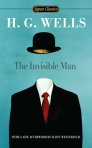
The Invisible ManThe Invisible Man by H. G. Wells

Classic sci-fi gets a resurrected boost. Wells’ novella and cautionary tale was first published in 1897. Now 123 years later in the 21st century, it’s adapted into a movie for the big screen. The Handmaid’s Tale Elizabeth Moss stars.
.

Brave New WorldBrave New World by Aldous Huxley

Huxley’s dystopian, imagined future written in 1931 is adapted into a TV series almost 90 years later. Again, a mark of what makes a book a classic, especially a sci-fi work. Downton early-exit Lady Sybil Jessica Brown Findlay’s in.
.

DuneDune by Frank Herbert

Another sci-fi classic, but closer to our time. A project by the acclaimed French Canadian director Dennis Villeneuve who has done some remarkable works like the Oscar nominated Arrival (2016), Blade Runner 2049 (2017) and Sicario (2015). Adapted into screen by Oscar winning writer Eric Roth (Forest Gump, 1994; A Star is Born, 2018). Timothée Chalamet, Rebecca Ferguson, and Oscar Isaac star.

Classic YA’s: 

Artemis_Fowl_first_edition_coverArtemis Fowl by Eoin Colfer

The first of Colfer’s popular series is a Disney production with Kenneth Branagh directing. A trending genre, the YA fantasy series has great potentials to be successful. A strong cast including Hong Chau, Judi Dench, Josh Gad.


The Secret Garden.jpgThe Secret Garden by Frances Hodgson Burnett
Like Little Women, this classic young reader novel has had several screen adaptations. I have no qualms about this; it only helps to spark renewed interest in the book. This new adaptation will have Colin Firth who was in the 1993 version to play Lord Archibald Craven and Julie Walters as Mrs. Medlock.
.

Contemporary Notables:

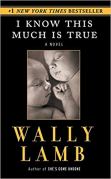
I Know this much is True.jpgI Know this much is True by Wally Lamb

Lamb’s novel about a twin brother’s advocacy and care for his paranoid schizophrenic sibling is adapted into a 6 episode TV miniseries. Mark Ruffalo will play both brothers, Dominick and Thomas Birdsey. Director Derek Cianfrance has a few fine works, the Cannes nominee Blue Valentine (2010), The Place Beyond the Pines (2012), and The Light Between Oceans (2016).

Little Fires.jpgLittle Fires Everywhere by Celeste Ng

Goodreads Choice of the Year Best Fiction (2017) and Novel of the Year on other sites, Chinese American writer Celeste Ng’s novel on class/race differences and aspirational conflicts in the idyllic community of Shaker Heights, Ohio, is adapted into a TV miniseries. Reese Witherspoon and Kerry Washington star.

Nine Perfect StrangersNine Perfect Strangers by Liane Moriarty

Moriarty’s website states her books had sold over 14 million copies worldwide. On the heels of her successful Big Little Lies turned into the small screen, Nine Perfect Strangers has already secured Nicole Kidman and Melissa McCarthy on board for the miniseries on Hulu. Her other books will follow.
.

the woman in the window.jpgThe Woman in the Window by A. J. Finn

A shaky narrator seeing a crime happening or being caught in one, Gone Girl was the first to kick off the trend. The Woman in the Window alludes to the Hitchcock classic Rear Window. Directed by Joe Wright (Darkest Hour, 2017; Anna Karenina, 2012), screenplay by Pulitzer winner Tracy Letts (August: Osage County, 2013), and an A-list cast with Amy Adams, Gary Oldman, Jennifer Jason Leigh, Julianne Moore.


Top Ripples of 2019 and the Decade

Best of the decade lists have been sprouting up everywhere now that we’re wrapping up  the second ten years of the 21st century. As Ripple Effects has been around for over 12 years now, I too have the privilege to post my own decade favourites, with links to my reviews. A disclaimer is, obviously, I can only rate films that I’ve seen. For 2019, I’ve yet to see 1917 and Bombshell.

But first off, before looking back to the decade, here’s the list of

Top Ripples of 2019:

  1. Little Women
  2. A Hidden Life
  3. Varda by Agnès
  4. An Elephant Sitting Still
  5. Pain and Glory
  6. The Farewell
  7. Parasite
  8. Marriage Story
  9. American Factory
  10. Rocks

.
Top Ripples of the Decade:

  1.  The Tree of Life (2011) –– Director Terrence Malick’s visual treatise on life, death, and everything in between… and after.
    .
  2.  Roma (2018) –– Nothing’s too mundane for a filmmaker, especially with childhood memory. Mexican director Alfonso Cuarón’s autobiographical work that won him 3 Oscars, Best Directing, Cinematography, and Best Foreign Language Film.
    .
  3.  Ida (2013) –– Polish-born director Pawel Pawlikowski’s gripping depiction of a young woman’s choice of the sacred or the secular.
    .
  4.  An Elephant Sitting Still (2018) –– A last outcry of a young talent, the first and last masterpiece of Chinese writer/director Hu Bo who took his own life after making the film at age 29.
    .
  5. Little Women (2019) –– No matter what your previously held memory of the adaptation of Louisa May Alcott’s classic is, Greta Gerwig’s 2019 rendition is worthy to be the definitive version from now on as we head into the third decade of the 21st century. Surely lots have to be left out in a 2 hr. movie; take it as a good prod to go read the book.
    .
  6.  A Hidden Life (2019) –– Austrian farmer Franz Jägerstätter gave up everything to stand by his conviction, refusing to take the oath of loyalty to Hitler. Terrence Malick’s newest film is a meditation on the meaning of life, and death.
    .
  7.  Silence (2016) –– Martin Scorsese’s epic adaptation of Japanese author Shusaku Endo’s novel, a harsh and audacious look at the persecution of Christianity during 1600’s Japan. Similar to Malick’s A Hidden Life but depicts a totally different choice and outcome for its protagonist.
    .
  8.  Clouds of Sils Maria (2014) –– French director Olivier Assayas’s mesmerizing tale of being famous, ageing, becoming obsolete, and the young rising. Juliet Binoche and Kristen Stewart offer interesting interplay, but it’s Stewart who stands out.
    .
  9.  12 Years A Slave (2013) –– Two Brits takes over the American story: Director Steve McQueen and actor Chiwetel Ejiofor who plays Solomon Northup. I wrote this in my review: the subject matter may be ugly, but the medium depicting it can be artistically gratifying, thus, conveying the message with even greater potency and inspiration.
    .
  10.  Certain Women (2016) –– Director Kelly Reichardt has chosen three short stories by Maile Meloy to form a cinematic triptych. The seemingly mundaneness of life is actually the very essence of it. The women are what make this film quietly impressive: Laura Dern, Michelle Williams, Lily Gladstone, Kristin Stewart.
    .
  11. Pain and Glory (2019) –– “The child is father of the man”, iconic Spanish filmmaker Pedro Almodóvar’s autobiographical sketch of his childhood, later life and career up to this point. Beautifully shot, a film for artists.
    .
  12. The Farewell (2019) –– Chinese American director Lulu Wang has put her family story on screen and captured the hearts of many, making Awkwafina the rising star this awards season. To tell, or not to tell, that is the question… and the answer is obvious depending on where you’re from.
    .
  13. Faces Places (2017) –– Agnes Varda at 89 goes on a road trip with photographer/artist JR, adorning dilapidated buildings and unlikely places with human portraits larger than life.
    .
  14. The Rider (2017) –– Chinese-American Chloé Zhao tells the rarely told story of a modern day cowboy’s existential crisis after he suffers a debilitating head injury. How she tells it is poetry on screen.
    .
  15. Arrival (2016) –– Admirable collaboration: French Canadian director Denis Villeneuve’s adapts Chinese American sci-fi writer Ted Chiang’s short story “Story of Your Life”, rendered with sensitive performance by Amy Adams. A film packed full of ideas, condensed sentiments, yes, like poetry.
    .
  16. Frances Ha (2012) –– Noah Baumbach has created a character that’s a perfect fit for partner Greta Gerwig, an aspiring dancer trying to find her place in NYC. The scene of Frances running and dancing through the streets of NYC has become an archetype for freedom and exuberance. (Look for it at the beginning of Little Women)
    .
  17. Varda by Agnes (2019) – The only female director of the French New Wave, Agnes Varda had left us with an inspiring legacy. This is her summing up, her last work wherein she went through every film she’d made, commenting with valuable insights and wisdom.
    .
  18. Our Little Sister (2015) –– I’ve to say this could well be my favourite Hirokazu Kore-eda movie. Koreeda is a master in filming family relationships, reminiscent of Ozu but with contemporary scenarios. This is a heartwarming film for the unhurried heart to savour.
    .
  19. Life of Pi (2012) –– What Canadian author Yann Martel has succeeded in literary form, Ang Lee has realized in this visually stunning cinematic offering, filming what is considered the ‘unfilmable’. Aligned with its magical realism, Lee ventured into flashy 3D.
    .
  20. The Past (2013) –– Iranian Director Asghar Farhadi elicited some amazing
    performance with this absorbing story. The film came out two years after A Separation, his Oscar winning film. I’d enjoyed The Past more.
    .


***


Other Top Ripples not on the above lists can be found on the sidebar. Click on the image to read my review.


‘Little Women’ is not just about heart, but mind, aesthetics, and other enjoyment

Greta Gerwig’s adaptation of Little Women is a joyous celebration of family and life. It’s an innovative feature, and a worthy rendition keeping Louisa May Alcott’s story intact and her spirit alive. The storytelling is shifted from linear to juxtaposing the timelines of seven years apart, from the March sisters’ teenage years to adulthood. A break from traditional adaptations of the novel, and a structure modern movie goers are familiar with.

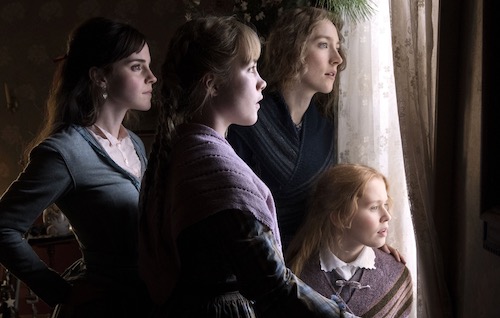
LITTLE WOMEN (1)

So, instead of waiting for two hours to see what have become of the girls, viewers get to see how they’ve turned out from the start and throughout the film as the timelines switches back and forth. One effect is the intermingling of memory and present reality, adding texture to just linear storytelling. The editing is smooth as music and sound often overlap the changes of scenes like a visual dissolve.

The Oscar nominated director (Lady Bird, 2017) has surpassed herself in crafting an exquisite piece of artful creation. Unlike most other movies nowadays, Little Women is shot using 35mm film rather than digital technology. Cinematographer Yorick Le Saux offers viewers the inherent aesthetics of the medium, a grainy, more subtle visuals that augment picturesque New England in the exterior shots, and the depth and mood in the low-light interior. The picnic scene at the beach is pure delight. Mixed with Alexandre Desplat’s original music, the film is a beauty to behold.

Alcott’s 19th century American classic (1868-9) has been transposed to the big and small screen many times. No matter what your previously held memory is, Katherine Hepburn as Jo back in the 1933 first adaptation, or Elizabeth Taylor as Amy in 1949, or the 1994 adaptation with Susan Sarandon as Mrs. March and Wynona Ryder as Jo and a few up-and-coming youngsters such as Kristen Dunst, Claire Danes, and Christian Bale (as Laurie), Gerwig’s 2019 rendition is worthy to be the definitive version from now on as we head into the third decade of the 21st century.

The story is told from the point of view of Jo (Saoirse Ronan), an aspiring writer in New York at present. She reflects upon her path so far and reminisces on her family life, the cacophony of sisterhood in a busy household in Concord, MA, during the Civil War. A single woman author pitching to publishers, Jo’s struggles parallel Alcott’s, a woman writer in a man’s world. As well, it would be apt to refer to Gerwig’s own challenges as a female writer/director in the present day movie industry.

The film is an alchemy of authentic, period backdrop and set design, stylish yet down-to-earth costumes, fused with a fresh and contemporary synergy. Credits go to the four young actors bringing to life the March sisters Meg (Emma Watson), Jo (Saoirse Ronan), Beth (Eliza Scanlen) and Amy (Florence Pugh) as they live through hard times while their father has gone with the Union Army as a volunteer chaplain. Their neighbour and friend Laurie (Timothée Chalamet) remains a perpetual presence in their lives. Their altruistic mother, Marmee (Laura Dern), holds the family together and extends her care to those in need outside their home. She is the example of love and heart for her daughters to emulate. Her screen presence is comparatively small though as Gerwig lets her girls shine, especially Jo and Amy.

A touch of surprise for me is that Gerwig has kept the historic period and setting authentic without adding any postmodern quirks to shock or provoke. Her script allows Alcott’s points to flow out through the dialogues and characters within context. This is not fiery feminism, but an intelligent depiction of the status of women in the historic period. It’s an updated version doing justice to Alcott’s astuteness in her social critique which is, alas, still relevant today.

Kudos to Gerwig in bringing out the youngest sister Amy, not so much as a foil to Jo, but a worthy rival. Amy proves that even though bratty and capricious as a child, she has grown up to grasp a clarity in seeing the worth of a woman in her society, which is, not much. The realistic and rich Aunt March (Meryl Streep) has a firm view of this: it’s a lost cause with Jo who says she will not marry, or Meg who falls for a poor teacher and has to curb her material desires, and Beth’s ill health, she has put her hope on Amy to marry rich to dig the family out of poverty. Amy who has lived with her Aunt for a while when Beth is sick with scarlet fever understands her own situation with a cool head as she articulates it to Laurie. Knowing that she doesn’t have what it takes to be a truly great artist––she whose stance is to be great or nothing––Amy sees her predicament clearly. It all comes down to economics:

And as a woman, there’s no way for me to make my own money. Not enough to earn a living or to support my family, and if I had my own money, which I don’t, that money would belong to my husband the moment we got married. And if we had children, they would be his, not mine. They would be his property, so don’t sit there and tell me that marriage isn’t an economic proposition, because it is. It may not be for you, but it most certainly is for me.

Virginia Woolf’s A Room of One’s Own comes to mind as she argues that economic disparity between men and women systemically disadvantages talented women to become successful.

In her research, Gerwig delves into Alcott’s other books as well as letters, thereby knowing her from a deeper perspective and not just from the novel Little Women. This understanding and appreciation is translated into the screenplay, capturing Alcott’s sharpness of mind and the sensitivity of her soul. Here’s a poignant scene as Jo pours out her heart to Marmee after rejecting Laurie’s marriage proposal. Has she made the right decision? In an interview, Gerwig says the words are all Alcott’s, from her book Rose in Bloom, except the last sentence added by Gerwig herself, equally brilliant, piercingly clear, and very Dickinson:

Women have minds, as well as just heart; ambition and talent, as well as just beauty. And I’m so sick of people saying love is all a woman is fit for. But I’m so lonely.

The March family has had their share of misfortune. But life can be beautiful for those who behold it as such and deem it meaningful to pursue one’s own dream or simply to enjoy one’s passion, no matter how short the allotment of time. Despite challenging personal and social reality, it’s a bliss to be alive, and yes, even better when one succeeds. Gerwig has effectively brought out this theme with both sensitivity and heart. The ending scene speaks to this truth. 


~ ~ ~ ~ Ripples


***


Related Posts:

In Praise of Austen: Virginia Woolf’s A Room of One’s Own

Can a movie adaptation ever be as good as the book?

‘A Hidden Life’: A Film for the Season

For over 10 years at Ripple Effects around this time, I’ve a Christmas post entitled Reading the Season. That’s when I post a book or collection of poetry that I find relevant for Christmas. This year I’ve something different. It’s a film that could offer some quietude among the cacophony of the season.

I first saw A Hidden Life at the Toronto International Film Festival in September. It’s now showing in selective cities.

**

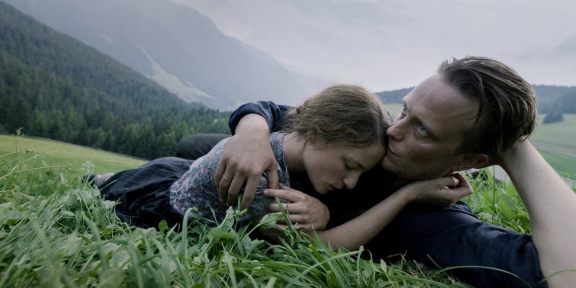
Written and directed by Terrence Malick, A Hidden Life is the story of an unsung hero, Austrian farmer Franz Jägerstätter (August Diehl), a conscientious objector who refused to take the oath of loyalty to Adolf Hitler to fight for the Nazis in World War II, for he saw Hitler’s war unjust and evil.

A Hidden Life
Valerie Pachner and August Diehl in the film A HIDDEN LIFE. Photo Courtesy of TIFF.

The title alludes to George Eliot’s ending of Middlemarch:

…for the growing good of the world is partly dependent on unhistoric acts; and that things are not so ill with you and me as they might have been, is half owing to the number who lived faithfully a hidden life, and rest in unvisited tombs.

A quest for spiritual meaning is the signature of the reclusive director’s works. They are often expressed in whispered voiceovers from the characters, revealing their doubts and questions, anguish and insights.

Days of Heaven (1978) establishes Malick’s aesthetic style of using natural light to shoot his films, every frame exudes cinematic poetry. The Thin Red Line (1998) begins his signature whispering voiceovers to express inner thoughts and spiritual quests. But it’s The Tree of Life (2011) that makes such whispers monumental as Malick situates the microcosm of a Texan family within the cosmos, and asks questions of the Creator the problem of pain and death, the struggle with human nature, with love and hate, and despite all human failings, the presence of grace.

Since The Tree of Life, Malick has produced several ‘misses’, films that are not well received as they are elliptical and experimental but visionary no less. To the Wonder (2012), Knight of Cups (2015) and Song to Song (2017) all point to one common quest: in the materialistic world of the rich and famous, what makes life meaningful? And, can true love be found?

A Hidden Life is Terrence Malick back to his form in a more traditional style of filmmaking, and more explicitly spiritual as he tells the story of a faithful, historic figure, Austrian farmer Franz Jägerstätter of St. Radegund, a village in Upper Austria. Before Germany’s ‘annexation’ (Anschluss) of his country, family life is blissful and easy for Franz. He farms the land among natural vistas, stays rooted in a close-knit community, happily fathers three young daughters, and is deeply in love with his wife Fani (Valerie Pachner). The arrival of a conscription letter in 1943 changes everything.

Franz knows he cannot join Hitler’s military, but the refusal to do so means certain death and the risk of endangering his family. He struggles hard to deal with the dilemma and seeks guidance from his Catholic church, but his priest tells him patriotism is what’s demanded of him. His village folks ostracize him; the mayor urges him to comply with Hitler’s demand, for one traitor among them can endanger them all. But Franz stands his ground even with the consequence of execution, a stance reminiscent of the Christian pastor Dietrich Bonhoeffer who died under Nazis hands for refusing to let Hitler’s doctrine to supplant his church.

In this way, A Hidden Life offers an opposite stance different from Martin Scorsese’s Silence (2016), adaptation of Shusaku Endo’s novel. Here we have a courageous conscientious objector willing to suffer the loss of everything and the risk of harm to his family and kinsfolks in defying a ruthless ruler. A Hidden Life is a real-life testimonial of a believer while in the face of persecution, still refuses to step on the Nazi fumie to renounce his faith.

After incarcerated in the German military prison near Linz then transferred to Berlin to await trial, Franz is allowed to write one letter to Fani every month. The love the couple share in the film has its basis on these poignant letters which have since been compiled and published by Orbis Books. Franz’s absence from home brings Fani back-breaking hardships on top of social ostracizing. Her mother and sister come to live with her to offer whatever support they can give.

Capturing mainly natural light for his filming, Malick contrasts the idyllic family life in the beauty of the natural landscape of Franz’s home setting with the harshness of his imprisoned existence. What’s more tortuous though is his internal struggle. While in prison, his captor Captain Herder (Matthias Schoenaerts) says to him: “What purpose does your defiance serve? No one knows about you.” Yet Franz is convinced that his action isn’t to please others or to glorify himself, but to do what’s right in the eyes of his God. Franz’s own hidden spiritual life empowers him to stay strong.

In his trial, again he is being challenged: “Will anyone outside this court hear you? No one will be changed.” Yet he says nothing in his own defence, an allusion to the One who had stood trial in front of a ruler and said nothing in the face of death.

In a voiceover we hear these inner thoughts, Franz’s words to Fani:

“Time will come when we’ll know what all this is for, and why we live.”

There are plenty of quiet moments, long takes and slow pacing for viewers to think and ponder. The 174 minutes of screen time offers an opportune respite from the hustle and bustle of the Season, a quietude to evaluate, if you will, now that we’re at the end of another decade and in a time of tumultuous change.

The soul-stirring music is another reason to sit down in the theatre and quietly let the story unfold. Film composer James Newton Howard has created a full orchestral score complementing the cinematography, not only in capturing the beauty of the vistas but in his own words: “… to focus on the emotional journeys and crises of conscience of the characters—writing music to reflect their story.” Listen for the solo violin representing the sentiments of Franz and Fani, masterfully played by the Canadian violin virtuoso James Ehnes.

What’s hidden could be more precious, like treasure in jars of clay. And these words came to mind as I give A Hidden Life further thoughts:

… we look not at the things which are seen, but at the things which are not seen: for the things which are seen are temporal; but the things which are not seen are eternal.

~ ~ ~ ~ Ripples


***


Reading the Season Posts:

2018: Madeleine L’Engle’s Poem The Irrational Season

2017: A Wrinkle In Time by Madeleine L’Engle

2016:  Silence by Shusaku Endo

2015: The Book of Ruth

2014: Lila by Marilynne Robinson

2013: Poetry by Madeleine L’Engle

2012: Surprised by Joy by C. S. Lewis

2011: Walking on Water by Madeleine L’Engle

2010: A Widening Light, Luci Shaw

2009: The Irrational Season by Madeleine L’Engle 

2008: The Bible and the New York Times by Fleming Rutledge

2008: A Grief Observed by C. S. Lewis

For my review of The Tree of Life and Silence, click on the links embedded in the titles.