Ruth Prawer Jhabvala: A Tribute to Rootlessness

On April 3, one day before Roger Ebert died, Ruth Prawer Jhabvala passed away from illness at the age of 85. Her death seemed to have been overshadowed in the next few days by Ebert’s. I feel here’s a life that ought to be noted as well, but maybe for a special reason.

ruth-prawer-jhabvala

Ruth Prawer Jhabvala was best known for her Oscar winning adaptations of E. M. Forster’s A Room With A View and Howards End. Her other screenplays include Kazuo Ishiguro’s The Remains of the Day, Henry James’s The Golden Bowl and The Bostonians, among a total of twenty-six.

But for Ruth (to discard formality and to focus on the person, allow me to call her Ruth), adapting screenplays was only a hobby. Her main calling was to be a writer of her own stories. She had heeded that call with fervour since childhood. Guardian’s obituary mentions Ruth once said about her writing time as “the only three hours in the day I’m really alive.”

There are thirty titles by Ruth Prawer Jhabvala on Goodreads, including novels, short story collections, and her works in anthologies. Among her accolades, most well known is the 1975 Booker Prize for her novel Heat and Dust, about the meeting of East and West in India. Her short stories had been published in The New Yorker since 1957, thirty-nine of them. Her latest appeared just one month before her death. She is the only person who had ever won both the Booker and the Oscar. Two Oscars, to be exact.

Reading her obituaries from several sources, I’m more intrigued by this matter of laying down roots, or rather, of rootlessness in the landscape of our life.

**

Ruth was born in Cologne in 1927 to a Polish father and a German mother. Her family was assimilated Jews in Nazi Germany. Her grandfather was the cantor in Cologne’s biggest synagogue. Her father Marcus was a lawyer. Assimilated or not, Ruth and her brother had to flee with her parents in the nick of time in 1939 to England. She was 12.

For the next twelve years, she grew up in London, learned a new language, adopted a new identity, and later graduated in English literature from Queen Mary College, London University. In 1948, upon finding out all members of his family were killed in the Holocaust, more than forty of them, Ruth’s father took his own life.

In 1951, when she was 24, Ruth married the architect Cyrus Jhabvala in London and followed him back to his native country India. Another uproot and transplant, this time, to a whole new continent. They settled in Delhi. For the next 25 years, Ruth immersed herself in her adopted country as a wife, mother, and writer. Colonial and post-colonial Indian life, East-West relationship and caste conflicts became her subject. Despite her effort in total immersion, she had not taken roots in India.

Finally, In 1976, a third continent, as Ruth and her husband moved to New York City. There, she found a place closest to a notion of home, paradoxically, because of “many people like herself: refugees, outsiders, interesting American discontents,” wrote the remaining Merchant-Ivory-Jhabvala collaborators, director James Ivory, in Time magazine’s tribute.

**

While still in India, Ruth had already collaborated with Merchant and Ivory on several movies. Now in New York, she lived in an apartment on the same block as they. The proximity of actual geographical location fostered a prolific period of their lives. Together, they had joined hands in more than twenty productions. Their forty years of collaboration remains the longest in movie history.

Ivory Jhabvala Merchant
Ivory, Jhabvala, Merchant

How did rootlessness affect her perspective? In Guardian’s obituary, I found this inspiring excerpt:

I stand before you as a writer without any ground of being out of which to write: really blown about from country to country, culture to culture, till I feel—till I am—nothing.” And yet, she said, this was one of her strengths. Many of her stories are about a kind of inner travel: feeling rootless, her protagonists find new ways to feel at home in the worlds they happen to inhabit.

Perhaps, in the vast landscape of literature, such rootlessness is essential for the imagination to take flight. Rootlessness allows flexibility and fluidity of navigation, the freedom to roam. Rootlessness can more readily unlock the wayfaring spirit within, and embrace change.

One result of being rootless could well be the hybrid identity. Amusingly the Merchant-Ivory-Jhabvala team itself is a good example. Producer Ishmael Merchant was a Muslim from Bombay who had settled in America; director James Ivory is the son of a French-Irish American; Ruth Prawer Jhabvala was a Polish-German-Jew from Cologne, Delhi, London, and New York City.

Perhaps as Nick Carraways, the narrator in The Great Gatsby, observes, only by being “within and without” can we see “the inexhaustible variety of life.”

***

Related posts and links:

Obituaries and tributes from The Guardian, The Telegraph, The Paris Review, Time Magazine, The New York Times.

Since 1957, The New Yorker had been publishing Ruth Prawer Jhabvala’s short stories, a total of 39, her last appeared only one month before her death. Thanks to The New Yorker, we can now read Ruth Prawer Jhabvala’s short stories online.

My book review of Howards End, my post on the Merchant Ivory production of Howards End, my review of A Room With A View (TV, 2007)

***

Photo Sources:

First photo from The Paris Review; Second photo from The Telegraph

Sign of Spring: Melting Snow

These are photos for Saturday Snapshot April 27.

Snow has mostly melted now, but there are still remnants of winter. Strangely, I feel a sense of loss. That’s why I treasure these photos, chronicling the fading of another season.

Inglewood Bird Sanctuary in our City a couple of weeks ago…

Inglewood Bird Sanctuary

Inglewood Bird Sanctuary 1

It was a pleasure to watch this pair of Mergansers enjoy themselves in the icy water. For me, I was in full winter gear… down jacket, toque and gloves:

Male & Female Common Mergansers

They were beautiful to look at. Seems like you can tell right away which is male and female:

Female and Male Mergansers

A few days later, in another part of the City I captured the last scenes of winter:

Melting snow

Finally this one, I just can’t resist naming it: “Doolittle Reflection”. It reminds me of Bev Doolittle’s paintings, Click Here and see what you think.

Doolittle Reflection

Snow… why am I missing it?

***

Saturday Snapshot is hosted by Alyce of At Home With Books.

Sign of Spring: Nesting

Here are my photos for Saturday Snapshot April 20.

Spring is always a slow emergence for us. There’s still snow on some trails, and no green leaves or flowers for another month. But a sure sign of spring is birds nesting.

Canada Geese scouting for nesting spots and guarding them closely:

Guarding the nest

And here’s one well nestled inside a tree:

Canada Goose inside tree

This one just wants to show off as spring spirit unfurls.

Showing off

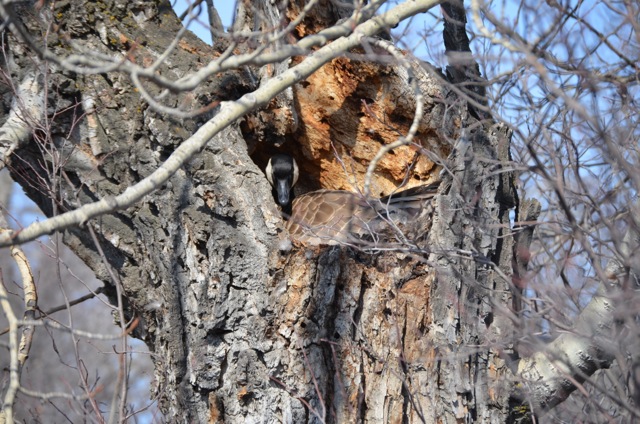
Remember the Papa Great Horned Owl I spotted a month ago? Just last week I saw Mama Owl nesting in the cavity of a dead tree, poking out just enough for me to take her picture. Other birdwatchers told me there were several young ones. Hopefully soon I’ll get to see them come out.

Owl nesting

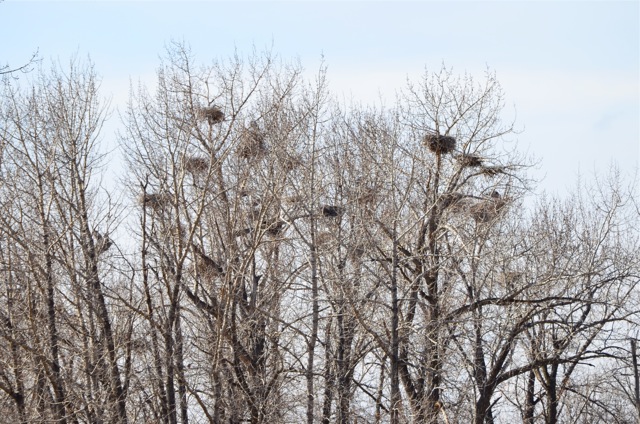
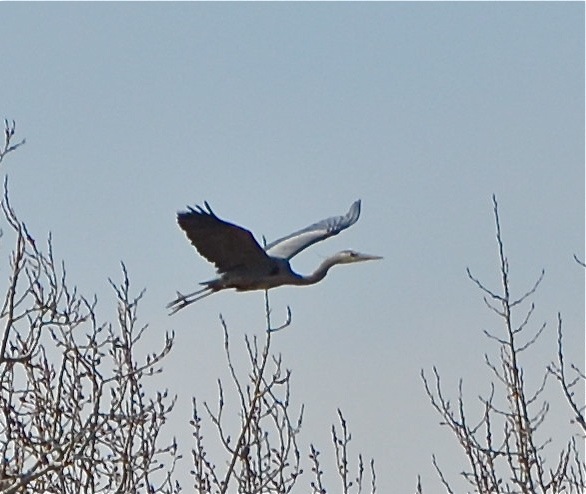
But nothing compares to the utter joy of seeing the Great Blue Herons yesterday. I had never thought I would see them right here in Alberta. But I found them following some directions to their nests, had to watch them from afar though as we were separated by The Bow River:

Great Blue Heron nests from afar

About a dozen nests high up on the trees:

Great Blue Heron Nests

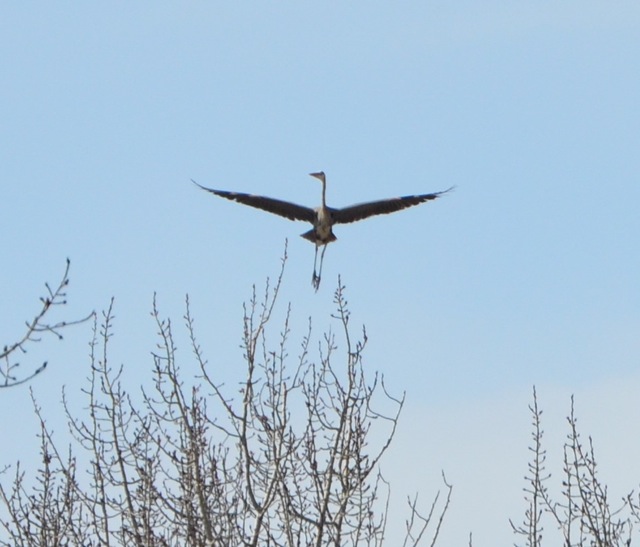
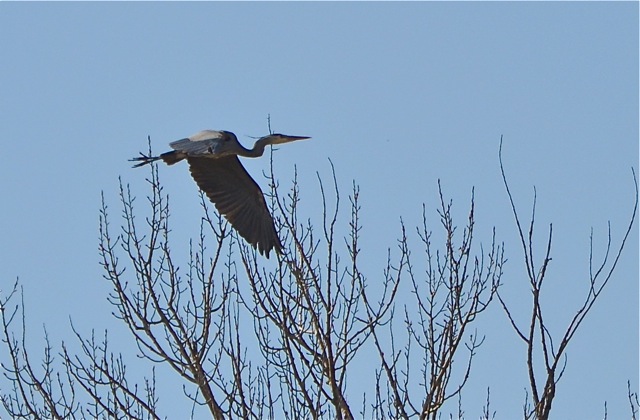
My patience paid off as I waited and finally saw the Herons come out of their nests. Just to stretch their legs:

Great Blue Heron Flying

Just stretching

Just stretching the legs

Again, from afar, they were black against the pale blue sky, too far for me to see clearly. Not until after I uploaded onto my computer and cropped them could I see a bit of their details. They look magical, albeit still blurry.

And yes, they are blue:

Pale blue

***

Saturday Snapshot is hosted by Alyce of At Home With Books. Click Here to see what others have posted.

***

Proust Read-Along: Swann’s Way Part One, Combray

Reading these first 264 pages of Proust conjures up some of my own memories…

I was sitting in a graduate class. A fellow student was doing a presentation on phenomenology. He brought into class a chocolate cake, cut it and gave each of us a piece. We were to describe this particular act of ‘Eating chocolate cake in class’.

What elicited only single words or phrases from us, Proust could have written pages. Why, from pages 60 to 64 the narrator details his experience of eating four morsels of the little cakes ‘petites madeleines’, the uplifting sensation, the taste, the action of dipping them into tea before eating, and the diminishing enjoyment after each mouthful. Above all, he relays how the very act of eating these madeleines has evoked long-buried childhood memories of Combray:

… in that moment all the flowers in our garden and in M. Swann’s park, and the waterlilies on the Vivonne and the good folk of the village and their little dwellings and the parish church and the whole of Combray and its surroundings, taking shape and solidity, sprang into being, town and gardens alike, from my cup of tea. (p. 64)

I don’t pretend to understand everything I read. Far from it. These first 264 pages of Proust’s seven volumes of In Search of Lost Time for me is a learning experience. I have to read through ambiguity, discard the expectations of clarity and congruity, accept incomprehension and press on. But an experience still, and surprisingly, an enjoyable one. An eye-opener too. Where have I read a sentence of 31 lines (p. 67-68) in such flowing prose, with such sensitivity and nuanced observations? And I must add, which I read at 1 a.m. I’m a quick study.

Sure, the unexamined life is not worth living. Proust must have plowed through his to the single second, and in depth too, as the madeleine-eating episode reveals. Insomnia sure has its benefits… arousing volumes of memories for the narrator.

Proust Book

From this first reading I’m surprised to find Proust’s subject matter comes from the mundane, from people and places in the village Combray where the narrator would go to stay for a period of time every year as a child. Even more a surprising delight is the loquacious way he describes the events, the people, the scenery, and the insights he can generate from the minutest observations.

A tiled roof is a tiled roof, okay, it looks more beautiful reflected on the river. But I was struck by how the narrator caught himself with speechless admiration, and ironically, articulating it with lucidity and humor:

The tiled roof cast upon the pond, translucent again in the sunlight, a dappled pink reflection which I had never observed before. And, seeing upon the water, and on the surface of the wall, a pallid smile responding to the smiling sky, I cried aloud in my enthusiasm, brandishing my furled umbrella: “Gosh, gosh, gosh, gosh!” But at the same time I felt that I was in duty bound not to content myself with these unilluminating words, but to endeavour to see more clearly into the sources of my rapture.  (p. 219)

Indeed, humor is another surprising find for me. In several places I’ve put down on the margin of the page, LOL!

So, I’ve quickly learned to go past those passages and sentences that have lost me, but soon as I come to something I can comprehend, and do resonate, I’d stop and reread, savoring the beauty of that moment.

My favourite passages include the heartbreaking accounts of the child’s longing for his mother’s goodnight kiss, the description of the church St. Hilaire where he goes to Sunday mass, the pages depicting the river Vivonne and the hawthorn trees in Swann’s park, the child’s discussions with Swann on reading and books, and his frustration with writer’s block as he strives to write poetry as a youngster.

But there is one passage I must mention. That is about the child’s Mamma caring to talk with their house maid and cook Françoise, asking her little questions about her feelings for her own family:

Francoise answered, laughing: ‘Madame knows  everything… [like] the X-rays that they brought here for Mme Octave, and which can see what’s in your heart’ — and she went off, overwhelmed that anyone should be caring about her, perhaps anxious that we should not see her in tears: Mamma was the first person who had given her the heart-warming feeling that her peasant existence, with its simple joys and sorrows, might be an object of interest, might be a source of grief or pleasure to someone other than herself (p. 73).

This, I think, is exactly what Proust has done.

Seeing the extraordinary in the ordinary, the village life, the kitchen and the table, the interactions and socializing, family relations, walking the country paths, the irises and the hawthorns… Reading this first part reminds me of paintings by Pieter Bruegel, or Van Gogh… and, not far from eating chocolate cake.

***

How’s your reading so far?

Janell of An Everyday Life

tuesday in silhouette

Wrap up post on Parts Two and Three: May 15.

***

Saturday Snapshot April 13: Bohemian Waxwings in Flight, Defying Grey

I had the chance to see the elusive Bohemian Waxwings converge in the past weeks. Now they are gone. From afar, they may evoke images from a Hitchcock movie:

Flocks of Bohemian Waxwings

But just a closer look would change your view… Avian Cirque du Soleil, acrobats of the sky:

Avian Cirque du soleil

Or… flight aesthetics, mesmerizing to behold:

Avian Aesthetics

I would have wanted a clear blue sky. But the grey offers a deeper fascination. These energetic Waxwings seem to defy the overcast dreariness, exuding a spirit and an aesthetics that colour cannot bring.

***

Saturday Snapshot is hosted by Alyce of At Home With Books.

All photos taken by Arti of Ripple Effects, 2013. All Rights Reserved.
I regret the obtrusive watermarks. I could well have positioned them down in a corner to enhance aesthetics. But practicality took over… hopefully they are deterrents of copying.

***

Roger Ebert, A Close Encounter

In memory of Roger Ebert, I will recount an unforgettable experience I had two years ago. I took the following photos, which now are even more memorable.

He was still tweeting just two days before his passing on April 4. Ebert’s presence and influence had been ubiquitous over his four-decade career as a film critic. But it just takes one single encounter to make all the difference to me.

***

Thanks to the Toronto International Film Festival, in September 2011 I had the chance to meet the legend. It was only natural for me to think that wherever there were film festivals, there were film critics. But I never would have thought that I would see Roger Ebert in person and to shake hands with him.

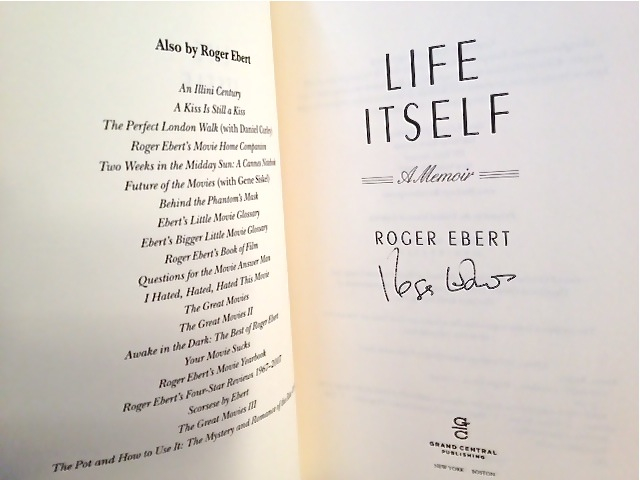
It was pure serendipity. While browsing in Indigo Books on Bay Street, I noticed a sign saying Roger Ebert would be in that store signing his memoir Life Itself a few days later. I had long followed his reviews since his “Siskel and Ebert” days, the two-thumbs-up duo. By the way, Ebert’s right thumb-up had been trademarked. Reviewing films for the Chicago Sun-Times since 1967, Roger Ebert was the first film critic to win a Pulitzer Prize for criticism (1975). He remained prolific even unto his last days.

Roger Ebert autograph Life Itself

So after seeing the sign I was thrilled to know I would have a chance to see Ebert in person, right there in Toronto. To me, such an encounter was not just about an autograph, or seeing a celebrity up close. It was about seeing a man who after torturous cancer treatments and surgeries for his thyroid, salivary gland and jaw, had lost a part of his face and the ability to talk and eat, and yet still maintained his humor and passions, who continued to press on to new ventures… this was about seeing life itself.

In the late afternoon on September 14, 2011, at the signing area in Indigo Books on Bay Street, people had been lining up for over an hour. I was one of them. At 7 pm, Roger came in walking slowly and with aid, stepped on stage and faced the crowd.

Ebert Signing

Together with his wife Chaz, they gave us a wave. Then he sat down and began signing. Photographs were allowed except for the rule of no posing. I waited my turn to go up to him, shake his hand and get his autograph in my copy of his memoir.
The Q & A session also began.

Roger’s wife Chaz was his voice. Personable and a film lover herself, Chaz shared some of her views of the TIFF selections. As executive producer of “Ebert Presents at the Movies”, she answered some questions without consulting Roger. But for most questions addressed to Roger, he would write in a small coiled notebook, handed it to Chaz to read out his answer.

Roger & Chaz

Here are some of the notes I had taken. Keep in mind this was a casual Q & A session in September, 2011. I’m sure Roger’s view towards 3D and CGI had changed considering his 4-star review of Ang Lee’s Life of Pi.

Q. Who influenced you the most?
A. He pointed to his wife standing behind him.

Q. Which decade is your favorite?
A. The 70’s… where you had The Godfather, Raging Bull…

Q. Buster Keaton or Charlie Chaplin?
A. Buster Keaton, albeit both are great.

Q. 3D?
A. Don’t ask. Story is number one.

Q. CGI (computer-generated imagery)?
A. Movies with CGI are soulless.

Q. All time best?
A. Citizen Kane.

Q. Favorite actor?
A. Robert Mitchum.

Q. Contemporary?
A. Al Pacino, Philip Seymour Hoffman, Tilda Swinton

Q. Favorite Canadian directors?
A. Atom Egoyan, David Cronenberg, Norman Jewison, Guy Maddin (thumb up)

Q. James Cameron?
A. Is James Cameron Canadian? Chaz asked in surprise.

Q. Favorite book?
A. A Fine Balance by Rohinton Mistry (Canadian! A voice came from the back)

Q. Any pressure from movie producers to write a good review?
A. No, he hasn’t been pressured. He was beyond reproach, Chaz answered.

Q. Any movies you haven’t seen?
A. The Sound of Music

Q. If there’s a movie made about you, who’d you want to play you?
A. Philip Seymour Hoffman. Chaz added, Oprah to play me. Diana Ross would be good too.

Q. Advice for potential film critics?
A. Do you want to get paid?

Q. Yes and no. (The questioner covered all bases.)
A. Start blogging. Roger replied. 

Q. How does your life influence the way you review a film?
A. It generates every word.

Definitely more than just an autograph. What an encounter. What a night.

***

Photos of Roger Ebert were taken with just a pocket camera at the event, book autograph page shot with iPhone at home.
Saturday Snapshot is hosted by Alyce of At Home With Books. Click Here to see what others have posted.

Before I Go To Sleep by S. J. Watson

Before I Go to Sleep47 year-old Christine has lost her memory for twenty some years due to trauma. She wakes up every morning to a forgotten past. She spends her day piecing together a life, who and where she is, her personal history, and, who her husband Ben is. Upon the advice of Dr. Nash, she writes it all down in a journal before she goes to sleep at night, for she’ll wake up the next morning wiped clean of her day old memory once again.

The book deals with some interesting issues. If the past is horrible to recall, would it be better if one does not remember, or, would one be better off knowing the truth despite pain? Is one made more vulnerable by knowing or not knowing? Further, if mental images conjure up, how can one be sure they are memories of actual happenings and not one’s imagination?

Author S. J. Watson leads the reader into a maze of intrigues, teasing us with an unreliable narrator Christine, casting shadows of imminent dangers, and trying to capture us with her vulnerability. So memory loss is an effective plot device, keeping us in the dark guessing, creating suspense, and revealing ever so slowly what really had taken place that caused the amnesia to set in, and how she could ever escape.

The book starts off with a most interesting scenario as Christine wakes up to an unknown world, but towards the middle it seems like it has forgotten that it is just the protagonist who has amnesia, not the readers, as it repeats the facts and descriptions with Christine’s journal entries. The last part is a page-turning thriller, albeit with a relatively improbable ending. The last pages explaining everything with a neatly wrapped up ‘here you go, see how logical it is’ kind of finish.

Memories… such a thematic element can be exceptionally gratifying to explore with deeper characterization. Surely the author has brought up the idea that memory defines us, a reader seeking for a more contemplative rendering of such a concept would be disappointed however, for Watson has chosen to use this interesting thematic material to craft a suspense thriller and not an idea-driven literary work. So what we have with notions relating to memories, to the nature of our identity and personality… etc. are merely used to build up a suspenseful plot. As a thriller, the book aims to lead on and not delve in.

Am I being a bit harsh here? Why, I just caught myself. I could well have been more lenient if I were not reading it along with Proust’s In Search of Lost Time (Remembrance of Things Past). Am I being fair to make comparison? It’s like comparing apples with oranges. Yet the coincident is too fascinating… both deal with remembering and sleeping, albeit one trying to fall asleep while the other trying not to. Just thinking… even the book covers that I have are similar.

Lots of ‘I love you’s’ are uttered, but none that can stir up any emotions in me the reader. Several films kept conjuring up in my mind as I read… Memento, Eternal Sunshine of the Spotless Mind, The Vow, and I must say the latter two managed to stir some affective resonance in me while exploring the topic of amnesia and a love relationship. But with this book, I just wanted to race to the end. For some, this might well be proof of an entertaining read.

And that is why I have high hopes for its film adaptation. Yes, I must applaud Watson for his strong debut. This novel published in 2011 has gained awards and accolades, on the bestseller lists in several countries, and translated into 30 plus languages. Its film rights has been snatched up by Ridley Scott. Filming now, it features the impressive cast of Nicole Kidman as Christine, Colin Firth (The King’s Speech) as Ben, and Mark Strong (Zero Dark Thirty) as Dr. Nash; Anne-Marie Duff (Nowhere Boy) is also on board. This is definitely a film I want to watch, not just because of the actors, but the screenwriter Rowan Joffe, who will direct as well. Joffe has shown us, with his script for The American (George Clooney stars) that yes, sometimes the film can be better than the book. Let’s hope this is also the case.

In the end page Watson notes that his novel, though totally fictitious, is inspired by actual medical cases, particularly that of Clive Wearing‘s, the British musicologist, conductor and BBC music producer, who has the same condition as Christine’s, albeit his is an even shorter memory span, just a short minute or so. His real life accounts have been recorded by his loving wife Deborah Wearing in her book Forever Today: A Memoir of Love and Amnesia. While he lives in the constantly present, he does not forget music or his love for his wife. Now that would be one inspiring book to read.

***

Click here to watch a short clip on Clive and Deborah Wearing on YouTube. Does he not remind you of another real life character, a pianist, whose life had also been made into a movie?

Just another Easter thought

This Luci Shaw poem was read out in the Tenebrae service I attended on Good Friday.

***

P1000367

Judas, Peter

because we are all
betrayers, taking
silver and eating
body and blood and asking
(guilty) is it I and hearing
him say yes
it would be simple for us all
to rush out and hang ourselves

but if we find grace
to cry and wait
after the voice of morning
has crowed in our ears
clearly enough
to break our hearts
he will be there
to ask us each again
do you love me

— Luci Shaw

***

A Happy Easter to all!

Saturday Snapshot March 30: Tenebrae

Tenebrae is Latin for shadows. I was in a Tenebrae Good Friday service yesterday, a symbolic visualization of the Easter narrative.

7 candles

Seven lit candles were gradually extinguished between scriptures, poetry, and music, symbolizing the imminent death of Christ. Ultimately only the centre flame, the Christ candle, was burning. Momentarily, it too was snuffed out.

“Then [Peter] began to curse and swear, ‘I do not know the man!’ And immediately a rooster crowed.” — Matthew 26:74

Total darkness.

Tanabrae

Later, the single Christ candle was relit… the resurrection, light illuminating darkness again. The solitary flame is in the lower left in the above photo.

***

Saturday Snapshot is hosted by Alyce of At Home With Books. These two photos were taken from where I sat, using my iPhone.

***

Diary of a Country Priest: An Easter Meditation

Last year around this time, I wrote about the book The Diary of A Country Priest by French author Georges Bernanos, (Journal d’un curé de campagne, 1936). I’d like to repost my review this week, for every time I read it, I find the essence of Easter.

***

The Diary of a Country Priest Book Cover

A young priest comes to his first parish, the rural town of Ambricourt, filled with humble hopes. All he wants is to serve the people, to give of himself, to bring God’s love. But as soon as he sets foot in the village, he is engulfed by hatred and rejection. There are dark secrets too sinister to be exposed. The young priest is an unwelcome alien. In a town afflicted by hypocrisy, pride, anger and bitterness, he is despised, taunted and ridiculed. His own innocence is no match even for the children in his catechism class, especially the precocious Seraphitas, a girl ‘with a hardness far beyond her years.’

Ambricourt is a world afflicted by the ‘leprosy of boredom’, a microcosm of the human condition. Bernanos uses diseases to illustrate his point well. The young priest himself is being slowly consumed by terminal illness. The pain in his stomach ultimately defeats his body, cancer. His diet consists mainly of bread dipped in wine which he makes for himself, and some potato soup. Poverty of means, but also frailty of body to take in solid food. Many a times we see him in the Garden of Gethsemane, pleading for strength in anguish. But he faithfully presses on, using his diary to confide his deepest thoughts, a means to commune with his God.

On the outskirt of Ambricourt is the Château of the powerful M. le Comte. The Count needs no priest to know about his adulterous affairs, this time, with the governess Mlle Louise. His wife Mme la Comtesse is totally absorbed by her long-held bitterness and grief from the loss of her young son. And his daughter Mlle Chantal is a deeply disturbed girl eaten up by anger and jealousy. Soon, she will be sent away to England, a most convenient plan devised by her father.

It is with this deep mess of a family that the young priest finds himself entangled. The most intense scene of the whole book, the climatic moment, comes when the priest goes to the Château to meet with Mme la Comtesse. She lost her beloved son when he was only eighteen months old, a child hated by his jealous older sister Chantal.

On his last day they went out for a walk together. When they came back my boy was dead.

Mme la Comtesse is fully engulfed by hatred for her daughter, grief for her lost son, and bitterness towards God.

Hearing her speak, a tear flows down the face of the young priest. “Hell is not to love any more, madame.” The young priest responds. And with miraculous strength, he delivers the following words.

… But you know that our God came to be among us. Shake your fist at Him, spit in His face, scourge Him, and finally crucify Him: what does it matter? It’s already been done to Him.

Towards the end of some soul piercing exchanges, Mme la Comtesse kneels down, releases her pain, and receives blessings from the young priest. Afterwards, she writes to him in a letter:

… I have lived in the most horrible solitude, alone with the desperate memory of a child. And it seems to me that another child has brought me to life again…

And this young child, a priest, consumed by illness, wreaked by frailty of spirit, can only marvel at the power through weakness:

Oh miracle — thus to be able to give what we ourselves do not possess, sweet miracle of our empty hands!

Not long after this, he succumbs to his illness. A life too short, a mission seems unaccomplished. But his last words faintly uttered on his deathbed are as powerful as the God who sends him:

Does it matter? Grace is everywhere…

And in the film, these three words leave me with one of the most impressive endings of all the films that I’ve seen:

“All is grace.”

 ***

~ ~ ~ ~ Ripples

CLICK HERE to read my film review of The Diary of a Country Priest.

The Diary of a Country Priest by Georges Bernanos, translated by Pamela Morris, Perseus Books Group, Philadelphia, PA, 1965, 298 pages.

Journal d’un curé de campagne, 1936, was winner of the Grand prix du roman de l’Académie française.

Saturday Snapshot March 23: Bohemian Waxwings

I came looking for them… Bohemian Waxwings, nomadic passerines, and I wasn’t disappointed. From a distance, I could hear their calls even before seeing them, buzzing, chirping, echoing, convivial. Flocks of them, maybe even a couple hundreds.

From a distance, I could see them congregate on tree tops, the sight could not match the sound. If not with intention, one could well dismiss them from afar, those ‘blackbirds’ on the trees, common sight, right?

Flocks of birds

But no. A closer look could tell they’re not ordinary at all. Their pose is elegant. And they’re not blackbirds. Here’s just a small corner of a tree, reminiscence of images on quilts and tapestry:

Image for quilts and tapestry

And a little more up close, one could sense their gregarious and convivial nature:

Convivial

Not until I went home, uploaded and cropped the photos could I see their silky plumage, fine and translucent, their pointed crest, the colourful markings on the wings, the yellow-tipped tails:

Bohemian Waxwings

Waxwing

Because of their nomadic nature, they can be here today, gone tomorrow. No wonder… they’re one of the birds included in the bucket list book: 100 Birds to See Before You Die. 

1 down, 99 to go…

***

Saturday Snapshot is hosted by Alyce of At Home With Books. CLICK HERE to see what others have posted.

Quotable Quotes from Downton Abbey Season 3

These are some of my favourite lines from Season 3. They remind me of why I enjoy Downton Abbey in the first place, the humor and subtext, and the superb cast that delivers every time.

Episode 1

The family must never be a topic of conversation. – Violet Crawley

Miss O’Brien, we are about to host a society wedding. I have no time for training young hobbledehoys. – Mr. Carson

Daisy: You’ve still kept me here with a dishonest representation.
Mrs. Patmore: Oh dear. Have you swallowed a dictionary?

Don’t worry about me. I’m an American. Have gun, will travel.  – Cora

Have gun will travel

Forgive, perhaps. Forget, never. – Violet

Come war and peace, Downton still stands and the Crawleys are still in it. – Martha Levinson

Mary, dearest Mary. Now, you tell me all of your wedding plans. I’ll see what I can do to improve them.  – Martha

Edith: There you are. I see you’ve said hello to Grandmama.
Violet: She is like a homing pigeon. She finds our underbelly every time.

I should hate to be predictable. – Mary to Matthew, at her wedding altar

Episode 2

Let me call you sweetheart...

Nothing succeeds like excess. – Violet

Are you not popular downstairs? – Robert to Thomas

Some animals adapt to new surroundings. It seems a better choice than extinction. – Martha to Robert

Well, in my opinion, to misquote Dr. Johnson, if you’re tired of style, you are tired of life. – Mr. Carson

Episode 3

At my age, one must ration one’s excitement.  – Violet

Let him go, let him go. You know he’s right. Don’t stop him doing the only sensible thing he’s come up with in months. – Violet to Edith at the altar

Being tested only makes you stronger. – Cora to Edith

If the poor don’t want it, you can bring it over to me. – Violet to Carson re. the wedding food.

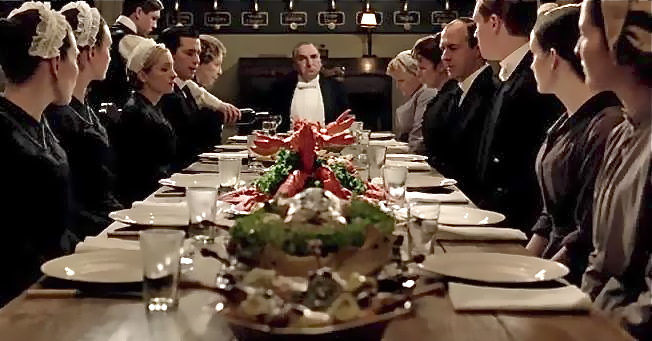
Wedding gourmet for downstairs

And the food? Here it is… probably the best quote of the Episode. In answering Alfred’s remark of: Is this all we’re getting? Just these picketty bits:

These are canapés, Alfred. For your first course, some truffled egg on toast, perhaps? Some oysters a la Russe? There’s lobster rissoles in Mousseline sauce or Calvados-glazed duckling, or do you fancy a little asparagus salad with Champagne-saffron vinaigrette? – Thomas and Mrs. Patmore

Episode 4

Robert: What a harsh world you live in.
Tom: We all live in a harsh world. But at least I know I do.

Carson: But Alfred is very good, you know. He’s very willing. Even if he is Miss O’Brien’s nephew.
Matthew: Clearly, nothing worse could be said of any man.
 

Episode 5

Cora: Sir Philip mustn’t bully him into silence.
Robert: My dear, this is just Clarkson’s professional pride like barbers asking, “Who last cut your hair?”

A woman of my age can face reality far better than most men. – Violet

Sybil, Tom & baby

Edith: She was the only person living who always thought you and I were such nice people. Oh Mary… Do you think we might get along a little better in the future?
Mary: I doubt it. But since this is the last time we three will all be together in this life, let’s love each other now, as sisters should.

Episode 6

There hasn’t been a Catholic Crawley since the Reformation. – Robert

Anyone who has use of their limbs can make a salmon mousse. – Mrs. Patmore

You know the trouble with you lot? You’re all in love with the wrong people. Now take those upstairs! – Mrs. Patmore

Robert: I’m flabbergasted.
Cora: You’re always flabbergasted by the unconventional.

Dr. Clarkson: So you want me to lie to them and say there was no chance at all?
Violet: Lie… is so unmusical a word. I want you to review the evidence honestly and without bias.
Clarkson: Even to ease suffering, I could never justify telling an outright lie.
Violet: Have we nothing in common?

Episode 7

Bates and Anna

But in the meantime, you just rest. Stay in bed, read books. – Robert to Bates

Convince me again. – Matthew to Mary

I do think a woman’s place is eventually in the home, but I see no harm in her having some fun before she gets there. – Violet

What is The Scarlet Letter? – Violet

Robert: Second [condition], you will both admit it when you realize you were wrong.
Violet: Oh, well that is an easy caveat to accept because I’m never wrong.

What’s the matter, Robert? Are you afraid you’ll be converted while you’re not looking? – Cora

Episode 8

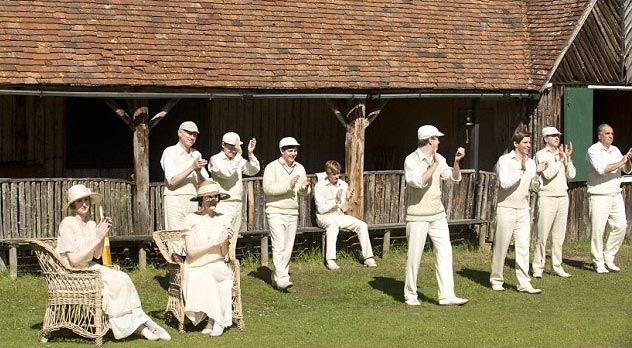
Cricket Match

Matthew: Bates must count himself lucky to be out of it [cricket match].
Anna: I think he’d like to walk normally, sir, even if playing cricket was the price he had to pay.

She hates London, so she’s coming to a great-aunt in Yorkshire to have a good time. How original. –Isobel to Violet re. Rose

Isobel: Of course, if you had had to sell Charlie to the butcher to be chopped up as stew to achieve the same ends, you would have done so.
Violet: Happily, it was not needed.

Episode 9 Finale

Edna: He’s nice looking, I give him that.
Mrs. Hughes: I don’t think you’re required to give him anything.

Don’t dislike him before you know him. That’s the hallmark of our parents’ generation, and I forbid it.  – Matthew to Mary, re. Gregson.

What I want is for her [Rose] to know that family can be a loving thing… Love is like riding or speaking French. If you don’t learn it young, it’s hard to get the trick of it later.  – Shrimpie

Matthew: I fall more in love with you every day that passes.
Mary: I’ll remind you of that next time I scratch the car.

Downton Abbey Christmas Special

*

Oh, but it’s more than just a scratch in the car. We’ll forgive, but not forget. – Arti

*

CLICK HERE to Quotable Quotes from Downton Abbey Season 1 and 2

***