Dances with Words

After listening to an audiobook, do you consider having read the book?

Why or why not?

I’ve been mulling over this question for some time now. I love reading, but I’m a slow reader. It’s always faster to listen to a book read to me than reading it myself. So you see the appeal there. And I can make good use of my time while driving.

But I always feel there’s a difference between listening and reading. All along, I don’t equate having listened to an audiobook with having read the printed pages. I’m beginning to find the word ‘finish’ most apt, since it can apply to both. Saying ‘I have finished a book’ can mean either.

Oral tradition of storytelling has long been around in human history, a way to preserve tales and legends that had not found a written form. But for those that do have a life in words, or, ‘texts’ in our eAge, why do I still hesitate to consider listening to them the same as reading the print version?

At long last, I think I’m beginning to get a hold of what could be the difference… and this may sound so common sense to you. But, it’s an Eureka moment for me.

Here it is: Reading a book is a first-hand encounter. I’m the sole interpreter of the text. Like partners in a dance, as a reader I respond and move with every single word in my own way.
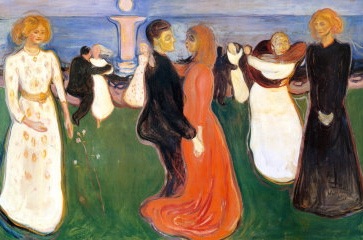
The Dance of Life by Edvard Munch (1900)

With audiobooks, I’m listening to a voice that has already interpreted the written codes. Every audio recording is a performance. And I mean it in a good sense. The reading I’m listening to has passed through an interpretive filter. That voice must have first read the words, internalized, and then delivered them with what the voice thought was the appropriate diction, pitch, accent, tempo, emotion…

When I’m reading a book, I’m dancing with the words as partners. When I’m listening to an audiobook, I’m watching a dance performance. I enjoy both. But the experiences are different… and there’s only one first-hand encounter that’s unique to me: my own.  But sometimes, I need to see how others dance too in order to appreciate the story or the characters more. We just may need dancing lessons every now and then.

I must give kudos to two audiobooks I finished recently. In both of them, the voice reading the text confirms how fascinating dances with words can be.

On Beauty by Zadie Smith, read by Peter Francis James:

I’m amazed how one reader can give life to characters of various cultural background in such a vivid manner. On Beauty explores in a nuanced and comical way, relationships and conflicts within a family, as well as between races, generations, and genders. It was shortlisted for a Booker (2005) and was the Orange Prize winner in 2006. Now imagine the myriad of characters.

The book describes two families intertwined in a cacophony of cultural dissonance, the fathers being academic rivals. In the Belsey family we have father Howard who is a white Englishman, his African American wife Kiki, their three youthful offspring who have grown up in America influenced by different subcultural vernaculars. Melting pot is a wrong term to describe them. It’s more like you’ve thrown classical, jazz, hip-hop, rap, all into the wok and stir fry.

Howard’s academic rival is Monty Kipps, who has brought his family from England to stay in America shortly as a visiting scholar teaching at the same college as Howard. The Kipps family members are all British citizens with Trinidadian heritage. Their two college age children have grown up in England.

The talented actor Peter Francis James has given a worthy portrayal of such a cultural mix of characters without turning them into caricatures, but has rendered them convincing and real. Zadie Smith’s nuanced dialogues and humor are well executed. It is a close encounter of dissonance in language, accents, values, and racial influences. What a dance performance this is. I have not read the book, but when I do read it, I’m sure I will not appreciate it as much if I haven’t heard the voices jumping up and down in my mind.

Gilead by Marilynne Robinson, read by Tim Jerome

Gilead was the 2005 Pulitzer Prize fiction winner. I read the book a few years back. Listening to the audio CD’s recently has not only brought back memory of my previous enjoyment, but insights that I’d missed my first time reading the book. All thanks to the calm, soothing, and gentle voice of Tim Jerome, portraying spot-on the ageing John Ames, Congregationalist minister of Gilead, Iowa.

Throughout the book, there’s only one character speaking, that of John Ames leaving a legacy to his very young son, telling him stories of his own grandfather and father, a family tradition of ministers. Jerome’s audio rendition of the book works in me like a devotional. His voice embodies grace and forgiveness. Listening to him can only augment my own reading experience, a performance to emulate for the dance of life.

***

What are some of your experiences of reading vs. listening to books? Which are your favorite audiobooks?

***

This is My Spring…

… and I’m fine with it.

I’ve seen lush green meadows, full bloom flowers, and fresh plump berries from many of your spring posts. I must share with you what I’m getting…

It’s a long process before green appears, but we’re used to that. Spring for us is a gestation of life, a long process. There can be false starts too, teasing us with more snow. It tests our patience.

First we wait for all the snow to melt:

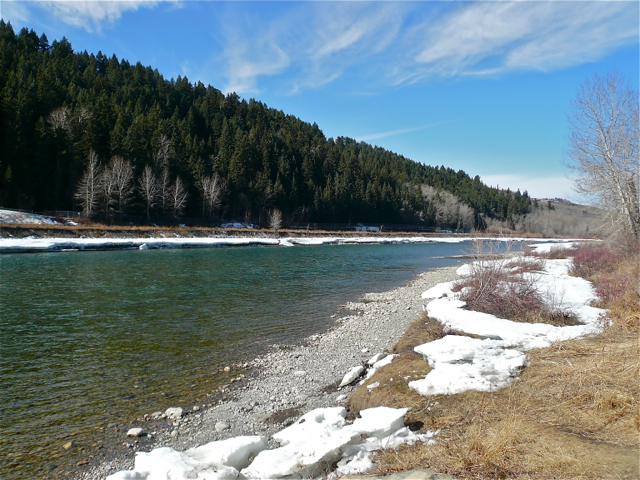
The melting Bow River
Another view, another colour

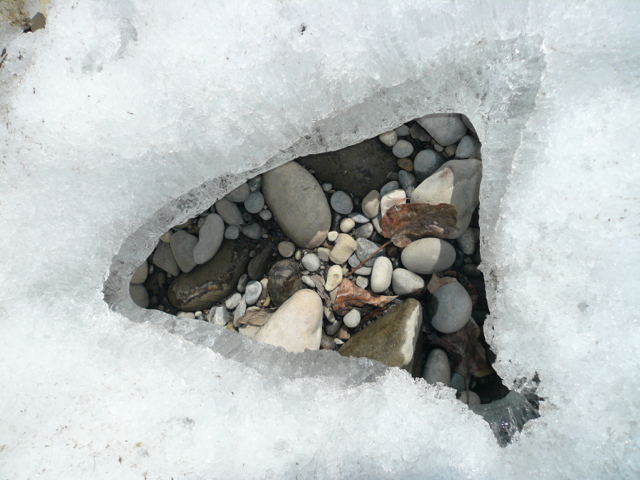
A closer look only fascinates me more, the sight and sound of spring… a rythmic ploink… ploink.

Dripping ice water
Icy frame of a kaleidoscope

The slowness of spring allows me to cherish a while longer the sights of a season past:

Snow bank along the Bow
Remnants of a colourful fall

Meanwhile… the buds silently appear. No greens yet, but still a sure sign of spring. Brown tips burgeoning out everywhere, keen and strong:

Sure sign of spring

Before the greens, many colours have to parade by, nature’s processional. As a spectator, I can only applaud.

Spring will burst forth in all its glory…  in its time.

***

Diary of a Country Priest: Film Adaptation (1951)

For me, the cinema is an exploration within. — Robert Bresson (1903-1999)

Robert Bresson is one of the most influential figures in French cinema. The acclaimed New Wave director Jean-Luc Godard once noted: “Robert Bresson is French cinema, as Dostoevsky is the Russian novel and Mozart is German music.”

I know, Austrians would say Mozart was Austrian. But this just shows his influence can cross borders. Same with Bresson, who is acclaimed as one of the forefathers of the French New Wave, even though his style is not experimental. The iconic Swedish director Ingmar Bergman had specifically cited Diary of a Country Priest as influence for his Winter Light.

Before Bresson adapted Diary of a Country Priest, two previous screenplays were attempted by others but turned down by the author Georges Bernanos himself. Bresson’s film was made after Bernanos died. Bernanos had nothing to worry about with Bresson’s interpretation, for the film is an almost literal and a worthy cinematic translation. It won the Prix Louis Delluc in France (best film of the year) and several international film awards. Bresson was given the Career Golden Lion at the 1989 Venice Film Festival.

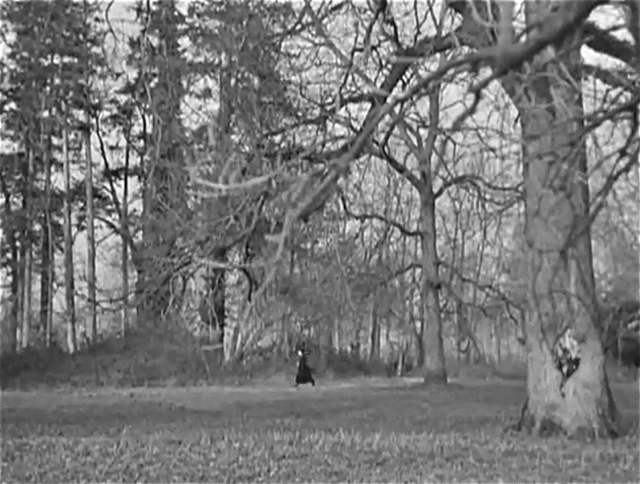
That Bresson, a professed agnostic, would choose to adapt a work by the Catholic writer Bernanos shows the moving power and the universal appeal of the book. The parish of Ambricourt is a microcosm of the human world. The seemingly placid village hides a spiritually barren landscape and a cocoon of depravity. The young priest, an unwelcome alien, is captured cinematically as small and vulnerable, an apt depiction of how he feels within:

An outsider barred from a gated mansion of dark secrets, like here at the front gate of the Château.

The light comes into the world, but the darkness refuses it. On screen, we see the young priest often shut out of gates and windows. The glass pane allows him to be observed from the inside, yet he is very much on the outside isolated, the weight of the world heavy on his face.

Bresson’s style is minimal, you may find this film somewhat austere. But I’m gratified by such style, devoid of color and whatever additives we find in movies today. Instead, every frame conveys an aesthetic simplicity and thematic purpose.

To explore the drama within, Bresson chose ‘non-actors’. “As far as I can, I eliminate anything which may distract from interior drama,” Bresson was quoted saying, and distractions included ‘acting’. He selected his ‘models’ (as he called them, not ‘actors’) first for their voice. He particularly looked for inexperience. The young Curé of Ambricourt was Claude Laydu’s first film role. Others that Bresson used were often one-time actors just for the film he was making.

The Criterion Collection DVD has a most helpful commentary by film historian Peter Cowie. His insight is invaluable to the appreciation of Bresson’s adaptation. One of his remarks is the off-screen sounds we often hear in a scene. The most intense one would have to be the climatic spiritual battle between Mme la Comtesse and the young priest. Totally engulfed by grief, hatred and bitterness, and living in isolated misery all the years since her young son died, Mme la Comtesse finally releases her pain and receives blessings from the priest. And what sound do we hear off-screen the whole time they are engaged in this soul-piercing scene in the drawing room: the gardener’s raking of dead leaves.

Another source I’ve often sought out is the book written by Paul Schrader: Transcendental Style in Film: Ozu, Bresson, Dreyer. Yes, if I must choose a word to describe Bresson’s style, I would use Schrader’s term: transcendental. His minimal, aesthetically simple, ‘non-acting’ style raises the viewer to a meditative plane which is beyond the material, beyond all distractions. That’s the essence of cinema that I find so meaningful and gratifying.

And finally, despite succumbing to his illness, the young priest leaves a legacy that his superiors, the senior vicars, could not have: an embodiment of the suffering Christ and the redemptive power of grace. Despite his own frailty and ultimate death, the young country priest  triumphs through his faith, however feeble it may have seemed in his own eyes. It does not matter, for all is grace.

~ ~ ~ ~ Ripples

***
AND TO ALL, A HAPPY EASTER!
***
Other related posts on Ripple Effects:
.
.
.
.
***

Diary of A Country Priest: A Book for Easter

Every year around this time, I come back to my perennial read The Diary of A Country Priest by French author Georges Bernanos(Journal d’un curé de campagne, 1936). In this book, I find the essence of Easter.

A young preist comes to his first parish, the rural town of Ambricourt, full of humble ideals. All he wants is to serve the people, to give of himself, to bring God’s love. But as soon as he sets foot in the village, he is engulfed by hatred and rejection. There are dark secrets too sinister to be exposed. The young priest is an unwelcome alien. In a town afflicted by hypocrisy, pride, anger and bitterness, he is despised, taunted and ridiculed. His own innocence is no match even for the children in his catechism class, especially the precocious Seraphitas, a girl ‘with a hardness far beyond her years.’

Ambricourt is a world afflicted by the ‘leprosy of boredom’, a microcosm of the human condition. Bernanos uses diseases to illustrate his point well. The young priest himself is being slowly consumed by terminal illness. The pain in his stomach ultimately defeats his body, cancer. His diet consists mainly of bread dipped in wine which he makes for himself, and some potato soup. Poverty of means, but also frailty of body to take in solid food. Many a times we see him in the Garden of Gethsamane, pleading for strength in anguish. But he faithfully presses on, using his diary to confide his deepest thoughts, a means to commune with his God.

On the outskirt of Ambricourt is the Château of the powerful M. le Comte. The Count needs no priest to know about his adulterous affairs, this time, with the governess Mlle Louise. His wife Mme la Comtesse is totally absorbed by her long-held bitterness and grief from the loss of her young son. And his daughter Mlle Chantal is a deeply disturbed girl eaten up by anger and jealousy. Soon, she will be sent away to England, a most convenient plan devised by her father.

It is with this deep mess of a family that the young priest finds himself entangled. The most intense scene of the whole book, the climatic moment, comes when the priest goes to the Château to meet with Mme la Comtesse. She lost her beloved son when he was only eighteen months old, a child hated by his jealous older sister Chantal.

On his last day they went out for a walk together. When they came back my boy was dead.

Mme la Comtesse is fully engulfed by hatred for her daughter, grief for her lost son, and bitterness towards God.

Hearing her speak, a tear flows down the face of the young priest. “Hell is not to love any more, madame.” The young priest responds. And with miraculous strength, he delivers the following words.

… But you know that our God came to be among us. Shake your fist at Him, spit in His face, scourge Him, and finally crucify Him: what does it matter? It’s already been done to Him.

Towards the end of some soul piercing exchanges, Mme la Comtesse kneels down, releases her pain, and receives blessings from the young priest. Afterwards, she writes to him in a letter:

… I have lived in the most horrible solitude, alone with the desperate memory of a child. And it seems to me that another child has brought me to life again…

And this young child, a priest, consumed by illness, wreaked by frailty of spirit, can only marvel at the power through weakness:

Oh miracle — thus to be able to give what we ourselves do not possess, sweet miracle of our empty hands!

Not long after this, he succumbs to his illness. A life too short, a mission seems unaccomplished. But his last words faintly uttered on his deathbed are as powerful as the God who sends him:

Does it matter? Grace is everywhere…

And in the film, these three words leave me with one of the most impressive endings of all the films that I’ve seen:

“All is grace.”

 ***

~ ~ ~ ~ Ripples

CLICK HERE to read my film review of The Diary of a Country Priest.

The Diary of a Country Priest by Georges Bernanos, translated by Pamela Morris, Perseus Books Group, Philadelphia, PA, 1965, 298 pages.

Journal d’un curé de campagne, 1936, was winner of the Grand prix du roman de l’Académie française.

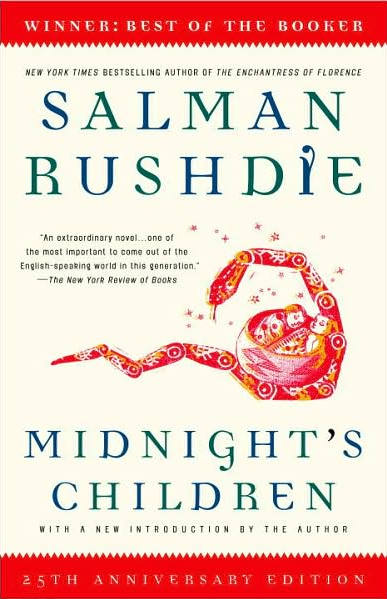
Midnight’s Children by Salman Rushdie, Book One

CLICK HERE to read my Movie Review of Midnight’s Children

***

In his introduction to the 25th Anniversary Edition of Midnight’s Children, Salman Rushdie writes:

In the West people tended to read Midnight’s Children as a fantasy, while in India people thought of it as pretty realistic, almost a history book.

I admit, when I started reading Midnight’s Children, I was frustrated. I knew I just couldn’t read it purely as a fantasy. Why, these are real dates in history, important events, the World Wars, the Mahatma’s call for an independent India with non-violent means, the separation of India and Pakistan along religious lines… There must be more, I told myself. I knew I could never read it as an insider, but I could at least peek through the fences, and get a glimpse of what’s going on inside.

And so I did. I searched for background info and author interviews, both online and off. As a result, my reading pleasure is enhanced after I found out how realistic the novel is. Personal happenings actually correspond with important historical events, not unlike the movie Forrest Gump, little people tossed in the currents of history.

Rushdie in an interview noted that instead of using an Austenesque way to tell his story by focusing on the details and the minute, he chose to adopt a Dickensian approach, placing his characters on a macro, societal canvas. As a result, we have a monumental epic. Mind you, he just wanted to write a novel about childhood, he said.

The narrator, Saleem Sinai, started with his Grandfather Aadam Aziz in 1915, thirty-two years before India’s independence. The young doctor examined his patient and future wife Naseem through a perforated sheet a bit at a time, under the close supervision of her cautious father. When at last she complained of a headache, he finally could see her face, “on the day the World War ended.” It’s pure humor also, and I’ve enjoyed Rushdie’s free wheeling brush strokes.

But often the comical may just serve to bring out more poignantly a sombre reality. When I first read the ‘Mercurochrome’ chapter, it didn’t hit me at all. Later, I read about the atrocity that had actually happened on April 13th, 1919, the Amritsar massacre. British Brigadier-General Reginald E. H. Dyer ordered Marshal Law regulations, banning all assemblies. A large crowd defied his orders and started converging in the compound Jallianwala Bagh for a peaceful protest. Dyer marched fifty riflemen up and ordered them to shoot at the crowd indiscriminately, men, women children.

They have fired a total of one thousand six hundred and fifty rounds into the unarmed crowd. Of these, one thousand five hundred and sixteen have found their mark… ‘Good shooting,’ Dyer tells his men, ‘We have done a jolly good thing.’ (p. 34)

A few days ago, Aadam helped the wounded on the streets and got Mercurochrome all over his white shirt, and had to explain to wife Naseem the red stains were not blood. Now on this fateful day, Naseem assumed the red was Mercurochrome again, but was told, “it’s blood,” and she fainted.

The relevance of the perforated sheet reemerges in the next generation when Amina Sinai, Saleem’s mother, has to learn to love her husband Ahmed Sinai one fragment at a time:

 ‘Who, after all,’ she reasoned privately, ‘ever truly knows another human being completely?’

The last two chapters ‘Methwold’ and ‘Tick, Tock’ strike a chord in me. Why, I’m not totally an outsider after all. For the first fifteen years of my life, I was a colonial. I was born and grew up in the then British colony of Hong Kong. So reading Book One of Midnight’s Children, I feel certain affiliation. It reminds me of my childhood days, which were also filled with multiplicity of cultures, the fusion of languages, and fortunately, the calm co-existence of religions. There were spittoons and Mercurochrome. I was familiar with bilingual usages, aware of the divide between the subject and the ruling, the East and the West. Even now, I can spot the ‘imitation Oxford drawls’. My “Tick, Tock” moment was when I watched on TV here in Canada the last governor of Hong Kong Chris Patten standing in the rain holding the British Colony flag, saying goodbye to all that on July 1, 1997.

Rushdie’s animated style makes his India colourful and fascinating. His characters, descriptions and dialogues are like the splashes of a Pollock painting. That’s where the fantasy comes in, I suppose, on the large canvas of history.

Book One ends with intrigue. Saleem Sinai, it turns out, is a changeling. At the stroke of midnight August 15, 1947, two boys were born, but was soon mixed up by midwife Mary Pereira in a wilful act of self-assertion. This too has its deeper reference:

When we eventually discovered the crime of Mary Pereira, we all found that it made no difference! I was still their son: they remained my parents. In a kind of collective failure of imagination, we learned that we simply could not think our way out of our pasts…

I look forward to reading the childhood of these two changelings Saleem and Shiva, and their  journeys ahead.

***

Here are the other Read-Along Posts for Book One (so far):

Bellezza at Dolce Belleza
Gavin of Page247
Janell of An Everyday Life
Jerikavonalexandra of averydisorientedreader
Colleen of Books in the City 

If you’ve written a post for our Read-Along, do let us know in a comment.

***

CLICK HERE to Book Two: Part A
CLICK HERE to Book Two: Part B
CLICK HERE to Book Three Conclusion

CLICK HERE to read a March 1, 2012 interview of director Deepa Mehta on CBC news.
CLICK HERE to read about the filming of Midnight’s Children.

Great Film Expectations

For an updated list of 2012 premieres of film adaptations, CLICK HERE.

With written works from Suzanne Collins’ The Hunger Games to Shakespeare’s Coriolanus materialized on the big screen, what else can we anticipate in this year and next?

Here’s an update of some upcoming film adaptations from literary works. Great choices for book groups too.

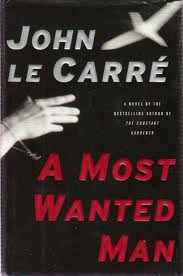
A Most Wanted Man by John Le Carré

On the heels of the acclaimed “Tinker Tailor Soldier Spy”, this time, Philip Seymour Hoffman is the man. Directed by Anton Corbijn whose last film was the deep and thoughtful “The American, a film I found to be much better than the book.

.

Anna Karenina by Leo Tolstoy

Finally, dates are set for the premiere: Sept. 7 in the UK, Nov. 9 in the US. I look forward to this one: Tom Stoppard screenplay, Joe Wright (Atonement, Pride & Prejudice) directs, Keira Knightly as Anna, Matthew MacFadyen Oblonzky, Jude Law Alexai, Aaron Johnson Count Vronsky, and Downton Abbey‘s Michelle Dockery (Lady Mary) as Princess Myagkaya, plus many other British stars.

.

Cloud Atlas by David Mitchell 

Winner of multiple awards and shortlisted for a Booker in 2004, the apocalyptic novel is adapted by Tom Tykwer (Run Lola Run) and The Wachowski’s (Matrix’s). Tom Hanks, Halle Berry, Susan Sarandon, Ben Whishaw (Bright Star), Hugh Grant, Jim Broadbent. Here’s Susan Sarandon’s take on the production.

.

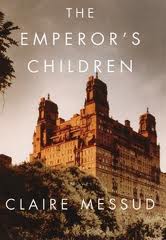
The Emperor’s Children by Claire Messud 

Some big names affiliated with this project are Richard Gere, Eric Bana, Keira Knightly, Emma Thompson, Rachel McAdams. Director Scott Cooper (Crazy Heart) on board. But I can find no more news after this announcement, which is fine, gives me more time to get to the book first. It’s been on my TBR list for a few years now.

.

Great Expectations by Charles Dickens

To coincide with the 200th birthday of Charles Dickens and the Olympics in London, Mike Newell (Enchanted April, Four Weddings and a Funeral) directs, screenplay by David Nicholl (One Day, Tess of d’Urbervilles, When Did You Last See Your Father) who may be also writing the third Bridget Jones movie. Ralph Fiennes is Magwitch, Helena Bonham Carter Miss Havisham, Jeremy Irvine, Pip.

.

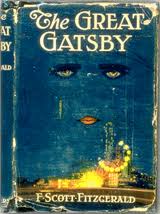
The Great Gatsby by F. Scott Fitzgerald 

What will F. Scott think when he sees his masterpiece produced in 3D in the 21st Century? Woody: do give us a sequel to “Midnight In Paris” with your brilliant imagination. Australian director Bez Luhrmann is poised to bring us this new version of Gatsby in 3D, which I’m sure will stir up lots of discussions. It has already. But no matter how I dislike 3D (except Hugo), I want to see Leo DiCaprio play Jay G., Carey Mulligan, Daisy B., and Tobey Maguire, Nick C. Do Click Here to read a Guardian preview close to 3D.

.

The Guernsey Literary and Potato Peel Pie Society by Mary Ann Shaffer and Annie Barrows

Kenneth Branagh will direct Kate Winslet in this popular novel about the power of literature in desperate wartime. This is a reprise of their cooperation from 1996, when Branagh, as Hamlet, also directed Winslet as Ophelia. No dates have been set for its production or release, but something to keep in mind.

.

The Hobbit by J. R. R. Tolkien

Coming out in three parts. “The Hobbit: An Unexpected Journey” in 2012, and “The Hobbit: The Desolation of  Smaug’ in Dec. 2013, and ‘The Hobbit: There and Back Again’ in July, 2014. Peter Jackson attempts to reprise his Rings Trilogy magic. Elijah Wood, Ian McKellen, Cate Blanchett, Orlando Bloom… the whole gang. Again, we’ll get to see beautiful New Zealand as setting.

.

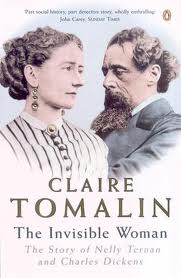
The Invisible Woman: The Story of Nelly Ternan and Charles Dickens by Claire Tomalin

Claire Tomalin’s account of Charles Dickens’ affair with the young writer Nelly Ternan will be brought to screen with script from Abi Morgan (Shame, The Iron Lady) to be directed by Ralph Fiennes, who will play Dickens himself. To add to the rave, Kristin Scott Thomas is also on board. Felicity Jones will be playing Nelly Ternan. Fiennes never ceases to amaze us with his versatility, after directing Shakespeare’s Coriolanus in postmodern style.

.

Les Miserables by Victor Hugo

Tom Hooper of “The King’s Speech” directs an all star cast in this musical offering. Hugh Jackman as Jean Valjean, Russell Crowe as Inspector Javert (is he going to sing too?), Helena Bonham Carter, Anne Hathaway join in the chorus. Just too bad Geoffrey Rush and Colin Firth are missing here. Release date for North America is Dec. 2012, which means it can be a contender in next Awards Season.

.

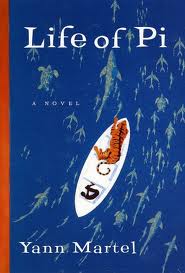
Life of Pi by Yann Martel

Director Ang Lee picked 17 year-old Suraj Sharma of Delhi, India, from 3,000 teenagers to play Pi Patel. Interesting that Tobey MacGuire will play Yann Martel, the author of the book which won the 2002 Man Booker Prize. The film to be shot in 3D has a December 2012 release date. Again, films opening in December usually have eye on the next Awards Season. Will keep our eyes peeled.

.

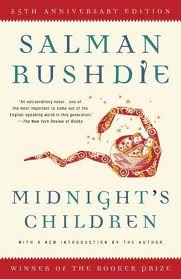
Midnight’s Children by Salman Rushdie

The Booker of Bookers winning work will see its author Salman Rushdie team up with acclaimed Canadian director Deepa Mehta in the film adaptation. Mehta in a recent interview hinted it will debut either at the Venice or the Toronto Film Festival this fall. You can still join us for a slow Read-Along of Midnight’s Children before the film comes out.

.

Rebecca by Daphne DuMaurier 

On the drawing board of Dreamwork and Working Title. Who can take the helm to reprise an adaptation made famous by Alfred Hitchcock, and actors to replace Sir Laurence Olivier as Mr. de Winter and Joan Fontaine as the new Mrs? Now, why does Carey Mulligan emerges in my mind… and Michael Fassbender

.

What Maisie Knew by Henry James

Looks like a good classic to read before seeing the movie. Julianne Moore and Alexander Skarsgård lead the cast. I’ve enjoyed previous Henry James adaptations of The Wings of the Dove, The Golden Bowl, and The Portrait of a Lady. Look forward to this one.

.

Books to be turned into TV series:

The Corrections by Jonathan Franzen

To be adapted into an HBO TV series with an all-star cast under the helm of Noah Baumbach (The Squid and the Whale). Stars include Ewan McGregor, Maggie Gyllenhaal, Rhys Ifans, Dianne Wiest, Chris Cooper and Greta Gerwig. But, will the author be involved in any of the writing?

.

A Visit From the Goon Squad by Jennifer Egan

Again, HBO has bought the rights to this one. The 2011 Pulitzer Prize winner is to be adapted into a half-hour TV series.

.

.

The Art of Fielding by Chad Harbach

Yet again, it’s HBO that will be developing the novel into a TV drama series, another project by the “uber producer” Scott Rudin, who also oversees “The Corrections.”

.

***

What are some of  your most anticipated films or books in the coming year(s)?

Quotable Quotes from Downton Abbey

SEASON 6 Recaps:

SEASON 6 FINALE: Goodbye to All That

SEASON 6 Episode 1, Jan.3, 2016

SEASON 6 Episode 2, Jan. 10, 2016

SEASON 6 Episode 3, Jan. 17, 2016

SEASON 6 Episode 4, Jan. 24, 2016

SEASON 6 Episode 5, Jan. 31, 2016

SEASON 6 Episode 6, Feb. 7, 2016

**

‘You can’t do very much as an actress unless you have the proper words to say…’ — Penelope Wilton, Isobel Crawley

Four weeks have passed since Downton Abbey Season 2 Finale aired on PBS. How are you holding up? To alleviate Downton Abbey withdrawal symptoms, I’ve been in a perpetual state of re-watching all the episodes from Season 1 and 2. Downton Abbey on Blu-ray is absolutely beautiful.

Downton Abbey film location: Highclere Castle

This Golden Globe, Emmy, and BAFTA award-winning miniseries has many appeals. For me, apart from the sumptuous setting, attention to details, great acting, and inspiring cinematography, the main attraction is the writing. Julian Fellowes’ script gives us intelligent dialogues reminiscent of Oscar Wilde’s wit and satire.

I have compiled a list of quotes from both Seasons. Lucky for 78 year-old Maggie Smith, she gets the best lines as Violet Crawley, Dowager Countess of Grantham.

Here they are in chronological order so you can reprise the scene. Enjoy!

Season 1

“O, heavens, girl. You’re building a fire, not inventing it.” — Mrs. Hughes to Daisy, S1E1

“Nothing in life is sure.” — Mrs. Patmore, re. Titanic sinking, S1E1

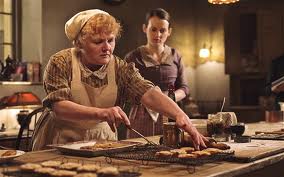
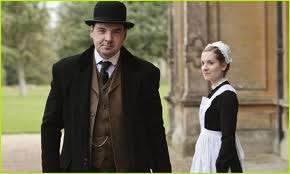
Mrs. Patmore and Daisy

“Every mountain is unclimbable until someone climbs it. So every ship is unsinkable until it sinks.” — Lord Grantham, S1E1

“We are allies, my dear, which can be a good deal more effective.” Violet Crawley, Dowager Countess of Grantham, in reply to Cora Crawley’s “Are we to be friends, then?” S1E1

Violet Crawley, Dowager Countess of Grantham

“What is a ‘weekend’?” — Violet Crawley, S1E2

“Daisy, what’s happened to you? I said you could go for a drink of water, not a trip up the Nile.”  — Mrs. Patmore. S1E3

“Are you afraid someone will think you’re American if you speak openly?” — Lord Grantham to Dowager Countess, S1E3

Dowager Countess and Lord Grantham

“But nobody learns anything from a governess, apart from French and how to curtsey.” Lady Sybil, S1E4

“No one ever warns you about bringing up daughters. You think it’s going to be like Little Women. Instead they’re at each other’s throats from dawn till dusk.” — Cora Crawley,  Countess of Grantham, S1E5

The Crawley Sisters

“Mary can be such a child. She thinks that if you put a toy down, it’ll still be sitting there when you want to play with it again.” — Lord Grantham, S1E5

“I love you Mr. Bates. I know it’s not ladylike to say it, but I’m not a lady and I don’t pretend to be.”  — Anna, S1E5
Mr. Bates and Anna
“If she won’t say yes when he might be poor, he won’t want her when he will be rich.” — Violet Crawley, Dowager Countess, S1E7
.
“First electricity, now telephones. Sometimes I feel as if I were living in an H.G. Wells novel.”  — Violet Crawley, S1E7
*****
Season 2
Mary Crawley seeing Matthew off to war.
 “War has a way of distinguishing between the things that matter and the things that don’t.” — Matthew Crawley, S2E1
.
Matthew Crawley in the trench

“I’m not a romantic… But even I concede that the heart does not exist solely for the purpose of pumping blood.” Violet Crawley, S2E2

“I’m a woman, Mary. I can be as contrary as I choose.” Violet Crawley, S2E4

“Are you like everyone else in thinking that because she’s a countess she has acquired universal knowledge by divine intervention?” Isobel Crawley to Dr. Clarkson re. Cora, Countess of Grantham, S2E4  (And you can substitute the word ‘countess’ with any word you need when quoting it.)

Dr. Clarkson and Isobel Crawley

“I’d rather have the right man, than the right wedding.” — Anna, S2E5

“I’m an American, I don’t share your English hatred of comfort.” Cora Crawley to Lord Grantham, S2E6

Lord Grantham and Cora Crawley

“Don’t be defeatist, dear. It’s very middle class.”  Violet Crawley to Edith, S2E8

“Sir Richard, life is a game in which the player must appear ridiculous.” Violet Crawley, Last Episode, Christmas at Downton Abbey.

“I want a good man for you, a brave man. Find a cowboy in the Middle West and bring him back to shake us up a bit.” Robert Crawley to daughter Mary. Last Episode, Christmas at Downton Abbey.

“1920. Is it to be believed? I feel as old as Methuselah.” Violet Crawley, Last Episode, Christmas at Downton Abbey.

***

DOWNTON RECAPS

DOWNTON Season 5 Finale, March 2, 2015: A Moorland Holiday

*

Season 4 Episode 8 (PBS): London 

Season 4 Episode 7 (PBS) 

Season 4 Episode 6 (PBS)

Season 4 Episode 5 (PBS)

Season 4 Episode 4 (PBS)

Season 4 Episode 3 (PBS)

Season 4 Episode 2 (PBS)

Downton Abbey Season 4 Opening (2 Hour) Special 

*

CLICK HERE to Quotable Quotes from Season 3: New List

*

SEASON 3: EPISODE 1  

SEASON 3: EPISODES 2 & 3 

SEASON 3: EPISODES 4 & 5 (More Downton Quotes)

SEASON 3: EPISODES 6 & 7 Finale

CLICK HERE to visit the Highclere Castle website. An absolute must-see.

*

Other posts you might like:

Quotable Quotes from Downton Abbey Season 3

Downton Abbey The Complete Scripts: Season 1

The Downton Ripples

Lady Almina and the real Downton Abbey: Facts that Give Rise to Fiction

***

The Importance of Being Earnest by Oscar Wilde

To celebrate St. Patrick’s Day, I’d like to post my second selection for the Ireland Reading Challenge 2012, and raise a toast to Oscar Wilde for his LOL funny three-act play The Importance of Being Earnest.  

Though written in 1894, Wilde’s work is surprisingly modern. Subtitled “A Trivial Comedy for Serious People”, it is a mashup of mistaken identities, social satire, biting ironies, and one-liners worthy of our late-night talk shows.

You can finish the breezy eighty-some pages in one sitting, but don’t read it in public. You don’t want to be mistaken. To most people, only a lunatic would LOL alone without a bluetooth hanging on his ear.

Jack Worthing is in love with Gwendolen Fairfax of London, cousin of his friend Algernon Moncrieff. But obstacles abound for his courtship. As a country gentleman with many responsibilities, he has to create a wayward younger brother and town-dweller named Earnest as an excuse for him to go out to town for pleasure and to see Gwendolen. While in town, he has taken the name Earnest. Algernon, just the opposite, has to create an invalid Bunbury in the country for him to visit so he can meet and woo Jack’s ward Cecily, while pretending he is Earnest, Jack’s younger brother from London.

Locales may be a hindrance, their major obstacle is Lady Bracknell, Gwendolen’s mother and Algernon’s Aunt, a formidable and feisty gatekeeper of aristocratic matrimony.

With Downton Abbey’s dialogues still ringing in my ears (been re-watching the blu-rays perpetually since its Season 2 Finale on PBS) I can easily imagine the Dowager Countess of Grantham, Violet Crawley, uttering Lady Bracknell’s lines. Screening for Jack’s eligibility as a suitor for her daughter Gwendolen, Lady Bracknell conducts the following interview.

LADY BRACKNELL:  How old are you?

JACK:  Twenty-nine.

LADY BRACKNELL:  A very good age to be married at. I have always been of opinion that a man who desires to get married should know either everything or nothing. Which do you know?

JACK (after some hesitation):  I know nothing, Lady Bracknell.

LADY BRACKNELL:  I am pleased to hear it. I do not approve of anything that tampers with natural ignorance. Ignorance is like a delicate exotic fruit; touch it and the bloom is gone. The whole theory of modern education is radically unsound. Fortunately in England, at any rate, education produces no effect whatsoever…

LADY BRACKNELL:  Are your parents living?

JACK:  I have lost both my parents.

LADY BRACKNELL:  To lose one parent, Mr. Worthing, may be regarded as a misfortune; to lose both looks like carelessness.

JACK:  The fact is, Lady Bracknell … I don’t actually know who I am by birth. I was … well, I was found.

LADY BRACKNELL:  Found!

JACK:  The late Mr. Thomas Cardew, an old gentleman of a very charitable and kindly disposition, found me, and gave me the name of Worthing, because he happened to have a first-class ticket for Worthing in his pocket at the time. Worthing is a seaside resort.

LADY BRACKNELL:  Where did the charitable gentleman who had a first-class ticket for this seaside resort find you?

JACK (gravely):  In a hand-bag.

LADY BRACKNELL:  A hand-bag?

JACK (very seriously):  Yes, Lady Brakcnell. I was in a hand-bag—a somewhat large, black leather hand-bag, with handles to it—an ordinary hand-bag in fact.

LADY BRACKNELL:  In what locality did Mr. Thomas Cardew come across this ordinary hand-bag?

JACK:  In the cloak-room at Victoria Station. It was given to him in mistake for his own.

LADY BRACKNELL:  The cloak-room at Victoria Station?

JACK:  Yes. The Brighton line.

LADY BRACKNELL:  The line is immaterial. Mr. Worhting. I confess I feel somewhat bewildered by what you have just told me. To be born in a hand-bag, whether it had handles or not, seems to me to display a contempt for the ordinary decencies of family life…

And many more lines that would show you Wilde could have made one great Oscar host.

***

The Movie (2002, DVD)

I’ve got the DVD. It never fails to delight no matter how many times I re-watch it. Lady Brecknell is portrayed by Judi Dench, as proficient as any Dench performance, albeit a bit too severe here. But just as well, she’s a monster to Jack Worthing.

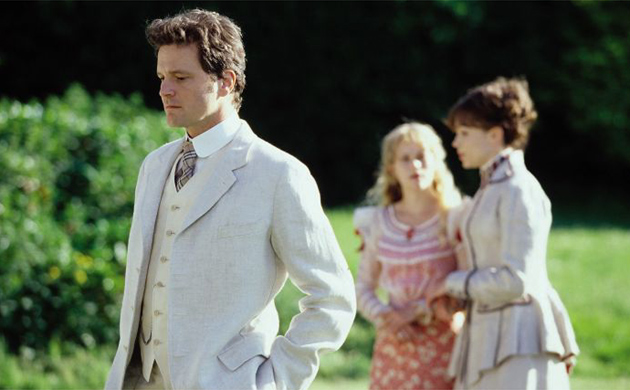
Jack is played by the ever talented Colin Firth. Dispelling the Mr. Darcy myth, Firth shows he can be one freewheeling comedic actor. Having seen many of his works, I find that with the right words to say, he can always deliver in style, even if he needs to stammer to get his words out.

Before Mamma Mia! (2008), Colin Firth had sung in a movie strumming a guitar, it is here. With Rupert Everett as the piano playing Algernon, the two come together in a duet to woo their love.

Frances O’Connor, who plays Fanny Price in Mansfield Park (1999), is Gwendolen, animated but much intimidated by her icily fierce mother Lady Brecknell. Reese Witherspoon is Cecily, Jack’s 18 year-old ward. The gals can easily call each other sisters if not for the mistaken identity of their love interest, Earnest. Thinking they are romantic rivals, the ladies are at each other’s throat as much as their genteel upbringing can allow, and  quickly become allies once the misunderstanding clears up.

Both Jack and Algernon are willing to go all out to have their names changed to Earnest via christening by the minister Dr. Chasuble, a role mastered easily by veteran actor Tom Wilkinson. Dr. Chasuble is a silent admirer of Cecily’s governess Miss Prism, played by Anna Massey with much comedic sense and timing.

At the end, Jack finds out his true parentage, realizes that he is more kin than kind to Algernon, and three matrimonies ensue, a happy ending Jane Austen would have approved. The movie adaptation is an enjoyable way to go through the play, not just with sight, sound and cinematic fun, but a delightful all-star cast.

Some tidbits: The film won a Best Costume Design award from Italy, and Reese Witherspoon was a nominee of the Teen Choice Award 2002. Looking at the cast today, we see 3 Oscar winners and 1 Oscar nominee.

As usual, the DVD carries special features like The Making Of and Behind the Scene featurettes, interviews with stars and crew, and audio commentary, always a valuable companion to the main feature.

~ ~ ~ Ripples

The Grey (2012): Of Wolves and Men

There are films that I expect to glean meaning from but leave me disappointed. And then there are those that do not appear to provoke thought at the outset and yet manage to do so, sending me out the theatre with gratified resonance. The Grey is one such film.

A plane carrying a group of Arctic oil-rig workers crash in the deep snow of the Alaskan wilderness. There are seven survivors. The task of leading them out of the crash site to seek safety falls on the shoulders of John Ottway (Liam Neeson). His job at the oil rig is security, a marksman protecting the workers from wild wolves. At the beginning of the film Ottway is shown to be suicidal, overwhelmed with grief from the recent passing of his wife. It is ironic to see at the end, he is propelled by courage to fight for his life.

In the cold expanse of Alaska, Ottway leads the surviving men to trudge through deep snow, trying to get to safety away from wolf territory. The men are pitted against each other, stranded at nature’s mercy, defenceless against a pack of carnivorous grey wolves. It’s a survival story, a suspense thriller that has me on the edge of my seat. But it goes further than that.

Director Joe Carnahan does not just show a group of roughnecks toughing it out in extreme condition, facing death at every turn. He brings to the forefront some existential queries, as one by one the men fall prey to the wild. Stripped to bare existence, how is man different from wolves? For what do we live? For what do we die? Such moments of ruminations are enhanced by Masanobu Takayanagi’s meditative cinematography.

As they leave the crash site, Ottway tells the survivors to collect all the wallets from the victims so they can contact their family, if they ever get back home. From the photos in their wallets, we get a glimpse of lives lived, and know that they have loved ones waiting. Following their treacherous path, we might sense that their outward skepticism masks a painful and silent hope for a transcending force, One who can save them from their fateful predicament.

The men don’t bond right away. The unruly, the scared acting tough. But extreme circumstances change them quickly. Sitting around a fire, they learn to cherish the memories they’ve had in their life, and begin to value each other. We know their fears. We listen to their stories. In one moving moment, Ottway shares a poem he remembers his Irish grandfather had written. Little does he know those words would become the fuel that catapults him to fight for his life at the end.

There’s something about Liam Neeson that stands out in a film. He embodies a kind of dignified charisma. But here in The Grey, it’s not just charisma, it is like poignant reality. The look on his face speaks volumes. In the film, he conjures up in his mind the wife he has loved and lost lying beside him. “Be brave,” he can hear her loving whisper. In real life, he just may be aching for the same, as his wife Natasha Richardson died after an accident in the snow three years ago.

Animal advocacy groups have voiced out their opposition to the portrayal of the Grey Wolves in the movie. Wolves are social animals, gentle and non-aggressive, they argue. The film gives them a bad rap. My thought is this: If a young human can go into his school and massacre his peers, and if humans can murder members of their own clans, why is it hard to imagine carnivorous wild wolves would prey and attack intruders in their territory? Showing that animals do act on their instinct is no disrespect.

After all, this is not a scientific study of wolf behavior. The film is less about wolves than men. The questions it poses cannot be answered by Science. And if you have to be accurate about all the facts, it’s not in Alaska where they shot the film, but here in Arti’s territory of Western Canada, Alberta and British Columbia to be exact. But what does it matter?

I will not give away spoiler about the ending, for it struck me most strongly and left me with deep resonance as I walked out of the theatre. It is poignant and powerful, although I did hear a gasp of ‘what?’ from someone in the dark theatre. If you go to see this movie, do sit through the credits, and stay there until the very end of the roll, you’ll see something more.

Yes, there is suspense and some action. But what’s more important is that there are quiet moments for ruminations. If you are comfortable with that, you would likely care to follow these men in their precarious strive for survival.

~ ~ ~ Ripples

***

We Need To Talk About Kevin (2011)

On International Women’s Day, we need to talk about mothers. Motherhood, the role that can bring so much joy, and so much grief. No grief can compare to that of seeing your child self-destruct, and in the process, destroying others.

To start with, the wandering, free-spirited Eva (Tilda Swinton) before motherhood reflects an unsettling soul. Seems like she accidentally trespasses into the territory that calls for extreme commitment when she gets pregnant. While other expectant mothers fully embrace their swollen bellies, Eva faces her pregnancy with apprehension and awkwardness. Once Kevin is born, she knows full well that it is an irreversible life-long occupation.

Kevin screams all day and night as a baby, is incommunicable as a toddler, foul-mouthed, menacing and hateful as a child. The first thing he does to his newborn younger sister while visiting her in the hospital is to splash water into her eyes. This act will be repeated when he becomes a teenager, but it won’t be as harmless as water. Can’t his parents see it coming? I must give credit to Tilda Swinton, who has given us an audacious and engaging performance as Eva, but one, I’m afraid, that may not appear quite as sensible as it should.

If you are not a tiger mom, but has a tiger son on your hands, what are you to do? Wouldn’t you have sought professional help for your child, or counselling for yourself? Yes, we see Eva take Kevin to a doctor when he’s a non-communicating toddler, but what about all the years hence, until at 16 when all hell breaks loose? Ezra Miller as teenaged Kevin is a persona of a most disturbed young man; unfortunately, his self-absorbed, relentless evil scheming renders his performance two-dimensional.

I have not read the book by Lionel Shriver. We Need to Talk About Kevin was the Orange Prize Winner of 2005, an award honoring women’s writing. Shriver might well have depicted her characters and their inner turmoils with more depth, as a literary rendition can.

I knew of the plot in general before I stepped into the theatre. My expectation was that the film would be exploring the issues of parental responsibility and guilt from raising a wayward child despite all good intentions. I thought it would deal with the problem of evil, or the issue of nature and nurture, and the choices we can make in spite of our predicament.

But the film surprises me in that it has not delivered what could have been a study of any of the above issues. Maybe parental guilt, but still, not in depth. We only see the stunned look of Eva in every scene. Even before the tragic end, with overwhelming evidences of a terribly disturbed son, we hear little communication between Eva and her unsuspecting husband Franklin (John C. Reilly), who encourages Kevin’s interest in archery. (ah-ha… big hint)  Seems like director Lynne Ramsay’s goal is just to shock and disturb with exaggerated visuals and sounds, or its lack of to create mood. The ubiquitous red, another obvious hint. It is effective as an absorbing, suspenseful thriller, relentless in its portrayal of evil, but for the purpose of…?

The film has been talked about much in the UK. And on both sides of the Atlantic, many critics have given it high acclaim; others have pointed to its Oscar snub. While I had high expectation before I saw it, I left with a void of disappointment, which, I’m afraid, has extinguished my interest to read the book. If you have read it, I’d love to hear you tell me otherwise.

But on this very day, let us give kudos to all mothers who, regardless of results, stay true to their role and love in spite of everything. This we can see in the final scene and the last shot, the embrace in prison, probably the most meaningful in the whole film.

~ ~ 1/2 Ripples

***

Midnight’s Children Read-Along Begins

CLICK HERE to read my review of Midnight’s Children the Movie

Our slow and flexible read-along of Midnight’s Children by Salman Rushdie begins today. How slow? Here’s the plan. Each section about 130 pages is to be covered in a month from March to June. On the last day of each month, we post our reading response to that part:

March 31 — Book One
April 30   — Book Two (Part A ending with ‘Alpha and Omega’)
May 31    —  Book Two (Part B starting with ‘The Kolynos Kid’)
June 30   — Book Three

How flexible? I’m not even calling them ‘reviews’. Let’s just share our thoughts as we read along. You can still continue with your regular blogging activities. And if for any reasons, you can’t keep up, don’t worry. If you miss writing a post, feel free to visit others’ and join in the discussion. If you’re not a blogger, you’re welcome to stop by as well on the last day of every month from March to June to share your view.

From the open invitation posted on Jan. 8, the following readers had shown interest to join in. I’ve put your links down so we’ll know where to go for the response posts at the end of the month. If you want to join in now, you’re most welcome. Just indicate your intention in a comment below and I’ll add in your link. Conversely, if you feel you can’t commit at this point, just let me know so I can take your link off.

  1. Bellezza of Dolce Bellezza
  2. Colleen of Books in the City
  3. Deborah of Temptations of Words
  4. ds of Third-Storey Window
  5. Janell of An Everyday Life
  6. Lauren of The Very Hungry Bookworm
  7. Gavin of Page247
  8. Jerika of averydisorientedreader
Do go to Bellezza’s blog to check out other participants’ links as well. 

In between these monthly posts, if being succinct is your style, you can share your thoughts in 140 characters with tweets anytime you want. Just leave your twitter name @… in the comment. You’re most welcome to follow some clumsy attempts at laconic expressions @Arti_Ripples

A General Introduction:

Voted Best of The Booker in 2008, Salman Rushdie’s Midnight’s Children has been classified as post-colonial literature, genre historical fiction and magic realism, rich in symbols and allegories. Here’s the Synopsis from the Booker site:

“Born at the stroke of midnight on August 15, 1947, at the precise moment of India’s independence, the infant Saleem Sinai is celebrated in the press and welcomed by Prime Minister Nehru himself. But this coincidence of birth has consequences Saleem is not prepared for: telepathic powers that connect him with 1,000 other “midnight’s children” – all born in the initial hour of India’s independence – and an uncanny sense of smell that allows him to sniff out dangers others can’t perceive. Inextricably linked to his nations, Saleem’s biography is a whirlwind of disasters and triumphs that mirror the course of modern India at its most impossible and glorious.”

Helpful Background Resources Online:

History of modern India from Colonial time

History India Timeline

Setting of Midnight’s Children

Characters in Midnight’s Children 

Book Review on 1981 publication from New York Review of Books

Deepa Mehta and Salman Rushdie collaborate on film adaptation

To all reading along, Enjoy!

***

Oscar Winners 2012

So here we are, another Academy Awards. Despite the gallant effort by Billy Crystal, his ninth time hosting, Oscars 2012 was lackluster and bland. Memorable moments were few. There was the usual glamour and glitter on the red carpet, but inside the ‘Chapter 11 Theatre”, renamed by Crystal, it was a night of mere form devoid of spirit.

With all the talents and resources they put into the production, you’d expect better executions and funnier, more brilliant presentations… The beginning mashup intro of the nominated films went well, starring Billy Chrystal in every one, but I was at a loss to see later a montage made up of clichéd, past movie moments, or that not funny Wizard of Oz focus group clip. A sound problem lasted long enough that I had to switch channel to make sure it wasn’t my TV.

Even before the show began, I was a bit disheartened. The reversal of the Academy decision to let Sacha Baron Cohen attend in character as ‘The Dictator’ could only open up opportunities for stunting. Self-promotion and free publicity aside, the shenanigan on the red carpet was definitely uncalled for. I’m referring to ‘The Dictator’ carrying an urn which he said contained Kim Jong-il’s ashes, as he was fulfilling the late ruler’s dream to attend the Oscars. Even up to then was fine. But, what’s the point of dumping the ashes all over Ryan Seacrest on the red carpet?  If you’ve missed it, click here to see what actually happened.

From ashes to awards, here are some major winners:

The Artist – 5 wins. Best Picture, Best Actor Jean Dujardin, Best Director Michel Hazanavicius, Best Original Score, Best Costume Design.

Hugo – 5 wins. Best Art Direction, Best Cinematography, Sound Editing, Sound Mixing, Visual Effects.

The Iron Lady – 2 wins. Best Actress Meryl Streep, Best Makeup Mark Coulier, J. Roy Helland.

The Help – 1 win. Best Supporting Actress Octavia Spencer.

Midnight In Paris – 1 win. Best Original Screenplay, Woody Allen.

The Descendants – 1 win. Best Adapted Screenplay, Alexander Payne, Nat Faxon, Jim Rash.

Some highlights and tidbits:

Jean Dujardin in his acceptance speech noted Douglas Fairbanks as the first Oscar host in 1929: “Tickets cost $5 and it lasted 15 minutes. Times have changed.” 1929 was the last year that a silent movie won an Oscar.

1929 was also the year Christopher Plummer and Max von Sydow were born, both Best Supporting Actor contenders. Canadian Plummer set the record for the oldest actor to win an Oscar at age 82 for Beginners.

A Separation wins Best Foreign Language Film. Writer/director Asghar Farhadi accepted Iran’s first Oscar. The film is an intense and totally captivating story of domestic conflicts marked by social and religious influences. Farhadi in his acceptance speech movingly distinguished between the people and the politics of his country.

Canadian entertainment troupe Cirque du Soleil added some spectacular performance and much needed energy at an otherwise lacklustre award show.

Colin Firth presenting Best Actress Award to Meryl Streep, his co-star in Mamma Mia! Streep has been nominated 17 times, this is her second Best Actress win since Sophie’s Choice in 1983. She’d also won a Best Supporting Actress Oscar for Kramer vs. Kramer in 1980. In her acceptance speech, she thanked her husband first, before the music drowned out her words she noted. Apparently moved and thrilled:

“When they called my name I had this feeling I could hear half of America going: ‘Aww no. Not her again’. But, you know, whatever.”

Woody Allen wins Best Original Screenplay for Midnight In Paris. I believe it’s an extended version of a short piece he wrote entitled “A Twenties Memory” decades earlier. Will we ever have the chance to hear  Woody Allen’s acceptance speech?

The Artist, a silent movie, wins Best Original Score. Music speaks louder than words.

While Hugo is based on the book The Invention of Hugo Cabret by Brian Selznick, his name was not mentioned by any of the winners in their acceptance speeches. Do authors have to become filmmakers before they are noticed?

***
For a full list of Oscar Winners 2012, CLICK HERE.

***

To read my review of The Artist, CLICK HERE.

To read my review of Midnight In Paris, CLICK HERE.