Paris in July 2025 – Delightful reads by Antoine Laurain

For Paris in July this year, I want to read an actual Parisian author writing Parisian stories. I did some digging and found Antoine Laurain. I’m late to the party, for Laurain has written more than a dozen books, which have been translated into twenty languages, an award-winning novelist whose talents are multi-faceted: author, journalist, screenwriter, film director, antique collector and dealer.

I’ve read or listened to four of Laurain’s novels in the past weeks: The Red Notebook (2014), The President’s Hat (2012), The Readers’ Room (2020), and The French Windows (2024). I still have many more to savour. These ones I’ve read are all like novellas, less than 200 pages, each unique in its storyline, very entertaining, easily accessible but not shallow. Laurain’s writing is a fusion of the literary and the popular, weaving suspense and romance, or adding a dash of magical realism as in The President’s Hat. Among these four, The Red Notebook is my favourite.
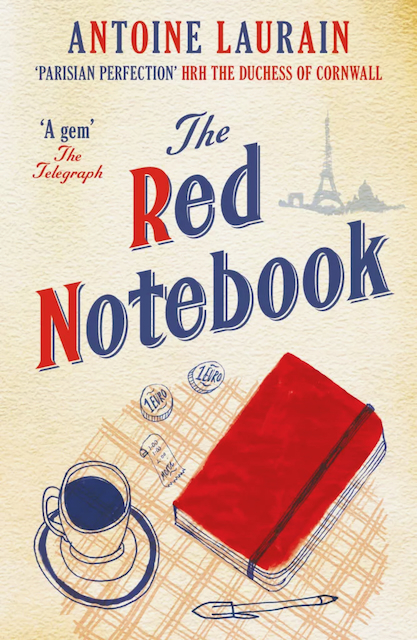
The Red Notebook by Antoine Laurain, Gallic Books (English edition), 2015,
159 pages.

Ahh… The contentment of being sought and found… and to be known.

Laurent, a bookstore owner, finds a woman’s leather handbag in good condition on top of a garbage bin on the street one morning, obviously stolen and discarded there. He takes it to the police station, but is told to wait. Doesn’t have time to spare, Laurent decides to leave it till the next day to hand it in. The mauve handbag is just too much of a lure for Laurent to keep his curiosity in check. That night at home, he opens it gingerly and explores the personal effects inside, hoping to find a name and address so he can return it to its owner.

Among the perfume, hair clip, keys, and numerous other items, there’s a red Moleskin notebook. Just too tempting, how can he not open it? The elegant and fluid handwriting records the owner’s self-reflections, her likes, her fears, her dream.

He had opened a door into the soul of the woman with the mauve bag and even though he felt what he was doing was inappropriate, he couldn’t stop himself from reading on.

It could sound creepy, but Laurain lets his readers empathize with this curious middle-age bookseller, for he is now a detective of the soul. And Laurain knows how to tell his story with humour. As he searches the bag, his girlfriend shows up, complicating matters. Later, adding zest to his quest, his daughter joins in his detective work readily and offers invaluable assistance.

Augmenting Laurent’s eagerness to find the owner of the bag himself instead of letting it go to the police is another object in the handbag, the book Accident Nocturne signed and with a line of dedication handwritten by the French author and Nobel laureate Patrick Modiano. The bookseller is overcome by a surge of passion, for Modiano is his favourite writer. Herein lies the clue to someone who shares the same mind as his. From the line of inscription, Laurent knows the first name of the owner of the bag, Laure.

While ordinary love stories might focus on a person looking for the right one to love, here in The Red Notebook, it describes the complementary side of the search as well, by revealing the one aspect which might be the most gratifying of true love: being sought and found… and to be known.

I like the idea of a man going to so much trouble to find me (no one has ever gone to so much trouble for me before)

While Laure has had men in her life before, but there has never been one who had really stepped inside her mind. Yet here is one stranger who has known and admired her inner being, and is passionate enough to go the distance to find her, and yet…

The ‘and yet…’ is purposely unwritten as I don’t want to give any spoilers. I highly recommend The Red Notebook as a light and entertaining read, one that touches that soft spot of the human heart, to be sought and found… and deeply known.

I await a filmmaker to take this up, write an English screen adaptation and set in New York City, find a perfect cast, and I’m sure it will make one marvellous rom com, or a little more serious but equally heartwarming rom dramedy.

Ah… Celine Song, would you be interested?

***

Paris in July 2025 is hosted by Words and Peace and France Book Tours

The Hunters: Two Novellas by Claire Messud

Always been fascinated by Claire Messud’s writing. Glad to discover a gem I’ve missed all these years, The Hunters, Two Novellas (first published 2001, this Norton edition, 2021) which I recently found in the basement of an indie bookstore, where used or overstocked books are stored.

The first novella is A Simple Tale. On the surface, it’s a Canadian immigrant story, how people came to Canada after the second World War to make a home for themselves and their future generation. But it speaks to deeper truths about belonging, hope, resilience, love and alas, family conflicts and disappointment. Immigrant or not, such are universal issues.

Maria Poniatowski was born in the Ukraine. WWII pushed her out of her village, stranded in Europe, and eventually arriving in Canada alone, having lost her family and close friends. She met Lev in the Displaced Persons camp, fell in love, married, and gave birth to baby Radek. Sounds common enough? But not in Messud’s interesting prose:

And finally there, in the Displaced Persons camp, Maria, an old maid of twenty… At long last. Dreamed, discarded, forgotten, it came to her on the sly, slowly at first, shy, and then in full torrent. That’s what the Displaced Persons camp would mean to her, in the ribbon of years: simply, love. (p. 26)

Settling in a new country doesn’t come naturally, especially when it’s totally foreign. Weeping and hardship may be for a short while, for joy soon comes. Maria receives a very Canadian welcoming at the Displaced Persons camp:

In the morning, that first September morning of 1946, there was the piercing early-autumn sunlight sifting through the pines, and the clean odor of the needles as they were trampled underfoot, and the soft damp mulch scent of the forest; and there were maples, in amongst the monstrous evergreens, turning, golden, vermilion, ochre in a riotous celebration of the Poniatowskis’ arrival. (p. 31)

Maria later found a housekeeping job with Mrs. Ellington, and became her life-long companion for decades. As little Radek grows up and Maria and Lev grow old, disappointments set in. The baby son she has raised all the years from the displacement camp to a house in Toronto is now a man with his own will but totally subdued by the girl he chooses to marry, an obvious unfit match, bringing his parents only disappointment and heartbreaks. Having endured and lived through the War and years of adjustments and finally calling a new country home, Maria, a widow now and alienated from her son and his family, watches Mrs. Ellington slip away. Alone again.

________

The second novella, The Hunters, can well be an exemplar for the now popular, contemporary genre of the psychological, suspense novels such as Before I Go to Sleep (J. S. Watson, 2011), Gone Girl (Gillian Flynn, 2012), The Girl on the Train (Paula Hawkins, 2015), The Woman in the Window (A. J. Finn, 2018)… just to name a few. An unreliable narrator, or a misleading perspective taking the story onto twists and turns until the frame of reference unraveled and truth spills out.

What Messud is doing in The Hunter, however, is a much deeper probe into the psyche of a person in solitude, blurring the imaginary with reality. How reliable is our judgement of character, or how accurate is our perception in deciphering facts from the inkling of our subjective mind? How reliable is our view on reality? Can we fully know someone?

An American academic spends a summer in London to do research on a book he or she is writing. Exactly, Messud does not specify the name or the gender of the narrator, this academic. I wonder what purpose would that serve, maybe universality. Nevertheless, Messud is an expert in psychoanalysis, and her prose, exquisite, as she describes the narrator’s state of mind and inner thoughts.

Choosing to stay in a neighbourhood away from the mainstream, academic centre of London, the narrator seeks solitude to nurse the ending of a love relation, as well, to seek refuge in the anonymity of a diverse neighbourhood where nobody knows her and no one the narrator wants to know.

Such a peaceful existence is interrupted one night by a downstairs neighbour Ridley Wandor, coming up to introduce herself and thus intrudes into the privacy and disrupt the solitude of our much annoyed narrator. Ridley Wandor would become the unwanted nemesis that summer, and months later, when a clearer view of facts is revealed, the cause of inescapable guilt.

The Hunters isn’t one of those page turners in which the plot pushes the reader to forge on, but an astute character study of both the hunter and the prey. In a deeper way, Messud challenges her narrator’s sense of reality, and just because of the lack of omniscience––our very limitation as human––shaking the narrator to the core as facts are revealed at the end. It’s hard to find an excerpt in the novella without dropping a hint as spoiler, but this famous line from Atticus Finch comes to me naturally:

You never really understand a person until you consider things from his point of view […] until you climb into his skin and walk around in it.”

For our narrator, this revelation comes a bit too late.

~ ~ ~ ~ Ripples

Novellas in November is co-hosted by 746 Books and Bookish Beck

Related posts on Ripple Effects:

Small Things Like These from novella to screen

The Quiet Girl Movie Review: From the Literary to the Visual

Passing by Nella Larsen: from Novella to Screen

The Gone Girl Phenom

Before I Go to Sleep: Movie or Book?

***

Virginia Woolf’s The Years sparks some surprising associations… Downton Abbey?

“She wanted to see the owl before it got too dark. She was becoming more and more interested in birds. It was a sign of old age, she supposed.” –––– Virginia Woolf, The Years* (186)

Finally, I finish my other 1937 Club read hosted by Kaggsy and Simon that took place in April, two months late, and that’s Virginia Woolf’s The Years, published in 1937. It sure feels like years for me to finish this book. Better late than never, for I have full intention to see what Woolf had to say in her last novel published during her lifetime (Between the Acts was published shortly after her death in 1941), specifically, what was in her mind just a few years before she took her own life.

The book follows the children of Colonel Abel Pargiter’s family as they go through the years crossing the 19th century into the 20th. It’s a family saga through chapters titled for a specific year, beginning with 1880, 1891, then into the new century 1907, 1908 and to the First World War, and finally the “Present Day” which is the 1930’s. Within each chapter the narratives are episodic, characters appear without introductions; readers would have to piece together who’s who and how they relate to each other.

A few unexpected mental associations came to me during my reading. The quote above at the beginning of this post is one of those surprises. A loud Whoa! when I read it: Interest in birds as a sign of ageing. It’s a thought in the mind of Eleanor, the eldest of the Partiger children, when she is fifty-five. She goes on to live past seventy when the book ends, and I’m sure has seen many more owls.

Another surprise for me in my reading experience of The Years is how it’s like watching an arthouse film, or any good movie for that matter. My first impression of that beginning chapter 1880 is that it reads like a script where the expressions and actions of the characters are highly nuanced and the subtext in their conversations speak volumes. Nothing much is happening but the seemingly uneventful narrative carries unsettling undercurrents.

Here’s an example. The Colonel, with his wife Rose on her death bed, is a troubled and temperamental man whom his seven children fear more than respect or love. He comes back home unexpectedly during supper time in the opening chapter and the way he drinks his tea while trying to strike up conversations in a surly manner with his children reflects his changing mood. A ready movie scene here. I’ve taken out the dialogues, but just the description of his tea-drinking actions reveal a lot about his character:

He stirred his sugar round and round in the cup as if to demolish it… ground the grains of sugar against the walls of his cup. [After some tense conversations with his children] Then he seemed to repent of his gruffness… He drank up his tea. Some drops fell on his little pointed beard. He took out his large silk handkerchief and wipe it impatiently… [Later] the Colonel took up his cup, saw there was nothing in it, and put it down firmly with a little chink. The ceremony of tea-drinking was over. (13-14)

Another surprise is that reading The Years makes me think of Downton Abbey, how a family goes through changes both in the larger socio milieu and in their personal lives through the years. The time-lapse is about the same as the six seasons of Downton, from horses to cars, from candles to electric lights, WWI and the changes it brings. The following line in Woolf’s novel makes me think of the Dowager Violet Crawley:

Then he looked at a car. It was odd how soon one got used to cars without horses, he thought. They used to look ridiculous. (215)

BTW, Edith Crawley, who breaks the mould and ventures out to live in London on her own and heads up a magazine she inherits from Michael Gregson and a London flat, has mentioned that she had met Virginia Woolf there, one of Michael’s Bloomsbury acquaintances. One can imagine the author just might have certain influence on her.

The Years is about lives lived, actions or non-actions, the regrets and the resignation of what had happened, the unchangeability of the past. Check out these lines, the introspection of Eleanor’s, just reminds me of Mary Crawley, who had uttered similar words thinking of her own past errors in judgment:

But once it’s done, there it is… How irrecoverable things are, she thought. We make our experiments, then they make theirs. (185)

Above all else, The Years is about the past and memories, and the meaning of it all. Proust’s Remembrance of Things Past comes to mind, no surprise. Both authors value the writing down of lives lived. But Woolf goes into a more depressed mode of seeing even the futility of it. As the chapters, ie, the years, move on, Woolf is more explicit about her view on life––I suppose that’s her perspective––through Eleanor’s point-of-view. Considering Woolf taking her own life just four years after this book was published, I paid attention to the reflections and internal search for existential meaning, or the failing of which, and find these passages particularly poignant. Short sentences like this: “Scenes passed over scenes; one obliterated another,” to reflection like the following, again, quite a cinematic moment:

Things can’t go on for ever, she thought. Things pass, things change, she thought, looking up at the ceiling. And where are we going? Where? Where?… The moths were dashing round the ceiling; the book slipped on to the floor. .. made an effort; turned round, and blew out the candle. Darkness reigned. (195)

to what seems like ultimate despair, take note that Woolf wrote this in the 1930’s:

But how can one be ‘happy’? she asked herself, in a world bursting with misery. On every placard at every street corner was Death; or worse––tyranny; brutality; torture; the fall of civilization; the end of freedom. (358)

I gave the book 3.5 out of 5 stars in my Goodreads review, an evaluation that’s based on my first reading, having had to figure out who’s who –– considering the Pargiters have seven children and some of them have their own children. And then there are extended family members, cousin, niece and nephew, and servants. I’m sure upon second reading, I’d be able to get a clearer picture of all the characters and would enjoy it more, for it really deserves more than one reading.

__________

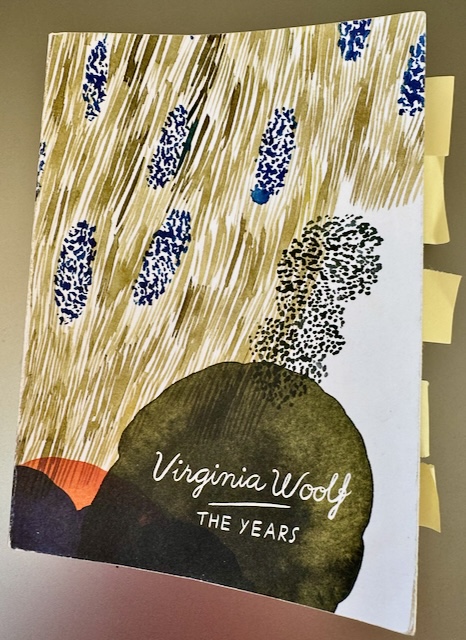
* The edition that I used (photo above) is Vintage Classics, Penguin Random House UK, London. 401 pages. Introduction by Susan Hill. With this inscription before the Introduction:
“The text of this edition of The Years is based on that of the original Hogarth Press Edition, published by Leonard and Virginia Woolf on 15th March 1937.”

***

Related Post on Ripple Effects:

In Praise of Austen: Virginia Woolf’s A Room of One’s Own

In Search of Lost Time by Marcel Proust: A Movie Reviewer’s Long Take

My other 1937 Club Posts:

Out of Africa by Karen Blixen from Book to Movie

Somerset Maugham’s Theatre and Screen Adaptation

Japanese Literature Challenge 17: Keigo Higashino’s Latest, ‘The Final Curtain’

Keigo Higashino is a prolific writer, more than sixty novels published and not only in the mystery genre, yet only thirteen have been translated into English. The Final Curtain is his latest, albeit it was published in Japan in 2014. English version by Giles Murray in 2023.

Thanks to Bellezza for hosting Japanese Literature Challenge for the seventeenth year, I get the chance to read this book with her. Yes, she has been my read-along pal all through my blogging years, dating way back to Midnight’s Children in 2012, and later Anna Karenina, Middlemarch, just to name a few.

Now, to Higashino. In The Final Curtain, something hits home for Detective Kaga, for it involves the death of his mother, who had deserted his father and him when he was a teenager. We learn that years ago Kaga knows of his mother’s mysterious death in the city of Sendai from an unknown woman who opens a bar there. That begins the rich and multi-layered story. As it turns out, the person that secretly releases the information to the bar owner is tied to at least two deaths in Tokyo in present day, weaving up a complex net of stories and family relations.

Yes, it’s sometimes confusing trying to figure out which character is which, for the names can be hard to distinguish. Be glad that the translator has a list of characters in the first page of the book where you can always turn to refresh your memory. The middle part could make a reader feel sluggish somewhat, but don’t get bogged down by it because this part sets the stage for a page-turning last section. Beginning with Chapter 22, there’s a dramatic switch in character description and perspective, you’ll be hooked to find out what had happened years ago that had led to the present day behaviour and demeanor of the characters.

Once again, Kaga comes through as a deep thinking, rational, and very clever young man. I don’t think of him as “A modern-day Poirot” as the description says on the book cover. Why, Kaga is a broad shouldered man with an impressive physique and in this book, a notable point and a crucial thread to the mystery is that Kaga is a kendo (Japanese sword) champion.

Every time I read Higashino I’m not only intrigued by the interwoven plot and the connections of characters, but the cultural aspects he presents during his storytelling. One notable point here is the importance of early school life has on the characters, and how readily old school mates are able to recall past events of students and teachers. People do have great memory power in Higashino’s novels.

Another aspect of Japanese culture I specifically look for is what the characters eat and drink. I’ve always had my eyes peeled to note Higashino’s description of Japanese food. Kaga and his detective cousin Matsumiya like to exchange info over beer. And what goes with it? “Matsumiya popped a few beans into his mouth and took a swig of beer as he contemplated his cousin.” And Kaga “shoveled some simmered burdock into his mouth with his chopsticks.” I admit I’ve to Google what burdock is. Other culinary delights mentioned are sashimi, grilled fish, tofu and rolled omelet.

I’d rate The Final Curtain to be one of my favourite Higashino mysteries, together with The Devotion of Suspect X. While it reveals the causes of the three major deaths in Tokyo, the ending of The Final Curtain gives me a feeling of ‘to be continued’, as the mystery of Kaga’s mother still lingers in my mind. I look forward eagerly to more Higanshino to be translated soon.

~ ~ ~ Ripples

Other Keigo Higashino Ripple reviews:

JLC16: The Swan and The Bat

The Devotion of Suspect X

Newcomer

Proust and the Multiverse

A pair of wings, a different respiratory system, which enabled us to travel through space, would in no way help us, for if we visited Mars or Venus while keeping the same senses, they would clothe everything we could see in the same aspect as the things of Earth. The only true voyage… would be not to visit strange lands but to possess other eyes, to see the universe through the eyes of another, of a hundred others, to see the hundred universes that each of them sees, that each of them is.  

This could be taken as dialogues from Dr. Strange in the Multiverse of Madness, or, Everything Everywhere All At Once, both 2022 movies flying high on the trending theme of multiple universes. But of course, the excerpt is Proust’s, and the universes he refers to are internal ones.

The above quote is taken from In Search of Lost Time Volume V: The Captive and The Fugitive (343), as the narrator Marcel acknowledges the infinite views that can arise from personal experiences of different individuals filtered through their own subjective lens. There are as many viewpoints as there are people, therefore, every object or event can evoke a variety of perspectives and responses. Subjectivity is Proust’s master stroke. Take this other excerpt from the same volume. As Marcel awakens in the morning:

… from my bed, I hear the world awake, now to one sort of weather, now to another! Yes, I have been forced to whittle down the facts, and to be a liar, but it is not one universe, but millions, almost as many as the number of human eyes and brains in existence, that awake every morning. (V:250)

Today, November 18th, is the centenary of Proust’s death at the age of 51 (1871-1922). A look at his contemporaries could help us place him in a historical context and probably source the influence of his introspective sensitivity and his ultra-reflexive writing. Again, the disclaimer here is that, I’m no Proust scholar… mere ripples out of my own tiny universe. I can think of the following iconic figures as I consider the historical context of Proust’s writing.

It was the era of psychoanalysis. I’m sure Freud (1856-1939) would have been eager to apply his own theory to explain the case of Marcel’s longing for his mother’s goodnight kiss as he lies in bed waiting for her to come up to his room every night. And then there was Carl Jung, (1875 – 1961), whose theory on personality and the unconscious could have sparked some light into Marcel’s epiphany of the involuntary memories: ephemeral flashbacks that fuel his imaginative mind with creative thoughts. It’s such kind of subliminal emergence of Time past that fills him with joy and meaning.

And of course, there are the other writers whom Marcel has mentioned in the book, Henry James (1843-1916) whose brother is also a prominent psychologist of the time, William James (1842-1910), across the Atlantic. Another notable, Marcel’s enthusiasm is heightened when talking about Dostoevsky (1821-1881), the master of characterizing the human psyche.  

And what’s with all the space travel idea, flying from star to star, while the Wright brothers had just successfully flown the very first aeroplane only in 1903? Huge imagination and insight for one to think of multiverses at that time. I’m not sure what the original French word is. Those who read In Search of Lost Time in French, is the word the same as its English translation, ‘universe’? (V: 250, 343)

Reading this sparked a personal flashback as I remember my experience of visiting “The Infinity Mirrored Room” created by the Japanese artist Yayoi Kusama (born 1929) at the Art Gallery of Ontario in Toronto a few years ago. Infinite reflections from these tiny silver balls:

____________________

Having said all the above about Proust’s sensitivity to subjective universes, here’s the rub. It is utterly ironic that these insights are taken from Volume V: The Captive and The Fugitive. Why, here in this volume, Marcel has taken Albertine captive in his parents’ home where he stays while in Paris. He first met Albertine in Balbec; she has now become his lover/mistress. No, she isn’t in chains, but the restraints Marcel puts on her is psychological rather than physical. He tracks her every move, “whenever the door opened I gave a start.” (494) In reality, there just might be two captives in that house, Albertine and Marcel himself, both caught in a psychological tug of war, maintaining a fragile relationship based on lies and evasiveness.

As much as he knows about his own thoughts and feelings, or even that of his housekeeper Francoise’s, Marcel’s empathy does not extend to Albertine’s universe. He might think his keeping her in his house is for her own good, “to save her from her orgiastic life which Albertine had led before she met me.” (474). Yet his ‘love’ for her is built upon his own possessiveness and jealousy; his displeasure with her intensifies when he learns it’s with other women that she seeks intimacy. Eventually, fleeing a stifling life, gasping for the air of freedom, Albertine leaves the house abruptly one morning. The captive now becomes the fugitive.

The events that follow are like a test of Marcel’s love for Albertine, showing if it is genuine or merely self-indulgence, egotism, or even just lust. Spoiler Alert from here on.

Marcel has never gone out to look for the fugitive. Until one day, he gets the news that Albertine has died in a horse-riding accident. Surely there is grief and pain in the immediate aftermath, but what does he miss most? “I needed her presence, her kisses.” (642) While he goes on to reminisce the good and the bad sides of Albertine, not long after that he has given her up for another:

The memory of Albertine had become so fragmentary that it no longer caused me any sadness and was no more now than a transition to fresh desires, like a chord which announces a change of key. And indeed, any idea of a passing sensual whim being ruled out, in so far as I was still faithful to Albertine’s memory, I was happier at having Andrée in my company than I would have been at having an Albertine miraculously restored… my tenderness for her, both physically and emotionally, had already vanished. (809-810)

“like a chord which announces a change of key…” O the fickleness of desire! The deceits of hidden motives and the capricious emotion one calls love. Marcel might be insightful in acknowledging multiple universes within individuals, pure love remains elusive. Dr. Strange crushes his enemies from the multiverse spectacularly, but the beast that lurks within oneself might be more formidable a foe to conquer.

***

‘Miracle and Wonder: Conversations with Paul Simon’ by Malcolm Gladwell

This is the best use of the audiobook format. You listen to conversations held by Malcolm Gladwell and his colleague, journalist Bruce Headlam, with the legendary singer songwriter Paul Simon; you hear him talk about his creative process and share interesting tidbits along the way; you hear myths debunked from Gladwell’s trademark inquiries; you discover new personal insights. Above all, you can hear the music icon who had created many world famous tunes over his 65 year career, now at 80, pick up his guitar and sing his own songs or listen to the recordings that had made him and his singing duo Art Garfunkel a household name. And more, you can hear reflections from other influential musicians like Renee Fleming, Sting, Herbie Hancock… For me, this listening experience has opened the floodgate of reminiscence and memories.

A myth debunked. No, Simon didn’t write his breakout hit “The Sound of Silence” in the subway under hauntingly existential circumstances, but in the bathroom of his parents’ house. The walls were tiled and the water running, he played his guitar in the dark and could hear echoes. He was 22. That was all he remembers now. No matter, that tune and the lyrics had sent echoes to the heart and soul of millions around the world.

The inspiration of “Bridge Over Troubled Waters” came from a line in the Black Gospel singer Rev. Claude Jeter’s (1914-2009) song “Mary Don’t You Weep”–– it says “I’ll be a bridge over deep water if you trust in my name,” a Biblical metaphor. While the title and lyrics were sparked by Jeter’s Gospel song, the melody was inspired by J. S. Bach. Another interesting tidbit is that sound engineer Roy Halee reminisces that it took him more than 100 hours to make the recording of “Bridge Over Troubled Water” as they explored different mixes of sound effects. Simon notes that the song had rippled to many different stylings and sung by so many others that he doesn’t feel it’s his own anymore. And he’s fine with that. In particular, he pays tribute to Aretha Franklin’s soulful rendition.

A poignant moment. When the first “Saturday Night Live” came back on after the tragedy of 9-11, the producer called Simon and asked him to perform in his show. I think you have to do “The Boxer”, he said. An iconic New Yorker song, a fighter that carries the reminders of being struck down yet still remains with resilience and tenacity. In the audiobook, Simon recollects that he had tried to put words in the bridging stanza but none came and so he decided to just use “lie la lie…lie lie lie lie lie lie lie lie la lie…” not knowing such wordless echoes would cross linguistic borders when live audience around the would join in spontaneously when he performed.

Where to locate Paul Simon? He refuses to be called a folk singer. His songs inspired by very different sources. His creative process often sparked by distant memories of tunes and rhythms. After the breakup with Garfunkel, he ventured into a musical fusion of cultures and stylings. Gladwell spends some time talking with Simon about how the song “Take Me to the Mardi Gras” came to be. There are at least five sources of creative contributions: the Black Gospel singer Claude Jeter, R & B musicians from Alabama, a New Orlean jazz brass band, Jamaica reggae, and plausibly, according to Gladwell’s instinct, a Yiddish riff. Such freedom to adapt different cultural roots in his compositions leads him later to his album “Graceland.”

Herein lies Gladwell’s sensibility, one I totally embrace and thanks to him, lays out in words the notion that has long lodged in my mind. Using Simon as an exemplar, a Jewish singer songwriter from Queens, NY, Gladwell says:

As a New Yorker, your cultural identity is something you get to hold loosely. It influences you, but it doesn’t define you. You’re free to roam and window shop and come up with your own combination.

The melting pot theory debunked––as attuned to Nathan Glazer’s social theory in Beyond the Melting Pot––well, at least in NYC during Simon’s early creative decades, this kind of freedom existed. But isn’t that a true requirement for one to be a global citizen, a member of our shared humanity, transcending ethnic borders and arbitrary barriers? Unfortunately, such a fluid cultural perspective has shifted in recent years to a narrow view demanding artists, writers, filmmakers… to stay in their cultural lane, to use Gladwell’s metaphor.

Another fascinating tidbit…wait till you get to where Gladwell links taste with memory when he talks about how Stephen Sondheim regrets that his lyrics in the “West Side Story” song “Maria” aren’t quite right, and then goes on to discuss with Simon about finding faults in his own compositions. BTW, “Homeward Bound” is Simon’s “Maria.”

Another issue Gladwell investigates is the mystery of longevity in the creative process, using David Galenson’s book Old Masters and Young Geniuses to compare and analyze why some artists hit their peaks as young prodigies while others are late bloomers, sustaining a long creative journey. Where to locate Paul Simon in this spectrum? I’ll leave that interesting topic for you to experience when you listen to this exceptional audiobook.

~ ~ ~ ~ Ripples

Miracle and Wonder: Conversations with Paul Simon by Malcolm Gladwell and Bruce Headlam with Paul Simon, audiobook ©2021 Pushkin Industries and Paul Simon (P)2021 Pushkin Industries and Paul Simon

***

Paris in July: A Culinary Sojourn

In 2008, Ann Mah, food writer and Francophile wife of an American diplomat, had her deepest desire realized when her husband Calvin was appointed a post in Paris. Having moved to three different cities in the previous five years: New York, Beijing, Washington, D.C., a three-year sojourn in Paris was beyond her wildest dream.

Then came the rub. Soon after they arrived in the City of Light, Calvin was called away to another diplomatic mission: in Baghdad, Iraq, by himself for one year. Just months arriving in Paris, Ann had a taste of fate in the most ironic form: to live in her dream City, alone. She knew that would probably be the hardest year of her life.

To fight off the loneliness and isolation she was experiencing, Mah began to look to another diplomat’s wife in Paris sixty years earlier for inspiration and channel her pioneering gusto: Julia Child.

The title is a giveaway. Mastering the Art of French Eating––instead of ‘Cooking’ as Child’s book––is a humble homage to the food journalist’s heroine. While she didn’t follow Child to the prestigious culinary school Le Cordon Bleu in Paris, in her year of living in France all by herself, Mah charted her own culinary journey to various regions in the country to taste and research on the cuisine of the land. The subtitle is also enticingly delicious: Lessons in food and love from a year in Paris.

In ten chapters, Mah presents the ten places she had visited, from Paris bistros to farmhouse kitchen, haute cuisine to communal cooking, she records her experience in the specific locales and their signature dish along with historical perspective. And at the end of each chapter, the recipe:

Paris / Steak Frites
Troyes / Andouillette
Brittany / Crêpes
Lyon / Salade Lyonnaise
Provence / Soupe au Pistou
Toulouse, Castelnaudary, Carcassonne / Cassoulet
Savoie & Haute-Savoie / Fondue
Burgundy / Boeuf Bourguignon
Aveyron / Aligot

From her last name, you might also be curious about her own background. Yes, within this little food memoir are sprinkled with stories of Mah growing up Chinese American in California. While her love of France brewed very early in her life following her family tour there as a child, she wasn’t given the chance to learn the language that she loved, French, but had to go to Chinese school on Saturdays as stipulated by some sort of a ‘tiger mom’. Within these chapters, then, embeds the quest for identity and personhood. Here’s a quote that more or less sums it up:


“Diplomacy has been called the world’s second-oldest profession, and ever since the sixteenth century––and maybe even before––other wives of diplomats have endured similar existential crises, fading into obscurity while their husbands’ achievements were recorded in history. Perhaps, then, that is why I turned to Julia [Child] for inspiration… not just because she loved food, and had also lived in China, and was also a trailing spouse, just like me––but because I was looking for proof that professional success and marriage to a diplomat were not mutually exclusive.” –– P. 218

A delightful read for Paris in July and actually, anytime.

Thyme for Tea and Readerbuzz are the hosts of this annual blogging event.

***

I listened to the audiobook first then read the hardcopy: Mastering the Art of French Eating: Lessons in Food and Love by Ann Mah, Viking Penguin Books, 2013. 273 pages. The audiobook is narrated by the actress Mozhan Marnò (The Blacklist, House of Cards), ideal for learning the pronunciation of the French words. Hardcopy is good for getting the recipes, and makes the narratives and anecdotes more memorable.

Bunner Sisters by Edith Wharton

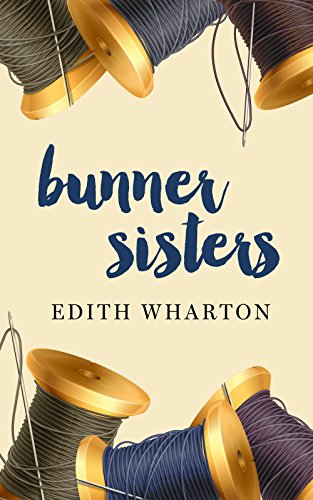
A lesser known novella by Edith Wharton, included in her book Xingu and Other Stories published in 1916. Two sisters operate a millinery shop, the eponymous Bunner Sisters, designing ladies hat in a run-down district of New York City.

A ladies hat shop in a shabby neighbourhood sounds incompatible and that’s the reality the Bunner sisters are dealing with, business barely sustaining their living with only a little left for a surprise birthday gift. Ann Eliza uses her savings to buy a new clock for younger sister Evelina’s birthday. Thus begins the turn in their lives.

Ann Eliza and Evelina remind me of Elinor and Marianne in Jane Austen’s Sense and Sensibility. The older is almost resigned to her fate but the younger constantly suppresses a bubbling, fleeing spirit yearning for fancier and more adventurous experiences. And that’s Ann Eliza’s wish for her sister as well. As the older sibling, she’s willing to give up her own bliss for Evelina’s happiness.

Well, that’s until lately, when Ann Eliza notices Mr. Herman Ramy, the clock maker who owns a dustier shop than theirs in the neighbourhood. Here’s how Wharton describe Ann Eliza’s change:

All the small daily happenings which had once sufficed to fill the hours now appeared to her in their deadly insignificance; and for the first time in her long years of drudgery she rebelled at the dullness of her life. With Evelina such fits of discontent were habitual and openly proclaimed, and Ann Eliza still excused them as one of the prerogatives of youth.

Anne Eliza finds opportunities to go to the clock shop to meet Mr. Ramy or in other places such as the market, but often comes to disappointments. There’s humour in these circumstances, her best laid plans often go awry, crashed by Evelina unknowingly. Ann Eliza always being the patient and self-sacrificing one, sees her chances slip away. As days go by, fate does seem to smile upon Evelina and leaves Ann Eliza behind.

Any more hints I’ll be spilling out spoilers, and that will crash your enjoyment. There are twists and turns. Looks like Wharton is influenced more by Henry James than Austen in leading her readers into the stark reality of being a woman at that time, and her astute revealing of her characters’ psychological states.

I’m always interested in why a filmmaker thinks a certain literary work is good movie material. Bunner Sisters is now a TV movie in development. Edith Wharton’s most well known, both book and adaptation, is probably The Age of Innocence. Bunner Sisters will be a much smaller project for sure, but still piques my curiosity. The Custom of the Country is also on the drawing board. Hope it will take off soon.

_________________

Here’s a piece of fond memory from my road trip to New England a few years ago when I visited Edith Wharton’s home The Mount. Relating to #NovNov event, I’m sharing a photo I took, Wharton’s home library:

One wall
Edith Wharton’s personal library at The Mount, photo taken by Arti, Oct. 2015

***

Bunner Sisters can be read online at Project Gutenberg. Here’s the link.

Check out what others are reading for Novellas in November hosted by Bookish Beck and Cathy746Books.

Klara and The Sun by Kazuo Ishiguro: A Book Review

Klara and The Sun is Kazuo Ishiguro’s eighth novel and the first after his Nobel Prize in 2017. This latest title is very different from his previous works. Here is a futuristic story in the style of a children’s fable. The language used is simple and descriptions explicit, written from the point of view of Klara, a humanoid robot. Ishiguro has dealt with sci-fi matter before in Never Let Me Go (2005) relating to human cloning, exploring the complexity of love and jealousy. Compared to Never Let Me Go, Klara and The Sun is a much lighter read.

Klara is an AF, Artificial Friend, to fourteen-year-old Josie. They meet in a store where AF’s are sold. Klara is displayed at the storefront when Josie comes in; their fondness of each other sparks off at first sight. Every AF is uniquely created, and here’s Klara’s selling points as Manager explains to Josie’s Mother:

‘Klara has so many unique qualities, we could be here all morning. But if I had to emphasize just one, well, it would have to be her appetite for observing and learning. Her ability to absorb and blend everything she sees around her is quite amazing. As a result, she now has the most sophisticated understanding of any AF in this store, B3s not excepted.’ (P. 43)

B3s are the newest and most advanced model of AF, but Josie insisted on having Klara. Mother gives in to her urging and Klara follows them home. Home is in a remote, rural area. The residence is big and offers views into a vast natural area. In this house the story of Klara and Josie begins.

Josie is a sickly teenager, walks with a limp and often bedridden. Klara is a faithful companion to her, follows her biddings to the dot. There are only two other characters in the house, Josie’s Mother and Melania Housekeeper, both are highly protective of Josie. Josie has a childhood friend, Rick, who lives nearby. Father resides in the city, the details are vague in terms of the reasons of the separation, but we know he cares for Josie very much but holds a different view from Josie’s Mother regarding how they should deal with Josie’s worsening health.

And then there’s Klara’s view of what she sees as a solution to Josie’s illness. Klara runs on energy from The Sun, a benevolent being watching over all. She will appeal to her source of life. As the story develops, we see how Klara’s empathy and love for Josie would put humans to shame. Ishiguro paints another picture of the artificial intelligence (AI) alarm which Sherry Turkle has set off when she writes about technology replacing human in Alone Together, or in the film Ex Machina where a humanoid robot eerily eliminating her creator. Ishiguro lets Klara’s story present the scenario where AI would surpass human in heart, thus implicitly posing the question: “What makes humans human after all?”

However, as the writing follows a straight forward, fable-like style of storytelling, questions such as this are not dealt with in any depth, albeit I feel they could have been explored further. For this reason, unlike Never Let Me Go, I find it hard to engage emotionally with the characters. As the story goes, I keep expecting that there would be some twists and turns in the plot or more complex handling of the thematic matter but which never come.

In a recent online conversation with Toronto International Film Festival’s Artistic Director Cameron Bailey, Ishiguro says he does not go into details about the science and technology mentioned in the book, all for the purpose of allowing readers’ imagination to fill in the blanks. Technical details are prone to be outdated easily. He prefers readers to involve in the world building of the story rather than being passive recipients. My response to this point is that, not just with the technical details, he has left the novel quite open for readers to exercise their imagination.

A movie adaptation is already in development. Again, adhering to his personal rule, Ishiguro will not be writing the screenplay and he will give ample freedom to the filmmaker to create their own movie with the name Klara and The Sun, as long as they take passionate ownership of their story.

~ ~ ~ Ripples

***

Related Posts:

Never Let Me Go: From Book to Film

Ex Machina Movie Review

Alone Together by Sherry Turkle

Reading the Season 2020: ‘Jack’ by Marilynne Robinson

Time for Ripple’s Christmas read, an annual post I name Reading the Season.

In the Pulitzer winning book Gilead (2004), Marilynne Robinson introduced us to the aging Rev. John Ames in the fictional Iowa town Gilead set in the 1950’s. The book is a letter Ames writes to his seven-year-old son, leaving him with a legacy of family memories, love and forgiveness.

In Home (2008), we enter the house of Ames’ lifelong friend, Rev. Robert Boughton, and meet her daughter Glory. For an ephemeral moment, his son Jack––Ames’ godson––the black sheep of the family appears. Jack returns home after twenty years of self-exile, looking for solace but sadly leaves again without reconciliation.

Lila (2014) is the story about Ames and his young wife Lila, who is homeless and aimless when the old Rev. first finds her on a country road. A beautiful story of how love bridges the great chasm between two utterly incompatible beings and leads to a magical union.

________

Marilynne Robinson’s newest book Jack (2020) is the fourth and last of the Gilead novels. It brings us back to the prodigal son in Boughton’s family, Jack, but this time, describing a sweet romance, albeit pointing to a challenging future. In terms of the time setting, Jack is a prequel to Gilead and Home. So we know how life unfolds for him. But for a moment, we dwell in some pleasant thoughts. The novel is like a reversal of Lila; here, Jack is the stray redeemed by Grace.

Nothing short of divine providence, Jack Boughton first meets Della Miles on the street, helping her in the rain to pick up papers blown by the wind. Della is a schoolteacher of literature, lover of poetry, witty, intelligent, and fearlessly independent. But, as fate would have it, she is a Black woman in segregated St. Louis during the 1950’s. Herein lies a precarious yet beautiful love story.

Jack and Della meet again one night in a cemetery serendipitously. Jack is destitute, just released after spending two years in prison, albeit for a theft he did not commit outside a pawn shop. Surely, justice isn’t on his side. Jack often gets roughed up or taunted, sometimes for no good reasons, but deep inside, he knows he’s not an innocent man. He’s destructive to others and himself, sometimes steals, and tries hard to remain sober. As mentioned in Home, years ago while still living at home in Gilead, Jack gets a girl pregnant, then just leaves town and disappears. The death of the baby later only adds to more burden and regrets.

Yet in Jack, Robinson’s depiction of the wayward protagonist is not without humour. Take this as an example:

Jack went out walking, trying to get tired enough to sleep, staying sober, so that if he did jump into the river, he could feel his demise has the dignity of considered choice.

Della has no reason to fall in love with Jack, the punishment for miscegenation is jail and being ostracized from her own family and both racial communities. The Miles are a reputable African American family of strong traditions and deep religious roots, the father being a Bishop in the Methodist denomination. No doubt Della is young and not tuned to the laws of a racist society that rewards the conformist and punishes the deviant. Yet, it is her internal light that leads her to defy unjust norms, look through Jack’s outward appearance to cherish his soul.

Della is Grace personified. The concept of ‘unmerited kindness’ is ubiquitous in the book, and Jack knows and is grateful to be the recipient of such. Receiving kindness might just be an understatement. He is redeemed and given a new life upon meeting Della.

Saying grace over pancakes in Della’s home after the cemetery meet, Jack recites spontaneously a verse from the poem “The Paradox” by African American poet Paul Dunbar (1872-1906) :

Down to the grave will I take thee,
Out from the noise of the strife;
Then shalt thou see me and know me––
Death, then, no longer, but life.

Indeed, the paradox of finding life among the dead is the pivotal moment in the book. They talk through the night as soulmates, treasuring the freeing experience inside the locked gate of a cemetery; for Jack, Della is like an epiphany, life in death.

Flannery O’Connor’s notion of the ‘intrusion of grace’ comes to mind as I read the book, light shining into darkness, even just a spark. Also emerged in my mental association is Dostoevsky’s Sonya, the Christlike figure that is a saving grace to Raskolnikov. Not that Jack is an axe murderer, but he knows too well that he needs to be rescued from himself.

Insight and wisdom come packaged in lightness of heart and humor, often embedded in the bantering between Della and Jack. And yet, they are lovers in limbo; while the subjective force of love prevails, there are uphill battles to be fought in the social and systemic front, and an arduous journey awaits. As the story timeframe takes place before Robinson’s Gilead and Home, we know how their lives turn out, which makes reading Jack such a bittersweet experience.

And here’s an imaginary scenario… if the love which surpasses all human barriers could be frozen in time, and let Grace have the last say, that would be heaven.

~ ~ ~ ~ Ripples

_________

2020 has been a most extraordinary year when we find and admit how fragile human beings are. We all need to be rescued not just from a physical virus but a spiritual one and be saved from ourselves. The Christmas Season is an appropriate time to ponder once again on that first crack of light, the epitome of the Intrusion of Grace.

Reading the Season Posts in Previous Years:

2019: ‘A Hidden Life’ by Terrence Malick: a film for the Season

2018: Madeleine L’Engle’s Poem The Irrational Season

2017: A Wrinkle In Time by Madeleine L’Engle

2016:  Silence by Shusaku Endo

2015: The Book of Ruth

2014: Lila by Marilynne Robinson

2013: Poetry by Madeleine L’Engle

2012: Surprised by Joy by C. S. Lewis

2011: Walking on Water by Madeleine L’Engle

2010: A Widening Light, Luci Shaw

2009: The Irrational Season by Madeleine L’Engle 

2008: The Bible and the New York Times by Fleming Rutledge

2008: A Grief Observed by C. S. Lewis

__________

Related Posts on The Intrusion of Grace:

Homage to Flannery O’Connor: Looking for Intrusions of Grace in Films

Diary of a Country Priest by Georges Bernanos

Diary of a Country Priest: Film Adaptation by Robert Bresson

Notes on the Synthesis of Film, Art… Life?

Two Trees Make a Forest: A Book Review

Multiplicity is what makes environmental historian Jessica J. Lee’s writing so unique. Born and raised in Ontario, Canada, to a mother who had immigrated from Taiwan and a father from Wales, Lee has since moved back and forth between England and Germany. Her biracial roots and her experience living in different countries have informed her nature writing, a voice that exudes a unique poignancy of a personal quest for identity and home.

In a previous post, I reviewed Lee’s debut memoir Turning: A Year in the Water, in which she describes how she swam in fifty-two lakes in the Brandenburg vicinity outside Berlin while completing her doctoral dissertation there, an exceptional and original endeavour to overcome personal issues.

In her new book, Two Trees Make a Forest, Lee writes about another quest that’s more complex and adventurous. In 2013, she visited Taiwan with her mother after the death of her grandfather, Gong . In 2017, she went back on her own to spend a few months to explore the island’s natural environs and immerse in her ancestral language, Mandarin. At the same time, she wanted to get close to a family history that she had just begun to unearth. Upon her grandmother’s death in Niagara Falls, Lee’s mother discovered a sealed envelope containing letters that her Gong had written but never sent, maybe to record his own life before Alzheimer’s snatched his memory away.

Gong was a pilot with the famous Flying Tigers during WWII, at that time under the Nationalist government of the Republic of China, defending the country against Japanese invasion. After WWII, the country was torn by a civil war. As the Communists took control, the Nationalists retreated to Taiwan. That was when Gong moved to Taiwan and continued his pilot career and became a trainer as well.

Gong met Lee’s grandmother, Po , in Taiwan and made a home there for decades until they immigrated to Canada in the 1980’s. Being rejected his flying credentials and too old to start all over again to be a pilot in a new country, Gong conceded with a job as a factory janitor. A sad but typical immigrant story.

Lee’s grandmother, Po, was born in Nanjing, China, and was there at the time of the Marco Polo Bridge Incident (Lugou Bridge 蘆溝橋事變), which sparked the Sino-Japanese war in July, 1937, often noted as the beginning of the Pacific front of WWII, two years before Hitler invaded Poland. As a young teenager, Po had to escape the subsequent Nanjing massacre in the hands of the Japanese. Lee’s short few pages of Po’s experience succinctly describe the horrors of the atrocity which she read about only in her twenties in the British Library. Po’s war experience had remained bitterly hidden. To some, grandparents sitting by the fire telling grandchildren their life story is a romantic myth.

As they settled in Taiwan, Gong and Po never returned to mainland China even after the travel ban between China and Taiwan was lifted in 1987. The home that each of them had known when they were young had long disappeared.

Lee’s book is a remarkable narrative of a granddaughter trying to piece together a family history while weaving in her own interests and specialization as an environmental historian and nature lover. The storytelling is a beautiful tapestry of multiple yarns. Lee’s use of metaphors from the natural world are exquisite and eloquent; the juxtapositions of natural history with family history alongside the author’s personal quest make Two Trees a multi-layered and intriguing read.

Photo Credit: Ricardo Rivas

Taiwan is an island just eighty-nine miles wide, but with a central mountain range that rises close to thirteen thousand feet, resulting in a huge variety of habitats rich in endemic biodiversity. The Portuguese first gave it the name Ilha Formosa: ‘Beautiful Island.’ But they later abandoned it, same with the Spaniards and the Dutch. Then it was colonized by the Japanese, and after WWII, occupied by the Nationalist Chinese. Records and management of the natural environs of the island fall in with the history of colonization.

_______________

The four main sections of the book are entitled with a single Chinese word: Island, Mountain, Water, and Forest. The title “Two Trees Make A Forest” actually is a simple tip to write the Chinese word for forest, which is made up of two ideographic symbol for wood .

It’s interesting to note too, that the word for island, , doesn’t involve water, but an ideogram of a bird hovering over a mountain. One doesn’t need to be surrounded by water to be insular. The natural environs point to that notion. When describing the biodiversity on Taiwan’s mountain peaks, Lee writes:

… for many species there is little place to migrate but skyward. Tree lines creep ever higher, and the realm of the cold-loving species shrinks. Bound to the summits, these species can live a lonely life. And in this way, mountains become islands of their own. (p.52)

The accounts of Lee’s hiking and the rare sightings are not all as idyllic as one would expect, like the frightening moment when confronting a territorial macaque (rock monkey) alone on a mountain trail, or the storm and rain that pounded her hiking group as they climbed the legendary, ‘haunted’ Qilai Mountain range. The feeling of being an outsider is particularly acute in situations like these.

This is not a place I could simply learn, and it is not mine anyway. I belong in a forest in a much bigger, colder country. I am not built for heat any more than my mother was built for winter. I speak in broken tones, making half sense to everyone I meet in Taiwan. My worlds exist in halves. (p.111)

Back to the liminal concept that pervades her previous book Turning about her experience in Germany. Again, Lee finds parallels of her personal situation in the natural world. Like the mangroves growing by the shore in between land and sea, she sees herself existing in such a liminal, in-between space. Having only a child’s level of Mandarin growing up in Canada, Lee finds herself unequipped to communicate in Taiwan. Here’s one encounter:

A taxi driver asked me why my Mandarin was so good for a foreigner. “My mother is from Taiwan,” I explained, and he turned on me in reprimand. “Then why is your Mandarin so poor?” (p. 106)

Wherever she goes, language grants her the potential for more meaningful engagement with the people in Taiwan, or in Germany. Instead of a geographical location, language could well represent home. “And where I couldn’t find words, I fell to other languages: to plants, to history, to landscape.” (p. 17) Indeed, Nature is a language unto its own.

The Taiwan sojourn is her attempt to be in touch with a family’s past. It is Gong’s death that elicits a deep lament in her. When he was afflicted by Alzheimer’s, Po took Gong back to Taiwan, found a care home for him and came back to Canada on her own. Gong died a lonely death, with which Lee strives to come to terms.

Edward Said wrote that the pathos of exile is the impossibility of return… Whatever the circumstances, there exists tragedy in being forced from home… Alzheimer’s brings another exile: from the imagined world of past and memory.

In Turning, Lee takes to swimming in lakes to confront her fears and personal loss. In Two Trees, dealing with regrets and longings for a grandfather who had died all alone, she has turned to the trees and deep woods in Gong’s homeland:

I find in the cedar forest a place where the old trees can span all our stories, where three human generations seem small. The forest stands despite us. (p. 253)

Like her experience in Turning, Nature once again embraces and absorbs her joy and grief; it too is home.

~ ~ ~ ~ Ripples

___________________________

Two Trees Make a Forest: In Search of my Family’s Past among Taiwan’s Mountains and Coasts by Jessica J. Lee, Catapult, New York, August, 2020, 282 pages.

Jessica J. Lee is the recipient of the 2019 RBC Taylor Prize Emerging Writer Award. She received a doctorate in environmental history and aesthetics in 2016. Two Trees Make a Forest was noted in Best Books of the Year by New Statesman and The Observer. She is founding editor of the Willowherb Review, publishing nature writing by writers from diverse cultures.

My thanks to Catapult, New York, for providing the reviewer’s copy and photos.

Kevin Kwan’s New Book is Screen-ready

As an homage to E. M. Forster’s A Room with a View, as well as a nod to the Merchant Ivory movie adaptation (1985), Asian American author Kevin Kwan has crafted another satire seven years after his Crazy Rich Asians started a surprise breakout trilogy.

If Forster were to read Kwan’s latest work, the stand-alone novel Sex and Vanity, would he be baffled by 21st century opulence, or shocked to see the social issues he wrote about in A Room with a View such as class and gender inequality still exist more than a century later? Kwan also throws in racism, of which Forster was keenly critical in his writing; A Passage to India comes to mind.

While the movie adaptation of Crazy Rich Asians was met with resounding applause from the Asian community, not everyone who shared the ethnicity felt represented, for they might not have been Asian born, or have never set foot in Singapore, Hong Kong, or China. This just speaks to the fact that there’s a myriad of cultural and geographical lineages when one uses the umbrella term ‘Asian’ or, ‘Chinese’.

This time, the net is cast out to those who are American born, second and third generations of the Asian diaspora, and in particular, the hapas, Hawaiian for ‘half’, people of mixed Asian and white heritage. The net reaches to others too, in particular New Yorkers, and fans of the Big Apple. Indeed, Kwan’s book reads like a love letter to New York City, to which the author pays tribute as: “The City that took me in, nurtured me, and changed me forever.”

Sex and Vanity follows the same structure and plot development as A Room with a View, even keeping the first names of the main characters. Kwan only needs to plug in the modern-day parallels splashed with his over-the-top descriptions of opulence and extravaganzas.

For those who’re apprehensive to pick up the book because of the two words in its title, maybe this would bring some relief: the former wouldn’t even make half a page of note in Normal People (by Sally Rooney) and the latter is wrapped in mirth. The book is pure escapism for summer reading fun.  

To his credit, Kwan has a keen eye for social prestige other than materialism. When first mentioned, character names are followed by a list of schools they have attended. Surely, in America and many parts of the world, one is defined by one’s alma mater. Naming even the kindergarten is exactly the case in point. Prestige starts early.

Part One takes place in Capri. Nineteen-year-old, Upper East Side born and raised hapa Lucie Churchill (92nd Street Y Nursery School / Brearley / Brown, Class of ’16) is on the Italian island with her cousin, forty-something Charlotte (Rippowam / Miss Porter’s / Smith) as chaperone. The fun doesn’t end with these bracketed school names. For further reading pleasure, Google them if not familiar.

The cousins are there to attend the week-long celebrations of Lucie’s childhood friend, Taiwanese heiress Isabel Chiu’s marriage to the son of an Italian mogul. The Hotel Bertolucci fails to give them a room with an ocean view which Charlotte had requested.

Overhearing Charlotte’s complaint, fellow wedding guest Rosemary Zao offers to exchange with them their view rooms she and her son George occupy. Why, she’s inundated with ocean views. Her home overlooks the Hong Kong harbour and she has beach front properties in Sydney and Lanikai, Hawaii. But Charlotte doesn’t take this easily. The Churchills have their pride, and prejudice.

Unlike his mother, George (Diocesan Boys’ School / Geelong Grammar / UC Berkeley, Class of ’15) is a man of few words. Actually, he is the perfect son-in-law for any Tiger Mom: on top of his “surfer, pretty boy physique,” he’s a high achiever. He can keep his cool and administer CPR to save a stranger and play “Goldberg Variations” in spontaneity in front of an admiring crowd (not at the same time). What more, George is honest with his feelings and passion.

The Blue Grotto: An important setting in the book that is utterly cinematic. Source: Wikipedia

The week-long wedding celebration is screen-ready with Capri’s natural and architectural beauty as backdrops.

Throughout the book, Kwan has dropped a ‘Where’s Waldo’ search for famous names, real-life or fictional, like the Crawleys of Downton, Darcy of Pemberley, “The World of Suzie Wong” (The actress Nancy Kwan being the author’s distant cousin), Monsieur de Givenchy, who comes out of retirement to design the wedding dress, and sightings of one Elizabeth Merchant and Lord Ivory.

What more, the renown diva Dame Kiri Te Kanawa performs in the wedding celebration, singing several operatic numbers and culminating with “O mio babbino caro”, the aria with which she’d swept the film with such a romantic overtone. And yes, Kwan is a Downton fan, remember S4 E3? The diva is a guest at the house party.

For Lucie, however, the short yearning in her heart for George is soon suppressed as the week-long Capri escapade draws to a close.

Part Two sees Lucie in her niche, NYC, five years later. An up-and-coming art consultant, Lucie is engaged to Cecil Pike, a billennial (billionaire millennials) raised with new money from oil-rich Texas. A Venetian canal flows through his New York West Village town house with full-time gondoliers in service. His marriage proposal to Lucie outside the Metropolitan Museum of Art involves the NYC Ballet, a marching band, the Mayor’s office, and the Big Apple Circus. Exactly.

Lucie has always been torn about her bicultural heritage, especially when she and her brother Freddie were left on their own with their mother after father Reggie Churchill died of a heart attack when she was just a child. The Churchills always boast about their pedigree being Mayflower descendants, rising in financial prowess through banking and inheriting Gilded Age fortune. In the building that matriarch Granny Churchill lives, even the doormen are snobbish.

Not that Luci’s Chinese lineage has nothing to be proud of. Her mother Marian Tang (Seattle Country Day / Lakeside / Harvard / Columbia PhD) is a well-established academic endowed with skin so young to look like a twenty-something. Despite being born in America, to the Churchills, Marian is a foreigner.

Lucie sees her situation clearly: “To Granny, no matter how graciously she behaved, no matter what she accomplished, she would always only ever be the poor little china doll.” So, marrying her WASP, crazy rich fiancé Cecil Pike should end all spite. But what she lacks is the view that she’s just a thing to boost Cecil’s ego and his brand.

Then George reappears. Kwan keeps his cues interesting to lead Lucie to see a clearer view of her situation, an obvious parallel with Forster’s story. Further, Kwan pinpoints racism even within families, as Lucie notes “it’s possible to love someone without realizing you’re being racist toward them.” Without getting serious and didactic, he handles these issues with bold, comical strokes.

If by the likely chance the book is picked up for a movie adaptation, my choice for a director would be New York born and raised Whit Stillman (Collegiate School / Millbrook School / Harvard) to balance with some soul and subtlety. Indeed, Kwan and Stillman (Love & Friendship, 2016; Metropolitan, 1990) would make a fine filmmaking hapa.

~ ~ ~ Ripples

NOTE: Reading Forster’s A Room with a View and watching the Merchant Ivory movie adaptation would enhance your reading pleasure of Sex and Vanity.

UPDATE: Sony Pictures and SK Global have acquired the film rights to Sex and Vanity.

______________


I thank Penguin Random House Canada for my reviewer copy of Sex and Vanity by Kevin Kwan (Far Eastern Kindergarten / ACS / Clear Lake High / UHCL / Parsons School of Design), 315 pages, 2020.

______________

Related Posts on Ripple Effects:

Stillman’s Love & Friendship: More than Book Illustration

Metropolitan: Whit Stillman’s Homage to Jane Austen

Summer Reads before the Coming Movies