Reading the Season: A Wrinkle in Time by Madeleine L’Engle

For the tenth year, I’m sharing a Christmas read here at the Pond. For the first time, it’s a book written for young readers but is ever so relevant for us grown-ups. Herein lies the ingenuity of writer Madeleine L’Engle. Time to dig out that copy that you might have read when you were a youngster. If you haven’t read it, now’s a good time.
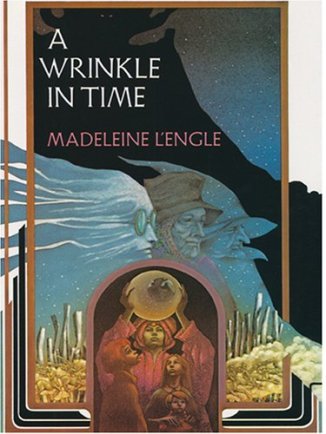
 

A Wrinkle in Time


Newbery Medal winner A Wrinkle in Time is the first book in the Time Quintet series of fantasy YA fiction about the Murray family, scientist parents and four children Meg, twins Dennys and Sandy, five year-old genius Charles Wallace, and that special friend of Meg’s, Calvin O’Keefe. The deceptively simple odyssey in time and space is packed with wonder and wisdom.

The book not only exudes insights but shows L’Engle’s remarkable foresights. Take this for an example, dematerializing and materializing  for easy transport. Published in 1962, the book came out four years before Scotty beamed Kirk up using the same method in the first season of Star Trek.

Or this fancy idea, ‘tesseracting’, that is, travelling through space and time via a wrinkle in time. The shortest distance between two points is not a straight line, but through a wrinkle when two points are folded. That’s fifty years before Christopher Nolan sends Matthew McConaughey interstellar travelling.

All concepts held in a simple plot. Meg, Charles Wallace, together with friend Calvin, go on an interstellar quest to look for Meg and Charles’ physicist father who had gone missing for almost a year while doing some classified scientific work for the government. This little, unequipped search party is initiated and aided by three celestial beings: Mrs. Whatsit, who’s much wiser than she appears, Mrs. Which, who doesn’t bother materializing but remains as a shimmering beam, and Mrs. Who, who speaks in quotes.

The more a man knows, the less he talks.

Their odyssey brings them finally to the planet Camazotz, where they find Mr. Murray confined by the evil Dark Thing, or IT (Surprise! 24 years before Stephen King’s book and now movie) The smart alecky Charles Wallace is easy prey and quickly influenced by IT. (And for Luddites, what better parallel to address our technology now, the evil IT) Ultimately, it’s Meg, our reluctant and timid heroine, who has to be the one to go fight IT to rescue her little brother.

The foolishness of God is wiser than men; and the weakness of God is stronger than men… God hath chosen the foolish things of the world to confound the wise; and God hath chosen the weak things of the world to confound the things which are mighty.

Meg knows Charles Wallace is not himself but trapped and deceived, and must be snatched from the evil force IT. She has just one weapon as her ammunition, given to her by Mrs. Whatsit, that one thing IT doesn’t have: LOVE. With her single act of bravery, she brings the family together again.

When I was a child, I read like a child, I thought like a child. When I became an adult, I can read like a child and like an adult too. That’s the joy of reading A Wrinkle in Time. One can find pleasure in the adventure and feel the vulnerability of the children, as well delve deeper into its symbolism and parallels, and ponder its layers of meaning.

L’Engle writes to the child and the adult in us. She can convey scientific and spiritual concepts at the same time and in a way that both young and old (and those in between) can enjoy. There’s no conflict between the cerebral and the spiritual; they co-exist comfortably in L’Engle’s work. Not only that, they fuse together and from that alchemy rises a whole new, inexplicable entity: Faith.

That first Christmas day when a baby was born in a lowly manger, the war against IT had started to win. Although the last, painful battle on the hill of Calvary had not been waged, the outcome was cast, just because LOVE came.

And the light shineth in darkness; and the darkness comprehended it not.


The Movie

‘Tis the Season to read or reread A Wrinkle In Time before the movie adaptation comes out in 2018. Helmed by Selma (2014) director Ava DuVernay, screenplay by Frozen (2013) scriptwriter Jennifer Lee, with some stellar beings including Rees Witherspoon, Oprah Winfrey, Mindy Kaling, Chris Pine et al.

***

Past Reading the Season Selections:

2016:  Silence by Shusaku Endo

2015: The Book of Ruth

2014: Lila by Marilynne Robinson

2013: Poetry by Madeleine L’Engle

2012: Surprised by Joy by C. S. Lewis

2011: Walking on Water by Madeleine L’Engle

2010: A Widening Light, Luci Shaw

2009: The Irrational Season 

2008: The Bible and the New York Times by Fleming Rutledge

2008: A Grief Observed by C. S. Lewis

Mudbound: From Book to Screen

The Book

Mudbound is Hillary Jordan’s debut novel, published in 2008. It won the Bellwether Prize for fiction, an award founded by author Barbara Kingsolver to promote literature of social justice and responsibility.

Mudbound Book Cover

The setting is WWII and its ending, as two American soldiers return from Europe to their families in Mississippi. One of them is Jamie, white, a flying ace whose co-pilot was shot dead right beside him in a fierce dogfight. The other, Ronsel, black, a decorated war hero who had fought in the tank battalion under General Patton. Both had experienced the war, seen the atrocity, now back home having to deal with the demons of the aftermath: for Jamie, traumatic shocks and survivor’s guilt; for Ronsel, another barbaric battlefront, racism in the Deep South.

Jamie comes back to a cotton farm owned by his older brother Henry McAllan and stays in the lean-to adjacent to the main house, itself but a shack with no running water or electricity. “Mudbound” is the proper name for it. When the rain pours and the wind blows, the mud drowns and pulls everything down, dirtying all from head to toe. A gloomy place to start anew as a farmer.

They weren’t all like that to start with. Henry has an engineering degree. Laura, Henry’s wife from Memphis, is also college educated. She learns of Henry’s intention to move to rural Mississippi and be a cotton farmer only weeks after her marriage. What’s worse, Henry’s obnoxious father, Pappy, will be coming to live with them.

Ronsel’s father Hap Jackson is the sharecropper working in the cotton fields owned by Henry. Fate brought the two families together. Hap and his wife Florence and all his children have been praying for Ronsel’s safe return from the war. Now their prayers are answered, but only pit Ronsel into another battlefront when he meets Jamie and the two strike up friendship, a despicable taboo.

Written in chapters that reveal the point of view of the various characters, the book is a sort of a literary ‘Rashomon’, how different people see the same event in their own light, or the lack of it. Such a writing structure evokes empathy as Jordan leads the reader to delve into the mind of the characters. And as the final climatic chapters come, we as readers get to know a crucial fact, an essential plot point we are privy to but which even other characters are not aware. We have Jordan to thank for such an insightful way to present the omniscient viewpoint in her storytelling.

The trajectory of the friendship between Jamie and Ronsel is tragically predictable. But what’s not predictable is Jordan’s incisive writing. Sometimes adding a short little phrase at the end of a sentence could make it speak much more. It’s writing like this that makes the book enjoyable despite its subject matter. Take this as an example, simple and subtle, but revealing effectively Laura’s inner turmoil after a tumultuous night:

“… I got up and checked on the children. They were sleeping, with an untroubled abandon I envied.”

Or this line to wrap up a climactic chapter. Such descriptions are perfect cues for nuanced  performance on screen:

“What we can’t speak, we say in silence.”

No spoiler here. But this is the kind of writing that conveys powerfully the emotions and events that sweep the reader up while allowing space to mull things over.

***

The Movie

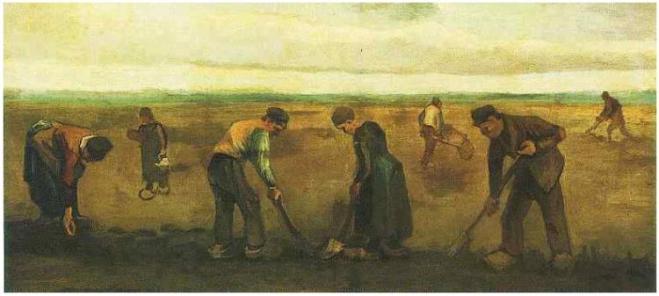
The cinematography (Rachel Morrison) is the most distinguished feature from the beginning. As the title suggests, the colour palette is a spectrum of browns, reminiscence of the paintings of Jean Francois Millet’s farmers toiling in the fields, or this Van Gogh’s Potatoes Farmers:

VVG Farmers-Planting-Potatoes

But before the mud swallows up life, there is the colourful, urbane, Memphis party scene, or the courtship under golden leaves. The contrast is heartbreaking. Laura (Carey Mulligan), who seems to have no say about her life and fate, has to follow her husband Henry McAllan (Jason Clarke) from the city to move to a shack with no running water or electricity on a cotton field in rural Mississippi. Being a landowner is the sole ambition for him.

But of course, not just Laura, but everyone is drawn into the muddy swamp. Hap Jackson (Rob Morgan) is the sharecropper on the McAllan fields. His wife Florence–absorbing performance from “the Queen of Hip-Hop Soul” Mary J. Blige–is soon asked to help Laura with caring for her two girls and household chores. The return of their son Ronsel (Jason Mitchell) and Henry’s younger brother Jamie (Garrett Hedlund) from Europe after the war will eventually link the two families down an inescapable path.

Turning the chapters of internal worlds into visuals on screen is a tall order. Director Dee Rees, who co-wrote the screenplay with Virgil Williams, had done an effective job by voiceovers, which is sometimes frowned upon as they could mean an easy-way out. But here, the voiceovers are intimate and personal. The few simple lines in the voice of the characters draw the viewers closer in. With Carey Mulligan, I admit I’m totally partial. Her alto voice is moving and poignant.

mudbound-movie-stills-4 (3)

Picking the right events from the book is crucial. Director Rees has followed closely to the plot lines using many of Jordan’s words, but also taken the liberty to switch around and combine them in the movie adaptation. Juxtaposing Ronsel and Jamie’s traumatic battle scenes with accidents and illness at home are effective and emotionally engaging; all have to fight their battles, big and small, at home or the frontline.

The most moving juxtaposition comes at the intense, climactic scene where the singing of a hymn replaces dialogues. It’s a juxtaposition of the visual with sound and silence. Jordan’s impressive line from the book is aptly adapted onto screen:

“What we can’t speak, we say in silence.”  Or here, in song.

The ending of the movie is altered, and I’m glad, for they who have suffered so much, so long, deserve a cathartic ending. This is a good example of a fine adaptation. It’s not a page by page transposition from book to screen, ‘faithful’ to the dot. But Rees has taken the liberty to unleash the dramatic, or maybe, melodramatic. It’s always cathartic to see love triumph after all. Mary J. Blige’s “Mighty River” is an appropriate wrap as the end credits roll.

***

~ ~ ~ ~ Ripples
Book and Movie

When is a window not a window?

Arti was in NYC for a week in September.

It was Friday afternoon free admission time when hundreds lined up several city blocks to get into MoMA, Museum of Modern Art. Once in there, it was like inside the Tower of Babel (not that Arti had been there), but just imagine the whole world had converged in this space, all kinds of languages were heard.

After visiting MoMA, some questions came to mind. Here are the Q & A’s. (Photos were allowed. The following were all taken using the iPhone 6)

When is a window not a window?

When it’s encased in plexiglass, with the name Marcel Duchamp placed beside it, declaring it to be an objet d’art. Dada-di, Dada-dum…

Not a window.jpg

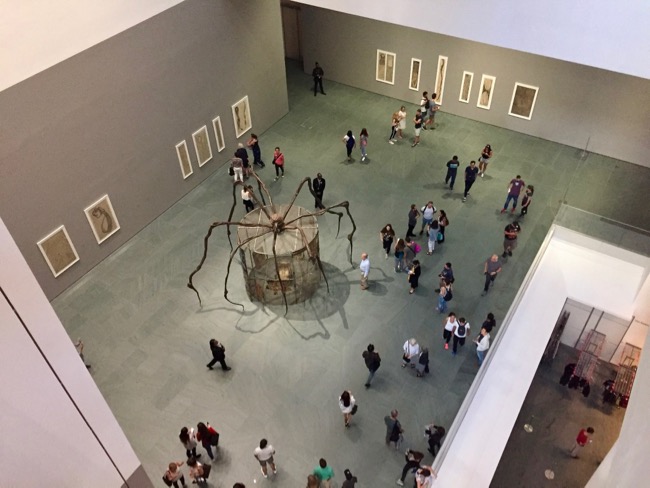
Or, when is a spider an objet d’admiration, something larger than life?

When it evokes a Kafkaesque vision:

Giant Spider 1

Spider

And why is the arachnid a double-edged sword?

Well, the artist Louise Bourgeois (1911-2010) saw it as a friend when it captured bothersome mosquitoes in her Connecticut country home. As well, Bourgeois also saw it as a symbol of her mother. Wait, not in looks or nature, but in the work that they do. Her mother was a tapestry restorer. Bourgeois saw sewing and spinning web to be a similar form of action.

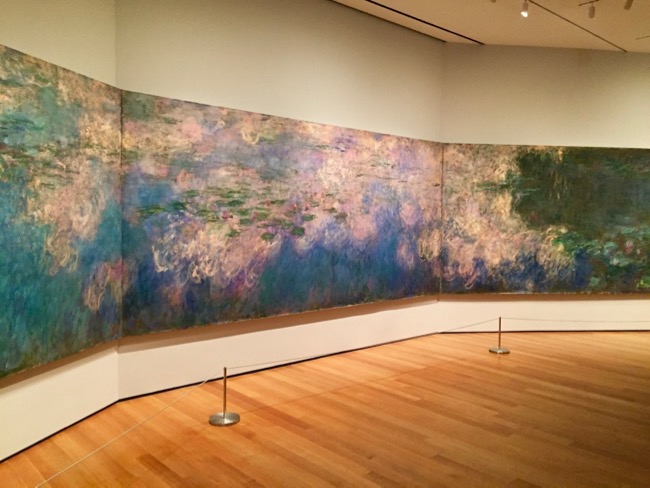
How do you take a good photo when there are crowds everywhere? A bit similar as how to get to Carnegie Hall, patience, patience, patience. The following are the before and after effects at Monet’s Lily Ponds:

Crowds.jpg

Monet's Water Lilies 1.jpg

What’s the major excitement of the whole experience? The ecstasy of seeing some famous artworks unexpectedly, ones that Arti had never thought she’d see in real life.

Christina’s World (1948) by Andrew Wyeth (1917-2009). And what is the blue patch in the middle? Arti’s watermark.

Christina's World.jpg

The only Edward Hopper (1882-1967) at MoMA, Gas (1940). As an avid bird watcher, Arti of course would have loved to see Nighthawks but Gas would do, for the serendipity.

Gas

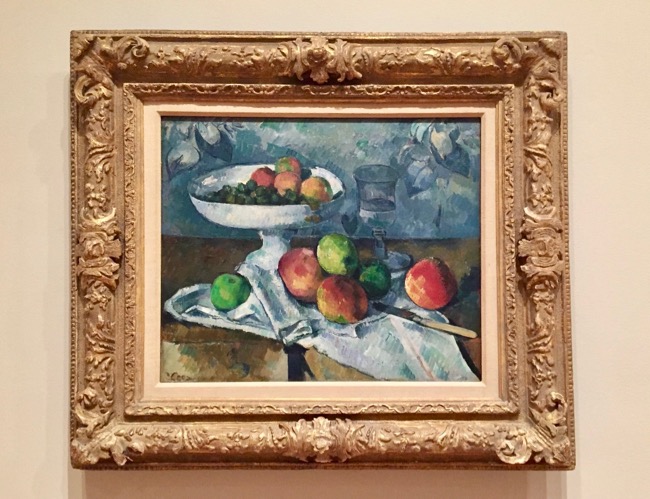
And glad to see Paul Cézanne’s (1839-1906) healthy diet:

Healthy diet

Ta-da! This is probably one of the most compelling reasons for many to visit MoMA, van Gogh’s The Starry Night (1889):

Starry Night

Which was the most memorable for Arti?

Jackson Pollack.jpg

One: Number 31, 1950 (1950) by Jackson Pollock (1912-1956)

Never thought it was so big, 8′ 10″ x 17′ 5 5/8″ (269.5 x 530.8 cm). No easy dripping.

***

A few related posts on Ripple Effects:

Arles: In the Steps of van Gogh 

Inspired by Vermeer

Edward Hopper, William Safire, the Visual and the Word

Alex Colville and the Movies

Art and Cliché

Golden Fall

Two years ago around this time, I drove across four New England states searching for fall foliage. Red was the colour I was looking for. It may surprise you, we don’t have red here in Alberta, no real Maples here. We might have some red from certain trees or shrubs, but not on a large scale as in Eastern Canada.

But what we have is gold, different shades of gold. Red can make the landscape more adorable, but gold is purity. Here’s the scenery in the past two days by the Bow River in my usual birding sites:

The Bow

Trees by the Bow

Trees 2

The scenes of a golden fall near the Pond, where layers of autumn foliage and evergreens make up the ripples of a boreal forest:

Golden fall

Golden.jpg

Golden 1

Golden 6.jpg

Golden 7.jpg

Even the path under my feet is golden:

Golden Path.jpg

I know, nothing gold can stay. Even as I type, a Winter Storm Warning is in effect. We’ll have snow overnight, and “Hazardous winter conditions are expected”.  So when this post is up on Monday, all the gold will likely be white, which makes these photos all the more precious. They could be the last of the fall memories of 2017.

But then again, if we can have winter in the fall, we can have summer in December. At least, that’s what I’m dreaming of…

***

Related Posts on Ripple:

My New England Road Trip Starts Here


The Last Days of Summer

It has been noted that the drive from Lake Louise in Banff National Park up the Icefields Parkway north to Jasper National Park is the most beautiful drive in the world. I spend a couple of our remaining summer days driving that scenic route and immerse in the other-worldly environs of pristine Jasper National Park.

The cold rain and wet snow in sections of the road remind me that, yes, autumn is at hand. But once I reach the boundary of Jasper National Park, I throw away any seasonal distinction. Wether it’s summer or autumn is immaterial. What’s captivating is the present. Here are some glorious sights of Jasper National Park.

The mysterious, clouds shrouded Medicine Lake in the morning light:

Clourds Shrouded Medicine Lake.jpg

Hurricanes hit Texas and Florida, here we’ve been affected by the wild fires from B.C. all summer. At the shore of Medicine Lake I feel the effects:

Wild Fire effect

But the natural beauty remains. The charred remnants of trees along the edge of the lake would become rich organic matter spurring new growths.

burned trees.jpg

A short 30 mins. drive from Medicine Lake is the picturesque Maligne Lake, serene and reflective:

DSC_0116.jpg

For those who must do something to seize the moment, there are canoes for rent and scenic cruises:

DSC_0122.jpg

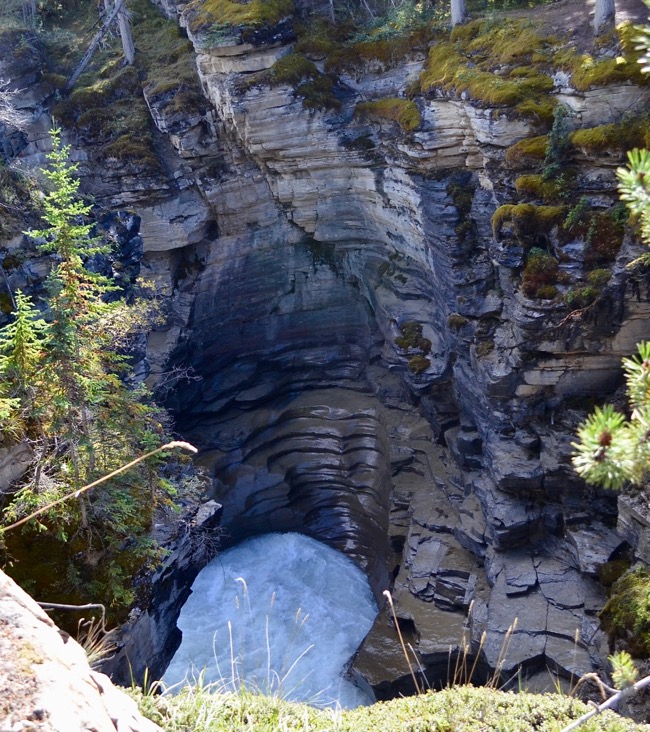
Before reaching the townsite of Jasper, the 93 Icefields Parkway leads to Athabasca Falls, where one can witness the power of Nature in an aesthetic mode. Who had turned the mighty torrents into Nature’s sculptors, carving quartzite and limestones into magnificent art installations?

DSC_0164.jpg

Nature's Sculptor.jpg


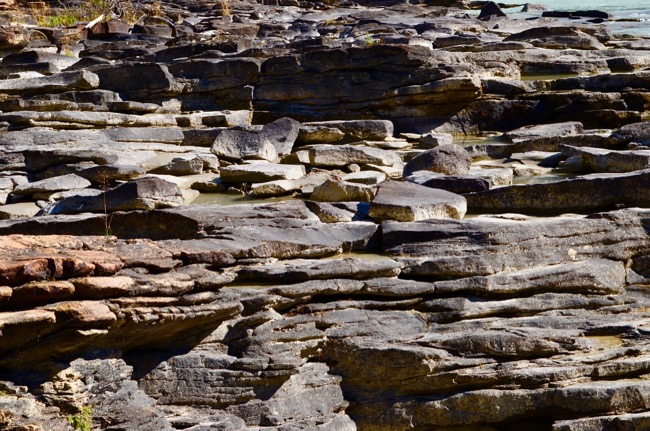
Hardened Ripples.jpg


DSC_0149.jpg


The Gorge.jpg

DSC_0136.jpg

In the Jasper townsite, even the man-made locomotive matches the scenery in the evening light. Like a watercourse streaming through the landscape, The Rocky Mountaineer passenger train passes through Vancouver and across the Rocky Mountains into Alberta’s Banff and Jasper National Parks.

DSC_0061.jpg

DSC_0062.jpg

DSC_0063.jpg

Even a cargo CN train exudes poetry. I credit it to the spirit of the environs:

DSC_0065.jpg


Just like the animals preparing for winter, I’m gathering visual memories to feed the cold months ahead.


***

Other Travel Posts on Ripple Effects:

New England Foliage Road Trip

Day Trip to Cambridge

Establishing Shot: A Visit to Toronto


Six Degrees of Separation or Prophetic Voices of our Time

I’ve read several books in recent months that are good evidence of ‘six degrees of separation’, and I’ll just end with four here. But more crucial is why such content at this time? They are all published in 2016 but still enjoy current bestselling positions. All are similar in their historical backdrop, authoritarian dictatorship in the 20th Century in two neighbouring countries, China and Russia. Or, maybe these writers of our time are indeed prophetic voices to stress that eerie caution: “Those who don’t know history are doomed to repeat it.”

Here’s the sequence of my reading:

Madeleine ThienDo Not Say We Have Nothing by Madeleine Thien

The top selling book in Canada according to CBC Books, Madeleine Thien’s exceptional novel of three characters, musicians at the Shanghai Conservatory of Music during the Cultural Revolution in China, leads us through decades of contemporary Chinese history from the Communist takeover after WWII to Mao’s Cultural Revolution to the 1989 Tiananmen Massacre, spanning generations and across two continents. Thien was teaching creative writing when her program was abruptly cancelled in the aftermath of the ‘Umbrella Revolution’ sprouting from the Occupy Central led by teenaged students in Hong Kong. That was a motivating force propelling the writing of the book. Following the most recent news that four young student leaders are given months of jail sentences for their actions, we know how timely a voice Thein is with this book.


Barnes The Noise of Time.jpgThe Noise of Time by Julian Barnes

Dimitri Shostakovich’s music is in the minds of the three musicians at the Shanghai Conservatory of Thien’s book. Shostakovich, himself a composer treading a precarious line between authenticity and self-preservation under Stalin, is an apt parallel of the situation the trio have to face.

Julian Barnes has crafted an imaginary biopic of Dimitri Shostakovich during Stalin’s tyrannical rule in the Soviet Union (1929-1953). Barnes’ depiction is internal, presenting the struggles, the giving-in and the self-loathing of a world famous composer and pianist who was unable to stand up to a ruthless and manipulative dictator. Speak truth to Power? Who can still stand, or live, after that? And it’s not just about oneself, but one’s family and all those associated.


Cometh the hourCometh the Hour by Jeffrey Archer (#6 of the Clifton Chronicles)

Jeffrey Archer, a prophetic voice? While his Clifton Chronicles have entertained us with imaginary characters spanning three generations of two British families, Archer does have the political mood of our times firmly held under his pen, and Lord Archer is a savvy political historian in his own right. This summer I binged on Jeffrey Archer, okay, not exactly your serious, prophetic voice, but no less relevant. This is especially true when his fictional character, Russian writer Anatoly Babakov, is imprisoned in Siberia for his book Uncle Joe. Based on his own experience while working under Joseph Stalin, Babakov offers readers an insider’s look into the ruler, revealing the ruthless dictator that he really was.

Babakov is awarded the Nobel Prize of Literature while still in prison. But not long after the announcement, he dies of a heart attack. His wife Yelena although escaped out of the country, wants to return to honour her husband. Archer’s character makes me think of the real life dissident Chinese writer and activist Liu Xiaobo, also Nobel laureate, but was denied the freedom to go and accept his Prize. He had been imprisoned for 11 years and sadly, died of liver cancer in July this year, 2017. And even more sadly, Liu’s wife could not see him at his deathbed and had gone missing after his death. Archer’s book was published in 2016. I’d say that’s quite prophetic.


A Gentleman in Moscow by Amor Towles

A Gentleman in MoscowA totally different tone, but the same historical backdrop. Towles has created an interesting and colourful character, the aristocrat Count Alexander Rostov, kept in house arrest when the Bolsheviks overrun the country. True to his personality and lifestyle – the major consolation of such a misfortune – Count Rostov serves his house arrest in the elegant Moscow Metropol Hotel across from the Kremlin, albeit in a cramped room in the attic. With his always pleasant demeanour, the former aristocrat makes himself at home at the grand hotel, meeting interesting characters, wine and dine to his heart’s content. He stays there for decades, with the historic changes happening outside the four walls of the Metropol: Lenin, Stalin, post-Stalin, and further. As fate would have it, Count Rostov encounters an idealistic youngster named Nina, and years later, takes up guardianship of her daughter Sofia, and thus his life and view begin to turn into something more purposeful. The Metropol makes me think of Wes Anderson’s The Grand Budapest Hotel. Instead of speaking truth to power and get slapped in the face or worse, Count Rostov thinks of an ingenious scheme to beat Power at their game. If I were a filmmaker, this is one to bank on.
***

Related Posts on Ripple Effects:

Do Not Say We Have Nothing Book Review

The Budapest Hotel: A Grand Escape


‘Certain Women’: To Connect on a Vast Landscape

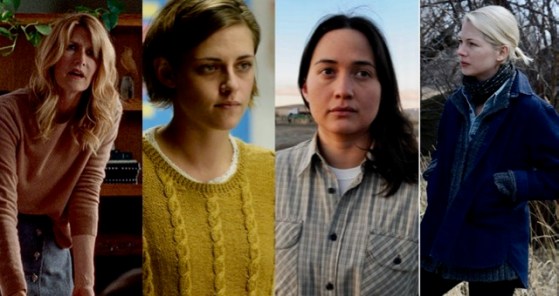
The common denominator is the landscape: Montana. Open country, clear, fresh air. The expanse of space could mean the freedom to roam. As we look into the four female characters, however, the vastness of the landscape and the cold winter could infer separateness and the need for connections. In the internal landscape, an assertion of self.

Director Kelly Reichardt (Wendy and Lucy, 2008) has chosen three short stories by Maile Meloy to form a cinematic triptych. Meloy’s stories are lean and succinct. Correspondingly, Reichardt’s style is minimal as with her previous works. She brings together three loosely linked stories that can stand on their own. To review them in a succinct way, I’ll use three words as my focal point for each.

Certain Women.jpg

Authority

Laura (Laura Dern), a woman lawyer in Livingston has to deal with a disgruntled client, Fuller (Jared Harris), who was injured in his construction job. As he has accepted a settlement, he can have no further claim for tort. Laura has explained this to him time and again, but he refuses to believe her until one day, they drive a few hours to another town to seek a second opinion from a personal injury lawyer, a male. As Fuller listens to the lawyer stating the same reason as Laura has been telling him all along, he just says ‘Okay’ and seems to accept the fact. Laura laments: “If I were a man, I could explain the law and people would listen and say ‘Okay.’ It’ll be so restful.”

A few days later, a hostage-taking incident occurs in the middle of the night, and Laura is called by the police. It’s Fuller taking a security guard hostage at a government office and wants her to go in to read him his file regarding compensation. Laura goes in and calmly diffuses the tense situation. The incident sends Fuller to prison. He seems content when Laura visits him. Laura finds a changed and much calmer Fuller. He appreciates her visit, and just wants an occasional letter from her to keep in touch. Laura does have authority after all, albeit may not be as she has hoped in the professional front. Her influence rests on her considerate demeanor making an impact on a personal and human level. And for this, Fuller learns to appreciate.

Authenticity

A city woman Gina (Michelle Williams) wants to build a country dream house, not to move in but as a weekend home. She has her eyes on a pile of sandstones that belong to long time resident of the land, Albert (Rene Auberjonois). The sandstones hold the history of the area, for they are from the original school house. We see the cracks in Gina’s relationship with her husband Ryan (James Le Gros) as they try to smooth-talk Albert, Gina seemingly caring but assertive in what she wants, while Ryan is apologetic and conciliatory. Why would a city woman want a pile of old sandstones for her country home? For authenticity, Ryan tells Albert. Ouch, is that supposed to be helpful or is he being sarcastic? Further, their daughter Guthrie (Sara Rodier) seems to be harder to placate as she is dragged along to the country reluctantly. The crevice in the mother-daughter relationship looks to be a tough fissure to fix.

Alienation

The most moving segment comes last. A young lawyer Beth Travis (Kristen Stewart) has to drive a few hours several nights a week after work from Livingston to Belfry to teach a night course on school law, a prior commitment before she found her present job. At the night class, she encounters a ranch hand, Jamie (Lily Gladstone), who drops in out of curiosity. The short moments of sharing as she accompanies Beth to a diner after class for a meal before she drives back home stir up deep longings. Gladstone’s restraint is particularly moving. Nuanced performance from both.

While she may be adroit with horses, it’s a human connection that Jamie yearns for. She comes to every class until one night, the students are told that the class will be taught by another teacher as Beth has quit due to the long drive. Eager to look for her, the ranch hand drives to Livingston to search for a lawyer named Beth Travis. What follows is an aching attempt to reach out towards an unrequited end. The last scene of the same horse-tending routines Jamie gets back to speaks poignantly. Life goes on despite…

~ ~ ~ 1/2 Ripples

***

Source materials: Short stories by Maile Meloy “Tome” and “Native Sandstone” from the collection Half In Love, and “Travis, B.” from Both Ways is the Only Way I Want it.

The Glass Castle: From Book to Screen

Jeannette Walls’ memoir had a “seven-year run on the New York Times best-seller list” after it was published in 2005, according to a NYT article . Now, 12 years later, a movie adaptation. So, the long wait is over. The wait, of course, belongs to those who don’t mind seeing a book turned into a movie.

As I’m a proponent of judging book and film as two different art forms on their own merits, I welcome movie adaptations. With this memoir, a non-fiction, I do feel the movie lacks the emotional punch as the first person narrative Jeannette Walls has so masterfully presented in her book. Walls’s memoir is a much livelier, engaging, and poignant piece of account depicting an extraordinary growing-up experience, a nomadic life of poverty until she and her siblings escaped from it.

As I’d mentioned in my review of the book, I was browsing in a bookstore when I picked up The Glass Castle randomly. The opening line captured my attention right away:

I was sitting in a taxi, wondering if I had overdressed for the evening, when I looked out the window and saw Mom rooting through a Dumpster.

That instantly drew me in. And for the rest of the book, Walls has not stopped captivating me with her growing up experience. She candidly shares how alcohol had ruined the potentials of her dreamer dad Rex, who had always dreamed of building them a glass castle. She tells us how her artistic mom Rose Mary had coped (or not), and the effects of their unconventional ‘parenting style’ had on the four children. Eventually, starting with the eldest, Lori, the children one by one escaped from their parents to NYC to start anew. As Jeanette saw her Mom digging through a Dumpster in NYC, she was a journalist at that time and living on Park Avenue. No judgement here, for the book explains all. The Glass Castle is a detailed account of Jeanette’s incredulous journey.

TGC_D40-4817.raf

Now, having said all that, I must state that the movie is still a watchable production. Unlike his previous realistic drama Short Term 12 (2013), writer director Deston Daniel Cretton has a tall order here: from the massive field of information in the memoir, to glean and pick just a few episodes to include in the film and string them up as a whole, while making them as interesting and captivating as the book. I know, Cretton must eliminate and condense, the difficult task of a movie adaptation.

Cretton chose to focus on the love hate relationships between father and daughter, and the actors have delivered, thanks to the performance of Woody Harrelson as Rex and the actors who play Jeannette as a youngster, Ella Anderson, and as adult, played by Academy Award Best Actress Brie Larson (Room, 2015). Harrelson is spot-on and dominates the screen.

Mom Rose Mary is played by Naomi Watts. And with this character, I feel there may be a miscast here. For one thing, since the film is heavily weighed on Rex, mom has a much minor role, which is a shortfall, for she does contribute to the children’s development, and taught them to appreciate reading, art, and the value of resilience, using the Joshua Tree as an object lesson, bent but alive. In my mind, Laura Dern could be a more suitable cast.

While the book is chronological, the movie juxtaposes the past with the present. It is done quite well, no confusion or disjointed feeling here. The editing is smooth and moves both storylines forward effectively. The scene of the accident when Jeanette has to cook as a young child and is burned badly is placed aptly at the beginning of the movie. Scars that can be seen visually is a good reminder of one’s past where memories could fade.

One of the main differences between The Glass Castle the book and the movie adaptation is distance. The book is intimate and close. Walls is such a straight forward writer that it feels like she’s right there sharing, opening up herself candidly to the reader. With the movie here, we are just like that, sitting afar as a spectator. It took me a while to engage.

The major issue is the mood. The book depicts a nomadic existence as Jeanette was growing up. The children were herded from place to place across States, often as dad Rex escaped from debtors. They had slept open in the Mohave desert, so, they could pick their own star as a present. Surely these may all be a disguise for their plight, euphemism offered by irresponsible parents. But none can deny the thrills and exhilaration of escapades and adventures. The togetherness of the siblings, the wonder of life are apparent in Walls’ descriptions. The word ‘dysfunctional’ had never appeared in my mind as I read the book.

The film however, focuses on the darker side. The abusive and volatile Rex dominates the screen. Poverty and gloom take over. The tipping point comes as the eldest Lori graduates from high school, and she makes an exit plan. We breathe an air of relief as the children one by one escapes to NYC. A few years later though, Rex and Rose Mary move out to be with them, so they can all be together again as one family.

Is a family being together always the best? As we see, togetherness may not be an ultimate good to pursue when harmony is impossible to reach. What’s more important is keeping oneself intact, one’s past reconciling with one’s present, the integrity of self. In the film, that is the turning point for Jeannette in the scene at the restaurant with an important client of her husband’s. Jeannette comes out from hiding about her family, albeit at the most inopportune moment.

The final scene is a beautiful wrap. The Walls gather together to have a family meal after Rex has died from illness. The siblings chat about their formative years in laughter. Resilience and loyalty to each other have kept them intact. A rewarding closure and a beginning towards a better future.

Do stay behind to watch the video of the real life Jeannette with her mom Rose Mary as the ending credits roll. And do sit through the credits until the very last line, wherein lies the emotional punch of the whole film:

“To all families, despite the scars, still find a way to love.”

~ ~ ~ Ripples


***


Related Post on Ripple Effects:

The Glass Castle Book Review

Metropolitan (1990): Whit Stillman’s Homage to Jane Austen

Thanks to New York born and raised director Whit Stillman, one of Jane Austen’s characters in her juvenilia, Lady Susan Vernon, had a field day last year. For those wondering how that came about, do seek out Stillman’s film Love & Friendship (2016), or his movie-tie-in book Love & Friendship: In Which Jane Austen’s Lady Susan Vernon Is Entirely Vindicated. 

But Janeites may not have noticed, back in 1990, five years before the pivotal year of wet shirt Darcy’s mortifying encounter with Lizzy Bennet, another Austen character was vindicated, Fanny Price of Mansfield Park. And they have Stillman to thank.

What does Jane Austen’s Mansfield Park, published in 1814 England, have in common with a bunch of upper class college freshmen/women in 1990 New York City, calling themselves UHB (Urban haute bourgeoisie), worrying about an ‘escort’ shortage for their debutante parties during their Christmas break?

Wait a minute, UHB? ‘Urban Haute Bourgeoisie‘? Isn’t that the kind of targets that would have interested Jane? Our astute Jane who loved to wield her pen, piercing through the façade of the rich and privileged, shaking the underlying status quo of society of her time? Jane would have loved Stillman’s film. She would be amused by the characters in this comedy of manners and their social commentaries. Debutante parties? Jane would be surprised to hear they still exist in the 20th century. If she were to write the screenplay, Jane would probably be less subtle.

Screen Shot 2017-07-17 at 10.03.38 PM

Stillman’s Metropolitan is not so much an acerbic satire but a gentle poke and  descriptive vignettes of the young UHB’s lifestyle and thinking. From his treatment of his characters, he is gentle and forbearing, albeit incisive, just enough to elicit some knowing chuckles.

In Mansfield Park, Jane presented a heroine that is a contrarian. Fanny Price is unadorned, impoverished, athletically challenged, a misfit and outsider when she enters the upper class home of Sir Thomas Bertram. But it’s her being principled and virtuous that make her stick out like a sore thumb. As Jane ends the book, Fanny gets the final praise, and an oblivious, but decent, Edmund as her ultimate reward.

Stillman’s Metropolitan is set in 1990 NYC. It has two characters that are a type of Fanny Price. First is Tom. He stands for everything that’s the opposite of the UHB. A self-professed socialist, Tom comes from the other side of the track. He wears a raincoat (albeit with a warm lining as he explains) in midwinter, and a ‘snob’ for public transit. Taxi? No, he’d rather walk.

Sure, his new found friends of the UHB know why. How many can afford to take the taxi as their usual means of transport and wears tux to parties? So, to their credit, despite knowing Tom might be from the opposite side of town, they receive him into their midst, especially as the girl Audrey likes him very much and wants him to help solve their, or her, ‘escort shortage’ to the debutante parties.

Audrey is a lover of books. She’s unpretentious, modest, and above all, a sensitive soul not unlike Fanny. In one scene, Audrey serves as a moral compass as the group gathers in the after party to a game that she disapproves of. That’s a Fanny incognito there. She insists on her stance despite everyone, Tom included, feels there’s nothing wrong with the game.

So there are the Austenesque parallels and types. You might be able to identify the Crawfords there too. The youthful characters are all serious in their viewpoints. One must give them credits. In their tux and gowns they discuss social theories. Therein lies Stillman’s gentle satire. While the sarcasm and humour is subtle, there are a few lines that are overt, lines I think Jane would have approved.

In this scene (above photo), Audrey and Tom discuss books. Audrey says Persuasion and Mansfield Park are her favorite Austen books, Tom is incredulous.

Tom:  Mansfield Park! You got to be kidding.

Audrey:  No.

Tom:  But it’s a notoriously bad book. Even Lionel Trilling – one of her
greatest admirers – thought that.

Audrey:  If Lionel Trilling thought that, he’s an idiot.

Jane probably would have thought, “Oh I wish I had written those lines.”

But wait, there’s more. Later in the party, Tom and Audrey continue to discuss Mansfield Park.

Audrey: You find Fanny Price unlikeable?

Tom: She sounds pretty unbearable, but I haven’t read the book.

Audrey: What?

Tom: You don’t have to have read a book to have an opinion on it. I
haven’t read the Bible either.

Audrey: What Jane Austen novels have you read?

Tom:  None. I don’t read novels. I prefer good literary criticism. That way
you get the novelist’s idea as well as the critic’s thinking. With
fiction I can never forget none of that has really happened. It’s all
made up by the author.

Oh I can see Jane ROFL.


~ ~ ~ 1/2 Ripples


***

Related Posts on Ripple Effects:

Stillman’s Love & Friendship: More than Book Illustration

Love & Friendship and Other Prospects

Mansfield Park: Jane Austen the Contrarian 


Upcoming Books to Movies 2017

Half a year’s gone already. How’s your reading and watching coming along? Here are some movie adaptations I anticipate for the latter half of the year.

The Glass Castle by Jeannette Walls

the-glass-castle-bookFinally, the movie adaptation is completed. More than seven years on the NYT Bestseller list, Jeannette Walls’ 2005 memoir of resilience and delight – yes, the two can co-exist – is high on my TBW list. After receiving her Academy Best Actress Award in another book-to-screen adaptation, Room (2015), Larson is back with her Short Term 12 director Destin Cretton. Interesting cast for the parents, Woody Harrelson as dreamer dad Rex Walls and Naomi Watts as uncouth artist mom Rose Mary. Coming out in August. Should be a good summer movie.


Tulip Fever by Deborah Moggach

Tulip FeverMoggach’s best known book is probably The Best Exotic Marigold Hotel, among her many titles. Tulip Fever is the author’s first historical fiction set in 17th century Holland, evoking the paintings of Vermeer’s. The story begins with a rich merchant in Amsterdam commissioning a painter to paint his young bride. The rest is up to the further imagining of Moggach’s creative mind. From book to screen adaptation written by Tom Stoppard, directed by Justin Chadwick, who helmed the adaptation of Philippa Gregory’s The Other Boleyn Girl (2008) and the excellent TV mini series of Dickens’ Bleak House. Cast includes Alicia Vikander, Judi Dench, Christoph Waltz. Coming out in August. Should be another good summer pick.


Wonder by R.J. Palacio

Wonder Book CoverAnother one high on my TBW list. This is one YA novel that appeals to both young and old, for the theme of acceptance and empathy is so much needed in our time. A look at the trailer shows the film is well cast. Room’s breakout young star Jacob Tremblay as disfigured fifth grader, entering school for the first time in his life; Julia Roberts plays mom and Owen Wilson is dad. Stephen Chbosky (The Perks of Being a Wallflower, 2012) directs. To be released November, 2017.
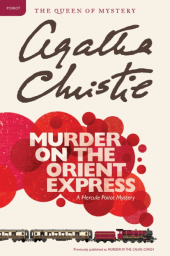


Murder on the Orient Express by Agatha Christie

Murder on the Orient Express.pngDame Agatha Christie’s famous work has gone through many renditions on the big screen, small screen and even a video game. But the classic has to be the Sidney Lumet directed 1974 production with Albert Finney, Lauren Bacall, Ingrid Bergman, John Gielgud, and a young Sean Connery, just to name a few. This 2017 version is directed by Kenneth Branagh who will, of course, takes up the role of Hercule Poirot. Cast include Johnny Depp, Michelle Pfeiffer, Daisy Ridley, Penélope Cruz, Judi Dench, Derek Jacobi, Willem Dafoe, a modern classic in the making? Coming out November, 2017.
 

EXTRA, EXTRA: Ordeal by Innocence by Agatha Christie

Ordeal by Innocence

Talking about Dame Agatha, the latest, yes just hours ago, it has been announced that the prolific writer – whose books have sold only less than The Bible and Shakespeare according to The Hollywood Reporter – will ring in yet another adaptation by BBC in time for the Christmas season. BBC touts a mighty cast with Bill Nighy, Catherine Keener, Matthew Goode, Eleanor Tomlinson among many talents. A jolly good Christmas for the Brits indeed. We’ll have to wait for Masterpiece to act.


***

Related Ripple Effects Posts:

The Glass Castle Book Review

Wonder by R. J. Palacio: Required Reading for All

The Best Exotic Marigold Hotel 

The Second, Best Exotic Marigold Hotel


A Movie to Celebrate Canada Day

Happy Canada Day to all my Canadian readers!

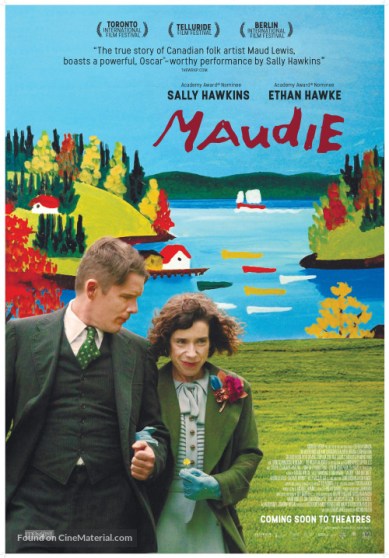
To celebrate Canada’s 150th birthday, and pay tribute to the Canadian spirit, I’d like to recommend the movie Maudie, about the folk art painter Maud Lewis (1903-1970). Born in Yarmouth, Nova Scotia, Maud lived with her brother Charles in their family house until he sold it. In the movie, Maud overhears Charles telling their Aunt Ida he will pay her to accommodate and look after Maud in her home.

Maudie

Born with a small frame, disfigured facial features and deformed fingers, Maud suffers from severe rheumatoid arthritis as an adult. Such handicaps however do not cripple Maud’s sanguine spirit and fierce independence. While staying at her Aunt’s place, she answers an ad for a housekeeper posted on the bulletin board of the local store. She jumps at the opportunity as she sees it as a way to move out of her Aunt’s and strive for her own independence.

The house that needs a housekeeper is home to Everett Lewis, a fish peddler in the village of Marshalltown, on Nova Scotia’s northwestern shore. Everett’s abode is a cramped, one-room hut with no running water or electricity. With her arthritic hands Maud cleans the floorboards and tends to Everett’s daily needs, cooking on the wood stove and bearing with Everett’s demeaning outbursts. The rule of the house is, he first, then his dogs, his chickens, and lastly, Maud.

Does Maud feel defeated? Well sure, but just temporarily. Her resilient and cheerful spirit can move even a mountain of a misanthrope. Not long after, she and Everett got married. “A pair of odd socks,” she says of their seemingly incompatible personalities. We hear it often nowadays, “diversity is strength”. The Lewis’s household is evidence to that.

And of course, there’s the economic factor.

Maud turns Everett’s dingy house into a pleasant abode. She begins to paint on every surface: the walls, windows, door, stove, washbasin with lively flowers, birds, and whatever she sees in nature. She also picks up small, discarded wood boards to paint scenery and snowscapes. Not long after, a sign “Paintings for Sale” is placed outside their tiny house to diversify the household economy.

Deer painting

Maud is one successful entrepreneur. Her folksy paintings soon draw the attention of passers by; the cheerfully decorated little house on the wayside soon becomes a stop for designated shopping and repeat customers, a point of interest for visitors. Later, it becomes a converging site for news crews and journalists. Each piece of board painting is sold for about five to six dollars, a card, 10 cent. Everett is the finance minister and holds the purse strings.

The movie presents Maud’s story with beautiful and absorbing cinematography. The pace is slow, allowing viewers to immerse in the outwardly harsh life of Maud’s, in contrast to her vibrant spirit and life-affirming talents. A tiny window is a frame of the world outside. The last part of the film comes to a sad note as Maud succumbs to illness of the lungs.

Now, to the making of the movie. The subject is Canadian, Maud Lewis is very much a Canadian folk art icon, her works are in the collection of the Art Gallery of Nova Scotia. The filming location is Newfoundland and Labrador. But note this: the movie is helmed by Irish director Aisling Walsh (BAFTA nom Fingersmith, 2005), Maud is played by the English actor Sally Hawkins (Oscar nom Blue Jasmine, 2013), Everett is played by American actor Ethan Hawke (Oscar nom Boyhood, 2014). If I were a protectionist ruler, I wouldn’t have let them come in to make it.

But then again, this is Canada, eh?


~ ~ ~ 1/2 RIPPLES

***

RELATED POST ON RIPPLE EFFECTS:

Séraphine and the wrought-iron chair 


10 Years

WordPress tells me I’ve been blogging for 10 years now. It’s been a life-changing decade. From a film lover writing reviews just for personal journalling, I’ve developed into writing to share. Hundreds of movies later, I’m now an Arts and Film Writer for Asian American Press. In recent years, I started covering Film Festivals; my appreciation for cinema art and independent films from all over the world had grown deeper.

Books, I’ve read a few, but then again, too few to mention. My TBR piles is expanding much faster than I can tackle. To manage them, I use the simplest method: deleting them from my memory. Many I’ve bought from the annual Book Sale (several posts), but I’ve since donated them back. There’s one on my Goodreads ‘currently reading’ shelf for years now which I don’t want to give up just yet, and that’s Proust’s In Search of Lost Time Vol. 3, The Guermantes Way.  Some day.

Other than books, movies, and my special interest in the transposition of one into the other, I’ve also become an avid birder. Arti of Ripple Effects has turned into a nature paparazzo. I’d thought of starting another blog just for nature photography but thought, hey, everyone needs a respite even from books and films. The Pond is open to all to throw in their two pebbles, make some ripples while enjoying a piece of natural beauty.

WordPress tells me in the side bar that I have 6,843 followers. Simply amazing, considering the number of comments I receive in each post. No matter, commenting isn’t a requirement when you visit the Pond. I’m just glad to know you’ve enjoyed your stay, even if it’s a short minute or two. And to all visitors and followers, a hearty thank-you. You’ve made my presence in the blogosphere meaningful.

To celebrate 10 years, to say goodbye to Spring (already) and welcome Summer, I’ll leave you with a few photos I’ve taken in the past few days.

The forest by the Pond:

DSC_0497 (2)

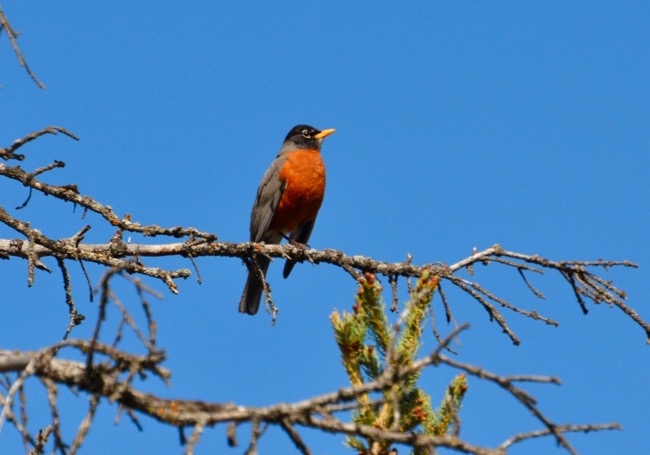
They may be the most common bird, but every Robin is a welcome sight against the blue sky:

DSC_0211

The well-groomed and handsome Cedar Waxwing, always camera ready:

DSC_0428 (1)

True to their name, the Yellow-headed Blackbird on a cattail:

DSC_0344


DSC_0182.jpg

The female Red-Winged Blackbird. Nature endows with different features:

DSC_0060

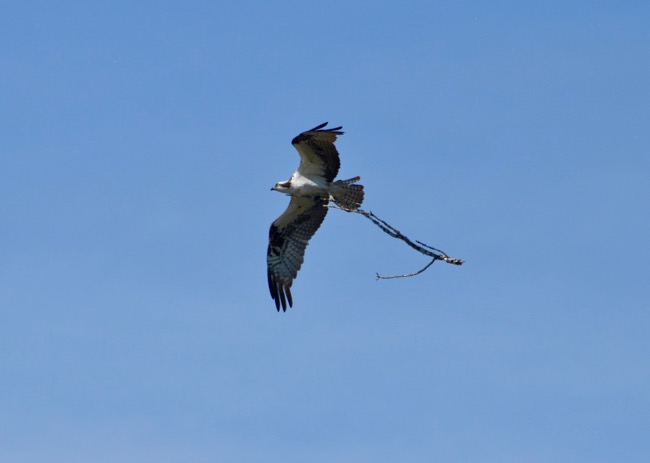
Up in the sky, an Osprey is busy transporting his building materials:

DSC_0289

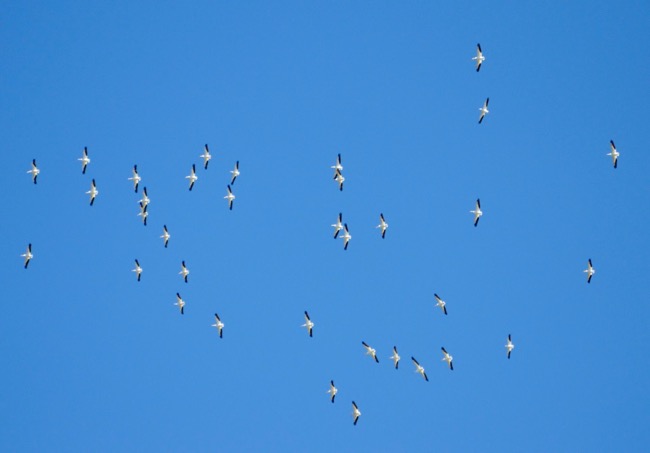
And a touring group of Pelicans, looking for my Air BnB?

DSC_0479 (1)


More to come.


***