If The Best Exotic Marigold Hotel is from the outside looking in, then English Vinglish is the reverse shot, bringing us a point of view from the inside looking out.
Writer-director Gauri Shinde gleaned from her real life experiences to craft this delightful dramedy that is rooted in human miscommunication, but speaks much more. The film is one of the Gala Presentations at the Toronto International Film Festival in September.
The legendary Bollywood star Sridevi comes back to the big screen after a 15 years hiatus to play Shashi, a devoted wife and mother in a modern, middle-class family in Pune, India. She is a lively, capable woman, a good cook who runs her own catering business, her specialty the ladoos, sweet golden balls of dainty delights. But she has to struggle with one major insecurity: she knows little English. Well, you may think, what’s the big deal. But with English recognized as the lingua franca by those living in a former British colony, and a patriarchal society, Shashi as a woman with no English sorely feels disadvantaged, even within her own family.
Her daughter teases her for her pronunciation, even her preschooler. She shies away from parent-teacher interviews, for her daughter goes to an English-speaking school. No matter how devoted a wife she tries to be, she feels the gap between herself and her husband (Adil Hussain, Life of Pi, 2012; The Reluctant Fundamentalist, 2012), who is proficient in English and thus becomes her spokesman in social situations.
“She’s born to make ladoos,” her husband’s intended praise of her cooking skills only reflects the confining social reality in which she finds herself. Not knowing English makes her feel subservient, without a voice.
The tipping point comes when Shashi’s niece is getting married in New York City. She has to go on her own to help her prepare for the wedding. Her family will travel later. An Indian woman in a sari on her first international flight alone, Shashi is understandably timid and insecure. But a friendly and helpful gentleman who sits beside her eases her anxiety. That role is aptly played by the veteran actor Amitabh Bachchan (Watch for him in The Great Gatsby, 2013)
A funny and quite original scene comes when this helpful gentleman suggests they watch the same in-flight movie, and he be her interpreter. Only he wears the headphone, and translates the dialogues out loud from English to Hindi for Shashi to hear, in a voice that’s animated and true-to-life, sound effects included. Here’s the rub… the movie is an action thriller of terrorists committing violence with guns and bombs. Other passengers trying to sleep have to shush him, short of subduing him for uttering bomb and death threats.
New York City, the place where one can transform oneself in a surprising way. Shashi has her first major language mishap in a coffee shop. Turning insult into courage, she enrolls in an English language class. The camaraderie of fellow learners lowers her guard and builds up her confidence. In a few short weeks, she has not only gained some mastery of the language but supportive friendship, with one being more intimately intended.
Shashi’s vindication comes at the wedding of her niece. Her husband and children have arrived for the occasion, not knowing her secret English lessons. In front of all the guests, Shashi is asked to make a speech to the newlyweds. While her husband tries to deflect the embarrassment and excuses her for lack of English, Shashi stands up and uses her new found voice to urge the bride and groom to value equality and treat each other with respect, a heartfelt speech well intended for her husband, and a lesson that brings tears of remorse to her daughter. This is one of the most moving wedding speeches in films I’ve seen. In case you’re interested, another memorable one is Dustin Hoffman’s at his daughter’s wedding in Last Chance Harvey (2008).
The 130 minute movie could benefit from keener editing, but the charming Sridevi carries it through with style and grace. It is a joy to watch her even amidst her insecurities, for she has won my heart with her quiet determination to overcome the odds, her strength of character shines through beautifully.
The movie offers a variety of entertainment, albeit not without some contrived moments. It is a full pack of heartwarming comedy, melodrama, cultural mishaps, the ESL classroom, Bollywood style music and dance numbers, but above all, reality. The film has brought to the forefront children showing disrespect for a parent with no English. This could be an issue particularly among immigrant families. Such a portrayal could well be indicative of society at large. Shashi has demonstrated that language does not define who she is, nor should it be the condition of respect and meaningful relationships.
The fact that we in North America can thoroughly enjoy a Hindi film, no doubt by reading English subtitles, could only mean that we can cross the language barrier to understand each other and appreciate different points of view. English may be the lingua franca in certain parts of the world, but it is compassion that joins us. What better way than to be entertained as we go about learning other perspectives?
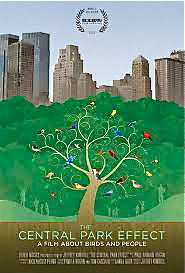
This is a must-see for all bird watchers, nature lovers, or anyone who lives in an urban jungle, thinking how one can stay there and escape at the same time. And, one would soon find this one-hour documentary just too short.
Beautifully shot, this exquisite gem of a film features its main characters the birds in Central Park. No make-up, no staging, no studio set-ups, all natural surrounding. Appearing also are the humans who dedicate their time, and some, their life in pursuing the sightings of these avian celebrities. The interviews of the birders show they are a species all their own.
Baltimore Oriole
Central Park is another major character in the film. I didn’t know this before, that it is completely man-made. The trees were planted there, the landscaping and ponds designed and built by human hands. But it is also nature. More than 200 species of birds pass through Central Park each year. During migration periods in the spring and fall, it is the hot spot of traffic thoroughfare, the hub of north-south continental flight routes.
Jeffrey Kimball is the film’s producer, director, cinematographer and narrator. I was so eager to see him in person for the Q & A after the film at the Vancouver International Film Festival on Oct. 8. Unfortunately, he had to rush back to his wife due to a medical emergency. I wish her well of course.
Common Yellowthroat
The 60 mins. documentary starts off right away by bringing us up-close to the avian paradise that is New York City’s Central Park, and with interviews of their inhabitants’ human admirers. What’s more interesting to hear than the exhilarating tone of the humans are the cheerful chirping of bird calls and songs throughout the film.
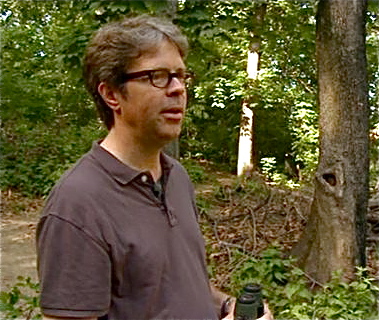
As a newly converted birder, I don’t need Jonathan Franzen to tell me the joy of birding, but it’s good to hear him share his view just the same: it’s ‘addictive’, that he would ‘miss work’ to go out to Central Park to have his fix of birdwatching. Oh, it’s also ’embarrassing’ too.
Jonathan Franzen
Yes, that’s the view of another birder, adult male. He shares that it’s been noted that birdwatching is not manly. There are guys who would carry their fishing rod and tell their wives they are heading out fishing, too embarrassed to admit actually it’s a birding they will go. It’s just… not cool.
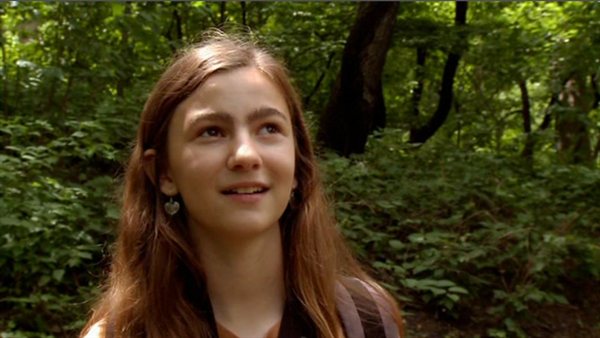
Anya Auerbach, 15, echoes that sentiment. Not cool, geeky even. But does she care? The answer is obvious. She is not into fashion like her peers, but she is into something deeply gratifying.
Anya Auerbach
As any birder would readily admit, binoculars hanging on their neck, and maybe a camera with a long lens on the side, they look like walking geeks, to be spotted and laughed at. But as they weigh the joy of actually seeing that rare thrush, to be labelled and misunderstood is a small price to pay.
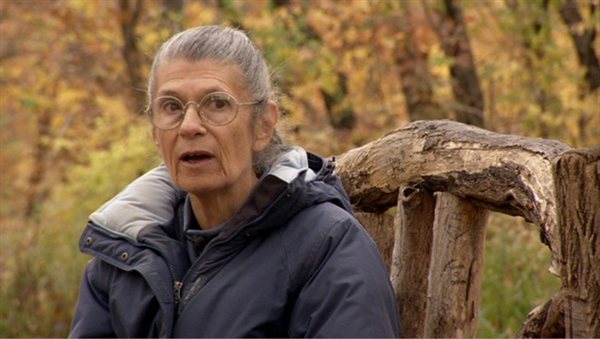
Starr Saphir is the matriarch of birding in Central Park. She has been leading birding groups in the spring and fall, four times a week for over 30 years. She could well be a walking specimen of the psychosomatic benefits of birding. Diagnosed with terminal breast cancer for a decade, Saphir testifies to how watching birds keeps her going. “Looking at birds really takes away sadness…” When one considers the fleeting nature of life, the joy is even more precious.
Starr Saphir
Chris Cooper disappears from his human social circle every year between April to Memorial Day. His friends know from experience that he has gone birding in Central Park. They understand his obsession. In the film, we can see his contagious enthusiasm.
Chris Cooper
Birdwatching is like collecting. The numbers count, how many species you’ve seen, which ones, the rarer the higher valued. It’s like seeing a unicorn… or, a bit more down-to-earth, it’s like you’ve seen pictures of a movie star, but when you actually see her/him in person, it’s a totally different feeling and experience.
“It’s mystical,” another birder articulated.
And to correct a misguided notion, birding is not a hobby, as one dedicated birder explains. Like raising children, it is a “deeply human activity.”
The Annual Central Park Christmas Bird Count is the longest running citizen science survey in the world. It is disheartening to note that the bird counts are dropping significantly in recent years.
Birds are nature’s celebrities, seeing them gives a birder deep pleasure and exhilaration. What’s most precious though, they are oblivious to their fame. They don’t flaunt their beauty, they don’t pose for pictures. They are as natural as can be.
As the credits roll at the end of the film, we see all those deserved to be named: species of birds that have appeared in the film.
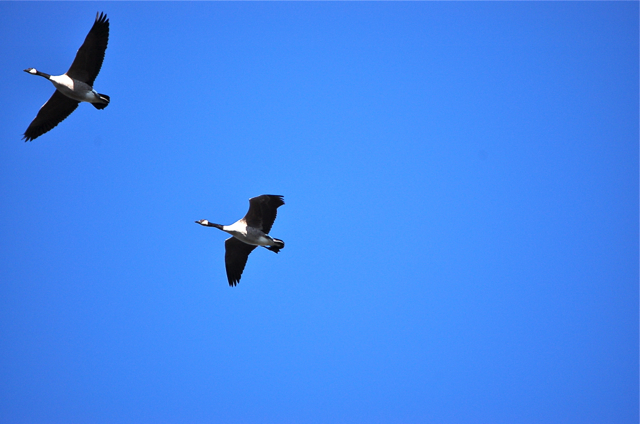
While I was birdwatching this week, I saw a flock of Canada Geese fly overhead in perfect V formation. With my recently trained quick reaction, I pointed my camera up, framed them so beautifully in my viewfinder, and CLICK. Shoot, my camera was turned off. Another quick reaction, I turned it back on and tried again… catching the tail end of the troop.
Here it is, better late than never:
Thanks to Alyce of At Home With Books for hosting Saturday Snapshot, let me have a chance to hone my eye-hand coordination.
***
Tomorrow September 30 is our Anna Karenina Read-Along First Post: Parts 1-4. Stop by again to join in the discussion and make some ripples.
An Autumn birdwatching course I just started brings me to a whole new world I haven’t explored before. Of course I’ve observed birds, appreciated and even photographed them occasionally, but never so up close and personal, and purposeful.
Some in my group are equipped with long 400mm lens, nature paparazzi. But we leave nature be, of course, and being so far away from our subjects, no invasion of privacy. This pensive Gull isn’t a bit bothered by us.
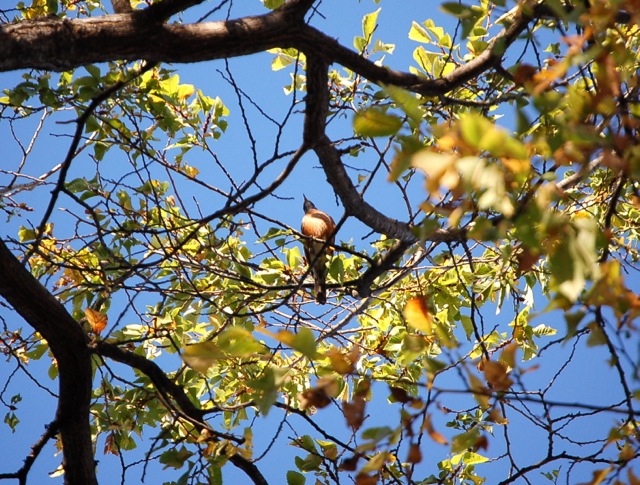
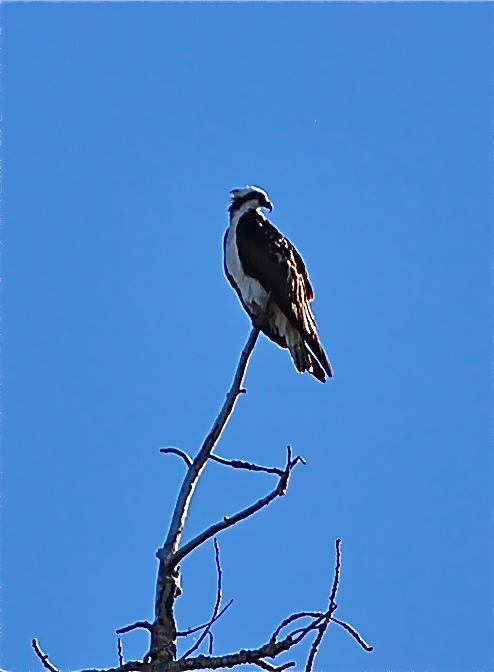
With just a 50-200mm lens, this is the best I can do. The Osprey is harder to capture of course. With a little help from iPhoto, here’s a closer look of her/him perched high up in a tree, and even farther cruising in the bright blue sky.
I can only wonder why it has taken me so long to come to such a fascinating world. 12 more weeks to go, yes, into the snow likely.
Five years ago in this last week of August I started Ripple Effects on WordPress. I still remember that first prompting from my son that I should start a blog.
“What’s that?” I asked.
I just can’t capture all that have come along since then.
To all of you who have visited, subscribed, followed, read, commented, and shown your support and encouragement in ways you might not have realized, I thank you all.
Here’s a cup of latte to celebrate and a teaser: How do you drink the latte without disturbing the beautiful foam art on top?
Well, it was pure serendipity that I managed to do just that. This is the photo during that occasion. I only have the ‘Before’ but not thought of taking an ‘After’ shot. But trust me, it wasn’t a mirage when I got near to the bottom of the cup.
What did I do? I was chatting away with a friend for maybe 10 minutes before I started sipping it slowly. By that time the top foam had been cooled down a bit and slightly ‘dried’. Disclaimer: I haven’t tested it again, but I will. Just to see if it really wasn’t a mirage that I saw.
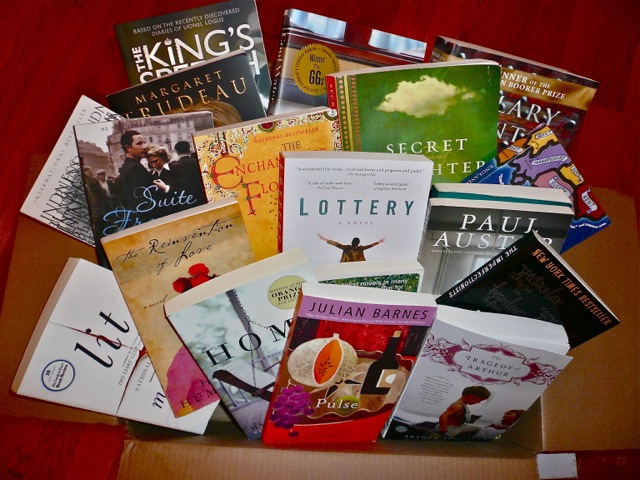
Every year the gigantic book sale organized by the Servants Anonymous Society in our City kicks off my summer reading stock-up. This weekend begins their tenth annual book sale at the Crossroads Market. Here’s a photo of the books I hauled back yesterday, all in like-new condition, all for $1.50 each since I’ve got 20 of them.
Many of the titles I’ve been watching out for some time. Some of them I came to know when I read their reviews on your blogs. Glad I can find them in the book sale and in such good condition. A few of the books look like they haven’t been opened.
Here’s the list in no particular order:
Travels In The Scriptorium by Paul Auster
England, England by Julian Barnes
Pulse, stories by Julian Barnes
Home by Marilynne Robinson
The Virgin Suicides by Jeffrey Eugenides
The Tragedy of Arthur by Arthur Phillips
Lit by Mary Karr
Suite Française by Irène Némirovsky
The Secret Daughter by Shilpi Somaya Gowda
Lottery by Patricia Wood
Blindness by José Saramago
The Reinvention of Love by Helen Humphreys
The Enchantress of Florence by Salman Rushdie
Wolf Hall by Hilary Mantel
The Mistress of Nothing by Kate Pullinger
Cool Water by Dianne Warren
The Imperfectionists by Tom Rachman
One Summer by David Baldacci
The King’s Speech by Mark Logue and Peter Conradi (biography of Lionel Logue)
Changing My Mind by Margaret Trudeau (autobiography)
**
Any of your favorites here? The Sale lasts for three weekends beginning June 8. If you were me, would you go back in the next two? Know my struggling sentiment?
A film that you have not seen in the theatre in North America. It premiered at the 2008 Toronto International Film Festival and disappeared until it emerged on DVD in April, 2012. A Summer in Genoa is a fine film that has slipped through the blockbuster-craving, profit-driven distribution network.
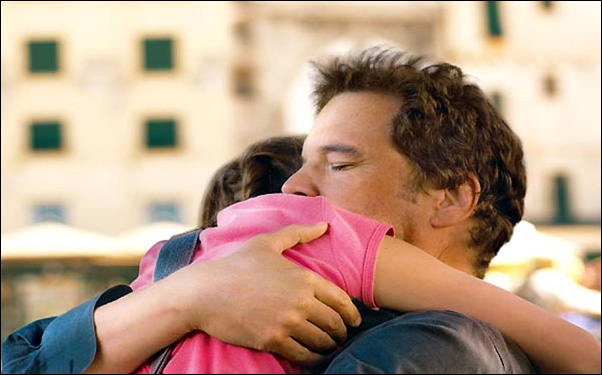
This is from Colin Firth’s pre-Oscar days, a performance that could well be a foreshadow of his Oscar nominated role in A Single Man a year later.
In A Summer in Genoa, Firth plays Joe, an English professor in Chicago who has lost his wife Marianne (Hope Davis) in a car accident. As father to teenager Kelly (Willa Holland) and her younger sister Mary (superbly played by then 10 year-old Perla Haney-Jardine), Joe has to lay aside his grief to continue with his family life in taking care of his daughters.
Five months after the accident, Joe’s old colleague Barbara (Catherine Keener) has lined up a teaching position for him in Genova, Italy. It is summer. The beautiful, historical seaside city will be a totally different scenery from Chicago. Joe thinks that could be a good change for all of them.
How does a family deal with loss? Here we see each person has to face it individually before coming together as a family.
Acclaimed director Michael Winterbottom (A Mighty Heart, 2007) uses a naturalistic style to depict the three of them adjusting to a new situation in their own way. Through a hand-held camera, we are privy to the life of a family like watching a home video. As with any other family, their daily routine is ordinary and mundane. Yet because of their predicament, we care for these characters, especially with young Mary always drifting off on her own. We fear for her safety.
I’ve appreciated Winterbottom’s naturalism throughout the film, not only in the camera work, but with the ‘non-acting’ of the characters (using Bresson’s notion). They come across as real people dealing with daily issues we could relate to. On top of adjusting to a new city and nursing or ignoring a wound that has yet closed, a family still needs to go on living as a family.
We see Joe make breakfast for his girls, go to teach at the university, come home and make dinner. The girls go to their piano lessons, and Kelly takes her younger sister walking in long and narrow alleyways of the old city finding their way. We see Kelly making acquaintances with some young men, and how she riskily push the limits and attempt some youthful explorations. As for the younger Mary, we see her sorely locked in her solitary self of guilt and loss.
The young actor Perla Haney-Jardine’s performance as Mary is particularly poignant. With her father and older sister preoccupied with their own interests, she is left alone to deal with her private pain. She sees her mother appear to her, communicating to her with her presence and words.
The music selection is a major appeal to me. A film that starts off with the beginning theme of Chopin’s Etude no.3 and carries it as a motif throughout is sure to capture my attention. Music is also a legacy from their mother who used to teach piano at the university.
But I’m totally won over as this is read with a voiceover. A final class assignment Joe gives out to his students. He listens to the recording with them, his face lost in thought. It is so thematically perfect. As he ponders, he must have tasted the relevance of its words to his own predicament, raising his two daughters, through life’s ebb and flow. Here in this shot confirms Firth’s talent of ‘non-acting’.
Shakespeare’s Sonnet 2
When forty winters shall besiege thy brow, And dig deep trenches in thy beauty’s field, Thy youth’s proud livery so gazed on now, Will be a tatter’d weed, of small worth held: Then being asked, where all thy beauty lies, Where all the treasure of thy lusty days; To say, within thine own deep sunken eyes, Were an all-eating shame, and thriftless praise. How much more praise deserved thy beauty’s use, If thou couldst answer ‘This fair child of mine Shall sum my count, and make my old excuse,’ Proving his beauty by succession thine! This were to be new made when thou art old, And see thy blood warm when thou feel’st it cold.
Special Features include equally naturalistic behind-the-scenes footage and cast interviews.
A book compiling two short stories and a novella, Everything in this Country Must reaffirms my admiration for Colum McCann’s spare and powerful writing.
McCann is the author of the 2009 National Book Award winner Let The Great World Spin.In my review of that book, I noted how he’d intricately woven together seemingly unrelated stories against the backdrop of the Twin Towers, crafting a moving tribute to NYC.
Before NYC, McCann had written about his home country Ireland. Everything In This Country Must (2000)is apoignant portrayal of how the political turmoils in Northern Ireland during the 80’s affect the three young protagonists in each of these stories. All the short pieces in the book are masterfully rendered, immediate, sharply focused, intense, minimal yet deeply charged. Above all, I’ve appreciated, as with Great World, McCann’s insightful metaphors.
***
Everything In This Country Must: Short Story
Nightfall, cold and raining. A man’s favorite work horse is near drowning with its forelegs caught in some rocks at the bottom of a flooding river. He gets his 15 year-old daughter to help him hold the horse’s head above water with a rope while he frantically dives into the water to get its legs out, but to no avail. He desperately needs help.
Soon enough, an army truck passes by. A few British soldiers quickly jump out to help. O what plight! The wrong people coming to the man’s aid. These soldiers remind him of the loss of his beloved. Despite his protest, they save the horse. The daughter now is torn between her gratitude towards the soldiers and her father’s anger.
Of course I will not tell you everything about this story. You must experience it yourself. Then you’ll be amazed how in just fourteen pages, McCann can depict a human flood of hatred and rage that can drown any living soul, and slap you with a haunting end that leaves you cold like night.
Wood: Short Story
With his father stricken ill in bed, a young boy helps his mother to secretly work in the family mill to earn some money, cutting logs and refining them to make poles which will then be used to hold political banners for the Protestant marches. The boy knows that his father, despite being Protestant, disapproves of these marches. That’s why he knows he has to do this stealthily, yes, to protect the pride of his father who now lays in bed unable to work, but maybe even more importantly, so not to betray his political stance. Mother and son toil in secret, turning raw wood into polished poles. The boy loves both parents, his loyalty a dilemma between reality and ideal.
And all this time the wind blows obliviously, swaying the oak trees behind the mill. “The trunks were big and solid and fat, but the branches were slapping around like people.”
Hunger Strike: Novella
Kevin is a new arrival to a Southern seaside town, living with his mother in a caravan by the shore. The move apparently is an attempt of his mother to get away from the political conflicts in the North. Kevin’s father had been killed in an accident some years ago. Currently his uncle, an IRA member imprisoned in Northern Ireland, is one of a group of inmates holding a hunger strike. Some have already died.
The uncle’s ordeal disturbs 13 year-old Kevin deeply. While his mother wants to give him a better life away from the turmoil, Kevin is emotionally entwined with his uncle’s struggle. The boy vicariously partakes in the hunger strike, counting the days, noting closely the deterioration of his uncle’s health, and even secretly dumps his own food away.
An older couple with a yellow kayak live close by. Kevin observes that they paddle in sync, they move and rest in perfect harmony. Their calm and quiet life is a huge contrast to his. Later, the couple befriend him. The old man teaches him how to paddle:
The blade should never go too deep into the water or else too much energy would be used. And there should never be too much of a splash when the paddle came out — it should look as if the sea had hardly been disturbed.
A hopeful new beginning for Kevin seems to ensue, but the situation continues to deteriorate in his hometown in the North, and with the plight of his uncle. The waves inside Kevin is just too rough for smooth and quiet paddling. A sea undisturbed belongs to the apathetic, and sometimes splashes are called for. McCann’s description of a tormented young life is both visual and haunting, and propels us to a poignant and heart-wrenching end.
~~~~ Ripples (yes, exactly my point)
Everything in This Country Must by Colum McCann, A Novella And Two Stories, Picador U.S.A., 2000, 150 pages.
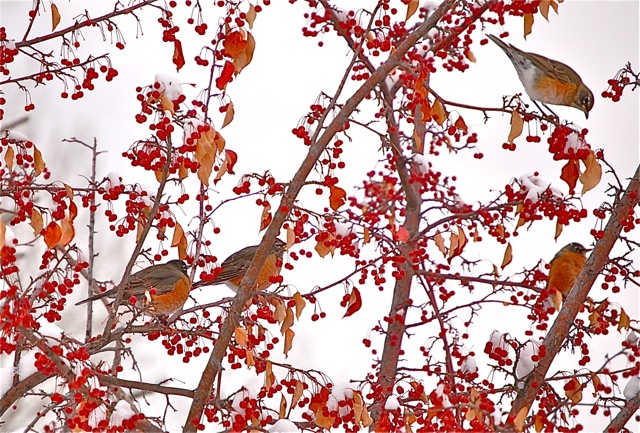
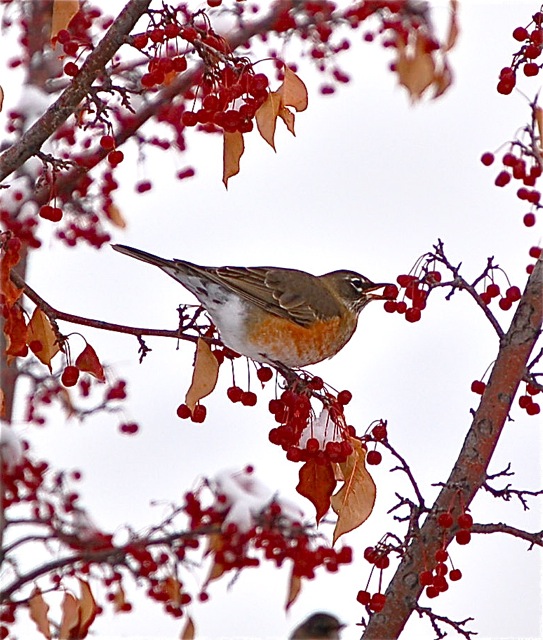

 Now, roll out those lazy, hazy, crazy days of winter…
















 Ripple Effects