Saturday Snapshot Aug. 27: Synchronized Swimming, Team Pelican

I don’t have to wait four years for another Olympics. A couple of days ago I caught sight of these Nature’s Athletes. From afar I could tell they were members of Team Pelican.

The Pelicans are a gregarious lot, their talents innate, every move graceful. They display their elegant team work in Nature’s open arena, effortless, in sync with each other. Here they are, full of bubbly camaraderie:

Comaraderie (2)

Remember a previous post where I saw them in the air, like squadrons of fighter jets; in the water, they form a tight-knit configuration as well. With that formation, they cooperate to surround fish in the water, scooping them into their pouches:

Inate talents (1)

What a beautiful idea: communal feeding. What you see here are snapshots. What I remember is a long video. I must have been there watching and snapping away for over a half hour:

Let's eat together (1)

Elegant synchronized swimmers in perfect harmony. Kudos to their Coach.

Synchronized Swimming (2)

Look at their sheer size in comparison to the gull behind them.

Sync Swim (1)

Sometimes you can get tangled up with minor mishaps. Wait up, guys, I’m a little stuck here:

Wait up 2

No worries. We’re Team Pelican. All for one and one for all; our bills as swords to pledge.

Bills as swords


***

Saturday Snapshot is hosted by West Metro Mommy Reads. CLICK HERE to see what others have posted.


100 Greatest Films of the 21st Century

The editors of BBC Culture had commissioned film critics all over the world to arrive at this list, polling “every continent except Antarctica.”  They received responses from 177 film critics. The list was published yesterday.

Sounds like a formidable task, albeit in actuality, the critics only had to look at 17 years of cinematic works (including the year 2000). Nevertheless, the titles are self evident of the positive effects of globalization, for the critics’ choices are markedly diverse.

You can check out the whole list here. I’ll just excerpt the top 50. Here, you can find directors from Africa, Asia, Australia, the Middle East, Europe, North America, South America. What a fantastic representation. I’ve no apology for using the #2 film image here instead of the top one; with Wong Kar-wai’s “In The Mood for Love”, I’m totally partial and very glad it reached this spot.

in-the-mood-for-love

No matter how you look at it, don’t get blown away by blockbuster mega productions. The independent cinema still remains the imaginary window to look into ourselves as well as out to the world, expanding our point of view with old tales to current issues.

50. The Assassin (Hou Hsiao-hsien, 2015)
49. Goodbye to Language (Jean-Luc Godard, 2014)
48. Brooklyn (John Crowley, 2015)
47. Leviathan (Andrey Zvyagintsev, 2014)
46. Certified Copy (Abbas Kiarostami, 2010)
45. Blue Is the Warmest Color (Abdellatif Kechiche, 2013)
44. 12 Years a Slave (Steve McQueen, 2013)
43. Melancholia (Lars von Trier, 2011)
42. Amour (Michael Haneke, 2012)
41. Inside Out (Pete Docter, 2015)
40. Brokeback Mountain (Ang Lee, 2005)
39. The New World (Terrence Malick, 2005)
38. City of God (Fernando Meirelles and Kátia Lund, 2002)
37. Uncle Boonmee Who Can Recall His Past Lives (Apichatpong Weerasethakul, 2010)
36. Timbuktu (Abderrahmane Sissako, 2014)
35. Crouching Tiger, Hidden Dragon (Ang Lee, 2000)
34. Son of Saul (László Nemes, 2015)
33. The Dark Knight (Christopher Nolan, 2008)
32. The Lives of Others (Florian Henckel von Donnersmarck, 2006)
31. Margaret (Kenneth Lonergan, 2011)
30. Oldboy (Park Chan-wook, 2003)
29. WALL-E (Andrew Stanton, 2008)
28. Talk to Her (Pedro Almodóvar, 2002)
27. The Social Network (David Fincher, 2010)
26. 25th Hour (Spike Lee, 2002)
25. Memento (Christopher Nolan, 2000)
24. The Master (Paul Thomas Anderson, 2012)
23. Caché (Michael Haneke, 2005)
22. Lost in Translation (Sofia Coppola, 2003)
21. The Grand Budapest Hotel (Wes Anderson, 2014)
20. Synecdoche, New York (Charlie Kaufman, 2008)
19. Mad Max: Fury Road (George Miller, 2015)
18. The White Ribbon (Michael Haneke, 2009)
17. Pan’s Labyrinth (Guillermo Del Toro, 2006)
16. Holy Motors (Leos Carax, 2012)
15. 4 Months, 3 Weeks and 2 Days (Cristian Mungiu, 2007)
14. The Act of Killing (Joshua Oppenheimer, 2012)
13. Children of Men (Alfonso Cuarón, 2006)
12. Zodiac (David Fincher, 2007)
11. Inside Llewyn Davis (Joel and Ethan Coen, 2013)
10. No Country for Old Men (Joel and Ethan Coen, 2007)
9. A Separation (Asghar Farhadi, 2011)
8. Yi Yi: A One and a Two (Edward Yang, 2000)
7. The Tree of Life (Terrence Malick, 2011)
6. Eternal Sunshine of the Spotless Mind (Michel Gondry, 2004)
5. Boyhood (Richard Linklater, 2014)
4. Spirited Away (Hayao Miyazaki, 2001)
3. There Will Be Blood (Paul Thomas Anderson, 2007)
2. In the Mood for Love (Wong Kar-wai, 2000)
1. Mulholland Drive (David Lynch, 2001)

Which ones have you seen? What do you think of the list? Mulholland Drive #1? You might ask.

***

Click on the link in the title to read Arti’s review.

‘Our Little Sister’: A Respite from Summer Superhero Movies

The following is my review of the film “Our Little Sister” by the acclaimed Japanese director Hirokazu Kore-eda, published in Asian American Press. I thank aapress.com for allowing me to post it here on my blog.

For those who might think a Japanese film would never make it to your local cinema, check this list of U.S. screenings:

http://sonyclassics.com/ourlittlesister/dates.html

***

our-little-sister

Premiering last year at Cannes, and later screened at other international film festivals the world over, Hirokazu Kore-eda’s “Our Little Sister” finally trickles into the local theatres of North American cities, which is timely. In a world rocked by tumultuous strife and unrests, this latest from Kore-eda makes a quiet solace, offering a taste of the ideal in human relationships and harmony despite brokenness.

“Our Little Sister” is Kore-eda’s most recent work after his 2013 Cannes Jury Prize winning “Like Father Like Son”. Following his usual subject of relationships in various family situations, “Our Little Sister” sees Kore-eda at the helm as director, writer, and editor of this production based on the popular Japanese graphic novel “Umimachi Diary” by Yoshida Akimi.

The three Koda sisters have not seen their estranged father for fifteen years. Sachi (Haruka Ayase), Yoshino (Masami Nagasawa) and Chika (Kaho) are now adults, living in the family’s traditional home his father had long deserted in the seaside town of Kamakura. His recent death sends the sisters to his funeral, awkwardly, meeting the woman who had stolen their father’s heart. But it is an inciting incident that changes all their lives. They meet their half sister, 15 year-old Suzu (Suzu Hirose). Herein lies the turning point for the four sisters. Moved by her little step-sister’s mature and quiet demeanor, or maybe stirred by her own older-sister instinct, Sachi invites Suzu to come away and live with them in Kamakura. Suzu gladly agrees.

The new Koda household now is a haven of happy sisterhood. Living under one roof, we see minimal conflicts and constant congeniality. Viewers from a different culture may find the saccharine relationships unrealistic. Are there not any conflicts at all? Of course there are. Kore-eda deftly leads us to some slow revealing. After three quarters of the 120-minute film, we begin to see inner turmoil rise to the surface.

Suzu had to take care of her father in his illness and seeing him to his last breath due to the incompetence of her mother; here is a young teenager bearing the burden of an adult. Now living with three older sisters, Suzu can finally enjoy the childhood she has missed. She quickly captures the attention of other students in her new school with her soccer skills, congeniality and maturity.

In the Koda household, Suzu is the angel of harmony, stirring up love and life. Kore-eda may have spent too much time on the leisurely-paced, day-to-day living such that viewers might feel the lack of conflicts to move the story along. I credit the style to Kore-eda’s realism and a candid camera focusing on the subtleties of nuanced interplay among the characters. Like his previous films “I Wish” (2011), the yearning for family connections of a young boy is shown by his actions and not so much by words, or in “Like Father Like Son” (2013), wherein conflicts are portrayed by contrasts and parallels. Here, while still nursing a deep resentment towards her father for deserting them years ago, Sachi struggles with the moral parallel now as she carries on a relationship with a married doctor at the hospital where she works.

Moral dilemmas, what to choose, how to live, and the search for identity are the issues Kore-eda’s characters have to deal with, but in a way that is quiet and gentle. He introduces us to other endearing characters in the town, adding numerous episodes to build up a human mosaic of harmony in the presence of brokenness and even death.

The scenic seaside town of Kamakura provides a beautiful backdrop for cinematographer Mikiya Takimoto (“Like Father, Like Son”) to shoot the film, reflective of the idyllic life that can be had, even in an imperfect world. The arching branches of the cherry blossoms, landscapes and seascapes mark the healing power of nature. But also like the petals of the cherry blossoms, which third sister Chika likes to pick up and gather in her palm, life is ephemeral.

Reminiscent of Ozu’s films, the passing train is a visual metaphor for the passage of time, changes, and the transience of life. To enrich the visuals, Yoko Kanno’s original score sweeps us through with warmth and tenderness, as a supporting voice telling the story. “Our Little Sister” is a heartwarming film for the unhurried heart to savor.


~ ~ ~ Ripples

***

Related Posts on Ripple Effects:

‘Like Father Like Son’: A Parent and Child Reunion

Yasujiro Ozu and the Art of Aloneness

Words Without Music by Philip Glass

“For me music has always been about lineage. The past is reinvented and becomes the future. But the lineage is everything.”    — Philip Glass

This 400 plus page memoir by Philip Glass (1937 -), with 14 pages of photos and 20 pages of index, is nothing short of epic. Glass has not only told us the story of his life so far, but chronicling a generation of American arts and music from an insider’s perspective. The zeitgeist of the Beat Generation and the preoccupation of Eastern philosophy with its search for transcendental experiences make the memoir an interesting and informative read.

Pertaining to Glass’s innovative musical style, I’ve experienced the book in several ways: reading the first half in hardcopy, listening to the latter part in audiobook format via hoopla, superbly performed by narrator Lloyd Jones, and listening to Glass’s works available on hoopla. Hoopla, btw, is wonderful.

Words Without Music Cover

Born 1937 to a secular Jewish family in Baltimore, Glass’s father Ben was a record store owner, mother Ida a librarian. The flute and the violin were his first instruments. Bursting with potentials ready to be unleashed, he left home to attend The University of Chicago at merely 15 years of age majoring in philosophy and mathematics. At Chicago, he’d decided what he wanted to do after graduation, to pursue a career in music, albeit the realization of which was still a blurry vision.

As a young college grad, Glass worked at a steel mill to save enough money to head to NYC for Juilliard, a decision that was against the wish of his mother: “If you go to New York City to study music, you’ll end up like your Uncle Henry, spending your life traveling from city to city and living in hotels.” His uncles also frowned on such an idea. They wanted him to take over the family’s building supplies business.

But the teenaged Glass was determined, only to face a closed door upon audition at Juilliard. No, he wasn’t qualified as a flute player, but, he was given the chance at the extension program to learn composition. Only a detour. Once he’d become a full-fledged student in Juilliard, he devoured all opportunities to learn. You’d think such a talent would become a young success soon after? Well, that wouldn’t have been as interesting a story as real life.

Philip Glass is classified as a ‘minimalist’, a label which he frowns upon. Reading the memoir, I can only say what’s minimal is the material means, money, while all else, passion, intellect, talents, cultural milieu, internal space, and the prolific output of works have been abundant throughout his life journey.

It would be decades later that Glass could earn enough to make a living by only composing. Along the way, he was contented with his day jobs in NYC, including being a furniture mover, plumber, and taxi driver. He nearly got killed driving a cab in NYC, albeit he does recall more pleasant excitement like the time he picked up Salvador Dali from 57th Street to the St. Regis Hotel. During that short trip, he was, alas, tongue-tied. Yes, the word is “contented”, for no matter what he had to do to earn a living—at first just for himself, later a family of four—he seemed happy to be on the right course striving for the ultimate goal. That in itself is inspiring. The tone of the book reflects a quiet and humble soul, reflective and personal.

Glass’s contact list is a who’s who of the Beat Generation and cultural icons in the following decades. He was a contemporary with Jack Kerouac, Jackson Pollack, John Cage, friend with Alan Ginsberg, Doris Lessing, Richard Serra, collaborator with Ravi Shankar, Leonard Cohen, wrote music for the works by Jean Cocteau, Samuel Beckett, composed for Martin Scorsese, Steven Daldry, Woody Allen, studied with Nadia Boulanger as an American in Paris, journeyed to the East to find enlightenment in New Delhi, Katmandu, Darjeeling, explored and created global music with musicians from India, Himalaya, Chinese, Australia, Africa, and South America. Just a few names. The 20 page index is a definite asset.

“I have come to understand that all music, without exception, is ethnic music.”

As for his own music, people always say it’s like “the needle is stuck in the groove.” To understand this, of course, you’ll have to know the operation of a vinyl record. To counteract the general public impression of repetition to no end of his music, he explains in details the Glass music theory. That I let you to explore for yourself.

But here are some passages that I’ve particularly noted with low tech stickies on the side of the page:

About John Cage’s famous piece 4′ 33″, wherein the pianist sits at the piano for four minutes and thirty-three seconds without touching any keys, whatever sound the audience hears during that time lapse becomes the piece, Glass writes:

“… a work of art has no independent existence… What Cage was saying is that there is no such thing as an independent existence. The music exists between you—the listener—and the object that you’re listening to. The transaction of it coming into being happens through the effort you make in the presence of that work. The cognitive activity is the content of the work.” (p. 95)

What goes on internally in the listener is what the piece is about. Makes me think of Roland Barthes’s “The Death of the Author” notion.

So do we have “the death of the composer” now?  Wait, actually, no. You see, Glass has this brilliant point. The composer still lives in that the performer interacts with and interprets his works, thus becoming a co-creator:

“… the performer has a unique function in terms of what I call this transactional reality which comes from being in the presence of the work: that the interpreter/player of the music becomes part of that. Until then, I had really thought of the interpreter as a secondary creative person. I never thought he was on the same level with Beethoven or Bach. But after I had spent some time thinking about all that and began playing myself, I saw that the activity of playing was itself a creative activity… ” (p. 96)

And how should the performer play the music? By listening intently and purposefully:

“The ideal way of performing, to my way of thinking, would be when the performer allows the activity of playing to be shaped by the activity of listening, and perhaps even by the activity of imagining listening.” (p. 97)

In 1957, Jack Kerouac’s On the Road had just been published and “everybody had read it”. With the $750 prize money he received from Juilliard at the end of his third academic year, he bought a motorcycle, probably an unintended item on which the music school would like to see the scholarship spent. Off he went on a cross-country road trip. But what’s the difference between he and his friends and the Kerouac’s clan? Glass writes:

“His [Kerouac’s] book is full of interesting characters, but that’s not what happened for us. We weren’t interested in having those kinds of experiences, we were out and abroad in America, consuming the country visually and experientially by driving through it…. (p. 102)

The renowned sitar virtuoso Ravi Shankar, or Raviji as he was known to friends and colleagues, at that time started collaborating with George Harrison. Glass notes that “The casual drug use by young people particularly upset him. Sometimes he would lecture me about drugs, and I had to remind him that I was drug-free.” Ummm, wonder if Raviji had lectured George Harrison on same.

In 1964, with a Fulbright Scholarship, Glass went to Paris to study with the eminent music guru Nadia Boulanger. For two years, she inspired and led Glass to higher grounds of musical epiphanies. One of the crucial lessons he took away after two years with Boulanger was the route to innovation. First, learn the conventional theoretical foundation, then you diverge and create your own:

“… an authentic personal style cannot be achieved without a solid technique at its base. That in a nutshell is what Madame Boulanger was teaching.” (p. 145)

His mother Ida went by train from Baltimore to NYC for her son’s first concert at Queens College on April 13, 1968. There were only six people in the audience including herself. As Glass drove her back to the train station after the concert, the only comment she made was that his hair was too long.

The second time Ida attended her son’s concert was eight years later in November 1976. This time, she was in the full house audience of four thousand people at the Metropolitan Opera for the performance of his first opera, Einstein on the Beach.

Glass movingly recalls his conversation with his mother at her death bed. She was in and out of a coma. She whispered two last words to him: “The copyrights”. Mother and son came to a perfect understanding. He reassured her, “It’s all taken care of, Mom. I’ve registered them all.”

He’d better.

Glass has composed more than twenty operas, eight symphonies, two piano concertos and concertos for violin, piano, timpani, and saxophone quartet and orchestra, soundtracks to films, 125 credits on IMDb for all sorts: full features, doc, shorts, TV. And more to come.

***


Saturday Snapshot July 16: Solace

It’s a mad, mad, mad, mad world.

I’d never imagine myself typing these words other than the title of the 1963 comedy. Tragedy instead, and very real, not in a movie. What’s happening these past days can drive one to despair. I’m not just thinking about the celebratory crowd mowed down by a truck, family with children watching fireworks. Or here, a mother murdered in her own home, her five year-old girl missing and three days late, her body found in a field. O, a national anthem and a peaceful baseball game jeopardized by a lone-wolf tenor. Or, a U.S. presidential candidate vowing to declare war once he’s elected.

That’s why I appreciate the Pond more and more these days. Not just to take me away from screens big and small, get some fresh air, breathe in the sight and sound of another world. No need for words, it’s a living testament of Nature reassuring the Maker’s Grace, antidote of madness. Not so much a place to escape but to think, revive, and just be.

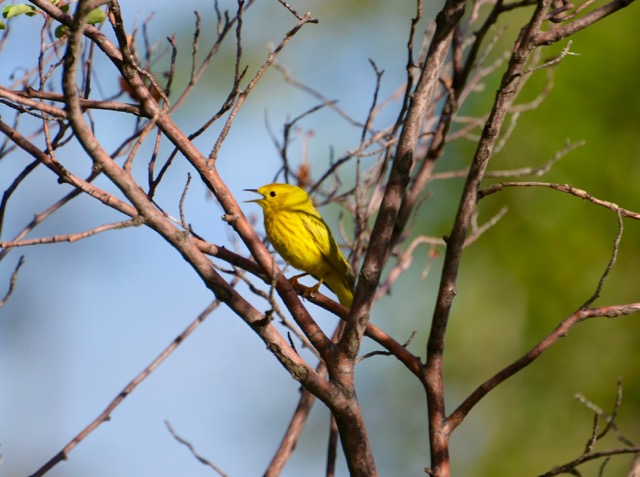
Peace returns soon as I step out of the car. How does that song go? All things bright and beautiful, all creatures great and small. I love them all, well some more than others. Like, I’m partial to the tiny yellow warbler than the muskrat:

Yellow Warbler

YB.jpg

I’ve pictures of the muskrat too, but never mind.

The quiet poise of the Eastern Kingbird. Got a juvenile here, I think, from the downy front. Such a tiny creature unknowingly is a carrier of a reaffirming message:

Eastern KB

Yes, even the ‘common’ sparrow (has a name too, Savannah) looks smart and confident. O the comfort of neither having to reap or sow, of being cared for:

The Sparrow

Or no need to worry what to put on. The Cedar Waxwing is often adorned and well groomed, ready for any photo op., yet raising no jealousy:

Cedar Waxwing

It’s a peaceful world out here by the Pond. Another song just come to mind…


And let it begin with us.

***

Saturday Snapshot is hosted by Metro Mommy Reads. CLICK HERE to see what others have posted.

Saturday Snapshot July 2: Summer Visitors

Here at the pond, summer visitors arrive to my natural Air B&B in June from near and far. I admit up here above the 49th parallel, I don’t get as many varieties as I’d like to see, nor as colourful as many of you have down in the south. Still it gives me great pleasure to host them.

Here are some of the avian visitors in the past month. Glad they find my Air B&B suitable for their stay, taking advantage of the pool and the amenities, free breakfast, lunch, and dinner. They are usually shy to be photographed, so I got them in my Air Guestbook unobtrusively.

Some new guests, for me anyway, like Mr. and Mrs. Ruddy Ducks. Hard to get them to come closer for photos, so here’s a blurry snapshot from afar. How do I identify them? The light blue bill of Mr. Ruddy:

Male & Female Ruddy Ducks

A repeat visitor, although not always easy to find, so I’m delighted to host, the Greater Yellowlegs:

Greater Yellowlegs

Families are most welcome. Here are my regular visitors, the CG Family:

The CG Family

Always glad to see them make themselves at home. I got this pic as they took their morning stroll:

A morning stroll

The quiet Spotted Sandpiper soaking in the sun and the sight:

Spotted Sandpiper

And of course, who can beat the free meals while they’re staying here. That’s why they keep coming back, look at this Great Blue Heron helping himself to the buffet:

Buffet meal


Is that a big fish that Mrs. Pelican just gulped in?

Pelican.jpg

And finally, I’ve waited for them for so long, the Yellow Warblers. I know they like their stay. Just listen to their calls as they share on their social platform:

Yellow Warbler

Well, if you’ve got food in your mouth, you can’t call back. No instant messaging here at the buffet table:

No msg

More from my Air Guestbook next time.

***

Saturday Snapshot is hosted by West Metro Mommy Reads. CLICK HERE to see what others have posted.


Saturday Snapshot May 28: New Kids on the Block

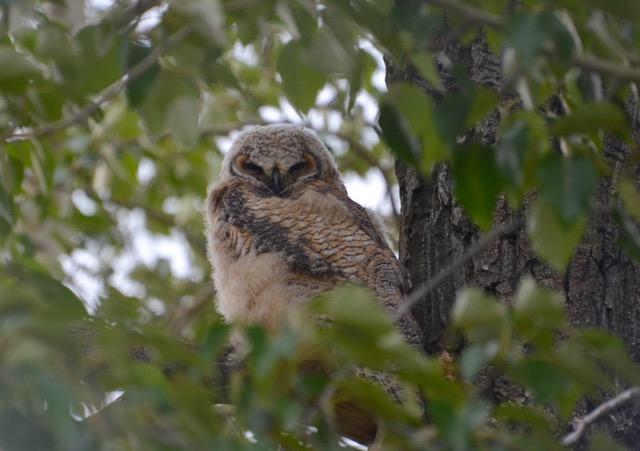
A month ago I saw two newborns in the Owlington abode. Here’s one of them out and about; the other must be still sleeping:

Owlington baby

A curious fella:

Owlington 1

Scratching and preening:

Owlington baby scratching

Mrs. Owlington is always close by watching:

Mrs. Owlington

I’ve always thought the Owlington is the only owl family by the pond until I came across these new kids in another part of the hood. Three of them snuggled up against one another on that windy afternoon:

New Kid 3.jpg

No mama or papa around. Wait, not just three, there’s one more on another branch. This bro is all cool and aloof:

New Kid 4

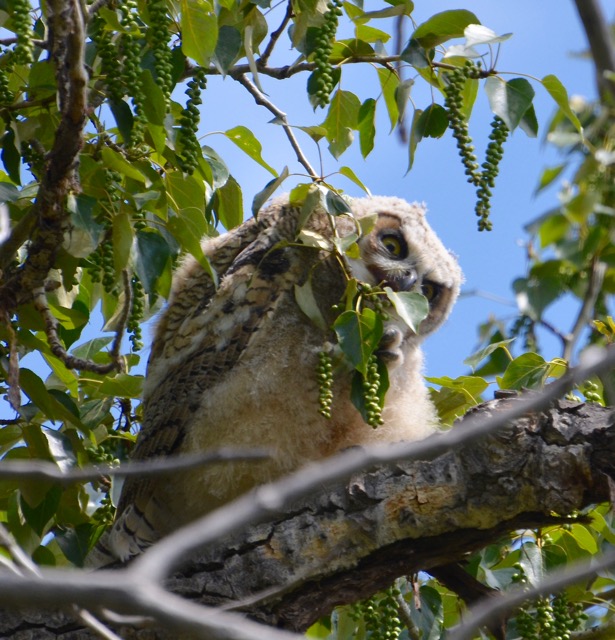
The next day I went back there and saw li’l bro again. This time his style really shown through. Why wait for papa to bring back dinner? Fast food right here:

Can't wait

These are some of the pictures I’d taken in the past weeks. As spring slowly arrives and is here to stay, so are myriads of new lives, bursting out in the hood, some are new encounters for me. Stay tuned for more Nature Photography here on Ripple Effects.

***

Saturday Snapshot is hosted by West Metro Mommy Reads. CLICK HERE to see what others have posted.


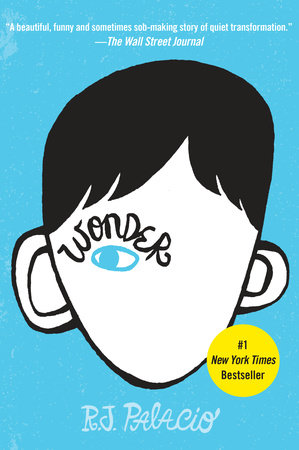
Wonder by R. J. Palacio: Required Reading for All

Wonder Book Cover

I woke up this morning thinking about Auggie. I missed him.

His extraordinary face with the unevenly positioned eyes, one half-shut all the time, the cleft lip and misshapen ears, abnormal features (I’ve learned not to use the word ‘deformed’ now) indelibly imprinted would elicit fear from those who see him the first time, especially unexpectedly. The shock may send out an uncontrolled gasp or even a scream. And if one is  maliciously driven, tiny-framed Auggie is a ready and easy target for bullying, especially in the setting he’s in now, middle school, the breeding ground for raw emotions and unchecked cruelty in both words and deeds. The ten year old has had twenty-seven surgeries big and small so far in his life. Homeschooled until now, Auggie is stepping out into 5th grade with unimaginable trepidation, mustering a courage no less than that required for all the surgeries he’d faced in his life.

Auggie, or, August Pullman, is a fictional character from R. J. Palacio’s book for 9-12 year olds, but he’s as real as my neighbor’s son, or even, my own. That’s the power of Palacio’s nuanced and realistic writing. This is a book for all ages, a required reading for every human being if I have my way, for Palacio has painted a perfect world.

In a perfect world, there are still babies born with facial abnormality. But that little life is still wrapped with warmth and cuddled with love and acceptance.

In a perfect world, that child will grow up not thinking himself ‘different’ or deficient, but as normal as any other kid his age. He can still enjoy reading his comics, be read to and tugged in at bedtime, master video games, watch Star War movies, play with his light saber, hug his doggie, and all those he loves: mom, dad and older sis. The child knows no deficiency.

In a perfect world, even after that child steps out of his well protected, comfort zone and ventures precariously into the reality of middle school, he can still find friends, however few at the beginning.

In a perfect world, there are still bullies and jerks. The child will still have to face incredulous challenges and learn to ignore horrible remarks more distorted than his facial features. In a perfect world, even in this seemingly cruel microcosm of the human society, this child can still find love, support, acceptance, and life-sustaining kindness.

In a perfect world, that child is considered a gift and a blessing, a challenge for us to be better human beings.

In a perfect world, good will overcome evil.

Seldom does a children’s book has such power over me. Actually, seldom do I read a children’s book, haven’t for a long, long while. But glad I’ve discovered Wonder. Auggie will live in my mind for a while even now that I’ve finished the book. I wish author R. J. Palacio’s Choose Kind anti-bullying movement will continue to flourish.

A book like this deserves a good movie adaptation. A recent announcement has given me hope that a worthy one might be on the drawing board. Well, just with the two being cast so far. Jacob Tremblay, the wonder boy who plays Jack in the acclaimed movie adaptation of Emma Donoghue’s Room is to play Auggie. His mom? Julia Roberts. As a mother of 10 and 8 year-olds, Roberts would have some insights to instill into her role.


***

I’m nobody! Who are you?

April is still here I’m glad. Here’s a timely piece to join in the celebration of National Poetry Month.

***

I’m nobody! Who are you?
Are you nobody, too?
Then there are two of us – don’t tell!
They’d banish us, you know.

How dreary to be somebody!
How public, like a frog
To tell your name the livelong day
To an admiring bog!

Emily Dickinson (1830-86)


DSC_0739

Oh the comfort of anonymity, no need to trend, to like or be liked, to climb the social media ladder, to reach new heights with more followers. Dickinson sure enjoyed her reclusive life, felt fine with being an unknown. Most of her poems were published posthumously, including this one.

***


Thoughts on Terrence Malick’s Knight of Cups

In the beginning was The Tree of Life.

That was the first work of divergence in the enigmatic director Terrence Malick’s body of work. His first four films spanned three decades–Badlands (1973), Days of Heaven (1978), The Thin Red Line (1998), The New World (2005)–productions that adhered to a relatively conventional storytelling approach, albeit still marching to the beat of his own drum. Then came six years of silence.

In 2011, we saw a new cinematic form come out. The Tree of Life emerged like a new life after a long metamorphosis. It was genre defying, with real and imaginary visuals replacing narrative plots, voiceover replacing dialogues. Dually cosmic and realistic, it boldly explored subjects that spanned eternity, from the Creation to the Afterlife. The story focused on a small Texan family during the 1950’s. The latent conflicts and tensions in the family’s relationships, father, mother, husband, wife, sons, brothers, brought forth a series of existential questions. Whispers of inner anguish, doubts, faith, and the search for redemption fill the movie theatre.

I was stunned by Malick’s audacity. This wouldn’t sit well with critics or viewers alike.

Apparently the thought of rejection didn’t bother the auteur, for the next year saw a repeat of the style. For those who thought The Tree of Life was only a one-time experiment were met with the confirmation that yes, this is Malick’s new cinematic style. To the Wonder is another film seemingly devoid of plot, a visual poetry of love, loss, and the human soul. We see again more voiceovers replacing dialogues, characters drifting through dreamscapes. The Tree of Life was only the beginning. Malick has created a new form of cinematic storytelling.

Then came Knight of Cups in 2015. The director that had taken thirty-two years to make his first four films gives us a trilogy of thought-provoking, genre-defying features in just four years. Knight of Cups is slowly trickling into limited screens this spring, but only an ephemeral appearance. In selective cities, it came quickly and was gone. The movie industry is big business, and box office sales is the bottom line, a fact that doesn’t seem to be a concern for Malick.

Knight of Cups.jpg

Knight of Cups starts off with a parable. A knight sent by his father, the King of the East, went into Egypt to find a pearl from the depths of the sea. But when the prince arrived the people poured him a cup that took away his memory. He soon forgets his identity and his mission to look for the pearl.

The allusion to Pilgrim’s Progress is also invoked. From that, we know the tale of one man’s escape from the City of Destruction and his quest to search for the Celestial City.

Visually on screen, an earthquake shakes up a sleeping man. We later learn that he is Rick (Christian Bale), a successful screenwriter in L.A., well networked with the rich and famous of Hollywood. Rick is roused up from the quake, tiptoes barefoot through shattered glass to get out into the street, an apt metaphor of his life, fragmented, broken like the debris on the ground.

Thus sets the stage as we follow Rick into the high life of Hollywood: parties, night clubs, Gatsby-esque wildness of L.A. and Las Vegas. The film cast interestingly is made up of well-known names from Hollywood (bravo at the parallel). Through all these, Rick appears aloof, a stranger in his own land.

Ummm, not unlike Camus’s outsider.

His agent tells him: “I want to make you rich. All you need to do is say yes. Who do you want to meet? I can arrange.”

Almost as close as another such luring promise… “all this I will give you, if you bow down and worship me.”

 But the outsider is a tormented soul desperately seeking meaning, not riches or fame. Ambivalent relationships with a skid row brother and a father (Brian Dennehy) who is in turmoil living through the suicide of another son are the slings and arrows hurled at Rick. “I died a different way, “ we hear him say.

Women? Six of them, at one time or another. Played by Cate Blanchett, Natalie Portman, Freda Pinto, Imogen Poots, Teresa Palmer, Isabel Lucas. They appear as vignettes, drifting in and out of his life; not all in waste, each has something to offer. One of them has uttered:

“We’re pilgrims on this earth. We’re not leading the life we’re meant for. We’re meant for something else.”

Or take his ex-wife Nancy (Cate Blanchett), a benevolent doctor who works with the poor. She could have been an inspiring figure, but they had to part. “I just want to be loved,” she says.

Of course, Rick can’t give what he doesn’t have. He too is searching for that powerful love that can complete him.

“Redeem my life… Justify me,” we hear Rick’s voiceover, a thirst which no human can quench.

He must rouse up from his sleep. Remember who you are and your mission. Remember the pearl? Go look for it. “How do I reach you? How do I find my way there?”

I’m glad from the fragments of internal dialogues, I can hear some positive words: “God shows His love through suffering… He leads you through. Regard them as gifts… more precious than happiness… Be thankful for suffering.”

Who would have thought? The reverse of common sense? But then again, how true. 

“You gave me peace, mercy, love, joy. You gave me what the world can’t give.”

Accompanying all these voiceovers is the captivating cinematography. It is interesting to see how three consecutive Oscar-winning cinematographer Emmanuel Lubezki (The Revenant 2015, Birdman 2014, Gravity 2013) converts soulful anguish onto the screen with lyrical, visual metaphors and well-paced changes of scenes. Faster paced for the ephemeral hedonism, slower for the meditative and transcendent.

The transporting effects are made complete by the musical score. Yes, that’s one of the main reasons I’m so mesmerized by Malick’s recent films. Knight of Cups has a long and expansive playlist with over 50 titles. Among them are these stirring pieces that capture my full attention, Wojciech Kilar ‘s “Exodus”, Arvo Pärt’s “Symphony No. 4 Los Angeles” and the film composer for Malick’s previous two works, the New Zealand born Hanan Townshend’s musical creations.

But one melody stands out and with the scenery on screen stirred me the deepest.

Now what’s the name of that piece? The music overwhelms me with a kind of existential longing, pathos, and deep resonance. 

Yes, got it. I later found out from the movie soundtrack, it was Solveig’s Song from Grieg’s “Peer Gynt”. I made a quick purchase and downloaded the tune and have been listening to it ever since. Like the effect of Smetana’s “The Moldau” in The Tree of Life, I know it will remain in my mind for some time to come.

That’s the reason I still go to the cinema. In that pitch-dark and relatively empty (what do you expect) theatre, I can sit quietly, watch, listen, and think.

~ ~ ~ 1/2 Ripples

***

Related Posts on Ripple Effects:

The Tree of Life Movie Review

Days of Heaven


Risen for Hope

The photo was taken just yesterday. Due to illness in the family, I’ve been staying mostly indoor as a caregiver. Yesterday was the first time I went out to greet spring and the birds. A Downy Woodpecker darted right into frame.

DSC_0614 (1)

While we’re enjoying an early spring this year, there had been times when it felt like spring would never come. A few years ago, I wrote this poem at Easter, when winter lingered and spring seemed so far away… and it was already April.

**

April is the month of empty dreams
Half the days gone
waiting for words and spring
still frozen ground
and on the screen
a frigid page as white as snow.

Brown could be the color of hope
After the white
for all I know
green is too much to wish for
I’m contented to see a patch
of dry and withered brown.

The sun is a perpetual sign
that there’s still hope
But it’s no herald of the seasons
for its presence comforts all year long
warming my blank and barren state
as I await for words and spring.

But Easter is an apt reminder
that The Word had come
spoken clear to half-frozen ears
His body hung on a lifeless tree
Blood and water flowed
onto parched and dusty earth

So what if no words come to me
That dreaded writer’s block
reigning the winter of sterility
numbing senses,
snatching thoughts,
seizing any sign of spring.

It’s not about a post or a blog,
Or even buds and melting snow.
The Word had come
lived and loved among us,
broken, bled, died and rose,
melting frozen hearts to greet
a new dawn and eternal Spring.

– by Arti, April 2011

  ***

We look not towards the climate, but the Christ.

Happy Easter to all!


In Other Words: Lahiri’s Reconstruction of Self

In Other Words book cover

A couple of years ago, I was surprised to read about Jhumpa Lahiri moving to Italy to live, even just for a few years. Author of four works of fiction – Interpreter of Maladies, The Namesake, Unaccustomed Earth, and The Lowland – at the prime of her writing and teaching career, having received the O. Henry Award in 1999, the Pulitzer in 2000, and her latest The Lowland shortlisted for the Booker in 2013, Lahiri decided to uproot her family and move to Italy to totally immerse in the Italian language. That means speaking, reading and writing in Italian.

In Other Words is Lahiri’s brave and candid account as a language learner. It compiles twenty-one essays and two short stories which she wrote in Italian. She uses the metaphor of swimming out into the lake instead of safely hugging the shore to refer to her Italian language learning experience. From her descriptions of the challenges and risks, the loss of anchor, the inability to express herself and be literate, let alone literary, the disorientation, the total humbling, her Italian venture is more like jumping off a precipice to billowy waters of unfathomable depth.

My hat off to Lahiri’s honest revealing of her frustrations and strive for a new identity; yes, after all, language is a major determinant of identity, one which is, unfortunately, superseded by one’s outer appearance and racial features. So it is heart-wrenching to read that despite her love of the Italian language, her total devotion to adopt it not just to live but as a tool of her trade as a writer, she is often seen as an outsider, a foreigner, barred from acceptance. Even when she speaks to Italians fluently in their language, they would respond to her in English.

English, that’s the rub. I was surprised to read that, while the author had achieved so much in her literary career as a writer in English, she chose to discard it to totally immerse in Italian. In the chapter entitled “The Metamorphosis”, she candidly admits that her writing in Italian (which she had been learning in America for some twenty years before) is a flight:

“Why am I fleeing? What is pursuing me? Who wants to restrain me?
The most obvious answer is the English language. But I think it’s not so
much English in itself as everything the language has symbolized for me…
It has represented a culture that had to be mastered, interpreted. I was
afraid that it meant a break between me and my parents. English denotes
a heavy, burdensome aspect of my past. I’m tired of it….”

Of course, that’s also the language that she loved, and succeeded with. The conflict in identity, first as an Indian immigrant with Bangali as her mother tongue, then as a writer in English who had garnered the Pulitzer Prize – an award that she felt she did not deserve – had shrouded her with unresolved tensions. Lahiri had felt deeply the tug of war between her parental heritage and adopted land. A rejection of both had silently crept in. Italian provides a way out:

“Italian offers me a very different literary path. As a writer I can demolish
myself, I can reconstruct myself, I can join words together and work on
sentences without ever being considered an expert. I’m bound to fail when
I write in Italian, but, unlike my sense of failure in the past, this doesn’t
torment or grieve me.”

Unbelievably surprising and honest, written in Italian and translated by The New Yorker editor Ann Goldstein, the bilingual book opens up to a dual English and Italian version. The short essays chronicle the progress of not only an insightful identity search and reconstruction of selfhood, but an invaluable personal documentation of second – no, additional – language learning journey. If this book was published a couple of decades earlier, I would likely have another topic for my thesis in my graduate work on second language learning; not only that, my view of English being the lingua franca, the language holding linguistic hegemony, would have completely changed as well.

After reading In Other Words and my surprising discovery of Lahiri’s ‘tormenting sense of failure’ with the English language (for all its symbolic meaning) or even her ‘undeserving’ feeling towards her award in her writing, I am relieved of a hidden burden. I don’t feel so badly about having had to constantly check and re-check my English: prepositions, idiomatic expressions, phrasal verbs usage, subject verb agreement… All the hurdles that confront me every time I write a post or an article. If Lahiri can be so candid about her frustrations and errors when it comes to language learning, why can’t I?

~ ~ ~ ~ Ripples 

***

My thanks to Asian American Press for allowing me to post my book review here on Ripple Effects. The last paragraph is added in just for my Ripple readers.

Related Posts on Ripple Effects:

 The Namesake by Jhumpa Lahiri: Book Review

The Namesake (2006, DVD): Movie Review

Unaccustomed Earth by Jhumpa Lahiri