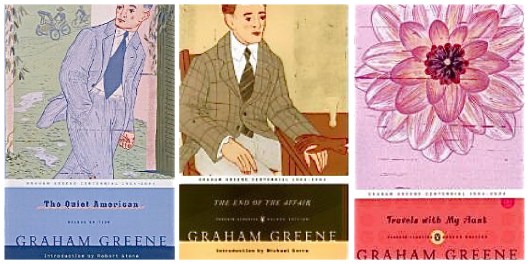
Here they are. Look at the book covers, all from the Penguin Classics Graham Greene Centennial Edition (2004), trade paperbacks with French flaps. It’s a delight to just hold them in my hands:
Travels with my Aunt (1969) is my first taste of Greene humor. Compared to the other two I’ve read, which are intense and deeply serious, this one is a light comic relief.
A conservative, retired bank manager Henry Pulling found a new relative at his mother’s funeral, his Aunt Augusta. She is everything he is not, an eccentric and liberal seventy-five-year-old sets to open a whole new world for his nephew. Upon Aunt Augusta’s insistence, Henry accompanies her travelling in Europe. In the process, she widens his contacts with some shady characters, opens his eyes to an underground world he has never imagined, leaves his trails with police investigations, and overturns his carefully guarded self into disarray.
The humor in Travels with my Aunt reminds me of Oscar Wilde’s The Importance of Being Earnest, and makes me think that, if it were written as a play, probably it would have been more effective and enjoyable.
I mean, considering it takes Greene only 180 pages to tell the complex story of The Quiet American, and 160 pages to depict the deeply conflicting The End of the Affair, why would he need 254 pages to jot down some travel notes. That’s right, he narrates in details and often digresses to leave us with some clever one-liners along the way. But, if he had picked up the pace a bit, and tightened up like the two previous books I read, I would have appreciated it much more. Okay, it’s selfish wishful thinking on my part, me being a very slow and easily diverted reader.
***
Ireland Reading Challenge 2012
And earlier in November, I’d finished The Ireland Reading Challenge 2012 also hosted by Carrie at Books and Movies. I aimed at the ‘Shamrock Level’ and read four books of at least three different genres. Here are my selections and links to my reviews:
No plans for taking up any Reading Challenge for 2013 yet. However, I do have two Read-Along’s planned for the coming year. Hope you can join me then. Will post soon.
Some of you may still have roses in your garden and lush green lawn, but here in my neck of the woods, this is what we’re having… Exactly, with the snow falling.
But what did I find while birding recently? The woods teeming with life as in the summer sun. Take this buck, our curiosity is mutual:
Or this Blue Jay flying overhead:
This Pileated Woodpecker busy at work:
Or this Black-capped Chickadee having fun:
Or this Red-breasted Nuthatch lounging on two branches:
Woodpeckers, Chickadees, Nuthatches, Robins, Blue Jays, Finches… They don’t migrate, but stay put and enjoy life where they are, even in deep winter when temperatures can easily dip below -20C. This is their hood.
Movies this fall is a bumper crop of film adaptations from literary sources. Two belong to the same genre of magic realism. While Midnight’s Children is more akin to realism, Life of Pi is pure magic.
Ang Lee has done it, filming what is considered the ‘unfilmable’. Canadian author Yann Martel’s Booker Prize winning novel Life of Pi is an existential fantasy, a story that challenges the limitations of human reasoning and opens the door to the imaginary and the quest for the Transcendent. What Martel has succeeded in literary form, Lee has realized in this visually stunning cinematic offering. While I know book and film are two very different art forms, I am glad that screenwriter David Magee has stayed true to the spirit of the novel, which I think is crucial in this case. Cinematographer Claudio Miranda’s creative camera work is also essential in turning Martel’s imaginary world into mesmerizing visuals on screen.
The difficulties are not just transposing the philosophical ruminations from book to screen, but to keep the audience’s attention and interest for two hours when the bulk of the story is about a 16 year-old boy adrift at sea for 227 days in a lifeboat with a Bengal tiger. Kudos to Lee for taking up this daunting task, a project of which several other directors had bowed out, including Jean-Pierre Jeunet (Amélie), M. Night Shyamalan (The Sixth Sense), and Alfonso Cuaron (Harry Potter and the Prisoner of Azkaban).
The production has taken Lee years to complete. He had to build the world’s largest self-generating water tank of its kind in Taiwan to shoot his film, utilize 3D technology and CGI to overcome many obstacles, do extensive research, and above all, find an actor who is capable to be Pi.
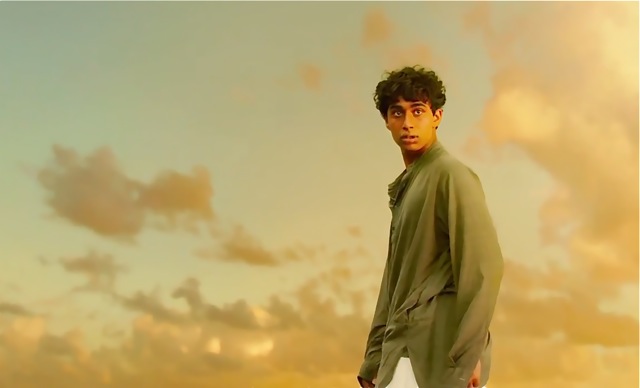
Ultimately Lee found 17 year-old Suraj Sharma in Delhi, India, from 3,000 candidates. Fate has it that Sharma was just accompanying his younger brother to the audition. The next set of challenges for Lee soon follows: directing Sharma who has never acted before, and, coaching him to imagine there is a fierce tiger present at the scenes, for Richard Parker is a virtual reality.
As I watched the film, I could see Lee’s own tenacity reflected in the character of Pi. In fact, the whole process of the production parallels the thematic significance of the story: the essence of reality, the nature of storytelling, the role of the imagination and faith in survival and in life.
**
The film begins with Pi as a boy (Gautam Belur at 5, Ayush Tandom at 12) growing up in Pondicherry, India. His father (Adil Hussain, English Vinglish) owns the Pondicherry Zoo. The most impressionable lesson he learns from his father is, the tiger is not his friend.
Pi has a loving mother (Tabu, The Namesake), and an older brother Ravi (Ayan Khan 7, Mohd Abbas Khaleeli 14, Vibish Sivakumar 19), a typical older sibling who teases and dares. This first act of family life is a delight, and the 3D effect in the opening sequence is wonderful to watch. The original score composed by Mychael Danna matches well with the exotic context.
We soon realize the story we are watching actually is the adult Pi (Irrfan Khan, Slumdog Millionaire) telling what had happened to him as a boy to a Canadian writer (Rafe Spall, A Room With A View), a story, Pi claims, that will make him believe in God.
Pi is short for Piscine. After the boy is constantly teased by his schoolmates with the pun of the name, he begins to introduce himself as Pi. He just might not have known how prophetic his name is. Precocious and earnest by nature, Pi embraces Hinduism, Christianity and Islam in his search for the divine. The value of Pi, the mathematical symbol, is 3.14, a number that goes on to infinity, which aptly reflects the boy’s heart for the Eternal.
**
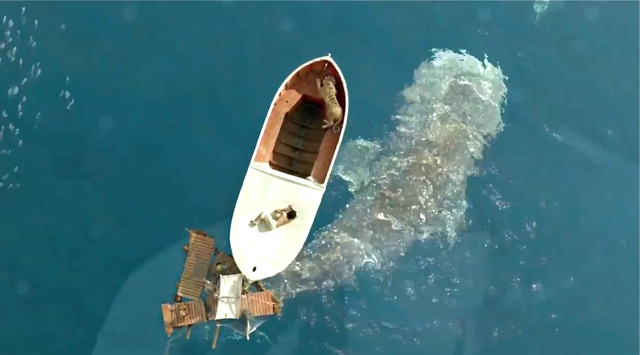
When he is 16 (Suraj Sharma), Pi’s family emigrates to Canada. They set sail on the Japanese cargo ship Tsimtsum, bringing on board the zoo animals. One stormy night, tragedy strikes. A shipwreck sends Tsimtsum to the bottom of the Pacific Ocean. Pi alone is saved as some sailors throw him overboard onto a lifeboat. Thus begins the magical journey of life in an open boat. Pi soon finds out he is not alone, for there in the boat is a hyena, a zebra, an orangutan called Orange Juice, and Richard Parker, a Bengal tiger. Soon there remain only two survivors, a 16 year-old Indian boy and a hungry tiger.
Lee demonstrates his technical and directorial prowess in this major second act of the film. He has aptly chosen to use the 3D camera. I’m not a fan of 3D, nor animal movies, but Lee’s usage of it makes what could have been an uneventful drifting at sea into an extraordinary movie experience.
What I read in the book jump out alive in magnificent visuals: the squall of flying fish, the gigantic whale shooting up from the ocean deep, the cosmic showcase of thunder and lightning, and the island overrun by meerkats. Magical realism in 3D, pure cinematic fantasy.
Lee’s style is minimalist: a life boat, a makeshift raft, a boy, a tiger, the open sea. Its simplicity exudes immense beauty; its stillness evokes quiet ruminations. This is not just a castaway, survival story. It depicts a close encounter of a soul experiencing nature and its maker. It also portrays an unlikely companionship between a boy and a tiger. Despite the loss of his family and the perils thrown at him, Pi clings to life with bare faith and the companionship he finds in Richard Parker.
The last part comes as a twist. Two employees of the ship’s insurance company interview the sole survivor of the shipwreck after Pi is rescued. Upon hearing Pi tell his ordeal, their rationale overrides any acceptance of the improbable. Here we see the thematic elements of fantasy versus reality, faith versus plausibility cleverly laid out. Like Martel’s novel, it poses a question that is open-ended, more for the viewer to resolve than for Pi to prove. A most thought-provoking end to a magical journey.
~ ~ ~ ~ Ripples
This review has been published in the Asian American Press print version, Nov. 30, 2012 issue. Online edition here. (Hint: There you’ll find Arti morphing from virtual reality into real life… take whatever is real for you.)
A NOTE ABOUT MOVIE PHOTOS: These images are used according to the Fair Use guidelines for criticism, comment and educational purposes. CLICK HERE for more information. CLICK HERE to read the Report of the Ad Hoc Committee of the Society For Cinema Studies, “Fair Usage Publication of Film Stills” by Kristin Thompson.
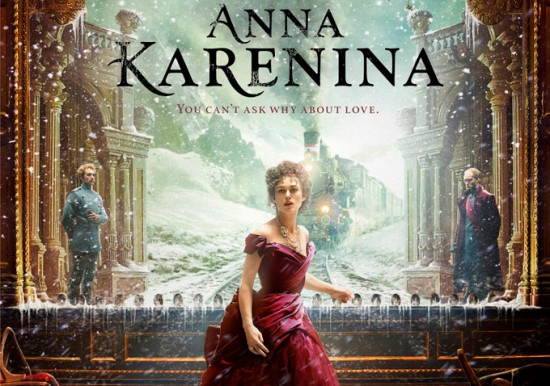
It is a good sequence, Anna Karenina read-along then the movie after. Screenwriter Tom Stoppard wrote as if his viewers already knew the story well, or have seen other film versions, for here, we are watching a highly stylized adaptation of Tolstoy’s epic novel, and it seems that it is a case of style over story.
Joe Wright’s (Atonement, Pride and Prejudice) version is a bold and therefore risky direction. Instead of a realistic rendering of Tolstoy’s epic, Wright offers us a new portal into the story of Anna Karenina. All the world’s a stage, and if anything, the highly reverberated gossip of Petersburg, the adulterous affair of Anna, wife of the respected government official Alexei Karenin with Count Vronsky is aptly rendered a spectacle. Wright’s innovative concept is an interesting take, weaving his characters between the front and the backstage and into the ‘real’ set.
The idea is brilliant, the permeability of actors in and out of limelight, mingling between their own realities, and the idea that all the world’s a stage, one is both an actor and a spectator.
However, the major premise of the cinema is make-believe. It is the ‘realness’, the believability of the characters and their predicaments that arouse our empathy. That happens when we emotionally immerse into the film. As a result, we care for the characters, even though we may not identify with them.
But here while watching this film, I experience a kind of cognitive dissonance. With its setting in the theatre, at the front and backstage, it is like a kind of deconstruction if you will, for we see that these are merely actors acting, and not ‘real’. So as a viewer, I’m just like a fly on the wall, observing how a theatrical production is done. As a result, I find myself detached and aloof.
A consequence of the highly stylized gestures and movements is that they lead to overacting. And with that, believability is compromised. Now, by genre this is not a musical, so, when seeing characters walk like they’re dancing or their actions performed in unison, like the public servants rubber-stamping paper works, the effect is comical. Well, it might be the intended effect, but one that sticks out in a contrived way. The harvesting scene with the workers swinging their scythe at the same time (do they actually do that in real life, for morale?) is another example, makes me think of how natural the harvesting scenes are in Terrence Malick’s Days of Heaven.
For some reasons, far from Anna Karenina, I have Stanley Kubrick’s A Clockwork Orange in my mind as an example of a successful stylized and yet captivating film.
Nevertheless, there are many admirable elements in the film. First the sumptuous set design and costumes. The continuous camera work from scene to scene is interesting to watch. But after a while, I feel like I need a breather. Thanks to the external shots, albeit few and far between, I can get a gulp of fresh air.
And I must mention a couple of impressive scenes. First is at the beginning, the opening ball where Kitty sees Anna dancing with Vronsky. That scene is well done in its dramatic effects. I can see the actors’ inner turmoils exposed believably, and for a rare moment, Anna’s conscience at work.
Another one is the horse race. It is interesting to see a horse race in a theatrical setting, like an indoor corral. Putting the horse race in a theatre does not seem to work for me at first, but Wright has handled it effectively… Vronsky’s falling, Anna’s outburst, the shooting of the back-broken horse is one of the few captivating moments in the film.
As for the casting, I’m afraid it looks like there is a bit of a miscast for one. Aaron Taylor-Johnson is believable as a young John Lennon in Nowhere Boy, but here in his blond curls and starched white uniform, he looks more like a truant school boy than the military rising star Vronsky.
Keira Knightly’s poise and costume give an apt portrayal of Anna. But sometimes her facial expressions make her look like a rebellious teenager, fighting house rules and ennui.
The one role I enjoy most is Matthew MacFadyen’s Oblonsky. My opinion might differ with many. I think he is a much more convincing Oblonsky here than Mr. Darcy in Pride and Prejudice (2005), another Wright’s production. Jude Law’s character is also well-portrayed as Anna’s restrained husband Karenin the government bureaucrat.
Good to see two of Downton Abbey’s actors in the film, Michelle Dockery (Mary Crawley) as Princess Myagkaya and for a brief minute Thomas Howes (Footman William) as Yashvin.
While the love affair between Anna and Vronsky leaves me quite detached, I do see love in others. I see it in Levin’s (Domhnall Gleeson) quiet yearning for Kitty (Alicia Vikander). I see it too in Kitty’s selfless caring for Levin’s ailing brother Nikolai (David Wilmot), and at the end I see it in Anna’s son Serhoza’s (Oskar McNamara) endearing concern for his toddler half-sister, and I see it in his father Karenin’s slight contented smile looking at his son care for Anna’s child with Vronsky.
And with that scene the film ends. All in all, the production is a brave new look at an old story. It can well lead to more readers trying to discover all the left-out conversations and story lines. And so be it, a worthy attempt to turn viewers back to the book.
I’ve been tagged, and I didn’t know it. A few weeks ago Bellezza of Dolce Bellezza tagged me for a Liebster Award. Didn’t find out until now. As the icon shown above, the Liebster Award is to discover new blogs… well, blogs that one may not have visited before.
So here I go to answer 7 good questions. Thanks, litlove, for first asking them. Here they are:
1. What do you think of literary prizes? Good idea or bad?
I think literary prizes are good pointers, their shortlists are often guide to my longlist of TBR’s. I like to follow the Booker, Giller, and Pulitzer, awards from the UK, Canada, and US. I even watch book awards if they show on TV, like the Giller here in Canada. Yeah, you can tell I love award shows… but for some reasons, I’m not so thrilled about the Nobel literature prize.
2. If you could write any sort of book, what would you write?
They say the first book is usually autobiographical. So let’s see if that’s any easier. Also, something that I can turn into a screenplay after it’s published… like killing two birds with one stone.
3. Describe your ideal home library/study.
A big comfy couch for reclining. Large coffee table beside for laptop, books, notebooks, junks, enough space to put coffee mugs and snacks. Built in book shelves, with books of course, artworks, a music system, and overall artistic chaos. And oh, a large flat screen TV facing the couch. Books and films always go together for me.
4. Name two new authors whose work you think will last the test of time, and explain your choices.
Kazuo Ishiguro. I like his style. His An Artist of the Floating World, Remains of the Day and Never Let Me Go cannot be more diverse in their setting and subject matter, which shows how versatile the writer is. I think his works can last the test of time. The other is Yann Martel. If he can write Life of Pi we can cut him some slack for slipping a bit in the next piece. If Pi can reach shore and be rescued after 227 days adrift at sea, I’m sure his story can survive the test of time. Also, really appreciated the writer’s effort to send our PM Stephen Harper a book every two weeks to enrich his reading.
5. Which books do you hope to get for Christmas?
Modern Library’s Top 100, you can pick any titles from it. Here’s the link. Thanks.
6. What’s the last book you did not finish and why?
The Finkler Question by Howard Jacobson, 2010 Booker Prize winner. I stopped at about page 50. I know, I should have gone a bit more before I quit, but, my patience just couldn’t stand the test of time. However, I think I’ll go back, restart and finish it, some day.
7. Would you accept 20 books that were absolutely perfect for you and dependably brilliant reads, if they were also the last 20 books you could ever acquire?
What? Not being able to acquire anymore? The answer is a no-brainer. And also, I’m afraid the perfect books for me now may not remain perfect through the years, considering how changeable I am. Anyway, acquiring books is one of life’s major pleasures and I just don’t want to give it up.
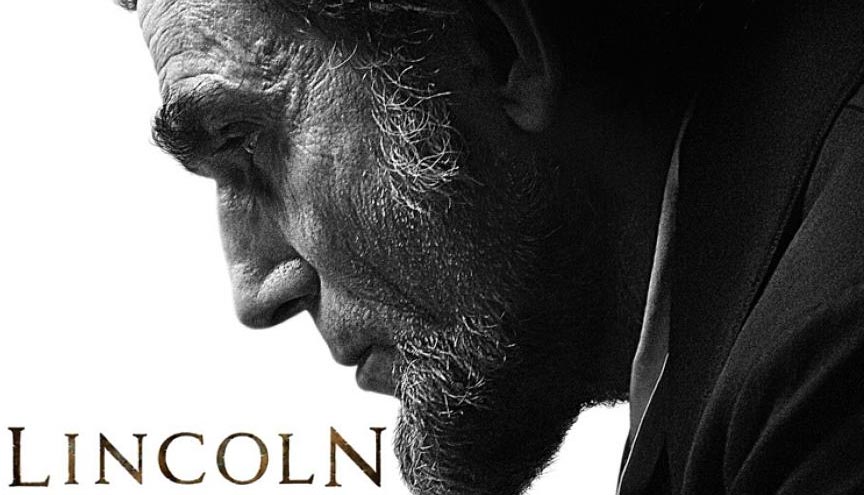
What more can I say that has not been said about this movie? I don’t want to repeat that it’s a strong contender for the Oscar race, or that Daniel Day-Lewis will likely taste his third Best Actor win as Lincoln, or that Tommy Lee Jones should get a nom in Best Supporting Actor for his role as Thaddeus Stevens, or Tony Kushner’s fine dialogues and captivating screenplay…
Here are some other thoughts that came to me as I watched the film, and later brewed in my mind.
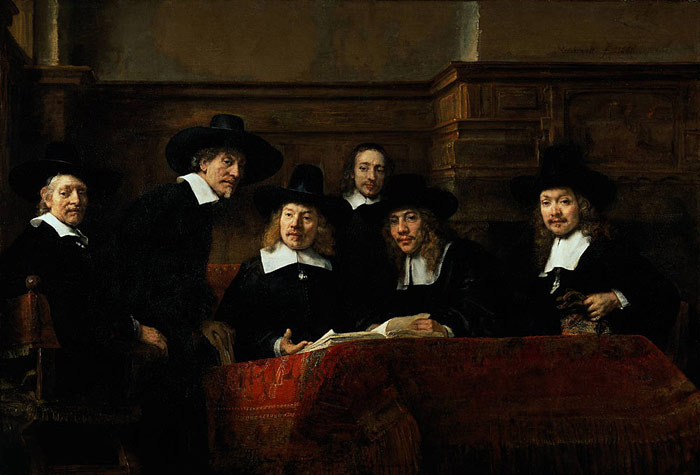
The Rembrandt impression. Watching the film is like seeing Rembrandt’s paintings come to life… especially all the indoor scenes with men gathering, in black, blue, and brown overtone throughout. Yes, the diffusing light from the windows may suggest Vermeer, but the predominantly men in most scenes dressed in black remind me more of Rembrandt. Like this one:
I can’t say much about the Dutch Masters in the above painting, they look pretty tame. But in the film Lincoln, the scenes wherein men congregate to discuss national affairs show the fierce power brokering and politicking of the time. We all know it was men who conferenced, talked about serious issues, made and won decisions, with whatever means avail to them, insults, intimidations, bickering, and persistent lobbying just to name a few.
And the women… The limited screen time Sally Field as Mary Todd Lincoln gets in the film could well indicate their position. Heaven forbid they get suffrage, and a voice. Truly, what can a wife do behind, in Mary’s own words, the most loved and powerful man in the country? How far we’ve come… but, does suffrage guarantee voices being heard? Just wondering.
As Mary Todd Lincoln, Field could well get an Oscar nom for her supporting role. She has done a fine job portraying the private grief behind the public face. Her son Willie died of high fever the night they had to entertain guests in a reception three years ago. A poignant scene occurs when the Lincolns as husband and wife quarrel over their past loss and now the possibility of losing another as their eldest son Robert (Joseph Gordon-Levitt) determines to enlist in the army, against his parents’ wish, or, is it only his mother’s?
From the photos above, we can tell how the casting, make-up and costume bring out the historic Mary Todd Lincoln. I remember Sally Field on Jay Leno said that she had to gain 25 pounds in 6 months to play the role, and later had to shed them all.
As an outsider, i.e., a non-American, I can’t say much about the accuracy of the content. I’m most interested to know which are Lincoln’s own words and in what context, and which are the scriptwriter’s. Even the British actor Daniel Day-Lewis himself had reportedly turned down the role at first as he felt he knew too little about the 16th U.S. President to portray him. As an outsider, I find it intriguing how an immensely influential historical figure is interpreted and portrayed. And apparently, there’s more than one angle.
Some time ago I watched PBS’s Looking For Lincoln, a documentary presented and written by Harvard professor Henry Louis Gates, Jr. It brings out a very different Lincoln, a complex, morally conflicting figure who had not initially tied the notions of freedom for the slaves with equality of the races. Gates went through extensive archival documents, Lincoln’s own notebooks, writings and debates, and interviews with scholars and academics to discover a Lincoln who had to lay aside prejudicial views and take on gradual personal changes as the Civil War bled on.
Interestingly, Gates interviews Doris Kearns Goodwin, the Pulitzer Prize winning biographer whose book Team of Rivalswas what Spielberg based his film in parts on. It has been noted that even before she wrote it Spielberg was willing to secure the film rights. In Gates’ documentary, Goodwin admits that there is a need to demythologize the man Lincoln. While generations revere his greatness, he is very much human with strengths and weaknesses.
Spielberg’s interpretation is the popular frame and presents a singularly, saintly and benevolent emancipator instead of a complex and pragmatic politician, a 19th century white man who was very much a product of his times.
No matter, whatever angle Spielberg has chosen to interpret and present Lincoln, he has done it convincingly. Credits are due to Daniel Day-Lewis’s superb performance. He has salvaged any shortfalls with great charisma.
However, I do feel there are two weak sections in the film… the opening and later at the end. Seems like Spielberg is trying a tad bit too hard right at the start, for the opening scene sounds contrived as four young Union soldiers, two from each race, stand in awe in front of Lincoln in an army camp and recite back to him the Gettysburg Address.
The other is the assassination. With the whole movie resting on careful detailing of the passage of the 13th Amendment, I was surprised to find Spielberg’s treatment of Lincoln’s assassination in such a hasty manner, albeit the young son Tad’s reaction is moving. This is a scene that deserves much greater intensity and depth, not only for dramatic effects but for the balance of the whole story and expectation from the audience. Now this is the director who gave us the chilling sequences of Jaws, building the suspense of impending danger through the thumping of music and the ironic oblivion of the crowds.
Nevertheless, the second Inaugural Address ends the film on a poignant note. With malice toward none, with charity for all… Spielberg leaves us with Day-Lewis’s charismatic persona of Lincoln exhorting the crowd. With that, he has crafted another epic which will long be remembered, but in the short term, a sure contender come Oscars 2013.
~ ~ ~ ~ Ripples
***
CLICK HERE to watch PBS’s ‘Looking For Lincoln’. It is presented in titled segments. You can click on any of them to watch. But I highly recommend that you go through the whole documentary, just for some alternative views.
PHOTO SOURCES: Mary Todd Lincoln andSally Field from Vanity Fair. Others are stills from movie trailer.
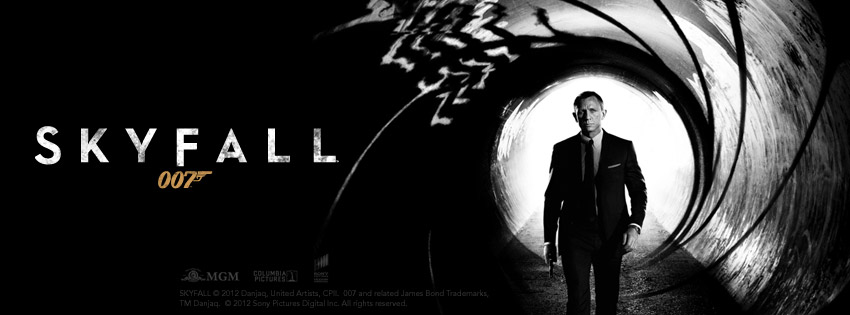
After 50 years, this 23rd instalment of the James Bond film franchise has just raised the bar and anchored its place in the 21st century spy action genre. Ian Fleming has long passed, but his iconic character lives on, portrayed and later resurrected by different suave British actors beginning with, and still my man, Sean Connery, to now Daniel Craig.
Resurrection is the word. You’ll hear it, and see its effect, for with Skyfall, looks like the franchise has just been resuscitated to a brand new life, just like the hero in the film. Kudos to Sam Mendes, the Oscar winning director who helmed such human drama as American Beauty and Revolutionary Road, working withcinematographer Roger Deakins, whose talent has enhanced some of my favorite films like Shawshank Redemption, Fargo, A Serious Man, True Grit…
So what we have is a slick and stylish action thriller but not just in form. Sure, Daniel Craig in his Tom Ford suit, always standing straight and legs apart is all about style, isn’t it? Well, yes and no. Here, we see some internal tapping into the Bond character, just enough to tie over to the next action sequence. And we see too Bond shedding a few tears, for a good reason.
The villain is Javier Bardem. The cold-blooded psychotic killer in No Country for Old Men is just as ruthless and haunting here, but with a change in hair-do. He is Raoul Silva, a vengeful ex-MI6 agent who has gotten hold of a list of all the identities of MI6 agents embedded in terrorist organizations. His pleasure is to kill them down the list. Bardem’s image of Silva reminds me of Hannibal Lecter in The Silence of the Lambs, especially the scene with that transparent cylindrical cage… just gives away what would be coming next.
And our beloved Judie Dench, who’s so versatile that one minute you see her in The Best Exotic Marigold Hotel and the next transported into MI6 headquarters as M. Of course, she’s long been M before Marigold. In Skyfall, Dench deservedly gets more significant screen time than in previous Bond movies. In a later part of the film, M is called to a public hearing to justify her actions and even the existence of MI6. She has some powerful lines which make the scene so gratifying. Her voice-over juxtaposes with the urgent sequence in which we see the villain Silva leaving a trail of violence heading over to get her. Here are the poignant lines she delivers, from Tennyson’s poem ‘Ulysses’:
Though much is taken, much abides; and though
We are not now that strength which in old days
Moved earth and heaven; that which we are, we are;
One equal temper of heroic hearts,
Made weak by time and fate, but strong in will
To strive, to seek, to find, and not to yield.
Can you sense a bit how this is quite a different Bond film?
A fine cast is always the major asset. Another veteran is Albert Finney, who appears almost incognito (to me that is) but a good match with Dench.
With the new life comes two new faces. Both are excellent choices. One is Ralph Fiennes, and he definitely suits the part. Another is Ben Whishaw. Can’t imagine his transformation from John Keats in Bright Star to the digitally savvy young Q. Playing alongside Craig, Whishaw makes an interesting contrast, the gun-wielding old-timer in the field and the young computer geek in the office, taking control of situations with his fingertips.
Further, there are the exotic locations, Istanbul and other places in Turkey, Shanghai, Macau and… Scotland, which not for its exoticism but atmosphere. Cinematographer Deakins has crafted some very stylish scenes that distinguish Skyfall from just any other action flick… aesthetically appealing, moody and atmospheric, a mixed bag of nostalgic noir and contemporary, and in the last part, even a dash of gothic. If not for that iconic Aston Martin DB5 from Goldfinger parked outside the old stone mansion by the moor, you’d think it’s right out of Wuthering Heights.
Adele also joins the league. She co-wrote the Skyfall theme song and sings it in a way that echoes previous Bond numbers, most obviously, ‘Diamonds Are Forever’.
Skyfall has propelled the Bond film to a new era and up a notch. I’ve appreciated the internal character exploration but of course, there are still the spectacular explosions and car chases, the over-the-top mayhem and implausible escapes. We need those to ensure the audience that our hero is alive and well, after given a new lease on life. He’s still the same old Bond, James Bond.
Funny, writing a post on this last part to wrap up our Read-Along is much harder than I first thought. Where do I begin?
Here are just some thoughts.
Tolstoy the Psychoanalyst… and More
First, this is not just one story but several, and not just appreciating a 19th C. writer in distant Russia, but this is Tolstoy the master storyteller. I’m amazed at his craft. What a sharp observer of human nature, the incisive psychoanalyst decades before Freud, not only piercing into the minds of women and of men, but our canine pals as well. Tolstoy the dog whisperer. Why, the hunting scene in Part Six is a unique exploration into the cognitive dissonance of Levin’s four-legged hunting partner Laska. And Tolstoy has amusingly shown us why dogs are man’s best friend. They know their master’s shortcomings, yet still remain faithful.
Tolstoy the Late-Night Show Host
And then there’s the humor. I was surprised from the start that Tolstoy’s style is so light and sometimes even deadpan. The best quotes comes from the minor characters. Here’s one from Yashvin, Vronsky’s friend from the military, condensing the 800 plus pages in a nutshell:
‘A wife’s a worry, a non-wife’s even worse,’ thought Yashvin… (p. 544)
Tolstoy can make one superb late-night show host. Listen to this:
A man can spend several hours sitting cross-legged in the same position if he knows that nothing prevents him from changing it; but if he knows that he has to sit with his legs crossed like that, he will get cramps… (p. 528)
That was what Vronsky feels with regard to society. And we know Vronsky gets more than just leg cramps.
Tolstoy the humorist? Or realist? Even the most casual remarks could bring me a smile of agreement. Like here, responding to Vronsky’s urge to go out for a walk, Oblonsky has aptly voiced out my sentiment:
‘If only it was possible to stay lying down and still go,’ Oblonsky answered, stretching. ‘It’s wonderful to be lying down.’ (p. 589)
All the World’s a Stage
Mariinsky Theatre, preeminent venue for music and ballet in 19th C. Russia
And then there are the spectacles. Society’s a stage where people are actors and spectators all at the same time. Tolstoy throws in many scenes reminding us that. When Anna and Vronsky come back to Petersburg, they appear separately in public at the theatre, something that Vronsky insists and Anna is indignant about. Vronsky seems to favour the spectator role, searching out people through his opera-glasses. In contrast, Anna would rather be the actor, bravely ignoring reverberations, be on centre stage. From his glasses, Vronsky saw Anna’s head, “proud, strikingly beautiful, and smiling in its frame of lace.” But now that he has her the mystery vanishes. Her beauty, though still entices, begins to ‘offend’ (p. 546).
Anna, oh Anna…
If Anna could have detached more and emoted less… Of course, she has never expected how fickle love can be, or that passion is so short-lived or changeable due to varying circumstances, or that too much of it could smother and delude. Ironically, she does look before she leaps. If only she has used her rationale for better judgement rather than calculating when the middle between two train cars will come, all for satisfying her own delusional revenge on Vronksy.
Further, which should have been no surprise to her, that marriage has ties that linger even after intimacy ends. Anna does not choose Vronsky over her husband, but Vronsky over her son, the two loves of her life. She has chosen romance over motherhood. If I’m being a tad bit unsympathetic, maybe that’s Tolstoy’s doing.
What’s surprising to me is that Tolstoy is quite matter-of-fact about Anna’s predicament. His description of Anna’s tragic demise is just one paragraph, and after that, no more mention of her. Following that comes Part 8, wrapping up the whole book with the limelight on Levin. Quite puzzling really since the book is her namesake.
Levin … Tolstoy?
At the end, is Tolstoy offering a contrast to Anna’s tragic end by detailing Levin’s spiritual awakening? The master storyteller certainly doesn’t shy away from issues which would be considered sensitive subjects and even taboos today, like God, religion, spirituality and morality. So in the book entitled Anna Karenina, Levin has the last word. Umm… which leads to a speculation that Tolstoy might have ‘an agenda’ behind his writing. Is he proselytizing?
More and more these days, I’m seeing people getting edgy about others presenting the case for faith, especially taking offence when it comes to Christianity. Nobody would squirm a bit if suddenly one day you declare you’ve become a Zoroastrian. Mind you, Tolstoy’s handling of Levin’s conversion is reasonably and philosophically grounded, albeit that sudden spark of epiphany is too overwhelming and spontaneous to be rationalized.
And all is within context of the story. Levin, having exceedingly gratified by marital bliss, by the pure love of an angelic woman in Kitty, and witnessed the miracle of life in seeing the birth of his son, has opened unreservedly his heart and soul towards God. We can read it as it is, a convincing turn for a character who has consistently been authentic and genuine in his search for meaning.
If we take offence to this ending, suspecting a hidden agenda from Tolstoy, then we could well shed similar sentiments towards other writers whose faith, convictions, or philosophical viewpoints are presented overtly or seeped through silently in their works. Would we be equally alarmed or offended when we read, for example, Thomas Hardy with his naturalism, Camus and Sartre their existentialism, Graham Greene his Catholicism, Isaac Bashevis Singer his Judaism, Somerset Maugham his Buddhism, and for that matter, Salman Rushdie his atheism? There’s no neutral writing, is there? Every writer breathes into his writing that which stems from his or her own personal world view and hopefully authentic self.
Funny too how Tolstoy in his time could so freely describe Levin’s spiritual awakening and explicitly write about the argumentations for the Christian faith in a literary work. Just makes me think that there might be more freedom of expression in days past than in today’s society.
***
So here we are, at the end of another Read-Along. Thanks to those who has participated in reading these 800 plus pages with me. To all who have stopped by the pond and thrown in a pebble or two, I’ve appreciated the ripples. To those who are just curious onlookers, your visits mean no less. It’s been a fun ride. Hopefully we’ll do another one in 2013. Will you join us then?
And now, to the movie…
***
Do go and visit these other Read-Along participants and join in the discussion there:
After a few years of using the blue ripples as my Gravatar, recently I’ve created a new one. It combines several of my interests… at present. I designed the set and took the photo in a mini makeshift ‘studio’, a little corner on a desk.
This Gravatar depicts pages rippling in fight, the soaring power of words. From the symbolic to the actual, most noticeable in the background is my bird book, guide to a new-found passion.
Underneath the pages in flight is Hemingway’s A Moveable Feast. While Hemingway may not be my favorite writer, the title of this book is significant, albeit you can’t see it here. Less noticeable is the screenplay I’m writing at the base of the pile. Can you see the brad? And oh, the title of the open book? Roger Ebert’s memoir Life Itself.
Books, films, birds and screenplay in progress… a moveable feast.
This is my fourth and final instalment for Ireland Reading Challenge 2012 hosted by Carrie of Books and Movies. What first attracted me to this newly published edition (August 2012) by Modern Library was its cover. I’m very fond of Modern Library’s classics in trade paperbacks, mainly because of their elegant covers as well as the size of the type. Interesting how type size has become a factor for my reading enjoyment in recent years… ok, no more elaboration on that.
While Joyce’s later works Ulysses and Finnegans Wake are considered iconic works of 20th C. literature, for some reasons I have no desire to take up the formidable challenge of deciphering them. But Dubliners, a collection of short stories written in his early 20’s, looks to be a much more manageable task.
With this new edition comes a new introduction, written by the Booker Prize winning author John Banville (The Sea, 2005). For me, two points stand out in his introduction. First is that Joyce himself had indicated that Dubliners could well be his best work. An admission that he might not have wanted to be publicized.
Second, Banville has slipped into a sentence an implied definition of ‘greatness’ in a literary work. Here’s it is, as he talks about the story “The Dead”:
It is indicative of the greatness of this story that after nearly a century of critical commentary and scholarship dissection it remains an enigma.
If the inscrutable is used as a qualification of greatness, then there are a few great ones in this collection.
Dubliners compiles fifteen short stories. In order of their arrangement, they cover the point of view of childhood, adolescence, to adulthood, yet they share similar themes based on love and loss, life and death, religion and conscience. It’s interesting as I caught myself while reading that I did not see the characters so much as residents of Dublin. They appear borderless. Their particular location and life situation might be tied to Dublin and Ireland at a certain point in time, but the issues they have to deal with transcend boundaries.
A twist that the stories seem to share is: people are not what they appear. Often, the picture presented in the first part of a story leads to an ironic ending. Further, below the surface of a character, there are unfathomable depths of feelings, conflicts, memories, longings and desires. Joyce’s superb writing takes the reader with him as he peels off layer after layer to show us the human soul… but not devoid of charm and humour.
Most of the stories are swift and short, some maybe like scenes and vignettes, their descriptions and character depictions sharp, precise, and succinct. The last one ‘The Dead’, the one that Banville notes as an ‘enigma’ in the introduction, is the longest with 55 pages, the highlight of the whole book.
Here are my favourites:
An Encounter – sometimes a most unlikely stranger can help us see ourselves a bit more clearly.
Araby – famous story that many of us might have read in school, adolescent infatuation, missed chances and the uncontrollable happenings in our everyday life.
Eveline – One may feel discontent with one’s claustrophobic life, but given the chance to escape, freedom may just be too risky a choice to make.
A Little Cloud – Yes, the grass is always greener on the other side, but some people may just be destined to stay in less green pastures… Our lot, is it by fate, or, by choice?
A Painful Case – Anna Karenina in short story form… well, maybe just a coincidence.
The Dead – A 55 page and by far the most gratifying story for me. Joyce sets the stage with a Christmas party and presents some lively characters, slowly focusing on Gabriel, a loving husband, and maybe drenched in a bit too much self-importance and confidence.
All’s well until the twist comes at the last 10 pages. A song at the party resurrects his wife’s memory of a young lover who died for love of her at 17. As the husband excavates his wife’s long past story, he comes to a humbling self-realization. His initial passionate sentiments for her change to jealousy but finally turn into a greater clarity of what love is.
I must quote this last sentence of the story, don’t worry, no spoiler, I’ve already given you that, but just for the beauty of the prose, and the meaning that runs silent and deep:
His soul swooned slowly as he heard the snow falling faintly through the universe and faintly falling, like the descent of their last end, upon all the living and the dead.
Here is my take on this ‘enigma’ of a story…
as the snow falls upon all
it is love that connects
among the living
and with the dead.
***
Dubliners by James Joyce, with a new introduction by John Banville. Published by Modern Library, NY, Paperback Edition, August 2012, 249 pages.
My other reviews for Ireland Reading Challenge 2012:
If The Best Exotic Marigold Hotel is from the outside looking in, then English Vinglish is the reverse shot, bringing us a point of view from the inside looking out.
Writer-director Gauri Shinde gleaned from her real life experiences to craft this delightful dramedy that is rooted in human miscommunication, but speaks much more. The film is one of the Gala Presentations at the Toronto International Film Festival in September.
The legendary Bollywood star Sridevi comes back to the big screen after a 15 years hiatus to play Shashi, a devoted wife and mother in a modern, middle-class family in Pune, India. She is a lively, capable woman, a good cook who runs her own catering business, her specialty the ladoos, sweet golden balls of dainty delights. But she has to struggle with one major insecurity: she knows little English. Well, you may think, what’s the big deal. But with English recognized as the lingua franca by those living in a former British colony, and a patriarchal society, Shashi as a woman with no English sorely feels disadvantaged, even within her own family.
Her daughter teases her for her pronunciation, even her preschooler. She shies away from parent-teacher interviews, for her daughter goes to an English-speaking school. No matter how devoted a wife she tries to be, she feels the gap between herself and her husband (Adil Hussain, Life of Pi, 2012; The Reluctant Fundamentalist, 2012), who is proficient in English and thus becomes her spokesman in social situations.
“She’s born to make ladoos,” her husband’s intended praise of her cooking skills only reflects the confining social reality in which she finds herself. Not knowing English makes her feel subservient, without a voice.
The tipping point comes when Shashi’s niece is getting married in New York City. She has to go on her own to help her prepare for the wedding. Her family will travel later. An Indian woman in a sari on her first international flight alone, Shashi is understandably timid and insecure. But a friendly and helpful gentleman who sits beside her eases her anxiety. That role is aptly played by the veteran actor Amitabh Bachchan (Watch for him in The Great Gatsby, 2013)
A funny and quite original scene comes when this helpful gentleman suggests they watch the same in-flight movie, and he be her interpreter. Only he wears the headphone, and translates the dialogues out loud from English to Hindi for Shashi to hear, in a voice that’s animated and true-to-life, sound effects included. Here’s the rub… the movie is an action thriller of terrorists committing violence with guns and bombs. Other passengers trying to sleep have to shush him, short of subduing him for uttering bomb and death threats.
New York City, the place where one can transform oneself in a surprising way. Shashi has her first major language mishap in a coffee shop. Turning insult into courage, she enrolls in an English language class. The camaraderie of fellow learners lowers her guard and builds up her confidence. In a few short weeks, she has not only gained some mastery of the language but supportive friendship, with one being more intimately intended.
Shashi’s vindication comes at the wedding of her niece. Her husband and children have arrived for the occasion, not knowing her secret English lessons. In front of all the guests, Shashi is asked to make a speech to the newlyweds. While her husband tries to deflect the embarrassment and excuses her for lack of English, Shashi stands up and uses her new found voice to urge the bride and groom to value equality and treat each other with respect, a heartfelt speech well intended for her husband, and a lesson that brings tears of remorse to her daughter. This is one of the most moving wedding speeches in films I’ve seen. In case you’re interested, another memorable one is Dustin Hoffman’s at his daughter’s wedding in Last Chance Harvey (2008).
The 130 minute movie could benefit from keener editing, but the charming Sridevi carries it through with style and grace. It is a joy to watch her even amidst her insecurities, for she has won my heart with her quiet determination to overcome the odds, her strength of character shines through beautifully.
The movie offers a variety of entertainment, albeit not without some contrived moments. It is a full pack of heartwarming comedy, melodrama, cultural mishaps, the ESL classroom, Bollywood style music and dance numbers, but above all, reality. The film has brought to the forefront children showing disrespect for a parent with no English. This could be an issue particularly among immigrant families. Such a portrayal could well be indicative of society at large. Shashi has demonstrated that language does not define who she is, nor should it be the condition of respect and meaningful relationships.
The fact that we in North America can thoroughly enjoy a Hindi film, no doubt by reading English subtitles, could only mean that we can cross the language barrier to understand each other and appreciate different points of view. English may be the lingua franca in certain parts of the world, but it is compassion that joins us. What better way than to be entertained as we go about learning other perspectives?

















 Ripple Effects