Discovery and Revisit at Home

One day in the future when I have to account for how I spent my time in the months of March to May, 2020, I will come up short for a better answer than cook, eat, read, watch, sleep and then repeat day after day, lockdown except for weekly essential groceries. I admit though, I take to such reclusive, stay-home life quite naturally, albeit I did miss the Pond.

You wouldn’t want to know what I cooked and ate during those months, but I can tell you the discovery and revisit I’d made at home.

The Great Courses on KANOPY

Kanopy is wonderful if you’re not into trendy pop culture movies and TV shows. The streaming service offers classic titles and worthy contemporary films, international in scope, and is free with your local library card or an academic library account. They also carry The Great Courses, numerous subjects to choose from covering a huge variety of interests.

I took two courses, both exemplify the word ‘edutainment’, academically sound and informative. One is “Reading and Understanding Shakespeare” taught by Marc Connor (professor at Washington and Lee U), the other is “Screenwriting: Mastering the Art of Story” taught by Angus Fletcher (Ohio State U). Both comprise of 24 videos. In the Shakespeare course, I learned over 40 tools to decipher the Bard’s plays, and from the Screenwriting course, how to build a story world.

There are many pleasant discoveries but there’s one I find most gratifying. Come to think of it, I shouldn’t have been surprised at all: Both lecturers have cited Jane Austen’s Pride and Prejudice, noting how Austen had used Shakespearean elements in her storytelling, and in turn, how her work had influenced modern day screenwriting.

Pride and Prejudice

To illustrate the tone of the Ironic Narrator, an ancient literary device dating back to the Greek and Roman satires, an example professor Fletcher uses is the opening sentence of Pride and Prejudice:

It is a truth universally acknowledged, that a single man in possession of a good fortune, must be in want of a wife.

The larger things of the cosmos, ‘universal truth’, is juxtaposed with that which is much smaller and singular, albeit such triviality may well have made up the cosmos of those who are parochial. Examples of such an ironic tone can be found in The Big Short, The Princess Bride, Fargo, and CSI. ‘All of them employ the same basic what and how of Pride and Prejudice, with their own little twists and tweaks.’

Maybe you’ve noticed I used the words ‘most gratifying’ with the pleasant surprise when I hear Austen being mentioned. Yes, Jane would turn in her grave to read what I’m going to write: it feels good to find someone, particularly a male with credentials, to confirm the value of her writing such that her work isn’t being seen as ‘just women’s novels’ or ‘chick lit’. Ugh… saying this is so unnecessary, for Austen doesn’t need to prove her worth among the ignorant. However, in this day and age, it takes movements and hashtags to confirm things that should have been valued. Misconceptions ought to be corrected.

Pride and Prejudice Revisited
(Audiobook cover image above)

So, after these two courses, I was all set to revisit my favourite Jane Austen novel, Pride and Prejudice. This time, I downloaded the Blackstone audiobook (2011) narrated by Carolyn Seymour, and listened to it twice back to back; this time, I enjoyed it more. Here’s my ripple stirred by the Bard himself:

Ah ha! Fair is foul and foul is fair
Darcy and Wickham as foils repel
Appearance and sweet words can ensnare
At last! Lizzy learns her lesson well.

Further, the famous ‘block to young love’ conceit, not blocked by an older character as in the Bard’s plays –– surely Lady Catherine de Bourgh is old but she’s no match for Lizzy –– but by the lovers’ own internal flaw, be it pride, or prejudice, or both. How satisfying to see the protagonists mature in their self-knowledge as the story develops, first Darcy then later Elizabeth, gaining clarity of their own true self. Not to mention how gratifying to see that figure of grace, Darcy, as he saves the reputation of the Bennet family with his own silent, altruistic plan all for the one he loves.

Well, what’s a staycation for if not to savour one’s favourite reads over again, doing nothing all day but just dwell in the story world without feeling guilty about time spent. I’m thinking it’s a little like being stranded on a deserted island, like Tom Hanks in Cast Away, and feeling lucky you’ve got Wilson as a companion, even when there’s no one to actually play volleyball with you.


***


Related Posts on Ripple Effects

I’ve written many posts on Jane Austen during the early years of blogging. Just put her name in Search you’ll find them. Here are some of my personal favourites:

Art Imitates Life, or Life Imitates Art, or…

Why We Read Jane Austen

In Praise of Austen: Virginia Woolf’s A Room of One’s Own

Bath’s Persuasion

Here’s a link to my articles published in the Jane Austen Centre Online Magazine
Up in the Trees

What I find walking in the woods can be redundant and mundane, that goes for my photos too. But looking up into the trees can be therapeutic psychologically, especially these days, not to mention beneficial for the neck muscles.

Mundane or unusual, here are some sightings during my walks in the past weeks.

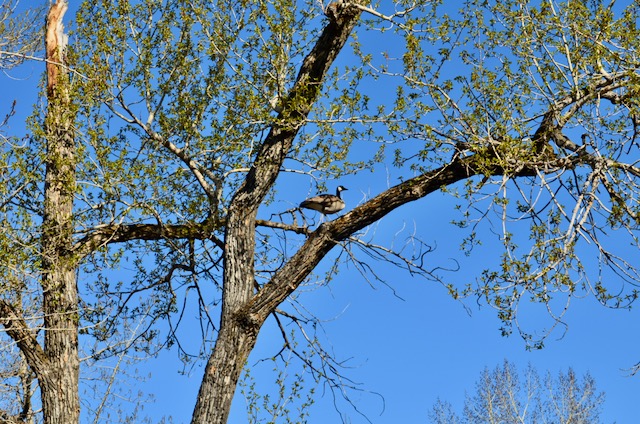
You see them everywhere, their by-products littering your grounds. But the Canada Geese in my neck of the woods don’t gather at the Pond or on the ground, but high up on trees. I think they nest there too:

Another CG on tree

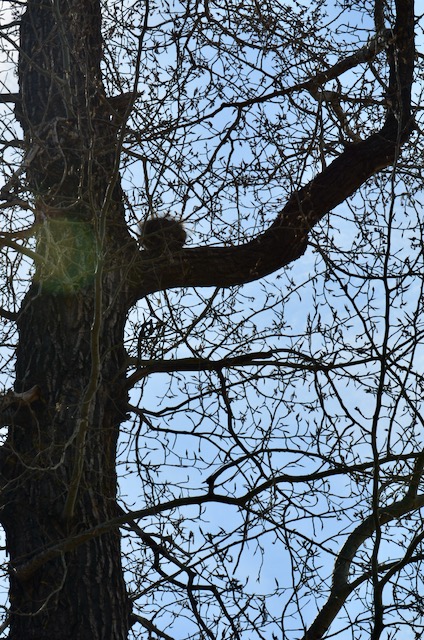
Here’s one taking the abode of a previous tenant, the owl family. How do their young come down from so high up? They’ll have to learn to fly first, just like other birds, another birder said when I asked. Or, the mother could carry them on their wings, my imagination added.

New Tenant

occupying the nest of the owls

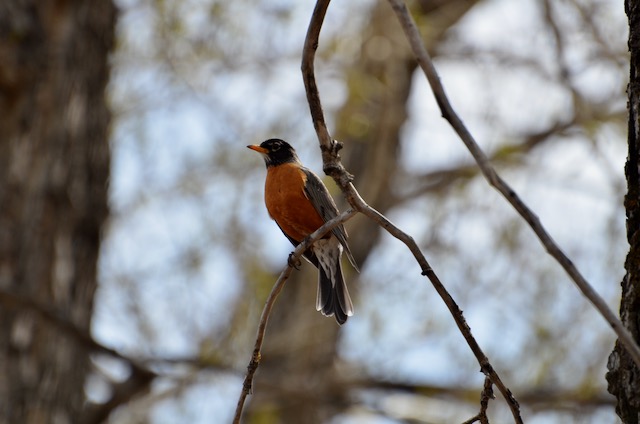
A Robin, never too common for me, especially when I capture a handsome one:

Robin not common

One time, I saw this ball from afar:

Ball on tree

Walked closer and found this. Do porcupines nest on trees too, or just for naps? Or, is it something else? The next day I went back to look for it and it was gone.

Porcupine ball
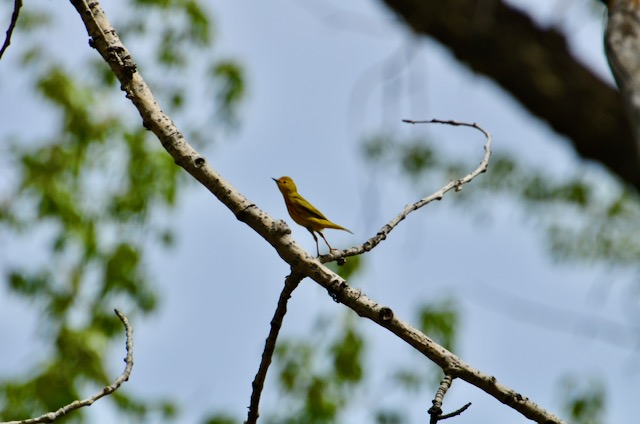
Mundane or unusual, my curiosity is piqued walking the same paths year after year. This curious Yellow Warbler well represents my feelings:

Curious Yellow Warbler

Here’s another curious one:

Curiosity

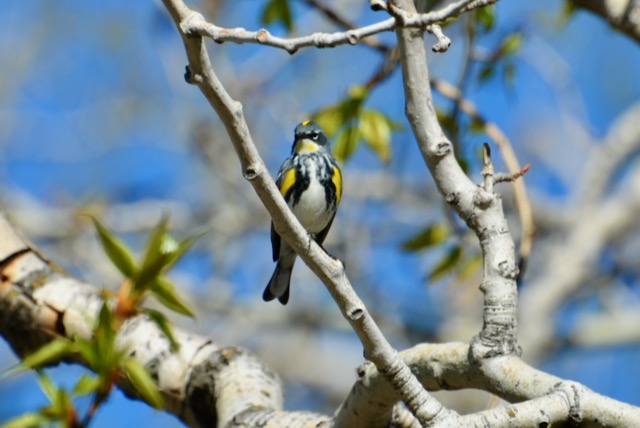
In a previous post about the Yellow-rumped Warblers, I’d noted that the white-throated one is called the Myrtle Warbler of the East and far north, and the yellow-throated one the Audubon’s Warbler from the West. Just curious, what do you call this one with both white and yellow on the throat:

Yellow-rumped Hybrid

Curiosity in the mundane. Maybe that could get me out of bed on those days when I get too used to that stay home mandate.

.

***

‘Benjamin Button’: A Curious Look at the Movie Adaptation

The idea of a baby born as an old man and then grows younger––a reverse trajectory of the human experience––is the premise in F. Scott Fitzgerald’s short story published in 1922, reviewed in my previous post. Prompted by a remark made by Mark Twain, Fitzgerald unleashed his imagination and wrote the story.

The tale was adapted into a 2008 movie directed by David Fincher who brought it all the way to the Oscars with 13 nominations the next year. I watch it for the first time in 2020 and am surprised to find its relevance: the fear of strangeness in our age of xenophobia.

As for the 13 Oscar nominations, the movie won only three: Art Direction, Makeup, and Visual Effects. These are difficult feats and deserving wins. Unlike the Academy’s (and some critics’) aloofness in embracing the film’s other achievements, I much appreciate the adapted screenplay and Fincher’s 166 minute visual rendition.

Here’s an exemplar of how a film adaptation diverges from the original literary source and yet still keeps its main concept, but instead of faithfully following the thin, short story, carries it to a different direction, creating an expanded and more gratifying version.

Benjamin Button

Screenwriters for the adaptation are Eric Roth and Robin Swicord. Roth is known for his Oscar winning adapted screenplay for Forrest Gump (1994), and Robin Swicord for her 1994 version of Little Women. They had chosen to turn Fitzgerald’s farcical, acerbic fantasy into a serious film in the vein of magical realism. The magic lies in the imaginary, reverse growth trajectory; the realism is love.

This is not just about love between two star-crossed lovers, Benjamin (Brad Pitt) and Daisy (Cate Blanchett), but about a woman with a huge heart, Queenie (Taraji P. Henson), who embraces a Gollum-like baby abandoned at her doorstep. Instead of a non-mentioned mother in Fitzgerald’s story, Queenie raises Benjamin with devoted affection. There’s love and acceptance as well from those in the old folks lodging house where Queenie works. Further, the movie adds one more layer, and that’s Daisy at her deathbed, sharing the story of her lost love with her daughter Caroline (affectively played by Julia Ormond), leaving her with a legacy of love.

The film makes amends to the sardonic tone of the short story by creating a moving love story. For a short period in their lives, both Benjamin and Daisy are of approximate age, but such joy doesn’t last as one grows older and the other younger. Yet unlike the short story, their love endures, for as long as one can hold on to it despite separation. And we find out that one can, all the way to her deathbed; the other is just too young to remember. What’s left is the transience of time and inevitable fate.

The setting is early 20th century on the cusp of WWI in New Orleans where Benjamin is born, and not 1860 Baltimore. As he grows younger, Benjamin goes through WWII instead of the Spanish-American War in the short story. The movie starts off with a modern time with Daisy’s final hours revealing to her daughter who her real father is. That’s 2005 New Orleans, during a hurricane when the hospital is preparing to evacuate. A disastrous storm as a backdrop in the telling of a billowy story. A name to denote the significance: Katrina. 

The movie is a divergence for Fincher too considering he’s a master of crime thrillers –– Zodiac came out just a year before in 2007, and more recently Gone Girl in 2014, Benjamin Button is Fincher’s only ‘romantic’ drama (The Social Network, 2010, is drama but definitely not ‘romantic’). Crafted in signature Fincher styling with low-light, sepia colour to enhance the period effects, the aesthetics in set design and cinematography bring out the notion of ‘every frame a painting’. 

Brad Pitt’s understated performance characterizes Benjamin aptly. Instead of remaining ‘the other’, Benjamin strives to connect, albeit in a gentle and quiet way. His love at first sight with then 7 years-old Daisy is a poignant encounter. Elle Fanning is a perfect cast. A child who holds no prejudice, she’s fascinated by the ‘strangeness’ in Benjamin. The Heart is a Lonely Hunter comes to mind.

Other curious finds: music by Alexandre Desplat, Tilda Swinton in some memorable sequences, Queenie’s husband Tizzy played by now two-time Oscar winner Mahershala Ali (Green Book, 2018 and Moonlight, 2016).

You probably have watched it before when the film first came out. How the world has changed in just twelve years. Watching it again now would probably bring you a different feel, and more relevance.


~ ~ ~ Ripples


***


Staying Home Binge Reading

Extraordinary times call for extraordinary measures, and I’m glad to do my social duty to stay home and binge read.

Since the beginning of the year, I’ve been reading mysteries from various countries. From the UK, Julian Symons’s The Colour of Murder, Agatha Christie’s Death on the Nile, Jacqueline Winspear’s Maisie Dobbs, and Alex Michaelides’s The Silent Patient, to the US, John Grisham’s Camino Island, and my first Mary Higgins Clark All by Myself, Alone, which reads like an American version of Death on the Nile. And now getting through Patricia Highsmith’s Edith’s Diary, which is a sort of psycho-mystery.

But thanks to Japanese Literature Challenge 13 over at Bellezza’s, I’m introduced to Japanese mysteries. I started with Akutagawa Ryūnosuke’s (芥川 龍之介) classic short stories “Rashomon” and “In A Grove”, posted here. After that, I’ve been intrigued by the novels written by the prolific Keigo Higashino (東野圭吾). Beginning with Malice, I’ve since binge read five of his mysteries.

There are ten books in the Detective Kaga series but only two have been translated into English: Malice and Newcomer, which I’ve reviewed in a previous post.

From the Detective Galileo series, there are 8 books from which three have been translated, The Devotion of Suspect X, Salvation of a Saint, and A Midsummer’s Equation. I devoured these in the past few weeks. Not everyone of them is a 4-Ripple rating, but this one definitely deserves it.

The Devotion of Suspect X


The Devotion of Suspect X book cover


(Winner of the 2005 Naoki Prize for Best Novel in Japan, and also winner of both the Edogawa Rampo Prize and the Mystery Writers of Japan Prize for Best Mystery. The English translation was nominated for an Edgar Award in 2012.)

From the start, the reader is eyewitness to a murder. We know who committed the crime, the murder weapon, the motive, and the actual scene. It happens in the home of single mother Yasuko and daughter Misato. The victim is Yasuko’s ex-husband, a menace in her life. A neighbour, Ishigami, is in his adjacent apartment unit at the time. What follows is a cat-and-mouse chase––in Higashino’s leisurely pace––of the police and the suspect and possible accomplice.

Detective Galileo is the nickname the Tokyo Police Department had given Manabu Yukawa, Assistant Professor of Physics at Imperial University. Yukawa is a college friend of Detective Kusanagi and someone whom Kusanagi seeks when he needs to bounce off ideas or just shoot the breeze, an actual phrase from the English translation, curious to know the original Japanese idiom.

Higashino’s novels are like bookish tourism. His story, characters and settings make movie images in my mind of what everyday Japanese life is like. Here in this case, the murder weapon is the electrical cord from a kotatsu. What’s a kotatsu? I wondered, so was happy to divert to some Googling on that. Do go and find out if you’re interested. Lively pictures I did find and a new discovery of a common item in a Japanese home.

Back to the book. The physics professor Yukawa is logical. He analyses and deducts with a clear mind. Funny that the real detective, his friend Kusanagi is often driven by presumptions and impulses. The two make an odd couple in this series. However, it’s in the suspect Ishigami, a high school math teacher, that Yukawa finds his match. From the case, Yukawa reunites with his university classmate Ishigami whom he has not seen since graduation. Yukawa remembers him as a rare genius, someone whom he respects with heartfelt affinity.

When an amateur attempts to conceal something, the more complex he makes his camouflage, the deeper the grave he digs for himself.  But not so a genius.  The genius does something far simpler, yet something no normal person would even dream of, the last thing a normal person would think of doing.  And from this simplicity, immense complexity is created.

It’s Yukawa, the physics professor who finally figures out the mind of the genius, a conjecture he’d wish wasn’t true, for pathos can overwhelm a rational mind. And that’s a parallel to depict Ishigami. For him, something rare had sprouted within: when love and devotion are factored into an equation, it could lead to the most extraordinary scenario.

With an intriguing plot and unexpected development in the final revealing, Higashino captures the emotions and humanity of his characters in a way that’s nothing short of profound. The story idea Higashino has created here is most unique and original, just reflects the ingenuity of the mind of the writer.


~ ~ ~ ~ Ripples


JLC13


The Devotion of Suspect X by Keigo Higashino, Translated by Alexander O. Smith with Elye J. Alexander. Minotaur Books, New York, 2011. 298 pages


***


More Films by Female Directors

Let’s continue to celebrate women beyond just one day or a weekend.

Previously on Ripple, I posted a list of my favorite films that happened to be directed by women. Here’s another list, not a personal favourite list but one just to show the variety of movies female directors have helmed, to shatter the myth and misconception that some might hold: ‘if we leave it to them, they’ll only churn out chick flicks.’

In alphabetical order, not ranked, director and year released in brackets, a list to hopefully inform, remind, and maybe surprise. There are many more, of course, but I’ll just stop at 65. How many have you seen? Which other ones you’d like to add?

>>>>>>>>>>>>>>>>>>>>>>***
___

A Beautiful Day in the Neighborhood (Marielle Heller, 2019)

A Thousand Suns (Mati Diop, 2013)

A Wrinkle in Time (Ava DuVernay, 2018)

American Psycho (Mary Harron, 2000)

The Arch (Cecile Tang Shu Shuen, 1970)

The Assistant (Kitty Green, 2020)

The Beguiled (Sofia Coppola, 2017)

Bend It Like Beckham (Gurinder Chadha, 2002)

         Big (Penny Marshall, 1988)

Birds of Prey (Cathy Yan, 2020)

Booksmart (Olivia Wilde, 2019)

Boys Don’t Cry (Kimberly Peirce, 1999)

Bridget Jones’s Diary (Sharon Maguire, 2001)

Can You Ever Forgive Me? (Marielle Heller, 2018)

Capernaum (Nadine Labaki, 2018)

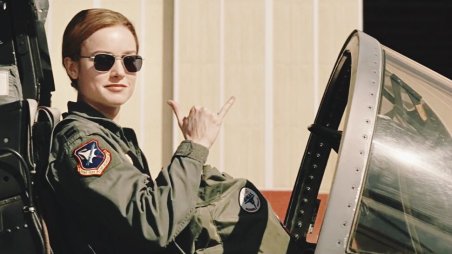
Captain Marvel (Anna Boden, 2019)

Captain Marvel's Carol Danvers

Charlie’s Angels (Elizabeth Banks, 2019)

Chocolat (Claire Denis, 1988)

Cloud Atlas (The Wachowskis co-direct, 2012)

Clueless (Amy Heckerling, 1995)

Fish Tank (Andrea Arnold, 2009)

Frozen / Forzen II (Jennifer Lee co-directs, 2013 / 2019)

High Life (Claire Denis, 2018)

The Hitch-hiker (Ida Lupino, 1953)

Hustlers (Lorene Scafaria, 2019)

The Iron Lady (Phyllida Lloyd, 2011)

Kung Fu Panda 2 (Jennifer Yuh Nelson, 2011)

Late Night (Nisha Ganatra, 2019)

Leave no Trace (Debra Granik, 2018)

Lost in Translation (Sofia Coppola, 2003)

Mamma Mia! (Phyllida Lloyd, 2008)

The Matrix / Reloaded (Lana and Lilly Wachowski, 1999 / 2003)

Meek’s Cutoff (Kelly Reichardt, 2010)

Miss Julie (Liv Ullmann, 2014)

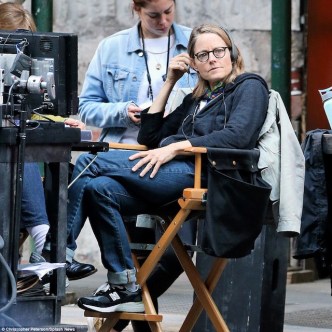
Money Monster (Jodie Foster, 2016)
..

Jodie Foster directs


Monster (Patty Jenkins, 2003)

Mulan (Niki Caro, 2020)

Mustang (Deniz Ganze Ergüven, 2015)

My Brilliant Career (Gillian Armstrong, 1979)

Night Moves (Kelly Reichardt, 2013)

Nowhere Boy (Sam Taylor-Johnson, 2009)

Pay It Forward (Mimi Leder, 2000)

Pitch Perfect 2 (Elizabeth Banks, 2015)

Point Break (Kathryn Bigelow, 1991)

…….The Prince of Tides (Barbra Streisand, 1991)

Queen and Slim (Melina Matsoukas, 2019)

Queen of Katwe (Mira Nair, 2016)

Seven Beauties (Lina Wertmüller, 1975)

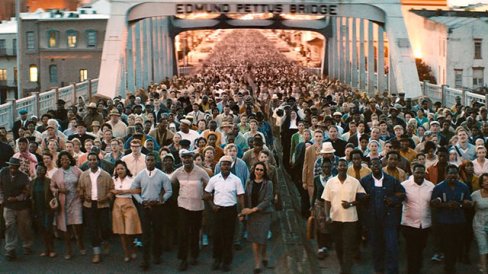
Selma (Ava Duvernay, 2014)

selma-bridge

Shrek (Vicky Jenson co-directs, 2001)

Something’s Gotta Give (Nancy Meyers, 2003)

The Portrait of a Lady (Jane Campion, 1996)

The Secret Garden (Agnieszka Holland, 1993)

The Souvenir (Joanna Hogg, 2019)

Toni Erdmann (Maren Ade, 2016)

Twilight (Catherine Hardwicke, 2008)

Unbroken (Angelina Jolie, 2014)

Wadjda (Haifaa Al-Mansour, 2012)

Washington Square (Agnieszka Holland, 1997)

We Need to Talk About Kevin (Lynne Ramsay, 2011)

Whale Rider (Niki Caro, 2002)

What Women Want (Nancy Meyers, 2000)

Winter’s Bones (Debra Granik, 2010)

Wonder Woman (Patty Jenkins, 2017)

The Zookeeper’s Wife (Niki Caro, 2017)


***


Women Directors of My Favorite Films

In 92 years of Oscar history, only five women have been nominated for Best Director:

Lina Wertmüller (Seven Beauties, 1976), Jane Campion (The Piano, 1993), Sofia Coppola (Lost in Translation, 2003), Kathryn Bigelow (The Hurt Locker, 2009) and Greta Gerwig (Lady Bird, 2017).

How many of them had won? One. Kathryn Bigelow in 2010.

Does that mean there aren’t many women directors around? Definitely not. It just reveals how things are for these artists striving under the glass ceiling. The USC Annenberg Inclusion Initiative research is a good frame of reference for annual facts and trend of women in the film industry. According to their newest study entitled “Inclusion in the Director’s Chair: Analysis of director Gender & Race/Ethnicity Across 1,300 Top Films from 2007 to 2019” (Jan. 2020), female directors of top-grossing films reached a 13 year high in 2019: 10.6%, breaking an average of just 4.8% throughout the past 12 years. Maybe studios have begun to see women can be trusted to make profitable movies after all.

Yet, how many women are nominated for Best Director in the 2020 Academy Awards?

None.

This is not a post of protest, nor of analysis, but of reminiscence. I’ve made a mental inventory of some of my favorite films, ones that have stirred some ripples in the Pond, and found many of them are directed by women. Their works might not have made it to the ‘top-grossing’ list… but, this just shows where my interests lie.

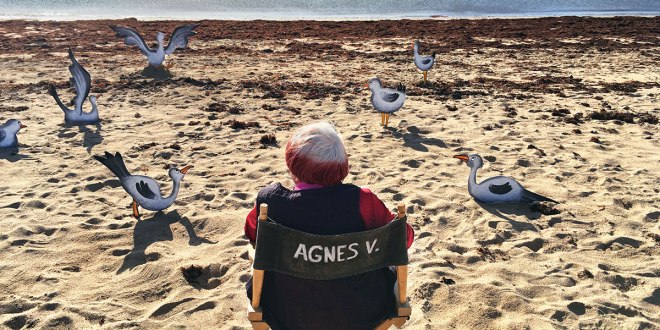
Varda by Agnes
Agnès Varda in the director’s chair. Photo Courtesy: TIFF19

***

Here they are in alphabetical order, with my favorite films bolded. Links are to my reviews:

Kathryn BigelowThe Hurt Locker (2008, Best Picture Oscar, Best Director), Zero Dark Thirty (2012). Bigelow is the only female to have won an Oscar in Directing. She has shown that when a woman takes on a military movie, she can master the conflicts both external and within.

Jane Campion – The New Zealand director is one of the five women in Oscar history to be nominated for Directing. The Piano (1993) is visually stunning and bold in its depiction of the yearnings of the human heart. Campion is the first (and only, so far) woman to have won the prestigious Palm d’Or at Cannes with this film. Bright Star (2009) is a lyrical portrayal of English poet John Keats and his muse Fanny Brawne before his untimely death at 25. A beautiful tapestry weaving together the visual and the word.

Nora Ephron – I miss Nora Ephron. It seems with her passing in 2012, romantic comedies aren’t the same anymore. Sleepless in Seattle (1993) and You’ve Got Mail (1998) will remain iconic from a period that still valued face-to-face meeting over the telephone or emails. And for some reasons, Meg Ryan seems to have gone out of sorts too. Hopefully she’ll make a come-back like Renée Zellweger did with Judy (2019).

Sarah GavronBrick Lane (2007) prompted my interest in the British director with her focus on a Bangladeshi wife in London; Suffragette (2015) depicts women’s personal struggles against a monumental period of British social history, but Rocks (2019) is the gripping, down-to-earth drama following a black teenage girl being left alone to fend for herself and take care of her little brother when their single mom deserts them, achingly real.

Greta GerwigLittle Women (2019) is a production that I’d enjoyed far more than Lady Bird (2017) for which Gerwig got a Best Director Oscar nom in 2018. It’s plain snubbing of her achievement in this year’s Academy Awards where the slate of Directing nominees are all males. Recognized at the Oscars or not, Gerwig’s Little Women will remain a definitive and worthy contemporary adaptation of Louisa May Alcott’s classic.

Mia Hansen-Løve – In Things to Come (2016), the French actor-turned-director Hansen-Løve presents a woman at the crossroads of life. Isabelle Huppert plays a philosophy professor whose husband leaves her for a younger woman, while her elderly mother with dementia needs her constant care, her publisher finds her text book no more relevant, and her two children have grown and lead lives of their own. What are the things to come for her?

Mira NairThe Namesake (2006) is the movie adaptation of the Pulitzer-winning author Jhumpa Lahiri’s first novel. A delightful and humane look at the generation gap within an immigrant family from India, and the clash the son has to face being caught between his present American life and his cultural roots.

Sarah Polley – Polley adapts Canadian Nobel Laureate Alice Munro’s short story for the film Away from Her (2006). At age 27, the Canadian actor-turned-director wrote the screenplay of an elderly couple facing separation as the Alzheimer stricken wife has to move away to live in a care home. Polley’s directorial debut sent veteran British star Julie Christie to the Academy Awards as a Best Actress nominee, and Polley herself for Best Adapted Screenplay.

Dee ReesMudbound (2007) is the adaptation of Hillary Jordan’s novel set in the American South at the end of WWII. Two military men, one white, Jamie, and one black, Ronsel, came back from Europe’s war zone to their home in Mississippi, each faces a different predicament. And for Ronsel, a decorated soldier who had fought under General Patton, home is a totally new battlefield.

Kelly Reichardt – Reichardt’s styling is naturalistic, casual but nuanced. Certain Women (2016) is a triptych of three short stories by Maile Meloy. Against the vast landscape of Montana, lives can be very ordinary, but Reichardt shows there’s no ordinary life. Similarly, Wendy and Lucy (2008) is a simple narrative about a young woman looking for work drifting through the Pacific Northwest with her dog Lucy. Reichardt has major stars in her cast who all look very comfortable being anonymous.

Lone Scherfig ­– Scherfig’s forte is her pleasant styling even when depicting a troubling story. Their Finest (2016) is England in her darkest hour during the Blitz in WWII but with the mood of a romantic comedy. And in 2009, Scherfig tells the story of an innocent teenage girl and her parents being duped by a man in An Education (2009). Carey Mulligan in her breakout role, landing her with a BAFTA win and an Oscar nom for Best Actress.

Agnès Varda – In her last film shortly before her death in 2019, Varda by Agnès, the French New Wave icon stated three crucial concepts in her filmmaking: Inspiration (the why), Creation (the how), and Sharing. The soft-spoken but astute artist has left us with a treasure trove of works, albeit not readily accessible in N. America. I’ve been able to watch several, including my favorites Cleo from 5 to 7 (1962) and Faces Places (2017).

Lulu Wang – The premise of the Chinese American director’s real-life family experience in The Farewell (2019) could be shocking to Western viewers, but that just shows the divides separating us who are framed by different cultures: to tell or not to tell an elderly family member of her terminal illness diagnosis. What Wang has ingeniously achieved in her film is to bridge the chasm separating the two sides with a human touch that transcends borders. Amazing feat.

Chloé Zhao – I hope this is a new trend, that is, let Asian Americans, or any underrepresented Americans of various cultural roots, to have the chance to showcase deserving works. The Rider (2018) is a poetic narrative of a contemporary cowboy–a rodeo bronco rider– recovering from debilitating head injury. Chinese American director Zhao is an unlikely person to tell the story; yet this is her vision after befriending the Sioux community in a South Dakota reservation.


***


‘Downhill’: Faux Majeure

Here’s a quote I’ll use again and again, from South-Korean director Bong Joon Ho’s acceptance speech for Parasite winning Golden Globe’s Best Foreign Language Film award in January:

“Once you overcome the one-inch-tall barrier of subtitles, you will be introduced to so many more amazing films.”

Downhill

Downhill is a case in point. If one is willing to overcome the one-inch tall barrier called subtitles (they are in English, mind you), one will be amazed how true and powerful and entertaining the Swedish film Force Majeure (2014) is, and that watching the Ruben Östlund directed original would likely reap the most enjoyment and provoke some deep thoughts. Maybe an American version isn’t needed to begin with.

Written and directed by Nat Faxon and Jim Rash, with the Oscar nominated Jesse Armstrong as co-writer, if they’re to make an American version, there could have been potential for a fresh take. Force Majeure‘s literal meaning is a superior force, an unavoidable, overtaking power. Here’s the premise of the movie, which in itself is an interesting case for discussion:

A well-intentioned family holiday at a ski resort for bonding is shattered as the result of an instinctive reaction on the part of the husband/father. It happens when a controlled avalanche strikes a little too close to his family sitting at an outdoor dining table, he runs for his life while his wife huddles and protects their two boys. What follows is the underlying current of discontent and anger of the wife’s surfacing like a geyser. 

The producers must have seen the potential comedy in such a scenario. One of them is Julia Louis-Dreyfus, the Emmy and Golden Globe winning comedy actor, and a fan of the original Swedish film. Playing the wife Billie, Dreyfus shows she has her heart in it. In several scenes, she’s effective in bringing out Billie’s frustration. However, the issues of the movie are beyond her control, a real case of force majeure?

First is the casting of the husband Pete with Will Ferrell. Surely, for a comedy, Ferrell would be a natural choice. Call it irony, the indifferent demeanor Ferrell gives out as an actor in this movie actually parallels the husband Pete’s attitude, as if he’s being dragged up the ski hill. Have cell, will travel. His phone is what he’s resorted to as companion on a family holiday that he’s not ready to go on.

Pete’s work friend Zach (Zach Woods) and his girl friend Rosie (Zoe Chao) happen to be near where they vacation, so Pete secretly texts them to come over to their hotel in the guise that it’s their initiative to drop in. Here’s a pair of supporting roles if given more to play can add substance and context to the thin storyline, but they don’t have the chance. In the original Force Majeure, this couple plays a crucial part, especially with Kristofer Hivju’s performance as Mats, who’s full of humor. Hivju is also in Downhill, but only with a very minor role as the ski hill manager.

Other issues pervade, the script could well be a major one. As a comedy, there’s not much for laughs. It presents a problem but doesn’t delve into it; a comedy doesn’t mean superficial treatments. As a film that’s supposed to capture a sporting vacation, it lacks energy. No wonder the kids are so bored. The title is prophetic; I’m sure that’s unintentional. 

If an American version is the intent, then make it truly American, tell an American marriage story with this scenario. With Downhill, however, the European location, the ski resort surroundings, the actual scene of the controlled avalanche mishap, the set design, even the teeth-brushing moments in the hotel bathroom look almost the same as the Swedish original, other than the fact that the actors speak English. With its loose editing and scattered thematic matters, Downhill looks more like a parody of Force Majeure than a stand-alone comedy on its own.


~ ~ Ripples 


***


CLICK HERE to read my review of Force Majeure


‘Parasite’ Makes Oscar History and more…

This morning you’d probably waken up to Parasites everywhere. What is Parasite, you might ask. In case you’re one of those who avoids watching the perennial award show of The Academy of Motion Picture Arts and Sciences, after 92 years, they have opened their door and allowed a non-English film to win the top prize, Best Picture of the Year.


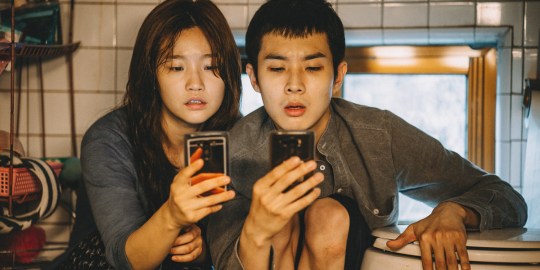
Parasite
Looking for Wi-Fi connection are brother and sister Woo-sik Choi and So-dam Park, a scene in “Parasite”. Photo courtesy of TIFF.

Last night at the Dolby Theatre in Hollywood, the South Korean, genre-bending dark comedy directed by Bong Joon Ho garnered four Oscars. Other than Best Picture, it won Best Director, Best Original Screenplay, and Best International Feature Film. Haven’t heard of Best International Feature Film either? It’s the new name for the old category Best Foreign Language Film, an effort to dispel the awkwardness of the term ‘Foreign’. Even within the continent of North America, many languages are spoken.

Previously, no non-English film had ever won Oscar Best Picture even though nominated: Ingmar Bergman’s Cries and Whispers (1974 Oscar), Ang Lee’s Crouching Tiger, Hidden Dragon (2000), Michael Haneke’s Armour (2013), Alfonso Cuarón’s Roma (2019). Parasite makes a monumental win in Oscars’ 92 years history by being the first non-English language film to reach the highest prize.

By opening this door, the Academy begins to reach out to tap its potential, international stature. The closest I can think of is Cannes. The most prestigious film festival in the world that takes place annually in the small resort town in the French Provence-Alpes-Côte d’Azur has maintained its status of bestowing the highest cinematic accolades across national borders.

About borders, director Bong’s vision is global: “I don’t think it’s necessary to separate all the borders of division if we pursue the beauty of cinema.” Referring to Chinese American filmmaker Lulu Wang’s Indie Spirit Best Picture win for her film The Farewell just the day before the Oscars, Bong said: “Like Lulu, we just all make movies.”

When it comes to breaking down barriers, Bong’s own acceptance speech at the Golden Globes is succinct and spot-on. As translator Sharon Choi relayed in English, the director’s commentary on differences and the language that unites is inspiring for our divisive world:

“Once you overcome the 1-inch-tall barrier of subtitles, you will be introduced to so many more amazing films. Just being nominated along with fellow amazing international filmmakers was a huge honor.” And in English, he added, “I think we use only one language: the cinema.”

I’ve had the chance to enjoy some refreshing cross-border collaborations at Film Festivals. Just to name a few from last year:

Frankie – the Cannes nominated American Ira Sachs directing two veterans of the cinema, French actress Isabelle Huppert and Irish actor Brendan Gleeson in a film shot in Portugal. Language: English, French, Portuguese.

To the Ends of the Earth – Director Kiyoshi Kurosawa shot the film in Uzbekistan (a former Soviet republic close to the Eurasian border) on a commission to celebrate the diplomatic relationship between Japan and Uzbekistan. Language: Japanese, Uzbek

The Truth Japanese auteur Hirokazu Koreeda directing the legendary Catherine Deneuve, Juliette Binoche and Ethan Hawke (no need to declare nationality, I think you got the idea) Language: French, English

Maybe the art of cinema could well be the lingua franca to unite us all.


***


Related posts on Ripple Effects:

My review of Bong Joon Ho’s Parasite and Lulu Wang’s The Farewell


Greta Gerwig Creates A Third Way to Adaptation with ‘Little Women’

In recent decades, there seems to have emerged two paths to approach movie adaptations of literary works, especially for a classic: faithful to the source, or awash it with contemporary strokes.

Here’s the rub: total loyalty would trigger criticisms of movies being a kind of illustrated book, simply redundant. But gloss it over with postmodern touches could strip an adaptation of the meaning and authenticity of the original text. Debates arise as to which is a better path.

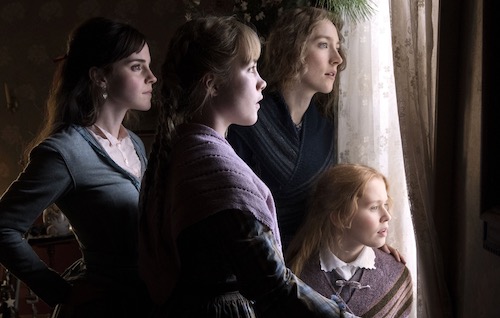
A few days ago, in a Writers Panel with five screenwriters at the Santa Barbara International Film Festival, Greta Gerwig presented a third way. She didn’t call it that, but that’s how I see it, a happy medium (pun intended). Her approach to Little Women is both loyal to the spirit and letter of Louisa May Alcott’s as well as creating a contemporary, artful production for modern viewers to enjoy.


little-women-1


I’ve to quote her exact words as they are inspiring. Here’s the link to the video. The following quotes can be found from 27 to 36 mins. How does Gerwig handle the loyalty aspect? The writer-director did extensive research in preparation for her screenplay:

I wanted to treat the text of Little Women as almost a sacred text, also other texts that Louisa May Alcott and her family and other contemporaries had generated between letters, and other books that she’d written. I wanted to ground as much as I could in that. I wanted everything to be footnoteable (she well had coined a new word) and I wanted every line you ask me about and I can say it’s here, that I have my references.

How does her version relate with previous adaptations?

But the fact that it’s been adapted for screen seven times, it’s been made into an opera, and made into a musical and made into two anime shows, this is a loved and interpreted work. The way that something that’s been loved and interpreted many times you get this collective memory of what it is.

There’s the text, which is the book, and then there’s urtext, which is every time it’s loved and interpreted again. Urtext does have a relationship with the text, but it’s also separate… I wanted to deliver on the pleasures of Little Women as we’ve collectively come to know them.

And how does the collective interplay with the personal?

Gerwig instilled her own style and framed it in her own light. Quite a few things I’ve observed, the most obvious difference from previous versions is the structure, her juxtaposing the past and present timelines. The story is told as Jo’s memories seamlessly woven with her present as a struggling writer alone in NYC, a fresh take that adds depth and texture.

Gerwig paints the past with a golden hue signifying the warmth of cherished family memories and the present with a cool, blueish tone sending out harsher, lonelier vibes. She has also given an elevated role for Amy to interact with Jo, two seemingly rival siblings but could well be two sides of the same coin. Amy the pragmatic realist who grows up to understand too well her lack of economic status as a woman and who is ready to take financial security over real love ultimately gets both. Jo the dreamer and idealist, who’d vowed she’d never marry, has also carved out a path of her own.

So what does the ending mean?

I don’t want to say: O here’s what the ending means… I wanted to create something that’s open to interpretation along two lines. I think the movie belongs to the audience, so it’s down to the reflection you see…

With the layered ending, Gerwig effectively depicts the struggles of not only the book character Jo as an aspiring author in Little Women, but parallels it with Louisa May Alcott the woman writer in a man’s publishing world, and extending by implication to Gerwig’s own reality as a woman writer-director striving in a male-dominated film industry. The triple-layered final act opens the door to a golden future as we see a progressive school for boys and girls, and a published author giving birth to her work and keeping her own copyright. As for that third, invisible layer, I do wish Gerwig continual success in her writing and filmmaking career despite the obstacles she faces in the real world.

***

Related Posts on Ripple Effects:

Little Women Movie Review

Top Ripples of 2019 and the Decade

Can a Movie Adaptation ever be as Good as the Book?


A Visit to the Art Gallery of Ontario

Whenever I’m in Toronto, the AGO is a must-see. Over the Christmas holidays I had the chance to catch the last few days of an awesome exhibition there: Early Rubens, plus some impressive works from other artists.

I use the word ‘awesome’ not casually, I mean exactly as the word is originally intended. Flemish Baroque artist Peter Paul Rubens’s (1577-1640) paintings are huge, depicting Biblical characters and narratives in epic scale. On a wall I read this Rubens quote:

I confess that I am by natural instinct better fitted to execute very large works than small curiosities. Everyone according to his gifts; my talent is such that no undertaking, however vast in size or diversified in subject, has ever surpassed my courage.   –  Peter Paul Rubens, Letter dated 1621

Glad he mentioned ‘Everyone according to his gifts’, or else those who are afraid of heights would never be able to score any artistic achievement.

Anyway, this one in particular haunted me, The Massacre of the Innocents, around 1611-1612. Mothers try desperately to protect their sons against muscular men:

Massacre of the Innocents

Those entangled, near-naked bodies are men following an order from King Herod to kill all babies under the age of two after hearing that the King of the Jews had been born in Bethlehem. Mary and Joseph took their baby son Jesus and fled to Egypt to escape a ruler’s jealous rage and his desperate cling to power. Yes, Jesus and his parents were migrants, one of the early political refugees escaping from a ruthless government.

Fast forward several centuries to 1903, and in contrast to the massive scale of human tragedy of the above painting, I was drawn to this very quiet, seemingly simple painting of a mother giving a bowl of soup to her child. The mother looks unwell and seems to give away what she needs to her child. This poignant and sparse scene entitled The Soup is Pablo Picasso’s social statement of poverty and homelessness:

Pablo Piccaso The Soup

A more relaxed social scene. This painting from the 19th C. French landscape painter Eugène Boudin, Beach Near Trouville, linked my thoughts to a movie scene right away. Boudin’s work is dated 1864, that’s around the same period as Louisa May Alcott wrote Little Women. Boudin depicts Parisian high society mingling on the beach town of Trouville. Notice the women’s dresses:

IMG_9395

My mental association was naturally the Greta Gerwig directed Little Women beach picnic scene. I couldn’t help but compare their formal attires even at the beach and the actual chairs they sat on in Boudin’s painting with the beach scene in Little Women, so free and casual (not displayed in AGO):

Beach Scene in Greta Gerwig's Little Women

Don’t you want to fly a kite with the March sisters on that sandy beach?

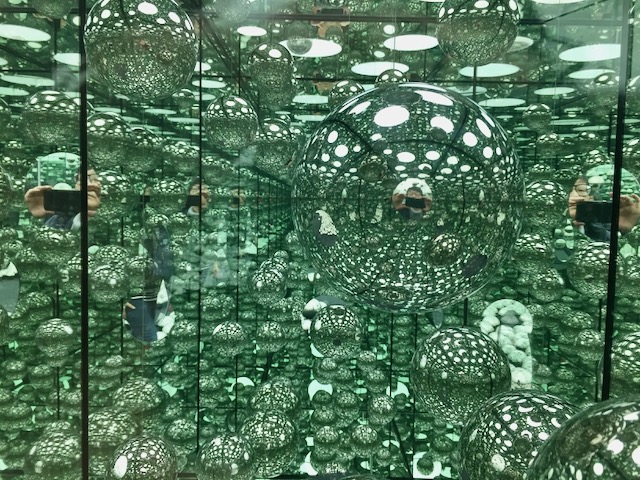
From the historic to the futuristic, the iconic Japanese artist Yayoi Kusama (born 1929) has invented visions of infinity with her experimental installations for three decades. Her work was exhibited at the AGO in 2017 and now the Gallery has a permanent set up Kusama called The Infinity Mirrored Room – Let’s Survive Forever. I had to reserve a time slot ahead for my visit. At my appointed time, which was another hour later, I still had to wait in line to go into the room.

It’s a room of silver spheres suspended from the ceiling and arranged on the floor set against mirrors. A person standing in the room will see seemingly infinite reflections:

Yayoi Kusama's Infinity Mirrored Room

Here’s the image of one silver ball in the middle of the room. I didn’t do any colour changes, so just interesting to see what looked to me was a silver ball came out green in the photo:

One silver ball

You can actually see me taking the picture. What does this all mean? According to Kusama, the room gives a person a sense of infinity and limitlessness.

Only two visitors were allowed inside the room at one time. And how long could we spend in there? One minute. A staff with a timer in hand monitored the flow of visitors. When our time was up, she knocked on the closed door for us to go out and another two would go in. Call it a visual oxymoron if you will: A one-minute taste of infinity. O the limits of our human experiences.


***

Related Posts on Ripple Effects:

Alex Colville and the Movies

Bernini’s Corpus and Modern Movies

My review of Greta Gerwig’s Little Women


Concord revisited with ‘Little Women’

Five years ago, I took a New England road trip with my cousin. It was a major endeavour for me coming from Western Canada, over 2,500 miles away. The photos here were taken during the road trip that fall. We began our drive across three States starting from Wayland, MA. Nearby Concord was our first point of interest. This is where Louisa May Alcott grew up and later transposed her real life family onto the page to write Little Women.

Thanks to writer/director Greta Gerwig’s adaptation, fond memories flash back as I watch the New England scenery captured so beautifully on screen. One of the memorable scenes is the panoramic autumn hillside in which Laurie made his failed attempt proposing to Jo. Another one was the Christmas morning breakfast give-away as Marmee led the girls to exercise love-in-action.

CONCORD, MA

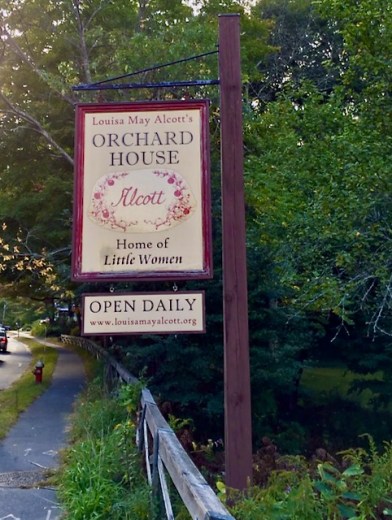
A major attraction in Concord is Orchard House where Louisa May Alcott wrote Little Women. The Alcott family owned Orchard House from 1857 to 1884, within which period all four Alcott girls Anna, Louisa, Lizzie and May had their most influential growing up years. The house is now a museum:

Sign

The rooms and furniture, Louisa’s (Jo) writing desk, the costume and props the girls made for their plays, Anna’s (Meg) wedding gown, and all of May’s (Amy) original paintings on the walls of her room are preserved inside the Orchard House Museum:

The Orchard House Museum

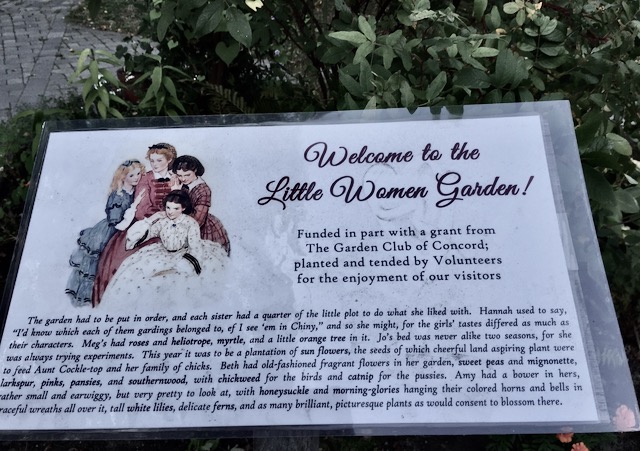
Louisa transposed her family onto the page, creating parallel characters in the March household. In the Little Women Garden, the March sisters had their own flower bed, each planted their section according to their taste or maybe, character. Here’s from the quote on the sign indicating their choices:

Meg – roses and heliotrope, myrtle, and a little orange tree
Jo – never alike two seasons, for she was always trying experiments
Beth – old-fashioned fragrant flowers, sweet peas and mignonette, larkspur, pinks, pansies, southernwood, with chickweed for birds and catnip for the pussies.
Amy – honeysuckle and morning-glories hanging their colored horns and bells in graceful wreaths all over it, tall white lilies, delicate ferns, and as many brilliant, picturesque plants.

The Garden

***

Here’s the issue many have questioned: Did Greta Gerwig alter the Little Women characters to appeal to modern day viewers, or, is she merely revealing Louisa May Alcott’s true image?

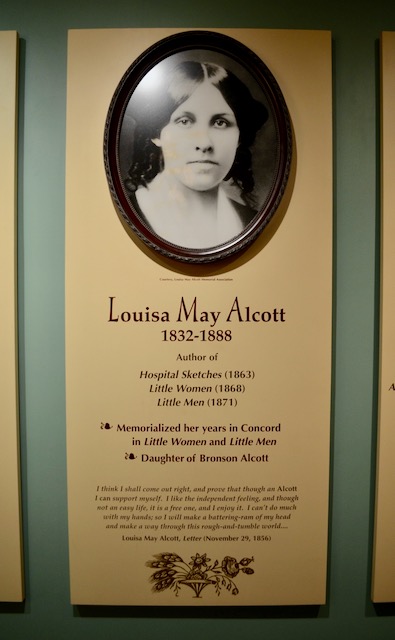
From Orchard House we went to visit the Concord Museum. Among plaques presenting some of Concord’s famous residents is this one of Louisa May Alcott. The quote on there comes from a letter Louisa wrote dated November 29, 1856:

I think I shall come out right, and prove that though an Alcott I can support myself. I like the independent feeling, and though not an easy life, it is a free one, and I enjoy it. I can’t do much with my hands; so I will make a battering-ram of my head and make a way through this rough-and-tumble world…


LMA

The Alcott parents, Bronson and Abigail were abolitionists and environmentalists. Bronson was the first teacher in Boston to admit a black student to his class despite protests from white parents who threatened either the black student go or they go. Bronson’s school was left with very few students consequently as he insisted his stance.

But his educational ideals must have been embraced by students as Bronson introduced the idea of raising their hands to speak in class, and he was the one who invented recess in school. There you go for a Jeopardy question.

Louisa’s mother Abigail was one of the first social workers in Boston, and was active in Women’s rights. She’d said, “I will go to the polls before I die if my daughters had to carry me there.”

The Alcott’s close friends and neighbours included prominent intellectuals and writers of the day: Emerson, Thoreau, Hawthorne. They made frequent, mutual visits, and had personal influence on Louisa’s formation and writing.

Down the road from the Alcott’s was Emerson’s home. Emerson had helped the financially strapped Bronson with acquiring Orchard House:

Emerson's Home

And living minimally by choice as an experiment, here’s Thoreau’s cabin (replica) at nearby Walden Pond:

thoreaus-cabin


Thoreau's Lake Side Cabin

Growing up under such stimulating milieu where thinkers and writers are free to explore new ideas and generate new philosophy, it was only natural that Louisa grew up grasping the values and the spirit of her parents and their friends, becoming a non-conformist herself.

Louisa had admitted she’s Jo in Little Women and added: “I didn’t make her half-bad enough.” If she’d been here today and directed the movie, I’ve a feeling she’d make Jo twice as radical and assertive. Gerwig is admirably restrained and for this, kudos to her.


***


Related Posts on Ripple Effects:

Little Women (2019) movie review

Can a movie adaptation ever be as good as the book?

A New England Fall Foliage Road Trip


More Movie Adaptations 2020

Previously on Ripple, a list of movie adaptations coming out this year was posted. Here are a few more, not only from books, but Broadway musicals (not as scary as Cats, so give them a try), and a Chinese poem.
.
Emma by Jane Austen

EMMA

While there have been many TV miniseries, and the modern-day spinoff, Clueless (1995), the only full-length movie adaptation of Austen’s Emma is back in 1996 with Gwyneth Paltrow as the heroine, Jeremy Northam as Mr. Knightley, and Toni Collette, Harriet Smith. The 2020 version stars Anya Taylor-Joy, born the year the last Emma adaptation came out. This 24 year-old rising star has already won acting awards in the US, UK, and at Cannes. This updated version sees Johnny Flynn as Mr. Knightley, Bill Nighy, Mr. Woodhouse, and Josh O’Connor (Prince Charles in The Crown, S3) as Mr. Elton. Do you want to see a new full-length movie adaptation of Emma? Or another Austen book?

..

The Turn of the Screw by Henry James
..

THE TURN OF THE SCREW
Movie title is The Turning, perhaps to take in the vibes of the horror classic The Shining. Why this genre is so popular is beyond me. Back in 1898 when Henry James published his horror novella as a serial, he couldn’t have imagined his writing would be turned into a motion picture projected on a huge screen 122 years later. Directed by Canadian photographer/filmmaker Floria Sigismondi, who’d made music videos for Marilyn Manson, David Bowie, and many others. Her disturbing style just might be what James had intended. Cast includes TV Stranger Things’ Finn Wolfhard and Brooklynn Prince (The Florida Project, 2017).


Deep Water
by Patricia Highsmith

Deep Water

Highsmith specialized in psychological thrillers. Several of her novels had been adapted into successful movies: Strangers on a Train (1951), The Talented Mr. Ripley (1999), and Carol (2015). Coming out this year is a marital thriller that Gone Girl author Gillian Flynn had identified as her favorite book and is, in her words, “a thriller about a suburban couple bent on mutual destruction.” Ben Affleck (Gone Girl, 2014) and Ana de Armas (Knives Out, 2019) star. Directed by Adrian Lyne, also a marital thriller specialist, whose works include Fatal Attraction (1987), Indecent Proposal (1993), and Unfaithful (2002), which was the last film he directed until now.
..


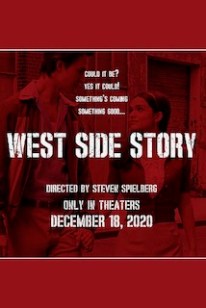
West Side Story by Arthur Laurents, Broadway musical by Leonard Bernstein and Stephen Sondheim.

WEST SIDE STORY POSTER (1).jpegSteven Spielberg directs this remake of the Bernstein/Sondheim musical (1957) and the 1961 Jerome Robin/Robert Wise movie for our time. In Dec. 2020, we’ll witness a new version of Shakespeare’s Romeo and Juliet. A cast of 130+ will join the Spielberg team with screenwriter Tony Kushner (Lincoln, 2012) and cinematographer, 2-time Oscar winner Janusz Kaminski (Saving Private Ryan, 1998 and Schindler’s List, 1993). Additional new music by David Newman. Ansel Elgort plays Tony; Maria is Rachel Zegler, chosen from 30,000 auditioned. Rita Moreno, who played Anita in the 1961 movie, also stars in this remake.


..
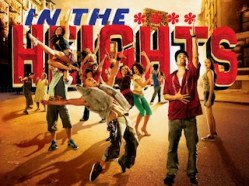
In the Heights
by Lin-Manuel Miranda

IN THE HEIGHTS.jpeg

Before Hamilton, there was In the Heights, Miranda’s breakout musical that won 4 Tony Awards in 2008. The musical is based on the book by Quiara Alegria Hudes, who now writes the screenplay transposing it onto the big screen. Miranda stars in this story set in the Hispanic-American neighborhood of Washington Heights in NYC. The movie is shot on location there. Directed by Jon M. Chu, whose Crazy Rich Asians became the summer sensation of 2018, showing Chu could create some spectacles. Would Miranda fans want to see a movie version of his works? In the Heights could well be a pilot project, as Hamilton the movie is currently in development.


..
Mulan
, legendary heroine from “The Ballad of Mulan” (in Chinese: 木蘭辭)

Hua Mulan.jpeg

According to the legend described in the narrative poem “The Ballad of Mulan”, Hua Mulan (Chinese: 花木蘭) is a female warrior in China during the Northern Wei period (386-536). To fulfill the conscription for military service for every family and for love of her ageing father, Mulan disguised as a male to join the army in her father’s place to protect her country from their northern enemies, the Huns. The rhymed verses in “The Ballad” provide vivid descriptions of Mulan’s determination and how she goes to nearby towns to buy a horse, a saddle and a whip, equipping herself for military service. After 10 years of fighting, she comes home to her overjoyed parents a decorated military commander.

Disney had wielded its creative license to introduce imaginary characters and songs in its original 1998 animation. Now 22 years later, a live-action feature film carries the legend further, albeit with no place for an actual pet dragon, so, no Mushu. Helmed by New Zealand director Niki Caro (The Zookeeper’s Wife, 2017), it should be noted that all four screenwriters are non-Chinese. No matter, at least the heroine and her purpose is true to the source material. Top-notch Chinese stars are on board: Gong Li, Donnie Yen, Jet Li, screen veteran Cheng Pei Pei, Tzi Ma from The Farewell, and Rosalind Chao from The Joy Luck Club, to name a few. Playing Mulan is multi-talented Liu Yifei who reportedly was selected after a five-continent search and auditioning a thousand candidates. Braced for a Westernized version of the age-old Chinese legend.


***