Finally, Guernsey from Book to Screen

It was nine years ago that I posted a book review of The Guernsey Literary and the Potato Peel Pie Society, the post-WWII set, epistolary novel by Mary Ann Shaffer and Annie Barrows. It’s a book of letters between the writer Juliet Ashton and her publisher, and later the members of the Guernsey Literary and Potato Peel Pie Society, which is an impromptu excuse made up by quick-thinking Elizabeth to avoid arrest by German soldiers as she and her friends are caught walking home after curfew.

To prepare for German advances, residents on Guernsey evacuated their children and sent their young men to war. Later as the Channel Islands were under enemy occupation, the people were stripped of their freedom and had to endure hunger, casualties and disappearances of loved ones.

Here are some thoughts in my book review post:

“Despite the subject matters, readers will find the book witty and delightful. Authors Shaffer and Barrows have depicted a myriad of lively characters, charmingly joined in their humanity by their strengths and weaknesses.  Yes, we can also visualize the madness of war. But we’re relieved to see too that people can weather hardship much better when they have a common bond, here, in the reading and sharing of fine literary works.”

A few years ago I read that the NYT Bestseller would be turned into a movie and that Kate Winslet would play Juliet Ashton, and later, Rosamund Pike. And so we wait. Now we have Lily James, and I’m glad. She’s a younger Juliet, but her screen presence is always appealing, albeit the adaptation doesn’t give her much of a chance to shine as in Mamma Mia! Here We Go Again. She belongs in the singing and dancing limelight, maybe not unlike her character Lady Rose in Downton Abbey.

Lily James as Juliet Ashton (1).jpg

Matthew Goode (Henry Talbot from Downton) as Sydney, Juliet’s publisher, is a solid supportive figure. Surely what he wants is more books from her, but Sydney knows she can’t be forced to do anything she doesn’t want to. Nice play between the two, and some effective scenes as he tries to help Juliet dispel haunting war memories.

How do you turn letters into a movie? Director Mike Newell focused on storytelling and it worked. The helmer of Mona Lisa Smile (2003) and perhaps the more memorable, Four Weddings and a Funeral (1994), had chosen to depict the dramatic narratives in the letters rather than the actual reading and writing of them; the writing part can be done by another character, the typewriter.

There are fewer literary mentions in the movie, and the book club scenes are kept to a minimum but interesting. Don’t miss the one at the end when the credits roll. We hear the sound of the typewriter, remember Atonement? With just two hours for the movie, naturally a lot of the details are skimmed out. What’s left are the essentials, loss and love.

Kudos to Penelope Wilton (Isobel Crawley of Downton, of course, and many more), she leads all the way by holding the suspense, the reason for her pain. We see her expressive face conveys tensions and deep sadness. Viewers who have not read the book would find the movie a mystery slowly being revealed as Juliet investigates the Society’s history. I appreciate Wilton’s face, from which I can clearly see how the loss of loved ones can drag one down to mere existence and nothing more, if not for Kit (Florence Keen).

Joining the roles as Society members are veteran actor Tom Courtenay as Eben, Katherine Parkinson as Isola, and Kit Connor as Eli. The fine cast let us visualize the events of the book as experiences of real persons. This may well be the very reason why some hesitate to embrace movie adaptations of the literary. To the purists, the imageries and characters conjured up in their mind while reading reign supreme and they’d guard them with much possessiveness. In this case, however, I find the adaptation offers something that’s not in the book. I can see the restraints of the characters, the burden as keepers of secrets, their faces telling stories and then withholding some.

Jessica Brown Findlay (Lady Sybil from Downton) as Elizabeth is well cast, albeit not much time is spent on exploring her love story with the German soldier Christian (Nicolo Pasetti, limited appearance). The resolution to such a dilemma and its fallout will never be easy to find.

As for the love interests, or disinterest, Glen Powell aptly plays the rich American Mark Reynolds. Recognize him from Hidden Figure? He’s John Glenn there. Here, he’s the high flying socialite publisher. After Guernsey, Juliet has to be frank with him, and with much apology, returns his engagement ring. After just a short exchange, he gets up from the table, says goodbye and walks away, only to return quickly to pluck the champaign bottle from the ice bucket before he leaves for good. Just spot-on. Is that in the book?

True love belongs to Dawsey Adams (Michiel Huisman, Game of Thrones) who begins it all with his letter to a name and address written on a book he happens to stumble upon. The moment he encounters Juliet as she sets foot on Guernsey, his fate is sealed. Dawsey is good at restraints, until he can’t hold it anymore at the end. The setting may be different but who gets to pop the question remains true to the book.

A movie as well can offer the scenery which the book can’t. But then again, imagination may still be needed as the shooting location is not actually Guernsey Island but North Devon. Click on the link to check it out.

What doesn’t need imagination is also my favourite scene: Dawsey’s carving of the juicy roasted pig.


~ ~ ~ Ripples

***

Guernsey Literary and Potato Peel Pie Society is on Netflix.


Middlemarch: You be the Screenwriter

It’s a wrap. Here’s my finale for our Middlemarch in May Read-Along.

You may be a print purist, don’t want to see a movie made. Just take this as an imaginary writing exercise then:

You’re offered the job of writing a screenplay, the tall order of turning Eliot’s 800-page novel into a movie. The task at hand is to choose from the numerous storylines and just focus on a few that your feature will cover.

The following are some of the main storylines and thematic matters in Eliot’s Middlemarch. This list is just off the top of my head, feel free to add in. Which ones would you select and elaborate?

**

Sisterhood between Dorothea and Celia

Dorothea’s marriage to Casaubon

Celia and Sir James Chettam

Mr. Brooke’s political involvement

Politics, power and influence in Middlemarch

The mysterious cousin of Casaubon: Will Ladislaw’s backstory

Relationship between Casaubon and Ladislaw

Newcomer Lydgate: the young, aspiring doctor

Old vs. New: The introduction of new ideas and methods and their reception or rejection in Middlemarch

Lydgate’s character: idealism vs. practice

The Vincy family: Mr & Mrs., Fred and Rosamund

The Caleb Garth family: Mr. & Mrs., Mary Garth

Fred Vincy and Mary Garth

Fred’s lifestyle, his love and dreams, and his change

Rosamund’s lifestyle, her love and dreams, and her change (or, has she?)

Featherstone: The subjective construction of will and estate

Mary Garth’s moral dilemma in dealing with Featherstone’s order regarding his will

Farebrother and family: Farebrother’s role in joining Fred and Mary despite his secret love for her.

Raffles the disruptor of Bulstrode’s life: the wages of sins, or, the consequences of actions that last beyond the statute of limitations

Ladislaw’s true identity and Bulstrode’s dark history

Raffles’ falling ill and Bulstrode taking him in for fear of reverberation, hence leading to the suspected ‘wrongful death’ incident and the presumed guilty of bribery between Bulstrode and Lydgate.

Will Ladislaw being victim of class discrimination and racial prejudice in the provincial town of Middlemarch

Family finance, debts and gambling endangering a fragile marriage between Fred and Rosamund

How to choose a mate, keys to a happy marriage

Difference between romance and love, looking at three pairs of relationships: Lydgate and Rosamund, Fred and Mary, Dorothea and Will

And for that matter, how about intellectualism vs. passion, the marriage of Dorothea and Casaubon

Choices of actions of the characters based on values (or lack of), principles, and plain gut

Poverty, welfare, and social actions, responsibilities of the rich

Male/Female relationships in marriage and society, and how Dorothea both fulfills prescribed duties and overrides expectations.

Finally, probably the most important element in a movie, the emotional impact it elicits in your viewers: Which of the above storylines will you focus on to bring out such effects?

We all love the Finale of the book. But why does Eliot spend so few pages in describing the love relations between Dorothea and Will? They are seldom seen together, and in the rare occasions that we do see them, they’re caught in awkward and embarrassing situations. Would you give them more screen time together in a positive light?

I think one reason Eliot doesn’t elaborate on their courtship could be because she doesn’t want to mislead her readers that this is a ‘romance novel’. Rather, she brings out a kind of sublime love between the two, particularly on the part of Dorothea, a noble love that motivates her to give up her wealth, position and the familiarity of Middlemarch. These in Dorothea’s views are but shackles restraining her to do what she wants and to love freely.

Finally, any casting suggestions?

**

A huge thank-you to all participants and spectators for your input, comments and posts. It’s been a pleasurable ride, even though the length and numerous storylines and characters may have bogged us down occasionally. I appreciate the pebbles thrown into the Pond to make all those ripples.

Enjoy your summer!


The Portrait of a Lady, Sequel, Remake(?)

The Portrait of a Lady by Henry James

First, thanks to Bellezza’s open invite to a read-along, posting the photo of John Banville’s newest book Mrs. Osmond, a sequel to The Portrait of a Lady by Henry James. I’d seen the 1996 movie adaptation directed by Jane Campion (The Piano, 1993), but had never read James’s novel. What better time to read both books than now.

The Portrait of a Lady

I got hold of The Portrait of a Lady (Modern Library, just love the cover) read part of it then turned to a sound recording (unfortunately couldn’t find the Juliet Stevenson narrated version). Prompted by JoAnn, I interspersed reading with listening and gleaned much pleasure doing that. Here’s my very short, 5-Star Goodreads review:

“Actually I was listening to the Blackstone Audio version of the book as well as reading  parts of the book to ascertain facts in the story or just savour the passages again. James’s portrait of Isabel Archer is one of the saddest fictional heroines I’ve come across. A reminiscence of Anna Karenina emerged as I read the latter part, but Isabel is a character much more likeable for me. Should she be destined to a ruined life due to a naive misjudgement, ok, maybe even foolishness, by marrying Gilbert Osmond? Osmond is evil personified, and I just can’t shake off the face of John Malkovich (from the movie) whenever I read about his cold, domineering hand over Isabel. Isabel definitely needs redemption and saving grace. So I do hope John Banville’s Mrs. Osmond will grant her that.”

The Portrait of a Lady by Jane Campion

Since the image of John Malkovich kept creeping up my mind as I read the book, I quickly turned to the movie adaptation right after I finished the book. I remember I was most disturbed by Osmond’s callous treatment of Isabel when I first watched it years ago; he appeared as a chilling, silent villain, bullying his innocent victim mercilessly. His stepping on Isabel’s floor-length dress to stop her from walking away was still vivid in my mind.

Nicole Kidman

Now as I saw the movie again, I find the feature more style than content. The tilted camera shots? A bit contrived. Malkovich is still evil, and Kidman still the innocent victim, but there isn’t much complexity in the characterization. The editing and much abridged dialogues leave a vacuum. Considering the rich descriptive prowess of Henry James, much is left to be desired in the film. Yes, I’m one who advocates for the appreciation of books and films as two different art forms, and should not be doing a literal comparison when judging the adaptation. Well, I’m not. I’m weighing the film on its own merits. Yes, set design is rich and some artistic shots, but overall pales despite the sumptuous colours. And, what happened to Nicole Kidman’s hair? As much as I’d appreciated Campion’s works, especially her Oscar winning (Best Original Screenplay) film The Piano, I do feel maybe it’s a good time to do a remake of The Portrait of a Lady.

Mrs. Osmond by John Banville

After the movie I turned right away to Banville’s book. Here’s my review on Goodreads:

Mrs. Osmond

“I jumped to this book right after reading Henry James’s The Portrait of a Lady. As I understand this new work of Banville’s to be a ‘sequel’ to James’s book, I had high expectations of the Booker winning author carrying Isabel Archer’s (Mrs. Osmond’s) story forward, taking her through twists and turns and eventually letting her find redemption and a new life. However this was not to be exactly as I’d envisioned.

Mrs. Osmond is divided into two Parts. Maybe for the benefit of those who haven’t read or reread The Portrait of a Lady in preparation for his book, Banville retells James’s story in Part I. While he’s very detailed in his descriptive style, and to his credit, creeping inside the minds of his characters, he repeats himself frequently in reminding his readers how Isabel Archer got deceived by Madame Merle and fell into the marriage trap of Gilbert Osmond’s. So basically the story remains static throughout Part I.

(Spoiler Alert in the following)

Part II leads us to Isabel’s own scheme of turning the tables on Osmond and Merle, and let them have a taste of their own medicine by just transferring the ownership of her residence the palazzo in Rome over to Madame M. and let the culprits be trapped with each other. That’s all there is to her plan, and it’s an expensive vengeance. As for her own dear life and its purpose for the remains of her days, the path is as obscure as before, albeit Banville has dropped a hint of the suffrage movement being a meaningful direction.

While Mrs. Osmond may not be as gratifying as I’d expected, this is an interesting concept, taking literary classics and imagining a sequel. Now that could lead to a brave new genre of fiction writing.”

A Movie Remake, anyone?

If there’s one, who’d you like to see playing the role of Isabel Archer? Gilbert Osmond? Madame Merle? Director?


***


Related Post:

Can a movie adaptation ever be as good as the book?


Top Ripples 2017

The following is a list of books, movies, and events that stirred up the most ripples for me in 2017. Note that the books and movies are not necessarily releases from 2017 but just what I’ve had the privilege to encounter this year. If you don’t see your book here, it could be that it’s on my TBR list for the coming year. If you don’t see your fave movie here, it could be that I haven’t watched it or that I have but, indeed, it’s not here. Click on the links to read my reviews.


MOVIES

Three Billboards Outside Ebbing, Missouri directed by Martin McDonagh

Mudbound directed by Dee Rees

Certain Women directed by Kelly Reichardt

The Big Sick directed by Michael Showalter

Stefan Zweig: Farewell to Europe directed by Maria Schrader

Wind River directed by Taylor Sheridan

Things to Come directed by Mia Hansen-Løve

Silence directed by Martin Scorsese

The Rider directed by Chloé Zhao (55th NYFF)

The Road to Mandalay directed by Midi Z (NYAFF)

Calvary directed by John Michael McDonagh


BOOKS

At the Existential Cafe: Freedom, Being, and Apricot Cocktails by Sarah Bakewell

Little Fires Everywhere by Celeste Ng

Mudbound by Hillary Jordan

Nutshell by Ian McEwan

Wildlife by Richard Ford

The Noise of Time by Julian Barnes

The God of Small Things by Arundhati Roy


EVENTS

Visit to MoMA Click on the link to my post.

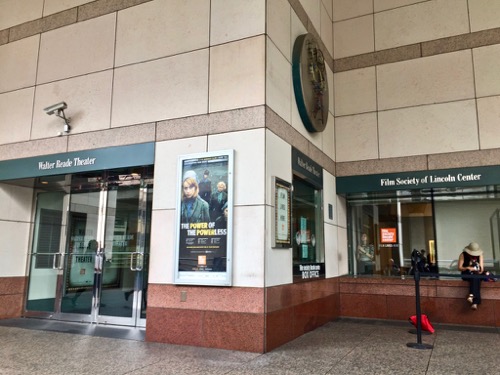
NYFF at Film Society of Lincoln Center: In September I had the chance to attend press screenings of the 55th New York Film Festival. CLICK HERE for all my reviews on AAPress.

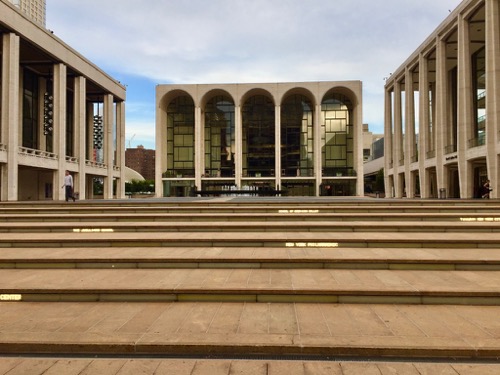
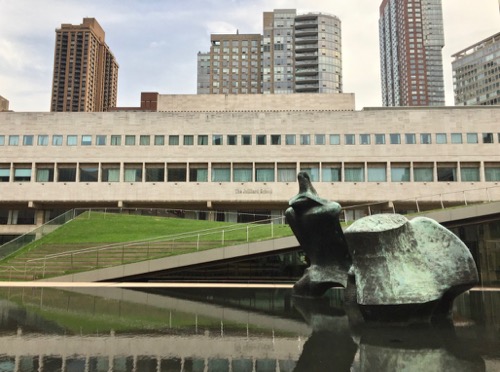
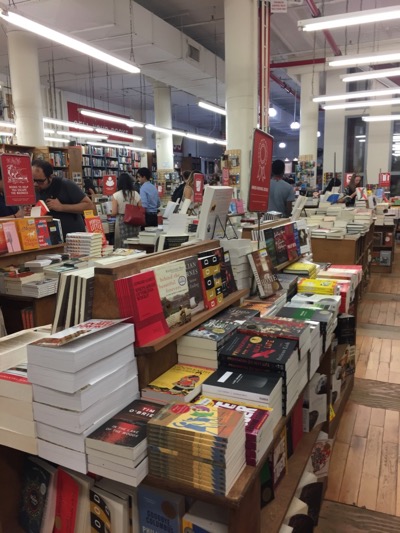
Other than hanging out at the Film Society of Lincoln Centre for the screenings, I’d experienced NYC on the bus, in the subway, and simply on foot, some days close to 20,000 steps, making my NYC trip extra rewarding. Here are some pics of the memorable experience.

Lincoln Center:

IMG_5673.jpg

Film Society of Lincoln Center where the screenings took place:

IMG_5676

The Juilliard School:

IMG_5670 (1)

Central Park:


Reflection in Central Park


One World Trade Center:

IMG_5907.jpg

IMG_5860

IMG_5852 (1).jpg

Strand Bookstore:

IMG_5691

IMG_5688

Brooklyn Bridge:

IMG_5784.jpg


IMG_5828

Where I found the best lobster roll I’d ever tasted, at the foot of the Brooklyn Bridge:

IMG_5837


And that’s a wrap.


***

And to all, a wonderful 2018 for books, films, and rewarding encounters! 

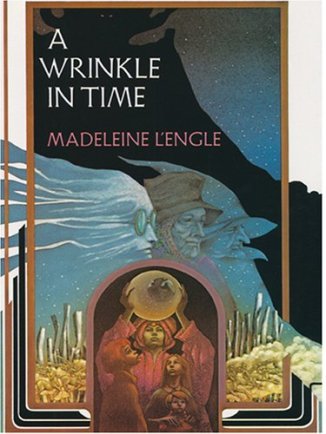
Reading the Season: A Wrinkle in Time by Madeleine L’Engle

For the tenth year, I’m sharing a Christmas read here at the Pond. For the first time, it’s a book written for young readers but is ever so relevant for us grown-ups. Herein lies the ingenuity of writer Madeleine L’Engle. Time to dig out that copy that you might have read when you were a youngster. If you haven’t read it, now’s a good time.


A Wrinkle in Time


Newbery Medal winner A Wrinkle in Time is the first book in the Time Quintet series of fantasy YA fiction about the Murray family, scientist parents and four children Meg, twins Dennys and Sandy, five year-old genius Charles Wallace, and that special friend of Meg’s, Calvin O’Keefe. The deceptively simple odyssey in time and space is packed with wonder and wisdom.

The book not only exudes insights but shows L’Engle’s remarkable foresights. Take this for an example, dematerializing and materializing  for easy transport. Published in 1962, the book came out four years before Scotty beamed Kirk up using the same method in the first season of Star Trek.

Or this fancy idea, ‘tesseracting’, that is, travelling through space and time via a wrinkle in time. The shortest distance between two points is not a straight line, but through a wrinkle when two points are folded. That’s fifty years before Christopher Nolan sends Matthew McConaughey interstellar travelling.

All concepts held in a simple plot. Meg, Charles Wallace, together with friend Calvin, go on an interstellar quest to look for Meg and Charles’ physicist father who had gone missing for almost a year while doing some classified scientific work for the government. This little, unequipped search party is initiated and aided by three celestial beings: Mrs. Whatsit, who’s much wiser than she appears, Mrs. Which, who doesn’t bother materializing but remains as a shimmering beam, and Mrs. Who, who speaks in quotes.

The more a man knows, the less he talks.

Their odyssey brings them finally to the planet Camazotz, where they find Mr. Murray confined by the evil Dark Thing, or IT (Surprise! 24 years before Stephen King’s book and now movie) The smart alecky Charles Wallace is easy prey and quickly influenced by IT. (And for Luddites, what better parallel to address our technology now, the evil IT) Ultimately, it’s Meg, our reluctant and timid heroine, who has to be the one to go fight IT to rescue her little brother.

The foolishness of God is wiser than men; and the weakness of God is stronger than men… God hath chosen the foolish things of the world to confound the wise; and God hath chosen the weak things of the world to confound the things which are mighty.

Meg knows Charles Wallace is not himself but trapped and deceived, and must be snatched from the evil force IT. She has just one weapon as her ammunition, given to her by Mrs. Whatsit, that one thing IT doesn’t have: LOVE. With her single act of bravery, she brings the family together again.

When I was a child, I read like a child, I thought like a child. When I became an adult, I can read like a child and like an adult too. That’s the joy of reading A Wrinkle in Time. One can find pleasure in the adventure and feel the vulnerability of the children, as well delve deeper into its symbolism and parallels, and ponder its layers of meaning.

L’Engle writes to the child and the adult in us. She can convey scientific and spiritual concepts at the same time and in a way that both young and old (and those in between) can enjoy. There’s no conflict between the cerebral and the spiritual; they co-exist comfortably in L’Engle’s work. Not only that, they fuse together and from that alchemy rises a whole new, inexplicable entity: Faith.

That first Christmas day when a baby was born in a lowly manger, the war against IT had started to win. Although the last, painful battle on the hill of Calvary had not been waged, the outcome was cast, just because LOVE came.

And the light shineth in darkness; and the darkness comprehended it not.


The Movie

‘Tis the Season to read or reread A Wrinkle In Time before the movie adaptation comes out in 2018. Helmed by Selma (2014) director Ava DuVernay, screenplay by Frozen (2013) scriptwriter Jennifer Lee, with some stellar beings including Rees Witherspoon, Oprah Winfrey, Mindy Kaling, Chris Pine et al.

***

Past Reading the Season Selections:

2016:  Silence by Shusaku Endo

2015: The Book of Ruth

2014: Lila by Marilynne Robinson

2013: Poetry by Madeleine L’Engle

2012: Surprised by Joy by C. S. Lewis

2011: Walking on Water by Madeleine L’Engle

2010: A Widening Light, Luci Shaw

2009: The Irrational Season 

2008: The Bible and the New York Times by Fleming Rutledge

2008: A Grief Observed by C. S. Lewis

Mudbound: From Book to Screen

The Book

Mudbound is Hillary Jordan’s debut novel, published in 2008. It won the Bellwether Prize for fiction, an award founded by author Barbara Kingsolver to promote literature of social justice and responsibility.

Mudbound Book Cover

The setting is WWII and its ending, as two American soldiers return from Europe to their families in Mississippi. One of them is Jamie, white, a flying ace whose co-pilot was shot dead right beside him in a fierce dogfight. The other, Ronsel, black, a decorated war hero who had fought in the tank battalion under General Patton. Both had experienced the war, seen the atrocity, now back home having to deal with the demons of the aftermath: for Jamie, traumatic shocks and survivor’s guilt; for Ronsel, another barbaric battlefront, racism in the Deep South.

Jamie comes back to a cotton farm owned by his older brother Henry McAllan and stays in the lean-to adjacent to the main house, itself but a shack with no running water or electricity. “Mudbound” is the proper name for it. When the rain pours and the wind blows, the mud drowns and pulls everything down, dirtying all from head to toe. A gloomy place to start anew as a farmer.

They weren’t all like that to start with. Henry has an engineering degree. Laura, Henry’s wife from Memphis, is also college educated. She learns of Henry’s intention to move to rural Mississippi and be a cotton farmer only weeks after her marriage. What’s worse, Henry’s obnoxious father, Pappy, will be coming to live with them.

Ronsel’s father Hap Jackson is the sharecropper working in the cotton fields owned by Henry. Fate brought the two families together. Hap and his wife Florence and all his children have been praying for Ronsel’s safe return from the war. Now their prayers are answered, but only pit Ronsel into another battlefront when he meets Jamie and the two strike up friendship, a despicable taboo.

Written in chapters that reveal the point of view of the various characters, the book is a sort of a literary ‘Rashomon’, how different people see the same event in their own light, or the lack of it. Such a writing structure evokes empathy as Jordan leads the reader to delve into the mind of the characters. And as the final climatic chapters come, we as readers get to know a crucial fact, an essential plot point we are privy to but which even other characters are not aware. We have Jordan to thank for such an insightful way to present the omniscient viewpoint in her storytelling.

The trajectory of the friendship between Jamie and Ronsel is tragically predictable. But what’s not predictable is Jordan’s incisive writing. Sometimes adding a short little phrase at the end of a sentence could make it speak much more. It’s writing like this that makes the book enjoyable despite its subject matter. Take this as an example, simple and subtle, but revealing effectively Laura’s inner turmoil after a tumultuous night:

“… I got up and checked on the children. They were sleeping, with an untroubled abandon I envied.”

Or this line to wrap up a climactic chapter. Such descriptions are perfect cues for nuanced  performance on screen:

“What we can’t speak, we say in silence.”

No spoiler here. But this is the kind of writing that conveys powerfully the emotions and events that sweep the reader up while allowing space to mull things over.

***

The Movie

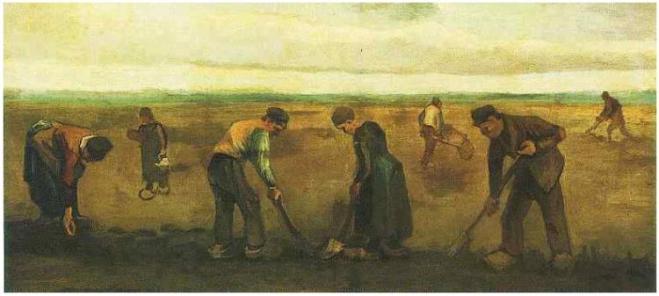
The cinematography (Rachel Morrison) is the most distinguished feature from the beginning. As the title suggests, the colour palette is a spectrum of browns, reminiscence of the paintings of Jean Francois Millet’s farmers toiling in the fields, or this Van Gogh’s Potatoes Farmers:

VVG Farmers-Planting-Potatoes

But before the mud swallows up life, there is the colourful, urbane, Memphis party scene, or the courtship under golden leaves. The contrast is heartbreaking. Laura (Carey Mulligan), who seems to have no say about her life and fate, has to follow her husband Henry McAllan (Jason Clarke) from the city to move to a shack with no running water or electricity on a cotton field in rural Mississippi. Being a landowner is the sole ambition for him.

But of course, not just Laura, but everyone is drawn into the muddy swamp. Hap Jackson (Rob Morgan) is the sharecropper on the McAllan fields. His wife Florence–absorbing performance from “the Queen of Hip-Hop Soul” Mary J. Blige–is soon asked to help Laura with caring for her two girls and household chores. The return of their son Ronsel (Jason Mitchell) and Henry’s younger brother Jamie (Garrett Hedlund) from Europe after the war will eventually link the two families down an inescapable path.

Turning the chapters of internal worlds into visuals on screen is a tall order. Director Dee Rees, who co-wrote the screenplay with Virgil Williams, had done an effective job by voiceovers, which is sometimes frowned upon as they could mean an easy-way out. But here, the voiceovers are intimate and personal. The few simple lines in the voice of the characters draw the viewers closer in. With Carey Mulligan, I admit I’m totally partial. Her alto voice is moving and poignant.

mudbound-movie-stills-4 (3)

Picking the right events from the book is crucial. Director Rees has followed closely to the plot lines using many of Jordan’s words, but also taken the liberty to switch around and combine them in the movie adaptation. Juxtaposing Ronsel and Jamie’s traumatic battle scenes with accidents and illness at home are effective and emotionally engaging; all have to fight their battles, big and small, at home or the frontline.

The most moving juxtaposition comes at the intense, climactic scene where the singing of a hymn replaces dialogues. It’s a juxtaposition of the visual with sound and silence. Jordan’s impressive line from the book is aptly adapted onto screen:

“What we can’t speak, we say in silence.”  Or here, in song.

The ending of the movie is altered, and I’m glad, for they who have suffered so much, so long, deserve a cathartic ending. This is a good example of a fine adaptation. It’s not a page by page transposition from book to screen, ‘faithful’ to the dot. But Rees has taken the liberty to unleash the dramatic, or maybe, melodramatic. It’s always cathartic to see love triumph after all. Mary J. Blige’s “Mighty River” is an appropriate wrap as the end credits roll.

***

~ ~ ~ ~ Ripples
Book and Movie

‘Certain Women’: To Connect on a Vast Landscape

The common denominator is the landscape: Montana. Open country, clear, fresh air. The expanse of space could mean the freedom to roam. As we look into the four female characters, however, the vastness of the landscape and the cold winter could infer separateness and the need for connections. In the internal landscape, an assertion of self.

Director Kelly Reichardt (Wendy and Lucy, 2008) has chosen three short stories by Maile Meloy to form a cinematic triptych. Meloy’s stories are lean and succinct. Correspondingly, Reichardt’s style is minimal as with her previous works. She brings together three loosely linked stories that can stand on their own. To review them in a succinct way, I’ll use three words as my focal point for each.

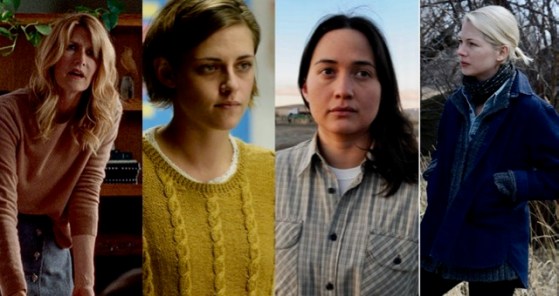
Certain Women.jpg

Authority

Laura (Laura Dern), a woman lawyer in Livingston has to deal with a disgruntled client, Fuller (Jared Harris), who was injured in his construction job. As he has accepted a settlement, he can have no further claim for tort. Laura has explained this to him time and again, but he refuses to believe her until one day, they drive a few hours to another town to seek a second opinion from a personal injury lawyer, a male. As Fuller listens to the lawyer stating the same reason as Laura has been telling him all along, he just says ‘Okay’ and seems to accept the fact. Laura laments: “If I were a man, I could explain the law and people would listen and say ‘Okay.’ It’ll be so restful.”

A few days later, a hostage-taking incident occurs in the middle of the night, and Laura is called by the police. It’s Fuller taking a security guard hostage at a government office and wants her to go in to read him his file regarding compensation. Laura goes in and calmly diffuses the tense situation. The incident sends Fuller to prison. He seems content when Laura visits him. Laura finds a changed and much calmer Fuller. He appreciates her visit, and just wants an occasional letter from her to keep in touch. Laura does have authority after all, albeit may not be as she has hoped in the professional front. Her influence rests on her considerate demeanor making an impact on a personal and human level. And for this, Fuller learns to appreciate.

Authenticity

A city woman Gina (Michelle Williams) wants to build a country dream house, not to move in but as a weekend home. She has her eyes on a pile of sandstones that belong to long time resident of the land, Albert (Rene Auberjonois). The sandstones hold the history of the area, for they are from the original school house. We see the cracks in Gina’s relationship with her husband Ryan (James Le Gros) as they try to smooth-talk Albert, Gina seemingly caring but assertive in what she wants, while Ryan is apologetic and conciliatory. Why would a city woman want a pile of old sandstones for her country home? For authenticity, Ryan tells Albert. Ouch, is that supposed to be helpful or is he being sarcastic? Further, their daughter Guthrie (Sara Rodier) seems to be harder to placate as she is dragged along to the country reluctantly. The crevice in the mother-daughter relationship looks to be a tough fissure to fix.

Alienation

The most moving segment comes last. A young lawyer Beth Travis (Kristen Stewart) has to drive a few hours several nights a week after work from Livingston to Belfry to teach a night course on school law, a prior commitment before she found her present job. At the night class, she encounters a ranch hand, Jamie (Lily Gladstone), who drops in out of curiosity. The short moments of sharing as she accompanies Beth to a diner after class for a meal before she drives back home stir up deep longings. Gladstone’s restraint is particularly moving. Nuanced performance from both.

While she may be adroit with horses, it’s a human connection that Jamie yearns for. She comes to every class until one night, the students are told that the class will be taught by another teacher as Beth has quit due to the long drive. Eager to look for her, the ranch hand drives to Livingston to search for a lawyer named Beth Travis. What follows is an aching attempt to reach out towards an unrequited end. The last scene of the same horse-tending routines Jamie gets back to speaks poignantly. Life goes on despite…

~ ~ ~ 1/2 Ripples

***

Source materials: Short stories by Maile Meloy “Tome” and “Native Sandstone” from the collection Half In Love, and “Travis, B.” from Both Ways is the Only Way I Want it.

Metropolitan (1990): Whit Stillman’s Homage to Jane Austen

Thanks to New York born and raised director Whit Stillman, one of Jane Austen’s characters in her juvenilia, Lady Susan Vernon, had a field day last year. For those wondering how that came about, do seek out Stillman’s film Love & Friendship (2016), or his movie-tie-in book Love & Friendship: In Which Jane Austen’s Lady Susan Vernon Is Entirely Vindicated. 

But Janeites may not have noticed, back in 1990, five years before the pivotal year of wet shirt Darcy’s mortifying encounter with Lizzy Bennet, another Austen character was vindicated, Fanny Price of Mansfield Park. And they have Stillman to thank.

What does Jane Austen’s Mansfield Park, published in 1814 England, have in common with a bunch of upper class college freshmen/women in 1990 New York City, calling themselves UHB (Urban haute bourgeoisie), worrying about an ‘escort’ shortage for their debutante parties during their Christmas break?

Wait a minute, UHB? ‘Urban Haute Bourgeoisie‘? Isn’t that the kind of targets that would have interested Jane? Our astute Jane who loved to wield her pen, piercing through the façade of the rich and privileged, shaking the underlying status quo of society of her time? Jane would have loved Stillman’s film. She would be amused by the characters in this comedy of manners and their social commentaries. Debutante parties? Jane would be surprised to hear they still exist in the 20th century. If she were to write the screenplay, Jane would probably be less subtle.

Screen Shot 2017-07-17 at 10.03.38 PM

Stillman’s Metropolitan is not so much an acerbic satire but a gentle poke and  descriptive vignettes of the young UHB’s lifestyle and thinking. From his treatment of his characters, he is gentle and forbearing, albeit incisive, just enough to elicit some knowing chuckles.

In Mansfield Park, Jane presented a heroine that is a contrarian. Fanny Price is unadorned, impoverished, athletically challenged, a misfit and outsider when she enters the upper class home of Sir Thomas Bertram. But it’s her being principled and virtuous that make her stick out like a sore thumb. As Jane ends the book, Fanny gets the final praise, and an oblivious, but decent, Edmund as her ultimate reward.

Stillman’s Metropolitan is set in 1990 NYC. It has two characters that are a type of Fanny Price. First is Tom. He stands for everything that’s the opposite of the UHB. A self-professed socialist, Tom comes from the other side of the track. He wears a raincoat (albeit with a warm lining as he explains) in midwinter, and a ‘snob’ for public transit. Taxi? No, he’d rather walk.

Sure, his new found friends of the UHB know why. How many can afford to take the taxi as their usual means of transport and wears tux to parties? So, to their credit, despite knowing Tom might be from the opposite side of town, they receive him into their midst, especially as the girl Audrey likes him very much and wants him to help solve their, or her, ‘escort shortage’ to the debutante parties.

Audrey is a lover of books. She’s unpretentious, modest, and above all, a sensitive soul not unlike Fanny. In one scene, Audrey serves as a moral compass as the group gathers in the after party to a game that she disapproves of. That’s a Fanny incognito there. She insists on her stance despite everyone, Tom included, feels there’s nothing wrong with the game.

So there are the Austenesque parallels and types. You might be able to identify the Crawfords there too. The youthful characters are all serious in their viewpoints. One must give them credits. In their tux and gowns they discuss social theories. Therein lies Stillman’s gentle satire. While the sarcasm and humour is subtle, there are a few lines that are overt, lines I think Jane would have approved.

In this scene (above photo), Audrey and Tom discuss books. Audrey says Persuasion and Mansfield Park are her favorite Austen books, Tom is incredulous.

Tom:  Mansfield Park! You got to be kidding.

Audrey:  No.

Tom:  But it’s a notoriously bad book. Even Lionel Trilling – one of her
greatest admirers – thought that.

Audrey:  If Lionel Trilling thought that, he’s an idiot.

Jane probably would have thought, “Oh I wish I had written those lines.”

But wait, there’s more. Later in the party, Tom and Audrey continue to discuss Mansfield Park.

Audrey: You find Fanny Price unlikeable?

Tom: She sounds pretty unbearable, but I haven’t read the book.

Audrey: What?

Tom: You don’t have to have read a book to have an opinion on it. I
haven’t read the Bible either.

Audrey: What Jane Austen novels have you read?

Tom:  None. I don’t read novels. I prefer good literary criticism. That way
you get the novelist’s idea as well as the critic’s thinking. With
fiction I can never forget none of that has really happened. It’s all
made up by the author.

Oh I can see Jane ROFL.


~ ~ ~ 1/2 Ripples


***

Related Posts on Ripple Effects:

Stillman’s Love & Friendship: More than Book Illustration

Love & Friendship and Other Prospects

Mansfield Park: Jane Austen the Contrarian 


Voicing out for ‘Silence’ and other adaptations

It’s a bit sad to see Martin Scorsese having had to defend the cinema. He wrote the piece in the May 31 issue of The Times Literary Supplement in response to the review of his film Silence by the novelist and literary critic Adam Mars-Jones. It is telling that the director didn’t write a defence of his film, but cinema itself.

Here’s the contentious viewpoints of Mars-Jones’s review, entitled “Subtle absolutisms”:

The transposition of a novel like Endo’s Silence into film, however “faithful”, can only amount to a distortion, an exaggeration overall however many elements of the book are represented.

and this:

In a book, too, reader and writer collaborate to produce images, while a film director hands them down.

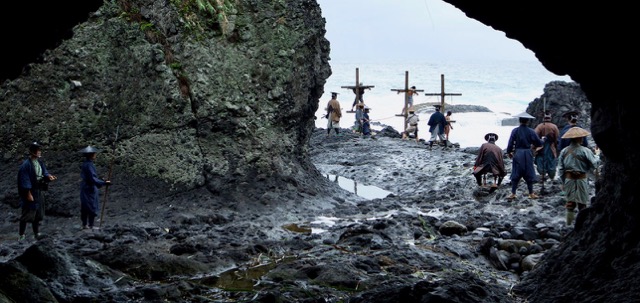
Really? Is a movie, and in this case, Scorsese’s adaptation of Japanese writer Shūsaku Endō’s novel Silence, a piece of “subtle absolutisms” as Mars-Jones’s title suggests? Do viewers in the theatre have no say but to receive from whatever mood or themes the director hands down to them, devoid of ‘collaboration’? Has the director presented to us – subversively as the title implies – his interpretations and we remain as the silent, passive, unthinking targets?

We’ve heard it before, haven’t we, that a movie leaves no room for the imagination. We can see it all, so explicitly displayed, in actions, colour, and mood, while readers reading a book interact with the book author to create a mental picture as they read, exercising their imagination.

Silence (1)

Any regular visitor to the Pond knows Arti disagrees with such criticisms. Even a two-dimensional painting can evoke in viewers a myriad of responses, let alone moving pictures. And how we interpret and interact with such sequential, moving images can be as diverse and subjective as our personalities and life experiences.

If as Mars-Jones says “those images [have] their predetermined progress in a darkened space imposes mood insistently” and if Scorsese embeds his ‘subtle absolutisms’ so ingeniously, the film should bring out very similar responses, predominantly one, as Mars-Jones has concluded: “desolation.”

But as one who dwells in a liminal, in-between space of two cultures, I’ve come across very different reactions to the film Silence. Such could well be said are the results of internal collaborations viewers have had while experiencing Scorsese’s visual storytelling. Indeed, the film has aroused different responses across cultures.

Among Western critics, it’s usually the aesthetics, acting, cinematography, and mood that are the key features noted, as with Mars-Jones’s review. Many point out they’d like to see the roles reversed with the two actors Andrew Garfield and Adam Driver. Many have noted that the film is being ‘faithful’ to the book, however, falling short of discussing the significance of such ‘faithfulness’.

This is an important point when reviewing the film. I usually do not seek how faithful a film is to its original literary work, for the two are totally different art forms, each expresses in its own terms and the appreciation of such should not be measured using the same criteria. When it comes to Scorsese being ‘faithful’ to Endo’s descriptions and narratives, unlike Mars-Jones’s critique of ‘exaggeration’, I find the director is unusually restrained here. He follows closely with Endo’s narratives, his treatment of the persecutions of Japanese Christians poignant and heart-stirring, inferring meaning rather than exposing gratuitous images. All such restraints point to Scorsese’s admiration and respect for the author and his work. At times, I feel Endo’s writing even more graphic.

On the other hand, among Asian viewers, especially among Chinese Christians (overseas and in Hong Kong), the film stirs up deep, theological resonance. Many have shared their heartfelt responses in the print and social media, heated debates ensue among believers, and even from the Sunday pulpit. The film’s characterization emerge as the prime subject for debates: Is Father Rodrigues a true Christian? Can apostasy be pardoned in the face of coercion? What does the last scene tell us about Rodrigues? Can one lead a two-faced, dichotomized life of faith like the hidden Japanese Christians? Or with some, the film has prodded the reflexive to see oneself in the Judas character Kichijiro. A call for empathy for those under authoritarian pressures to give up their faith appear to be an unexpected result, albeit the other side would push for perseverance no matter what.

Rather than the overhanging cloud of near desolation as Mars-Jones points out, the film had stirred up ripples of vibrant discussions around the issues of salvation, suffering, apostasy, betrayal, denial, and redemption. Many of the views I’ve read reflect a pleasurable gratitude as having indulged in a thought-provoking film well made, their faith energized as they ponder on soul-stirring applications to their life.

Perhaps there’s a Roland Barthes parallel here. The death of the author comes after a piece of work is written, for it has reached its destination. Now it’s the reader’s turn to interact and give it meaning. Maybe it is so with film as well. As the director completes his production, it is given a new state of being when it is screened. As viewers interact with it, interpreting and extracting personal meaning, appreciating those elements that strike a chord with their own life experiences, they’re giving life to it in the cinema of their minds.

***

RELATED POSTS ON RIPPLE EFFECTS:

Reading the Season: Silence by Shusaku Endo

Silence the movie arrives in the most unwelcome time

Can a movie adaptation ever be as good as the book?


Two Films for Thoughts at Easter

I’ve tried different words for the title: Two films for the uninterested, indifferent…

So you think Easter is too maudlin an occasion for you. You’re not fond of bunnies, nor church services, and this talk about death and new life has become too clichéd. That’s ok. How about watching a couple of films? No, not Mel’s Passion, you know how the story goes. Something different.

First is a rather tame one. Previously on Ripple, I’d written about the book by Georges Bernanos’s The Diary of A Country Priest (1936), here’s the film adaptation (1951). Watch it for its artistic values and for the appreciation of a French film legend, Robert Bresson.

Robert Bresson is one of the most influential figures in French cinema. The acclaimed New Wave director Jean-Luc Godard once noted: “Robert Bresson is French cinema, as Dostoevsky is the Russian novel and Mozart is German music.”

I know, Austrians would say Mozart was Austrian, but this just shows his influence has crossed borders. Same with Bresson, who is acclaimed as one of the forefathers of the French New Wave, even though his style is not experimental. Swedish iconic director Ingmar Bergman had specifically cited Diary of a Country Priest as influence for his Winter Light.

Do note this: Bresson was a professed agnostic. His adapting a work by the Catholic writer Bernanos shows the moving power and the universal appeal of the book. The parish of Ambricourt in the story is a microcosm of the human world. The seemingly placid village hides a spiritually barren landscape and a cocoon of malice. The young priest, an unwelcome alien, is barred from entry into the inner world of its residents.

the-gate-of-le-chateau

Watch for its cinematography. Watch for its symbolism. I won’t go into details again. CLICK HERE to read my full review after you’ve finished this post.

***

A 1951, black and white film may not pique your interest. Here’s a modern version, and a word of warning: Definitely not for the faint of heart.

Calvary.jpeg

Calvary, the acclaimed 2014 Irish film written and directed by John Michael McDonagh (The Guard, 2011). It won the Prize of the Ecumenical Jury at the Berlin International Film Festival that year among other accolades, and Brendan Gleeson garnered several Best Actor awards in the festival circuit.

Unlike the young priest in Diary, Father James (Brendan Gleeson) chooses to enter the priesthood in his middle age. He was married before, now a widower, has an adult daughter Fiona (Kelly Reilly). He has his past, but has made a clean start, to serve with integrity in an Irish rural town. Like the young priest in the French town of Ambricourt, Father James’ sincerity and total commitment is met with ridicule and hostility, albeit on the surface, the town folks seem to be relatively friendly to him.

How has the world changed since Bernanos’s time? Plenty, not just for the way people conduct their lives, but the Catholic Church has left a tarnished image of sexual abuse.

The opening scene sets an ominous overtone of what’s to come. It is Sunday, Father James sits in the confessional. On the other side a man tells his story explicitly of being raped by a priest when he was seven years old. That horrifying experience lasted for five years almost every other day, rendering him irreparably damaged. He utters a death threat to Father James: one week later he will meet him on the beach and he will kill him.

Why kill Father James? He’s an innocent priest, a good one as a matter of fact. The man says: “There’s no point killing a bad priest. But killing a good one? That’d be a shock. They wouldn’t know what to make of that. I’m going to kill you cos you’ve done nothing wrong.”

Retribution for the crimes of the Catholic Church? Resolving personal bitterness? Administering justice?

A startling opening that turns into suspense as the film progresses. Father James recognizes the voice. He knows who he is, but we as audience don’t. The director leads us to look into the lives of several characters, allowing us to ponder who it is that wants to kill the priest. Sounds familiar? “Lord, who is it?” But Father James knows, and he still treats the man with a pastoral heart.

“I’m going to kill you cos you’re innocent.” Every day of the week, Father James lives with that threat. Each passing day sends him closer to the hill called Calvary. But Father James goes on with his work, caring, being a friend, ministering, including to his own daughter who has recently attempted suicide. He is heartbroken; she feels she can go on now knowing he cares.

Not saying that he’s a saint. How can you live with such a threat from a man who seems to mean business. Father James is all too human… and that’s the side that appeals. To say it’s been an eventful week is an outright understatement. Things just get too personal, and Father James copes with all the wits he can muster. He needs not turn water into wine, there’s plenty around. He waits. We wait.

Then Sunday comes. He prepares himself and heads to the beach.

The very last scene is one of the most heart-wrenching endings I’ve seen, and it’s not at the beach, not with Father James.

It’s about the ripple effects of Calvary: one man bearing the sins of all.


~ ~ ~ ~ Ripples
for both films

***

Related Posts on Ripple:

Robert Bresson’s Au Hasard Balthazar (1966): A Timeless Parable

Ida’s Choice: Thoughts on Pawlikowski’s Ida (2013)

Homage to Flannery O’Connor: Looking for Intrusions of Grace in Films

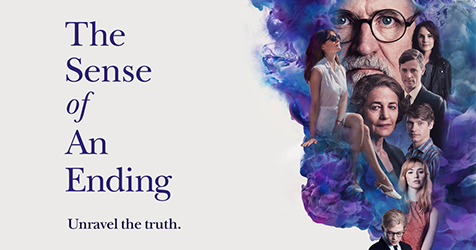
The Sense of an Ending the Movie

When I first knew that The Sense of an Ending was being adapted into a movie, I thought whoever that took up the project had a tall order. That it’s a Booker Prize winner automatically adds pressure and expectations, but the more important consideration is the nature of the book, introspection saturated with internal dialogues.

The novel is powerful and intense in that, in merely 150 pages, Barnes has dismantled the scaffold of self-knowledge in his protagonist by challenging the accuracy of his memories. The eerie effect is, that can happen to us too. How accurate are our memories of ourselves, of others, of events in our life? It’s crucial because what we remember about them build up the person who we think we are today.

So, who had taken up this difficult task to helm the movie? It’s Ritesh Batra, the Mumbai born, Indian director who brought us the interesting film The Lunchbox (2013). Batra has an excellent cast to work with, that should have made his job a bit easier. But one can see he follow the script pretty closely and that’s what made me wish there could be more stylistic touch. Similarly, the screenplay by Nick Payne could have been spiced up a bit. However, its being overall loyal to Barnes’s novel, except a few addons, may have cleared up some ambiguity for the reader.

The Sense of an Ending

In his old age, Tony Webster (Jim Broadbent) received a registered letter notifying him of a small inheritance from someone he had known way back in his university days. The money isn’t the important thing, it’s the diary that is supposed to go with it that opens up a door to his past. And so begins the story. Tony has to rethink everything about himself (younger played by Billy Howle), his first love Veronica Ford (younger played by Freya Mavor), Veronica’s family, in particular his mother Sarah (Emily Mortimer), and his school friends Adrian Finn (Joe Alwyn, who plays Billy Lyn in Ang Lee’s 2016 movie).

There are hits and misses in this adaptation. Broadbent delivers a solid performance as the clueless Tony Webster, a man who has lived all his life lacking the lucidity of seeing himself and others in the proper light, or is it selective memory? The little bit of addon is good, letting Tony set up an old camera shop to get him out of bed everyday. It’s also a good link because when he first met Veronica, she was toying with one, and he had received one from her as a gift as well. Herein lies the linkage of the object with the distant past.

Tony has his ex-wife Margaret (Harriet Walters) to thank, for she humours him by meeting him time and again just to listen. She may be doubting what Tony is telling her, but she is patient and wait for him to slowly rediscover himself. That’s what a good listener does, isn’t it, she helps you question yourself.

Adding the plotline of Tony’s daughter Susie (Michelle Dockery) giving birth to a baby is effective. Those who miss Downton Abbey would be glad to see Mary Crawley again, in a new role. But the real effect here is that her giving birth to a newborn son leads me to appreciate the title of the book, something that I did not quite get when I was reading. I wondered about the relevance of the book title when I was reading it. The movie’s last scene clears this up for me. After all these years of misinformed self-knowledge, Tony finally comes to the end of a chapter in his old age, still not too late. With the renewed relationship with his ex Margaret, and a new grandchild, Tony is ready to call an end to a clueless life and start anew. Once more, with feeling.

The weakest link I feel is with the elderly Veronica character played by Charlotte Rampling. It’s a missed opportunity for the director to draw out more from this veteran actor. Unlike in the book, which depicts an absolutely frustated Veronica, possibly traumatized by what had happened to her in life, finding Tony not understanding a bit about the past. “You just don’t get it, do you?” Exasperated, she has said this several times in the book, if my memory serves me correctly.

So here in the movie, the most crucial scenes ought to be Tony’s meeting with the older Veronica for the first time after all those decades and Veronica seeing Tony still oblivious to what had happened. But no, we see an utterly aloof Veronica, too calm for those tense cinematic moments. “You just don’t get it, do you?” has not been said even once, if my memory serves me correctly.

And the most crucial line in the pub when Tony finds out the truth, it ought to be the climax but the scene is so understated that any built up has been eroded. Now he gets it, and what reaction does he show at the moment and afterwards? I feel it’s the director’s job to augment the moment, and let it ripple into the next sequences. I’m sure the cast can easily oblige. Just for the sake of eliciting more emotional engagement from the viewers. I remember how sensational it felt when I came to that part in the book.

Overall, it’s a pleasure watching these veteran actors in the same production. Together with the above-mentioned cast members, there are also Matthew Goode, the history teacher, but not in a scene with Michelle Docerty, and Merchant Ivory star James Wilby playing the small role of Veronica’s father.

That it is shot on location in London, especially watching Tony meet Veronica again on “the wobbly bridge” leading to Tate Modern is particularly poignant in light of recent events. Overall, a watchable adaptation to go with the book.

~ ~ ~ Ripples

***

Related Posts on Ripple Effects:

The Sense of an Ending Book Review

The Lunchbox Movie Review

New Announcements of Books to Screen

Some exciting announcements of upcoming adaptations:

howards-end-by-e-m-forsterHowards End by E. M. Forster

E. M. Forster’s 1910 novel Howards End is to be adapted into a four-part TV miniseries produced by BBC and Starz, to be helmed by the Oscar nominated Manchester by the Sea director Kenneth Lonergan. Hayley Atwell plays Margaret Schlegel, Matthew Macfayden takes the role of Henry Wilcox, and Tracey Ullman is Aunt Juley Mund. I just can’t help but compare this new cast to that of the, shall I say, definitive 1992 Merchant Ivory production with Emma Thompson, Helena Bonham Carter, Anthony Hopkins and Vanessa Redgrave. Inimitable. Yet, I’m glad to hear of a rebirth of this brilliant E. M. Forster novel.

.

guernsey-literary-and-potato-peel-pie-societyThe Guernsey Literary and Potato Peel Pie Society by Anne Barrows and Maryanne Shaffer
At long last, the best-selling novel (2009) is finally adapted for the big screen, renamed Guernsey. Phew! While its popularity has subsided by now, I hope the movie will revive it, for it’s a delightful read and the characters are resilient residents on German occupied Guernsey Island during WWII. Written as a series of letters between a London writer Juliet Ashton and her friend and publisher Sydney Stark and later, with the charming Guernsey folks, the book exalts the power of reading, not potato peeling. How do you turn epistles into a movie? We’ll have to see. Downton Abbey‘s Lily James will play Juliet, after first Kate Winslet then Rosamund Pike dropped out. Hope this will go to completion. The director is Mike Newell, known for Great Expectations (2012), Mona Lisa Smile (2003), and perhaps the most memorable, Four Weddings and a Funeral (1994).

.

the-child-in-timeThe Child in Time by Ian McEwan

At last something to look forward to after Downton. Ian McEwan’s Whitbread winning novel (1987) about the perpetual trauma of a lost child will be adapted into a 90 min. TV drama co-produced by BBC and Masterpiece. Benedict Cumberbatch to star. With the Sherlock series going down an erratic rather than rational path, I hope this one is a more grounded outlet for Benedict’s superb acting skills, like his Parade’s End (2013). This is his second time in a McEwan novel. Back in 2007, he played a supporting role in the Oscar nominated Atonement, relatively unknown, stressing on the ‘relatively’. And hats off to actors who can navigate freely between the big and small screen platforms.


.

51p921wTKtL._SX308_BO1,204,203,200_ (1).jpg

The Sea Change by Elizabeth Jane Howard

Glad to learn that Kristin Scott Thomas (I’ve Loved You So Long, The English Patient) is stepping out from her long acting career into the director’s chair, and acting too in this adaptation of English author Elizabeth Jane Howard’s novel. While I haven’t read any of Howard’s works, I’d seen the screenwriter Rebecca Lenkiewicz’s, and that’s her screenplay for the Oscar winning Polish film Ida (2013). I highly anticipate Lenkiewicz’s new work. Glad she’s collaborating with Scott Thomas in her directorial debut. Mark Strong is said to be in talks to join the project. Of course, my dream cast would be Colin Firth with Kristin Scott Thomas.


.

crazy-rich-asians

Crazy Rich Asians by Kevin Kwan

According to director Jon Chu (Now You See Me 2), this will be “the first all-Asian cast feature from a Hollywood studio in a long, long time.” Umm… since Joy Luck Club (1993) that is. A risk or a good opportunity? Constance Wu (TV’s “Fresh Off the Boat”) is on board to play a major role. If you’ve not read the book, rest assure that with a title like this, it has got to be a satire, and not a get-rich-quick manual. Not that I’m crazy, nor rich, but reading Kwan’s imaginary yet true-to-life characters is an extravagantly wild ride. His astute and bold satire of modern day’s opulent Singaporean families (his own cultural background) is what Jane Austen would have loved to poke fun of if she found herself in a 21st century rich Asian home. But of course, just like the writing of our dear Jane of yesteryears, the heroine (Rachel in Kwan’s book) is your everyday middle class, highly educated yet modest gal growing up in (immigrant) America, finding (surprise!) that her boyfriend actually is Mr. Darcy incognito when she travels back with him to his family home in Singapore for the wedding of his best friend. I highly anticipate this one, but with great trepidations. They better make this work, or it could easily be a disaster of ethnic proportions.

***

Related Post on Ripple Effects:

Howard’s End by E. M. Forster
Ida’s Choice: Thoughts on Pawlikowski’s Ida
I’ve Loved You So Long movie review
The Guernsey Literary and Potato Peel Pie Society Book Review