Top Ripples 2017

The following is a list of books, movies, and events that stirred up the most ripples for me in 2017. Note that the books and movies are not necessarily releases from 2017 but just what I’ve had the privilege to encounter this year. If you don’t see your book here, it could be that it’s on my TBR list for the coming year. If you don’t see your fave movie here, it could be that I haven’t watched it or that I have but, indeed, it’s not here. Click on the links to read my reviews.


MOVIES

Three Billboards Outside Ebbing, Missouri directed by Martin McDonagh

Mudbound directed by Dee Rees

Certain Women directed by Kelly Reichardt

The Big Sick directed by Michael Showalter

Stefan Zweig: Farewell to Europe directed by Maria Schrader

Wind River directed by Taylor Sheridan

Things to Come directed by Mia Hansen-Løve

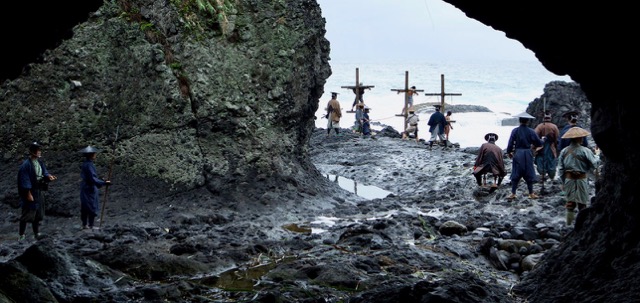
Silence directed by Martin Scorsese

The Rider directed by Chloé Zhao (55th NYFF)

The Road to Mandalay directed by Midi Z (NYAFF)

Calvary directed by John Michael McDonagh


BOOKS

At the Existential Cafe: Freedom, Being, and Apricot Cocktails by Sarah Bakewell

Little Fires Everywhere by Celeste Ng

Mudbound by Hillary Jordan

Nutshell by Ian McEwan

Wildlife by Richard Ford

The Noise of Time by Julian Barnes

The God of Small Things by Arundhati Roy


EVENTS

Visit to MoMA Click on the link to my post.

NYFF at Film Society of Lincoln Center: In September I had the chance to attend press screenings of the 55th New York Film Festival. CLICK HERE for all my reviews on AAPress.

Other than hanging out at the Film Society of Lincoln Centre for the screenings, I’d experienced NYC on the bus, in the subway, and simply on foot, some days close to 20,000 steps, making my NYC trip extra rewarding. Here are some pics of the memorable experience.

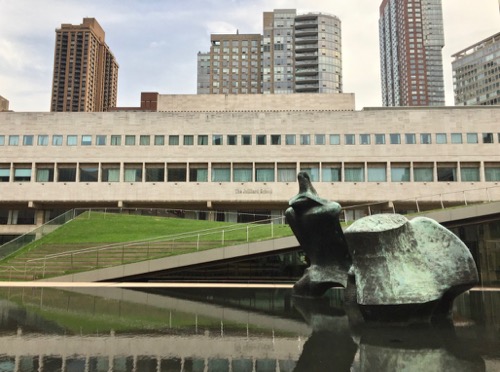
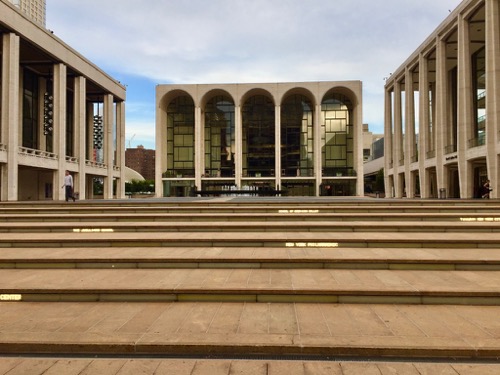
Lincoln Center:

IMG_5673.jpg

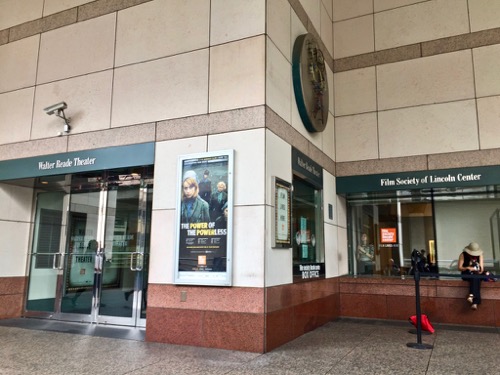
Film Society of Lincoln Center where the screenings took place:

IMG_5676

The Juilliard School:

IMG_5670 (1)

Central Park:


Reflection in Central Park


One World Trade Center:

IMG_5907.jpg

IMG_5860

IMG_5852 (1).jpg

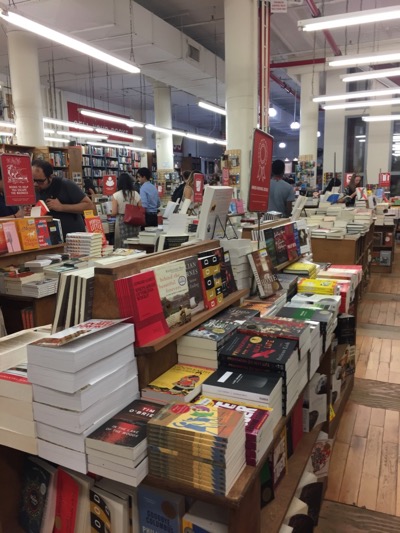
Strand Bookstore:

IMG_5691

IMG_5688

Brooklyn Bridge:

IMG_5784.jpg


IMG_5828

Where I found the best lobster roll I’d ever tasted, at the foot of the Brooklyn Bridge:

IMG_5837


And that’s a wrap.


***

And to all, a wonderful 2018 for books, films, and rewarding encounters! 

Reading the Season: A Wrinkle in Time by Madeleine L’Engle

For the tenth year, I’m sharing a Christmas read here at the Pond. For the first time, it’s a book written for young readers but is ever so relevant for us grown-ups. Herein lies the ingenuity of writer Madeleine L’Engle. Time to dig out that copy that you might have read when you were a youngster. If you haven’t read it, now’s a good time.


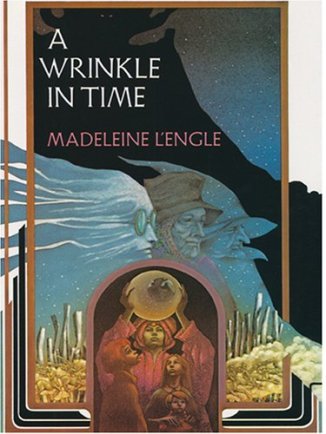
A Wrinkle in Time


Newbery Medal winner A Wrinkle in Time is the first book in the Time Quintet series of fantasy YA fiction about the Murray family, scientist parents and four children Meg, twins Dennys and Sandy, five year-old genius Charles Wallace, and that special friend of Meg’s, Calvin O’Keefe. The deceptively simple odyssey in time and space is packed with wonder and wisdom.

The book not only exudes insights but shows L’Engle’s remarkable foresights. Take this for an example, dematerializing and materializing  for easy transport. Published in 1962, the book came out four years before Scotty beamed Kirk up using the same method in the first season of Star Trek.

Or this fancy idea, ‘tesseracting’, that is, travelling through space and time via a wrinkle in time. The shortest distance between two points is not a straight line, but through a wrinkle when two points are folded. That’s fifty years before Christopher Nolan sends Matthew McConaughey interstellar travelling.

All concepts held in a simple plot. Meg, Charles Wallace, together with friend Calvin, go on an interstellar quest to look for Meg and Charles’ physicist father who had gone missing for almost a year while doing some classified scientific work for the government. This little, unequipped search party is initiated and aided by three celestial beings: Mrs. Whatsit, who’s much wiser than she appears, Mrs. Which, who doesn’t bother materializing but remains as a shimmering beam, and Mrs. Who, who speaks in quotes.

The more a man knows, the less he talks.

Their odyssey brings them finally to the planet Camazotz, where they find Mr. Murray confined by the evil Dark Thing, or IT (Surprise! 24 years before Stephen King’s book and now movie) The smart alecky Charles Wallace is easy prey and quickly influenced by IT. (And for Luddites, what better parallel to address our technology now, the evil IT) Ultimately, it’s Meg, our reluctant and timid heroine, who has to be the one to go fight IT to rescue her little brother.

The foolishness of God is wiser than men; and the weakness of God is stronger than men… God hath chosen the foolish things of the world to confound the wise; and God hath chosen the weak things of the world to confound the things which are mighty.

Meg knows Charles Wallace is not himself but trapped and deceived, and must be snatched from the evil force IT. She has just one weapon as her ammunition, given to her by Mrs. Whatsit, that one thing IT doesn’t have: LOVE. With her single act of bravery, she brings the family together again.

When I was a child, I read like a child, I thought like a child. When I became an adult, I can read like a child and like an adult too. That’s the joy of reading A Wrinkle in Time. One can find pleasure in the adventure and feel the vulnerability of the children, as well delve deeper into its symbolism and parallels, and ponder its layers of meaning.

L’Engle writes to the child and the adult in us. She can convey scientific and spiritual concepts at the same time and in a way that both young and old (and those in between) can enjoy. There’s no conflict between the cerebral and the spiritual; they co-exist comfortably in L’Engle’s work. Not only that, they fuse together and from that alchemy rises a whole new, inexplicable entity: Faith.

That first Christmas day when a baby was born in a lowly manger, the war against IT had started to win. Although the last, painful battle on the hill of Calvary had not been waged, the outcome was cast, just because LOVE came.

And the light shineth in darkness; and the darkness comprehended it not.


The Movie

‘Tis the Season to read or reread A Wrinkle In Time before the movie adaptation comes out in 2018. Helmed by Selma (2014) director Ava DuVernay, screenplay by Frozen (2013) scriptwriter Jennifer Lee, with some stellar beings including Rees Witherspoon, Oprah Winfrey, Mindy Kaling, Chris Pine et al.

***

Past Reading the Season Selections:

2016:  Silence by Shusaku Endo

2015: The Book of Ruth

2014: Lila by Marilynne Robinson

2013: Poetry by Madeleine L’Engle

2012: Surprised by Joy by C. S. Lewis

2011: Walking on Water by Madeleine L’Engle

2010: A Widening Light, Luci Shaw

2009: The Irrational Season 

2008: The Bible and the New York Times by Fleming Rutledge

2008: A Grief Observed by C. S. Lewis

Little Fires Everywhere by Celeste Ng: A Book Review

NOTE: I thank Penguin Random House Canada for the reviewer’s copy of the book, and Asian American Press for allowing me to post my review here.

Little Fires Everywhere

Chinese American writer Celeste Ng (伍綺詩) had garnered numerous accolades for her debut novel “Everything I Never Told You”, including a New York Times Notable Book of 2014, Amazon’s #1 Best Book of 2014, winner of the Massachusetts Book Award, and the Asian/Pacific American Award for Literature, just to name a few.

Like the stunning opening in her debut work, Ng in her second novel “Little Fires Everywhere”, begins with a dramatic scene: Mrs. Richardson, after being awaken by the smoke detectors, stands on her front lawn in her pale blue robe and watches firemen saving her house from total burnt down. The prime suspect of the fire is her youngest daughter Izzy. With that, Ng leads us into the story of the Richardsons’, an upper-middle class family living in the quiet suburb of Shaker Heights, Ohio, which was Ng’s hometown during the 90’s.

Ng grew up in Pittsburgh, Pennsylvania, and Shaker Heights, Ohio, her scientist parents having immigrated from Hong Kong. Ng graduated from Harvard University and earned an MFA from the University of Michigan (now the Helen Zell Writers’ Program at the University of Michigan), where she won the Hopwood Award.

The thematic elements of race, parenthood, and family secrets leading to devastating consequences as in her debut novel are carried over. Covering a larger scope, “Little Fires Everywhere” expands to other issues as well, offering us views into a myriad of realistic characters and the interplay of two families, specifically, two mothers holding opposite values. Ng’s riveting storytelling skills carry us through the various plot lines breezily, while taking the time to breathe life into her characters, and deftly locks us into mental debates on contentious issues. Although set in the 90’s, the issues raised are as relevant today.

The Richardson family, one could say, is the epitome of the American Dream. They live in a six- bedroom home in a desirable part of town. The matriarch Elena and her husband Bill are well connected and respectable in the community, she a journalist with the local paper the Sun Press and he a defence lawyer. They have four teenaged children, the eldest Lexie heading to Yale. Second son Trip is popular in school, especially among girls. Third child Moody is wrapped up in his own cocoon. Youngest Izzy is the black sheep of the family. She is not happy despite her family’s affluence, or maybe, if Mrs. Richardson is willing to look deeper into her daughter’s mind, Izzy’s discontent could be exactly due to her family’s secure standing in the rule-constraining suburb. Mrs. Richardson would not trade any of her privileges, for she is living “a perfect life in a perfect place.” Her main task now is to smother any sparks that can disrupt the status quo and surface calmness in her family and community.

Celeste Ng.jpg

As the title suggests, metaphors of fire are everywhere. There are flames of passion, fury, dissatisfactions, and the fuse of suburban ennui, as apparent in the lives of the teenagers, potential fire hazards. These are all inherent threats to the idyllic, quiet town, where high school graduates are expected to head to Ivy league colleges, and where parents are oblivious to the secret lives of their teenagers, and vice versa.

The story begins not with the aftermath of the house fire, but the reason leading to it. Mrs. Richardson has just rented the upper floor of her revenue property, a duplex on the other side of town, to new tenants, single mother Mia Warren and her teenage daughter Pearl. Mia is an artist, her medium, photography. She works at menial jobs to sustain her art, and brings up Pearl moving about the country in their VW Rabbit, forty-six different towns since Pearl’s birth.

As they settle in Shaker Heights, Pearl comes to know the Richardson children and is attracted to their lifestyle. Conversely, Izzy Richardson is mesmerized by Mia’s artist life and hangs around in the duplex to help and learn from her art-making. This time, Mia and Pearl may just be settling down.

It is obvious from the start that Mrs. Richardson and Mia comes from opposing sides of ideals. While suggesting Mia take portraits for people in town to earn more money, thinking about her rents no doubt, Mrs. Richardson is confronted with the notion of the artist as a photographer, as Mia replies, “the thing about portraits is, you need to show people the way they want to be seen. And I prefer to show people as I see them.”

Mia works at the Chinese restaurant Lucky Palace to sustain a living. Mrs. Richardson offers her to work in the Richardsons’ home, cleaning and cooking a few days a week to earn some extra money. Although reluctant about the proposal but to not jeopardize their relationship, Mia agrees. Hence, Mia delves further into the Richardson family life.

As she so deftly deals with in her first novel, Ng weaves into her storylines and characters the subjects of culture and identity. The intermingling of lives between the Richardson family and Mia soon pits them into taking two contentious sides in a prominent court case in town. The Richardsons’ best friends, the McCulloughs, have just adopted a Chinese baby found abandoned at the fire hall, Mirabelle, or May Ling Chow, her birth name. The birth mother Bebe now regrets her decision which she had made in a most dire financial situation at the time. Bebe comes from China, and happens to be Mia’s co-worker at Lucky Palace. Mia is openly supportive of Bebe, while Mr. Richardson represents the McCulloughs. The case has divided the town, and now Mrs. Richardson knows she needs to dig into Mia’s past to discredit Mia and to get back at her for drawing her dear friends the McCulloughs into tormenting legal entanglements.

It is when Ng reveals Mia’s backstory that the narrative is most riveting. We are led to a moving account, a page turner even, on a subject that is complex and crucial: what makes a mother? In her novel, Ng intertwines three possible scenarios of pregnancy, wanted, unwanted, surrogate. And with these contrasting lines, she delves into the issues of adoption and identity. Are babies best brought up by their own biological mothers, especially when culture comes into play? What makes a baby Chinese? American? Or more complex still, Chinese American? The McCulloughs have well intentions to bring Mirabelle up by regular dine-outs in a Chinese restaurant, and finding her ‘Oriental Barbies’ to play with. Are these enough? If not, what is?

Cultural appropriation is a trendy topic nowadays, not only in the adoption circle, but in other realms. These are issues that require deeper pondering and research work, no doubt, ones that should be confronted deeper than Ng can deal with in her novel. Nonetheless, a fictional setting is an interesting place to spark off the debate. Just another one of her little fires in the book.

While “Everything I Never Told You” is a microscopic look at a mixed-race family during the 70’s, dense and intense, not unlike a Bergman chamber work, “Little Fires Everywhere” is looser and more expansive in thematic matters, with sprinkles of laughs here and there, not unlike a John Hughes’ movie in the 80’s. One can feel Ng is freer to roam with the larger, open space. Just as with her debut work, Ng does not shy away from the issues of race and identity, while challenging the notion of ‘success’. One should not be surprised that this is still the fundamental term we are struggling to define in our society today.


~ ~ ~ 1/2 Ripples


***


Here’s a short review of Ng’s debut novel “Everything I Never Told You” (audiobook) I’d posted on Goodreads.


Six Degrees of Separation or Prophetic Voices of our Time

I’ve read several books in recent months that are good evidence of ‘six degrees of separation’, and I’ll just end with four here. But more crucial is why such content at this time? They are all published in 2016 but still enjoy current bestselling positions. All are similar in their historical backdrop, authoritarian dictatorship in the 20th Century in two neighbouring countries, China and Russia. Or, maybe these writers of our time are indeed prophetic voices to stress that eerie caution: “Those who don’t know history are doomed to repeat it.”

Here’s the sequence of my reading:

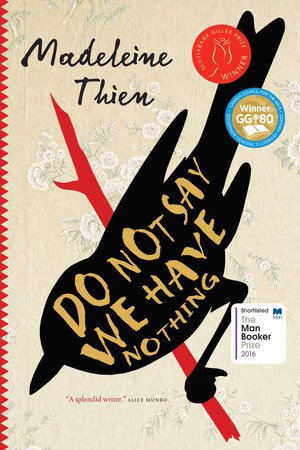
Madeleine ThienDo Not Say We Have Nothing by Madeleine Thien

The top selling book in Canada according to CBC Books, Madeleine Thien’s exceptional novel of three characters, musicians at the Shanghai Conservatory of Music during the Cultural Revolution in China, leads us through decades of contemporary Chinese history from the Communist takeover after WWII to Mao’s Cultural Revolution to the 1989 Tiananmen Massacre, spanning generations and across two continents. Thien was teaching creative writing when her program was abruptly cancelled in the aftermath of the ‘Umbrella Revolution’ sprouting from the Occupy Central led by teenaged students in Hong Kong. That was a motivating force propelling the writing of the book. Following the most recent news that four young student leaders are given months of jail sentences for their actions, we know how timely a voice Thein is with this book.


Barnes The Noise of Time.jpgThe Noise of Time by Julian Barnes

Dimitri Shostakovich’s music is in the minds of the three musicians at the Shanghai Conservatory of Thien’s book. Shostakovich, himself a composer treading a precarious line between authenticity and self-preservation under Stalin, is an apt parallel of the situation the trio have to face.

Julian Barnes has crafted an imaginary biopic of Dimitri Shostakovich during Stalin’s tyrannical rule in the Soviet Union (1929-1953). Barnes’ depiction is internal, presenting the struggles, the giving-in and the self-loathing of a world famous composer and pianist who was unable to stand up to a ruthless and manipulative dictator. Speak truth to Power? Who can still stand, or live, after that? And it’s not just about oneself, but one’s family and all those associated.


Cometh the hourCometh the Hour by Jeffrey Archer (#6 of the Clifton Chronicles)

Jeffrey Archer, a prophetic voice? While his Clifton Chronicles have entertained us with imaginary characters spanning three generations of two British families, Archer does have the political mood of our times firmly held under his pen, and Lord Archer is a savvy political historian in his own right. This summer I binged on Jeffrey Archer, okay, not exactly your serious, prophetic voice, but no less relevant. This is especially true when his fictional character, Russian writer Anatoly Babakov, is imprisoned in Siberia for his book Uncle Joe. Based on his own experience while working under Joseph Stalin, Babakov offers readers an insider’s look into the ruler, revealing the ruthless dictator that he really was.

Babakov is awarded the Nobel Prize of Literature while still in prison. But not long after the announcement, he dies of a heart attack. His wife Yelena although escaped out of the country, wants to return to honour her husband. Archer’s character makes me think of the real life dissident Chinese writer and activist Liu Xiaobo, also Nobel laureate, but was denied the freedom to go and accept his Prize. He had been imprisoned for 11 years and sadly, died of liver cancer in July this year, 2017. And even more sadly, Liu’s wife could not see him at his deathbed and had gone missing after his death. Archer’s book was published in 2016. I’d say that’s quite prophetic.


A Gentleman in Moscow by Amor Towles

A Gentleman in MoscowA totally different tone, but the same historical backdrop. Towles has created an interesting and colourful character, the aristocrat Count Alexander Rostov, kept in house arrest when the Bolsheviks overrun the country. True to his personality and lifestyle – the major consolation of such a misfortune – Count Rostov serves his house arrest in the elegant Moscow Metropol Hotel across from the Kremlin, albeit in a cramped room in the attic. With his always pleasant demeanour, the former aristocrat makes himself at home at the grand hotel, meeting interesting characters, wine and dine to his heart’s content. He stays there for decades, with the historic changes happening outside the four walls of the Metropol: Lenin, Stalin, post-Stalin, and further. As fate would have it, Count Rostov encounters an idealistic youngster named Nina, and years later, takes up guardianship of her daughter Sofia, and thus his life and view begin to turn into something more purposeful. The Metropol makes me think of Wes Anderson’s The Grand Budapest Hotel. Instead of speaking truth to power and get slapped in the face or worse, Count Rostov thinks of an ingenious scheme to beat Power at their game. If I were a filmmaker, this is one to bank on.

***

Related Posts on Ripple Effects:

Do Not Say We Have Nothing Book Review

The Budapest Hotel: A Grand Escape


Metropolitan (1990): Whit Stillman’s Homage to Jane Austen

Thanks to New York born and raised director Whit Stillman, one of Jane Austen’s characters in her juvenilia, Lady Susan Vernon, had a field day last year. For those wondering how that came about, do seek out Stillman’s film Love & Friendship (2016), or his movie-tie-in book Love & Friendship: In Which Jane Austen’s Lady Susan Vernon Is Entirely Vindicated. 

But Janeites may not have noticed, back in 1990, five years before the pivotal year of wet shirt Darcy’s mortifying encounter with Lizzy Bennet, another Austen character was vindicated, Fanny Price of Mansfield Park. And they have Stillman to thank.

What does Jane Austen’s Mansfield Park, published in 1814 England, have in common with a bunch of upper class college freshmen/women in 1990 New York City, calling themselves UHB (Urban haute bourgeoisie), worrying about an ‘escort’ shortage for their debutante parties during their Christmas break?

Wait a minute, UHB? ‘Urban Haute Bourgeoisie‘? Isn’t that the kind of targets that would have interested Jane? Our astute Jane who loved to wield her pen, piercing through the façade of the rich and privileged, shaking the underlying status quo of society of her time? Jane would have loved Stillman’s film. She would be amused by the characters in this comedy of manners and their social commentaries. Debutante parties? Jane would be surprised to hear they still exist in the 20th century. If she were to write the screenplay, Jane would probably be less subtle.

Screen Shot 2017-07-17 at 10.03.38 PM

Stillman’s Metropolitan is not so much an acerbic satire but a gentle poke and  descriptive vignettes of the young UHB’s lifestyle and thinking. From his treatment of his characters, he is gentle and forbearing, albeit incisive, just enough to elicit some knowing chuckles.

In Mansfield Park, Jane presented a heroine that is a contrarian. Fanny Price is unadorned, impoverished, athletically challenged, a misfit and outsider when she enters the upper class home of Sir Thomas Bertram. But it’s her being principled and virtuous that make her stick out like a sore thumb. As Jane ends the book, Fanny gets the final praise, and an oblivious, but decent, Edmund as her ultimate reward.

Stillman’s Metropolitan is set in 1990 NYC. It has two characters that are a type of Fanny Price. First is Tom. He stands for everything that’s the opposite of the UHB. A self-professed socialist, Tom comes from the other side of the track. He wears a raincoat (albeit with a warm lining as he explains) in midwinter, and a ‘snob’ for public transit. Taxi? No, he’d rather walk.

Sure, his new found friends of the UHB know why. How many can afford to take the taxi as their usual means of transport and wears tux to parties? So, to their credit, despite knowing Tom might be from the opposite side of town, they receive him into their midst, especially as the girl Audrey likes him very much and wants him to help solve their, or her, ‘escort shortage’ to the debutante parties.

Audrey is a lover of books. She’s unpretentious, modest, and above all, a sensitive soul not unlike Fanny. In one scene, Audrey serves as a moral compass as the group gathers in the after party to a game that she disapproves of. That’s a Fanny incognito there. She insists on her stance despite everyone, Tom included, feels there’s nothing wrong with the game.

So there are the Austenesque parallels and types. You might be able to identify the Crawfords there too. The youthful characters are all serious in their viewpoints. One must give them credits. In their tux and gowns they discuss social theories. Therein lies Stillman’s gentle satire. While the sarcasm and humour is subtle, there are a few lines that are overt, lines I think Jane would have approved.

In this scene (above photo), Audrey and Tom discuss books. Audrey says Persuasion and Mansfield Park are her favorite Austen books, Tom is incredulous.

Tom:  Mansfield Park! You got to be kidding.

Audrey:  No.

Tom:  But it’s a notoriously bad book. Even Lionel Trilling – one of her
greatest admirers – thought that.

Audrey:  If Lionel Trilling thought that, he’s an idiot.

Jane probably would have thought, “Oh I wish I had written those lines.”

But wait, there’s more. Later in the party, Tom and Audrey continue to discuss Mansfield Park.

Audrey: You find Fanny Price unlikeable?

Tom: She sounds pretty unbearable, but I haven’t read the book.

Audrey: What?

Tom: You don’t have to have read a book to have an opinion on it. I
haven’t read the Bible either.

Audrey: What Jane Austen novels have you read?

Tom:  None. I don’t read novels. I prefer good literary criticism. That way
you get the novelist’s idea as well as the critic’s thinking. With
fiction I can never forget none of that has really happened. It’s all
made up by the author.

Oh I can see Jane ROFL.


~ ~ ~ 1/2 Ripples


***

Related Posts on Ripple Effects:

Stillman’s Love & Friendship: More than Book Illustration

Love & Friendship and Other Prospects

Mansfield Park: Jane Austen the Contrarian 


Jane Austen 200: Room or No Room, She Did It

Today is the Bicentenary of Jane Austen’s death. On July 18, 1817, suffering excruciating pain, Jane died of her illness at age 41. As a tribute, I’m reposting my article on Virginia Woolf’s A Room of One’s Own.

***


A Room of One’s Own is based on a series of lecture Woolf delivered at the two women’s colleges in Cambridge University on the topic of “Women and Fiction”.  It was published in 1929.

Woolf lamented the disparities women in a patriarchal society had to face throughout history.  The stream of consciousness flowed into torrents of incisive social observations and satirical commentaries.

She noted that women had long been deprived of equitable opportunities in education and employment. Men were rich, women were poor; men got to roam the country and travel the world, women had to be satisfied with the domestic.  Men were great writers, poets, playwrights, women had to concede to find fulfillment in “making puddings and knitting stockings”. Men had rooms to work, to rest, to create…women, the average, middle class women, seldom had a room of their own.

…to have a room of her own, let alone a quiet room or a sound-proof room, was out of the question, unless her parents were exceptionally rich or very noble, even up to the beginning of the nineteenth century.

And sadly, Woolf had to utter this statement:

Yet genius of a sort must have existed among women as it must have existed among the working classes.

Isn’t it true, Jane spent her most prolific years writing in a very public room in Chawton House.  In the midst of family activities, at a small and spartan desk, she revised Pride and Prejudice and Sense and Sensibility, wrote Mansfield Park, Emma, and Persuasion, and began Sanditon:

Jane's writing desk in Chawton

And isn’t it true that only in movies do we see the idyllic desk against a clear window, with soft light diffusing in, gently illuminating a lady dressed in elegant regency gown, writing on expansive papers and stationary, contemplating in solitude:

Room or no room, recognized or not, something happened towards the end of the eighteenth century that, according to Virginia Woolf, deserved much more mention in history than the Crusades or the Wars of the Roses:  The middle-class woman began to write.

Woolf pointed out that not only did Jane Austen lack a room of her own, having had to write her novels in the very public sitting-room, she had to hide her manuscripts or cover them with a piece of blotting-paper, as observed by her nephew James Edward Austen Leigh in his Memoir of Jane Austen.

Ironically, there lay the genius of Austen, and the few woman writers around her time such as Bronte and George Eliot.  Woolf wrote:

…and we must accept the fact that all those good novels, Villette, Emma, Wuthering Heights, Middlemarch, were written by women without more experience of life than could enter the house of a respectable clergyman; written too in the common sitting-room of that respectable house and by women so poor that they could not afford to buy more than a few quires of paper at a time upon which to write.

Little did they know, it was in such a room that they were trained in the prerequisites of novel writing:

…all the literary training that a woman had in the early nineteenth century was training in the observation of character, in the analysis of emotion.  Her sensibility had been educated for centuries by the influences of the common sitting-room.  People’s feelings were impressed on her; personal relations were always before her eyes.  Therefore, when the middle-class woman took to writing, she naturally wrote novels…

Not only that, they wrote good novels.  With reference to Jane Austen, Virginia Woolf concluded:

Here was a woman about the year 1800 writing without hate, without bitterness, without fear, without protest, without preaching.  That was how Shakespeare wrote.

High praise indeed.


***

Previous Post on Jane Austen 200:

Jane Austen’s Persuasion: A Bath Walking Tour

Jane Austen’s Persuasion: A Bath Walking Tour

As a tribute to the Bicentenary of Jane Austen’s death, July 18th, 2017 to be exact, I’m reposting my personal encounter with the city of Bath, Jane’s home for four years and the setting of Persuasion.

***

The second time I visited Bath, I was a more intentional traveller. I let Austen’s Persuasion be my guide.  With a detailed street map in my hand, I went exploring the places mentioned in the novel, many of them I missed in my first visit.

“I was not so much changed…” was Anne Elliot’s words to Captain Wentworth upon seeing him eight years after turning him down.  The termination of their relationship was not her own intention, but duty had driven her to yield to Lady Russell’s persuasion.  It would have been a “throw-away” for Anne at 19 to engage with “a young man who had nothing but himself to recommend him, and no hopes of attaining affluence, … uncertain profession, and no connections.” (p. 20)

But the star-crossed lovers are granted the bliss of a second chance, and rightly grab it this time. Austen’s setting of Bath in the book is no coincidence.  The Georgian City was the centre of fashion and the epitome of genteel society, a hotbed of social phenom for the critic and satirist in Austen. Jane had lived in Bath herself for four years, 1801 – 1805, with her sister Cassandra and their parents. Ironically, she was unpersuaded by its attractions according to her biographer Claire Tomalin.

Austen aptly uses Bath’s addresses for the purpose of her characterization. Geographical location is everything in a class-conscious society, as Keiko Parker’s excellent article Jane Austen’s Use of Bath in Persuasion points out.

First off,  there’s the Pump Room, where in Jane Austen’s days people socialized and met one another, gathered to drink the therapeutic water, catch the latest fashion, simply to see and be seen. The magnificent structure and decor makes The Pump Room a fine restaurant now:

Despite its grand decor, the areas around the baths are residences for the common folks in Austen’s time. Mrs. Smith, the poor, infirmed widow with whom Anne maintains a loyal friendship, lives in the Westgate Buildings close to the Baths. Anne becomes a laughing stock for the snobbish Sir Walter when he hears of her least favourite daughter is determined to visit Mrs. Smith instead of accepting an invitation to Lady Dalrymple’s, someone belonging to the upper echelon of society:

“Miss Anne Elliot, you have the most extraordinary taste! Everything that revolts other people, low company, paltry rooms, foul air, disgusting associations, are inviting to you.” (p. 113)

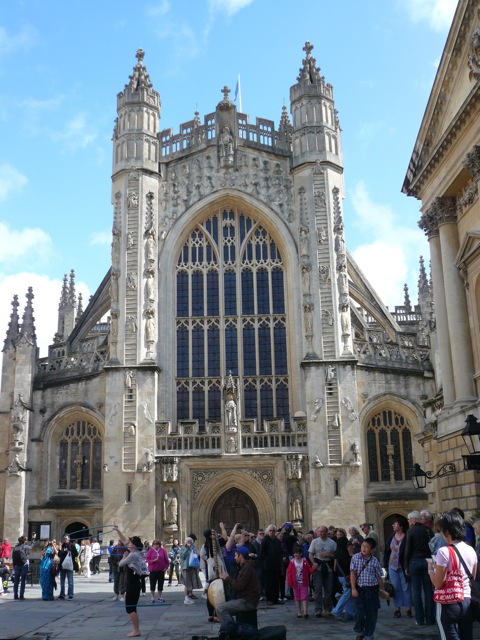
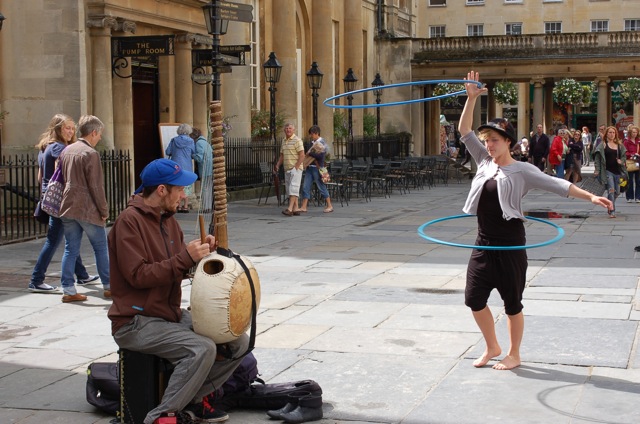
Today, the open area outside the Pump Room by the Roman Baths is perhaps the most popular tourist gathering place. Tour buses stop at the Bath Abbey for pick up and drop off, buskers perform in the open space outside the Roman Baths and Pump Room:

Nearby is Sally Lunn’s Bun, originated in 1680 by a young French refugee, in the oldest house of Bath, ca. 1482. Now a restaurant on top, the cellar a museum that houses the original kitchen and cookwares, Sally Lunn’s serves this traditional creation: a large, soft, round bun that can go with just about anything. But probably best like this, simply with garlic butter:

The beautiful street corner outside Sally Lunn’s:
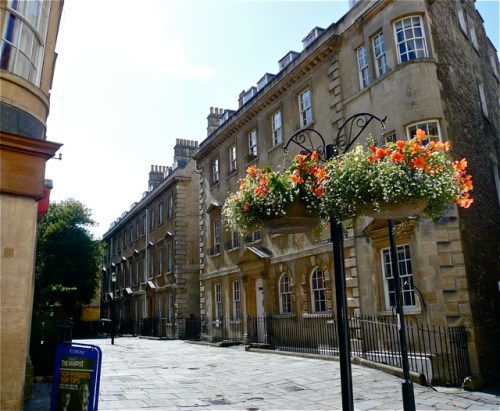
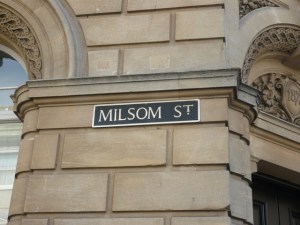
Further up the town, there’s Milsom Street, a vibrant commercial area of shops and businesses.  The first time Anne saw Captain Wentworth again in Bath was on Milsom Street.  Here’s a present day view of the same site:
.

As for Sir Walter himself, despite having to rent out his country mansion Kellynch Hall to avoid financial ruins, he has no intention that his retreat to Bath should compromise his status and comfort.  It’s only natural that others are curious: “What part of Bath do you think they’ll settle in?”  The answer is quite obvious: the part that is befitting their social standing.

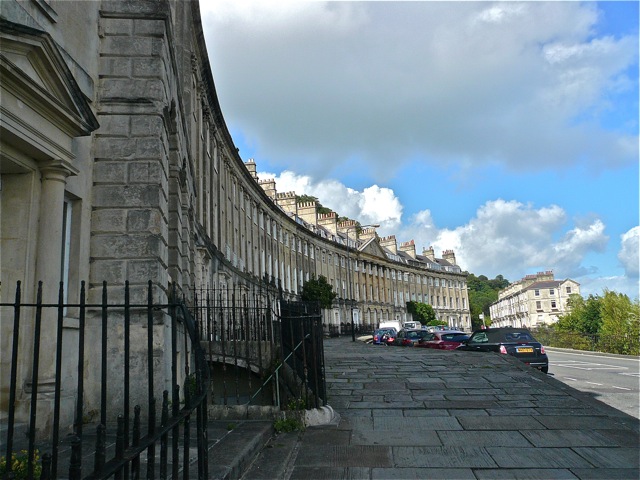
According to Keiko Parker’s insightful article, physical elevation in Bath directly corresponds to social standing. The highest point at that time would have to be Camden Place, which is today’s Camden Crescent. While I was looking for it, the ‘Ye Old Farmhouse Pub’ was mentioned to me as the marker. I was glad to find it while walking up Landsdown Road, for it was indeed quite an uphill walk.

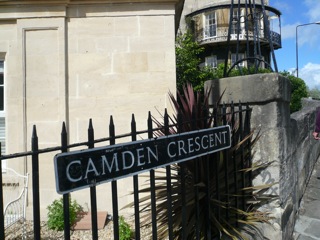
“Sir Walter had taken a very good house in Camden Place, a lofty, dignified situation, such as becomes a man of consequence; and both he and Elizabeth were settled there, much to their satisfaction.

Anne entered it with a sinking heart, anticipating an imprisonment of many months…” (p. 98)

Just typical Austen, the overt contrast of characters using something indirect, here, the sense of place.

The houses on Camden Crescent has unobstructive view of lower Bath.  They are not grand mansions, but then again, location is everything. The following are some of the houses found on this road across from the escarpment:

And where do Sir Walter’s tenants Admiral and Mrs. Croft lodge during their short stay in Bath?  On Gay Street, not too high, not too low: “… perfectly to Sir Walter’s satisfaction.  He was not at all ashamed of the acquaintance, and did, in fact, think and talk a great deal more about the Admiral than the Admiral ever thought or talked about him.” (p. 121)

Elizabeth is not even half as kind as her vain and snobbish father.  Regarding the Crofts’ arrival in Bath, she suggests to Sir Walter that “We had better leave the Crofts to find their own level.” (p. 120)

In contrast, Anne has a good impression of the Admiral and his dear wife, the kind and down-to-earth couple, Mrs. Croft’s being the sister of Captain Wentworth having minimal bearing on Anne’s fondness of them. During their sojourn in Bath to mend a gouty Admiral Croft, Anne enjoys watching them strolling together, “it was a most attractive picture of happiness to her.” (p. 121)

So I’m just not a bit surprised to see their temporary lodging in Bath being on Gay Street.  Who else had lived there?  Jane Austen herself: #25 to be exact:
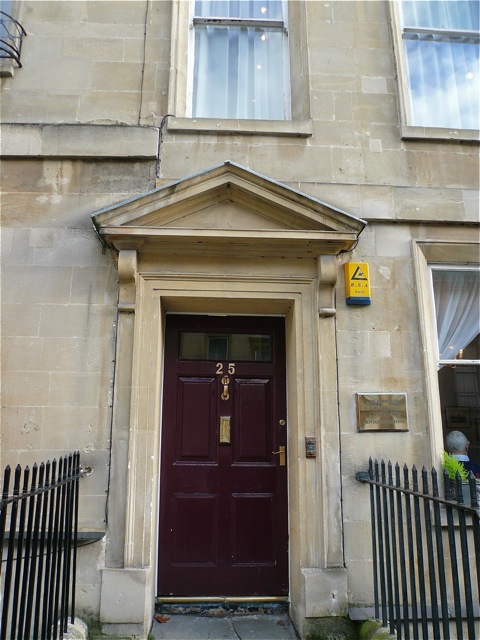
As for a suitable place for socializing, Sir Walter and his favourite daughter Elizabeth choose the Upper Assembly Rooms, a much newer development closer to their upper, more fashionable side of town, although he would prefer entertaining in private which is even more prestigious.

The Assembly Rooms are a magnificent architectural legacy in their own rights.  Designed by John Wood the Younger, who raised the £20,000 needed for the venture, the ground-breaking project began in 1769 and opened for public use in 1771.  It was the biggest investment in a single building in 18th Century Bath. Four public rooms made up the suite:  The Octagon, Ball Room, Card Room, and Tea Room.

“Sir Walter, his two daughters, and Mrs, Clay, were the earliest of all their party at the rooms in the evening; and as Lady Dalrymple must be waited for, they took their station by one of the fires in the Octagon Room (p. 131).

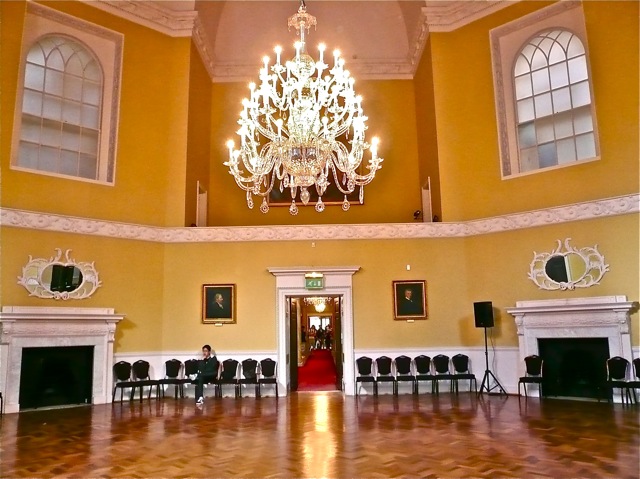
Here’s the exquisite Octagon Room:

Regarding the chandelier, there’s this interesting account in The Authorised Guide (p.7):

“On 15 August 1771 Jonathan Collett quoted £400 for supplying five cut-glass chandeliers for the Ball Room. They were up in time for the opening of the Rooms in September, but the following month disaster struck when ‘one of the arms of the chandilers in the Ballroom fell down during the time the company was dancing, narrowly missing  Gainsborough. What could be salvaged from the set was made up into a single chandelier, which now hangs in the Octagon.”

I was just simply amazed at how long these chandeliers had lasted, well over 300 years, and in excellent shape. Their brilliance had not faded, evolving from candlelight to gas, and now electric:

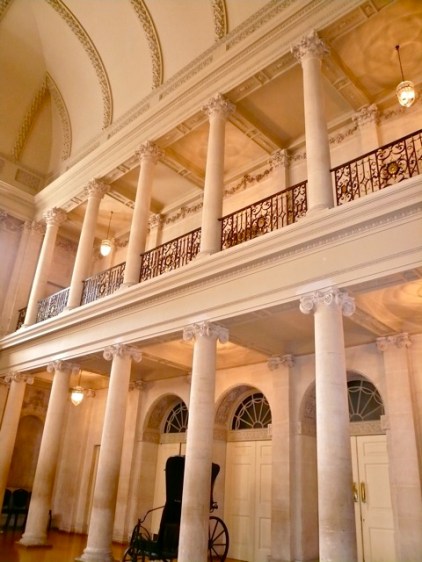
Anne and her party attend a music program in the Concert Hall.  That’s a function in the Tea Room. Despite the name which seems to convey a small and cozy setting, the Tea Room is a gorgeous room of 60 ft. by 43 ft. dimension.  On one end is a magnificent colonnade of the Ionic order.  Subscription concerts are regular events held in the Tea Room. Mozart and Haydn had written compositions to be performed there, with Haydn himself having graced the magnificent venue.
.
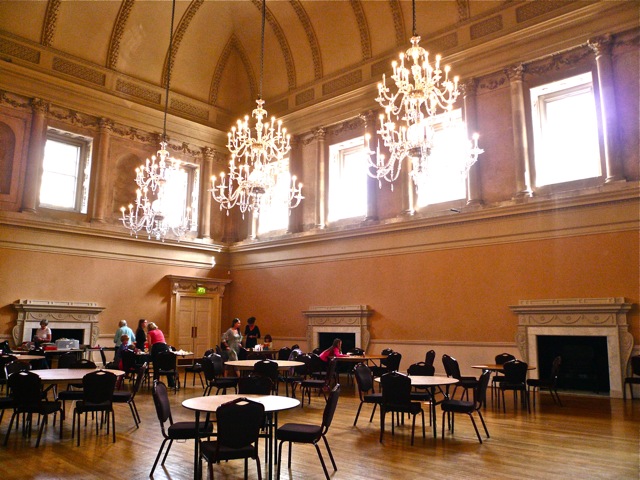
But what does Anne Elliot think about all the grandeur?  After earlier in the Octagon Room talking with Captain Wentworth, who has openly expressed his long-held passion for her, Anne, overwhelmed by a great flood of euphoria, now walks into the Concert Room (Tea Room):

“Anne saw nothing, thought nothing of the brilliancy of the room.  Her happiness was from within. Her eyes were bright, and her cheeks glowed; but she knew nothing about it.  She was thinking only of the last half hour…” (p. 134)

As a visitor to the historic venue, I was captivated by the well-maintained interior and its elegance, and presently amused and surprised to find this display in between two columns: The Chair, which is mentioned several times in Persuasion. The Bath Chair was invented right here in the Georgian City to transport the rich and the sick.  It could be steered by the passenger:

.

Jane might have noticed the frivolity and pierced through the façade of high society of the time with her critical eyes, but as a modern day tourist, I’m just amazed at how well history has been preserved, totally persuaded that Bath is a place I will definitely revisit some more in the future.

***

All photos taken by Arti of Ripple Effects, August 2010.  All Rights Reserved.

References:

1. Jane Austen: A Life by Claire Tomalin, Penguin Books, 2000.

2.  Persuasion by Jane Austen, The Modern Library Classics, Introduction by Amy Bloom, Modern Library Paperback Edition, 2001.

3. The Authorised Guide: The Assembly Rooms, Bath. Published by the Heritage Services division of Bath and North East Somerset Council in association with the National Trust.  Written by Oliver Garnett and Patricia Dunlop.

4. “What Part of Bath Do You Think They Will Settle In?”: Jane Austen’s Use of Bath in Persuasion by Keiko Parker.  Retrieved Online http://www.jasna.org/persuasions/printed/number23/parker.pdf

***

To join in the celebration of Jane Austen 200, I’ll have more Austen posts coming up this week.
Voicing out for ‘Silence’ and other adaptations

It’s a bit sad to see Martin Scorsese having had to defend the cinema. He wrote the piece in the May 31 issue of The Times Literary Supplement in response to the review of his film Silence by the novelist and literary critic Adam Mars-Jones. It is telling that the director didn’t write a defence of his film, but cinema itself.

Here’s the contentious viewpoints of Mars-Jones’s review, entitled “Subtle absolutisms”:

The transposition of a novel like Endo’s Silence into film, however “faithful”, can only amount to a distortion, an exaggeration overall however many elements of the book are represented.

and this:

In a book, too, reader and writer collaborate to produce images, while a film director hands them down.

Really? Is a movie, and in this case, Scorsese’s adaptation of Japanese writer Shūsaku Endō’s novel Silence, a piece of “subtle absolutisms” as Mars-Jones’s title suggests? Do viewers in the theatre have no say but to receive from whatever mood or themes the director hands down to them, devoid of ‘collaboration’? Has the director presented to us – subversively as the title implies – his interpretations and we remain as the silent, passive, unthinking targets?

We’ve heard it before, haven’t we, that a movie leaves no room for the imagination. We can see it all, so explicitly displayed, in actions, colour, and mood, while readers reading a book interact with the book author to create a mental picture as they read, exercising their imagination.

Silence (1)

Any regular visitor to the Pond knows Arti disagrees with such criticisms. Even a two-dimensional painting can evoke in viewers a myriad of responses, let alone moving pictures. And how we interpret and interact with such sequential, moving images can be as diverse and subjective as our personalities and life experiences.

If as Mars-Jones says “those images [have] their predetermined progress in a darkened space imposes mood insistently” and if Scorsese embeds his ‘subtle absolutisms’ so ingeniously, the film should bring out very similar responses, predominantly one, as Mars-Jones has concluded: “desolation.”

But as one who dwells in a liminal, in-between space of two cultures, I’ve come across very different reactions to the film Silence. Such could well be said are the results of internal collaborations viewers have had while experiencing Scorsese’s visual storytelling. Indeed, the film has aroused different responses across cultures.

Among Western critics, it’s usually the aesthetics, acting, cinematography, and mood that are the key features noted, as with Mars-Jones’s review. Many point out they’d like to see the roles reversed with the two actors Andrew Garfield and Adam Driver. Many have noted that the film is being ‘faithful’ to the book, however, falling short of discussing the significance of such ‘faithfulness’.

This is an important point when reviewing the film. I usually do not seek how faithful a film is to its original literary work, for the two are totally different art forms, each expresses in its own terms and the appreciation of such should not be measured using the same criteria. When it comes to Scorsese being ‘faithful’ to Endo’s descriptions and narratives, unlike Mars-Jones’s critique of ‘exaggeration’, I find the director is unusually restrained here. He follows closely with Endo’s narratives, his treatment of the persecutions of Japanese Christians poignant and heart-stirring, inferring meaning rather than exposing gratuitous images. All such restraints point to Scorsese’s admiration and respect for the author and his work. At times, I feel Endo’s writing even more graphic.

On the other hand, among Asian viewers, especially among Chinese Christians (overseas and in Hong Kong), the film stirs up deep, theological resonance. Many have shared their heartfelt responses in the print and social media, heated debates ensue among believers, and even from the Sunday pulpit. The film’s characterization emerge as the prime subject for debates: Is Father Rodrigues a true Christian? Can apostasy be pardoned in the face of coercion? What does the last scene tell us about Rodrigues? Can one lead a two-faced, dichotomized life of faith like the hidden Japanese Christians? Or with some, the film has prodded the reflexive to see oneself in the Judas character Kichijiro. A call for empathy for those under authoritarian pressures to give up their faith appear to be an unexpected result, albeit the other side would push for perseverance no matter what.

Rather than the overhanging cloud of near desolation as Mars-Jones points out, the film had stirred up ripples of vibrant discussions around the issues of salvation, suffering, apostasy, betrayal, denial, and redemption. Many of the views I’ve read reflect a pleasurable gratitude as having indulged in a thought-provoking film well made, their faith energized as they ponder on soul-stirring applications to their life.

Perhaps there’s a Roland Barthes parallel here. The death of the author comes after a piece of work is written, for it has reached its destination. Now it’s the reader’s turn to interact and give it meaning. Maybe it is so with film as well. As the director completes his production, it is given a new state of being when it is screened. As viewers interact with it, interpreting and extracting personal meaning, appreciating those elements that strike a chord with their own life experiences, they’re giving life to it in the cinema of their minds.

***

RELATED POSTS ON RIPPLE EFFECTS:

Reading the Season: Silence by Shusaku Endo

Silence the movie arrives in the most unwelcome time

Can a movie adaptation ever be as good as the book?


Two Films for Thoughts at Easter

I’ve tried different words for the title: Two films for the uninterested, indifferent…

So you think Easter is too maudlin an occasion for you. You’re not fond of bunnies, nor church services, and this talk about death and new life has become too clichéd. That’s ok. How about watching a couple of films? No, not Mel’s Passion, you know how the story goes. Something different.

First is a rather tame one. Previously on Ripple, I’d written about the book by Georges Bernanos’s The Diary of A Country Priest (1936), here’s the film adaptation (1951). Watch it for its artistic values and for the appreciation of a French film legend, Robert Bresson.

Robert Bresson is one of the most influential figures in French cinema. The acclaimed New Wave director Jean-Luc Godard once noted: “Robert Bresson is French cinema, as Dostoevsky is the Russian novel and Mozart is German music.”

I know, Austrians would say Mozart was Austrian, but this just shows his influence has crossed borders. Same with Bresson, who is acclaimed as one of the forefathers of the French New Wave, even though his style is not experimental. Swedish iconic director Ingmar Bergman had specifically cited Diary of a Country Priest as influence for his Winter Light.

Do note this: Bresson was a professed agnostic. His adapting a work by the Catholic writer Bernanos shows the moving power and the universal appeal of the book. The parish of Ambricourt in the story is a microcosm of the human world. The seemingly placid village hides a spiritually barren landscape and a cocoon of malice. The young priest, an unwelcome alien, is barred from entry into the inner world of its residents.

the-gate-of-le-chateau

Watch for its cinematography. Watch for its symbolism. I won’t go into details again. CLICK HERE to read my full review after you’ve finished this post.

***

A 1951, black and white film may not pique your interest. Here’s a modern version, and a word of warning: Definitely not for the faint of heart.

Calvary.jpeg

Calvary, the acclaimed 2014 Irish film written and directed by John Michael McDonagh (The Guard, 2011). It won the Prize of the Ecumenical Jury at the Berlin International Film Festival that year among other accolades, and Brendan Gleeson garnered several Best Actor awards in the festival circuit.

Unlike the young priest in Diary, Father James (Brendan Gleeson) chooses to enter the priesthood in his middle age. He was married before, now a widower, has an adult daughter Fiona (Kelly Reilly). He has his past, but has made a clean start, to serve with integrity in an Irish rural town. Like the young priest in the French town of Ambricourt, Father James’ sincerity and total commitment is met with ridicule and hostility, albeit on the surface, the town folks seem to be relatively friendly to him.

How has the world changed since Bernanos’s time? Plenty, not just for the way people conduct their lives, but the Catholic Church has left a tarnished image of sexual abuse.

The opening scene sets an ominous overtone of what’s to come. It is Sunday, Father James sits in the confessional. On the other side a man tells his story explicitly of being raped by a priest when he was seven years old. That horrifying experience lasted for five years almost every other day, rendering him irreparably damaged. He utters a death threat to Father James: one week later he will meet him on the beach and he will kill him.

Why kill Father James? He’s an innocent priest, a good one as a matter of fact. The man says: “There’s no point killing a bad priest. But killing a good one? That’d be a shock. They wouldn’t know what to make of that. I’m going to kill you cos you’ve done nothing wrong.”

Retribution for the crimes of the Catholic Church? Resolving personal bitterness? Administering justice?

A startling opening that turns into suspense as the film progresses. Father James recognizes the voice. He knows who he is, but we as audience don’t. The director leads us to look into the lives of several characters, allowing us to ponder who it is that wants to kill the priest. Sounds familiar? “Lord, who is it?” But Father James knows, and he still treats the man with a pastoral heart.

“I’m going to kill you cos you’re innocent.” Every day of the week, Father James lives with that threat. Each passing day sends him closer to the hill called Calvary. But Father James goes on with his work, caring, being a friend, ministering, including to his own daughter who has recently attempted suicide. He is heartbroken; she feels she can go on now knowing he cares.

Not saying that he’s a saint. How can you live with such a threat from a man who seems to mean business. Father James is all too human… and that’s the side that appeals. To say it’s been an eventful week is an outright understatement. Things just get too personal, and Father James copes with all the wits he can muster. He needs not turn water into wine, there’s plenty around. He waits. We wait.

Then Sunday comes. He prepares himself and heads to the beach.

The very last scene is one of the most heart-wrenching endings I’ve seen, and it’s not at the beach, not with Father James.

It’s about the ripple effects of Calvary: one man bearing the sins of all.


~ ~ ~ ~ Ripples
for both films

***

Related Posts on Ripple:

Robert Bresson’s Au Hasard Balthazar (1966): A Timeless Parable

Ida’s Choice: Thoughts on Pawlikowski’s Ida (2013)

Homage to Flannery O’Connor: Looking for Intrusions of Grace in Films

Diary of a Country Priest by Georges Bernanos

I return to The Diary of A Country Priest by French author Georges Bernanos, (Journal d’un curé de campagne, 1936) perennially at Easter time. Like Endo’s Silence, it reveals candidly a priest’s suffering and struggles in the midst of a harsh and unwelcome world. Unlike Silence though, light shines through the cracks more warmly. Power through weakness, life conquering death, the essence of Easter.

***

The Diary of a Country Priest Book Cover

A young priest comes to his first parish, the rural town of Ambricourt, filled with humble hopes. All he wants is to serve the people, to give of himself, to bring God’s love. But as soon as he sets foot in the village, he is engulfed by hatred and rejection. There are dark secrets too sinister to be exposed. The young priest is an unwelcome alien. In a town afflicted by hypocrisy, pride, anger and bitterness, he is despised, taunted and ridiculed. His own inexperience is no match even for the children in his catechism class, especially the precocious Seraphitas, a girl ‘with a hardness far beyond her years.’

Ambricourt is a world afflicted by the ‘leprosy of boredom’, a microcosm of the human condition. Bernanos uses diseases to illustrate his point well. The young priest himself is being slowly consumed by terminal illness. The pain in his stomach ultimately defeats his body, cancer. His diet consists mainly of bread dipped in wine which he makes for himself, and some potato soup. Poverty in materials parallels the frailty of his body to take in solid food. None of these though can compare to the sufferings in his spirit. Many a times we see him in the Garden of Gethsemane, pleading for strength in anguish. But he faithfully presses on, using his diary to confide his deepest thoughts, a means to commune with his God.

On the outskirt of Ambricourt is the Château of the powerful M. le Comte. The Count needs no priest to know about his adulterous affairs, this time, with the governess Mlle Louise. His wife Mme la Comtesse is totally absorbed by her long-held bitterness and grief from the loss of her young son. And his daughter Mlle Chantal is a deeply disturbed girl eaten up by anger and jealousy. Soon, she will be sent away to England, a most convenient plan devised by her father.

It is with this deep mess of a family that the young priest finds himself entangled. The most intense scene of the whole book, the climatic moment, comes when the priest goes to the Château to meet with Mme la Comtesse. She lost her beloved son when he was only eighteen months old, a child hated by his jealous older sister Chantal.

On his last day they went out for a walk together. When they came back my boy was dead.

Mme la Comtesse is fully engulfed by hatred for her daughter, grief for her lost son, and bitterness towards God.

Hearing her speak, a tear flows down the face of the young priest. “Hell is not to love any more, madame.” The young priest responds. And with miraculous strength, he delivers the following words.

… But you know that our God came to be among us. Shake your fist at Him, spit in His face, scourge Him, and finally crucify Him: what does it matter? It’s already been done to Him.

Towards the end of some soul piercing exchanges, Mme la Comtesse kneels down, releases her pain, and receives blessings from the young priest. Afterwards, she writes to him in a letter:

… I have lived in the most horrible solitude, alone with the desperate memory of a child. And it seems to me that another child has brought me to life again…

And this young child, a priest, consumed by illness, wreaked by frailty of spirit, can only marvel at the power through weakness:

Oh miracle — thus to be able to give what we ourselves do not possess, sweet miracle of our empty hands!

Not long after this, he succumbs to his illness. A life too short, a mission seems unaccomplished. But his last words faintly uttered on his deathbed are as powerful as the God who sends him:

Does it matter? Grace is everywhere…

And in the film, these three words leave me with one of the most poignant endings of all the films that I’ve seen:

“All is grace.”

 ***

~ ~ ~ ~ Ripples

English Edition of The Diary of a Country Priest by Georges Bernanos, translated by Pamela Morris, Perseus Books Group, Philadelphia, PA, 1965, 298 pages.

Journal d’un curé de campagne, 1936, was winner of the Grand prix du roman de l’Académie française.

Upcoming Post:

The Film Review of Robert Bresson’s Diary of a Country Priest (1951).

Related Post:

Silence the Movie Arrives in the Most Unwelcome Time

Silence by Shusaku Endo


Do Not Say We Have Nothing Book Review

April 3rd UPDATE: Do Not Say We Have Nothing shortlisted for the Baileys Prize.

***

First the Booker, then the Giller and the GG, and now longlisted for Baileys Women’s Prize for Fiction, this voice must be heard. I thank Asian American Press for allowing me to post my review here in full, and Penguin Random House Canada for my reviewer’s copy.

***

Just a few months after it was published in May, 2016, Madeleine Thien’s Do Not Say We Have Nothing was shortlisted for a Booker Prize and had won the top two Canadian literary awards, the prestigious Scotiabank Giller Prize and the Governor General’s Award for fiction. That is extraordinary achievements for the Vancouver born, Montreal based writer.

Thien creates her third novel on a large canvas, spanning from the decades leading to Mao’s Cultural Revolution in 1960’s China and onward to the Tiananmen Square protests and government crackdown in 1989. Even though her novel does not stem directly from a personal experience like others’ such as Dai Sijie’s semi-autobiographical Balzac and the Little Chinese Seamstress, or the eye-witness account of journalist Jan Wong’s Red China Blues, Thien’s outsider’s stance is far compensated by her extensive and detailed research, not just 20th Century history of China but down to the streets and local teahouses. Further, the absence of a first-person experience is replaced by an exuberance of imaginary characters and storytelling, all intricately woven with actual accounts of historical figures and events.

While not being an eye-witness, Thien’s cultural lineage could have brought her into a kind of insider’s realm. Born to Malaysian-Chinese immigrant parents in Canada, Thien’s previous writing had depicted the unique perspective framed by her upbringing. The stories in her collection Simple Recipes (2001) have revealed poignantly the cultural and generational conflicts that could exist in a North American Asian family. Further, Thien’s previous novel Dogs at the Perimeter (2011) had prepared her well to venture into the abyss of human atrocity, with the backdrop of Khmer Rouge’s infamous killing fields in Cambodia. Do Not Say We Have Nothing presents a larger landscape and a more ambitious undertaking than her previous works.

Madeleine Thien

This is how the book opens, simple yet powerful:

“In a single year, my father left us twice. The first time, to end his marriage, and the second, when he took his own life.”

Here we hear a voice, seemingly nonchalant, but still lucid and sad. This is the voice of the protagonist, Marie. She was ten years-old and living with her mother in Vancouver when she learned of her father’s suicide in Hong Kong. The year was 1989. Not long after this news, Marie’s mother took in nineteen-year-old Ai-ming from China, alien and undocumented, escaped out of the country during the Tiananmen crackdown.

Ai-ming’s short refuge in Marie’s home bonded the two like sisters. As well, she opened the eyes of young Marie to life inside a totalitarian regime. The radio played only eighteen pieces of approved music. Her father, Sparrow, would listen to illegal music secretly and hum the melody of his own composition when he thought no one was around. Ai-ming’s interactions with Marie have prodded her—now twenty years later and a professor of mathematics at Simon Fraser University—to search for the truth about her father Kai and his mentor, Ai-ming’s father Sparrow, as well the tragic personal and national history that had consumed their lives.

With Ai-ming’s help, Marie and her mother began to decipher a secret hand-copied manuscript Kai had kept, “The Book of Records”, passed on to him from Sparrow, an allegorical account of their life in China, outward journey and clandestine dreams, “things we never say aloud”. As a young child, Marie was overwhelmed. Now as an adult, she is driven all the more to pursue the truth of her own family history.

It is not easy to follow Thien’s story in the first few chapters as there are many characters introduced with their own backstory. Time frame switches back and forth, spanning two continents. As I entered Chapter 4, I had to draw up a character chart, as I was looking into a kaleidoscope of three generations and other colourful figures against tumultuous events. If the book had included such a chart at the beginning, it would be most helpful for readers.

We follow Marie’s discovery as she comes to learn that her father Kai used to be a gifted piano student at the Shanghai Conservatory of Music, and Sparrow, a prominent composer, was his teacher there. Together with Sparrow’s young cousin Zhuli, a prodigious violin student, the three forged an unspeakable bond. They cherished each other’s dreams with youthful fervors, which all were altered if not extinguished when Mao ignited his Cultural Revolution.

When she was small, Zhuli discovered by accident her parents’ secret storage where they hid their treasures of western classical music records and books. This led to her parents, Swirl and Wren the Dreamer, to be charged as counter-revolutionary. They were publically criticised and humiliated, then sent to separate labour camps in the remote northwest of China in the name of ‘re-education’. Zhuli was taken secretly to her aunt, Big Mother’s Knife, Sparrow’s mother, and there she grew up. The woman who brought her there had met her aunt only once while on the train. As she ate a lot of the White Rabbit brand candies, we know her by that name. The White Rabbit told Zhuli about her parents’ situation matter-of-factly:

“They’ve been sent for re-education, that’s all… Since you’ve never been educated at all, it seemed pointless to send you along with them.”

This is just one incident where Thien deftly dispenses humour amidst somber events. This is what makes the book enjoyable to read. The subtle humour often is the wrapping of the resilience of human spirit hidden among tragic happenings.

Thien’s story is embedded in historical facts. The prestigious Shanghai Conservatory of Music was shut down in 1966 during the Cultural Revolution, its five hundred pianos destroyed, denouncement and physical battering of the professors and students had resulted in deaths and suicides. Bearing the brunt of the persecution was the unyielding Conservatory President He Luting, beaten but not bent.

Due to their political affiliation, Sparrow’s parents Big Mother Knife and Ba Lute are spared, but what remains in Sparrow is a compromising existence, being sent to work as a factory work for twenty years after the shutdown of the Conservatory. Kai the pragmatist chooses to follow the mainstream and becomes a Red Guard. Young Zhuli sets foot on a tragic path.

With such a setting, it is only natural that Thien would use classical music as the leitmotif of her composition. Shostakovich, Beethoven and Bach are like witnesses to the unfolding of human atrocity, their melodies the fuel that sustains whatever internal fervour that remains. Shostakovich, himself a composer treading a precarious line between authenticity and self-preservation under Stalin’s rule, is an apt metaphor of the situation the trio have to face. The different choices made by Sparrow, Kai and Zhuli well represent the paths that are opened to an artist facing political persecutions.

On another note, and true to her Canadian root, Thein lets pianist Glenn Gould and his two recordings of Bach’s Goldberg Variations be a recurring motif in her story. Bach’s ethereal and invigorating theme and variations belong to Sparrow, the sustenance for his inner life despite deadening circumstances outside.

As the canvas is huge, Thien’s subject matters are numerous. The details and complexity may be a hindrance to readers’ enjoyment. Yet Thien’s voice is close and personal. Do Not Say We Have Nothing, the title taken from the workers anthem the ‘Internationale’, deserves our listening ears. As an instructor of the then newly established MFA Program in Creative Writing at City University of Hong Kong from 2010, Thien experienced first-hand the abrupt cancellation of the program in 2015 “as a result of internal and external politics” as stated in her Acknowledgement at the back of the book. In her article in The Guardian (May 18, 2015), she notes that students from the Program had published essays in support of the Occupy Central student-led democracy movement, the ‘Umbrella Revolution’, that brought Hong Kong to a standstill. That personal experience could well have informed and given her the potent, insider’s voice in her novel writing.

***

~ ~ ~ ~ Ripples


New Announcements of Books to Screen

Some exciting announcements of upcoming adaptations:

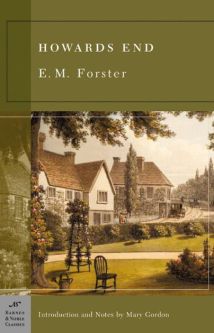
howards-end-by-e-m-forsterHowards End by E. M. Forster

E. M. Forster’s 1910 novel Howards End is to be adapted into a four-part TV miniseries produced by BBC and Starz, to be helmed by the Oscar nominated Manchester by the Sea director Kenneth Lonergan. Hayley Atwell plays Margaret Schlegel, Matthew Macfayden takes the role of Henry Wilcox, and Tracey Ullman is Aunt Juley Mund. I just can’t help but compare this new cast to that of the, shall I say, definitive 1992 Merchant Ivory production with Emma Thompson, Helena Bonham Carter, Anthony Hopkins and Vanessa Redgrave. Inimitable. Yet, I’m glad to hear of a rebirth of this brilliant E. M. Forster novel.

.

guernsey-literary-and-potato-peel-pie-societyThe Guernsey Literary and Potato Peel Pie Society by Anne Barrows and Maryanne Shaffer
At long last, the best-selling novel (2009) is finally adapted for the big screen, renamed Guernsey. Phew! While its popularity has subsided by now, I hope the movie will revive it, for it’s a delightful read and the characters are resilient residents on German occupied Guernsey Island during WWII. Written as a series of letters between a London writer Juliet Ashton and her friend and publisher Sydney Stark and later, with the charming Guernsey folks, the book exalts the power of reading, not potato peeling. How do you turn epistles into a movie? We’ll have to see. Downton Abbey‘s Lily James will play Juliet, after first Kate Winslet then Rosamund Pike dropped out. Hope this will go to completion. The director is Mike Newell, known for Great Expectations (2012), Mona Lisa Smile (2003), and perhaps the most memorable, Four Weddings and a Funeral (1994).

.

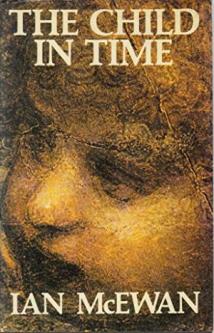
the-child-in-timeThe Child in Time by Ian McEwan

At last something to look forward to after Downton. Ian McEwan’s Whitbread winning novel (1987) about the perpetual trauma of a lost child will be adapted into a 90 min. TV drama co-produced by BBC and Masterpiece. Benedict Cumberbatch to star. With the Sherlock series going down an erratic rather than rational path, I hope this one is a more grounded outlet for Benedict’s superb acting skills, like his Parade’s End (2013). This is his second time in a McEwan novel. Back in 2007, he played a supporting role in the Oscar nominated Atonement, relatively unknown, stressing on the ‘relatively’. And hats off to actors who can navigate freely between the big and small screen platforms.


.

51p921wTKtL._SX308_BO1,204,203,200_ (1).jpg

The Sea Change by Elizabeth Jane Howard

Glad to learn that Kristin Scott Thomas (I’ve Loved You So Long, The English Patient) is stepping out from her long acting career into the director’s chair, and acting too in this adaptation of English author Elizabeth Jane Howard’s novel. While I haven’t read any of Howard’s works, I’d seen the screenwriter Rebecca Lenkiewicz’s, and that’s her screenplay for the Oscar winning Polish film Ida (2013). I highly anticipate Lenkiewicz’s new work. Glad she’s collaborating with Scott Thomas in her directorial debut. Mark Strong is said to be in talks to join the project. Of course, my dream cast would be Colin Firth with Kristin Scott Thomas.


.

crazy-rich-asians

Crazy Rich Asians by Kevin Kwan

According to director Jon Chu (Now You See Me 2), this will be “the first all-Asian cast feature from a Hollywood studio in a long, long time.” Umm… since Joy Luck Club (1993) that is. A risk or a good opportunity? Constance Wu (TV’s “Fresh Off the Boat”) is on board to play a major role. If you’ve not read the book, rest assure that with a title like this, it has got to be a satire, and not a get-rich-quick manual. Not that I’m crazy, nor rich, but reading Kwan’s imaginary yet true-to-life characters is an extravagantly wild ride. His astute and bold satire of modern day’s opulent Singaporean families (his own cultural background) is what Jane Austen would have loved to poke fun of if she found herself in a 21st century rich Asian home. But of course, just like the writing of our dear Jane of yesteryears, the heroine (Rachel in Kwan’s book) is your everyday middle class, highly educated yet modest gal growing up in (immigrant) America, finding (surprise!) that her boyfriend actually is Mr. Darcy incognito when she travels back with him to his family home in Singapore for the wedding of his best friend. I highly anticipate this one, but with great trepidations. They better make this work, or it could easily be a disaster of ethnic proportions.

***

Related Post on Ripple Effects:

Howard’s End by E. M. Forster
Ida’s Choice: Thoughts on Pawlikowski’s Ida
I’ve Loved You So Long movie review
The Guernsey Literary and Potato Peel Pie Society Book Review