The Portrait of a Lady, Sequel, Remake(?)

The Portrait of a Lady by Henry James

First, thanks to Bellezza’s open invite to a read-along, posting the photo of John Banville’s newest book Mrs. Osmond, a sequel to The Portrait of a Lady by Henry James. I’d seen the 1996 movie adaptation directed by Jane Campion (The Piano, 1993), but had never read James’s novel. What better time to read both books than now.
The Portrait of a Lady

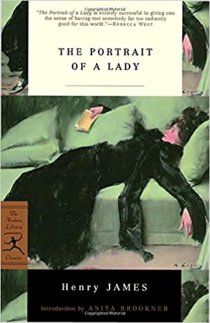
I got hold of The Portrait of a Lady (Modern Library, just love the cover) read part of it then turned to a sound recording (unfortunately couldn’t find the Juliet Stevenson narrated version). Prompted by JoAnn, I interspersed reading with listening and gleaned much pleasure doing that. Here’s my very short, 5-Star Goodreads review:

“Actually I was listening to the Blackstone Audio version of the book as well as reading  parts of the book to ascertain facts in the story or just savour the passages again. James’s portrait of Isabel Archer is one of the saddest fictional heroines I’ve come across. A reminiscence of Anna Karenina emerged as I read the latter part, but Isabel is a character much more likeable for me. Should she be destined to a ruined life due to a naive misjudgement, ok, maybe even foolishness, by marrying Gilbert Osmond? Osmond is evil personified, and I just can’t shake off the face of John Malkovich (from the movie) whenever I read about his cold, domineering hand over Isabel. Isabel definitely needs redemption and saving grace. So I do hope John Banville’s Mrs. Osmond will grant her that.”

The Portrait of a Lady by Jane Campion

Since the image of John Malkovich kept creeping up my mind as I read the book, I quickly turned to the movie adaptation right after I finished the book. I remember I was most disturbed by Osmond’s callous treatment of Isabel when I first watched it years ago; he appeared as a chilling, silent villain, bullying his innocent victim mercilessly. His stepping on Isabel’s floor-length dress to stop her from walking away was still vivid in my mind.

Nicole Kidman

Now as I saw the movie again, I find the feature more style than content. The tilted camera shots? A bit contrived. Malkovich is still evil, and Kidman still the innocent victim, but there isn’t much complexity in the characterization. The editing and much abridged dialogues leave a vacuum. Considering the rich descriptive prowess of Henry James, much is left to be desired in the film. Yes, I’m one who advocates for the appreciation of books and films as two different art forms, and should not be doing a literal comparison when judging the adaptation. Well, I’m not. I’m weighing the film on its own merits. Yes, set design is rich and some artistic shots, but overall pales despite the sumptuous colours. And, what happened to Nicole Kidman’s hair? As much as I’d appreciated Campion’s works, especially her Oscar winning (Best Original Screenplay) film The Piano, I do feel maybe it’s a good time to do a remake of The Portrait of a Lady.

Mrs. Osmond by John Banville

After the movie I turned right away to Banville’s book. Here’s my review on Goodreads:

Mrs. Osmond

“I jumped to this book right after reading Henry James’s The Portrait of a Lady. As I understand this new work of Banville’s to be a ‘sequel’ to James’s book, I had high expectations of the Booker winning author carrying Isabel Archer’s (Mrs. Osmond’s) story forward, taking her through twists and turns and eventually letting her find redemption and a new life. However this was not to be exactly as I’d envisioned.

Mrs. Osmond is divided into two Parts. Maybe for the benefit of those who haven’t read or reread The Portrait of a Lady in preparation for his book, Banville retells James’s story in Part I. While he’s very detailed in his descriptive style, and to his credit, creeping inside the minds of his characters, he repeats himself frequently in reminding his readers how Isabel Archer got deceived by Madame Merle and fell into the marriage trap of Gilbert Osmond’s. So basically the story remains static throughout Part I.

(Spoiler Alert in the following)

Part II leads us to Isabel’s own scheme of turning the tables on Osmond and Merle, and let them have a taste of their own medicine by just transferring the ownership of her residence the palazzo in Rome over to Madame M. and let the culprits be trapped with each other. That’s all there is to her plan, and it’s an expensive vengeance. As for her own dear life and its purpose for the remains of her days, the path is as obscure as before, albeit Banville has dropped a hint of the suffrage movement being a meaningful direction.

While Mrs. Osmond may not be as gratifying as I’d expected, this is an interesting concept, taking literary classics and imagining a sequel. Now that could lead to a brave new genre of fiction writing.”

A Movie Remake, anyone?

If there’s one, who’d you like to see playing the role of Isabel Archer? Gilbert Osmond? Madame Merle? Director?


***


Related Post:

Can a movie adaptation ever be as good as the book?


Don’t just drive past Three Billboards

Three Billboards outside Ebbing, Missouri is a ‘Coen-esque’ feature with Fargo (1996) star Frances McDormand. This might well be one of the better Brit-U.S. collaborations in recent, tumultuous years. And McDormand just might head to another Best Actress Oscar win after Fargo.

Caution: The following discussion involves a minor spoiler. Not so much a spoiler in plot but in idea. I can’t be more obscure in reviewing the film if I’m to delve into meaning.

***

In British writer/director Martin McDonagh’s debut feature In Bruges (2008), the main character, a hitman, Ken (Brendan Gleeson), explains to his angry crime boss Harry (Ralph Fiennes) why he didn’t kill his young protégé Ray (Colin Farrell) as Harry had ordered, saying: “He has the capacity to change. We all have the capacity to change.”

Three Billboards outside Ebbing, Missouri is McDonagh’s damatization of this pivotal idea in full force: We all have the capacity to change. Viewers may not like the characters or their speech, but the dark comedy leads us to the point where we’ll find it worthwhile to hold our judgment, no matter how despicable they behave or speak. And that is the main reason for the gratifying ending of Three Billboards: Change. A change from distraught to calmness, from tension to release.

three-billboards-poster-2

Indeed, language is the spoken expression, the tip of the iceberg. What lies beneath and beyond language is the essence of a character. McDonagh’s script is starkly effective in presenting the different sides of his characters. Not that we should make excuses for their wrongs, but that everyone has a backstory and a present reality to deal with.

Mildred Hayes (Frances McDormand) has lost her teenage daughter Angela (Kathryn Newton) to a most violent, horrific crime, ‘raped while dying’. She is frustrated by the inability of the police to bring in any arrests. The three billboards she pays for outside Ebbing, Missouri advertise to the world her rage, targeting police chief Willoughby (Woody Harrelson). It’s her intention that the publicity they draw could lead to some effective police actions.

McDonagh is apt to instil humour into the sombre subject matter. The dialogues are sharp and the actors deliver. Call it a dramedy if you will, but the spontaneous laughters generated in the theatre are bittersweet, for they are acerbic depiction of racism, injustice, and the grieving rage of the unconsoled.

The three billboards pit Mildred against the town except for her co-worker Denise (Amanda Warren) in the gift shop and an admirer James (Peter Dinklage) in the bar. Her action has put her otherwise devoted son Robbie (Lucas Hedges) in an awkward position in school and inflamed her ex Charlie (John Hawkes), whose 19 year-old girlfriend Penelope (Samara Weaving) is totally oblivious to what’s going on in town. Dixon (Sam Rockwell) from the police station shows his utter disgust with unchecked impulses.

While the ensemble cast deserves kudos, the pivotal acts fall on three characters. Their superb performance augments the incisive and thoughtful script.

McDonagh wrote the role of Mildred Hayes with Frances McDormand in mind, and she delivers with a punch. Her actions as an angry and helpless mother is stark and brutish, but McDonagh also shows us her vulnerable side, a mother who is regretful of the argument she’d had with her daughter on that fateful day, mournful for a daughter who’d never come home, and embittered by the ineptness on the part of the police. McDormand indwells her role so effectively that she makes me see only the angry Mildred, and totally forget the pregnant, innocent police woman in Fargo.

Sam Rockwell’s dimwitted, racist Dixon stirs up non-stop laughs in the theatre. His ultimate change is the powerful force that makes the latter half of the story so gratifying.  Rockwell’s performance is spot-on. McDonagh wants us to have a last laugh on him too: Dixon’s heart may have melted by some kind, motivating words from chief Willoughby, but his intellect remains intact.

Woody Harrelson plays Chief Willoughby with a heart. He is a tough police chief and yet underneath is a kind man, a loving husband to his wife Anne (Abbie Cornish) and a devoted father to his two young girls. Furthermore, Mildred is not the only one bearing life’s harsh blows. While Mildred reacts with rage, Willoughby deals with repressed fears.

A few kind words can cause immense change. And when one person changes, the ripple effects are contagious. The latter part of the film with its twists and turns slowly reveal how positive changes ripple on. For often underneath the hard surface lies a moldable heart. I particularly appreciate the audacity of McDonagh’s writing. Among the tough and macho, love is noted as the key to hold up oneself as love leads to calmness, and calmness to thoughtful actions.

Tying up the emotional bond is the music, in particular, the Irish folk song “The Last Rose of Summer”. Thomas Moore’s lyrics and the soft yearning of Renée Fleming’s voice sings out the sad tune in Mildred’s heart, a cry for justice and the dispelling of emptiness and loss. In the opening scene, the song introduces us to the three billboards as Mildred drives by and contemplates her vengeful scheme, the song reprises as vengeance engulfs a distraught heart and leads to a violent act. Ironically, that scene becomes a pivotal turnaround for Dixon in the police station.

‘Tis the last rose of summer left blooming alone
All her lovely companions are faded and gone
No flower of her kindred, no rosebud is nigh
To reflect back her blushes and give sigh for sigh

The juxtaposition of a quiet Irish folk tune with a fictional, small American town dealing with the fallouts of a horrific, unsolved crime may sound incompatible, but it’s poignant and effective here.

Old loves are irreplaceable, yet regrets cannot heal deep wounds. Lovely companions may have faded, but new ones can be forged, albeit not the same nature, but there’s  hope for new bonds. The last rose of summer dissolves to the first red leaf of fall. It could still be a beautiful season.

~ ~ ~ ~ Ripples

The Shape of Water is all Enfolding

In his review of Guillermo del Toro’s Pan’s Labyrinth (2006), Roger Ebert described it as a fairy tale for adults. Well Roger, the director of fantastical cinematic imagery has given us another one. Compared to Pan’s Labyrinth, this is a simpler and less horrifying tale. The Shape of Water is a delightful love story with a gratifying, requiting end.

The Shape of Water is set during the Cold War, in 1962 U.S., inside a high security, science research centre. Richard Strickland (Michael Shannon) oversees a new arrival from the Amazon (South America that is), a monstrous beast, and if he cares to really examine the creature with an appreciative eye, a beautiful Amphibian Man (clandestinely played by Doug Jones). Yes, the reverse of Hans Christian Andersen’s The Little Mermaid.

In the research centre is Dr. Holffstetler (Michael Stuhlbarg), who has to tend to his covert mission, it is the Cold War after all, but from a scientific point of view, does have an appreciative eye for the creature.

The Shape of Water (1)

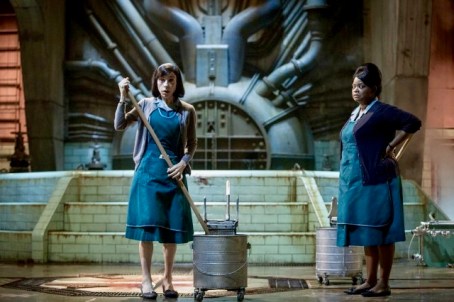
At the bottom of the rung are the janitorial staff, Elisa and Zelda, and with them the story comes alive. Sally Hawkins and Octavia Spencer’s duo performance is worth your movie ticket. They are the heart and soul of the story, something which the villain lacks. As a fairy tale, we can identify who that is right away, and the irony of who the monster is quickly becomes apparent.

Elisa is mute, she cannot speak but can hear what you say, so be careful. She knows a language that you’ll need a translator to understand, so be careful about that too. Thanks to Zelda, her official interpreter, she knows what not to translate as Elisa speaks her mind to ruthless Strickland.

Elisa’s neighbour is Giles (Richard Jenkins), an artist who does appreciate the Amphibian Man. He is of immense help to Elisa, a faithful friend to her despite endangering his own life. As a fairy tale, we see the good among the characters in sharp contrast to the villain.

As she cleans the facility, Elisa soon comes to appreciate the Amphibian Man, and the creature soon relates to her as she is, not as a handicapped, low-ranking cleaner. The two forge a bond stronger than any dangerous obstacle. The film moves into the second half as a thriller and leads us to see how love overcomes such obstacles. Love not just between the two obvious characters, but from those built upon friendship and mutual respect. As for the Amphibian Man, he is more powerful than just brute force as the story reaches its climax.

As the Awards Season is well underway, all leading to the finale, the Oscars, we see The Shape of Water gaining tremendous momentum. Among other accolades, it won the AFI Award for Movie of the Year, two Golden Globes: del Toro for Best Director and Alexandre Desplat for Best Original Score, and just received 12 BAFTA nominations. While Sally Hawkins and Octavia Spencer both get acting noms, they face strong contenders such as Frances McDormand (Three Billboards Outside Ebbing, Missouri) and Saoirse Ronan (Lady Bird).

The Shape of Water is a simple depiction of human longings and our universal need for connection. It’s a fairy tale love story and not a treatise on controversial subjects for debates. It offers some interesing cinematic visualization, like the beginning scene of Elisa’s apartment under water. The underwater romantic rendition towards the end of the movie, coincidentally, elicits another indelible cinematic moment from my memory, an underwater love scene also involving a woman who cannot speak, a film with which Marlee Matlin won her Best Actress Oscar with her heart-wrenching performance, and that’s Children of a Lesser God (1986).

Surely, water, the shape of it, all enfolding, is the main idea, for that’s what love is like.

~ ~ ~ 1/2 Ripples


Wintry but not bleak

Extreme cold warnings greeted the New Year in Toronto. A record low temperature was recorded on January 5, a frigid -23C (that’s -9.4F). I’m happy to say that I was there to experience such a newsworthy occasion during my stay over the Christmas and New Year holidays.

Here are photos I took on that very day, January 5, 2018, witnessing an awesome sunrise over Lake Ontario. Wintry but not bleak:

Sunrise

Sunrise over Lk Ontario Jan 5.jpg


Inside it’s always warm. And on a cold day, looking out the window can be a meditative respite:

IMG_6197.jpg


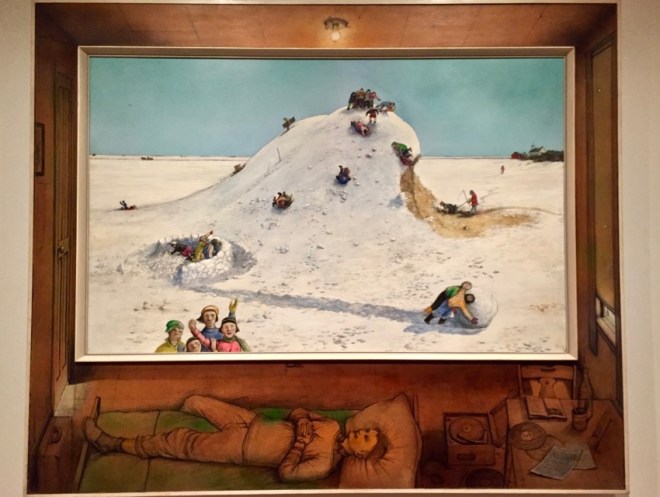
Artist and writer William Kurelek (1927-1977) knew how to find pleasure in the cold. Why of course, he was born in Alberta, and spent his childhood years on the prairies:

Kurelek


As well, Shelley’s positivism is always a boost for me. No need to wait for the groundhog. “O Wind, If Winter comes, can Spring be far behind?”

No matter what the weather, it can still be it a worthwhile year.


***


Top Ripples 2017

The following is a list of books, movies, and events that stirred up the most ripples for me in 2017. Note that the books and movies are not necessarily releases from 2017 but just what I’ve had the privilege to encounter this year. If you don’t see your book here, it could be that it’s on my TBR list for the coming year. If you don’t see your fave movie here, it could be that I haven’t watched it or that I have but, indeed, it’s not here. Click on the links to read my reviews.


MOVIES

Three Billboards Outside Ebbing, Missouri directed by Martin McDonagh

Mudbound directed by Dee Rees

Certain Women directed by Kelly Reichardt

The Big Sick directed by Michael Showalter

Stefan Zweig: Farewell to Europe directed by Maria Schrader

Wind River directed by Taylor Sheridan

Things to Come directed by Mia Hansen-Løve

Silence directed by Martin Scorsese

The Rider directed by Chloé Zhao (55th NYFF)

The Road to Mandalay directed by Midi Z (NYAFF)

Calvary directed by John Michael McDonagh


BOOKS

At the Existential Cafe: Freedom, Being, and Apricot Cocktails by Sarah Bakewell

Little Fires Everywhere by Celeste Ng

Mudbound by Hillary Jordan

Nutshell by Ian McEwan

Wildlife by Richard Ford

The Noise of Time by Julian Barnes

The God of Small Things by Arundhati Roy


EVENTS

Visit to MoMA Click on the link to my post.

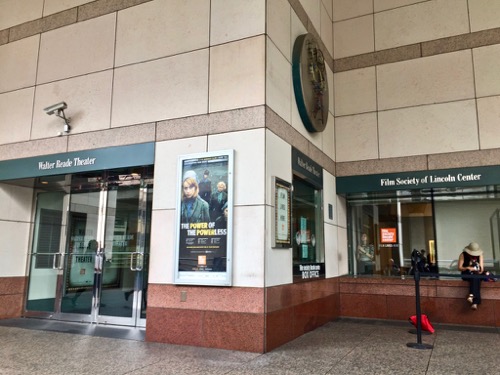
NYFF at Film Society of Lincoln Center: In September I had the chance to attend press screenings of the 55th New York Film Festival. CLICK HERE for all my reviews on AAPress.

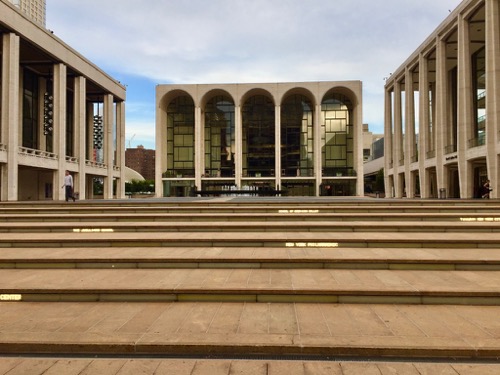
Other than hanging out at the Film Society of Lincoln Centre for the screenings, I’d experienced NYC on the bus, in the subway, and simply on foot, some days close to 20,000 steps, making my NYC trip extra rewarding. Here are some pics of the memorable experience.

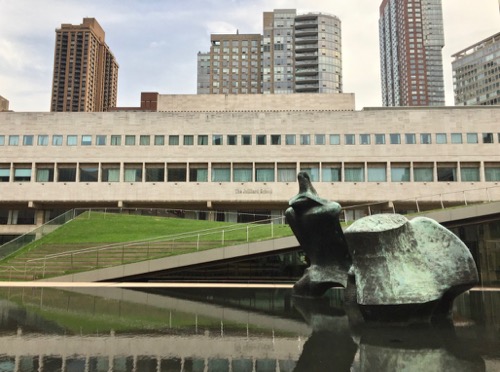
Lincoln Center:

IMG_5673.jpg

Film Society of Lincoln Center where the screenings took place:

IMG_5676

The Juilliard School:

IMG_5670 (1)

Central Park:


Reflection in Central Park


One World Trade Center:

IMG_5907.jpg

IMG_5860

IMG_5852 (1).jpg

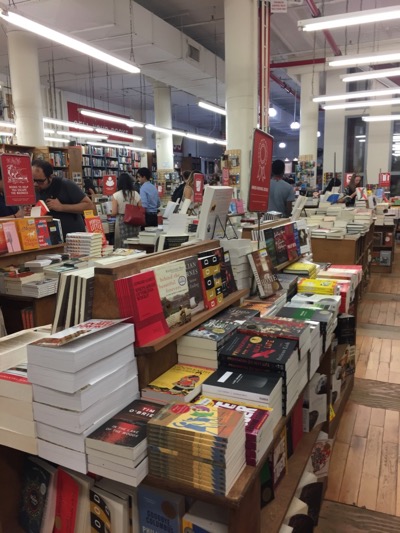
Strand Bookstore:

IMG_5691

IMG_5688

Brooklyn Bridge:

IMG_5784.jpg


IMG_5828

Where I found the best lobster roll I’d ever tasted, at the foot of the Brooklyn Bridge:

IMG_5837


And that’s a wrap.


***

And to all, a wonderful 2018 for books, films, and rewarding encounters! 

Reading the Season: A Wrinkle in Time by Madeleine L’Engle

For the tenth year, I’m sharing a Christmas read here at the Pond. For the first time, it’s a book written for young readers but is ever so relevant for us grown-ups. Herein lies the ingenuity of writer Madeleine L’Engle. Time to dig out that copy that you might have read when you were a youngster. If you haven’t read it, now’s a good time.


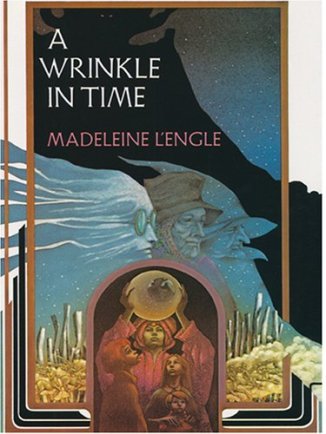
A Wrinkle in Time


Newbery Medal winner A Wrinkle in Time is the first book in the Time Quintet series of fantasy YA fiction about the Murray family, scientist parents and four children Meg, twins Dennys and Sandy, five year-old genius Charles Wallace, and that special friend of Meg’s, Calvin O’Keefe. The deceptively simple odyssey in time and space is packed with wonder and wisdom.

The book not only exudes insights but shows L’Engle’s remarkable foresights. Take this for an example, dematerializing and materializing  for easy transport. Published in 1962, the book came out four years before Scotty beamed Kirk up using the same method in the first season of Star Trek.

Or this fancy idea, ‘tesseracting’, that is, travelling through space and time via a wrinkle in time. The shortest distance between two points is not a straight line, but through a wrinkle when two points are folded. That’s fifty years before Christopher Nolan sends Matthew McConaughey interstellar travelling.

All concepts held in a simple plot. Meg, Charles Wallace, together with friend Calvin, go on an interstellar quest to look for Meg and Charles’ physicist father who had gone missing for almost a year while doing some classified scientific work for the government. This little, unequipped search party is initiated and aided by three celestial beings: Mrs. Whatsit, who’s much wiser than she appears, Mrs. Which, who doesn’t bother materializing but remains as a shimmering beam, and Mrs. Who, who speaks in quotes.

The more a man knows, the less he talks.

Their odyssey brings them finally to the planet Camazotz, where they find Mr. Murray confined by the evil Dark Thing, or IT (Surprise! 24 years before Stephen King’s book and now movie) The smart alecky Charles Wallace is easy prey and quickly influenced by IT. (And for Luddites, what better parallel to address our technology now, the evil IT) Ultimately, it’s Meg, our reluctant and timid heroine, who has to be the one to go fight IT to rescue her little brother.

The foolishness of God is wiser than men; and the weakness of God is stronger than men… God hath chosen the foolish things of the world to confound the wise; and God hath chosen the weak things of the world to confound the things which are mighty.

Meg knows Charles Wallace is not himself but trapped and deceived, and must be snatched from the evil force IT. She has just one weapon as her ammunition, given to her by Mrs. Whatsit, that one thing IT doesn’t have: LOVE. With her single act of bravery, she brings the family together again.

When I was a child, I read like a child, I thought like a child. When I became an adult, I can read like a child and like an adult too. That’s the joy of reading A Wrinkle in Time. One can find pleasure in the adventure and feel the vulnerability of the children, as well delve deeper into its symbolism and parallels, and ponder its layers of meaning.

L’Engle writes to the child and the adult in us. She can convey scientific and spiritual concepts at the same time and in a way that both young and old (and those in between) can enjoy. There’s no conflict between the cerebral and the spiritual; they co-exist comfortably in L’Engle’s work. Not only that, they fuse together and from that alchemy rises a whole new, inexplicable entity: Faith.

That first Christmas day when a baby was born in a lowly manger, the war against IT had started to win. Although the last, painful battle on the hill of Calvary had not been waged, the outcome was cast, just because LOVE came.

And the light shineth in darkness; and the darkness comprehended it not.


The Movie

‘Tis the Season to read or reread A Wrinkle In Time before the movie adaptation comes out in 2018. Helmed by Selma (2014) director Ava DuVernay, screenplay by Frozen (2013) scriptwriter Jennifer Lee, with some stellar beings including Rees Witherspoon, Oprah Winfrey, Mindy Kaling, Chris Pine et al.

***

Past Reading the Season Selections:

2016:  Silence by Shusaku Endo

2015: The Book of Ruth

2014: Lila by Marilynne Robinson

2013: Poetry by Madeleine L’Engle

2012: Surprised by Joy by C. S. Lewis

2011: Walking on Water by Madeleine L’Engle

2010: A Widening Light, Luci Shaw

2009: The Irrational Season 

2008: The Bible and the New York Times by Fleming Rutledge

2008: A Grief Observed by C. S. Lewis

Mudbound: From Book to Screen

The Book

Mudbound is Hillary Jordan’s debut novel, published in 2008. It won the Bellwether Prize for fiction, an award founded by author Barbara Kingsolver to promote literature of social justice and responsibility.

Mudbound Book Cover

The setting is WWII and its ending, as two American soldiers return from Europe to their families in Mississippi. One of them is Jamie, white, a flying ace whose co-pilot was shot dead right beside him in a fierce dogfight. The other, Ronsel, black, a decorated war hero who had fought in the tank battalion under General Patton. Both had experienced the war, seen the atrocity, now back home having to deal with the demons of the aftermath: for Jamie, traumatic shocks and survivor’s guilt; for Ronsel, another barbaric battlefront, racism in the Deep South.

Jamie comes back to a cotton farm owned by his older brother Henry McAllan and stays in the lean-to adjacent to the main house, itself but a shack with no running water or electricity. “Mudbound” is the proper name for it. When the rain pours and the wind blows, the mud drowns and pulls everything down, dirtying all from head to toe. A gloomy place to start anew as a farmer.

They weren’t all like that to start with. Henry has an engineering degree. Laura, Henry’s wife from Memphis, is also college educated. She learns of Henry’s intention to move to rural Mississippi and be a cotton farmer only weeks after her marriage. What’s worse, Henry’s obnoxious father, Pappy, will be coming to live with them.

Ronsel’s father Hap Jackson is the sharecropper working in the cotton fields owned by Henry. Fate brought the two families together. Hap and his wife Florence and all his children have been praying for Ronsel’s safe return from the war. Now their prayers are answered, but only pit Ronsel into another battlefront when he meets Jamie and the two strike up friendship, a despicable taboo.

Written in chapters that reveal the point of view of the various characters, the book is a sort of a literary ‘Rashomon’, how different people see the same event in their own light, or the lack of it. Such a writing structure evokes empathy as Jordan leads the reader to delve into the mind of the characters. And as the final climatic chapters come, we as readers get to know a crucial fact, an essential plot point we are privy to but which even other characters are not aware. We have Jordan to thank for such an insightful way to present the omniscient viewpoint in her storytelling.

The trajectory of the friendship between Jamie and Ronsel is tragically predictable. But what’s not predictable is Jordan’s incisive writing. Sometimes adding a short little phrase at the end of a sentence could make it speak much more. It’s writing like this that makes the book enjoyable despite its subject matter. Take this as an example, simple and subtle, but revealing effectively Laura’s inner turmoil after a tumultuous night:

“… I got up and checked on the children. They were sleeping, with an untroubled abandon I envied.”

Or this line to wrap up a climactic chapter. Such descriptions are perfect cues for nuanced  performance on screen:

“What we can’t speak, we say in silence.”

No spoiler here. But this is the kind of writing that conveys powerfully the emotions and events that sweep the reader up while allowing space to mull things over.

***

The Movie

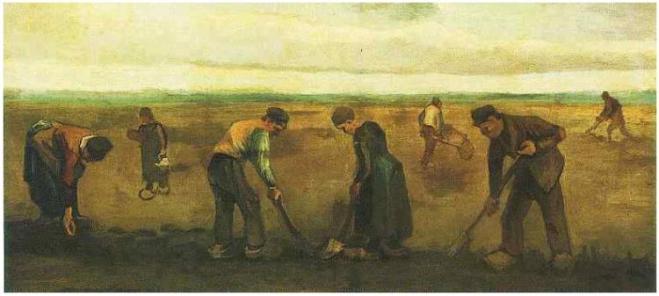
The cinematography (Rachel Morrison) is the most distinguished feature from the beginning. As the title suggests, the colour palette is a spectrum of browns, reminiscence of the paintings of Jean Francois Millet’s farmers toiling in the fields, or this Van Gogh’s Potatoes Farmers:

VVG Farmers-Planting-Potatoes

But before the mud swallows up life, there is the colourful, urbane, Memphis party scene, or the courtship under golden leaves. The contrast is heartbreaking. Laura (Carey Mulligan), who seems to have no say about her life and fate, has to follow her husband Henry McAllan (Jason Clarke) from the city to move to a shack with no running water or electricity on a cotton field in rural Mississippi. Being a landowner is the sole ambition for him.

But of course, not just Laura, but everyone is drawn into the muddy swamp. Hap Jackson (Rob Morgan) is the sharecropper on the McAllan fields. His wife Florence–absorbing performance from “the Queen of Hip-Hop Soul” Mary J. Blige–is soon asked to help Laura with caring for her two girls and household chores. The return of their son Ronsel (Jason Mitchell) and Henry’s younger brother Jamie (Garrett Hedlund) from Europe after the war will eventually link the two families down an inescapable path.

Turning the chapters of internal worlds into visuals on screen is a tall order. Director Dee Rees, who co-wrote the screenplay with Virgil Williams, had done an effective job by voiceovers, which is sometimes frowned upon as they could mean an easy-way out. But here, the voiceovers are intimate and personal. The few simple lines in the voice of the characters draw the viewers closer in. With Carey Mulligan, I admit I’m totally partial. Her alto voice is moving and poignant.

mudbound-movie-stills-4 (3)

Picking the right events from the book is crucial. Director Rees has followed closely to the plot lines using many of Jordan’s words, but also taken the liberty to switch around and combine them in the movie adaptation. Juxtaposing Ronsel and Jamie’s traumatic battle scenes with accidents and illness at home are effective and emotionally engaging; all have to fight their battles, big and small, at home or the frontline.

The most moving juxtaposition comes at the intense, climactic scene where the singing of a hymn replaces dialogues. It’s a juxtaposition of the visual with sound and silence. Jordan’s impressive line from the book is aptly adapted onto screen:

“What we can’t speak, we say in silence.”  Or here, in song.

The ending of the movie is altered, and I’m glad, for they who have suffered so much, so long, deserve a cathartic ending. This is a good example of a fine adaptation. It’s not a page by page transposition from book to screen, ‘faithful’ to the dot. But Rees has taken the liberty to unleash the dramatic, or maybe, melodramatic. It’s always cathartic to see love triumph after all. Mary J. Blige’s “Mighty River” is an appropriate wrap as the end credits roll.

***

~ ~ ~ ~ Ripples
Book and Movie

Little Fires Everywhere by Celeste Ng: A Book Review

NOTE: I thank Penguin Random House Canada for the reviewer’s copy of the book, and Asian American Press for allowing me to post my review here.

Little Fires Everywhere

Chinese American writer Celeste Ng (伍綺詩) had garnered numerous accolades for her debut novel “Everything I Never Told You”, including a New York Times Notable Book of 2014, Amazon’s #1 Best Book of 2014, winner of the Massachusetts Book Award, and the Asian/Pacific American Award for Literature, just to name a few.

Like the stunning opening in her debut work, Ng in her second novel “Little Fires Everywhere”, begins with a dramatic scene: Mrs. Richardson, after being awaken by the smoke detectors, stands on her front lawn in her pale blue robe and watches firemen saving her house from total burnt down. The prime suspect of the fire is her youngest daughter Izzy. With that, Ng leads us into the story of the Richardsons’, an upper-middle class family living in the quiet suburb of Shaker Heights, Ohio, which was Ng’s hometown during the 90’s.

Ng grew up in Pittsburgh, Pennsylvania, and Shaker Heights, Ohio, her scientist parents having immigrated from Hong Kong. Ng graduated from Harvard University and earned an MFA from the University of Michigan (now the Helen Zell Writers’ Program at the University of Michigan), where she won the Hopwood Award.

The thematic elements of race, parenthood, and family secrets leading to devastating consequences as in her debut novel are carried over. Covering a larger scope, “Little Fires Everywhere” expands to other issues as well, offering us views into a myriad of realistic characters and the interplay of two families, specifically, two mothers holding opposite values. Ng’s riveting storytelling skills carry us through the various plot lines breezily, while taking the time to breathe life into her characters, and deftly locks us into mental debates on contentious issues. Although set in the 90’s, the issues raised are as relevant today.

The Richardson family, one could say, is the epitome of the American Dream. They live in a six- bedroom home in a desirable part of town. The matriarch Elena and her husband Bill are well connected and respectable in the community, she a journalist with the local paper the Sun Press and he a defence lawyer. They have four teenaged children, the eldest Lexie heading to Yale. Second son Trip is popular in school, especially among girls. Third child Moody is wrapped up in his own cocoon. Youngest Izzy is the black sheep of the family. She is not happy despite her family’s affluence, or maybe, if Mrs. Richardson is willing to look deeper into her daughter’s mind, Izzy’s discontent could be exactly due to her family’s secure standing in the rule-constraining suburb. Mrs. Richardson would not trade any of her privileges, for she is living “a perfect life in a perfect place.” Her main task now is to smother any sparks that can disrupt the status quo and surface calmness in her family and community.

Celeste Ng.jpg

As the title suggests, metaphors of fire are everywhere. There are flames of passion, fury, dissatisfactions, and the fuse of suburban ennui, as apparent in the lives of the teenagers, potential fire hazards. These are all inherent threats to the idyllic, quiet town, where high school graduates are expected to head to Ivy league colleges, and where parents are oblivious to the secret lives of their teenagers, and vice versa.

The story begins not with the aftermath of the house fire, but the reason leading to it. Mrs. Richardson has just rented the upper floor of her revenue property, a duplex on the other side of town, to new tenants, single mother Mia Warren and her teenage daughter Pearl. Mia is an artist, her medium, photography. She works at menial jobs to sustain her art, and brings up Pearl moving about the country in their VW Rabbit, forty-six different towns since Pearl’s birth.

As they settle in Shaker Heights, Pearl comes to know the Richardson children and is attracted to their lifestyle. Conversely, Izzy Richardson is mesmerized by Mia’s artist life and hangs around in the duplex to help and learn from her art-making. This time, Mia and Pearl may just be settling down.

It is obvious from the start that Mrs. Richardson and Mia comes from opposing sides of ideals. While suggesting Mia take portraits for people in town to earn more money, thinking about her rents no doubt, Mrs. Richardson is confronted with the notion of the artist as a photographer, as Mia replies, “the thing about portraits is, you need to show people the way they want to be seen. And I prefer to show people as I see them.”

Mia works at the Chinese restaurant Lucky Palace to sustain a living. Mrs. Richardson offers her to work in the Richardsons’ home, cleaning and cooking a few days a week to earn some extra money. Although reluctant about the proposal but to not jeopardize their relationship, Mia agrees. Hence, Mia delves further into the Richardson family life.

As she so deftly deals with in her first novel, Ng weaves into her storylines and characters the subjects of culture and identity. The intermingling of lives between the Richardson family and Mia soon pits them into taking two contentious sides in a prominent court case in town. The Richardsons’ best friends, the McCulloughs, have just adopted a Chinese baby found abandoned at the fire hall, Mirabelle, or May Ling Chow, her birth name. The birth mother Bebe now regrets her decision which she had made in a most dire financial situation at the time. Bebe comes from China, and happens to be Mia’s co-worker at Lucky Palace. Mia is openly supportive of Bebe, while Mr. Richardson represents the McCulloughs. The case has divided the town, and now Mrs. Richardson knows she needs to dig into Mia’s past to discredit Mia and to get back at her for drawing her dear friends the McCulloughs into tormenting legal entanglements.

It is when Ng reveals Mia’s backstory that the narrative is most riveting. We are led to a moving account, a page turner even, on a subject that is complex and crucial: what makes a mother? In her novel, Ng intertwines three possible scenarios of pregnancy, wanted, unwanted, surrogate. And with these contrasting lines, she delves into the issues of adoption and identity. Are babies best brought up by their own biological mothers, especially when culture comes into play? What makes a baby Chinese? American? Or more complex still, Chinese American? The McCulloughs have well intentions to bring Mirabelle up by regular dine-outs in a Chinese restaurant, and finding her ‘Oriental Barbies’ to play with. Are these enough? If not, what is?

Cultural appropriation is a trendy topic nowadays, not only in the adoption circle, but in other realms. These are issues that require deeper pondering and research work, no doubt, ones that should be confronted deeper than Ng can deal with in her novel. Nonetheless, a fictional setting is an interesting place to spark off the debate. Just another one of her little fires in the book.

While “Everything I Never Told You” is a microscopic look at a mixed-race family during the 70’s, dense and intense, not unlike a Bergman chamber work, “Little Fires Everywhere” is looser and more expansive in thematic matters, with sprinkles of laughs here and there, not unlike a John Hughes’ movie in the 80’s. One can feel Ng is freer to roam with the larger, open space. Just as with her debut work, Ng does not shy away from the issues of race and identity, while challenging the notion of ‘success’. One should not be surprised that this is still the fundamental term we are struggling to define in our society today.


~ ~ ~ 1/2 Ripples


***


Here’s a short review of Ng’s debut novel “Everything I Never Told You” (audiobook) I’d posted on Goodreads.


When is a window not a window?

Arti was in NYC for a week in September.

It was Friday afternoon free admission time when hundreds lined up several city blocks to get into MoMA, Museum of Modern Art. Once in there, it was like inside the Tower of Babel (not that Arti had been there), but just imagine the whole world had converged in this space, all kinds of languages were heard.

After visiting MoMA, some questions came to mind. Here are the Q & A’s. (Photos were allowed. The following were all taken using the iPhone 6)

When is a window not a window?

When it’s encased in plexiglass, with the name Marcel Duchamp placed beside it, declaring it to be an objet d’art. Dada-di, Dada-dum…

Not a window.jpg

Or, when is a spider an objet d’admiration, something larger than life?

When it evokes a Kafkaesque vision:

Giant Spider 1

Spider

And why is the arachnid a double-edged sword?

Well, the artist Louise Bourgeois (1911-2010) saw it as a friend when it captured bothersome mosquitoes in her Connecticut country home. As well, Bourgeois also saw it as a symbol of her mother. Wait, not in looks or nature, but in the work that they do. Her mother was a tapestry restorer. Bourgeois saw sewing and spinning web to be a similar form of action.

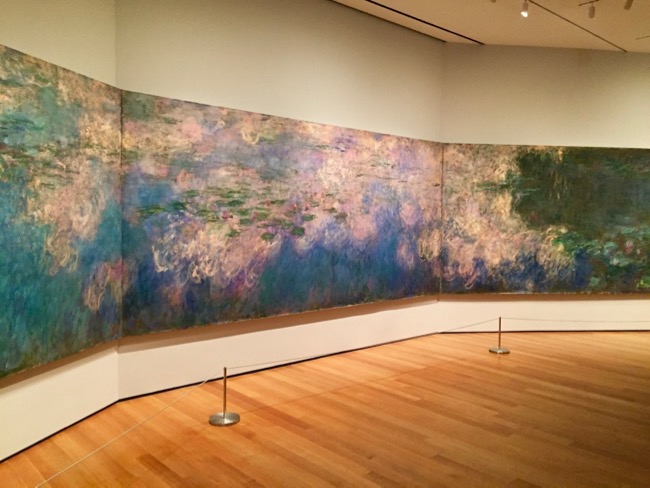
How do you take a good photo when there are crowds everywhere? A bit similar as how to get to Carnegie Hall, patience, patience, patience. The following are the before and after effects at Monet’s Lily Ponds:

Crowds.jpg

Monet's Water Lilies 1.jpg

What’s the major excitement of the whole experience? The ecstasy of seeing some famous artworks unexpectedly, ones that Arti had never thought she’d see in real life.

Christina’s World (1948) by Andrew Wyeth (1917-2009). And what is the blue patch in the middle? Arti’s watermark.

Christina's World.jpg

The only Edward Hopper (1882-1967) at MoMA, Gas (1940). As an avid bird watcher, Arti of course would have loved to see Nighthawks but Gas would do, for the serendipity.

Gas

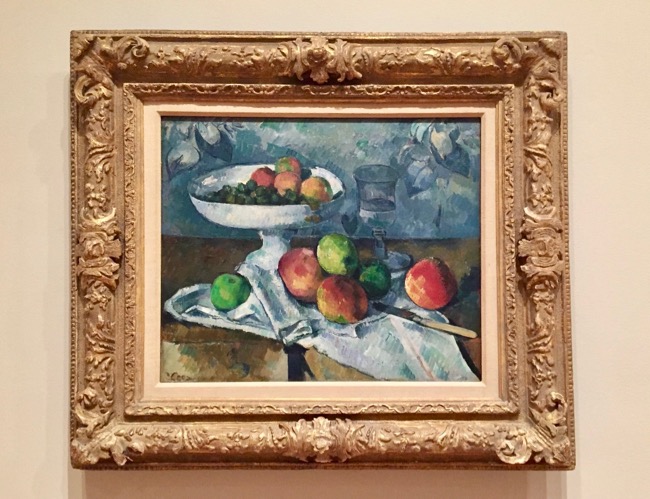
And glad to see Paul Cézanne’s (1839-1906) healthy diet:

Healthy diet

Ta-da! This is probably one of the most compelling reasons for many to visit MoMA, van Gogh’s The Starry Night (1889):

Starry Night

Which was the most memorable for Arti?

Jackson Pollack.jpg

One: Number 31, 1950 (1950) by Jackson Pollock (1912-1956)

Never thought it was so big, 8′ 10″ x 17′ 5 5/8″ (269.5 x 530.8 cm). No easy dripping.

***

A few related posts on Ripple Effects:

Arles: In the Steps of van Gogh 

Inspired by Vermeer

Edward Hopper, William Safire, the Visual and the Word

Alex Colville and the Movies

Art and Cliché

Golden Fall

Two years ago around this time, I drove across four New England states searching for fall foliage. Red was the colour I was looking for. It may surprise you, we don’t have red here in Alberta, no real Maples here. We might have some red from certain trees or shrubs, but not on a large scale as in Eastern Canada.

But what we have is gold, different shades of gold. Red can make the landscape more adorable, but gold is purity. Here’s the scenery in the past two days by the Bow River in my usual birding sites:

The Bow

Trees by the Bow

Trees 2

The scenes of a golden fall near the Pond, where layers of autumn foliage and evergreens make up the ripples of a boreal forest:

Golden fall

Golden.jpg

Golden 1

Golden 6.jpg

Golden 7.jpg

Even the path under my feet is golden:

Golden Path.jpg

I know, nothing gold can stay. Even as I type, a Winter Storm Warning is in effect. We’ll have snow overnight, and “Hazardous winter conditions are expected”.  So when this post is up on Monday, all the gold will likely be white, which makes these photos all the more precious. They could be the last of the fall memories of 2017.

But then again, if we can have winter in the fall, we can have summer in December. At least, that’s what I’m dreaming of…

***

Related Posts on Ripple:

My New England Road Trip Starts Here


The Last Days of Summer

It has been noted that the drive from Lake Louise in Banff National Park up the Icefields Parkway north to Jasper National Park is the most beautiful drive in the world. I spend a couple of our remaining summer days driving that scenic route and immerse in the other-worldly environs of pristine Jasper National Park.

The cold rain and wet snow in sections of the road remind me that, yes, autumn is at hand. But once I reach the boundary of Jasper National Park, I throw away any seasonal distinction. Wether it’s summer or autumn is immaterial. What’s captivating is the present. Here are some glorious sights of Jasper National Park.

The mysterious, clouds shrouded Medicine Lake in the morning light:

Clourds Shrouded Medicine Lake.jpg

Hurricanes hit Texas and Florida, here we’ve been affected by the wild fires from B.C. all summer. At the shore of Medicine Lake I feel the effects:

Wild Fire effect

But the natural beauty remains. The charred remnants of trees along the edge of the lake would become rich organic matter spurring new growths.

burned trees.jpg

A short 30 mins. drive from Medicine Lake is the picturesque Maligne Lake, serene and reflective:

DSC_0116.jpg

For those who must do something to seize the moment, there are canoes for rent and scenic cruises:

DSC_0122.jpg

Before reaching the townsite of Jasper, the 93 Icefields Parkway leads to Athabasca Falls, where one can witness the power of Nature in an aesthetic mode. Who had turned the mighty torrents into Nature’s sculptors, carving quartzite and limestones into magnificent art installations?

DSC_0164.jpg

Nature's Sculptor.jpg


Hardened Ripples.jpg


DSC_0149.jpg


The Gorge.jpg

DSC_0136.jpg

In the Jasper townsite, even the man-made locomotive matches the scenery in the evening light. Like a watercourse streaming through the landscape, The Rocky Mountaineer passenger train passes through Vancouver and across the Rocky Mountains into Alberta’s Banff and Jasper National Parks.

DSC_0061.jpg

DSC_0062.jpg

DSC_0063.jpg

Even a cargo CN train exudes poetry. I credit it to the spirit of the environs:

DSC_0065.jpg


Just like the animals preparing for winter, I’m gathering visual memories to feed the cold months ahead.


***

Other Travel Posts on Ripple Effects:

New England Foliage Road Trip

Day Trip to Cambridge

Establishing Shot: A Visit to Toronto


Six Degrees of Separation or Prophetic Voices of our Time

I’ve read several books in recent months that are good evidence of ‘six degrees of separation’, and I’ll just end with four here. But more crucial is why such content at this time? They are all published in 2016 but still enjoy current bestselling positions. All are similar in their historical backdrop, authoritarian dictatorship in the 20th Century in two neighbouring countries, China and Russia. Or, maybe these writers of our time are indeed prophetic voices to stress that eerie caution: “Those who don’t know history are doomed to repeat it.”

Here’s the sequence of my reading:

Madeleine ThienDo Not Say We Have Nothing by Madeleine Thien

The top selling book in Canada according to CBC Books, Madeleine Thien’s exceptional novel of three characters, musicians at the Shanghai Conservatory of Music during the Cultural Revolution in China, leads us through decades of contemporary Chinese history from the Communist takeover after WWII to Mao’s Cultural Revolution to the 1989 Tiananmen Massacre, spanning generations and across two continents. Thien was teaching creative writing when her program was abruptly cancelled in the aftermath of the ‘Umbrella Revolution’ sprouting from the Occupy Central led by teenaged students in Hong Kong. That was a motivating force propelling the writing of the book. Following the most recent news that four young student leaders are given months of jail sentences for their actions, we know how timely a voice Thein is with this book.


Barnes The Noise of Time.jpgThe Noise of Time by Julian Barnes

Dimitri Shostakovich’s music is in the minds of the three musicians at the Shanghai Conservatory of Thien’s book. Shostakovich, himself a composer treading a precarious line between authenticity and self-preservation under Stalin, is an apt parallel of the situation the trio have to face.

Julian Barnes has crafted an imaginary biopic of Dimitri Shostakovich during Stalin’s tyrannical rule in the Soviet Union (1929-1953). Barnes’ depiction is internal, presenting the struggles, the giving-in and the self-loathing of a world famous composer and pianist who was unable to stand up to a ruthless and manipulative dictator. Speak truth to Power? Who can still stand, or live, after that? And it’s not just about oneself, but one’s family and all those associated.


Cometh the hourCometh the Hour by Jeffrey Archer (#6 of the Clifton Chronicles)

Jeffrey Archer, a prophetic voice? While his Clifton Chronicles have entertained us with imaginary characters spanning three generations of two British families, Archer does have the political mood of our times firmly held under his pen, and Lord Archer is a savvy political historian in his own right. This summer I binged on Jeffrey Archer, okay, not exactly your serious, prophetic voice, but no less relevant. This is especially true when his fictional character, Russian writer Anatoly Babakov, is imprisoned in Siberia for his book Uncle Joe. Based on his own experience while working under Joseph Stalin, Babakov offers readers an insider’s look into the ruler, revealing the ruthless dictator that he really was.

Babakov is awarded the Nobel Prize of Literature while still in prison. But not long after the announcement, he dies of a heart attack. His wife Yelena although escaped out of the country, wants to return to honour her husband. Archer’s character makes me think of the real life dissident Chinese writer and activist Liu Xiaobo, also Nobel laureate, but was denied the freedom to go and accept his Prize. He had been imprisoned for 11 years and sadly, died of liver cancer in July this year, 2017. And even more sadly, Liu’s wife could not see him at his deathbed and had gone missing after his death. Archer’s book was published in 2016. I’d say that’s quite prophetic.


A Gentleman in Moscow by Amor Towles

A Gentleman in MoscowA totally different tone, but the same historical backdrop. Towles has created an interesting and colourful character, the aristocrat Count Alexander Rostov, kept in house arrest when the Bolsheviks overrun the country. True to his personality and lifestyle – the major consolation of such a misfortune – Count Rostov serves his house arrest in the elegant Moscow Metropol Hotel across from the Kremlin, albeit in a cramped room in the attic. With his always pleasant demeanour, the former aristocrat makes himself at home at the grand hotel, meeting interesting characters, wine and dine to his heart’s content. He stays there for decades, with the historic changes happening outside the four walls of the Metropol: Lenin, Stalin, post-Stalin, and further. As fate would have it, Count Rostov encounters an idealistic youngster named Nina, and years later, takes up guardianship of her daughter Sofia, and thus his life and view begin to turn into something more purposeful. The Metropol makes me think of Wes Anderson’s The Grand Budapest Hotel. Instead of speaking truth to power and get slapped in the face or worse, Count Rostov thinks of an ingenious scheme to beat Power at their game. If I were a filmmaker, this is one to bank on.

***

Related Posts on Ripple Effects:

Do Not Say We Have Nothing Book Review

The Budapest Hotel: A Grand Escape